
Our readers keep the lights on and my morning glass full of iced black tea. As an Amazon Associate, I earn from qualifying purchases.
Specs are compiled from manufacturer listings and verified buyer reviews and can change over time — please confirm the key details on the product page before buying.
Saltwater is brutal on a boat’s finish. It dulls the gelcoat, eats into metal fittings, and turns a glossy hull into a chalky mess within a season if you use the wrong wax. The right marine wax creates a barrier that salt and UV rays struggle to penetrate, keeping your boat looking sharp without requiring you to rewax every other weekend.
I’m Min — the founder and writer behind Gadgets Feed. This guide is built by comparing the manufacturers’ published specifications and the patterns across verified customer reviews, so you get each pick’s real strengths and trade-offs instead of marketing spin.
Whether you own a center console, a cruiser, or a freshwater boat that sees salt on trailer trips, the boat wax for saltwater you choose determines how much elbow grease you spend and how long that shine survives the next tide.
Our Picks at a Glance

How To Choose The Best Boat Wax For Saltwater
Saltwater breaks down ordinary car wax fast because the salt crystals are abrasive and the sun’s UV rays hit harder on the water. You need a marine-grade formula that creates a tougher shield. Here are the three things to check before you buy.
Polymer or Carnauba Base
Carnauba wax gives a deep, wet-look gloss that looks great at the dock, but it wears down quicker under direct sun and salt spray. Polymer or synthetic waxes bond tighter to gelcoat and last longer between applications. Hybrid formulas that blend carnauba with marine-grade polymers give you the look of a show wax with the staying power of a sealant. Check the label for “marine-grade polymers” if durability is your priority.
UV and Salt Resistance
Not every “marine wax” actually blocks UV rays or resists mineral deposits. Look for a product that specifically states UV protection and salt or mineral resistance. This prevents the gelcoat from yellowing and oxidation from turning the hull chalky. If the description mentions “ceramic coating” or “SiO2,” that usually means better long-term protection than a straight wax.
Application Style
Paste wax takes more effort to apply and buff off, but it often lasts longer on vertical surfaces like hull sides. Spray wax is quicker and great for a mid-season boost, but it may not hold up as long on the hull. One-step cleaner waxes are a solid middle ground if your boat already has light oxidation or water spots, because they clean and protect in a single pass.
Quick Comparison
| Model | Best For | Formula Type | Bottle Size | Saltwater Protection | Amazon |
|---|---|---|---|---|---|
| Collinite 885★ Best Overall | Premium paste gloss | Paste carnauba+polymer | 12 fl oz | UV & salt deposits | $21.95Amazon |
| Meguiar’s M6132Also Great | One-step clean + wax | Liquid cleaner wax | 32 fl oz | Salt & air corrosion | $23.81$29.49Amazon |
| Collinite 925 | Longest-lasting sealant | Liquid gel polymer | 16 fl oz | 4-7 months salt/mineral | $20.75Amazon |
| Boat Juice Ceramic | Spray-on ceramic ease | SiO2 ceramic spray | 16 fl oz | SiO2 durable barrier | $24.49Amazon |
| Woody Wax Spray | Non-skid decks + metal | Spray no-buff | 16 fl oz | Saltwater & oxidation | $40.99Amazon |
In‑Depth Reviews
1. Collinite 885 Fleetwax
Our pick — over 4.5★ from 850+ verified ratings; the strongest balance of quality and price.
The classic paste wax that leaves a wet-look shine while resisting salt deposits.
Collinite 885 is the paste version of the brand’s marine protection. It blends carnauba wax with marine-grade polymers to create a durable barrier against UV exposure, surface heat, and salt or mineral deposits. The main difference from the liquid-gel 925 is the application feel — paste wax goes on thicker, requires moderate buffing effort, and often leaves a deeper gloss on dark-colored hulls. It weighs 13.4 ounces, which is lighter than the Meguiar’s 2 pounds but heavier than the Boat Juice spray’s 1 pound.
Rated 4.7 out of 5 stars from 877 reviews, the 885 has a slightly higher rating than the 925, and owners frequently mention that it beads water for months. The 12 fluid ounce container covers multiple applications on fiberglass boats, but the paste format means you use a bit more product per coat compared to the liquid gel. It is designed for gelcoat, fiberglass, clear coat, finished wood, and painted metals — more versatile than a dedicated spray wax. The catch is effort: you will work harder applying and removing it than you would with a spray or liquid wax.
This is a solid choice if you enjoy the traditional waxing ritual and want the deepest possible shine from a paste. It resists salt and UV just as well as the 925, but it is better suited for show boats or hulls where appearance matters more than speed of application.
Showroom shine: The paste format gives a deeper, wetter gloss than liquid waxes, but you trade convenience for that look.
Choose this if: you prefer a paste wax and want maximum gloss on a dark gelcoat hull.
Pass on it if: application speed is more important than a mirror finish.
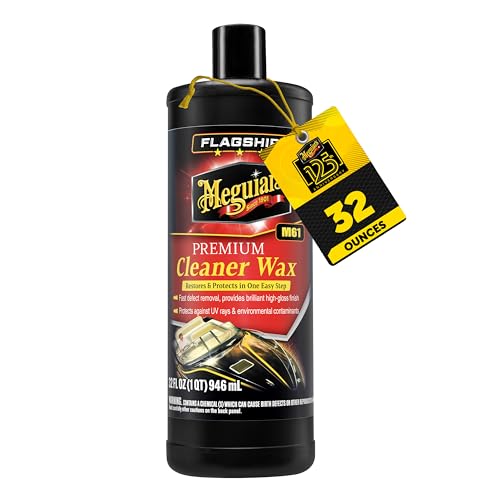
2. Meguiar’s Flagship Premium Cleaner Wax M6132
The one-step cleaner wax that fixes oxidation and seals it in the same pass.
If your boat’s gelcoat has light oxidation, water spots, or minor swirls, this Meguiar’s formula saves you from a two-step process. It is a cleaner wax, meaning it removes light to moderate defects while depositing a protective layer against UV rays and salt corrosion all at once. That convenience matters when you are trying to get the boat back in the water quickly. Buyers report that it works well even in direct sunlight, which is rare for a marine wax that does not smear or bake on.
At 32 fluid ounces, this bottle holds twice the amount of the Collinite 925’s 16 fluid ounces, so you get more product per purchase for a mid-range price. It is rated 4.6 out of 5 stars from 985 reviews, making it the most-reviewed wax on this list — a sign that real owners trust it for routine saltwater maintenance. Keep in mind that it is a one-step formula, not a dedicated ceramic or polymer sealant, so the protection layer is thinner than the Collinite options. It is ideal for regular seasonal use rather than an all-winter layup coat.
The liquid format applies easily by hand or with a dual-action polisher. Its main job is cleaning and protecting together, which reduces the total time you spend detailing. If your hull is already in good shape and you just want a fast refresh before a weekend trip, this is the most efficient choice.
Why it wins
- Cleans light defects and protects UV/salt in one step
- 32 fl oz bottle — double the volume of most competitors
- Safe on gelcoat and fiberglass; works in direct sun
The trade-off
- Protection layer is not as durable as a dedicated polymer sealant
- Not a ceramic coating; won’t match SiO2 longevity
Grab this if: you want to clean minor oxidation and wax in one afternoon without extra steps.
Look elsewhere if: you need a heavy-duty sealant that lasts a full season on a stored boat.
3. Collinite 925 Marine Wax

A marine wax that promises four to seven months of protection from one application.
Unlike the Meguiar’s cleaner wax above, the Collinite 925 is a pure liquid-gel sealant. It does not clean — it just protects, and it does that job exceptionally well. Collinite fortifies this formula with marine-grade polymers that resist salt and mineral deposits at a level the brand compares to ceramic coatings. The result is a high-gloss carnauba shine that lasts much longer than a standard wax. Owners mention that water beads tightly on the surface weeks after application, a clear sign the sealant is still active.
The 16 fluid ounce bottle covers up to five 20-foot fiberglass boats, which is impressive value for a mid-range product. Weighing 2 pounds, the Meguiar’s is double the weight of the Boat Juice Ceramic’s 1 pound, but the Collinite 925 is lighter at just under 1 pound, making it easy to store in a dock box. It is safe to apply by hand or with a dual-action polisher. The main commitment here is prep — your gelcoat needs to be clean and oxidation-free before application because the sealant locks in whatever is underneath.
This is the pick for boat owners who wax once in the spring and do not want to think about it again until fall. The 4-7 month durability claim is backed by its reputation among coastal professionals. If you trailer your boat in saltwater and want the longest gap between waxing sessions, the 925 delivers that and nothing else gets in the way.
Durability star: This sealant holds up to salt and sun for months longer than a standard paste wax, but you must clean the hull first because it does not remove existing oxidation.
Buy it for: the longest-lasting wax protection on gelcoat without paying ceramic-coating prices.
skip it if: your hull has water spots or haze you want to remove in the same step.
4. Boat Juice Protection Ceramic Coating
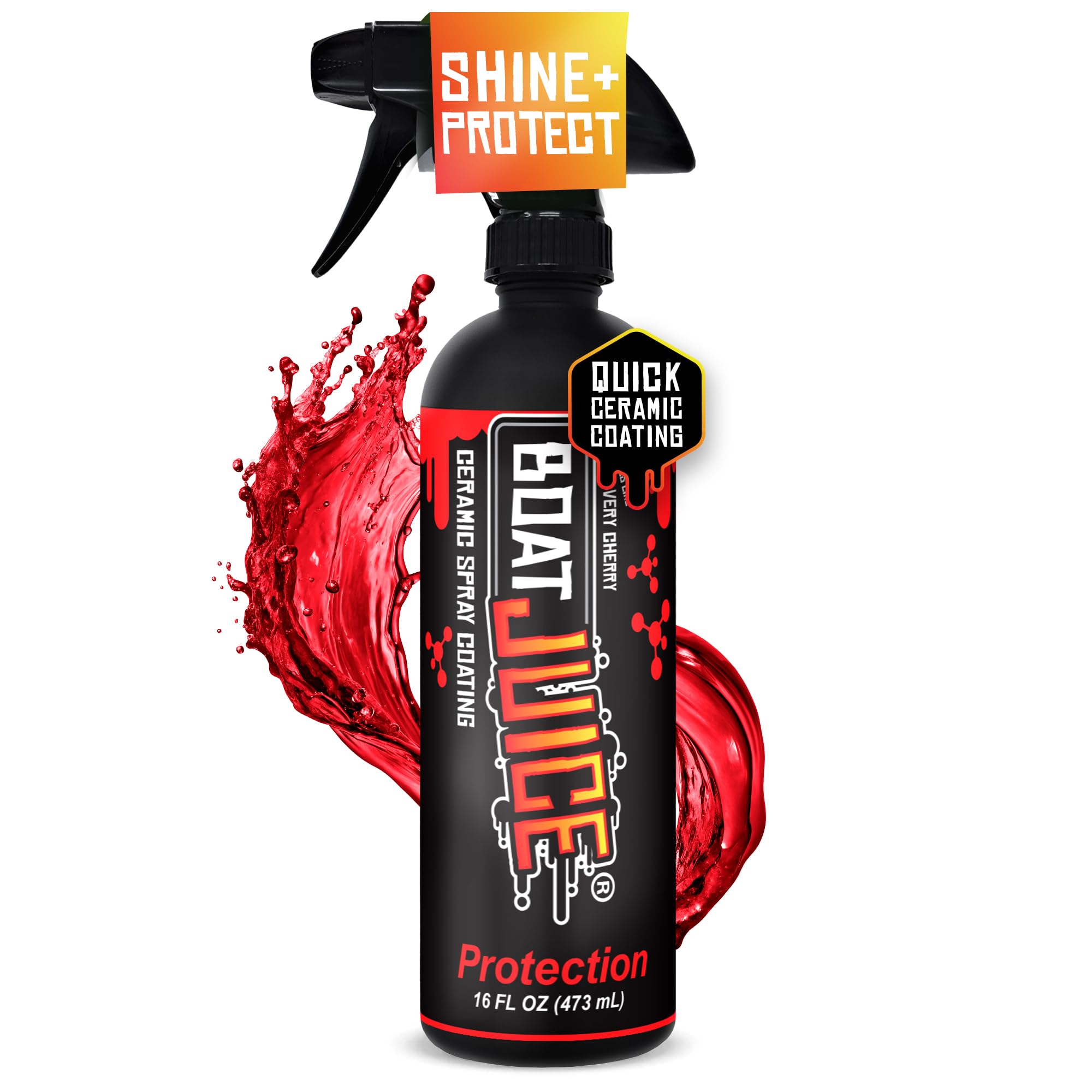
A spray-on ceramic coating that bonds to gelcoat for extreme slickness and water beading.
Boat Juice uses SiO2 (silicon dioxide, the same base material as professional ceramic coatings) in an easy spray-on, wipe-off formula. It creates a durable, hydrophobic layer that makes salt spray and dirt slide off the hull. Unlike the Collinite or Meguiar’s waxes, this is a true ceramic-infused coating, so it bonds more chemically to the surface rather than sitting on top. That means longer protection and a slicker feel — a common point in positive reviews. It also smells like cherry instead of chemical solvents, which makes wiping down the boat a more pleasant task.
The product dimensions are 3 x 4 x 8.5 inches, and it weighs just 1 pound — the lightest bottle on this list. The 50% size difference compared to the Woody Wax’s 2 x 4 x 11.25 inches shows how compact this spray is for storage. It is safe on gelcoat, chrome, glass, vinyl, and plastics, so you can use it on windshields and seats as well. Made in the USA since June 2023, it has earned a 4.6 out of 5 rating from 320 reviews. Keep in mind that a spray ceramic is thinner than a professional-grade ceramic coating, so it may not last as long as a multi-coat application. You will likely reapply mid-season for best results.
This pick suits boat owners who want modern ceramic technology without the labor of traditional waxing. Spray on, wipe off, and you are done. It is especially good for a mid-season touch-up when you do not want to break out the buffer.
Easy upgrades
- Spray-on ceramic gives better water beading than standard wax
- Safe on multiple surfaces — gelcoat, glass, vinyl, and plastic
- Pleasant cherry scent makes detailing less of a chore
Shortcomings
- Thinner coating than professional-grade ceramic; needs reapplication
- Not a cleaner — hull must be spotless before application
Perfect for: a quick, modern ceramic boost between full wax jobs.
Not for: heavy oxidation or deep scratches — this is a protectant, not a polish.
5. Woody Wax Boat Spray
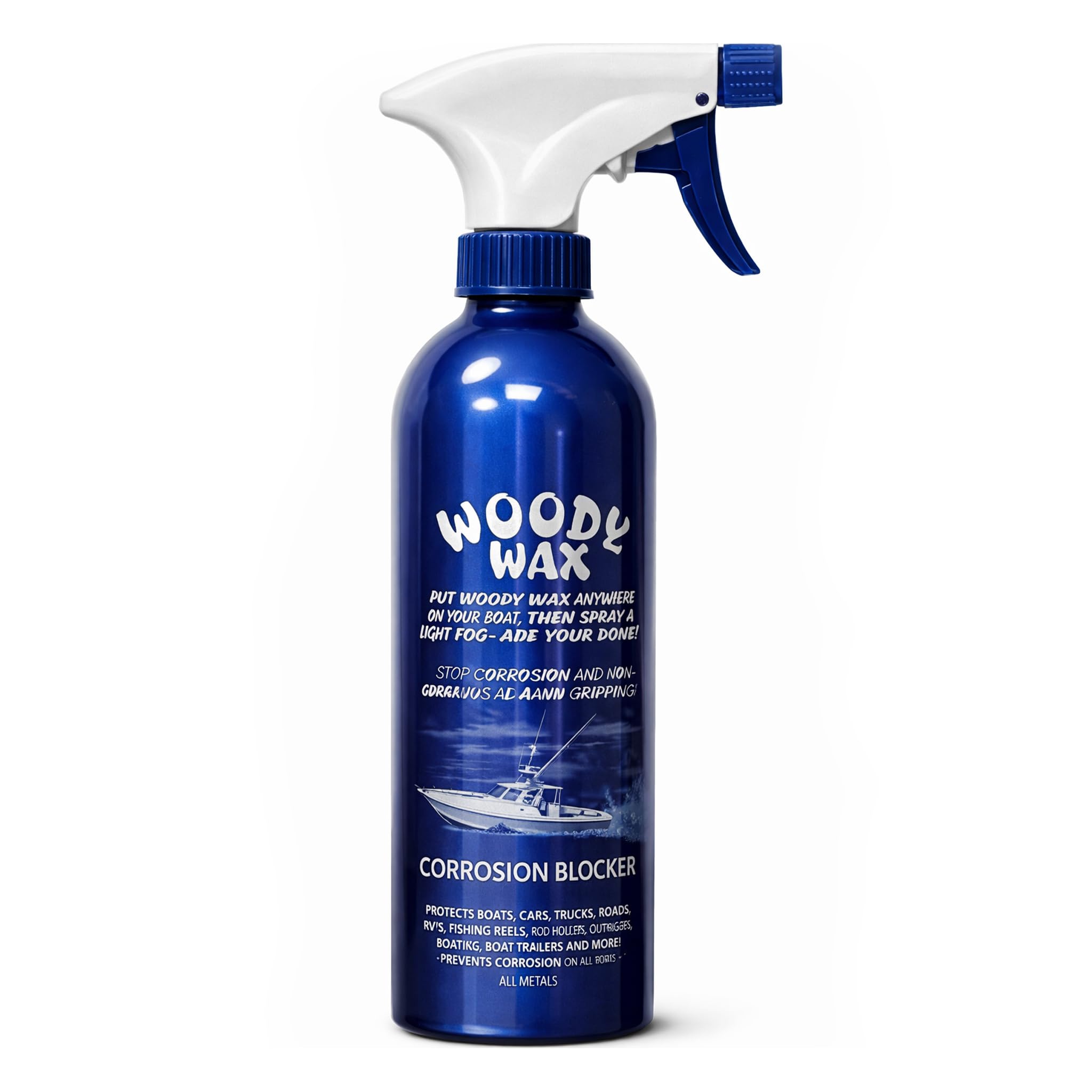
The only boat wax that protects your deck without making it slippery to walk on.
Woody Wax solves a unique problem that the other picks ignore: maintaining traction on non-skid deck surfaces. Standard wax leaves decks dangerously slick, but Woody Wax creates a heavy-duty, non-slick shield that is safe for walking while still protecting against saltwater and oxidation. It also doubles as a professional metal restorer for T-tops, outriggers, and engine parts, removing oxidation from stainless steel and anodized aluminum without hard scrubbing. Customers note that it works on fiberglass, aluminum, stainless steel, vinyl seats, and even electrical components, making it the most versatile product here.
The no-buff formula lets you simply spray it on and wipe it in with a cotton glove or cloth — no rubbing or buffing required. At 1.5 pounds and 2 x 4 x 11.25 inches, the bottle is the tallest of the group but still easy to store. It has a 4.7 out of 5 star rating from 444 reviews, tying the Collinite 885 for the highest rating on this list. The catch is that it is the most expensive option, priced at the premium end, and it is not a traditional gloss wax — the finish is more of a protective matte barrier than a deep shine. If showroom gloss is your main goal, the Collinite or Meguiar’s options are better.
This is the right wax if you own a boat with extensive non-skid decking or a lot of metal hardware. It is also the only product here that is explicitly designed for electrical components, which is useful for engine bays and wiring conduits exposed to spray.
Multi-surface workhorse: Woody Wax protects decks, metal, and electronics in one pass, but you sacrifice high-gloss shine for that versatility.
Best for: boaters who want one product for non-skid decks, metal restoration, and electrical protection.
Not ideal if: your priority is a deep, wet-looking gloss on the hull — pick a dedicated wax instead.
Understanding the Specs
Polymer vs Carnauba vs Ceramic
The base material determines how long the protection lasts and how glossy the finish looks. Carnauba wax gives a warm, deep shine but wears off faster under sun and salt. Marine-grade polymers bond tighter and survive more wash cycles. SiO2 ceramic coatings create a hard, hydrophobic layer that beads water aggressively — they last longer but cost more and often require a perfectly clean surface before application. Many products blend these, like the Collinite 885 which combines carnauba with polymers for both gloss and durability.
One-Step Cleaner Wax
A cleaner wax contains mild abrasives that remove light oxidation, water spots, and minor scratches while depositing a protective wax layer in the same step. This is convenient for boats that are waxed regularly and have only superficial wear. It saves an entire polishing step. The trade-off is that the protection layer is thinner than a dedicated sealant because the abrasives also remove some of the wax as you work it in. Products like the Meguiar’s M6132 are designed for this dual role.
FAQ
Can I use car wax on a boat in saltwater?
How often should I wax my boat in saltwater?
What is the difference between Collinite 885 and 925?
Do I need to polish before applying marine wax?
Can I use a spray ceramic coating over existing wax?
Will wax prevent oxidation on my boat?
Is Woody Wax safe for non-skid deck surfaces?
How do I apply paste wax to a fiberglass boat?
What does SiO2 do in a boat ceramic coating?
Is one-step cleaner wax better than a separate polish and wax?
Final Thoughts: The Verdict
For most owners, the boat wax for saltwater winner is the Meguiar’s M6132 because it removes light defects and applies UV protection in a single step, saving time without sacrificing saltwater defense. If you want the longest-lasting sealant and do not mind prepping the hull first, grab the Collinite 925. And for non-skid decks and metal restoration, the standout is the Woody Wax Spray.
How We Picked
We do not accept paid placement. Every pick is matched to a real buyer and a real use-case; we do not hands-on test units.
Sources & Methodology
Specifications: manufacturer listings and product documentation. Review insights: verified customer reviews, as of July 2026. Pricing: not shown on this page (it changes often); check the current price via the retailer link.
As an Amazon Associate, Gadgets Feed earns from qualifying purchases. This does not affect which products we feature.
Related Guides
Product prices and availability are accurate as of the date/time indicated and are subject to change. Any price and availability information displayed on Amazon at the time of purchase will apply to the purchase of this product. As an Amazon Associate I earn from qualifying purchases.
CERTAIN CONTENT THAT APPEARS ON THIS SITE COMES FROM AMAZON. THIS CONTENT IS PROVIDED "AS IS" AND IS SUBJECT TO CHANGE OR REMOVAL AT ANY TIME.
Amazon and the Amazon logo are trademarks of Amazon.com, Inc. or its affiliates.