
Our readers keep the lights on and my morning glass full of iced black tea. As an Amazon Associate, I earn from qualifying purchases.
Specs are compiled from manufacturer listings and verified buyer reviews and can change over time — please confirm the key details on the product page before buying.
Your basement stays dry only if your sump pump turns on automatically the moment water rises — no manual switch-flipping required. This guide cuts through the specs (gallons per minute, horsepower, and switch types) to help you pick a pump that fires up on its own and keeps your storage room, laundry area, or finished basement from turning into a wading pool.
I’m Min — the founder and writer behind Gadgets Feed. This guide is built by comparing the manufacturers’ published specifications and the patterns across verified customer reviews, so you get each pick’s real strengths and trade-offs instead of marketing spin.
We looked at seven models, from compact backup units to heavy-duty cast-iron workhorses, to find the best fit for your home. Keep reading to find which automatic sump pump actually keeps your basement dry while staying affordable or your back.
Our Picks at a Glance


How To Choose The Best Automatic Sump Pump
Choosing a sump pump is a balance of horsepower (HP), flow rate (GPH or GPM), build materials, and the type of automatic switch. The wrong switch type can mean the pump does not fit your basin or fails to activate in time.
Float Switch Types: Tethered vs Vertical vs Electronic
A tethered float switch has a large ball on a loose cord that rises with the water level. It works well in wide pits but can get tangled or stuck in narrow ones. A vertical float switch is a tall, narrow tube that moves up and down, making it perfect for tight sump basins. An electronic water sensor switch uses probes to detect water — it is great for “last-inch” drainage because it has no moving parts to jam, but it may not work in places with low-conductivity water like distilled or purified water.
Flow Rate: GPH and GPM
Gallons Per Hour (GPH) at zero feet of lift tells you the pump’s maximum speed with no upward resistance. But real pits require vertical lift (often 10-20 feet), so look for the GPH at the height you actually need. A 1/2 HP pump can move 2500-4300 GPH at zero feet, while a 1/3 HP model usually handles 2000-2500 GPH. If your pit floods fast during heavy rain, you want a higher flow rate.
Build Materials: Cast Iron, Stainless Steel, or Plastic
Cast iron and stainless steel housings dissipate heat better, resist corrosion, and last longer than plastic when submerged 24/7. Plastic (thermoplastic) is lighter and cheaper but may crack over years of use. The VEVOR uses a stainless steel surface over a cast iron frame, while the Red Lion and Liberty Pumps use cast iron and aluminum.
Quick Comparison
| Model | Best For | Flow Rate | Horsepower | Max Lift Height | Amazon |
|---|---|---|---|---|---|
| BOMGIE Automatic 2250GPH★ Best Overall | Highest lift height for deep pits | 38 GPM | 0.33 HP | 33.5 ft | $89.99Amazon |
| VEVOR 1/2 HPAlso Great | Highest flow in a heavy-duty build | 72 GPM | 0.5 HP | 28 ft | $105.90Amazon |
| Westinghouse 1/2 HP | Reliable auto start in narrow pits | 68.3 GPM | 0.5 HP | 28 ft | $114.99Amazon |
| Red Lion RL-SC50V | Durable cast iron with proven longevity | 71 GPM | 0.5 HP | 28 ft | $204.97Amazon |
| Liberty Pumps 237 | Trusted brand for residential drainage | 44 GPM | 0.33 HP | 21 ft | $189.55Amazon |
| FLUENTPOWER 1/2 HP | Budget-friendly with manual mode | 42 GPM | 0.5 HP | 26 ft | $50.53$53.19Amazon |
| Green Expert 1/3HP | Last-inch drainage on flat floors | 33 GPM | 0.35 HP | 23 ft | $55.79$61.99Ends inAmazon |
In‑Depth Reviews
1. BOMGIE Automatic 2250GPH Sump Pump
Our pick — over 4★ from 900+ verified ratings; the strongest balance of quality and price.
The best reach for a basement that is deep below grade.
With a 33.5-foot maximum vertical lift, the BOMGIE out-reaches every other pump here — the Green Expert’s 23-foot max is 46% less. So this is the pick if your discharge pipe runs far up before dumping outside, like from a deep basement or crawlspace. The 1/3 HP copper-wire motor pushes 38 GPM (2250 GPH) at zero feet, and the automatic switch kicks in when water reaches 1.5 inches, then runs for 60 seconds after the water drops to a quarter inch before shutting off. That extra run-time clears standing water more thoroughly than a simple on/off switch.
The thermoplastic body (a type of hard plastic) is corrosion-resistant and handles 1/8-inch solids. At 8.6 pounds and 7.6″ x 7″ x 12″, it is compact and portable. The 10-foot power cord and included 3/4″ garden hose adapter make setup straightforward. Buyers mention it is quiet enough to run in a crawlspace without waking the house, and the UL certification (a safety standard from Underwriters Laboratories) adds confidence.
Compared to the Liberty Pumps 237’s 21-foot max lift, the BOMGIE reaches 60% higher, making it the better choice for deep sump pits or basements with a long vertical run. The 18-month warranty is shorter than the Red Lion’s 3-year coverage, but the unit’s build quality gets consistent praise from buyers.
Vertical Champion
- 33.5-foot max lift — highest in this comparison
- Auto switch runs 60 seconds after water drops below 1/4 inch
- UL certified and compact at 8.6 pounds
Lower Flow Rate
- 38 GPM is slower than the 1/2 HP models (69-72 GPM)
- Thermoplastic body is less durable than cast iron
Perfect for: deep basement pits where the discharge pipe runs high before exiting — the 33.5-foot lift handles the climb.
Not ideal for: high-volume flood scenarios; the 38 GPM is slower than the VEVOR’s 72 GPM.
2. VEVOR 1/2 HP Sump Pump
The water-mover that outflows most 1/2 HP pumps in its class.
This pump is all about raw capacity. It pushes 72 gallons per minute (4320 GPH) — that is 2.2 times faster than the Green Expert’s 33 GPM. So when a heavy storm sends water into your pit fast, the VEVOR keeps up without struggling. It combines a corrosion-proof cast iron frame (the metal shell around the motor) with a stainless steel surface, so the parts that sit in water resist rust. The IPX8 waterproof rating (meaning it can be submerged continuously) adds trust for long-term underwater use.
The automatic tethered float switch (a ball on a cord that rises with water) kicks the pump on and off based on water level, which is handy for basements with a larger pit. Buyers report it runs quietly at this flow rate and assembled in minutes with the 1-1/2″ NPT (national pipe thread) discharge. But the trade-off is size — at 15.6″ x 11.2″ x 10″ and nearly 16 pounds, it needs a pit at least 22 inches tall and 15 inches wide. Small or shallow basins will crowd it.
Compared to the lighter FLUENTPOWER at 8.38 pounds, the VEVOR is 87% heavier — you feel the build quality in your hands, but you also feel the effort of hauling it into a pit.
Why It Leads
- 72 GPM is the highest flow rate in this comparison — moves water faster than the Westinghouse’s 68.3 GPM
- Cast iron frame plus stainless steel surface for corrosion resistance
- IPX8 waterproof rating means it lives safely underwater
What to Watch For
- Requires a large pit (22″H x 15″Dia.) — won’t fit narrow sump basins
- 15.7 pounds is heavy; lifting it out for cleaning is a workout
Reach for this if: your basement pit is large and you need the fastest water removal in the list — the 72 GPM leaves nothing standing.
Look elsewhere if: you have a narrow or shallow sump pit; the VEVOR’s footprint and 22-inch clearance requirement won’t fit.
3. Red Lion RL-SC50V

A cast-iron workhorse built for the long haul in a narrow basin.
The Red Lion’s rugged cast iron housing and clog-resistant impeller (the rotating part that pushes water) can handle semi-solids up to 3/8-inch — handy if your sump pit collects grit or small debris. It moves 71 GPM at zero feet, nearly matching the VEVOR’s 72 GPM, and hits a 28-foot shutoff height (the highest point it can still push water). The piggy-back vertical float switch (a narrow tube that plugs into the wall outlet, then the pump plugs into it) activates when water reaches 7.25 inches and shuts off at 2.75 inches. This design fits narrow pits where a tethered float would jam against the wall.
One smart design detail: the float switch unplugs from the pump for easy maintenance or testing without disassembling the unit. At roughly 20 pounds, it is the heaviest pump here, a sign of the dense cast iron that dissipates heat well. The manufacturer backs it with a 3-year warranty, which is longer than most competitors. Buyers with frequent storm flooding note it starts reliably every time, even after sitting dry for months.
Compared to the plastic-bodied FLUENTPOWER, the Red Lion’s cast iron feels tougher and handles sudden surge loads better, though the weight makes it less portable for occasional use in ponds or pools.
Built to Last
- Cast iron housing and impeller handles 3/8-inch solids
- Piggy-back vertical float switch fits narrow pits and unplugs for maintenance
- 3-year manufacturer warranty
Hefty Downside
- 19.75 pounds makes it heavy to carry and position
- Requires a basin 15 inches or larger in diameter
Who this suits: homeowners who want a rugged, permanent install in a narrow sump pit and value longevity over portability.
One real limitation: the weight and size mean it is not a grab-and-go backup pump for pond or pool draining.
4. Westinghouse 1/2 HP Sump Pump
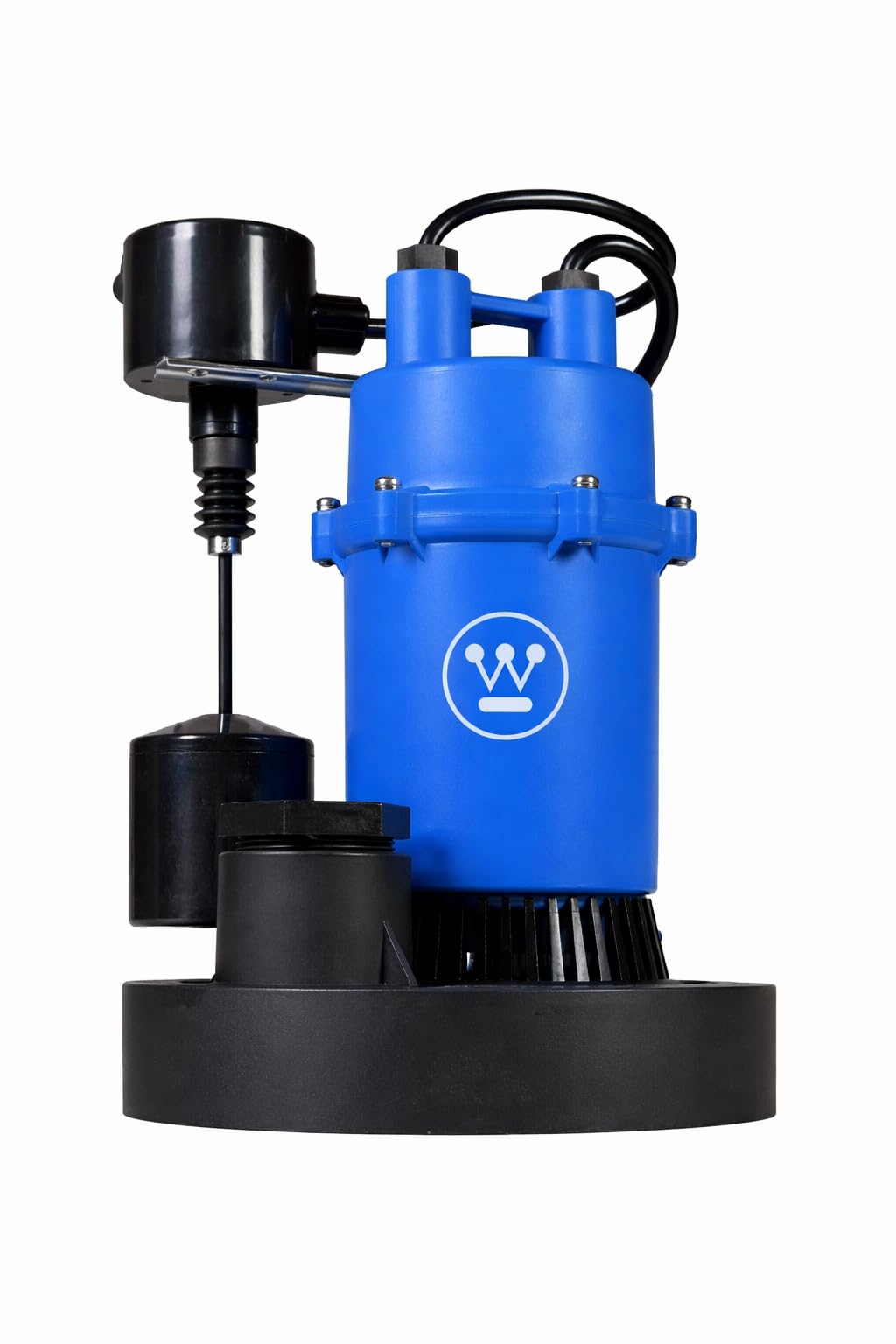
The go-to for tight basins that need a reliable vertical float.
With a 1/2 HP motor that moves 69 GPM (4100 GPH) and a 28-foot vertical lift, the Westinghouse sits in the same performance tier as the VEVOR and Red Lion. But it uses an integrated vertical float switch (a narrow tube that moves straight up and down), which takes up minimal room. That makes it a strong pick for narrow sump pits where a tethered float ball (a large ball on a cord) would brush against the wall and stick. The top suction design (water is drawn in from the top, not the bottom) helps prevent airlocks (air trapped inside the pump that stops flow).
The epoxy-coated aluminum housing keeps weight reasonable. The oil-filled PSC (permanent split capacitor) motor with thermal overload protection (a safety circuit that shuts the motor off if it gets too hot) protects it from overheating during extended runs, then restarts once it cools. Buyers mention it installs quickly with a standard 1-1/2″ discharge and runs quieter than expected for a 1/2 HP pump.
At 52% more horsepower than the BOMGIE’s 0.33 HP, the Westinghouse is noticeably punchier for deep lifts and high-flow scenarios — but the aluminum housing will not resist physical abuse as well as the Red Lion’s cast iron.
Narrow Pit Fit
- Integrated vertical float switch fits tight basins without jamming
- Top suction design reduces airlocks
- 69 GPM is competitive with premium models
Material Trade-Off
- Aluminum housing is less dent-resistant than cast iron or stainless steel
- No included lifting rope or hose adapters
Best for: narrow sump pits where a tethered float will not fit — the vertical switch avoids snags.
skip it if: you need extreme durability against rough handling; the aluminum body is lighter but less rugged than cast iron.
5. Liberty Pumps 237

A proven brand that trade-offs flow for clog resistance.
The Liberty 237 uses a vortex-style impeller (a spinning part that creates a whirlpool to pull water through rather than a direct blade that can snag). This design lets it pass 3/8-inch solids (like sand or small gravel) without jamming. The 1/3 HP motor moves 44 GPM — slower than the 1/2 HP picks above, but steady and reliable for normal residential groundwater control. You can drain a kiddie pool or handle routine seepage without worry.
The deep-finned, powder-coated aluminum motor housing helps dissipate heat during extended runs so the motor stays cooler longer. The vertical magnetic float switch is automatic and works in narrow pits. At 11 pounds and 9.6 inches wide, it is easier to install in a standard 18-inch basin than the larger VEVOR. Buyers with heavy clay soil (which produces fine sediment in the water) report the vortex impeller keeps the pump running when a conventional impeller would clog. Liberty backs it with a 2-year warranty.
Compared to the Green Expert’s 33 GPM, the Liberty moves 33% more water, so it handles moderate flooding faster — but it cannot reach the 28-foot lift of the 1/2 HP pumps.
Clog Fighter
- Vortex-style impeller handles 3/8-inch solids without clogging
- Vertical magnetic float switch fits narrow pits
- Deep-finned motor housing dissipates heat well
Lower Flow
- 44 GPM is slower than 1/2 HP competitors (69-72 GPM)
- 21-foot max lift limits use in deep pits
Ideal if: your sump water carries grit or small solids — the vortex impeller keeps running when others jam.
Not for you if: fast, high-volume pumping is your priority; the 1/2 HP models move near double the flow.
6. FLUENTPOWER 1/2 HP Submersible Sump Pump
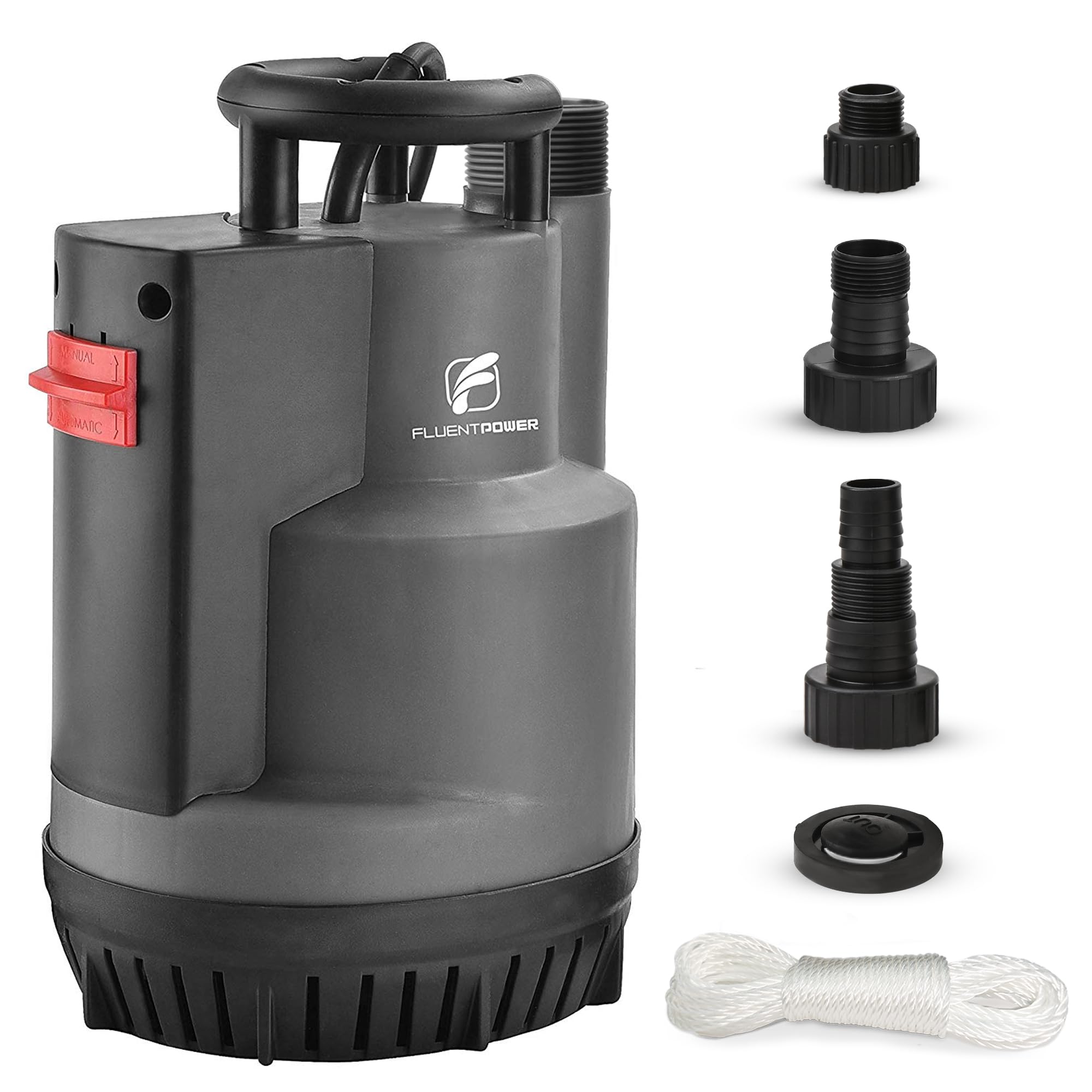
A dual-mode pump that scoots into tight budget corners.
The FLUENTPOWER packs a 1/2 HP motor into a compact body (8.38 pounds, 7.9″ x 6.5″ x 11.7″) — the lightest 1/2 HP model here and 87% lighter than the VEVOR. That makes it easy to carry around for temporary jobs like draining a pool, a pond, or a flooded garage after a storm. It moves 42 GPM (2500 GPH) with a 26-foot max lift, which is lower than the premium 1/2 HP units but still solid for mid-range use.
The built-in float switch (a ball on a cord, in this case) starts the pump when water hits 4 inches and shuts off around 2 inches. The clever part is the manual mode switch, which lets you drain down to about half an inch when the water level is too low for the float to trigger. It comes with a 16.4-foot power cord (the longest in this comparison) and adapters for 3/4″ garden hose, 1″ NPT, and 1-1/2″ high-capacity discharge.
One reviewer noted the check valve (a one-way flap that prevents backflow) is included, so water does not trickle back into the pump after it shuts off. Compared to the Green Expert, the FLUENTPOWER has 52% more horsepower and lifts 3 feet higher, making it faster for moderate-depth pits.
Dual-Mode Versatility
- Manual mode drains to 1/2 inch, below float switch activation
- 8.38 pounds is easy to carry for temporary jobs
- 16.4-foot cord reaches distant outlets
Flow Trade-Off
- 42 GPM is slower than other 1/2 HP pumps (69-72 GPM)
- Thermoplastic housing is less durable than cast iron for constant submersion
Grab this if: you need a portable backup pump that pulls double duty for home draining and emergency water removal.
Pass if: you plan to install it permanently in a high-flow basement; the 42 GPM may not keep up during a fast flood.
7. Green Expert 1/3HP Submersible Sump Pump

The pump that gets your basement floor down to the last film of water.
Green Expert’s unique water sensor switch (electronic probes that detect water rather than a floating ball) is the standout feature here — it drains water down to 1/25 inch of the floor surface, far lower than any float-switch pump can reach. The sensor detects when no water is present and auto-stops after 15 seconds. That means your basement floor dries completely instead of leaving a thin sheet of dampness that can promote mold. The pump moves up to 33 GPM at a 10-foot lift (2000 GPH at zero feet) and reaches 23 feet vertically.
The 1/3 HP PSC (permanent split capacitor) motor is oil-free, so there is no oil to leak, and the thermal overload protection prevents overheating. At 8.8 pounds and 9.5″ x 6.7″ x 10.6″, it is compact enough to stash on a shelf between uses. The kit includes a lifting rope, non-return valve (one-way check valve), and three adapters (1″, 1-1/2″, and 3/4″ GHT). Reviewers praise the last-inch drainage in flooded garages and flat slab basements — one mentioned it turned a swampy floor into a dry surface within minutes.
Compared to the BOMGIE’s 33.5-foot max lift, the Green Expert’s 23-foot max is 46% less reach, so it is not ideal for deep pits. Its 33 GPM is also the lowest flow rate in this group, making it a secondary or backup pump for most basements.
Super-Floor Drying
- Water sensor drains to 1/25 inch — leaves floor nearly dry
- Oil-free motor with thermal overload protection
- Compact and lightweight at 8.8 pounds
Slow Flow
- 33 GPM is the slowest flow rate in this comparison
- 23-foot max lift limits use in deep sump pits
- Water sensor may not work with distilled or purified water
Ideal as a: backup pump or for flat basement floors — the last-inch drainage leaves a truly dry finish.
Better options for: main sump pits with fast flooding; the 33 GPM is slower than the 72 GPM VEVOR.
Understanding the Specs
Flow Rate (GPH / GPM)
This measures how much water the pump moves per hour or minute. A higher number (like 72 GPM on the VEVOR) means faster water removal, which matters when a storm flash-floods your sump pit. Lower flow rates (like 33 GPM on the Green Expert) still work for normal groundwater seepage but may not outpace a sudden surge. Always match the flow rate to your pit’s incoming water speed.
Float Switch Types
The switch is what makes a sump pump automatic. Tethered float switches use a ball on a cord — they are simple but need a wide basin. Vertical float switches move up and down in a narrow tube, fitting tight pits. Electronic water sensors have no moving parts, so they do not jam, but they may fail in low-conductivity water (like distilled water). Pick the type that fits your physical space first.
Horsepower and Lift Height
Horsepower (HP) is a rough indicator of power — 1/2 HP pumps typically lift water 26-28 feet, while 1/3 HP models lift 21-23 feet. The BOMGIE breaks that rule with a 33.5-foot lift on 1/3 HP. The max lift height (also called shutoff head) tells you the highest vertical distance the pump can push water. If your discharge pipe climbs more than 20 feet, a pump with a higher lift rating is important.
Build Materials
Cast iron and stainless steel are the gold standard for durability in permanent sump installations — they resist corrosion and handle physical bumps better than plastic. Aluminum housings like the one on the Westinghouse are lighter but can dent. Thermoplastic (used in the BOMGIE and FLUENTPOWER) is budget-friendly and corrosion-proof but may crack over years of submersion. If your pump runs every cycle, splurge on a metal housing.
FAQ
Will a 1/3 HP pump keep up with a heavy rainstorm?
Can I use a sump pump with a garden hose?
What is a piggy-back float switch?
What is the difference between a tethered and a vertical float switch?
How long does a sump pump typically last?
What size discharge pipe should I use?
What is thermal overload protection?
Can I install a sump pump in a crawl space?
Final Thoughts: The Verdict
Across the board, the automatic sump pump winner is the VEVOR 1/2 HP because its 72 GPM flow rate and cast iron build offer the best balance of speed and durability for a permanent install. If you want a premium vertical float switch for a narrow pit, grab the Red Lion RL-SC50V. And for last-inch drainage on a flat basement floor, the standout is the Green Expert.
How We Picked
We do not accept paid placement. Every pick is matched to a real buyer and a real use-case; we do not hands-on test units.
Sources & Methodology
Specifications: manufacturer listings and product documentation. Review insights: verified customer reviews, as of July 2026. Pricing: not shown on this page (it changes often); check the current price via the retailer link.
As an Amazon Associate, Gadgets Feed earns from qualifying purchases. This does not affect which products we feature.
Related Guides
Product prices and availability are accurate as of the date/time indicated and are subject to change. Any price and availability information displayed on Amazon at the time of purchase will apply to the purchase of this product. As an Amazon Associate I earn from qualifying purchases.
CERTAIN CONTENT THAT APPEARS ON THIS SITE COMES FROM AMAZON. THIS CONTENT IS PROVIDED "AS IS" AND IS SUBJECT TO CHANGE OR REMOVAL AT ANY TIME.
Amazon and the Amazon logo are trademarks of Amazon.com, Inc. or its affiliates.