
Our readers keep the lights on and my morning glass full of iced black tea. As an Amazon Associate, I earn from qualifying purchases.
Specs are compiled from manufacturer listings and verified buyer reviews and can change over time — please confirm the key details on the product page before buying.
The real problem with a damp basement wall isn’t the stain — it’s the hydrostatic pressure (the force of groundwater in the soil) pushing water through the masonry from the outside. A regular wall paint simply peels off under that force. You need a coating that bonds, flexes, and actually blocks moisture under pressure. This guide compares five proven options that do exactly that, from flexible liquid rubber to high-pressure masonry waterproofers.
I’m Min — the founder and writer behind Gadgets Feed. This guide is built by comparing the manufacturers’ published specifications and the patterns across verified customer reviews, so you get each pick’s real strengths and trade-offs instead of marketing spin.
You need a coating rated for below-grade use (designed for walls that touch soil), whether you seal a cinder block foundation or treat a painted concrete wall. Below are the five most reliable contenders for the best basement waterproof paint, with honest trade-offs spelled out for each one.
Our Picks at a Glance

How To Choose The Best Basement Waterproof Paint
Basement conditions vary. You might have a painted wall that is damp, a bare cinder block that seeps water after rain, or a concrete foundation with visible hairline cracks. Not every waterproofing paint handles all three equally well. Focus on three specs first.
Hydrostatic Pressure Rating
This number measures how much water pressure the dried film can stop before it lets moisture through. For a typical below-grade basement wall (one that sits partly or fully underground), look for at least 10 psi. A 20 psi rating adds more safety margin for walls with high water tables (groundwater levels close to the basement floor).
Elongation (Flexibility)
Concrete and masonry shift over time — small cracks form as the house settles. A coating with high elongation (stretchability, measured in percentage) bridges those cracks and stays intact. Liquid rubber formulations can reach 900% elongation. That means the film stretches nearly ten times its length before tearing.
Surface Compatibility
Some products bond best to bare concrete and masonry. Others (like Zinsser WaterTite-LX) are formulated to stick to previously painted walls without peeling. Check the manufacturer’s surface-prep instructions. If your wall already has a coat of paint, you may need a product designed for that specific scenario.
Quick Comparison
| Model | Best For | Coverage | Resists | Dry Time | Amazon |
|---|---|---|---|---|---|
| AMS Blue Max Liquid Rubber★ Best Overall | Extreme Flexibility | 1 Gal | 900% Elongation | 24 hrs | Amazon |
| Zinsser WaterTite-LXBest for Painted Walls | Painting Over Old Paint | 100 sq ft/gal | 20 psi Water Pressure | 2 hrs | Amazon |
| Ames Block & Wall Liquid Rubber | Foundations & Retaining Walls | 1 Gal | Flex Membrane | 24 hrs | Amazon |
| INSL-X WaterBlock Acrylic | High Alkali Resistance | 75-125 sq ft/gal | 12 psi Water Pressure | Fast Drying | Amazon |
| Drylok 275 Masonry Waterproofer | Large Area Coverage | 5-Gal Pail | 10 psi Water Pressure | 3 hrs | Amazon |
In‑Depth Reviews
1. Ames Blue Max White Liquid Rubber Waterproofer, 1 Gal
Our pick — over 4.5★ from 550+ verified ratings; the strongest balance of quality and price.
This liquid rubber stretches 900% without cracking, making it the most flexible defense against foundation movement.
That 900% elongation (the dried film can stretch nearly ten times its original length before tearing) is the key spec that sets Ames Blue Max apart from the Drylok 275, which lacks an elongation spec and uses a rigid acrylic formula. When a concrete wall settles or a hairline crack opens, a rigid paint splits along that line. The Blue Max membrane simply stretches with it and stays sealed. Buyers consistently report it bonds tightly to concrete, wood, and even metal — one reviewer noted it held up on a below-grade cinder block wall through a wet season with no peeling. You roll it on like thick paint (wait 24 hours between coats), and it works on vertical or horizontal surfaces. At just over 11 pounds for the gallon pail, it is also lighter than many of its competitors.
On the other hand, the 24-hour recoat time slows down a project compared to a fast-drying acrylic like the Zinsser WaterTite-LX, which dries in 2 hours. And while it handles many surfaces, the manufacturer recommends it for below-grade and insulated concrete foundations specifically. For a large basement, you will need multiple gallons — the product is sold in 1-gallon pails.
Who it fits best: If your main concern is a settling foundation that produces micro-cracks, the extreme flexibility of this liquid rubber is the right solution.
The value read: This gallon is a premium performer at a mid-range price — the highest elongation number in this lineup for the cost.
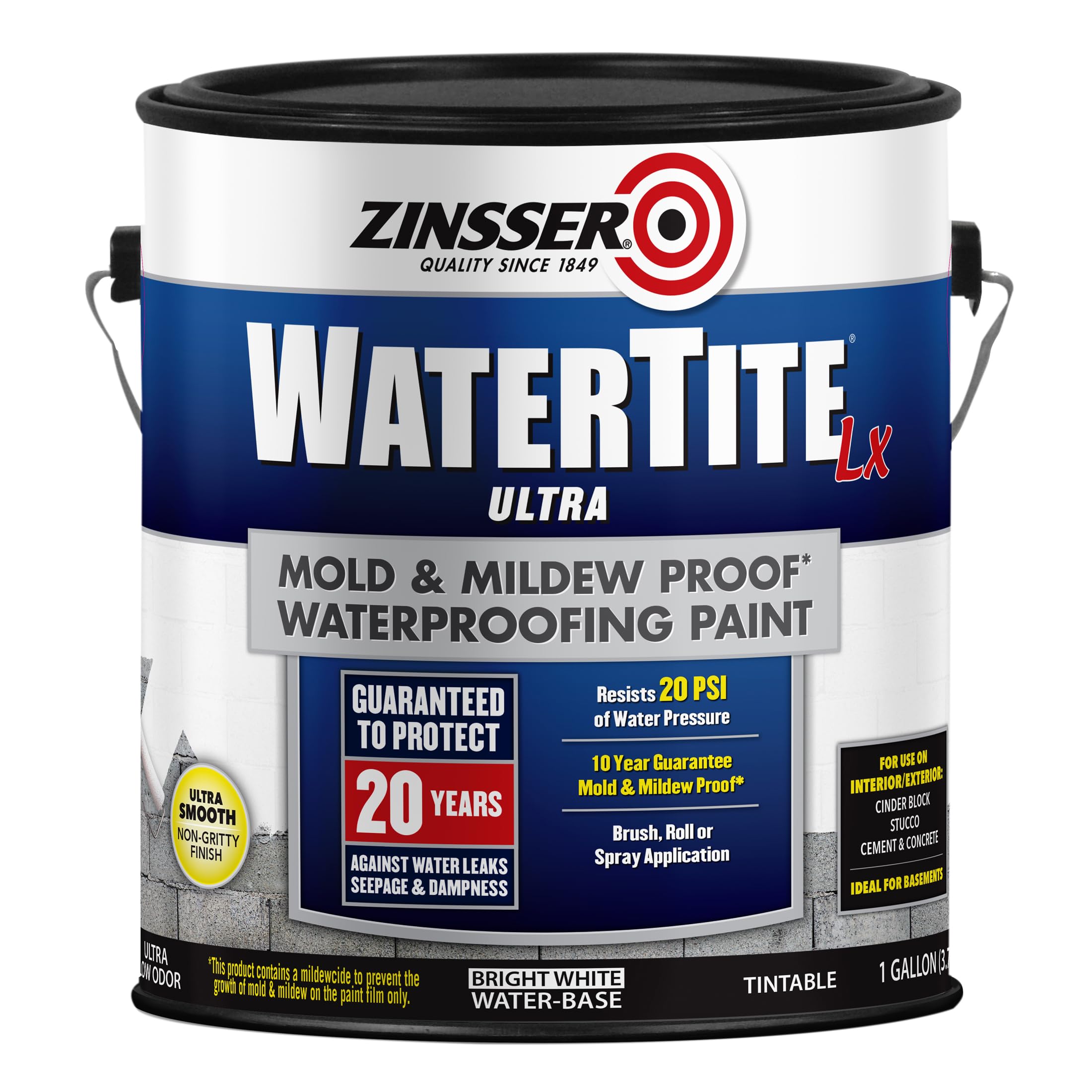
2. Zinsser 270267 White WaterTite-LX Mold & Mildew-Proof Waterproofing Paint
The rare waterproof paint that sticks to previously-painted basement walls and still resists 20 pounds of water pressure.
Paint-on-paint adhesion is the classic basement-paint trap. Most waterproofers need bare masonry to bond. Zinsser formulated WaterTite-LX to solve that — it is a latex-base paint that rolls onto dry, old paint without peeling. The manufacturer guarantees it resists water pressure up to 20 psi, at 20 psi versus the Drylok’s 10 psi. It also carries a 15-year waterproof guarantee and a 10-year mold and mildew-proof guarantee on the paint film. A 2-hour dry time (much faster than the 24-hour liquid rubbers) means you can do two coats in one day. At 12.25 pounds for a gallon, it is heavier than a standard latex paint because of the waterproofing additives.
The trade-off is the coverage: 100 square feet per gallon, which is on the lower side. For a standard 8-foot basement wall, a single gallon might cover roughly a 12.5-foot-long wall section. Larger basements will need multiple gallons. Reviewers also note that the finish is a matte, non-gritty white, so it looks like a regular flat paint — attractive to some buyers but too plain for others.
The standout feature: The 20 psi hydrostatic pressure rating makes this one of the strongest water-blockers in this guide, especially for walls where you cannot strip the old paint.
Reach for this if… your basement wall already has paint on it and you need to waterproof over it without sanding or stripping.
3. INSL-X WaterBlock Acrylic Masonry Waterproofer Paint, White, 1 Gallon

An acrylic masonry waterproofer that stands up to the high alkaline (pH-13) chemistry of fresh concrete and cinder block.
New concrete and cinder block have a high pH — sometimes up to pH-13 — that can chemically attack and break down regular paint over time. INSL-X WaterBlock is specifically formulated to resist that high alkalinity, so it lasts on fresh walls where other paints might lift. On the water-pressure side, it holds back up to 12 psi of hydrostatic pressure. Coverage is roughly 75 to 125 square feet per gallon, depending on the roughness of the block. It dries to a semi-gloss white finish that looks more finished than the typical flat white waterproofer. The included components list a can opener and stir stick — small but thoughtful when you are standing in a basement with a gallon of paint.
The main catch is the temperature window: the manufacturer specifies application only when the air and surface temperatures are between 50°F and 90°F. That is fine for summer basement work, but if you are painting a cold basement in late fall, you may need a heater in the room. Also, the 12 psi rating, while solid, is 12 psi versus the Zinsser’s 20 psi. For a wall that gets heavy groundwater pressure, that difference matters.
Best scenario for it: Freshly poured concrete basement walls or new cinder block, where alkali resistance is needed most.
Pick this over the Zinsser if… your wall is brand new concrete, not old paint. The alkali protection keeps the coating from chemically degrading.
4. Ames Block & Wall Liquid Rubber Waterproofer Multi-Purpose Coating & Sealant, 1 Gallon

A targeted liquid rubber formulation for block walls and foundations, coming in at just 9.25 pounds per gallon and a lower cost.
Where the Blue Max (product 1) is the over-achiever in elongation, the Block & Wall is the focused specialist. It is a flexible waterproofing membrane designed specifically for foundations, retaining walls, and block walls — not necessarily metal or wood. At 9.25 pounds per gallon, it is significantly lighter than the 11.05-pound INSL-X and the 12.25-pound Zinsser, which makes carrying it down basement stairs easier. Unlike the Blue Max it is made in China (the Blue Max is made in the USA), which may be a factor for some buyers. It holds a strong 4.6 out of 5 rating across 336 reviews, and buyers consistently note it bonds well to concrete block even on vertical surfaces.
The limitation is materials compatibility: the data lists metal and wood as compatible, but the product name (“Block & Wall”) suggests its primary design is for masonry. For a mixed-material basement with wood sill plates and a concrete floor joint, you might want the broader-surface Blue Max or a multi-surface coating instead. It also has a 24-hour drying time between coats, same as the Blue Max.
What buyers mention: A common review pattern notes it goes on easy with a roller, but a second coat for thick coverage is the norm, which stretches the gallon’s real coverage.
Best for: Poured concrete foundations and concrete block walls where the specific use case aligns with the “Block & Wall” design — at a lower weight and cost than the premium Blue Max.
5. Drylok 275 Masonry Waterproofer Water-Based White, 5-Gallon Pail

The 5-gallon pail that tackles a whole basement wall in one go — no pre-mixing, no pre-wetting, just roll.
When you are sealing an entire basement, the labor of opening five individual gallon cans adds up. The concrete-specific formulation withstands 10 psi of water pressure, which is the standard for below-grade masonry waterproofing. Drylok advertises a 3-hour dry time and less than 100 g/L VOC content (volatile organic compounds — the chemicals that create paint fumes), so the odor is lower than many traditional solvent-based waterproofers. The white finish is tintable, so you can add a color if you want a different look.
The 66-pound pail is heavy — expect to need a hand truck or a helper to get it down basement stairs. Also, the 10 psi rating is lower than both the Zinsser (20 psi) and the INSL-X (12 psi). For a wall with heavy groundwater pressure, a higher-psi product like the Zinsser may be more reliable. A buyer in a low-pressure dampness situation, however, will likely have no trouble.
The efficiency argument: One trip, one pail, no stopping to swap cans. For a full basement job, the 5-gallon volume saves trips to the store and keeps the paint consistency uniform.
Reach for this if… you are waterproofing a large unfinished basement with concrete walls and want the convenience of bulk — just be ready for the weight.
Understanding the Specs
Hydrostatic Pressure (Psi)
This number measures how much water pressure from the soil outside can push against the dried paint film before water gets through. A 10 psi rating covers most average basements. A 20 psi rating adds safety margin for homes on a high water table or with active groundwater drainage issues. Do not treat it as a guarantee of dry walls — think of it as the coating’s resistance level, not a cure-all for structural water entry.
Elongation (Flexibility)
Listed as a percentage (like 900%), elongation tells you how much the dried coating can stretch before it tears. High elongation is critical for basements because concrete develops micro-cracks as the house settles. A rigid coating with 0% elongation will split right along that crack. A liquid rubber with 900% elongation stays intact even if the wall shifts.
FAQ
Can I apply basement waterproofing paint over old paint?
Do I need to seal cracks before painting?
How long does basement waterproof paint last once applied?
Is one coat enough, or do I need two?
Can I use regular drywall paint after applying waterproof paint?
What does VOC content mean for basement paint?
Will waterproof paint stop water coming through the wall joint?
Can I apply basement waterproof paint in cold weather?
Which is better — liquid rubber or acrylic waterproofer?
Does waterproof paint work on painted cinder block?
Final Thoughts: The Verdict
If you want one dependable pick, the best basement waterproof paint winner is the Ames Blue Max Liquid Rubber because its 900% elongation handles foundation movement better than any competitor and it holds a top 4.6/5 rating. If you are painting over an existing painted wall, grab the Zinsser WaterTite-LX for its 20 psi resistance. And for a full-basement pour, the Drylok 275 5-Gallon Pail saves trips with its 5-gallon volume and 3-hour dry time.
How We Picked
We do not accept paid placement. Every pick is matched to a real buyer and a real use-case; we do not hands-on test units.
Sources & Methodology
Specifications: manufacturer listings and product documentation. Review insights: verified customer reviews, as of July 2026. Pricing: not shown on this page (it changes often); check the current price via the retailer link.
As an Amazon Associate, Gadgets Feed earns from qualifying purchases. This does not affect which products we feature.