
Our readers keep the lights on and my morning glass full of iced black tea. As an Amazon Associate, I earn from qualifying purchases.
Specs are compiled from manufacturer listings and verified buyer reviews and can change over time — please confirm the key details on the product page before buying.
Choosing the right set of alligator clips with wire sounds simple until you are mid-diagnosis and a clip pops off or the conductor frays at the crimp. The real difference between a frustrating tangle and a reliable test session depends on three things: the thickness of the wire (measured in AWG, American Wire Gauge), how the clip connects to that wire, and whether the insulation can handle the voltage you feed it. This guide walks through seven sets, each picked because it solves a specific problem — from bench work to automotive diagnostics to running long circuits.
I’m Min — the founder and writer behind Gadgets Feed. This guide is built by comparing the manufacturers’ published specifications and the patterns across verified customer reviews, so you get each pick’s real strengths and trade-offs instead of marketing spin.
If you need a durable replacement for a Klein multimeter or a retractable set to trace trailer wiring, the best alligator clips with wire deliver dependable connections that stay put through repetitive use, making your electrical work faster and safer.
Our Picks at a Glance

How To Choose The Best Alligator Clips With Wire
The wrong set wastes time — clips that won’t grip, wire that kinks, insulation that cracks. Focus on these three factors to get a set that actually lasts on your bench or in your toolbox.
Pick the Right Wire Gauge for the Job
Thicker wire carries more current without heating up. A 14 AWG (American Wire Gauge) wire, like the one on the Dunzy set, handles up to 20A (amps) and stays flexible because it uses silicone insulation. Thinner 18 AWG wire is fine for low-current signal work and multimeter leads but will feel stiff if you try to draw more than 10A through it. Match the gauge to your typical load — thick for power, thin for signal.
Check the Connection Method
A clip that pulls off the wire is a clip you cannot trust. Sets where the clip is soldered or stamped-and-soldered to the conductor hold up far longer than simple crimped connections. The EDGELEC set explicitly mentions soldered joins, which means the weak mechanical point becomes the wire itself, not the crimp that could loosen over time.
Match the Safety Rating to Your Meter
A CAT III 1000V / CAT IV 600V rating tells you the insulation can survive high-energy spikes without breaking down — so the lead stays safe even if a surge hits it. If you are working on automotive circuits or household mains (120V-240V), look for this rating. For low-voltage breadboard work (under 50V), a lower rating is fine. The Klein and CNHIDEE leads both carry this dual safety rating.
Quick Comparison
| Model | Best For | Wire Gauge | Length | Safety Rating | Amazon |
|---|---|---|---|---|---|
| Klein Tools 69381★ Best Overall | Professional multimeter use | 18 AWG | 3 ft | CAT III 1000V / CAT IV 600V | Amazon |
| Sumnacon 4 in 1Lab Favorite | Bench power supply & lab testing | Not listed | 6.6 ft | 1000V / 15A | Amazon |
| CNHIDEE Heavy Duty | Automotive diagnostics | 18 AWG | 3 ft | CAT III 1000V / CAT IV 600V | Amazon |
| SWANLAKE 5-Piece | Multi-point testing & breadboarding | Not listed | 3.5 ft | 1000V / 15A | Amazon |
| Dunzy 14 Gauge | Battery & moderate current testing | 14 AWG | 3.3 ft | 1500V / 20A | Amazon |
| EDGELEC 6pc Test Leads | Color-coded bench work | 14 AWG | 3.87 ft | 1000V / 15A | Amazon |
| CALHAWK 20′ Retractable | Long runs & vehicle circuits | 18 AWG | 20 ft | Not listed | Amazon |
In‑Depth Reviews
1. Klein Tools 69381 Alligator Clip Test Leads
Our pick — over 4.5★ from 750+ verified ratings; the strongest balance of quality and price.
The two-stage clamping system in these leads lets you grab tiny wires without the main jaws bottoming out — a real time-saver in crowded junction boxes.
What sets the Klein 69381 apart from every other set here is the two-stage clamping system. The front pinchers grab small wires and battery terminals without the main jaws hitting their limit, while the full clip opens wide enough for larger conductors. It is a design borrowed from proper meter leads, and once you use it, a plain single-jaw clip feels like a step down.
The 18 AWG (American Wire Gauge) double-insulated wire runs 3 ft and carries a CAT III 1000V / CAT IV 600V safety rating — the same rating professional meters use, so it can handle high-energy surges from mains power without the insulation breaking down. The banana plugs are right-angle, which keeps the lead low-profile against the meter so it does not stick out awkwardly. Buyers consistently call the quality heavy-duty, and the 4.8-star crowd rating across several hundred reviews backs that up. The clips also detach and replace, so you are not tossing the whole set if a jaw wears out.
Why pros grab these
- Two-stage clamping handles both tiny and large conductors — a real time-saver compared to the CNHIDEE’s single-stage jaws.
- CAT III 1000V / CAT IV 600V rating meets professional safety standards for mains work.
- Right-angle banana plug keeps the lead tidy against the meter body.
The honest trade-off
- Clips are on the larger side — tight-spot work requires some wiggling.
- Does not fit every budget multimeter brand (Harbor Freight Cen-Tech is a known miss because of non-standard jack spacing).
- Priced a notch above generic sets, reflecting the Klein name.
Reach for these if: you work on live circuits daily and want a lead that matches your meter’s safety rating with a clever clamp that grabs anything from a fuse leg to a battery post.
Look elsewhere if: your multimeter uses non-standard banana spacing or you only need a throwaway set for a one-off project.
2. Sumnacon 4 in 1 Banana Plug Alligator Clip Test Lead
At 6.6 ft, this Sumnacon lead is 6.6 ft versus the Klein’s 3 ft, a length that matters when your meter sits on one end of the bench and the circuit under test lives on the other.
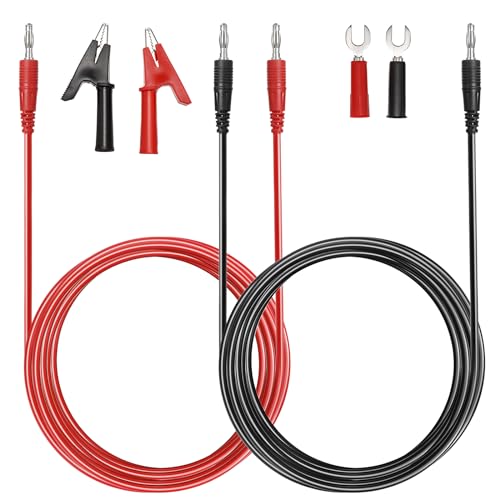
The modular design packs two banana plugs (the standard 4mm plug found on most meters and power supplies), two alligator clips, and two copper fork inserts. You can run alligator-to-banana, fork-to-banana, or banana-to-banana, which makes it the most versatile single kit here for lab work.
The silicone insulation is genuinely soft and flexible — it does not develop the “memory” curl that PVC (polyvinyl chloride) wire gets after being rolled up. One owner ran 5 amps through the clips without any warming, which matches the 15A / 1000V rating. The banana plugs fit snugly into a KunKin KP184 DC Load Tester and common bench supplies. Buyers rate this set a real bargain for the price, with quality being the most-discussed strength.
Purists may want to snip and solder their own ends, but as one experienced builder put it, “I could have made these but decided to be lazy and buy them — glad I did.” The length is just right for most small electronics projects without leaving a snake’s nest on the bench.
The one-liner: Best reach-to-price ratio of the bunch, with modular tips that adapt to whatever connector your gear uses.
Ideal for: the bench engineer who wants one lead that covers alligator, fork, and banana connections without buying three separate packs.
Consider another if: you need a CAT-rated safety lead for mains work — this set is not individually CAT-rated like the Klein or CNHIDEE, so it is not certified for high-energy spikes.
3. CNHIDEE Heavy Duty Alligator Clips Test Leads

This set mirrors the Klein in specs — 18 AWG, 3 ft, CAT III 1000V / CAT IV 600V — but at a price that makes it a strong alternative for the shop, especially if you own a Snap-On meter.
The large alligator jaws are useful for grabbing battery terminals and thick ground straps. One buyer specifically noted it “fits my snap on multimeter perfectly,” which is a common compatibility headache with generic leads that might use non-standard banana jack spacing.
Customers consistently call out the build quality and clip size as the highlights. The performance rating is the top praise across reviews, with the leads handling vehicle diagnostics, battery testing, and continuity checks without issue. The 4.5-star average across over 130 ratings confirms this is a reliable set for moderate use. The insulation feels heavy-duty and the banana plugs seat firmly in most meters.
Where it falls slightly short of the Klein is in the fine-point clamping — the jaws are large, so grabbing a single small wire in a crowded fuse box takes more care. But for the price, this is the set that gets the most “glad I bought these” reactions from weekend mechanics.
What owners value
- Same CAT III / CAT IV safety rating as premium leads at a lower cost, so it is safe for mains circuits.
- Large jaws work well on automotive battery terminals and thick cables.
- Compatible with Snap-On and other pro multimeters from the start.
The minor caveat
- Clip jaws are bulky for precision work on circuit boards or small terminals.
- A few owners note the banana plug fit is snug on some meters — your mileage may vary.
Best for: the automotive tech who needs a reliable, CAT-rated lead that fits pro meters without paying the premium markup.
skip it if: you need the two-stage fine-point clamp of the Klein for small-wire work — this is a full-jaw-only design.
4. SWANLAKE 5-Piece Dual-Ended Alligator Clip Test Leads

Most alligator clip sets give you one or two leads. The SWANLAKE gives you five individually colored pairs, each with a clip on both ends and a 3.5 ft length, so you can set up power, ground, and signal simultaneously.
That means you can set up multiple test points at once — power, ground, signal, trigger — without juggling or marking wires. The copper-clad clips provide strong conductivity at 1000V / 15A, and the rubber insulation cover prevents accidental shorting against adjacent clips.
Durability is the standout trait. One owner deliberately stretched a clip until the wire broke — the joint held, the wire snapped first. That is the sign of a proper soldered connection rather than a crimp that pulls loose. Quality and durability are by far the most-mentioned aspects in the reviews, with buyers calling them “solid jumpers” that “last a long time.” The 4.7-star average reflects near-universal satisfaction.
The catch is length: at 3.5 ft, these are long jumpers. If your work typically needs 12-inch patches for tight breadboard routing, these will feel like extension cords. But for testing across a car engine bay or between bench gear, that extra reach is exactly what you want.
Bottom line: The best multi-lead kit for anyone who runs several test points at once — the soldered construction means they will outlast the project.
Reach for this if: you need multiple simultaneous connections for circuit debugging, HVAC checks, or automotive sensor testing — the color-coding keeps it all straight.
Think twice if: your work is confined to tight breadboard proto areas; look for shorter 12-inch jumpers instead.
5. Dunzy 14 Gauge Jumper Wires with Alligator Clips
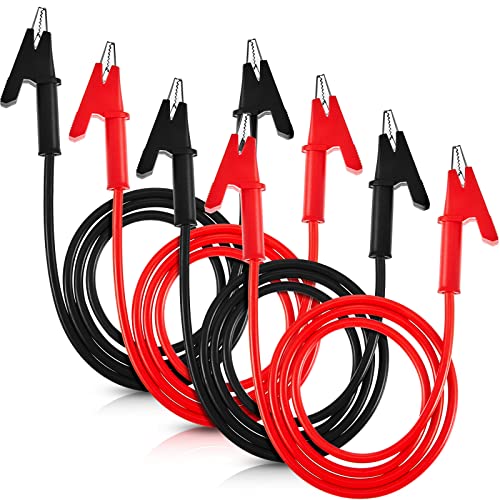
When you need to push serious current — battery testing, charger verification, motor circuits — thin 18 AWG wire heats up. The Dunzy set uses 14 AWG stranded copper with a silicone jacket rated for 1500V / 20A, which is the highest current rating in this roundup.
The silicone stays soft even in cold garages and does not kink like PVC; owners consistently call it “super flexible.” The 3.3 ft length is enough to reach across an engine bay without excess slack.
The clips themselves are nickel-plated with plastic covers that prevent accidental shorts against metal panels. One owner specifically uses these on magneto coils for small engines, which is a demanding inductive load (a component that creates high-voltage spikes). Another noted the clamping power is strong — “a key feature” — and the clips stay put once engaged. At 4.6 stars across 240 ratings, quality is the top-mentioned trait, and owners feel the value is excellent given the 14 AWG wire typically costs more.
The only shortcoming is the clip shape: they are standard alligator jaws, not the needle-nose style that fits into tight terminal blocks. If your work involves crowded terminal strips, you might prefer a slimmer profile. But for raw current capacity and durable construction, this set leads the pack.
What stands out
- 14 AWG wire handles 20A without noticeable heating — top-tier for current, outperforming the 18 AWG sets.
- Silicone jacket stays flexible in cold conditions and resists kinking permanently.
- Plastic clip covers prevent accidental shorts on metal surfaces.
The trade-off
- Clip jaws are standard size — not ideal for tight terminal block access.
- Four pieces (two pairs) is fewer leads than the SWANLAKE multi-pack.
Best for: battery and high-current testing where 18 AWG wire would get warm — the 14 AWG / 20A rating gives real headroom.
Not for: precision work in dense terminal strips; get a slimmer probe set for that.
6. EDGELEC 14 Gauge 6pcs Alligator Clips Electrical with Wire

The EDGELEC set gives you six individual leads in six distinct colors, so you can keep power, ground, and signal straight at a glance when probing multiple points.
Each lead uses 14 AWG (American Wire Gauge) UL3135 copper wire with silicone insulation rated at 1000V / 15A — UL3135 (Underwriters Laboratories standard 3135) confirms the silicone can handle 150°C and 600V, so the insulation resists melting from a soldering iron. The alligator clips are 2.2 inches long, nickel-plated copper with a non-slip rubber sleeve, and they open up to 10mm — wide enough for most automotive and bench connections.
What owners praise most is the quality of the wire and the strong clamping force of the clips. The fact that the clips are soldered and stamped to the wire gives you confidence they will not separate under tension. The total length including clips is 3.87 ft, slightly longer than the Dunzy set. One owner ran 3.5 amps through them continuously and reported no issues. Quality is far and away the most-discussed aspect, with the set earning a 4.6-star average.
The mixed feedback centers on clip shape — some wish the jaws were more needle-nose for tighter access — and a few isolated reports of clips detaching during heavy use. For normal breadboarding, automotive diagnostics, and general testing, these hold up well. The six-color organization alone makes this a strong contender for the organized workshop.
The verdict: More leads, more colors, and 14 AWG wire at a price that undercuts most single-color sets — a smart pick for multi-point probing.
Grab these if: you value color-coding to keep test points straight and need thick wire that handles 15A without complaint.
Consider alternatives if: you need needle-nose clips for tight spaces — these are standard profile jaws.
7. CALHAWK 3 Wire 20′ Retractable Test Leads

Every other lead in this roundup is a fixed-length cable. The CALHAWK is a retractable reel with three independent 20 ft leads, each with an 18 AWG wire and a 2-inch alligator clip that opens 1/2 inch — purpose-built for long runs.
When you are testing a trailer harness, ringing out wires on an aircraft, or tracing a long circuit in a building, 20 ft of reach saves you from dragging your meter cart or using extension leads.
The clips retract into rubber sheaths when not in use, which keeps them from snagging on tool box edges. Owners consistently praise the versatility for automotive electrical work: three leads let you set up power, ground, and signal simultaneously, which is a big step up from standard two-wire reels. One buyer specifically upgraded from a 2-wire reel to this 3-wire version and called it “great value.” The 4.6-star average across over 500 ratings makes it the most-reviewed set here after the Klein.
The recurring point of mixed feedback is the retraction mechanism — some find it smooth, others say the wire is hard to pull out or does not rewind as cleanly as expected. The 18 AWG wire is fine for signal and low-current work, but do not expect to push 15A through 20 ft of thin wire. This is a specialty tool for reach, not for high current.
Why it is unique
- 20 ft retractable reel eliminates tangled long leads — stores compactly when not in use.
- Three independent wires let you test power, ground, and signal at once.
- Clips retract into sheaths for safe storage and tangle-free carry.
The honest note
- 18 AWG wire limits current — not for high-power testing; the Dunzy set handles that better.
- Retraction feel varies between units; some owners find it stiff.
- Bulkier in the toolbox than a simple pair of leads.
Reach for this if: you routinely test long wire runs, trailer circuits, or vehicle harnesses and want one tool that stores neatly and reaches far.
Look elsewhere if: your work is all bench-level or high-current; the 18 AWG wire and retraction bulk are not ideal for either situation.
Understanding the Specs
Wire Gauge (AWG) and Current Capacity
The American Wire Gauge number tells you how thick the copper conductor is. A lower number means thicker wire. 14 AWG wire handles up to 20A safely, while 18 AWG is better suited for signal-level work under 10A. Thicker wire also stays cooler under load and resists voltage drop over longer runs, which matters when you are testing a battery at the far end of a 20 ft lead.
CAT III / CAT IV Safety Rating
This is a voltage protection rating defined by the International Electrotechnical Commission (IEC). CAT III 1000V means the insulation can withstand a 1000-volt spike in a building-level distribution circuit — like when testing a wall outlet. CAT IV 600V protects against spikes at the utility entrance, where power enters a building. A lead with this rating is safe for use on mains circuits; a lead without it should only be used on low-voltage electronics or automotive systems under 50V.
FAQ
Can I use alligator clips with wire for automotive battery testing?
What is the difference between a soldered clip and a crimped clip?
Will aftermarket alligator clip leads fit my Fluke or Klein multimeter?
How long should a set of alligator clip test leads last?
Can I use 14 AWG test leads on a breadboard?
What does “UL3135” mean on the wire insulation?
Are longer test leads (6 ft+) better than shorter ones?
Can I repair an alligator clip test lead if the clip breaks?
Why do some alligator clips have rubber sleeves over the jaw?
What is the practical difference between 15A and 20A rated leads?
Final Thoughts: The Verdict
For most people, the best alligator clips with wire winner is the Klein Tools 69381 because the two-stage clamping system and CAT-rated safety make it the most versatile lead for both professional and serious hobbyist work. If you want modular connector options and extra reach (6.6 ft) for bench testing, grab the Sumnacon 4-in-1. And for high-current battery and motor testing where 14 AWG wire matters, the Dunzy 14 Gauge set is the one to reach for.
How We Picked
We do not accept paid placement. Every pick is matched to a real buyer and a real use-case; we do not hands-on test units.
Sources & Methodology
Specifications: manufacturer listings and product documentation. Review insights: verified customer reviews, as of July 2026. Pricing: not shown on this page (it changes often); check the current price via the retailer link.
As an Amazon Associate, Gadgets Feed earns from qualifying purchases. This does not affect which products we feature.