
Our readers keep the lights on and my morning glass full of iced black tea. As an Amazon Associate, I earn from qualifying purchases.
Specs are compiled from manufacturer listings and verified buyer reviews and can change over time — please confirm the key details on the product page before buying.
You need a 400-foot ethernet cable to run internet across your yard, through the attic, or into a detached garage. The right spool gives you a steady, high-speed connection for years. The wrong one means signal loss, weather damage, and a wasted afternoon redoing the job. This guide uses the specs and real owner experiences to show you which cable is built for your specific job.
I’m Min — the founder and writer behind Gadgets Feed. This guide is built by comparing the manufacturers’ published specifications and the patterns across verified customer reviews, so you get each pick’s real strengths and trade-offs instead of marketing spin.
We sorted through top-rated options for durability, speed, and shielding to find the very best 400 ft ethernet cable for homes, offices, and demanding outdoor installs.
Our Picks at a Glance
How To Choose The Best 400 Ft Ethernet Cable
Picking the right cable depends on three things: the distance you need to cover, the speed your devices can handle, and the environment you run it through. A 400-foot spool covers most residential runs—from the router in the basement to an outbuilding or a second-floor office. The internal construction and protective jacket decide how long it lasts and how fast it stays.
Match the Category to Your Speed
The most common question is which generation to pick. A Cat5e cable handles up to 1 Gbps at 350 MHz, which covers almost every home internet plan today. A Cat6 cable also supports 1 Gbps at 250-350 MHz but is tested to higher interference standards, making it a better bet for runs near power lines. Cat7 jumps to 10 Gbps at 600 MHz and adds shielding between each twisted pair. Cat8 goes all the way to 40 Gbps at 2000 MHz. For almost any real-world home use, Cat6 or Cat7 offers the best value; future-proofers might lean into Cat8.
Prioritize Shielding for Outdoor Runs
When you run a cable outside or through walls, electromagnetic interference (EMI) from nearby power cables or appliances can slow your connection. Shielded cables like STP (Shielded Twisted Pair), FTP (Foiled Twisted Pair), and SFTP (Screened and Foiled) add a layer of metal foil or braid that blocks this interference. For a direct burial or an exterior wall run, this extra protection is well worth it to maintain a clean signal at the full 400-foot length.
Quick Comparison
| Model | Best For | Category | Frequency | Shielding | Amazon |
|---|---|---|---|---|---|
| VEETCOM Cat7★ Best Overall | Top-Rated All-Around | Cat 7 | 600 MHz | STP | Amazon |
| XXONE Cat6Top Performer | Durable Workhorse | Cat 6 | 350 MHz | STP | Amazon |
| Conable Cat5e | Budget Heavy-Duty | Cat 5e | 350 MHz | UTP | Amazon |
| Soibke Cat6 (Bulk) | Custom-Length Install | Cat 6 | 250 MHz | FTP | Amazon |
| LEKVKM Cat8 | Maximum Speed Future-Proof | Cat 8 | 2000 MHz | SFTP | Amazon |
| Soibke Cat7 (Bulk) | Versatile DIY Kit | Cat 7 | 600 MHz | SFTP | Amazon |
In‑Depth Reviews
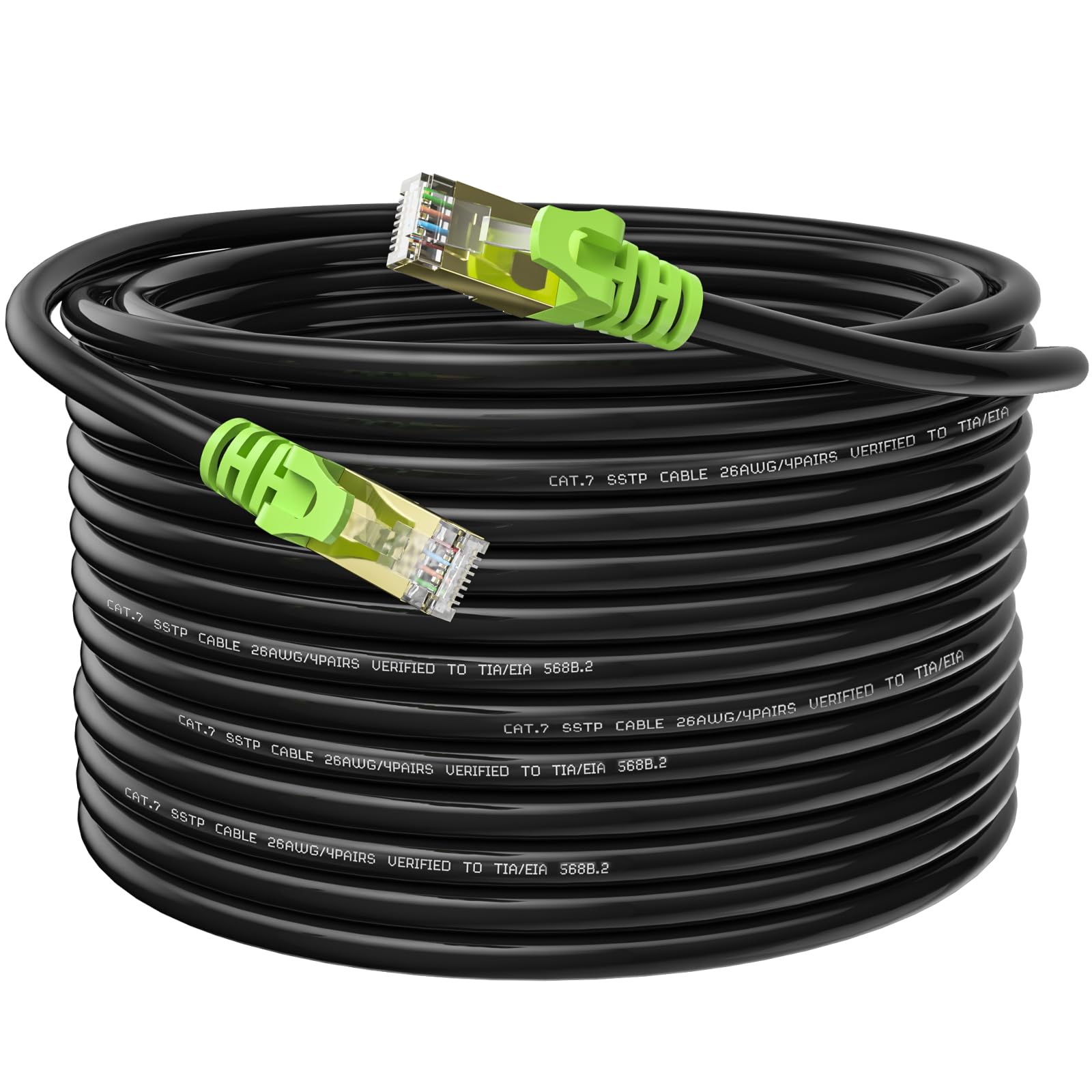
1. VEETCOM Outdoor Cat 7 Ethernet Cable 400ft
Our pick — over 4.5★ from 500+ verified ratings; the strongest balance of quality and price.
The crowd favorite that shrugs off wind, rain, and sun for years on end.
This VEETCOM Cat7 cable is the one owners reach for when they need to bury a line or run it along a sunny exterior wall and never think about it again. The build quality wins people over instantly — a thick, rugged jacket that one owner reported “held up for over 3 years and running strong” on the side of the house facing the most sun and wind. You get a 600 MHz frequency with 10 Gbps data transfer support, at 600 MHz compared to the Conable Cat5e’s 350 MHz, meaning this VEETCOM cable leaves far more headroom for future network upgrades and heavy data streams.
The shielding here is Shielded Twisted Pair (STP), which protects your signal from the kind of electromagnetic interference you often find running cables near power lines or in an attic with HVAC equipment. Performance is the most-praised trait right after quality, and the consensus is clear: this cable delivers full speed across the entire 400-foot run without any noticeable signal loss. Its high compatibility also means it works with everything from older 100BASE-TX gear to modern 10GBASE-T networks.
What wins people over
- True outdoor durability — buyers report surviving years of full sun, rain, and wind exposure
- 600 MHz frequency provides plenty of bandwidth for future network speed upgrades
- STP shielding keeps the signal clean on long runs near interference sources
- Comes with a lifetime warranty for confidence
A real caveat
- A few owners note that a standard Cat6 cable run inside a protective pipe can perform similarly at a lower cost
Reach for this if: you need a single, reliable cable for a long-term outdoor or direct burial run and want the confidence that comes with the highest owner satisfaction rate.
Look elsewhere if: you are on a tight budget and can protect a lower-category cable inside a conduit.
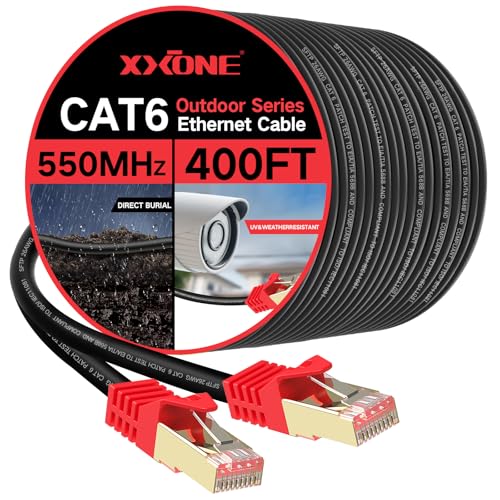
2. XXONE Outdoor Cat 6 Ethernet Cable 400ft
The cable that feels like it was built by a different, tougher factory.
When owners talk about this XXONE Cat6, the words “premium” and “top-notch” come up again and again, specifically for the build quality. The cable uses 100% bare copper wire, not copper-clad aluminum (CCA, a cheaper wire with a copper coating over aluminum), which makes a meaningful difference for signal quality over the full 400 feet. The Shielded Twisted Pair (STP, a design that wraps each wire pair in foil to block interference) construction blocks interference, and the PVC jacket is thick enough that one owner described it as “the sturdiest build quality of any ethernet cable owned” and “the cable that Iron Man would probably use.”
It is rated for 10 Gbps at 350 MHz, which matches the Cat6 standard perfectly for demanding applications like security camera systems — one owner confirmed it “works fine on my security camera system.” The cable is also compatible with VoIP phones (phones that make calls over the internet), thanks to its shielded connectors and male-to-male RJ45 ends. The main trade-off is that thick jacket, while incredibly protective, can make the cable a bit stiff to bend around tight corners, a common trait among heavy-duty outdoor cables. Owners recommend it for long straight runs like across a yard or through an attic.
Its standout trait: the build quality is the most-discussed feature, and the consensus is that this cable outlasts cheaper alternatives that need replacing every 12-16 months.
Perfect for: anyone running cable to security cameras, WiFi extenders, or between buildings and wanting a cable that feels physically indestructible.
Not ideal for: installations that require tight 90-degree bends or extreme flexibility in tight spaces.
3. Cat5e Outdoor Ethernet Cable 400 Feet (Conable)

A double-jacketed workhorse that brings heavy-duty features to a budget price.
This Cat5e cable from Conable outperforms pricier rivals with a UV-resistant LLDPE outer jacket and a PVC inner jacket, giving you a two-layer defense against sun, moisture, and temperature swings. Unlike the VEETCOM Cat7, this is an unshielded (UTP) cable, so it doesn’t have the extra foil or braid for blocking electromagnetic interference, but the 350 MHz bandwidth is perfectly adequate for standard 1 Gbps home networks. The functionality is what owners praise most — it works reliably across various weather conditions.
One thing owners highlight is that at 24AWG with a heavy-duty double jacket, this cable is stiff and “non-flexible”, making it best suited for long straight pulls rather than tight corners. It comes with 25 cable ties to help keep the run organized, and the gold-plated RJ45 contacts are a nice touch for maintaining signal quality at this price point. It achieved a very high satisfaction rate among a large pool of owners, which is rare for a budget pick.
Who it works for: if you need a 400-foot run for basic internet in a garage or shed and want the most durable budget option available.
Best for: straightforward outdoor installations where you don’t need to bend the cable around sharp corners and you want to save money without sacrificing a rugged jacket.
Skip if: you need a flexible cable for tight spaces or require shielded cable to cancel out signal interference near power lines.
4. Soibke Cat 7 Outdoor Ethernet Cable Bulk 400ft (DIY Kit)

The DIY spool that covers three different installs from a single purchase.
This Soibke Cat7 cable is the most versatile option for those who need to run multiple shorter cables or cover a complex route. It includes 20 gold-plated RJ45 connectors, so you can cut the bulk 400-foot spool into custom lengths for different devices. The cable uses SFTP (Screened and Foiled Twisted Pair) shielding — a triple-layer design where each pair is wrapped in aluminum foil with a braided outer shield — which is the most aggressive interference protection you can get. This makes it ideal for runs near power lines, data centers, or heavy machinery.
It supports 10 Gbps at 600 MHz, matching the Cat7 standard, and the 24AWG single-core copper-clad aluminum (CCA) conductor offers a better gauge than thinner 26AWG or 32AWG cables for reduced signal loss. Owners note that the bright orange jacket is easy to spot during installation and for future maintenance. One owner specifically praised it as “excellent for attic run where there is a large temperature change.” The only catch is the caveat from the manufacturer that this cable is not recommended for PoE (Power over Ethernet, which sends electricity through the cable to power devices) connections, which limits its use for powering devices like security cameras or access points directly.
Its best trick: the included connectors mean you aren’t stuck with a single 400-foot loop — you can make a 200-foot run, a 100-foot run, and a few short patch cables from the same spool.
Grab this for: complex home wiring projects or shop setups where you need multiple cable lengths and the highest level of shielding.
Think twice if: you plan to power devices over this cable (PoE) — the manufacturer advises against it for this specific model.
5. LEKVKM Cat8 Ethernet Cable 400Ft

The overkill cable that makes sure your wired network never becomes the bottleneck.
If you want to absolutely max out your home network for the next decade, this Cat8 cable is the one. It supports a staggering 40 Gbps data transfer rate at 2000 MHz, which leaves the VEETCOM Cat7’s 600 MHz in the dust. It uses SFTP (Screened and Foiled Twisted Pair) shielding to protect against electromagnetic and radio-frequency interference (EMI/RFI), and it uses 4 pairs of bare copper conductors. This level of performance is overkill for today’s typical home internet plans, but for someone with a multi-gigabit connection, a home server, or heavy local network transfers, it removes any future ceiling.
Owners confirm its durability in punishing conditions — one reported burying it in the ground and driving “tractors and heavy equipment over it (not recommended)” with zero issues after a year. The quality is the most-praised aspect, and the cable is backward compatible with Cat6, Cat5e, and Cat5 networks, so it works with all your existing gear. The main consideration is that the thick PVC jacket, while protective, can make it harder to work with in tight spaces. It also comes pre-terminated with RJ45 connectors, so you need to plan your route carefully to fit the 400-foot length as a single continuous run.
The big advantages
- 40 Gbps at 2000 MHz is the highest performance tier available for home use
- SFTP triple shielding provides the best protection against interference
- Owners confirm real-world durability under extreme conditions (buried, driven over)
- Backward compatible with all older network standards
A practical note
- You need a multi-gigabit network (switches, NICs) to actually use the full speed — it is future-proofing, not a boost for a standard 1 Gbps plan
Reach for this if: you are building a high-performance home network with multi-gigabit switches and want to bury a cable that will not be obsolete.
Look elsewhere if: you have a standard 1 Gbps internet plan; the extra speed potential will go unused and a Cat6 or Cat7 cable will perform identically.
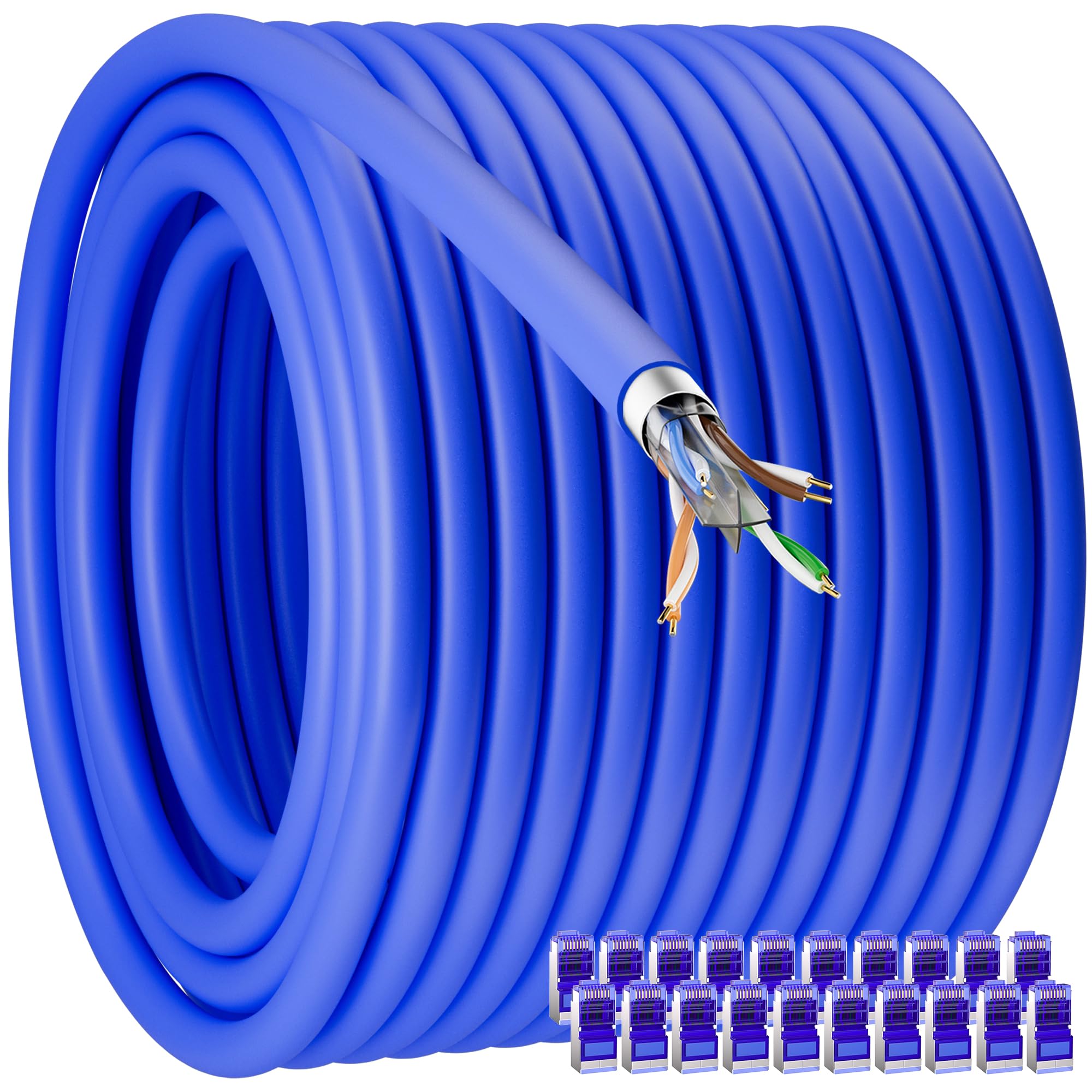
6. Soibke Cat 6 Direct Burial Ethernet Cable 400ft
The thicker-gauge spool for those who cut and crimp their own ends.
This Soibke Cat6 cable stands out because of its 23AWG conductor — a noticeably thicker wire than the 24AWG or 26AWG found in many other cables. A thicker gauge provides a higher bandwidth margin and less signal loss over long distances, which is exactly what you need for a 400-foot run. This is a bulk cable (no pre-terminated ends), and it comes with 20 gold-plated RJ45 connectors so you can create custom-length runs for different rooms or devices. The FTP (Foiled Twisted Pair) shielding helps block interference without the stiffness of a fully braided shield.
It is rated for 1 Gbps at 250 MHz, which is standard for Cat6 but slightly lower bandwidth than the XXONE Cat6 (350 MHz). The PVC jacket is rated for UV resistance and waterproofing, making it suitable for direct burial. A satisfied owner noted it “solved our issues nicely” for a bedroom with poor WiFi by providing a rock-solid wired connection. The catch is that you need a crimping tool and some basic expertise to attach the connectors properly — it is not a plug-and-play cable. The manufacturer also notes it is not recommended for PoE.
The deciding factor: the 23AWG gauge gives this cable a real edge in signal integrity over the full 400 feet compared to thinner alternatives.
Best for: the DIY enthusiast who wants to route multiple custom cables throughout a house or office and values stronger signal integrity from thicker wire.
Skip if: you want a ready-to-go pre-terminated cable you can plug in immediately.
Understanding the Specs
Frequency (MHz)
This number tells you the maximum bandwidth your cable can handle, measured in megahertz. A higher frequency means the cable supports faster data rates and can maintain a clean signal over longer distances. For a 400-foot run, a cable rated for 600 MHz (like Cat7 or Cat8) has a lot more headroom than one rated for 250-350 MHz (Cat5e or Cat6). In practice, a higher frequency means less chance of signal degradation at the far end of your run.
Shielding (UTP vs STP vs FTP vs SFTP)
Unshielded (UTP) cable is fine for indoor runs far from power lines, but any cable that goes outside or near electrical wiring benefits from shielding. Shielded Twisted Pair (STP) wraps each pair in foil, Foiled Twisted Pair (FTP) wraps the whole bundle, and Screened and Foiled (SFTP) does both. For a 400-foot direct burial cable, you almost always want at least STP or FTP to prevent the surrounding ground and power noise from degrading your signal.
FAQ
Can I bury a standard Ethernet cable directly in the ground?
What is the difference between Cat6 and Cat6a for a 400-foot run?
Will a Cat8 cable work with my old router?
How do I know if I need shielded or unshielded cable?
Does a longer cable mean slower internet?
What does PoE (Power over Ethernet) mean for my cable choice?
Can I cut a pre-terminated cable to make it shorter?
What is the best cable category for a gigabit home internet plan?
Final Thoughts: The Verdict
If you want one dependable pick, the 400 ft ethernet cable winner is the VEETCOM Cat7 because it holds the highest owner satisfaction for long-term outdoor durability and offers great speed headroom at a fair price. If you want a budget-friendly option that still provides a tough double jacket, grab the Conable Cat5e. And for a future-proof multi-gigabit network, the LEKVKM Cat8 is the one to reach for.
How We Picked
We do not accept paid placement. Every pick is matched to a real buyer and a real use-case; we do not hands-on test units.
Sources & Methodology
Specifications: manufacturer listings and product documentation. Review insights: verified customer reviews, as of July 2026. Pricing: not shown on this page (it changes often); check the current price via the retailer link.
As an Amazon Associate, Gadgets Feed earns from qualifying purchases. This does not affect which products we feature.