
Our readers keep the lights on and my morning glass full of iced black tea. As an Amazon Associate, I earn from qualifying purchases.
Specs are compiled from manufacturer listings and verified buyer reviews and can change over time — please confirm the key details on the product page before buying.
The right additional weights turn a weighted vest from a simple accessory into a real training tool. But the wrong ones slide, dig in, or just refuse to fit your carrier — and that frustration kills every rep. This guide cuts through the confusion by looking at three proven options, each built for a different vest and a different type of workout.
I’m Min — the founder and writer behind Gadgets Feed. This guide is built by comparing the manufacturers’ published specifications and the patterns across verified customer reviews, so you get each pick’s real strengths and trade-offs instead of marketing spin.
Whether you are loading up for a Murph, a ruck march, or a heavy carry day, the best additional weights for weighted vest boil down to fit, finish, and how they feel when you move.
Our Picks at a Glance

How To Choose The Best Additional Weights For Weighted Vest
Picking additional plates is simpler than you think once you know what to measure and where you will use them. Miss the pocket size, and nothing else matters — the weight will either jam in or flop around.
Start With Your Pocket Dimensions
Every vest carrier has a specific internal pocket width and height. Measure yours before you click “buy”. If the data says the plate is 9.8″ x 11″ and your pocket is smaller, it will not seat flat. If the pocket is much larger, the plate can shift sideways during a run. This single step removes most fit headaches.
Flat Profile vs. Curved Profile
A flat plate sits flush against your chest or back like a board. That is fine for slow rucking or static lifts, but during burpees or running the hard edge can dig in at the top and bottom of the range of motion. A curved plate follows your torso’s natural shape, distributing pressure more evenly. The trade-off: curved plates often cost more per pound and are harder to stack with other gear in the same pocket.
Weight Increments and Stacking
Look at the available pair sizes. The best sets offer multiple options — say 5.5 lb, 8.5 lb, 15 lb, and 20 lb per pair — so you add resistance gradually without buying an entirely new set. Check the thickness in reviews if that matters for your vest.
Quick Comparison
| Model | Best For | Weight Options (per pair) | Profile | Material | Amazon |
|---|---|---|---|---|---|
| LEKÄRO Steel Plates★ Best Overall | Budget-friendly versatility | 5.51 / 8.81 / 15.43 / 20.94 lb | Flat | Alloy Steel | Amazon |
| VEVOR Premium Steel | Accurate weight, smooth edges | 5.75 / 8.75 / 14.5 / 19.75 lb | Flat | Premium Steel | Amazon |
| AmStaff Fitness Curved | Maximum comfort for movement | 7 / 11 / 17 / 27 lb | Curved | Alloy Steel | Amazon |
In‑Depth Reviews
1. LEKÄRO Steel Weighted Vest Plates
Our pick — over 4.5★ from 450+ verified ratings; the strongest balance of quality and price.
Four weight increments and a flat profile that fits most carriers — the best per-pound value here.
You can scale this set from a light warm-up walk to a tough ruck march because LEKÄRO offers four pair sizes: 5.51, 8.81, 15.43, and 20.94 lb. Buyers report that the plates raise a walking heart rate from 115-120 up to 135-140 bpm, which is the exact zone for cardio-overload training. The 9.8″ x 11″ dimensions fit most standard tactical carriers, and the flat profile sits flush against the body with minimal shifting during burpees or push-ups. Buyers praise the fit and weight accuracy most of all, calling them a great value compared to store-bought alternatives.
The laser-cut steel carries a powder coat (a baked-on layer of dry paint) that resists rust through sweaty outdoor sessions. A few owners note that flat plates can feel less comfortable than curved ones inside a tight plate carrier — the edges are hard during deep squats or kettlebell swings. If your vest pocket is exactly 9.8″ x 11″, these slide in perfectly; if it is smaller, measure carefully first.
Compared to the VEVOR set, the LEKÄRO plates give you a slightly heavier max increment (20.94 lb vs 19.75 lb per pair). That extra headroom matters if you want to push progressive overload (adding weight over time) without stacking two pairs.
Why They Work
- Four pair sizes cover a wide weight range
- Flat, flush fit reduces bounce during burpees
- Powder coating protects against sweat and outdoor moisture
The Fit Reality
- Flat edges can dig in during deep dynamic movement
- Not ideal for vests with very small pockets
Reach for these if: you want the widest weight ladder for the lowest per-pound cost — the crowd favorite here holds a crowd-sourced 4.7 stars across hundreds of owners.
Look elsewhere if: your workouts involve lots of running or jumping where a curved profile would feel more natural.
2. VEVOR Premium Steel Weight Vest Plates
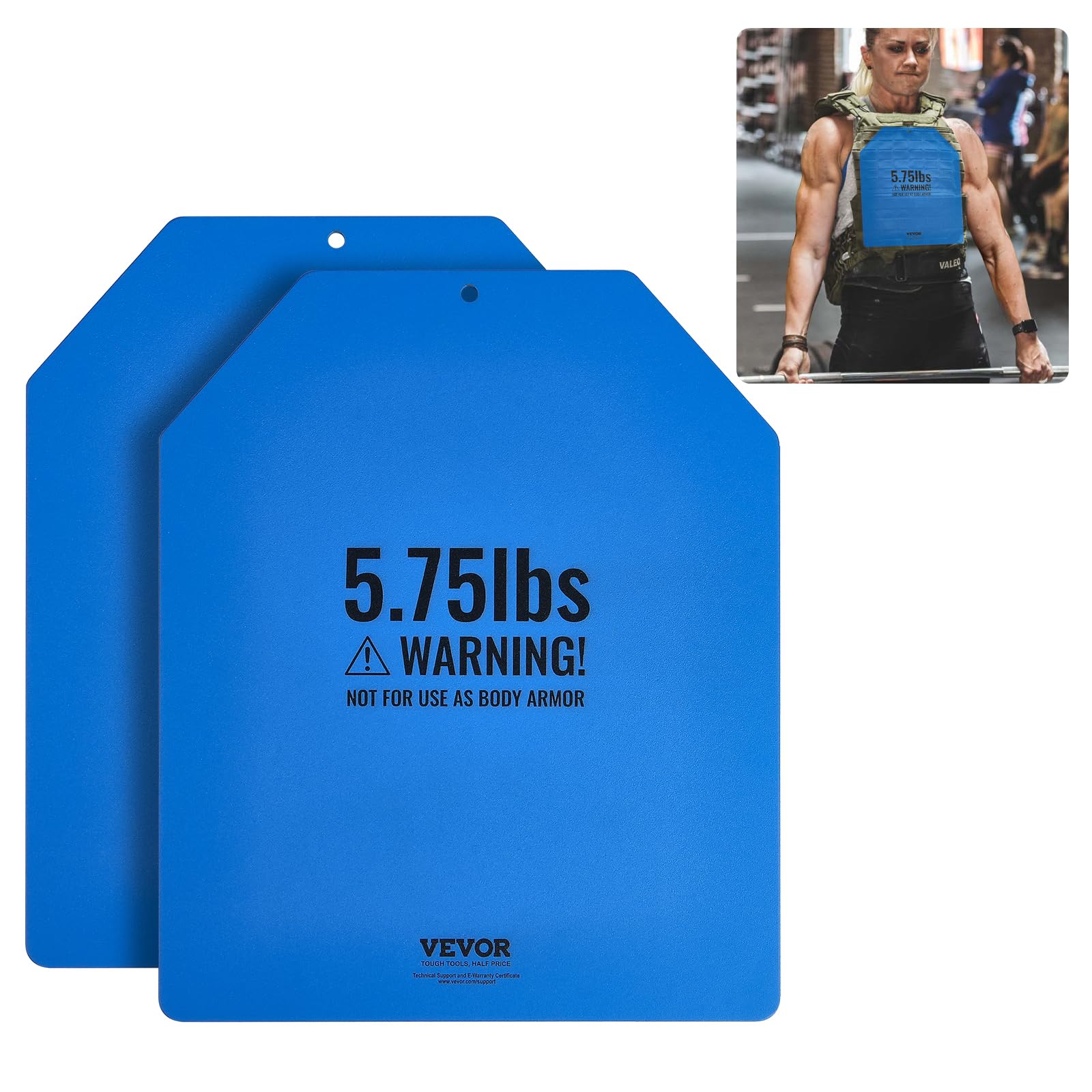
The flat plate that fits a 5.11 tac trainer with zero wobble — owners say the weight matches the label exactly.
VEVOR matches LEKÄRO’s approach with its own four-tier range — 5.75, 8.75, 14.5, and 19.75 lb per pair — but differentiates with a smoother edge finish and tighter packaging. Owners say the plates fit a 5.11 tac trainer vest smoothly and that the weight is remarkably accurate to the label. The recurring verdict: “Was able to squat, push up, kettlebell with this on and no digging in issues.” That is high praise for a flat-profile plate in a sport where hard corners usually mean bruised ribs.
The steel is heavy-duty with rounded corners, and VEVOR packs each set in three layers of bubble wrap to prevent shipping dings. A few owners mention that the powder coating feels a bit thin; if you sweat heavily or train in rain, some light surface rust can appear over time. That is the same risk that affects every budget-to-mid steel plate, so a quick wipe-down after use solves it.
Compared to the LEKÄRO set, the VEVOR plates are functionally identical in size and weight range, but the edge finishing and fit in specific brand vests (5.11, Everymate) is a tick tighter, which matters if you hate even a millimeter of play.
The Standout Qualities
- Accurate weight — owners confirm it matches the label
- Rounded corners prevent digging during squats and presses
- Excellent fit in 5.11 and Everymate carriers
The Trade-Off
- Powder coating is thinner than pricier brands
- Flat profile still less body-conforming than a curved plate
Pick these if: you own a 5.11 or Everymate vest and want plates that seat solidly with no rattle.
Skip them if: you train in wet climates and cannot commit to drying plates after every session.
3. AmStaff Fitness Curved Weight Vest Plates

The only plate here with a 3D curved design (a curve that follows your chest and back) — it stays put through 5k runs.
Owners who switched from flat plates report that the curve eliminates the hard pressure points that can kill a long run or a Murph. The AmStaff plates are made from laser-cut alloy steel with a powder-coated finish, and they come in four pair options: 7, 11, 17, and 27 lb total. A buyer who uses them for 5k runs and walks confirms the weight distribution is excellent — no shifting, no bouncing.
Fit is universal for most tactical carriers that accept a 10″ x 12″ plate, and the design lets you stack multiple pairs in one pocket if your vest has the depth. The trade-off for the ergonomic curve is the higher cost per pound compared to the flat LEKÄRO and VEVOR sets — this is the premium pick in the range. A few owners wish the curve was slightly deeper for very lean torsos, but for the vast majority it is a dramatic upgrade in all-day comfort.
If the flat plates above leave you bruised after a heavy carry, the AmStaff curve is the direct fix. Think of it as the running-centric choice for anyone who hates a board strapped to their chest.
What Owners Love
- Curved design hugs the body — no digging during runs
- Allows stacking multiple plates per pocket
- High-quality laser-cut steel with durable powder coat
The Catch
- Premium price per pound vs flat competitors
- Curve may feel mild for buyers with a very narrow torso
Reach for these if: you plan to run, ruck, or do high-rep WODs where comfort over time matters more than the absolute lowest price.
Think twice if: your budget is tight and your workouts are mostly static — a flat plate will save you money with no real discomfort.
Understanding the Specs
Flat vs. Curved Profile
A flat plate (like the LEKÄRO and VEVOR options) lays against your body like a board. It is cheaper to make and fits most standard pockets, but during dynamic moves — burpees, sprint intervals, box jumps — the hard, sharp edges can dig into your ribs or shoulder blades. A curved plate (like the AmStaff) follows the natural line of your torso, spreading the load over a wider area so you barely feel it when you run. If you move a lot, the curve is worth the extra cost. If you mostly stand and lift, flat works fine.
Powder Coating and Rust
Every steel plate on this list uses a powder-coated finish (a baked-on layer of dry paint) to resist sweat and outdoor moisture. The coating handles repeated wipe-downs better than standard paint. Thicker coatings last longer; thinner ones (the VEVOR is the most likely to show wear) can chip or allow surface rust if you leave them in a wet gym bag. Wipe plates dry after a heavy sweat session and they will outlast your vest.
Weight Increments and Scaling
Most plate sets sell in pairs — you buy a single pair to add a fixed amount (5.5 lb per plate = 11 lb total). The best options let you buy heavier increments as you get stronger without replacing your entire set. The LEKÄRO, for example, sells four distinct pair weights, so you can go from 11 lb total all the way to nearly 42 lb total by stacking two pairs. Check that your vest pocket is deep enough to hold stacked plates if that is your plan.
FAQ
Will these plates fit any weighted vest?
Can I stack two pairs of plates in one pocket?
Flat or curved — which is better for running?
How do I clean steel weight plates?
Do these plates work for Murph training?
Is the weight on the plate accurate?
Can I use these in a hiking backpack for rucking?
Do these plates rust if I sweat on them?
How heavy do these plates go?
Can I use these as body armor?
Final Thoughts: The Verdict
For the majority of shoppers, the additional weights for weighted vest winner is the LEKÄRO Steel Plates because they offer the widest weight ladder at the best per-pound value, with a flat profile that works across carriers and a fit that hundreds of owners confirm. If you want the most accurate weight and a tighter fit in specific brand vests like 5.11, grab the VEVOR Premium Steel. And for running-heavy or high-movement workouts where comfort is the priority, the AmStaff Fitness Curved Plates are the ones to reach for — that ergonomic curve makes the miles disappear.
How We Picked
We do not accept paid placement. Every pick is matched to a real buyer and a real use-case; we do not hands-on test units.
Sources & Methodology
Specifications: manufacturer listings and product documentation. Review insights: verified customer reviews, as of July 2026. Pricing: not shown on this page (it changes often); check the current price via the retailer link.
As an Amazon Associate, Gadgets Feed earns from qualifying purchases. This does not affect which products we feature.