
Our readers keep the lights on and my morning glass full of iced black tea. As an Amazon Associate, I earn from qualifying purchases.
Specs are compiled from manufacturer listings and verified buyer reviews and can change over time — please confirm the key details on the product page before buying.
A battery rattling loose in a boat bilge is a corrosion disaster waiting to happen — salt spray, vibration, and a short circuit can kill your electronics and leave you stranded. The right box locks the battery down, vents dangerous hydrogen gas safely overboard, and seals out the marine environment that eats standard plastic alive. This guide breaks down the real-world build quality, sizing, and safety features across the top contenders so you pick the one that will still be watertight after a season of chop.
I’m Min — the founder and writer behind Gadgets Feed. This guide is built by comparing the manufacturers’ published specifications and the patterns across verified customer reviews, so you get each pick’s real strengths and trade-offs instead of marketing spin.
Whether you are wiring a trolling motor, outfitting a center console, or adding backup power to a cabin cruiser, finding the right battery boxes for boats means matching the physical footprint to your battery group size and choosing the material toughness your local water demands.
Our Picks at a Glance

How To Choose The Best Battery Boxes For Boats
Every battery box on this list will hold a battery, but the one that lasts differs by how it handles the three real marine threats: physical vibration that cracks cheap plastic, hydrogen gas buildup that can ignite in a closed compartment, and salt spray that corrodes terminals through the lid seal. Start by matching the box’s internal dimensions to your battery’s group size — a Group 24 battery (roughly 10 x 6.8 x 8.9 inches) is smaller than a Group 31, and forcing it into an oversized box lets it slide around and damage the terminals.
Material: Polypropylene vs. Steel vs. Stainless Steel
Polypropylene (the industry standard for most vented boxes) is acid-resistant, impact-tested, and naturally non-corrosive — the Attwood and Seachoice boxes are good examples of this tough plastic. Steel boxes like the Peastorm add theft resistance and a built-in lock, but the paint coating can chip and rust if scratched, so buyer reports on paint quality and rust resistance are worth heeding. Stainless steel (found on the Sidasu dual-box) is the most durable option against saltwater, but it is also heavier — at 11 pounds empty it is a permanent fixture, not portable.
Venting vs. Sealed
A vented box (all Attwood and Camco models here) has a hose port that channels explosive hydrogen gas outside the boat compartment — this is mandatory if the battery sits inside a closed locker, under a seat, or anywhere without open airflow. A sealed box (the POWO Carlife and ALL-TOP smart boxes) is gasketed to keep water out, which is ideal for open-deck mounting where the battery is exposed to rain and spray, but it should never be placed in a fully enclosed space because pressure and gas can build.
Integrated Ports vs. Simple Storage
Smart battery boxes (POWO Carlife, ALL-TOP, SeaSense) come pre-wired with Anderson connectors, USB charging ports, voltmeters, and circuit breakers — they turn a raw battery into a portable power station for phones, fish finders, and trolling motors without any electrical work. Traditional boxes (Attwood, Seachoice, Camco) are just a plastic shell with a strap — you provide your own wiring and fusing, which gives you full control but requires more setup. Choose the smart route if you want plug-and-play convenience; pick a traditional box if you already have a wired system and just need safe containment.
Quick Comparison
| Model | Best For | Battery Fit | Material | Weight | Amazon |
|---|---|---|---|---|---|
| POWO Carlife Smart Box★ Best Overall | Portable power station | 10Ah–30Ah LiFePO4 | Plastic (sealed) | — | Amazon |
| Attwood 9084-1Large Capacity | Large Group 29/31 | Group 29, 31 | Polypropylene | 2.6 lbs | Amazon |
| Seachoice Group 27Best Value | Budget-friendly standard | Group 27 | Polyethylene | 1.6 lbs | Amazon |
| Camco 55371 | Enclosed compartment venting | Group 24 | Plastic | 1 lbs | Amazon |
| SeaSense Deluxe | Small boat with tester | Group 24 or 27 | Plastic | — | Amazon |
| Peastorm Steel Box | Lockable theft protection | Group 27 | Steel (coated) | 10.6 lbs | Amazon |
| ALL-TOP Smart Box | DIY power station | Group 24, 27, 31 | Plastic | — | Amazon |
| Sidasu Dual Box | Two-battery setups | Two Group 24/27 | Stainless steel | 11 lbs | Amazon |
| Yak-Power Pack | Kayak hatch fitment | Up to 3x 7Ah | Plastic (sealed) | 4 lbs | Amazon |
In‑Depth Reviews
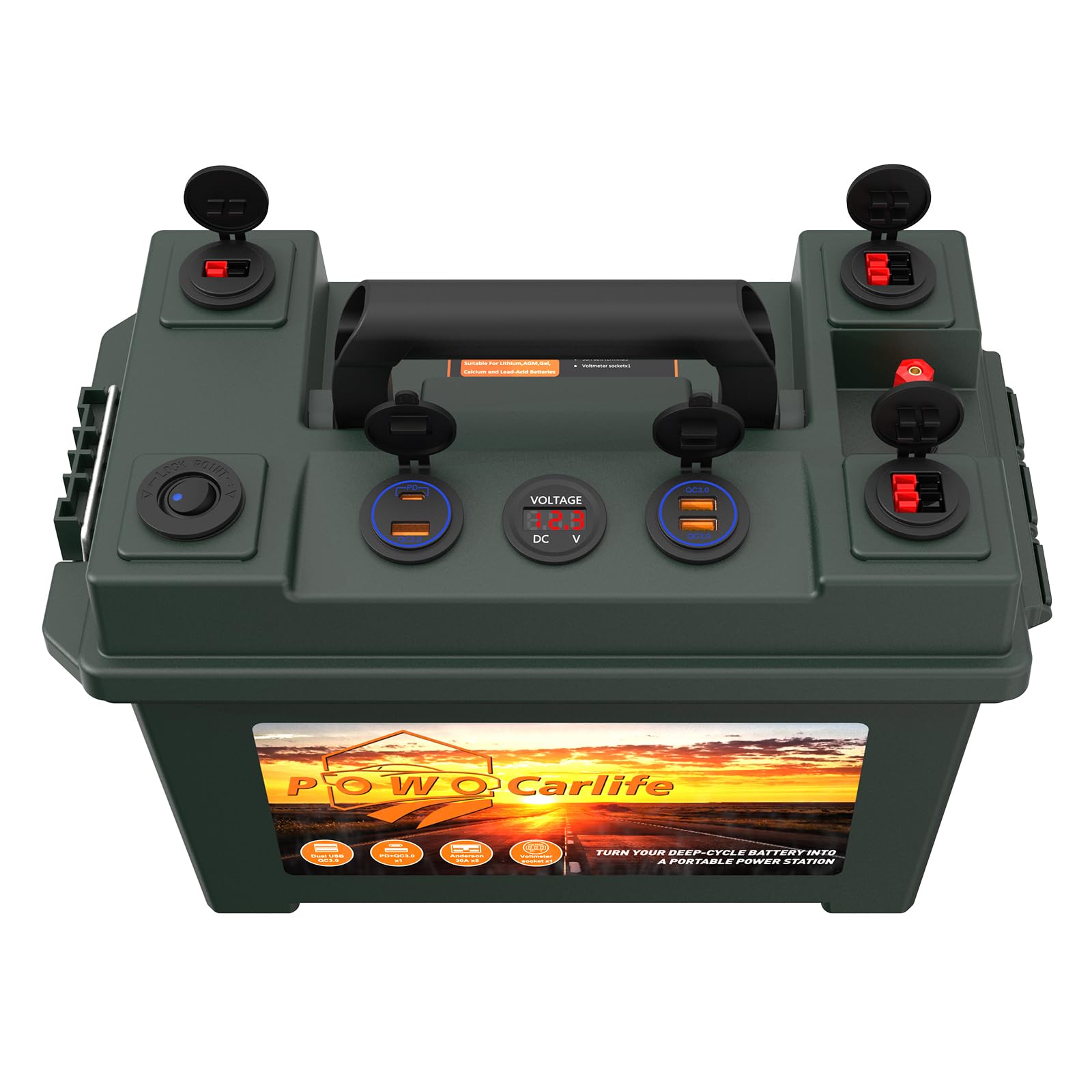
1. Battery Box for 30Ah/20Ah/10Ah, Waterproof Battery Box with Anderson Plug and Dual QC3.0
Our pick — over 4.5★ from 150+ verified ratings; the strongest balance of quality and price.
The plug-and-play box that turns any small LiFePO4 into a portable power station
This is the box that earns its place on your boat by doing the electrical work for you. It comes with a 30A Anderson plug (compatible with solar charging), dual QC3.0 USB ports, and a 30A fuse — so you can run a trolling motor, charge a phone, and read the battery voltage from the built-in voltmeter without opening the lid. Buyers report the internal wiring uses proper 10AWG to the terminals and 14AWG to the Powerpoles, which feels more deliberate than the cheaper integrated boxes on the market.
The real-world catch is size. This box is built for 10Ah, 18Ah, or 20Ah LiFePO4 batteries — specifically, a 20Ah fits well while a 30Ah is too tall. The crowd favorite consensus lands on “excellent build quality” and “worth the price,” particularly among ham radio operators and campers who rely on the Anderson connector for their gear. For a small-boat or kayak setup where you need waterproofing (the seal handles rain and dust) and multiple power outputs in one compact unit, this is the most complete solution at this level.
It is lighter in construction than premium equivalents — the hinge feels a little thin — but the 30A overload protection and fast-charging QC3.0 ports make it a smarter buy than a bare plastic box you would have to wire yourself.
Why it wins
- Built-in 30A Anderson plug and dual QC3.0 USB ports — no extra wiring needed
- Waterproof seal handles rain and splashes on deck
- Rocker ON/OFF switch and voltmeter give you full control at a glance
The trade-off
- Inside dimensions are smaller than they look — a 30Ah battery does not fit
- Lighter-duty hinge than pricier boxes; treat the lid gently
Reach for this if: you want one box that contains the battery, fuses, ports, and voltmeter — just drop in a 20Ah LiFePO4 and go.
Look elsewhere if: your boat uses a full-size Group 24 or 27 battery; this box is too small for those.
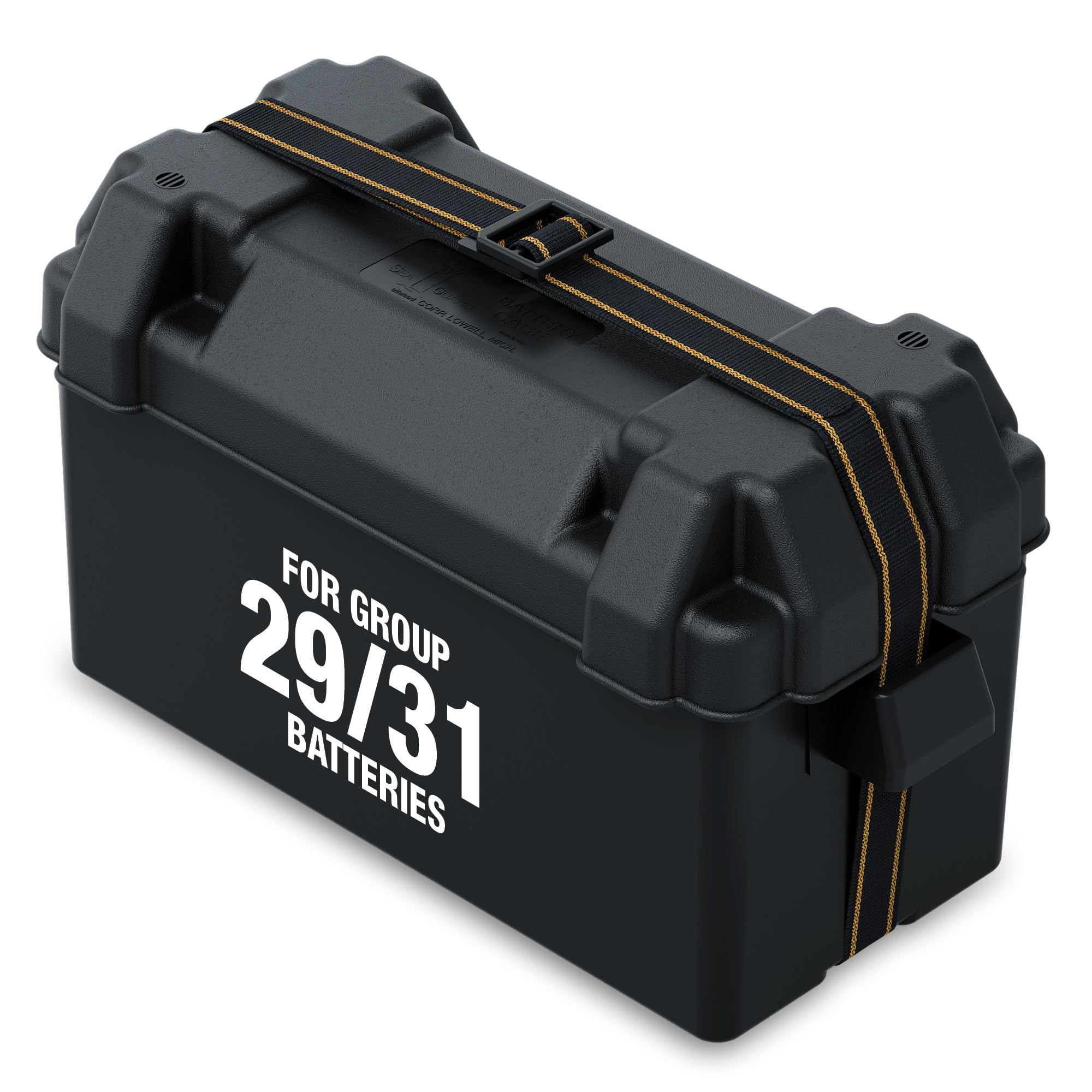
2. Attwood 9084-1 Large Vented Battery Box with Mounting Strap, Fits Group 29 and 31 Series Batteries
The go-to large box that swallows a Group 31 and still leaves room for the cables
When your boat runs a big deep-cycle battery — a Group 29 or 31 — this is the standard the marine industry has trusted for years. The inside measures 15-7/16 inches long by 6-15/16 inches wide by 9-3/4 inches tall, which is generous enough that owners mention it fits most large batteries with extra room. The acid-resistant polypropylene is impact-tested from -20°F to +120°F, so it holds up to engine-room heat and winter storage without turning brittle.
The included 40-inch strap is rated to withstand 350 lbs of force — that is nearly 4 times the US Coast Guard requirement — and the box meets both ABYC and USCG standards for OEM-installed systems. The lid snaps on securely, and the integrated ventilation channels hydrogen gas away while minimizing water intrusion. At 2.6 pounds it is noticeably heavier than the Seachoice box (a 1-pound difference that speaks to the thicker walls), and customers note it stays watertight even after months of exposure.
A few owners mention the strap latch can feel flimsy and the included strap bracket template is slightly inaccurate — measure twice before drilling. But for a large vented box at this price point, the sturdiness and fit are consistently praised.
What stands out
- Fits the largest common marine batteries (Group 29 and 31) with extra space inside
- Vented design safely routes hydrogen gas out of enclosed compartments
- Meets ABYC and USCG standards — the same spec used in factory-built boats
The catch
- Strap latch is the weak link — some upgrade to a ratchet strap right away
- The mounting bracket template is slightly off; measure before you drill
Who it fits: anyone with a large Group 29 or 31 battery who needs USCG-compliant containment for a below-deck or engine-compartment installation.
Skip it for: smaller Group 24 or 27 batteries — the extra interior space lets the battery slide without additional foam blocking.
3. Seachoice USCG-Approved Marine Group 27 Series Standard Battery Box with Strap & Mounting Kit
A lightweight, USCG-approved shell that does the basics right at a budget price
At just 1.6 pounds, this is the lightest standard box on the list — but that does not mean it is flimsy. The acid-resistant polyethylene construction holds a Group 27 battery securely, and reviewers point out it handles a 65-pound deep-cycle without any flex. The included mounting hardware lets you bolt it down in a boat locker or on a trailer tongue. It meets both ABYC E-10 and USCG 183.420, so it is legal for any marine installation.
The Seachoice earns its value label by doing exactly what a battery box should do — contain the battery, vent the gas, and stay out of the way — with no extra ports, no USB sockets, and no gimmicks. The lid’s design allows easy cable access, and the strap holds well under normal conditions. Where it falls short of the Attwood is in the mounting hardware: the included bolts and brackets are hard plastic rather than metal, which one buyer flagged as a potential durability point over time.
If your setup is simple (battery in a compartment, no need for built-in charging ports), this box saves you money without cutting corners on safety certification.
Straight talk: consider it the budget baseline that hits all the regulatory marks. The plastic hardware is the only real concession — swap in stainless bolts if you want it to last a decade.
Best for: trailer boats or simple power setups where you just need a compliant, lightweight box that meets USCG specs.
Not the pick if: you want integrated ports — this box is a shell only, and you wire everything yourself.
4. Camco 55371 Vented RV/Marine Battery Box, Standard – Holds (1) Group 24 Battery

The complete venting solution for mounting a Group 24 battery inside an enclosed locker
If your boat has a sealed storage compartment where you plan to house the battery, the Camco comes with everything you need to vent explosive gas safely overboard: the box, a flexible hose, a hose mount plate, a louvered vent grille, and foam tape. This is the only box in the lineup that includes the full vent-run hardware from the start — no separate trip to the hardware store. The internal dimensions fit a single Group 24 battery (14-7/8 x 9-5/8 x 10-1/4 inches excluding the vent ports), which covers the standard deep-cycle size most small boats use.
Buyers consistently call the build quality excellent — the box, the hose connectors, and the grille all feel sturdier than the factory-installed box many RVs come with. One owner noted it kept a battery secure over an 800-mile journey home, which says a lot about the hold-down design. At only 1 pound it is the lightest full-size box here, making it easy to handle during installation in tight compartments.
But if you are installing in an enclosed space that needs a proper gas-exit path, buying a separate vent kit later often costs the same or more.
The bottom line: you are paying for the complete safety kit, not just the box. For sealed compartments, that is the right place to spend.
Ideal for: enclosed battery lockers in boats and RVs where the battery needs a plumbed vent to the outside.
Not for: open-deck installations — the vent hardware is unnecessary weight and cost if the battery breathes freely.
5. SeaSense Deluxe Power Station Battery Box – Battery Tester for Boats, Fits Group 24 or 27

The box that checks your battery health at the push of a button, without popping the lid
A standout feature separates this from every other traditional box here: external terminals and a one-touch battery tester. You connect the box to your battery, close the lid, then press the button to see the charge level — no need to open the box until the battery actually needs replacement. That is genuinely useful on a small boat where you want a quick check before heading out. It also includes a 12-volt accessory socket (cigarette-lighter style) and a 10-amp circuit breaker for short protection.
The box fits both Group 24 and Group 27 batteries, and the vinyl-coated steel wing nuts resist corrosion better than standard hardware. Buyers find the interior roomy, though the battery can slide around unless you add foam padding. The tester is accurate only when no load is running — it reads the surface charge, not the real capacity — so treat it as a quick reference rather than a diagnostic tool. Some shoppers say the cigarette port stops working or the lid fit is not as tight as they would like.
Compared to the ALL-TOP smart box (which offers Anderson connectors and USB), the SeaSense is simpler and more affordable, but the build quality gets more mixed feedback — it feels durable enough for a tiller-steer boat but not as solid as the Camco or Attwood alternatives.
What you get
- External battery tester — press a button to check charge without opening the lid
- 12V accessory socket with a 10A circuit breaker for short protection
- Fits both Group 24 and 27 batteries
Where it slips
- The lid does not always fit snugly; the strap can loosen over time
- Charge indicator only works accurately when the motor is off
Reach for this if: you want a quick battery-health check without disconnecting cables on a small boat.
Think twice if: you need absolute waterproofing or a tight seal in a wet-deck mounting location.
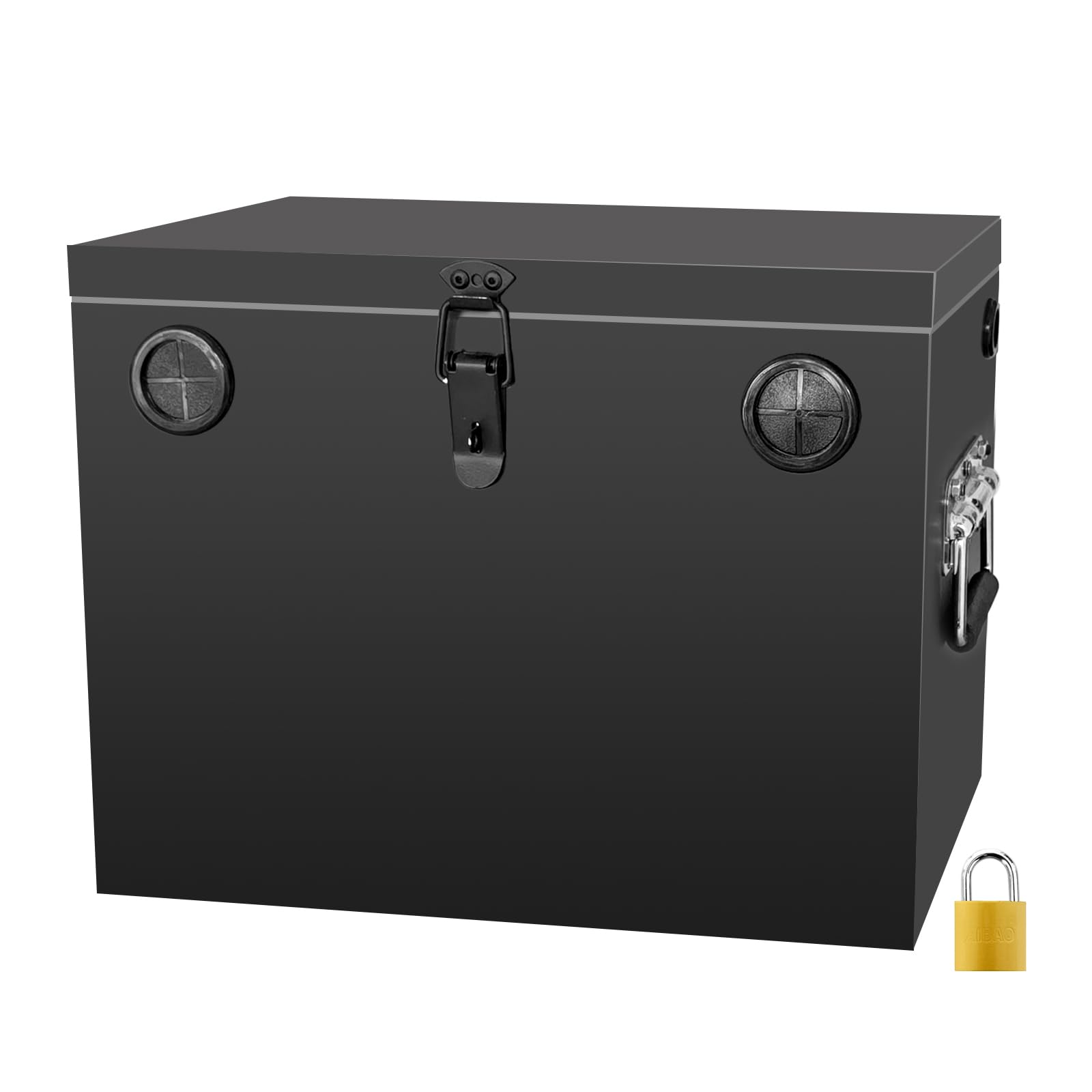
6. Peastorm Trailer RV Marine Battery Box – 12V Waterproof Steel Battery Relocation Kit
A heavy-duty steel box that locks your battery where polypropylene alone would flex
If you store your boat in a shared marina or leave the battery on a trailer tongue, the Peastorm gives you theft resistance that no plastic box can match. It is made from quality steel with a black spray coating, and it ships with a lock, rubber grommets for wire pass-throughs, mounting screws, and handles on both sides. The maximum internal capacity reaches up to 13.78 x 7.8 x 11 inches, which fits a Group 27 battery with room to spare — some owners fit a 200Ah lithium battery inside without issue.
The locking latch uses a spring design that buyers report works fantastically — it clicks shut securely and a key lock keeps honest people honest. The pre-drilled holes align well with standard trailer tongues and the included grommets make routing cables clean and waterproof. However, the steel is thin enough that several owners comment on the paint chipping and surface rust appearing after a season of exposure. The box is also heavy at 10.6 pounds — it is a permanent mount, not something you carry on and off the boat.
For the price, you get a lockable, waterproof steel enclosure that is fireproof and UV-resistant. The paint durability is the main concession — consider a quick coat of rust-resistant spray paint if you boat in salt water.
Cost-to-benefit read: pay mostly for the steel construction and lock. The paint will need maintenance in a salt environment, but the underlying box is tougher than any polypropylene alternative.
Who it fits: boaters who leave batteries on a trailer tongue or in an unattended marina slip where theft is a genuine concern.
Not for: inside-cabin installation — the steel adds unnecessary weight and the lock is irrelevant inside a locked boat.
7. ALL-TOP Smart Battery Box, 12V Marine Case w/ 50AMP Connectors, Multi Ports & Circuit Breaker

The brainiest box here — two 50A Anderson ports turn a raw battery into a solar-ready power hub
This is the box for the boater who wants to build a custom power system without buying a pre-made generator. It features two 50A quick connectors (compatible with Anderson SB50 plugs), external positive and negative terminals, a digital voltmeter, two USB ports (5V 2.1A and 1A), and a 12V cigarette socket — all protected by a 16A resettable circuit breaker and two 60A fuses on the Anderson lines. It fits Group 24, 27, and 31 batteries, and buyers have successfully dropped in 100Ah LiFePO4 batteries with no fitment issues.
The build quality is the most-praised aspect here — the box feels solid, the wiring is clean, and the voltmeter reads accurately within 0.1 volts. Some owners have even wired three units in series for a 36V outboard trolling motor, which tells you the Anderson connectors handle serious current. The catch is the cigarette lighter socket: several owners mention it breaking on first use or feeling flimsy. The box also lacks a carry handle (one owner solved it with a strap), and since it has no internal battery tie-down, smaller batteries can shift around.
Compared to the POWO Carlife box (which uses a 30A Anderson and targets smaller 20Ah batteries), the ALL-TOP is built for full-size marine batteries and higher current loads — more expensive, but more capable.
What powers it ahead
- Two 50A Anderson connectors with individual 60A fuses — handles fridges and ovens
- Full overcurrent protection: resettable 16A breaker plus fused high-current lines
- Fits the most common battery group sizes (24, 27, 31) including 100Ah LiFePO4
Where you might adapt
- Cigarette lighter socket is the weak point — plan to use the Anderson ports for heavy loads
- No carry handle and no internal battery tie-down; smaller batteries need foam shimming
Reach for this if: you want to run a 12V fridge, charge devices, and connect solar panels — one box, one install, full control.
Look elsewhere if: you only need a simple sealed container; this is overkill for a single trolling-motor battery with no accessories.
8. Stainless Steel Dual Battery Box 12V Waterproof Marine Battery Storage, Fits Two 12V Group 24/27 Batteries

The stainless steel vault that swallows two Group 27s and never rusts
If your boat runs dual batteries — a starting battery and a house bank, or two 6-volt golf-cart batteries in series — this Sidasu box is the most durable option on the market. The internal dimensions are 21.7 inches long by 8 inches wide by 11 inches tall, which fits two Group 24 or 27 side by side with space left over. The stainless steel construction is waterproof, sunproof, and fireproof, with a black anti-rust paint coating that adds an extra corrosion barrier over the raw metal.
Buyers praise the sturdiness above all else — it is strong enough to stand on, and the rubber grommets for wiring pass-throughs make installation tidy. The recessed base keeps the enclosure off the deck, preventing water pooling, and the detachable non-slip feet add stability on uneven surfaces. One owner installed it on an RV tongue with a Li Time 320Ah lithium battery and reported a perfect fit. At 11 pounds it is a permanent fixture, not portable, but that weight buys you real confidence in a saltwater environment.
The main complaint is the lid latch rivets — some units arrive with loose rivets that cause the latch to jiggle, and the seal is not quite tight enough without an aftermarket D-shaped gasket. For the price, you get a high-capacity dual-battery solution that no plastic box can match for longevity, but check the latch rivets on delivery.
Durability read: the stainless body is built for decades. The latch hardware is the only place Sidasu cut a corner — inspect it and consider a bead of silicone if the seal needs help.
Best for: dual-battery house banks on larger boats, RV tongues, or any saltwater installation where corrosion kills ordinary steel boxes.
Not for: small single-battery setups — the size and weight are overkill for a basic trolling-motor battery.
9. Yak-Power YP-BBK Power Pack Battery Box, Battery Solution for Kayak

The compact sealed box purpose-built to slip inside a kayak hatch and power your electronics
This is the only box on the list designed specifically for the tight confines of a kayak hull. It measures 11.5 x 9.5 x 6.5 inches and holds up to three 7Ah batteries or two 12Ah batteries — a common setup for powering a fish finder and a phone charger on a day trip. The waterproof design comes with a sealed lid, a master power switch, and an integrated dual USB charging port so you can juice a mobile device and an action camera without opening the box. It also includes a home battery charger to maintain the batteries between trips.
The standout feature is the custom-tooled SAE plug-and-play connectors with real copper wire — these are snug, weatherproof, and designed to stay connected in the wet, bouncing environment of a kayak. Buyers consistently praise the quality and ease of setup, noting that a standard 12V 12Ah battery fits snugly and does not rattle when the box is picked up by the handle. The pick-and-pull foam inside lets you customize the fit for different battery sizes.
The honest limitation is value for money — at this price point, you are paying for the brand’s dedicated kayak ecosystem (the box is designed to pair with Yak-Power’s hub station and SAE accessories). It is also a tight squeeze in some kayak models; a few owners found it did not fit in an Ascend 12T or a Native Titan 10.5 without additional SAE extension cords. Measure your hull hatch opening before buying.
Why kayakers choose it
- Compact footprint fits inside most kayak hatches; holds up to three 7Ah batteries
- Dual USB charging port and master power switch built into the sealed lid
- Includes a home battery charger for overnight top-ups between trips
The fitment factor
- Will not fit every kayak model — measure your hatch first
- Battery connectors are F1 terminal; larger batteries with F2 terminals need an adapter
Reach for this if: you kayak with a fish finder, phone, and camera — the sealed, hatch-friendly design keeps everything dry and powered.
Think twice if: you have a full-size boat with a large Group 27 battery; this box is too small for anything beyond 12Ah batteries.
Understanding the Specs
Battery Group Sizes
A battery group number (24, 27, 29, 31) defines a standard physical footprint, not the electrical capacity. A Group 24 battery is roughly 10 x 6.8 x 8.9 inches, while a Group 31 is about 13 x 6.8 x 9.4 inches. Always measure your battery’s length, width, and height — then compare to the box’s internal dimensions. An oversized box lets the battery slide around and can snap the terminals off in rough water.
Vented vs. Sealed Boxes
A vented box has a hose port that channels explosive hydrogen gas outside the boat compartment — this is required by USCG and ABYC standards when the battery lives inside a locker, under a seat, or in any enclosed space. A sealed box uses a gasket to keep water out, which protects the battery on an open deck but must never be installed in a closed compartment because gas pressure can build dangerously. Choose vented for below-deck; choose sealed for open-air locations.
USCG and ABYC Certification
USCG 183.420 and ABYC E-10.7 are the two main marine safety standards for battery boxes. They specify minimum requirements for hold-down strap strength (a box meeting the standard can withstand at least 89 lbs of force; the Attwood box exceeds this at 350 lbs), acid resistance, and venting. If your boat is inspected or insured, a non-certified box could fail a safety check — always look for the USCG or ABYC label on the product listing.
Anderson Connector Amperage Ratings
The SB series Anderson connectors found on smart boxes (30A on the POWO Carlife, 50A on the ALL-TOP) handle high-current loads like trolling motors, fridges, and inverter input. The number (30A, 50A) is the maximum continuous current the connector is rated for. A 50A connector can power a much larger fridge or charge a house bank faster than a 30A version — but both require proper fusing (the ALL-TOP pairs each with a 60A fuse) to protect the wiring in a short circuit.
FAQ
Can I use a standard car battery box on a boat?
How do I know what size battery box my boat battery needs?
Do I need a vented battery box or a sealed one?
What does USCG 183.420 mean on a battery box?
How often should I replace a boat battery box?
Will a Group 27 battery fit in a Group 24 battery box?
Are battery boxes with built-in USB ports safe to use in the rain?
What is the difference between an Anderson SB50 and a standard SAE connector?
Can I install a battery box on its side or upside down?
How do I maintain a steel battery box to prevent rust?
Final Thoughts: The Verdict
For most boaters, the battery boxes for boats winner is the POWO Carlife Smart Box because it gives you the portable power-station features — Anderson plug, dual QC3.0 USB, voltmeter, and waterproof seal — at a price that undercuts anything with similar connectivity. If you need a vented box for a large Group 31 battery in an enclosed compartment, the Attwood 9084-1 is the USCG-compliant workhorse at a fair.html is the USCG-compliant workhorse. And for dual-battery house banks on a saltwater boat, the Sidasu Dual Box is the stainless-steel option that will outlast every other box on this list.
How We Picked
We do not accept paid placement. Every pick is matched to a real buyer and a real use-case; we do not hands-on test units.
Sources & Methodology
Specifications: manufacturer listings and product documentation. Review insights: verified customer reviews, as of July 2026. Pricing: not shown on this page (it changes often); check the current price via the retailer link.
As an Amazon Associate, Gadgets Feed earns from qualifying purchases. This does not affect which products we feature.