
Our readers keep the lights on and my morning glass full of iced black tea. As an Amazon Associate, I earn from qualifying purchases.
Specs are compiled from manufacturer listings and verified buyer reviews and can change over time — please confirm the key details on the product page before buying.
Buying a small generator can feel like a gamble. Pick the wrong one, and you get a machine that won’t start when the power goes out, drowns out conversation, or cannot keep a fridge and a few lights running at the same time. The right 1000-watt-class generator powers your essentials quietly for days without hassle. The difference depends on a few key trade-offs: inverter vs. conventional engine, noise level, and weight.: an inverter (which gives delicate electronics safe, steady power) versus a conventional engine, how loud it gets when you actually plug something in, and whether the weight matters more for tailgate trips or home backup.
I’m Min — the founder and writer behind Gadgets Feed. This guide is built by comparing the manufacturers’ published specifications and the patterns across verified customer reviews, so you get each pick’s real strengths and trade-offs instead of marketing spin.
The best 1000 watt generator for most people is the one that starts on the first pull, sips fuel quietly, and weighs little enough to carry one-handed — The Honda EU1000i sets that standard, but the budget-friendly Aceup and Pulsar models offer real value if you understand their limits.
Our Picks at a Glance
How To Choose The Best 1000 Watt Generator
A 1000-watt-class generator fills a specific niche: it is portable enough to throw in a trunk, quiet enough to use at a campground, and powerful enough to run a refrigerator, a few lights, a television, and phone chargers simultaneously. The key is matching the generator’s running watts — not its peak or surge watts (a momentary power spike for motor start-up) — to the items you plan to plug in. Most fridges draw 600-800 watts when the compressor kicks on, and adding a lamp or a laptop charger pushes you toward the 900-watt ceiling common in this class. Understanding that, you can sort by engine type, noise level, fuel tank size, and weight.
Inverter vs. Conventional Engine
Inverter generators produce cleaner power — a steady sine wave (a smooth, pure electrical waveform) — that is safe for sensitive electronics like computers, CPAP machines, and modern refrigerator control boards. They also automatically adjust engine speed to match the load (an Eco Throttle or similar system), which cuts fuel use and noise. Conventional generators run at a fixed speed regardless of how much you plug in; they are cheaper but louder and produce power that can damage delicate electronics without a conditioner (a device that cleans up the electrical output). For camping and home backup, an inverter model is almost always worth the premium.
2-Stroke vs. 4-Stroke Engine
Many compact generators in this wattage range use a 2-stroke engine (an engine that completes its power cycle every single revolution) that runs on a premixed gasoline-and-oil blend (typically 50:1). That means no separate oil changes, but you must measure and mix the oil at every fill-up. A 4-stroke engine (like the Honda EU1000i) uses straight gasoline and has a separate oil reservoir that needs periodic changes; it is generally cleaner-running and quieter but heavier. If you are the type who wants to grab a gas can and go, a 4-stroke is less fuss. If you don’t mind mixing, a 2-stroke saves money upfront.
Noise Level and Runtime
Noise is measured in decibels (dB(A)), a scale that mimics human hearing. A normal conversation is roughly 60 dB(A). A generator operating at 42-50 dB(A) — the Honda EU1000i’s range — is barely audible from a short distance. Budget 2-stroke generators tend to run louder, often compared to a lawnmower or weed eater. Runtime matters just as much: a 0.6-gallon tank that delivers 3 to 6.8 hours means you will be refueling at least once per day on a camping trip, while a 1.1-gallon tank can stretch to 6 hours at half load. Pair these numbers with your habits — are you OK waking up to refuel, or do you need all-night runtime?
Weight and Portability
Every pound matters when you are loading gear into a pickup bed or tucking a generator into an RV compartment. The lightest in this class is the Honda at 29 pounds; the heavier 2-stroke units hover around 35-37.5 pounds. A 35-pound generator is still one-handable for most adults, but when you add fuel and extension cords, that weight difference of 6-8 pounds becomes noticeable over a weekend. Built-in carrying handles make a bigger difference than the raw number.
Quick Comparison
| Model | Best For | Running Watts | Noise Level | Weight | Amazon |
|---|---|---|---|---|---|
| Honda EU1000i★ Best Overall | Quiet camping & sensitive electronics | 900W | 42-50 dB(A) | 29 lb | Amazon |
| Aceup Energy 1200W (Yellow)Best Value | Budget home backup & tailgating | 900W | Similar to weed eater | 35.5 lb | Amazon |
| Aceup Energy 1200W (Black) | Camper/RV storage compartments | 900W | Quiet enough for conversation at 23 ft | 35 lb | Amazon |
| Pulsar PG1202SA | Workshop & outdoor tools | 900W | Lawnmower-like | 37.5 lb | Amazon |
| Pulsar G1200SG | Jobsite power tools | 900W | Moderate | 37.5 lb | Amazon |
In‑Depth Reviews
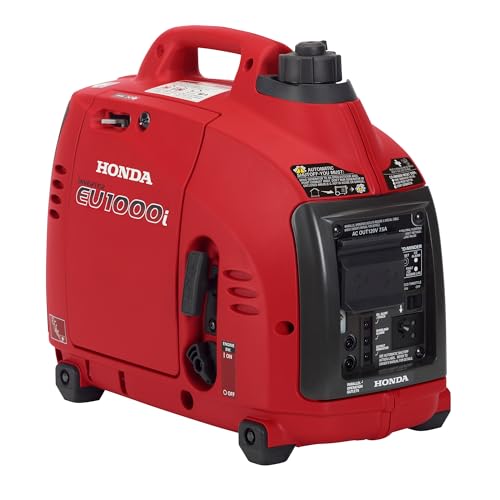
1. Honda EU1000i 1000 Watt Inverter Generator
Our pick — 4.5★ from 100+ verified ratings; the strongest balance of quality and price.
The quietest inverter here sips fuel and starts after years of neglect — protecting laptops and CPAPs without a power conditioner.
If you value your sleep and your laptop, the Honda EU1000i is the one to beat. It produces clean inverter power (a steady, computer-safe sine wave) that is safe for computers, CPAP machines, and modern fridge control boards — no power conditioner (an extra device to clean the electricity) needed. At 29 pounds, it is noticeably lighter than the 35-pound Aceup units, and the 0.6-gallon fuel tank delivers 3.0 to 6.8 hours of runtime, depending on load. The Eco Throttle system (which matches engine speed to the plugged-in load) means it sits at a barely audible idle when the fridge compressor is off and gently spools up when you turn on a light.
The quiet is the defining trait: 42 to 50 dB(A) is quieter than a normal conversation.: 42 to 50 dB(A) (decibels A-weighted, the human-hearing scale) is quieter than a normal conversation, which is around 60 dB(A). Owners consistently report that at 100 feet with an extension cord, the generator is barely audible. One buyer called it “900W continuous, very quiet, fuel-efficient, easy start and oil changes,” and another noted it started flawlessly after two years of storage during a hurricane, powering two refrigerators, lights, and a sump pump. The trade-off is that this Honda costs considerably more than the 2-stroke units. Buyers also mention it lacks a carburetor drain (a screw to empty the fuel chamber for storage) and Bluetooth monitoring — both found on the 2000-watt version — so you will want to run it dry or add stabilizer before storage.
Honda quiet inverter: The inverter technology means you can plug a laptop directly into this generator without worrying about voltage spikes — something the cheaper 2-stroke Aceup and Pulsar units cannot promise.
premium price tag: The 0.6-gallon tank is smaller than the 1.1-gallon tanks on the Aceup picks, so you will stop for fuel more often on an all-night run — about 3 hours at full load versus the Aceup’s 6 hours at half load.
quietest small gen: You camp, need to power sensitive electronics, or want a generator that starts instantly after months of sitting — the Honda EU1000i is the gold standard in this class.
budget buyers: You need maximum runtime per tank and cannot justify the premium price — the Aceup models give you a bigger 1.1-gallon fuel tank for hundreds less.
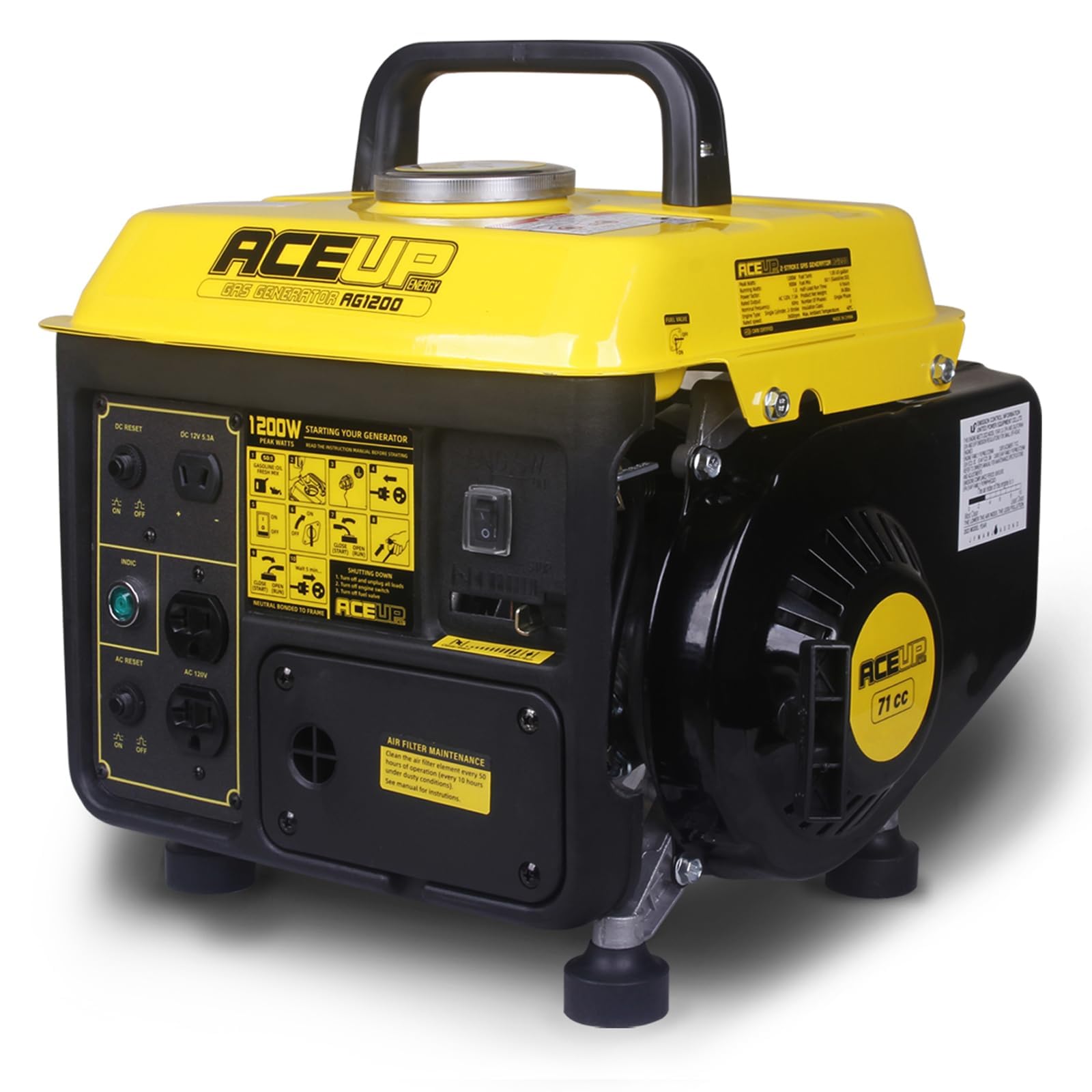
2. Aceup Energy 1,200W Gas Powered Generator (Yellow)
The compact 2-stroke that undercuts the Honda by hundreds but still delivers 6 hours of runtime per tank.
The Aceup Energy 1,200W delivers 900 running watts from a 71cc 2-stroke engine (a lightweight design that requires a premixed gas-oil blend), and it does it at a price that undercuts the Honda by a wide margin. The 1.1-gallon fuel tank provides up to 6 hours of operation at half load — at 6 hours versus the Honda’s 3 hours — and the 35.5-pound weight is still manageable for one person. What owners praise is that it “starts on the first pull” and runs relatively quietly for a 2-stroke; one buyer described the noise as “like weed eater at high idle,” which is acceptable for tailgating or job sites but louder than the EU1000i’s 42-50 dB(A).
The value is strong, but owner feedback reveals a reliability split. Many report trouble-free use for days at a time — powering a fridge, freezer, fan, and Starlink during an outage. But a notable minority received units that would not start or ran only briefly before stopping. The 2-stroke engine requires a 50:1 gas-to-oil mix, which some buyers find inconvenient, and it is not CARB-compliant (it does not meet California’s strict emissions standards) for sale in that state. The one-year limited warranty and free lifetime technical guidance are solid, but the non-English-speaking tech support has drawn complaints.
large fuel tank: The 1.1-gallon fuel tank gives you 6 hours at half load — a full hour more than the Honda at 0.6 gallon, and the Aceup costs a fraction of the Honda.
spotty reliability: The reviews split sharply: many owners get a perfectly good generator, while a fair share report units that fail immediately — check the return policy before ordering.
long runtime: You need a cheap, portable generator for occasional weekend power at a campsite or tailgate and you are comfortable mixing your own fuel — the Aceup delivers the most runtime per dollar in this class.
reliability seekers: You depend on a generator for emergency home backup where reliability is non-negotiable — the Honda EU1000i is a safer bet for critical situations.
3. Aceup Energy 1200W Gas Generator (Black)
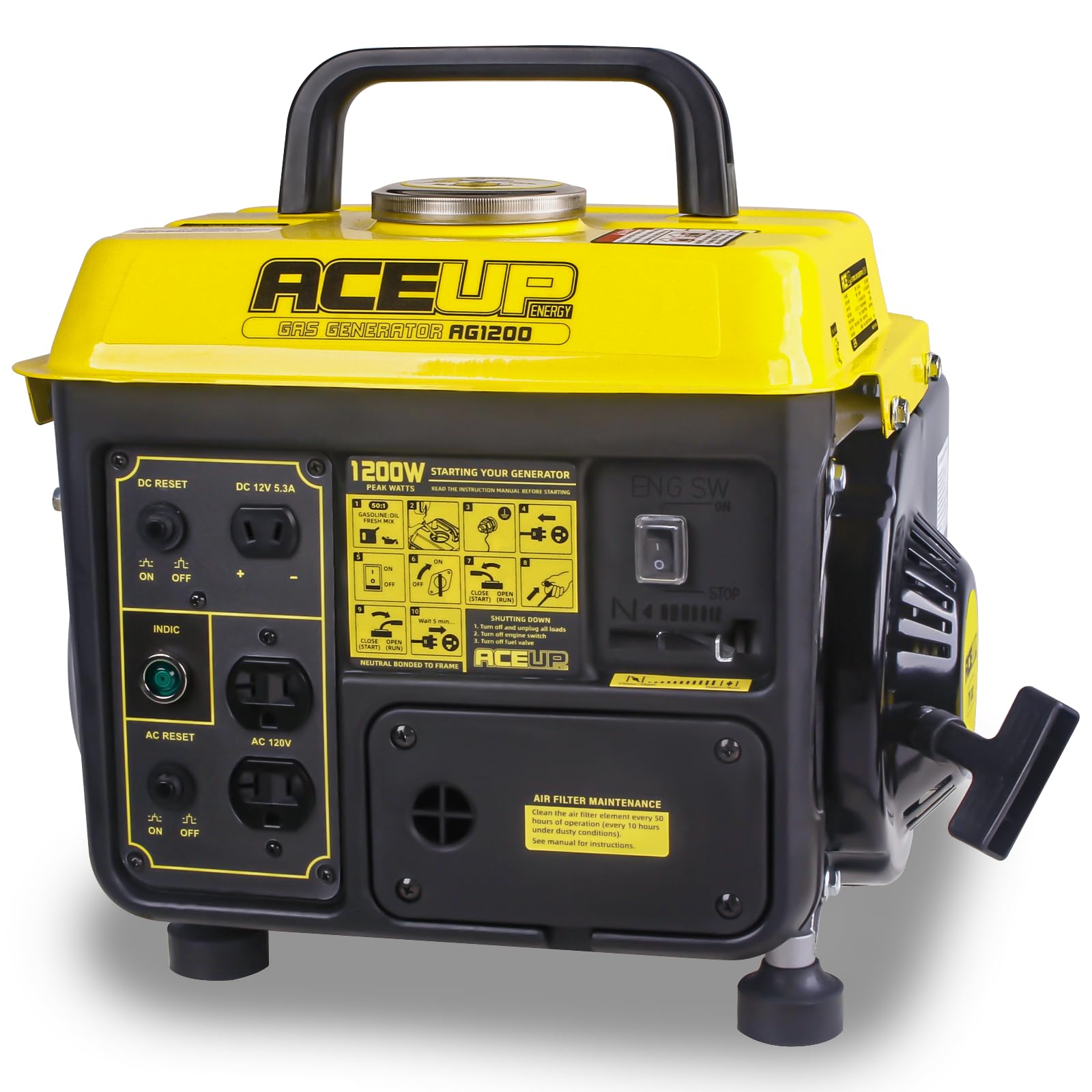
The blacked-out sibling that slides into a camper side compartment and runs quietly enough for conversation at 23 feet.
This black version of the Aceup 1200W shares the same 71cc 2-stroke engine, 900 running watts, and 1.1-gallon tank as the yellow model, but it has a slightly different footprint: 15.5 inches long by 14.4 inches wide by 14 inches tall, making it a near-perfect fit for the side compartment of a camper. Owners confirm this, with one calling it “nice generator, fits perfectly in the side compartment of my camper, runs good and quiet.” The noise level is low enough that conversation is possible 23 feet away, and most buyers report it starts on the first pull after mixing fuel and oil at a 50:1 ratio.
The performance consensus is strong — buyers routinely praise its power output. — buyers routinely praise its power output, noting it can run a 6,000-BTU air conditioner without straining. Durability, however, is the recurring red flag. A small but significant number of owners mention the unit breaking after five uses, and there have been rare reports of units catching fire. The 2-stroke engine also means you must mix 87 octane or higher unleaded gasoline with 2-cycle oil (50:1 ratio) — something the Honda’s 4-stroke engine eliminates entirely. If you are a careful owner who drains the carburetor and stores it dry, the longevity may match the Honda, but the reviews suggest it is less forgiving of neglect than the EU1000i.
compact RV fit: The 15.5 x 14.4 x 14-inch dimensions let it slide into spaces the Honda and Pulsar models cannot fit — ideal for RV owners who want a dedicated onboard generator.
durability concerns: While most owners have zero issues, the negatives on durability are the loudest complaint in the reviews — treat this as a fair-weather generator, not a daily driver.
camper companion: You own an RV or camper with a specific side compartment and want a generator that disappears into the vehicle — this Aceup was designed for exactly that use case.
heavy users: You plan to put hundreds of hours on a generator every year — the Honda is built for long-term reliability, while the Aceup is more of a weekend warrior.
4. Pulsar PG1202SA 1,200W Gas-Powered Portable Generator

The 7-year veteran that proves cheap 2-strokes can last — if you run ethanol-free gas and use fuel stabilizer.
The Pulsar PG1202SA is the most-reviewed generator in this roundup, and for good reason — it has been on the market long enough to accumulate real longevity data. — it has been on the market long enough to accumulate real longevity data. The 69cc 2-stroke engine delivers 900 running watts and 1,200 peak watts (a momentary surge for starting motors), with a 1.1-gallon tank that runs up to 5 hours at half load. At 37.5 pounds, it is the heaviest of the bunch, but the built-in carrying handle makes it manageable. Owners who maintain it with ethanol-free gas and fuel stabilizer report it still running strong after seven years, with one review calling it “reliable after 7 years with proper maintenance.” The two 120V outlets and one 12V DC output are standard for this class.
The mixed bag here is noise and power quality. At idle, the generator is relatively quiet — one owner described it as a “small lawnmower motor with outlets” — but it revs up noticeably under load, making it louder than the Honda. The power is also not clean; customers note voltage fluctuation at low loads and some have damaged sensitive boat batteries and an EcoFlow unit (a portable power station) when plugged directly. The manufacturer explicitly states this generator is “not supposed to run AC units,” so you need to respect its 900-watt continuous ceiling. Reliability splits the room: the top positive aspect is quality (107 owners praise it), but reliability draws 205 mentions, and Amazon flags it as a mixed sentiment — meaning many owners have zero issues, but a significant number report units that smoke, leak oil, or stop working.
proven engine life: The reviews show that with ethanol-free gas, stabilizer, and a carburetor drain at season’s end, this Pulsar can run for seven years without major issues — that is rare in the budget 2-stroke category.
dirty power output: The power is “dirty” enough that multiple reviewers point out damaged electronics when running laptops or battery chargers directly — budget for a power conditioner or use it only for tools and resistive loads (like lights and heaters).
careful owner: You need a generator for the workshop or job site, where you are running power tools and don’t care about clean sine wave power — the Pulsar is the most affordable way to get 900 watts on a job site.
electronics users: You plan to power computers, CPAP machines, or any sensitive electronics — the Honda’s inverter technology is the only safe bet for those loads.
5. Pulsar G1200SG 1,200W Carrying Handle Generator

The 71cc budget runner that delivers 17 hours on a single gallon at minimal load — but needs a gentle hand and a power conditioner for electronics.
The Pulsar G1200SG is a near-clone of the PG1202SA — same 69cc 2-stroke engine, same 900 running watts, same 37.5-pound weight — but in a black-and-gray color scheme. what separates it is a strong value-for-money reputation: the top positive aspect in the reviews is value (8 owners single it out), and buyers consistently say it “works as described” for light construction and power-tool use. The magneto ignition (a simple spark system) is reliable enough that most units fire up in three pulls.
The negatives mirror the PG1202SA: the power is dirty enough that you need a power conditioner for sensitive electronics, and the noise level is moderate — one owner compared it to “an old chainsaw until loaded.” The reliability split is also similar, with a notable minority receiving units that failed after a short break-in period. One buyer’s unit ran for one hour as recommended, then refused to start the next day at a campsite. The warranty and support are basic, and the engine requires the same 40:1 or 50:1 gas-oil mix as the other 2-stroke units. For a weekend jobsite generator or a tailgate backup, it is a functional budget pick; for anything mission-critical, the Honda or a well-maintained PG1202SA is a smarter choice.
17-hour runtime: One owner achieved 17 hours on less than a gallon of fuel, making this Pulsar the efficiency leader of the budget picks when run at minimal load — impressive for a 2-stroke and far better than the Honda’s 3.0 hours at full load.
inconsistent quality: The reviews are split enough that you should consider an extended warranty or buy from a retailer with a solid return policy — about as many owners call it garbage as call it a bargain.
fuel efficiency: You need the cheapest possible 900-watt generator for occasional use at a job site or in the backyard, and you are comfortable with the risk of getting a lemon — the G1200SG is the lowest-priced entry in this class.
consistent power: Dependability is your top priority for emergency backup — spend the extra money on the Honda EU1000i and get the confidence that comes with Honda’s engineering reputation.
Understanding the Specs
Running Watts vs. Peak Watts
Running watts is the continuous power a generator can supply for hours at a time. This is the number that matters for everyday use — it is what your refrigerator, lights, and laptop actually draw. Peak watts (sometimes called surge watts) is the burst of power the generator can deliver for a few seconds when a motor, like a fridge compressor or a sump pump, first kicks on. A generator rated 1,200 peak watts and 900 running watts means you cannot draw 1,200 watts for more than a split second; your continuous load must stay under 900. Always match your equipment’s running watt total to the generator’s running watt rating, not the peak number.
dB(A) Noise Rating
Decibels measured on the A-weighted scale, which approximates human hearing. A difference of 3 dB(A) is a barely noticeable change; a difference of 10 dB(A) sounds twice as loud. A normal conversation at 3 feet is about 60 dB(A). The Honda EU1000i at 42-50 dB(A) is roughly as loud as a library or a quiet bedroom. A budget 2-stroke generator often runs at 60-70 dB(A) — comparable to a vacuum cleaner or a lawnmower at 50 feet. If you camp in quiet campgrounds, the inverter generator’s quieter operation will keep neighbors happy and park rangers off your back.
2-Stroke vs. 4-Stroke Engine
A 2-stroke engine completes a power cycle every single revolution of the crankshaft, giving it more power per pound but requiring a premixed gasoline-and-oil blend (usually 50:1) for lubrication. There is no separate oil reservoir, so no oil changes, but you must measure and mix oil into every gallon of gas. A 4-stroke engine completes its cycle every two revolutions, has a separate oil reservoir, and runs on straight gasoline. It is generally quieter, cleaner-burning, and more fuel-efficient, but heavier and more expensive. For occasional use, a 2-stroke’s lower price is appealing; for long-term reliability, a 4-stroke like the Honda is the better investment.
Eco Throttle / Automatic Idle Control
Generators with this feature automatically reduce engine speed when the electrical load is light — such as when a refrigerator compressor is off but the lights are on. This cuts fuel consumption and noise dramatically during low-load periods. The Honda EU1000i’s Eco Throttle is the best-known example in this class. Without it, a generator runs at full speed all the time, wasting fuel and creating unnecessary noise even when you are only powering a phone charger. If you plan to run a generator for hours at a light load — typical for camping — Eco Throttle is a must-have feature.
FAQ
Will a 1000 watt generator run a refrigerator?
Can I run a 1000 watt generator all night?
Is a 1000 watt generator loud?
What is the difference between a 2-stroke and a 4-stroke generator?
How do I break in a new 2-stroke generator?
Can I use a 1000 watt generator for a CPAP machine?
How do I maintain a 1000 watt generator for long-term storage?
What size generator do I need for a camping trip?
Is inverter technology worth the extra cost?
Can I run two 1000 watt generators together?
Final Thoughts: The Verdict
Across the board, the best 1000 watt generator is the Honda EU1000i because it combines whisper-quiet operation, clean inverter power for sensitive electronics, and Honda’s legendary reliability in a 29-pound package. If you want massive fuel capacity for the dollar and don’t mind mixing your own gas, grab the Aceup Energy 1200W (Yellow) — it gives you 6 hours of runtime on a single tank for a fraction of the Honda’s price. And for RV owners with a specific storage compartment, the Aceup Energy 1200W (Black) is the one to reach for, as it fits perfectly in a camper side compartment and runs quietly enough for conversation nearby.
How We Picked
We do not accept paid placement. Every pick is matched to a real buyer and a real use-case; we do not hands-on test units.
Sources & Methodology
Specifications: manufacturer listings and product documentation. Review insights: verified customer reviews, as of July 2026. Pricing: not shown on this page (it changes often); check the current price via the retailer link.
As an Amazon Associate, Gadgets Feed earns from qualifying purchases. This does not affect which products we feature.