
Our readers keep the lights on and my morning glass full of iced black tea. As an Amazon Associate, I earn from qualifying purchases.
Specs are compiled from manufacturer listings and verified buyer reviews and can change over time — please confirm the key details on the product page before buying.
You want your speed, direction, and engine data right at eye level so you never glance down at the dashboard again. But most people pick the wrong one — either a unit that washes out in sunlight or a model that does not fit their car’s year or system. This guide cuts through that confusion by matching each pick to a real driving need.
I’m Min — the founder and writer behind Gadgets Feed. This guide is built by comparing the manufacturers’ published specifications and the patterns across verified customer reviews, so you get each pick’s real strengths and trade-offs instead of marketing spin.
The right aftermarket heads up display for cars depends on matching the system — GPS or OBD2 (on-board diagnostics, plugging into your car’s computer port) — with your daily drive and budget. A simple plug-and-play speedometer or a full gauge cluster? Here is how to decide.
Our Picks at a Glance
How To Choose The Best Aftermarket Heads Up Display For Cars
Decide where your data comes from and how much information you actually want floating in your field of view. A simple GPS-only HUD (a heads-up display that uses satellite signals) gives you speed, direction, and time — no installation fuss. An OBD2 unit (connecting to your car’s diagnostic port) pulls live engine data from your car’s computer, letting you see RPM, coolant temperature, voltage, and fuel consumption. Your vehicle’s year and your need for engine diagnostics determine which system fits.
GPS vs OBD2 — Which System You Need
A GPS-based unit (like the wiiyii or OinDoDi models) works in literally every vehicle because it uses satellite signals. You just plug it into a USB port. An OBD2 unit (like the MAIMEIMI or Liiiyuan) must connect to your car’s OBD2 port, usually located under the dashboard — and it only works on vehicles built after 2008 that support the OBD2 protocol. Many OBD2 units also list specific incompatibilities with certain brands like Dodge, Jeep, Chrysler, and hybrids.
Display Visibility and Brightness
Display brightness matters more than any other spec. A 4.2-inch LED screen that can automatically adjust its brightness to ambient light will be clear in the noonday sun and not blinding at midnight. Units with manual brightness settings or a single fixed level can wash out during the day or glare too much at night. The green or yellow digits typically cause less eye strain than blue after dark.
Real-World Mounting and Size
A compact HUD (1.8 to 2.4 inches tall) tucks between dash and windshield without blocking your view. Larger screens, like the 5.5-inch wiiyii, show more data but may sit too high or reflect awkwardly. A reflective windshield film fixes projection issues on most units.
Quick Comparison
| Model | Best For | Screen Size | System Type | Alarm Features | Amazon |
|---|---|---|---|---|---|
| OinDoDi C3010★ Best Overall | Best Overall | 4.2″ LED | GPS Only | Overspeed + Fatigue | Amazon |
| KUOWEIHUD F2Dual-Satellite Ace | Dual-Satellite Accuracy | Compact 3.3″ | GPS + BDS | Overspeed + Fatigue (4hr) | Amazon |
| MAIMEIMI P6 | Engine Data Pros | 4.3″ | OBD2 + GPS | Overspeed + Fatigue | Amazon |
| wiiyii G10 | Large Screen Value | 5.5″ | GPS Only | 3-Stage Overspeed + 8hr Fatigue | Amazon |
| wiiyii P8 | A-Pillar Mounting | 1.8″ | OBD2 + GPS | Overspeed | Amazon |
| AZIJYV M22 | Windshield Projection | 3.7″ | GPS Only | Overspeed (Beep) | Amazon |
| Liiiyuan M17 | Budget OBD2 Starter | Compact | OBD2 + GPS | Overspeed + Fatigue | Amazon |
In‑Depth Reviews
1. OinDoDi C3010 Heads Up Display
Our pick — over 4★ from 70+ verified ratings; the strongest balance of quality and price.
The crowd favorite that nails speed, compass, and alarms in one clean package.
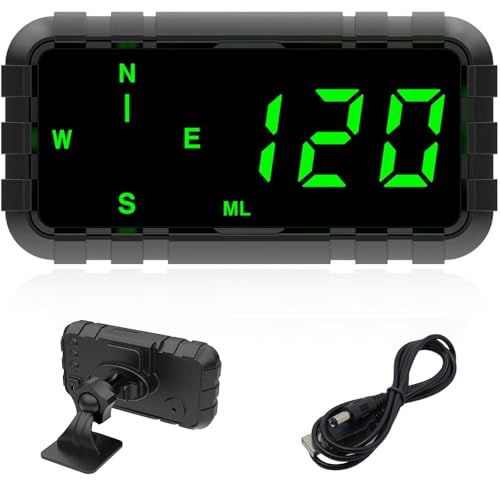
This unit packs seven functions into a 4.2-inch LED screen — vehicle speed, compass direction, driving time, mileage, overspeed alarm, fatigue driving warning, and a kilometers-to-miles toggle. The light sensor inside automatically adjusts the display’s brightness so the big green digits stay sharp in direct sun and won’t glare at night. What wins people over is its sheer functionality — the most-praised aspect by owners is how well it works right from the start.
Setup is truly plug and play: connect the USB cable (included) to your car’s USB port or a 12V adapter. The unit powers on and off with the car. There is no built-in battery and no installation required, so there is zero fire hazard in summer heat. The compass direction works only while the vehicle is moving and after GPS locks on — a caveat owners mention as a quirk rather than a flaw.
Buyers report that calibration took about five minutes using Waze, with the speed matching within 1 mph from 10 to 85 mph after a small adjustment. The 4.2-inch screen is notably larger than the compact KUOWEIHUD F2 (3.3 inches), making it easier to read at a quick glance without squinting.
What Owners Rave About
- Large, bright LED digits readable for seniors and anyone with tired eyes
- Works in literally any vehicle — car, truck, golf cart, boat, SUV
- Solid build from ABS+PC, a high-temperature-resistant anti-fire material
The Trade-Offs
- Compass requires GPS lock and vehicle motion to display direction
- No OBD2 data — only GPS speed, time, and mileage are available
Reach for this if: you want a dead-simple GPS HUD that works on any car, truck, or even a golf cart — no compatibility worries, just plug it in and go.
Look elsewhere if: you need engine data like RPM or coolant temperature; this is a pure GPS unit with no OBD2 connection.
2. KUOWEIHUD F2 Digital Speedometer
The compact one that pulls from two satellite networks for faster lock and better accuracy.
Many single-GPS HUDs struggle under bridges and in cloudy weather. The KUOWEIHUD F2 avoids that by using both GPS and BeiDou (China’s satellite system) to receive up to 32 satellites simultaneously. The dual-band approach gives this unit a higher refresh rate and a quicker initial satellite lock than the single-GPS OinDoDi — a real advantage for anyone living in areas with heavy tree cover or tall buildings.
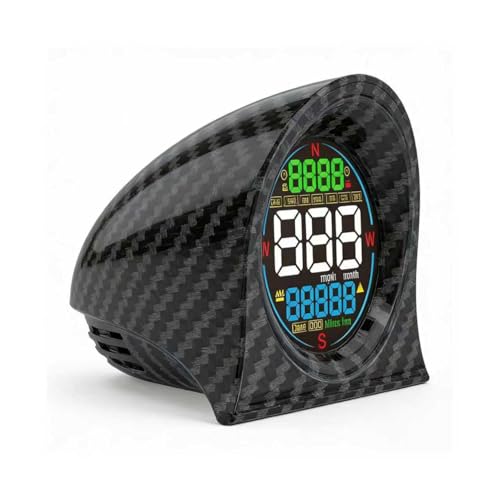
You can scroll through six different display interface combinations: speed plus time, speed plus driving time, speed plus odometer, speed plus altitude, and others. A built-in light sensor handles brightness automatically so the screen stays visible under direct sunlight without blinding you at night. The body itself is wrapped in a carbon fiber texture and measures just 3.29 x 2.76 x 2.72 inches — noticeably more compact than the OinDoDi’s 4.2-inch unit. Quality is the second most-praised aspect among owners, who describe it as well made with more functions than they expected.
One honest note: the car’s glass can interfere with satellite reception. If your windshield has a metal-based explosion-proof film, the GPS signal may degrade. The manufacturer recommends choosing carefully based on your vehicle’s actual window coating.
Best for accuracy hunters: the dual-satellite system locks faster and holds steady in areas where single-GPS units drift, making it a strong pick for overland trips and rural driving.
Grab it for: the dual-satellite speed accuracy and the compact carbon-fiber design that tucks into tight dashboard spots without blocking your view.
skip it if: your windshield has metal-based explosion-proof film — the GPS signal will struggle regardless of the dual system.
3. MAIMEIMI P6 OBD2 Speedometer

The full-dashboard replacement that reads your engine’s vitals over OBD2 or GPS.
This is the HUD for gearheads and anyone who likes to watch their engine’s health in real time. The MAIMEIMI P6 runs two systems: OBD2 mode pulls speed, RPM, water temperature, oil temperature, voltage, fuel consumption, and more from the car’s computer. GPS mode, which works with every vehicle regardless of year, displays altitude, speed, distance, time, and date. You can switch between 10 different data combinations — more than any other HUD on this list.
Owners mention that the unit saved one owner from overheating twice, thanks to the live water temperature readout. The display is a bit narrow in its viewing angle, but the numbers update smoothly and the brightness is good. The OBD2 system has significant compatibility restrictions: it will not work with pre-2008 vehicles, and the manufacturer specifically lists Dodge, Jeep, Chrysler, French, Italian, Suzuki, Mazda6, hybrid and diesel engines, trucks, RVs, and several other model lines as incompatible (including Infiniti QX50, Lexus IS300H, and Honda CRV). If your car falls on that list, use GPS mode instead.
There is a 1-year warranty included, and the metal-and-plastic body feels more premium than the full-plastic wiiyii or AZIJYV units. The trade-off is that the OBD2 speed and tachometer can feel slightly laggy, and the temperature may display in Celsius regardless of your settings.
Where It Shines
- Live coolant temp, RPM, voltage, and fuel consumption — no other GPS-only HUD can do this
- 10 fully customizable display interfaces and color options
- Metal build feels durable; includes a 1-year warranty
Where It Struggles
- OBD2 mode has a long list of incompatible vehicles — check your model before buying
- RPM readout can be slow to update, making it less useful for performance driving
Who it fits: owners of a 2008+ compatible vehicle who want a full engine dashboard with coolant temp, voltage, and RPM data projected at eye level.
Who should pass: anyone with a pre-2008 vehicle, a hybrid, a diesel truck, or certain brands (Dodge, Jeep, Chrysler, French/Italian models) — the GPS mode works, but then you lose the OBD2 data that makes this unit special.
4. wiiyii G10 Digital GPS Speedometer

The biggest screen here, packing altitude, longitude, and a 3-stage speed alarm into one box.
The wiiyii G10 is all about real estate. Its 5.5-inch display dwarfs every other unit on this list — the OinDoDi measures 4.2 inches, the KUOWEIHUD comes in at roughly 3.3 inches — which means you can see speed, altitude, driving time, direction angle, longitude, latitude, clock, satellite count, and acceleration time all at once. The screen auto-brightens and dims based on ambient light, and the green display mode is strongly recommended by owners for nighttime driving to reduce eye strain.
The three-stage overspeed alarm is a standout safety feature: you can set it to beep at different speed thresholds, so you get a gentle reminder before a ticket rather than a sudden alert. The eight-hour fatigue driving reminder is another layer of protection for long road trips. Owners appreciate the adjustability — the most-praised feature — with settings for speed correction, brightness, and multiple display options. Customers note that after eight months of daily use the unit still works well, with accurate speed and direction readouts.
Accuracy is mixed: some owners find the G10 astonishingly accurate, while others report speed off by 15-20 mph. Installation varies — some find it straightforward (5-minute USB setup), while others say the instructions are poor. At 150 grams, it is the lightest GPS-only unit on the list (the OinDoDi weighs 160 grams), but the large screen can also mean more sunlight glare on certain dashboards.
Best for drivers who want maximum data at a glance: the 5.5-inch screen shows altitude, coordinates, speed, and time together — information density that no compact unit can match.
Choose it for: the enormous screen and the 3-stage overspeed alarm that lets you set different beep thresholds for different zones.
Think twice if: you need dead-certain speed accuracy right from the start; a portion of units need careful calibration to match your car’s true GPS speed.
5. wiiyii P8 Head Up Display

The only HUD designed to mount on your A-pillar trim, keeping your windshield completely clear.
Every other unit on this list sits on the dashboard or sticks to the windshield. The wiiyii P8 can be installed on the A-pillar trim — the vertical post between your windshield and side window — so the screen sits naturally in your peripheral vision without blocking the road ahead. It is the smallest unit here at 1.8 inches (320×240 resolution), but that tiny size makes it unobtrusive. You can also classic dashboard-mount it with the included Velcro or 3M tape if the pillar placement does not suit your car.
This is an OBD2 plus GPS dual system. In OBD2 mode it reads speed, RPM, water temperature, battery voltage, intake pressure, fuel flow, and boost pressure. Reviewers point out that the speed offset is adjustable and accurate to within 1 mph after compensation. The most-praised aspects are quality and value for money — owners say it packs impressive features for the price, particularly as a boost gauge for tuned cars. One owner reported no issues after a full year of use on a tuned Mercedes AMG.
The display’s auto-brightness works fine according to most, but some owners note it is too bright at night despite the automatic adjustment. The manufacturer says it takes about half a mile of driving for the GPS to lock onto a satellite. There is also a compatibility risk: the unit is CE, FCC, and RoHS listed but reports mixed functionality with some vehicles (Functionality is the most-discussed aspect at 92 mentions, but the verdict is mixed). A few shoppers say units failing around the three-month mark, though the majority find it works reliably.
What Makes It Unique
- A-pillar mounting means zero dashboard clutter and an unobstructed windshield
- Reads boost pressure, MAF, fuel flow — useful for tuned or performance cars
- Very compact 1.8-inch display fits into tight cabins
The Realistic Trade-Offs
- Some buyers report units failing after a few months; warranty support can be inconsistent
- Fuel per mile display locked to km/l (not US mpg) for some users
- Included Velcro strips may not hold well in heat; many owners swap for heavy-duty tape
Best for: drivers who want a clean A-pillar installation and need to monitor boost or water temp on a tuned or turbo car.
Not for: anyone who wants a large, easy-to-read speed number — this screen is tiny, and the 320×240 resolution is not as sharp as a modern phone.
6. AZIJYV M22 Windshield Speedometer Projector

A novel flat-screen HUD that reflects speed data onto your windshield rather than sitting in a box.
The M22 is not your typical dashboard cube. It is a GPS-mode flat-screen projector designed to bounce the speed reading off your windshield, mimicking the experience of a factory-built HUD. It displays speed, clock, travel time, distance, and a GPS compass, and alerts you with a beeping sound when you exceed the set speed limit. The color scheme is designed to be intuitive — you can take in the speed data with a single glance.
Installation is simple: plug the USB cable in and the unit powers on with the car. The 40-gram weight makes it feather-light compared to the 160-gram OinDoDi, but that lightness comes with a catch. The reflective film included in the box is reported by owners to be too small and not sticky enough — many swap it for a larger aftermarket film. The speed calibration took two tries in one owner’s experience. The design concept is clever: it presents data through the windshield itself, reducing the feeling of looking at a separate device. Build quality is the most-praised aspect, with 29 owners noting it feels solid.
The accuracy and reliability are the most-discussed aspects — and both are rated as mixed by owners. Some call it extremely accurate after adjusting the speed offset (you can fine-tune it in the settings). Others report it takes over 10 minutes to find a satellite, or that the unit locks up on 0 mph after getting hot. The compass, speed, and time functions work via GPS, so any loss of signal in tunnels or underground garages is normal but still frustrating.
The honest read: a clever concept with solid build quality, but satellite acquisition can be slow and daytime visibility requires a good reflective film — not a set-and-forget upgrade for everyone.
Reach for it if: you like the idea of a projected HUD that keeps your dashboard clean, and you do not mind spending 10 minutes on setup and calibration.
pass on it if: you need a unit that works reliably every time you start the car without fiddling with satellite lock or reflective film placement.
7. Liiiyuan M17 HUD

An entry-level OBD2 HUD that gives you RPM and voltage without a premium price tag.
If you want to dip your toes into OBD2 data without spending on the MAIMEIMI, the Liiiyuan M17 is the budget gateway. It runs the same dual OBD2-plus-GPS system, displaying speed, RPM, water temperature, voltage, fuel consumption, single trip mileage, direction, and 100-km acceleration time. The yellow display color is a deliberate choice — long-time HUD users report that yellow numbers are less distracting at night than blue or white, reducing eye strain on dark highways.
The unit is certified CE, FCC, and RoHS, and it powers on and off with the car. OBD2 mode works for vehicles made after 2008, but like the MAIMEIMI, it is not compatible with hybrid electric cars, diesel engines, pickup trucks, or computer-modified cars. GPS mode is the fallback for those vehicles. The compact body and light 2.08-ounce weight make it easy to mount on any dashboard without slipping.
The honest picture reveals some shadows. Accuracy is the most-discussed aspect, and the verdict from owners is mixed. One owner found the speed accurate after calibrating around 70 mph, while another reported the unit displayed a fixed number like 18 or 13 mph and never changed, stopping completely after one month. A few owners mention their unit randomly reboots or fails to illuminate certain data. The manufacturer offers after-sales email support, but the return window is limited — a risk to consider before buying.
The straight talk: the M17 works well for some (one owner’s dad loves the clear display), but the failure rate is higher than average — treat it as a low-cost experiment rather than a long-term investment.
Best for: a cautious first try at OBD2 HUDs — especially if you want the warmer yellow display and have a 2008+ compatible car with a generous return window.
Look elsewhere if: reliability is your top concern; several owners mention units failing within the first month, and accuracy is inconsistent across batches.
Understanding the Specs
OBD2 vs GPS — What Each Actually Does
A GPS-only HUD calculates your speed and position from satellite signals. It works on any car, truck, or boat because it does not connect to the vehicle’s computer. But it cannot show engine data like RPM, coolant temperature, or voltage. An OBD2 HUD plugs into your car’s OBD2 port (usually under the steering wheel) and reads live data from the engine control unit. This gives you real-time engine vitals, but the unit must be compatible with your vehicle’s year and brand — many OBD2 HUDs are incompatible with hybrids, diesels, and some makes like Dodge, Jeep, and Chrysler. Some units (like the MAIMEIMI P6 or Liiiyuan M17) combine both systems: use OBD2 when it works, fall back to GPS when it does not.
Auto Brightness and Display Readability
A light sensor built into the HUD measures ambient light and automatically raises or lowers the screen brightness. This prevents the display from washing out in the midday sun and from blinding you on a dark highway. Units without this sensor (or with only manual adjustment) tend to be either uncomfortably bright at night or too dim during the day. Digital LED screens, like the 4.2-inch display on the OinDoDi or the 5.5-inch on the wiiyii G10, are generally easier to read at a glance than small LCD panels. Green or yellow digits cause less eye strain than blue in low-light conditions.
FAQ
Will an aftermarket HUD work with any car?
How long does it take to install one of these HUDs?
Do I need an HUD if my car already has a digital speedometer?
Can I use an HUD with polarized sunglasses?
Why does my HUD show a different speed than my dashboard?
How long do aftermarket HUDs last?
Will a reflective windshield film affect my GPS signal?
Can I mount an HUD on the A-pillar instead of the dashboard?
What does a fatigue driving alarm do?
Can an HUD read and clear engine fault codes?
Final Thoughts: The Verdict
For the most dependable, no-fuss entry into an aftermarket heads up display for cars, the OinDoDi C3010 is the crowd champion because its large 4.2-inch LED screen, seven functions, and universal USB compatibility get everything right for almost any driver. If you want dual-satellite GPS accuracy and a compact carbon-fiber design, the KUOWEIHUD F2 is your pick — it locks onto satellites faster and holds steady in signal-challenged areas. And for the driver who needs RPM, water temperature, and voltage readings from the OBD2 port, the MAIMEIMI P6 delivers that full engine dashboard — but only if your car is on its compatibility list.
How We Picked
We do not accept paid placement. Every pick is matched to a real buyer and a real use-case; we do not hands-on test units.
Sources & Methodology
Specifications: manufacturer listings and product documentation. Review insights: verified customer reviews, as of July 2026. Pricing: not shown on this page (it changes often); check the current price via the retailer link.
As an Amazon Associate, Gadgets Feed earns from qualifying purchases. This does not affect which products we feature.