
Our readers keep the lights on and my morning glass full of iced black tea. As an Amazon Associate, I earn from qualifying purchases.
Specs are compiled from manufacturer listings and verified buyer reviews and can change over time — please confirm the key details on the product page before buying.
You need a plastic sheet that won’t rip the second a gust hits it. You want something thick enough to block rain, dust, and cold drafts without wrestling a flimsy roll that folds under its own weight. This guide cuts through the aisle of options to find the 3 mil plastic sheeting that actually gets the job done — for gardens, paint jobs, winter window covers, or dust barriers. We sorted through construction-grade rolls, multipacks, and specialty dust barriers so you know exactly which sheet fits your next project.
I’m Min — the founder and writer behind Gadgets Feed. This guide is built by comparing the manufacturers’ published specifications and the patterns across verified customer reviews, so you get each pick’s real strengths and trade-offs instead of marketing spin.
Whether you are covering soil, sealing a doorway from construction dust, or protecting a greenhouse frame, the right 3 mil plastic sheeting saves you from wasted time and crumpled material.
Our Picks at a Glance
How To Choose The Best 3 Mil Plastic Sheeting
3 mil is the balance for most homeowners. Thinner 1-mil or 2-mil rolls tear if you breathe on them, and thicker 4-mil or 6-mil is heavy and harder to drape over odd shapes. At 3 mil, you get solid puncture resistance without fighting the material during installation. What matters next is how you plan to use it — outdoors under the sun or indoors for containment.
UV Protection vs. Indoor Use
If the sheeting will sit in direct sunlight for more than a week — covering a greenhouse, a pile of firewood, or a window — you need UV inhibitors. Without them, the plastic turns brittle and cracks quickly. Indoor jobs like paint drop cloths or dust barriers have zero sun exposure, so UV protection is irrelevant there; you can save money on a white semi-translucent roll.
Roll Size and Coverage
A single 10-foot by 25-foot roll covers 250 square feet. That is enough to mask one large room, line a garden bed, or wrap a small shed. If you are sealing off multiple doorways or covering a long trench, a 50-foot roll (500 sq ft) saves you from buying a second one. The 2-pack versions give you backup material without paying for two separate purchases.
Clarity Matters for Windows
Not every 3 mil sheet is see-through. Some rolls are crisp, others are translucent (you see light but not shapes), and the opaque black rolls block everything. If you need to see through a porch screen or a temporary window cover, check the reviews for “clarity” before buying. A roll that looks clear on the product page can arrive cloudy.
Quick Comparison
| Model | Best For | Coverage | Color | UV Protection | Amazon |
|---|---|---|---|---|---|
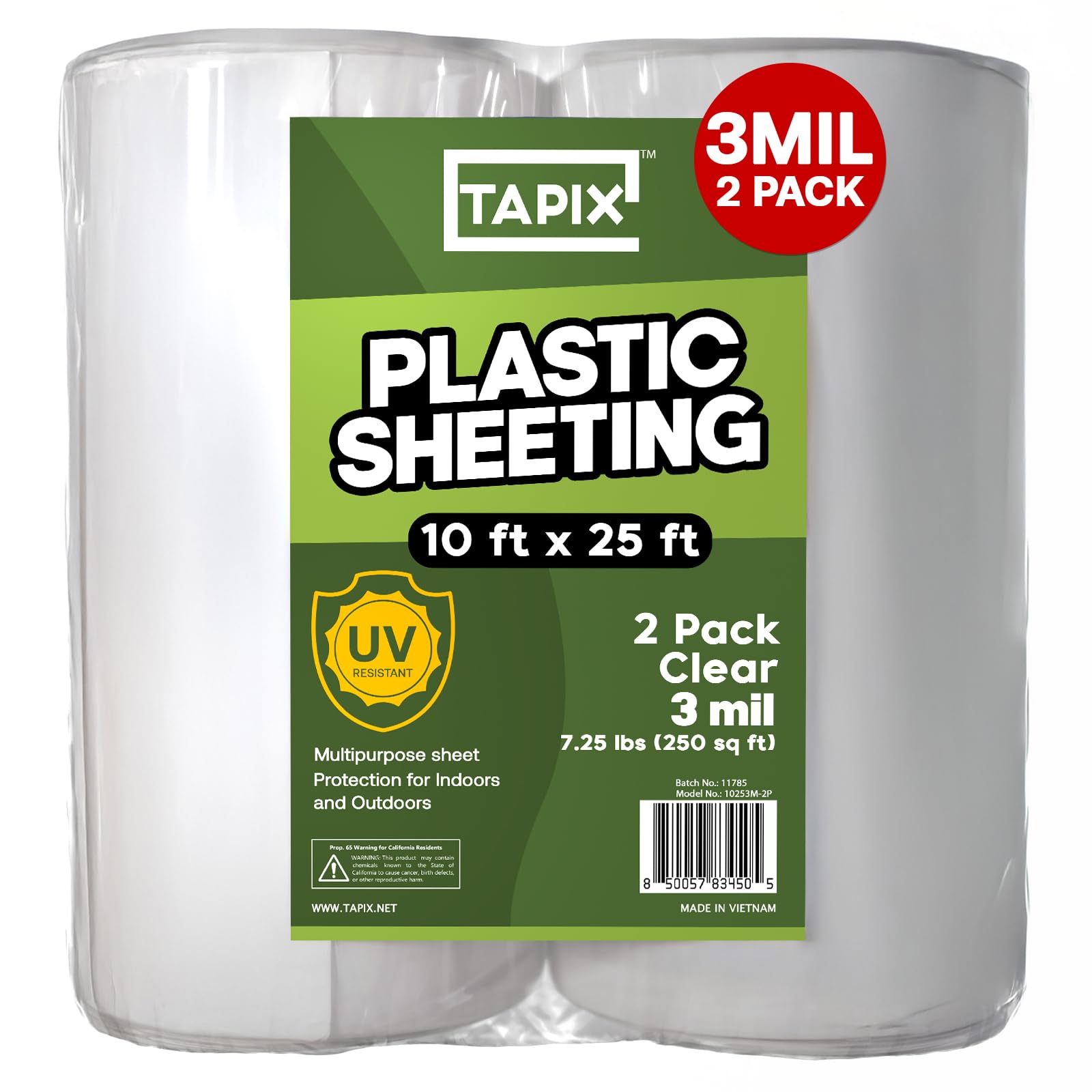
| Tapix 2-Pack (10′ x 25′)★ Best Overall | Overall value and outdoor projects | 500 sq ft (2 x 250 sq ft) | Clear | Yes | Amazon |
| Film-Gard 626132 (10′ x 25′) | Ground cloths and black-outs | 250 sq ft | Black | No | Amazon |
| ZipWall PY50 (10′ x 50′) | Professional dust containment | 500 sq ft | White | No | Amazon |
In‑Depth Reviews
1. Tapix Plastic Sheeting 2-Pack (10′ x 25′)
Our pick — over 4.5★ from 250+ verified ratings; the strongest balance of quality and price.
The two-pack that delivers 500 square feet of UV-stabilized plastic without a second trip to the store.
You get twice the material for roughly the same price as a single roll from some competitors — 2.0 Count vs 1.0 Count — and each 10-foot by 25-foot roll includes UV inhibitors that stop the sun from turning your garden cover or winter window seal into cracked confetti. The polyethylene film is waterproof and weather-resistant, so rain, snow, and wind bounce off it during outdoor jobs. What wins people over is the durability and quality (over a dozen owners single out each attribute): the plastic shrugs off punctures during installation yet stays lightweight enough for one person to drape over a greenhouse frame. It is notably more tear-resistant during setup than a basic clear roll like the Film-Gard, because the UV stabilizers also fortify the film.
The trade-off is clarity. Several owners note the sheet is translucent, not crisp. If you need to keep a view through a porch screen or a window, the milky look may disappoint. But for everything else — covering furniture during a paint job, creating a temporary zipper door, winterizing a window, or lining a garden bed — the feedback is relentless praise. Buyers report: “Excellent quality! We use it for the garden and it held up very well so far!” and another used it to tape over a large window for winter with no complaints.
What Owners Love
- UV protection keeps the plastic from sun damage during outdoor use
- Two-pack at a single-roll price — a 2.0x value advantage
- Waterproof and tear-resistant, yet light enough for one-person installation
The Real-World Catch
- Translucent, not clear — unsuitable for projects where visibility through the sheet matters
Best for: any outdoor-to-indoor project — gardens, windows, painting, emergency prep — where UV exposure is real and a second roll saves a second errand.
skip it if: you need a perfectly clear film to see through (porch enclosures, picture-window winter covers); this sheet is milky on purpose to diffuse light.
2. Film-Gard 626132 Consumer Plastic Sheeting (10′ x 25′)

The black sheet that blocks weeds, hides soil, and doubles as a stealth tent ground cloth.
This construction-grade polyethylene roll serves a completely different purpose than the clear Tapix two-pack above — it is opaque black. That makes it the pick for landscape mulch (no light gets to the weeds), for covering expensive soil bags during a storm, and for creating a privacy window film that still lets diffused daylight pass through. At 3.4 pounds for a 250-square-foot roll, it is easy to carry to the garden or toss into a camping bin. Owners mention: “Bought to use as a ground cloth under camping tent. Good gauge (thickness) for tent floor protection, folds to fit in tent bag.”
The coverage is what owners praise most — over a dozen mention it — and the material survives high wind without tearing when stapled down with a power stapler. The thickness does get mixed reactions; at 3 mil it is thinner than a dedicated landscape fabric, so one owner doubled the sheet under a rock garden and poked drainage holes to stop mosquito breeding. That is the honest limit: for ground cover under heavy stone or repeated foot traffic, you might want a second layer. Unlike the Tapix, this roll has no UV protection, so it is strictly for short stints in the sun.
Where It Shines
- Black color blocks all light — ideal for weed suppression and privacy film
- Light enough (3.4 lbs per roll) to bring camping as a tent footprint
- Construction-grade material handles staple guns and winter weather without tearing
The Fine Print
- No UV protection — not the first choice for long-term outdoor exposure without shade
- Some find the 3 mil thin for heavy rock gardens; doubling is an easy workaround
Reach for this if: the job needs total light blockage — ground cloth, garden mulch, privacy panel, or covering supplies from debris.
Look elsewhere if: your project lives in full sun for months or you need a clear window cover; this black roll blocks everything, including the view.
3. ZipWall PY50 Dust Barrier Plastic Sheeting (10′ x 50′)

A tear-resistant commercial roll that stays up for days without drooping, designed for the dustiest of jobs.
If you are ripping out tile, sanding drywall, or spray-painting a project that cannot get airborne dust on every surface, this is the specialist. The 50-foot roll (twice the length of the Film-Gard’s 25-foot roll) unrolls smoothly from its dispenser and works specifically with ZipWall poles to create a floor-to-ceiling seal that keeps fine particles contained. The review pages sum it up: “Thick, tear-resistant plastic; works well with ZipWall poles for tight floor-to-ceiling seal.” Owners also mention it holds up for a week without sagging and the white finish lets light through so you do not work in a dungeon. The Tapix two-pack is better for gardens; this ZipWall is built purely for indoor renovation dust.
The honest trade-off is the ecosystem: this sheeting is made for ZipWall’s own spring-loaded poles (sold separately). If you try to rig it with tape or ceiling screws, the weight of the plastic can pull it down — especially on high ceilings. That said, for a renovation where dust needs to stay in one room, the durability and ease of use are repeatedly called out as top attributes by owners. One buyer ran it across three doorways and still had material left over, confirming the 500-square-foot coverage stretches far.
The Pros
- Thick 3 mil construction resists tears and holds a tight floor-to-ceiling seal with proper poles
- White semi-translucent film provides privacy without blocking the sun
- 50-foot roll offers twice the coverage of standard homeowner sheets
Consider This
- Designed to pair with ZipWall poles (not included) — DIY rigging is less reliable
- No UV protection; strictly an indoor dust-containment tool
The right pick for: anyone mid-renovation who needs a dust-free zone — contractors, painters, and serious DIYers with ZipWall poles.
Not the pick for: garden covers, window wraps, or outdoor landscaping — this is an indoor specialist that needs those poles to perform.
Understanding the Specs
3 Mil Thickness
Mil measures thickness in thousandths of an inch. A 3-mil sheet is 0.003 inches thick. That is roughly three times the thickness of a heavy-duty trash bag, giving you much better puncture resistance without the stiff, hard-to-fold feel of thicker 6-mil film. For most homeowners, 3 mil is the balance: strong enough for garden covers and drop cloths, flexible enough to wrap around furniture and window frames.
UV Inhibitors
Some rolls include UV stabilizers — compounds mixed into the polyethylene that slow sun damage. Without them, plastic sheeting left outdoors can become brittle and start cracking within a few weeks. If your sheeting will see direct sunlight (covering a greenhouse, solar heater, or lumber pile), a UV-protected roll like the Tapix two-pack is worth the slight premium. For indoor-only jobs like dust barriers or paint drop cloths, UV protection adds zero value.
FAQ
Is 3 mil plastic sheeting strong enough for a temporary greenhouse?
Can I use 3 mil sheeting as a vapor barrier in my crawl space?
How does 3 mil compare to regular painter’s drop cloths?
Will 3 mil plastic stop drywall dust completely?
What does “translucent not clear” mean in practice?
Can I paint over 3 mil plastic sheeting?
How do I cut 3 mil plastic sheeting cleanly?
Will the plastic turn yellow or crumble after a month outdoors?
Does black plastic sheeting trap more heat than white?
How many square feet do I need for a standard two-car garage wall covering?
Final Thoughts: The Verdict
The Tapix Plastic Sheeting 2-Pack is the best buy for most people because you get UV protection, 500 square feet of coverage, and a 2.0x unit-count advantage over single rolls — all without needing to pick up a second roll mid-project. If your job requires total light blockage and a tent-friendly ground cloth, the Film-Gard 626132 in black covers exactly that at a reasonable price point. And for contractors or serious renovators who need a floor-to-ceiling dust barrier, the ZipWall PY50 provides the tear resistance and sag-free seal that keeps fine particles where they belong — in the work area, not the rest of the house.
How We Picked
We do not accept paid placement. Every pick is matched to a real buyer and a real use-case; we do not hands-on test units.
Sources & Methodology
Specifications: manufacturer listings and product documentation. Review insights: verified customer reviews, as of July 2026. Pricing: not shown on this page (it changes often); check the current price via the retailer link.
As an Amazon Associate, Gadgets Feed earns from qualifying purchases. This does not affect which products we feature.