
Our readers keep the lights on and my morning glass full of iced black tea. As an Amazon Associate, I earn from qualifying purchases.
Specs are compiled from manufacturer listings and verified buyer reviews and can change over time — please confirm the key details on the product page before buying.
You have been stranded by a dead lead-acid battery or struggled to lift a heavy, bulky box into a tight engine bay. The fix is switching to a lithium chemistry that weighs far less, cranks much harder, and lasts years longer than the old standard. This guide covers the three best 12-volt lithium car batteries on the market right now — from a drop-in replacement that saves serious pounds to a dual-purpose powerhouse that runs your accessories all weekend without the engine.
I’m Min — the founder and writer behind Gadgets Feed. This guide is built by comparing the manufacturers’ published specifications and the patterns across verified customer reviews, so you get each pick’s real strengths and trade-offs instead of marketing spin.
Upgrading a daily driver, a weekend track car, or a truck that runs a fridge and a microwave? Finding the best 12 volt lithium car battery depends on matching cold cranking amps (CCA, the measure of starting power in cold weather) and capacity (amp-hours, how long it runs your gear) to your real loads — and this guide lays out exactly which one does what.
Our Picks at a Glance
How To Choose The Best 12 Volt Lithium Car Battery
Switching from lead-acid to lithium in your car is not a one-size-fits-all move. The right choice depends on three main things: how much starting power your engine needs, whether you also run accessories off the same battery, and which physical size fits your tray. Here is what to check before you buy.
Group Size and Physical Fit
Car batteries come in standard BCI group sizes (Group 31, Group 47, Group 48) that define length, width, and height. Measure your current battery tray and confirm the polarity orientation — lithium batteries are only a drop-in replacement if they share the exact same footprint and terminal layout as the original.
Cold Cranking Amps (CCA)
CCA measures how many amps a battery can deliver at zero degrees Fahrenheit for 30 seconds while keeping voltage above 7.2 volts. A higher CCA number means easier starting in cold weather and for high-compression engines. For a typical four-cylinder car, 400 to 600 CCA is fine; for a big V8 or a diesel truck, 800 to 1600 CCA is the safer target.
Capacity and Dual-Purpose Use
Amp-hour (Ah) rating tells you how long the battery can run things like lights, a fridge, or an inverter after the engine is off. A pure starter battery focuses on high CCA with low Ah. A dual-purpose battery balances both — enough CCA to start the engine and enough Ah to run accessories for hours or days without draining.
Quick Comparison
| Model | Best For | CCA | Weight | Capacity | Amazon |
|---|---|---|---|---|---|
| NOCO Lithium NLX31★ Best Overall | Dual-Purpose Power | 1,600A peak / 200A cont. | 37.9 lbs | 120Ah | Amazon |
| Wuldnmar G47 LiFePO4 | Lightweight Daily Driver | 600A (tested to 850) | 11.02 lbs | — | Amazon |
| TPE Group 48 | High-CCA Performance | 1,100A (tested to 1,300) | 16.09 lbs | 50Ah (max 60Ah) | Amazon |
In‑Depth Reviews
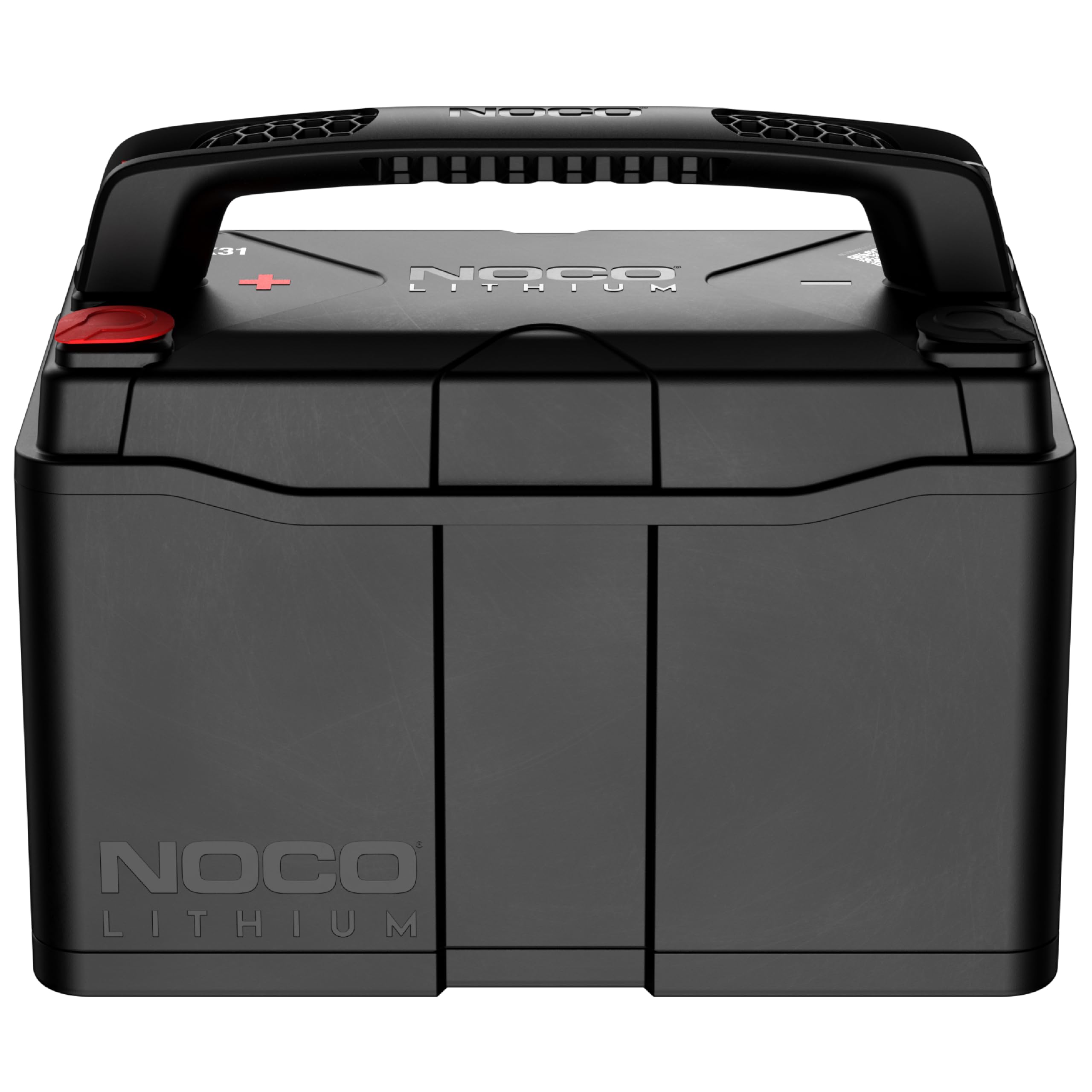
1. NOCO Lithium NLX31
Our pick — over 4.5★ from 30+ verified ratings; the strongest balance of quality and price.
The dual-purpose battery that starts a Peterbilt and powers a weekend fridge.
This is the battery for the person who needs everything — massive starting power AND true deep-cycle capacity (the ability to discharge deeply and recharge repeatedly without damage) in one box. The NOCO NLX31 delivers 1,600 amps of peak current (enough to spin a big diesel instantly) and 120 amp-hours of continuous deep-cycle energy without any voltage drop-off. Buyers report installing four of them in a 2015 Peterbilt 579, where they crank faster than the old lead-acid batteries and run a microwave, coffee maker, and fridge all weekend without the engine running, all without triggering an inverter low-voltage trip (a safety shutoff when voltage drops too low).
At 37.9 pounds, it is still noticeably lighter than a comparable Group 31 AGM battery The built-in Battery Management System (BMS) handles overcharge, overdischarge, and short circuits with active thermal monitoring that requires no manual reset. It recharges fully in just 2.4 hours at a 50-amp charge current The IP65 rating resists vibration, water, and dust, and the quad-post terminal layout supports series or parallel setups for up to four batteries.
The trade-off is the weight. At 37.9 pounds, this is not a featherlight battery — it is built for full-size trucks, RVs, marine applications, and off-grid setups where capacity and starting power matter more than shaving every pound. The 11.02-pound Wuldnmar (below) is over three times lighter, but it offers a fraction of the deep-cycle capacity.
What wins people over
- 1,600A peak starting current — turns over big diesels without struggle
- 120Ah deep-cycle capacity with no voltage sag
- Fully recharges in 2.4 hours, twice as fast as lead-acid
- IP65-rated against water, dust, and vibration
The honest fit note
- At 37.9 lbs it is heavy compared to pure starter lithiums
- Overkill for a small commuter car that only needs starting power
Reach for it if: you drive a full-size truck, van, RV, or boat and want one battery that starts the engine and runs your accessories for days.
Look elsewhere if: you only need a starting battery for a small car and want to save every ounce.
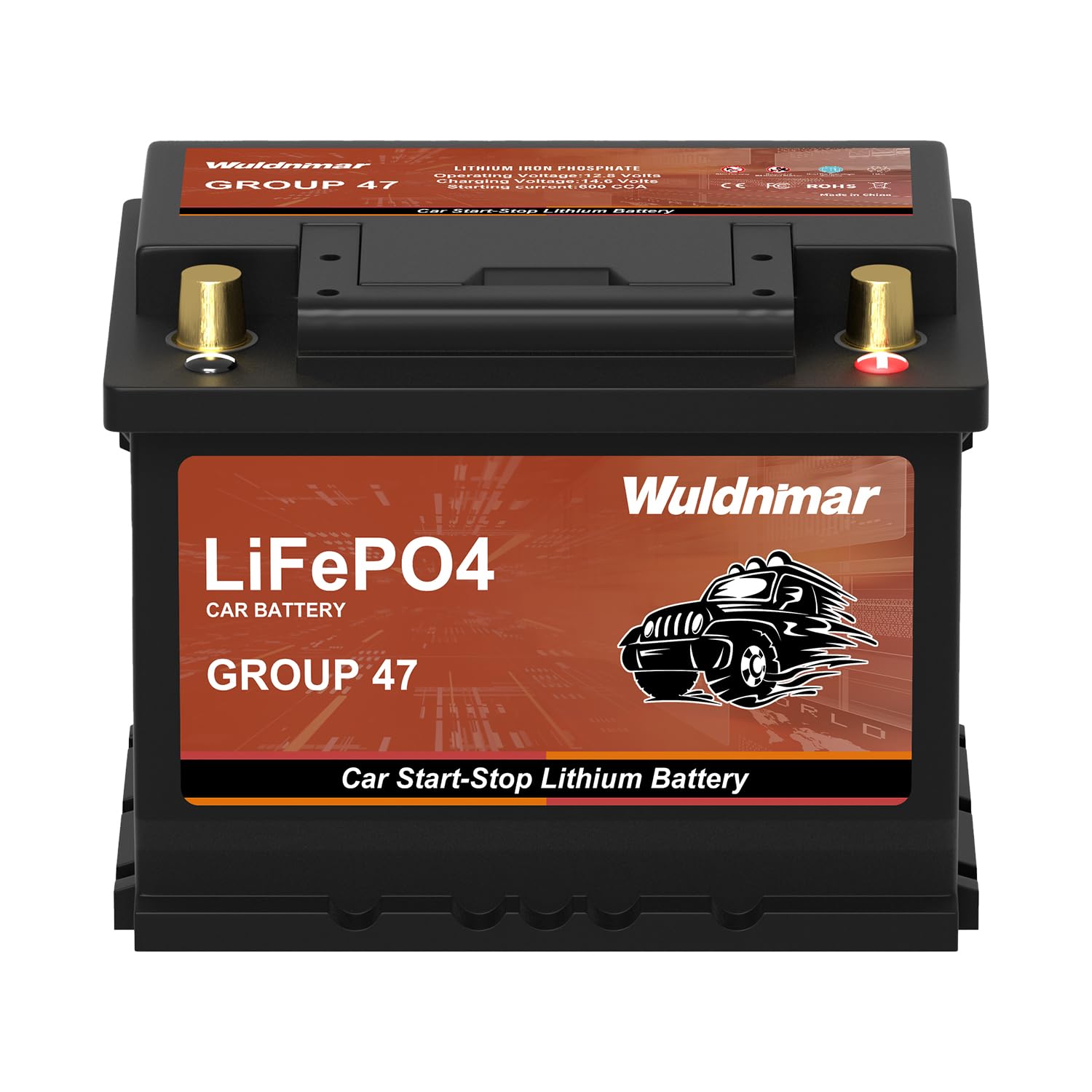
2. Wuldnmar G47 LiFePO4 600CCA
The featherweight that drops into a 1990 Jetta and fires right up.
This is the battery for the lightweight-obsessed driver — the one who wants every pound shaved off the front axle without sacrificing reliability. The Wuldnmar G47 weighs just 11.02 pounds, at 11.02 pounds versus the NOCO at 37.9 pounds It delivers a rated 600 cold cranking amps, tested up to 850 CCA, in a compact Group 47 form factor (9.60 x 6.92 x 7.75 inches). One owner slid it into a 1990 VW Jetta GLI replacing a Group 41 lead-acid and said it fit the battery tray better than the original, plugged right in, and started the car with no effort.
The LiFePO4 chemistry and built-in BMS give you overcharge, overdischarge, and overcurrent protection. Owners using it in performance applications praise the performance — one runs a 4,000-watt amplifier circuit with the engine off for 20-30 minutes at full tilt with no issues. That said, performance reviews are mixed on battery performance consistency. A few owners running high-voltage alternators (14.8V cold start in a V8 Miata) note that lithium charging behavior differs from AGM and suggest monitoring voltages closely. Another report mentions a check-engine light (code P2610) potentially tied to low voltage, which resolved with a battery tender but returned without one.
The number to note: 11.02 pounds against 37.9 pounds for the NOCO. That is a weight gap of nearly 27 pounds — a real difference for handling, acceleration, and ease of installation. If your car uses a Group 47 (H5) size, check terminal orientation before buying; the polarity is marked [- +].
Why owners like it
- 11.02 lbs — drastically lighter than any lead-acid or dual-purpose lithium
- 600 CCA (tested to 850) starts most passenger cars easily
- Direct drop-in for Group 47/H5 applications
What to watch
- Mixed reviews on battery performance consistency in some vehicles
- Lack of stated amp-hour capacity leaves some uncertainty for deep-cycle use
Ideal for: the daily-driver or weekend-track owner who wants the lightest possible lithium battery for a Group 47-fit car.
Think twice if: your vehicle has a high-output alternator above 14.5V and you are not comfortable monitoring charge voltages.
3. TPE Group 48 60Ah 1100CCA

The 16-pound track upgrade that drops nearly 30 pounds off your nose.
If you drive a Corvette, a sports car, or any vehicle where unsprung and front-axle weight matters (less weight on the wheels and front end improves handling), this TPE Group 48 battery is the crowd-pleaser. It weighs 16.09 pounds and delivers 1,100 cold cranking amps (CCA, tested up to 1,300 CCA), which is a massive punch for a battery this light. Owners of a C7 Grand Sport and a C8 Z06 report saving 25 to 30 pounds over the factory lead-acid — one Corvette owner measured a drop from 44.6 pounds down to 14.8 pounds, a 29.8-pound saving that sharpens handling and acceleration.
The BMS-protected LiFePO4 cells give you a rated capacity of 50Ah (max 60Ah) and a cycle life the maker says can reach up to 2,000 runs. The battery is fully charged from the start, so there is no activation or acid fill — just measure your Group 48 tray (10.8 x 6.9 x 7.5 inches), drop it in, and start. A 2013 GMC Sierra owner confirms it holds charge better than the old lead-acid battery, and the weight is the single most-discussed positive aspect. Performance is the top praise in the reviews, with weight coming second.
The catch is the Group 48 form factor — this is a specific size used mostly in European cars, some GM trucks, and Corvettes. It will not fit a Group 47 or Group 31 tray without adapter plates. Also, the 50Ah capacity is modest for deep-cycle accessory use; this is a starter battery first, with enough reserve for short-duration loads. The price sits above a comparable AGM, but owners across the board call it cost-effective given the longevity and weight savings.
Owner-tested verdict: “Saved 25lbs in my C7 Grand Sport track car. Has been flawless over the first 3 months.” The thing everyone raves about is the weight — dropping nearly 30 pounds off the front axle is a real upgrade for any performance car.
Reach for it if: you drive a Group 48-fit sports car, track car, or truck and want a big CCA boost with minimal weight.
skip it if: your battery tray is a different BCI group size (Group 47, Group 31) and you do not want to adapt the fitment.
Understanding the Specs
Cold Cranking Amps (CCA)
CCA is the number that tells you how well a battery can start your engine in freezing weather. It measures the amps the battery can deliver at 0°F for 30 seconds while staying above 7.2 volts. If you live where winters get cold or drive a high-compression V8, 800+ CCA is a safer bet. For a modern four-cylinder, 500 to 600 CCA is usually plenty.
Amp-Hours (Ah) and Deep-Cycle
Amp-hours tell you the battery’s energy storage — how long it can run things when the engine is off. A pure starter battery may have a small Ah rating because it is designed for short, high-current bursts. A dual-purpose battery (like the NOCO NLX31 at 120Ah) can run a fridge, lights, or an inverter for hours or days without damaging the cells. For most daily drivers, a moderate Ah is fine; for RVs and overlanding, you want the biggest Ah in your tray.
FAQ
Will a lithium car battery work in my standard car?
How long does a LiFePO4 car battery last?
Can I use a standard lead-acid charger on a lithium battery?
What is the difference between a starter battery and a dual-purpose battery?
Can a lithium battery handle start-stop vehicles?
How much weight can I save switching from lead-acid to lithium?
What does the Battery Management System (BMS) do?
Is a lithium car battery safe in hot or cold weather?
Can I use a lithium car battery for audio or inverter loads?
Do I need to modify my car’s charging system for a lithium battery?
Final Thoughts: The Verdict
For most people, the 12 volt lithium car battery winner is the NOCO Lithium NLX31 because it does it all — 1,600 amps of starting power combined with 120Ah of deep-cycle capacity in a rugged IP65-rated shell. If you want the lightest drop-in for a Group 47 daily driver, grab the Wuldnmar G47 at 11.02 pounds. And for a high-CCA track-day upgrade that saves nearly 30 pounds off your Corvette’s nose, the TPE Group 48 is the one the C8 owners reach for.
How We Picked
We do not accept paid placement. Every pick is matched to a real buyer and a real use-case; we do not hands-on test units.
Sources & Methodology
Specifications: manufacturer listings and product documentation. Review insights: verified customer reviews, as of July 2026. Pricing: not shown on this page (it changes often); check the current price via the retailer link.
As an Amazon Associate, Gadgets Feed earns from qualifying purchases. This does not affect which products we feature.