
Our readers keep the lights on and my morning glass full of iced black tea. As an Amazon Associate, I earn from qualifying purchases.
Specs are compiled from manufacturer listings and verified buyer reviews and can change over time — please confirm the key details on the product page before buying.
Finding the right 2 pin headphone cable often means choosing between a length that keeps you tethered to your desk and a sound quality that lifts your listening. This guide compares three top-rated cables built for the daily listener and the dedicated audiophile, cutting through the marketing to highlight what each one actually delivers in real use.
I’m Min — the founder and writer behind Gadgets Feed. This guide is built by comparing the manufacturers’ published specifications and the patterns across verified customer reviews, so you get each pick’s real strengths and trade-offs instead of marketing spin.
Stop guessing at compatibility and start hearing the difference a better conductor makes. We compare connectivity, conductor count, and real-world feedback to find the best 2 pin headphone cable for your setup.
Our Picks at a Glance

How To Choose The Best 2 Pin Headphone Cable
Choosing a 2 pin headphone cable is about matching the length to your listening space and the build to your ears. First, decide on the length: a 1.2m cable is perfect for portable use, while a 1.5m or 2m cable gives you room to move at a desktop setup. Next, look at the conductor—silver-plated copper offers brighter highs and better detail retrieval, which audio enthusiasts often prefer. Finally, check the connector orientation: standard 0.78mm 2-pin is the most common, but some IEMs use a recessed 2-pin that needs compatible plugs.
Length and Your Listening Space
Your cable length determines how freely you can move without pulling your IEMs out. A 1.2m cable is great for a jacket pocket or a phone in your hand, but it can be restrictive when your source sits on a desk or in a lap. A 1.5m cable gives you slack to lean back, and a 2m cable is a treat for desktop DACs and studio racks—no more feeling like you’ve reached your limit.
Conductor Material and Strand Count
Most cables use silver-plated copper (SPC) wire. Silver enhances high-frequency clarity, while copper keeps the bass solid. More strands—like 16 cores instead of 4—mean lower resistance and often a more flexible cable. But the actual benefit depends on your IEM and your ear: some listeners notice a cleaner soundstage, others hear no difference at all. For most people, a 16-strand SPC cable offers the best balance of upgrade and value.
Connector Compatibility
The standard 0.78mm 2-pin connector fits the vast majority of detachable IEMs today. However, some brands recess the socket slightly, so you need a cable with a narrower plug to avoid a gap. Always check your IEM’s pin type before buying.
Quick Comparison
| Model | Best For | Length | Conductor Strands | Connector | Amazon |
|---|---|---|---|---|---|
| Linsoul Tripowin Zonie★ Best Overall | Desktop & studio setups | 2 meters | 16-core SPC | 0.78mm 2-Pin | Amazon |
| keephifi KBEAR ST16-Max | Medium-length convenience | 1.5 meters | 16-strand SPC (224 cores) | 0.78mm 2-Pin | Amazon |
| NICEHCK IcyMoon | Budget-friendly upgrade | 1.2 meters | 16-strand OCC silver-plated | 0.78mm 2-Pin | Amazon |
In‑Depth Reviews
1. Linsoul Tripowin Zonie IEM Cable
Our pick — over 4.5★ from 350+ verified ratings; the strongest balance of quality and price.
The extra-long cable that frees you from your device without sacrificing sound quality.
The Tripowin Zonie has long been a favorite for budget-conscious audio enthusiasts, but its standard length always felt a bit short for desk users. This 2-meter version solves that. Buyers report the “perfect length to reach the back of my desktop,” which is exactly the relief you need when your amp or DAC sits on a shelf or across the desk. The 16-core silver-plated copper wire feels soft and flexible, with a braiding technique that resists tangling. The pre-shaped earhooks sit securely whether you’re leaning in for a mix or moving around the room.
Listeners note a clear improvement in sound. The highs feel more open and less distorted, and the midrange stays intact. At 2 meters, there is less tension on the connectors, which means less strain on your IEM’s socket over time. Quality is the most-discussed praise, with functionality and sound quality also standing out. Durability earns mixed feedback—some wish the braiding felt more substantial, but the crowd loves the tangle-free behavior and comfort.
One thing to know: a few owners found the cable barely short of a full 2 meters when measured. If you absolutely need every inch, measure your route first. But for most desktop, studio, and living-room setups, this cable delivers a noticeable upgrade in freedom and clarity.
Best in Practice
- Generous 2-meter length for flexible desk setups
- Soft, tangle-resistant braid with 16-core SPC wire
- Snug, adjustable chin slider and secure earhooks
Consider This
- Some debate over exact 2-meter length
- Braiding feels a bit loose to a few owners
Reach for this if: you need desk-length freedom and a tangle-free, flexible cable that doesn’t break the bank.
Look elsewhere if: you need an ultra-tough cable for heavy stage use or strict hard travel.
2. keephifi KBEAR ST16-Max IEM Cable
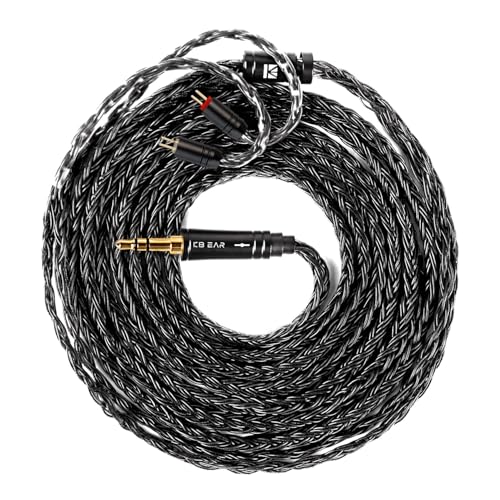
The medium-length cable with a massive 224-core conductor for a richer, more detailed sound.
The KBEAR ST16-Max hits a smart middle ground: it gives you enough length for desktop use without the extra slack of a 2-meter cable. At 1.5 meters, it is longer than a pocket-friendly 1.2m cable and shorter than the 2-meter Zonie, so you can use it at your desk or on the go. This cable uses a 16-strand braid with each strand having 14 cores—that makes 224 total cores of 5N single-crystal copper with silver plating. The result is a conductor that keeps bass deep and controlled while opening up the highs for airy, detailed playback. Buyers praise the cable quality highly, and the value is clear for the price.
Owners note the cable feels solid and substantial, which is great for longevity but means the weight can pull out a loose-fitting IEM. One owner sums it up: “Great cable, the length is so convient for desktop setup.” The sound signature aims for a warm, musical character, with the 224-core design handling complex tracks without blurring instruments together.
The main trade-off is that the sturdy braid and thicker strands can make the cable feel a bit stiff, and the weight of the splitter may tug on longer ear loops. Also, the chin slider is not the most effective for all ear sizes. Cable quality is the top praise by a wide margin, with flexibility and tangle-free use being a little more mixed. For desktop use where you want a noticeable step up in conductor quality, this is a strong pick.
What Stands Out
- High-density 224-core conductor for cleaner sound
- Ideal 1.5-meter length that avoids being too long or too short
- Gold-plated, anodized aluminum connectors resist corrosion
Check These
- Heavier cable can weigh down less secure IEMs
- Braided wires can snag on rough surfaces
Grab this for: a desktop-friendly length with a conductor dense enough to reveal studio-quality detail.
Pass if: your IEMs have shallow fit or you need a lightweight, travel-only cable.
3. NICEHCK IcyMoon IEM Upgrade Cable
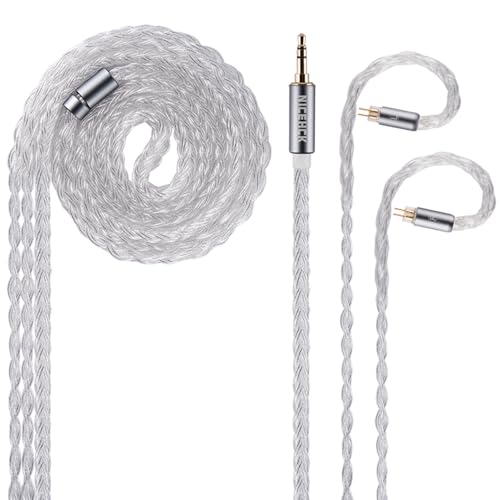
The budget-friendly 16-strand cable for a clear audio improvement.
The NICEHCK IcyMoon looks and feels like a higher-end cable, even though it sits at an entry-level price. It uses a 16-strand OCC monocrystalline (a high-purity copper crystal) and silver-plated OFC (oxygen-free copper) conductor inside a thick, durable jacket. One owner immediately noticed the difference: “I can hear the difference and works better than my stock 6cable Iem cables.” The 1.2-meter length is right for portable players and phone listening—enough slack to keep the phone in a bag pocket without pulling your IEMs out. The silver aluminum alloy plug and splitter give it a sleek, minimalist look that matches just about any IEM.
What wins people over is the sheer value. The cable uses a 16-strand OCC silver-plated conductor, which is a substantial upgrade over stock cables. The sound comes through with a balanced output, and the 0.78mm 2-pin connectors snug into standard IEM sockets. The thick coating feels reassuringly sturdy, though a few note it is thicker than average, which can add stiffness. The aluminum shell helps prevent corrosion, a small but welcome detail for long-term ownership.
Since this cable uses a 3.5mm single-ended plug, it works with standard portable DACs and phones without a balanced adapter. For the price, there is very little to regret. The only caution is the thicker profile: it might be less flexible than a thinner cable, and the lack of a chin slider (or a less effective one) could be a minor annoyance for active listening. For a straightforward, affordable upgrade over a stock cable, this is a clear win.
What Shines
- 16-strand OCC silver-plated conductor at a very low price
- Thick, sturdy build that feels more premium than its cost
- Stylish silver aluminum alloy connectors
Keep in Mind
- Thicker than average cable may feel stiff
- Limited to 3.5mm single-ended termination
Ideal for: budget-first buyers who want a pure audio upgrade from stock cables without spending a lot.
Look past if: you need a flexible, thin cable for active use or a balanced 4.4mm plug.
Understanding the Specs
Length and Flexibility
The length of a 2 pin headphone cable affects what you can do with it. A 1.2m cable is fine for a pocket player, while 1.5m and 2m versions let you reach your desktop rack or move around more. Flexibility is key: a soft, braided cable resists tangling and feels comfortable against your skin.
Conductor Strands and Materials
The strands inside carry the audio signal. A 16-core silver-plated copper (SPC) wire is a common upgrade that balances bright highs with solid bass. More strands (like 224 cores in some cables) mean lower resistance and potentially better detail, but the real benefit depends on your IEM.
FAQ
Will a 2 pin headphone cable fit all IEMs?
Can I use a 2 meter cable for portable listening?
What is the best length for a desktop setup?
Does a silver-plated cable actually sound better?
What does “16-core” or “224-core” mean?
Can I replace the cable on any IEM?
What is the difference between 2-pin and MMCX?
How long do these cables last?
Can I use a balanced cable with a standard 3.5mm jack?
Does a thicker cable mean better sound?
Final Thoughts: The Verdict
For most buyers, the best 2 pin headphone cable winner is the Linsoul Tripowin Zonie because its 2-meter length, tangle-free 16-core-silver-plated braid, and crowd-pleasing reputation cover both desktop and mobile needs at a reasonable price. If you prefer a medium-length cable with a high-density 224-core conductor for richer detail, grab the keephifi KBEAR ST16-Max. And for a budget-friendly pure upgrade that brings twice the strands of a stock cable, the NICEHCK IcyMoon delivers impressive audio value without breaking your wallet.
How We Picked
We do not accept paid placement. Every pick is matched to a real buyer and a real use-case; we do not hands-on test units.
Sources & Methodology
Specifications: manufacturer listings and product documentation. Review insights: verified customer reviews, as of July 2026. Pricing: not shown on this page (it changes often); check the current price via the retailer link.
As an Amazon Associate, Gadgets Feed earns from qualifying purchases. This does not affect which products we feature.