
Our readers keep the lights on and my morning glass full of iced black tea. As an Amazon Associate, I earn from qualifying purchases.
Specs are compiled from manufacturer listings and verified buyer reviews and can change over time — please confirm the key details on the product page before buying.
That sputtering well pump or the sprinkler zone that drains back every cycle — you need a solid 1 1/4 check valve to stop the backward flow. A good one keeps your system primed, protects your pump from dry-running damage, and saves you from crawling under the house to re-prime on a freezing morning.
I’m Min — the founder and writer behind Gadgets Feed. This guide is built by comparing the manufacturers’ published specifications and the patterns across verified customer reviews, so you get each pick’s real strengths and trade-offs instead of marketing spin.
The best 1 1/4 check valve for your setup depends on one thing — matching the material and valve type to your piping system, pressure, and what you are pumping through it.
Our Picks at a Glance


How To Choose The Best 1 1/4 Check Valve
A check valve is a simple device — it lets water flow one way and slams shut if it tries to go backward. But picking the wrong one for your 1-1/4-inch system can cause water hammer (that loud banging when the valve closes), a pump that cycles on and off constantly, or an eventual failure that leaves you with a flooded basement or a dry well. Here is what to look for.
Valve Type: Spring vs. Swing vs. Inline
A spring-loaded poppet valve uses a spring to push the sealing disc closed, so it works in any orientation — horizontal or vertical. This is the most common type for well pumps and irrigation because it is quiet and reliable. A swing check valve uses a hinged flap that swings open with flow and falls shut by gravity — these need horizontal installation or vertical flow upward. They handle higher flow rates well but can chatter if the flow is turbulent. An inline check valve is a compact spring-loaded design made for tight spaces but often has a narrower internal passage; some buyers report they are not suitable for water with solids like pond silt or debris.
Material: Brass vs. Plastic
Brass is the gold standard for durability in a check valve — it resists corrosion, handles higher pressures (typically 200 PSI), and the machine work on the threads is precise, which means fewer leaks. A lead-free brass valve is required for potable (drinking) water systems under national plumbing codes. Plastic valves — usually PVC or ABS — are much cheaper, lighter, and resistant to chemicals, but they are more brittle and a few owners mention them cracking or failing faster, especially on well pumps that cycle under constant pressure. Plastic is a fine choice for cold-water garden irrigation or sump pump discharge if you keep an eye on it.
Pressure and Cracking Pressure
The maximum pressure rating, given in PSI (pounds per square inch), tells you the highest pressure the valve can withstand without bursting. For most residential well and irrigation systems, a 150 PSI to 200 PSI rating is plenty. Cracking pressure is the minimum pressure needed to push the valve open — typically around 0.5 PSI for spring valves. A lower cracking pressure means the valve opens more easily, which is critical for low-pressure gravity-fed systems or hand pumps where every bit of head pressure matters.
Installation Orientation
Some check valves are designed for vertical installation only — the Red Lion ABS swing check is one example. Most spring-loaded poppet valves (the brass ones) can be mounted horizontally or vertically, which gives you flexibility in tight crawlspaces or pump houses. Always check the product’s spec sheet before gluing or threading your pipe, because a valve installed in the wrong orientation may not seal properly and can cause backflow.
Quick Comparison
| Model | Best For | Material | Pressure Rating | Connection Type | Amazon |
|---|---|---|---|---|---|
| Parts2O TC2505LF★ Best Overall | Well pump priming | Lead-free Brass | — | 1-1/4″ NPT Threaded | Amazon |
| MIDLINE VALVE PVC InlineBudget Champion | Budget irrigation | PVC Plastic | 150 PSI | 1-1/4″ Solvent (Glue) | Amazon |
| Red Lion SCV114Sump Specialist | Sump pump discharge | ABS Plastic | — | 1-1/4″ or 1-1/2″ Slip | Amazon |
| Boltigen Spring Check Valve | General backflow prevention | Solid Brass | 200 PSI | 1-1/4″ NPT Female | Amazon |
| Flngr 1-1/4″ Check Valve | Well & irrigation systems | No-Lead Brass | 200 PSI | 1-1/4″ NPT Female | Amazon |
| Merrill CVNL125 | Vertical & horizontal installs | No-Lead Brass | 200 PSI | 1-1/4″ NPT Female | Amazon |
| Wassermann Spring Check Valve | Submersible well pumps | Brass | — | 1-1/4″ NPT & FNPT | Amazon |
| Midline Valve 432U336 | Potable water systems | Cast Brass, Lead-Free | 200 PSI WOG | 1-1/4″ FIP Threaded | Amazon |
| Hallmark Industries Check Valve | Submersible pump backup | Brass | — | 1-1/4″ NPT Male in / FNPT out | Amazon |
In‑Depth Reviews
1. Parts2O TC2505LF 1-1/4-Inch Check Valve
Our pick — over 4.5★ from 750+ verified ratings; the strongest balance of quality and price.
The brass benchmark that keeps well pumps reliably primed for years.
This is the valve most owners reach for when a plastic one fails. It is made from lead-free brass with a stainless steel spring — the poppet-style design gives you full 360-degree flow, meaning less restriction through your 1-1/4-inch pipe. What wins people over is how it handles the constant duty of a well pump: the low opening pressure means even a shallow well or a pitcher pump on a 36-inch riser (a vertical pipe rising from the well) can push it open without struggle.
The compact body is 2.16 x 2.34 x 5.04 inches — notably shorter than some brass swing valves — which saves space in tight pump houses. A few owners note the threading is precise and seals cleanly with standard Teflon tape. The recurring trade-off is that this is a spring-loaded poppet; if your water has turbulent flow right after a 90-degree turn, it can chatter (the spring vibrates as the poppet bounces), but most installations see zero issues.
Parts2O reliable seal: The workhorse pick for anyone on a well — it holds prime easily, and the all-brass construction outlasts any plastic valve on the shelf.
limited flow capacity: If your system has turbulent flow from tight bends, you may hear a chatter; a short straight pipe run before the valve usually solves it.
durable choice: you need a durable, leak-free brass valve for a well, irrigation pump, or holding tank — it is the most trusted pick in this class.
tight spaces: you are on a tight budget or only need a one-season fix for a lawn sprinkler line — a plastic valve costs less.
2. MIDLINE VALVE PVC Inline Check Valve 1-1/4″
A cost-saving inline check that shines in clean-water sprinkler and pond output lines.
At roughly a third the price of a brass valve, this PVC inline check from Midline Valve is the go-to for budget sprinkler repairs and pool circulation. It uses solvent-weld (glued) connections instead of threads, so you need PVC primer and cement to install it, but once glued, the seal is permanent and leak-free. The specs are solid for cold-water use: it is rated to 150 PSI at 73°F and the cracking pressure is just 0.5 PSI (half a pound), so even low-flow gravity systems can open it.
The catch — and it is a real one — is that this valve is not designed for water with solids. As a few owners discovered, using it on a pond intake line with debris or silt can cause clogging. On the output side of a clean-water pump or in a sprinkler zone where the water is filtered, it works flawlessly. The reliable build quality (24 positive mentions) and the price point make it a smart choice for the job it was designed for.
Midline clear design: This is a pure clean-water valve — keep it on sprinkler, pool, or pump output lines and it performs beautifully.
requires proper alignment: Put it on a pond or dirty-water intake and you will be unclogging it; the manufacturers say the same thing.
transparent option: you need an inexpensive, reliable check for a sprinkler system, waterfall pump output, or any cold-water line without solids.
misalignment risk: your water has sediment, sand, or pond debris — grab a brass swing or spring valve instead.
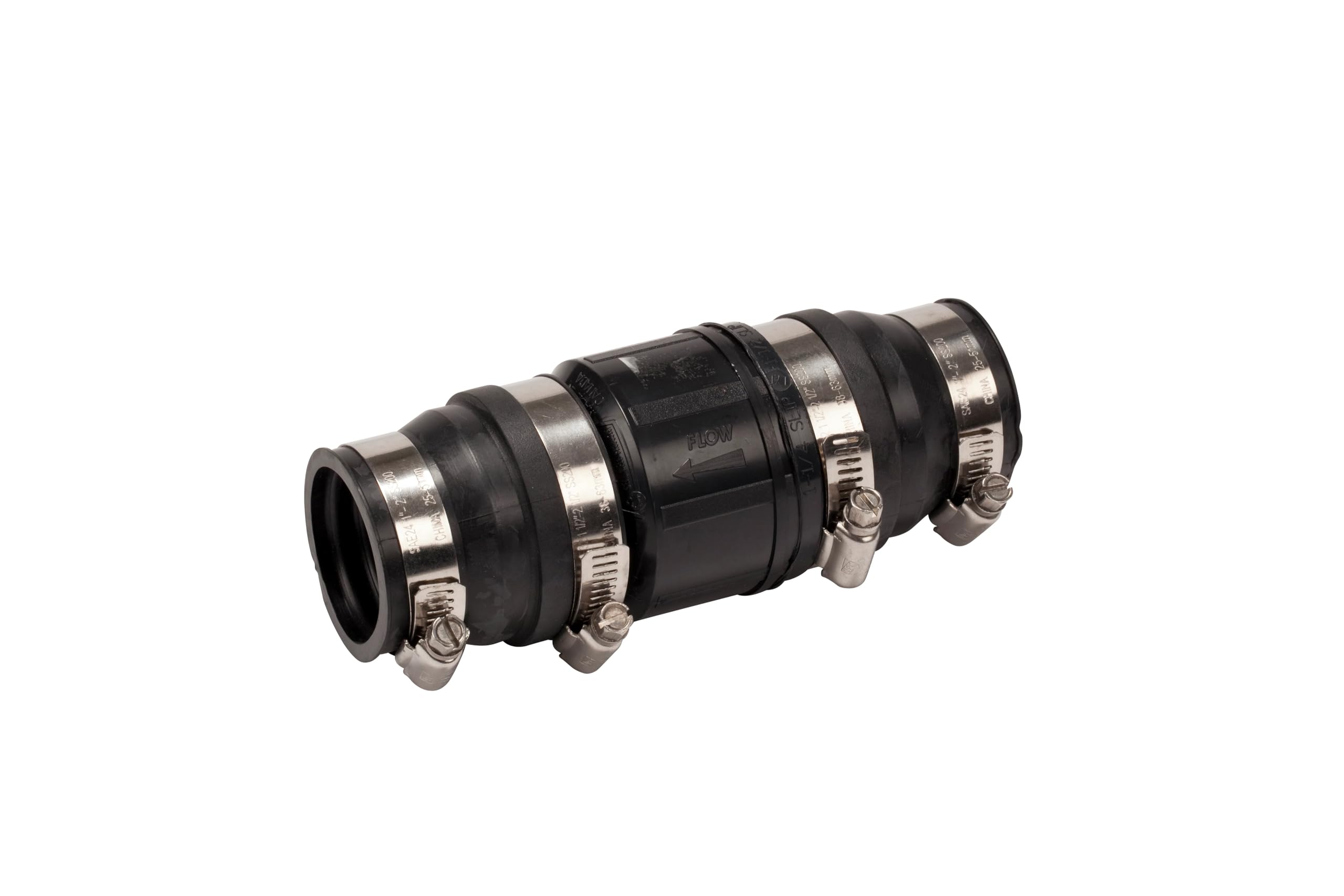
3. Red Lion SCV114 Vertical Sump Pump Check Valve
The ABS flapper that shuts tighter than anything else in the sump pit.
This is not a universal check valve — it is built exclusively for vertical installation, which is exactly what a sump pump discharge pipe is. The Red Lion SCV114 uses a flapper-style design (a hinged rubber disc that swings fully open when water flows) instead of a spring-loaded poppet. The flapper opens 100%, which means less resistance on the pump and less debris buildup. what separates it is the dual-size adapters: you get reversible fittings that let you use this on either 1-1/4-inch or 1-1/2-inch pipe, making it a future-proof choice if you ever upsize your discharge line.
Compared directly against valves from three other manufacturers by one shopper who took the time to compare, this one was described as the most water-tight of them all. The four stainless steel clamps give you a solid mechanical grip without glue. At just 0.6 pounds, it is featherlight and easy to handle. The only catch is the vertical-only requirement — install it sideways and it will not seal at all, so mark the flow direction arrow carefully before gluing. At 8.28 inches long (the full length of the assembly), it is noticeably longer than the compact Parts2O brass valve — a 3.8x dimensional difference in length when you look at the full unit against the Parts2O’s 5.04 inches — so measure your pipe clearance before buying.
Red Lion vertical fit: For a sump pump riser, this is the valve that buyers trust most to stop backflow and keep the pump from short-cycling.
horizontal only: it must sit upright on a vertical pipe — no horizontal installations.
sump pump pick: you are replacing a sump pump check valve and want a leak-free seal with the flexibility of dual pipe sizes.
horizontal pipes: your installation is horizontal or you need a spring-loaded valve for a pressurized well line — grab a brass spring valve instead.
4. Boltigen Solid Brass Spring Check Valve 1-1/4″ NPT
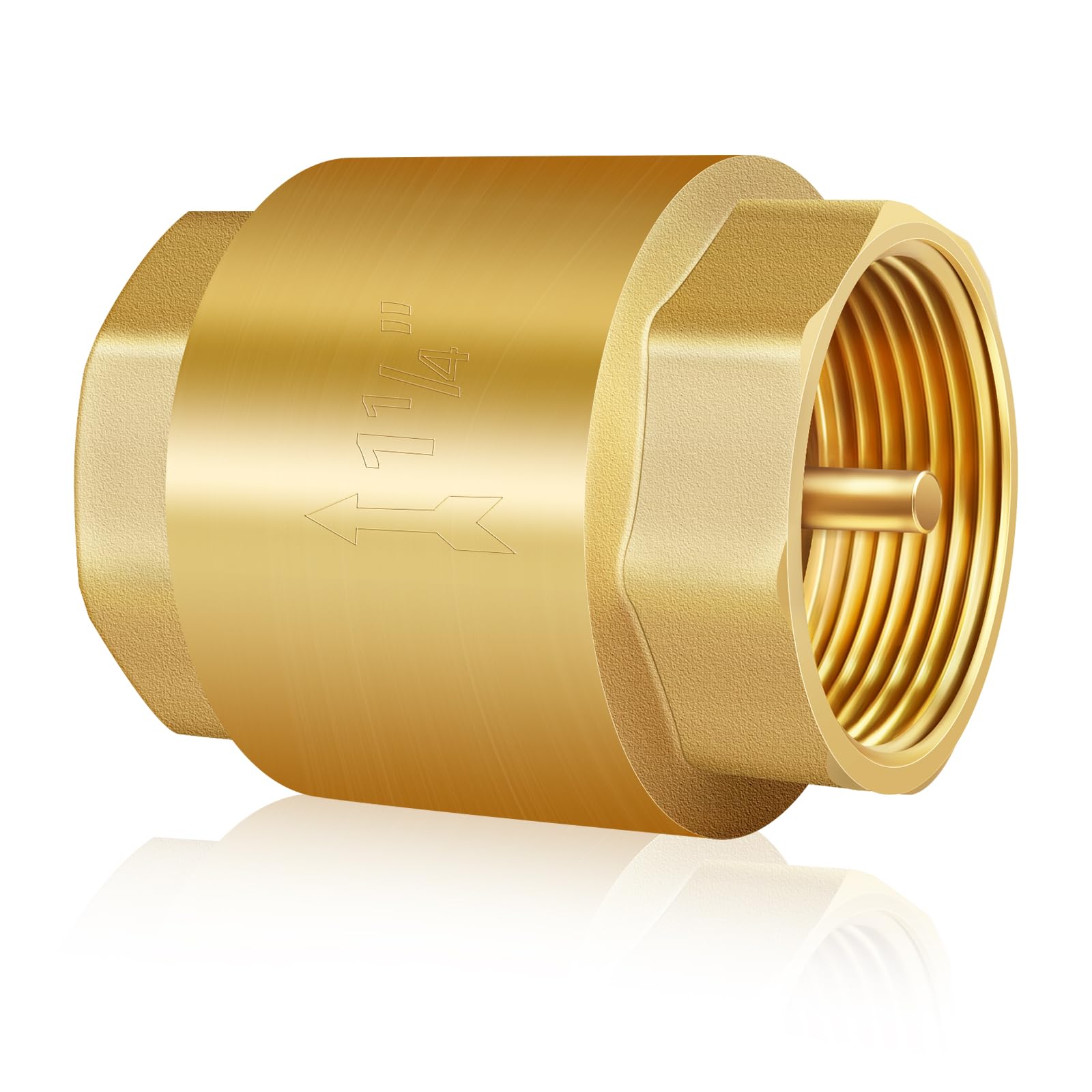
A heavy-duty brass spring check that took a sprinkler system from broken to fixed.
The Boltigen is a straightforward spring-loaded check valve made of solid brass with a stainless steel spring, and it earned its spot by offering most of the premium-build benefits at a mid-range price. It is rated to 200 PSI (that is 14 bar) with a wide temperature range from 14°F to 248°F (-10°C to +120°C), so it handles everything from freezing outdoor sprinkler lines to hot-water recirculation loops. It installs in any orientation — horizontal or vertical — because the spring holds the poppet closed regardless of gravity.
What stands out in owner feedback is the build quality — 16 buyers praise it directly. One ran theirs at 30 PSI on a sprinkler system and confirmed it holds fine, comparing it favorably to the 70-dollar valves at the local plumbing shop. The NPT threads (National Pipe Taper, the standard tapered thread that seals as you tighten) on the Boltigen are clean and leak-free with Teflon tape. A small number of units arrived with a slight weep, which the owners attributed to their own thread-tape job rather than the valve itself.
Boltigen affordable brass: You get the durability of a solid brass body and a 200 PSI rating without spending premium money — a smart middle-ground pick.
plastic internals: It is a newer brand with fewer reviews than the established names; long-term track record is still being written.
budget brass: you want a brass spring check that works in any position and can handle both cold and hot water lines while staying affordable.
long-term use: you prefer a brand with a decade-long track record in well pumps — the Parts2O or Merrill are safer bets for that.
5. Flngr 1 1/4-Inch No-Lead Brass Check Valve

A brass spring check with a deliberately short body — useful for tight plumbing bays.
At just 2.6 inches tall (its outer dimensions are 2.1 x 2.1 x 2.6 inches), this Flngr valve is noticeably shorter than most of the competition. If you are replacing a check valve in a cramped pump house or under a sink where every inch of vertical clearance counts, that shorter profile saves you from having to re-plumb the entire section. It is made from no-lead brass, rated to 200 PSI, and requires just 5 PSI to open — that is the cracking pressure, which means even a low-pressure pump or gravity feed will push through it without resistance.
The catch is the same shortness that helps in tight spaces can cause issues in a replacement scenario. One reviewer noted it was slightly shorter than the valve they were replacing, which meant they had to modify the pipe length to make it fit — not a design flaw, just something to measure for before you glue or thread. Quality feedback is strong (6 buyers call it top-notch), but the mix of feedback on reliability means this is better suited to a straightforward new install where you control the pipe length rather than a drop-in replacement.
Flngr compact size: When pipe clearance is your primary headache, the Flngr’s compact body is the easiest way to solve it.
measure clearance: It is shorter than many standard check valves — check your existing pipe spacing before assuming a direct swap.
space saver: you are building a new 1-1/4-inch line in a tight space and want a solid brass spring check that fits without crowding.
tight fits: you need a drop-in replacement for an existing valve — bring a tape measure first.
6. Merrill CVNL125 1-1/4″ No-Lead Brass In-Line Check Valve

A brass spring check with a multi-year track record on deep submersible wells.
This is the valve that owners of 400-foot deep wells reach for, installing one every hundred feet plus one at the holding tank. The Merrill CVNL125 is a no-lead brass spring-loaded poppet valve rated to 200 PSI, and its reputation comes from the fact that the internal poppet operates smoothly and the abrasion-resistant O-ring (a rubber seal inside that prevents leaks around the moving stem) holds a positive seal over years of cycling. It carries IAMPO certification (International Association of Plumbing and Mechanical Officials), which means it meets national plumbing standards for potable water.
The build quality is what earns the highest praise — the brass machining is precise, the threads are clean, and the valve feels solid in hand. Several customers note buying a second unit years later because the first one is still working, which is the best sign of longevity in this category. The only question mark is that the 200 PSI rating is for cold water at ambient temperature; if you are running hot water near the 140°F limit, de-rate the pressure accordingly per standard plumbing practice.
Merrill deep-well certified: This is the valve you install and forget about — multiple reviewers point out years of trouble-free service on submersible pumps.
heavy weight: The 200 PSI rating is for cold water; hot water near 140°F reduces the safe working pressure — check your system temperature.
well pump choice: you have a deep submersible well or any pressurized system where long-term reliability matters more than saving a few dollars.
light setups: you need a quick temporary fix or the lowest possible upfront cost — a plastic inline valve will do for a season.
7. Wassermann 1-1/4″ Brass Spring Check Valve
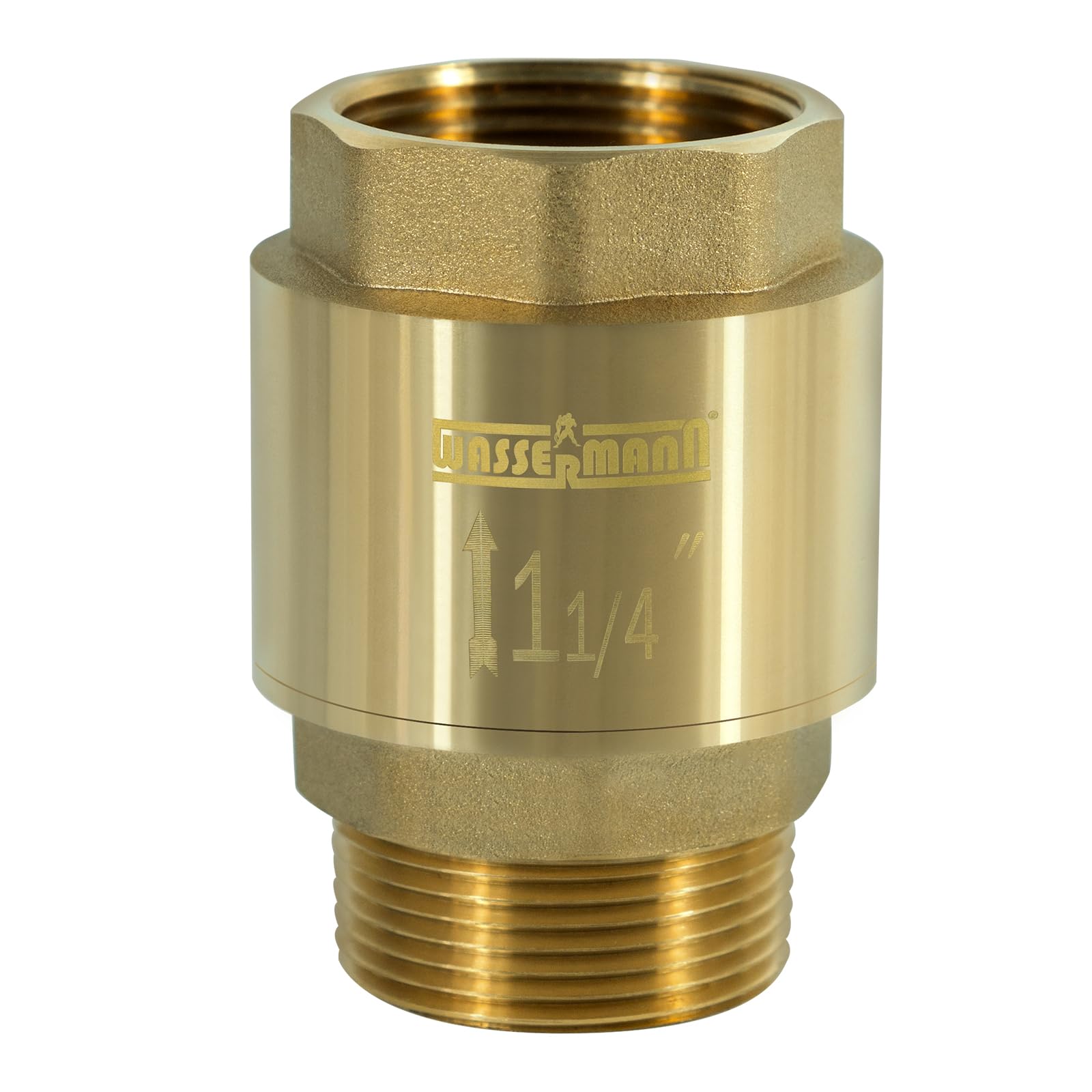
Machine work so precise the seal holds — not even a pound of pressure lost over a full week.
The Wassermann check valve is a relatively new entry from a specialized brand, but it is making an immediate impression on well owners. It is a spring-loaded brass valve with 1-1/4-inch NPT threads on the inlet and 1-1/4-inch FNPT threads on the outlet (FNPT is female National Pipe Taper, meaning it receives a male pipe thread). The standout claim from actual use is that one buyer mentioned losing not even 1 pound of water pressure over a week — that is extraordinary sealing performance on a well pump system.
The reason for that seal is the accuracy of the machine work. Several owners compared it directly to big-box-store valves and noted that the threads and the internal poppet fit are a noticeable improvement. At 2.48 x 2.48 x 3.3 inches, it is compact enough for tight installations, and the spring-loaded design works in both vertical and horizontal positions. The only reason this is not the top pick is the relatively low review count — 49 ratings — so the long-term durability picture is less proven than the Parts2O or Merrill, which have hundreds of reviews spanning years. But the early signal is extremely strong.
Wassermann tight seal: The machining precision is the headline — this valve holds pressure like no other at this weight class.
slow response: With only 49 reviews so far, the five-year track record is unproven; early adopters are very happy.
leak prevention: you want the tightest possible seal and the best machining precision for a submersible well pump or hand-pump system.
quick flow: you prefer a brand with thousands of reviews and a decade of proven reliability — stick with Parts2O or Merrill.
8. Midline Valve 432U336 Cast Brass Swing Check Valve 1-1/4″

The tilting-disc brass swing check that revived a ram pump’s output from 7 to 10-11 GPH.
Unlike the spring-loaded poppet valves above, this Midline Valve 432U336 is a swing check — it uses a hinged disc that tilts open with forward flow and falls shut by gravity when flow stops. The benefit is minimal restriction and excellent flow characteristics, especially in systems where you need to handle significant volume with very little pressure drop. It is made from cast brass with a lead-free, dezincification-resistant (anti-corrosion) body, certified to NSF/ANSI-61/372 for potable water. The pressure rating is 200 PSI WOG (water, oil, gas) and 125 PSI WSP (working steam pressure).
This valve is the top choice for a ram pump (a pump that uses the momentum of flowing water to lift a portion of that water higher) — one owner found it increased their pump cycles dramatically, boosting output from 7 to 10-11 GPH (gallons per hour). The construction is heavy-duty, and the threaded FIP ends (Female Iron Pipe, which is the same as NPT) are standard. A small number of owners mention leakage if the valve is not perfectly seated, but the overwhelming consensus — 23 positive mentions for functionality and 21 for quality — confirms this is a well-engineered valve that handles flow beautifully.
Midline swing flow: For systems where every drop of pressure matters — ram pumps, gravity-fed irrigation, or high-volume lines — the swing design is the right call.
orientation critical: Swing checks need horizontal installation (or vertical upward flow) to close properly; spring checks are more forgiving.
low resistance: you need maximum flow with minimal pressure drop, especially for a ram pump, irrigation mainline, or potable water system.
vertical pipes: your pipe run is vertical — a spring-loaded poppet valve seals in any orientation without relying on gravity.
9. Hallmark Industries Brass Check Valve 1.25″ NPT

The brass safety net owners add even when the pump claims to have a built-in check valve.
Hallmark Industries is well-known in the submersible pump world, and their 1-1/4-inch check valve is designed as an external backup to the check valve that is often built into the pump itself. The reasoning is practical: built-in check valves fail without warning, and when they do, the entire column of water in the drop pipe rushes back down, causing the pump to spin backward — which can damage the internal components. This valve adds a mechanical second line of defense, and owners who install it report a “low-maintenance” level of confidence.
The construction is all-brass with male NPT threads on the inlet and female FNPT on the outlet, a threaded design that lets you screw it directly into the pump discharge head without adapters. At 2.97 x 2.15 x 2.15 inches, it is compact enough for a well seal (the metal plate where the pipe exits the well casing). The feedback on the quality is strong — one buyer who researched extensively called the build “exceptional.” A few owners were unsure about the correct installation direction (the flow arrow is cast into the brass, so it is not something you can miss once you look).
Hallmark brass body: If you have a submersible well pump, this valve is the cheapest insurance against a failed built-in check that could cost you a pump replacement.
basic design: The male NPT inlet means you need a female threaded fitting on your pump — check your pump discharge before ordering.
simple backup: you are installing a submersible well pump and want an external brass check valve as a backup — most owners call it essential.
high demand: you need a valve for a non-pump application like a sprinkler gravity line — a simpler inline check will do the same job for less.
Understanding the Specs
Cracking Pressure
This is the minimum water pressure required to push the valve open. It is typically measured in PSI (pounds per square inch). Most spring-loaded 1-1/4-inch check valves have a cracking pressure of 0.5 PSI to 5 PSI. A lower number is better for gravity-fed systems or low-pressure applications because the valve opens more easily, so the pump does not have to fight to push water through. A higher cracking pressure (like 5 PSI) is fine on a well pump system that already runs at 40-60 PSI.
NPT vs. Slip vs. Solvent Connections
NPT (National Pipe Taper) is the standard threaded connection for brass check valves — the threads are tapered so they tighten and seal as you screw them in, usually with Teflon tape or pipe dope. Slip connections are smooth and meant for PVC or ABS pipe, secured with solvent cement (glue). Solvent-weld connections are the same as slip — you apply primer and cement, push the pipe in, and the joint becomes permanent. Threaded connections can be disassembled later; glued connections cannot. Choose the type that matches your existing piping — mixing connection types requires an adapter.
Maximum Working Pressure (PSI)
This is the highest internal pressure the valve body can safely withstand without rupturing. For residential well and irrigation systems, a 150 PSI to 200 PSI rating is more than adequate because most well pressure tanks cycle between 40 and 60 PSI. If you are using the valve on a hot water system, be aware that higher temperatures reduce the safe working pressure — plastic valves rated at 150 PSI at 73°F may have a significantly lower rating at 140°F. Brass valves handle heat much better.
Material: Brass, ABS, and PVC
Brass is a copper-zinc alloy that resists corrosion, handles high pressure and temperature, and provides precise thread machining — it is the standard for potable water systems because it can be made lead-free. ABS (Acrylonitrile Butadiene Styrene) is a black plastic used in sump pump systems; it is impact-resistant and cheap, but it is not rated for hot water or high pressure. PVC (Polyvinyl Chloride) is a white plastic common in irrigation and pool systems; it is chemical-resistant and inexpensive, but it becomes brittle in sunlight and cold temperatures. For buried or outdoor applications, brass lasts longer but costs more.
FAQ
Will a 1-1/4-inch check valve fit my 1-inch or 1-1/2-inch pipe?
What is the difference between a swing check and a spring check valve?
Can I install a 1-1/4-inch check valve vertically?
Do I need a lead-free check valve?
What happens if a check valve fails?
What does “200 PSI WOG” mean on a swing check valve?
Do I need Teflon tape or pipe dope on the threads?
Why does my check valve make a banging or chattering noise?
How often should I replace a check valve?
Can a check valve be installed upside down?
Final Thoughts: The Verdict
For the majority of shoppers, the 1 1/4 check valve winner is the Parts2O TC2505LF because it combines lead-free brass durability, a proven track record with well pumps, and a low cracking pressure that works across nearly every residential system. If you want a budget-friendly option for clean-water sprinkler or pool lines, grab the MIDLINE VALVE PVC Inline. And for a sump pump discharge where only a vertical swing check will do, the Red Lion SCV114 is the one to reach for.
How We Picked
We do not accept paid placement. Every pick is matched to a real buyer and a real use-case; we do not hands-on test units.
Sources & Methodology
Specifications: manufacturer listings and product documentation. Review insights: verified customer reviews, as of July 2026. Pricing: not shown on this page (it changes often); check the current price via the retailer link.
As an Amazon Associate, Gadgets Feed earns from qualifying purchases. This does not affect which products we feature.