
Our readers keep the lights on and my morning glass full of iced black tea. As an Amazon Associate, I earn from qualifying purchases.
Specs are compiled from manufacturer listings and verified buyer reviews and can change over time — please confirm the key details on the product page before buying.
Hard plastic is tough—finding an adhesive that actually sticks to it is the real challenge. Most glues just bead up and fail, leaving you with a loose piece and a sticky mess. The secret is picking a formula that chemically welds the surface rather than just sitting on top of it, which is exactly what this guide is built to help you do.
I’m Min — the founder and writer behind Gadgets Feed. This guide is built by comparing the manufacturers’ published specifications and the patterns across verified customer reviews, so you get each pick’s real strengths and trade-offs instead of marketing spin.
The best adhesive for hard plastic depends on if you need a fast hobby bond, a weatherproof automotive repair, or a gap-filling epoxy that handles stress.
Our Picks at a Glance


How To Choose The Best Adhesive For Hard Plastic
Hard plastic comes in many varieties—ABS, polystyrene, acrylic, polycarbonate, and rigid PVC all behave differently when glued. Picking the wrong adhesive leads to a weak joint or a melted surface.
Solvent-Weld vs. Epoxy vs. Cyanoacrylate
A solvent-weld cement (like the Testors or Tamiya picks) chemically melts the plastic surfaces together, fusing them into a single piece. Epoxies (like the J-B Weld) create a separate structural layer that fills gaps and bonds dissimilar materials. Standard super glue (cyanoacrylate) works in a pinch but tends to be brittle on hard plastics and can leave a white haze on clear surfaces.
Cure Time and Working Time
Some repairs need a bond in seconds—others need time to reposition parts. Fast-setting cements, like the Testors at 2 hours to full cure, are ideal for model assembly where parts fit snugly. Slower epoxies, such as the J-B Weld at 30 hours to cure, give you 15 minutes of working time for clamping or aligning larger repairs.
What Plastic You Are Bonding
Check the compatible materials on the label. ABS and polystyrene accept solvent cements well. Acrylic needs a specialized formula like LITKO Craftics to avoid fogging. Polypropylene and polyethylene (often found on kitchen containers and some outdoor gear) resist almost every common adhesive—you need a specific two-part system or surface primer for those.
Quick Comparison
| Model | Best For | Full Cure Time | Compatible Material | Number of Pieces | Amazon |
|---|---|---|---|---|---|
| Testors 290278 Cement★ Best Overall | Hobby & model assembly | 2 Hours | ABS, Polystyrene | 2 | Amazon |
| J-B Weld Plastic Bonder BlackTop Performer | Structural & automotive repairs | 30 Hours | Plastic, PVC, Fiberglass, Metal | 2 | Amazon |
| K Tool Q Bond Ultra Strong KitBest Value | Garage & workshop repairs | Seconds (sets fast) | Hard Plastic, PVC, Metal | 4 | Amazon |
| Games Workshop Adhesive for Plastic | Miniature models & small parts | Quick set (approx. minutes) | Plastic | 1 | Amazon |
| Loctite Vinyl, Plastic & Fabric Adhesive | Flexible repairs on mixed materials | 24 Hours | Plastic, Vinyl, Fabric, Glass, Wood | 2 | Amazon |
| LITKO Craftics #33 Acrylic Cement | Acrylic & clear plastic projects | 24 Hours | Acrylic, PVC, Styrene, Polycarbonate | 1 | Amazon |
| Tamiya 87012 Plastic Cement (3-pack) | Precision plastic model kits | 3 Hours | Plastic | 3 | Amazon |
| Plastruct Plastic Weld Kit | Model cars & crafts | Quick set (approx. minutes) | Plastic, Acrylic, Styrene, ABS | 6 | Amazon |
| 3M Plastic and Emblem Adhesive | Automotive emblems & trim | 24 Hours | Plastic, Metal, Vinyl | 1 | Amazon |
In‑Depth Reviews
1. Testors 290278 Cement for Plastic, 1.75 Fl Oz
Our pick — over 4.5★ from 850+ verified ratings; the strongest balance of quality and price.
The classic hobby cement that chemically welds hard plastic in just 2 hours.
This is the go-to for anyone assembling model kits or repairing ABS and polystyrene parts. The solvent chemically melts the surfaces together, creating a joint that is often stronger than the surrounding plastic. Buyers report it “melts plastic surfaces together for strong bond; dries quickly,” which is the exact behavior you want for a permanent fix.
It comes as two 0.875-oz tubes, giving you 1.75 oz total. The 4 included gluing tips let you switch between precision application and broader coverage. Quality is what owners praise most—over 50 buyers single it out as the standout feature. The full cure finishes in 2 hours, which is a 12x speed advantage over adhesives that need a full 24 hours to set.
The only watch point is the fast-drying nature: once it touches plastic it grabs quickly, so you need to be precise. It is formulated specifically for ABS and polystyrene, not every plastic type, so check what you are bonding before applying.
Why it wins the list: Nearly a thousand owners give this a near-perfect 4.8-star average combined with the fastest advertised cure time among the best-sellers. It is the crowd favorite for a reason.
Reach for this if: You assemble plastic model kits or need a fast, strong bond on ABS and polystyrene parts.
Look elsewhere if: You need to bond acrylic, polycarbonate, or flexible vinyl—the formula is not designed for those materials.
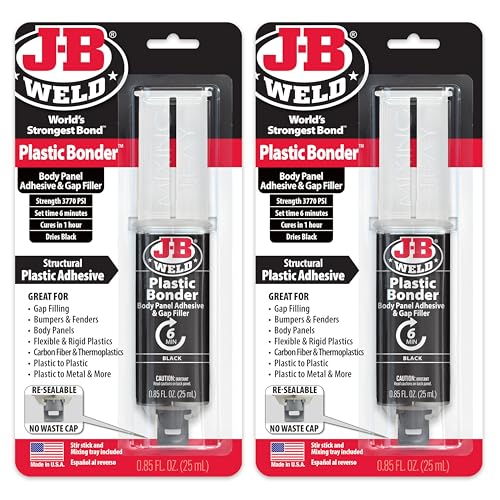
2. J-B Weld Plastic Bonder Black 25ml Syringe – 2 Pack
A structural epoxy that fills gaps and delivers 3770 PSI of tensile strength.
When a repair needs to handle real load—bumper brackets, cracked scooter parts, hardware that takes weight—this two-part urethane system steps in where solvent cement cannot. The syringe dispenses an equal 1:1 mix ratio, and the resealable cap keeps the remaining epoxy usable for multiple repairs.
The 15-minute set time gives you enough working window to clamp and align, while the 30-hour full cure delivers automotive-grade strength. Effectiveness is what owners praise most, with over 820 people calling it out as the best feature. It bonds to thermoplastics, coated metals, fiberglass, ceramic, and concrete—far beyond just hard plastic.
The fast set also generates noticeable heat during curing. And the black color means you will see it on lighter plastics unless you sand and paint over it. Unlike the Testors, this is not a solvent weld—it creates a separate layer on the surface.
The real-world take: Seventeen thousand plus owners give this 4.6 stars. It is the most-reviewed adhesive on the list by a wide margin, and for good reason—it works on almost everything.
Grab this when: You need a gap-filling, weather-resistant epoxy for automotive, outdoor, or structural plastic repairs.
Skip it for: Bonding polypropylene or polyethylene—this formula struggles with those plastics.
3. K Tool International 90002 Q Bond Ultra Strong Adhesive Kit
The two-stage system that bonds in seconds and reinforces with powder.
Unlike a standard one-step glue, this kit uses a two-part method: apply the liquid adhesive, then sprinkle the reinforcing powder over it to build strength. The result is a bond that sets in 3-4 seconds and has been tested on real-world repairs. One owner successfully fixed a treadmill cover with 4 broken screw attachment points using the initial glue bond followed by powder reinforcement—the hold lasted through 3+ months of use.
It comes with one bottle for plastics and one for metals, plus separate reinforcing powders for each. Strength is the top praised aspect, with nearly 390 owners calling it out. The kit has 4 pieces total—double the count of single-tube adhesives.
The 0.22-pound kit is dense and versatile, but the fumes are strong—work in a ventilated area. And on smooth plastic without sanding, the bond can fail. It excels on hard plastics, PVC, and metals where you need an instant grip.
What wins people over
- Sets in seconds, not hours
- Powder reinforcement adds real durability to stressed joints
- Includes separate formulas for plastic and metal
The honest trade-offs
- Strong fumes require good ventilation
- Fails on smooth plastic unless you sand the surface first
- Overpriced for what is essentially super glue plus powder
Best for: Quick garage and workshop repairs where you cannot wait hours for a glue to cure.
Not ideal for: Fine model assembly or clear acrylic—the thick bond is visible and hard to sand cleanly.
4. Loctite Vinyl, Plastic, and Fabric Adhesive, Pack of 2 Clear

A flexible clear adhesive that bridges plastic, vinyl, and fabric in one tube.
Most hard plastic adhesives create a rigid joint that cracks under flex. This Loctite formula stays slightly flexible when cured, making it the right pick for repairs where the material bends—vinyl bar stools, fabric-to-plastic bonds, or reattaching padding to a lawn mower seat. One owner used it to repair vinyl blinds bonded to fabric blinds and reported the bond held through an entire mowing season.
It comes as a 2-pack, giving you two tubes for the price. The paste form dries clear, so it does not leave a visible glue line on transparent or translucent plastics. Effectiveness is the top praised aspect, with nearly 30 owners calling it out. It works on glass, paper, wood, vinyl, and plastic alike.
The 24-hour full cure is a 12x wait compared to the Testors, so you need patience. And it can “string” if you pull the nozzle away too fast—apply with a steady hand. It is not a solvent weld, so the bond is chemical adhesion rather than fusion.
Who this fits: Anyone repairing mixed-material items like upholstery, vinyl trim, or fabric-covered plastic parts. The flexibility is the edge over rigid epoxies.
Choose this if: You are bonding plastic to fabric or vinyl where the joint will flex in use.
Pass on it for: Structural load-bearing repairs on hard plastic—this adhesive is strong but not designed for high-stress joints.
5. Tamiya 87012 Plastic Cement 20ml 3pcs Set
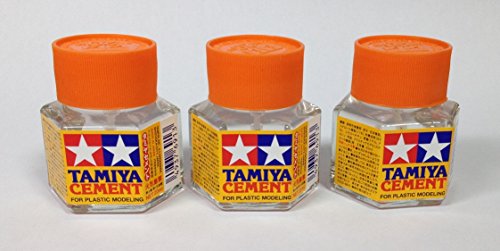
The brush-in-bottle cement that flows into tight joints with precision.
Serious model builders know Tamiya for a reason—the built-in brush applicator in the lid lets you paint a thin bead along a seam line, and the solvent wicks into the gap by capillary action. The 3-pack gives you 20ml per bottle, so you have backup for larger projects. One buyer describes it as essential for plastic model kits, noting the “nice brush applicator to get into joints.”
Full cure takes 3 hours, which is faster than the 24-hour options but a bit slower than the Testors’ 2 hours—though the brush precision makes up for the extra hour. Versatility is the top praised aspect, with over 30 owners singling it out.
The thin liquid can ruin plastic if you apply too much—it melts the surface, so control is critical. It is designed for styrene and acrylic model building, not for heavy-duty repairs on thick industrial plastics. And the package and instructions are in Japanese, though the applicator is intuitive enough.
The modeler’s verdict: With a 4.7-star average from nearly 500 owners, this is the reference standard for precision plastic assembly. The brush applicator makes it the best choice for small, detailed parts.
Best for: Assembling scale models, gunpla, and plastic kits where accuracy matters more than speed.
Avoid for: Filling large gaps, bonding metal to plastic, or repairing thick outdoor plastics.
6. LITKO Craftics #33 Thick Acrylic Cement
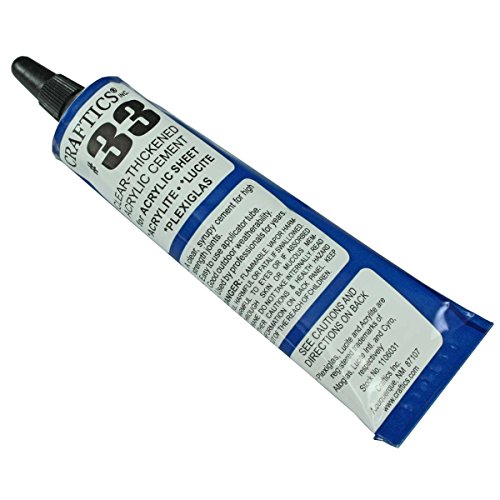
The solvent cement that bonds acrylic without clouding or fogging the surface.
Standard cyanoacrylate super glue leaves a white, hazy residue on clear acrylic—a dealbreaker for display pieces, fish tank lids, and laser-cut projects. This medium-bodied solvent cement dries completely clear and will not fog transparent acrylic. One owner used it to assemble a guide rail on an acrylic fish tank lid and reported a “secure and invisible bond.” Another bonded a broken plastic refrigerator drawer and it was still holding up months later.
The 1.5 oz tube fills small gaps by design, bonding acrylic to itself and to rigid PVC, styrene, butyrate, and polycarbonate. Full strength arrives in 24 hours, but the fast initial set lets you handle parts sooner. Effectiveness is the top praised aspect, with nearly 20 owners calling it out.
The formula is runny—apply carefully because once it makes contact there is no repositioning. It is industrial-grade, so use it in a ventilated area. And it will not bond acrylic to metal; it is strictly for plastic-to-plastic solvent welding.
What makes it special
- Bonds clear acrylic without any fogging or whitening
- Thick formula fills minor gaps in imperfect joints
- Works on Plexiglas, Lucite, polycarbonate, and styrene
One real limitation
- Runny consistency makes application tricky—you get one chance
- Requires good ventilation and safety precautions during use
Reach for this if: You are assembling acrylic display cases, aquariums, or laser-cut projects where appearance matters.
Skip it for: Bonding different materials together—this is a pure plastic-to-plastic solvent weld.
7. 3M Plastic and Emblem Adhesive, 08061, 5 oz Tube
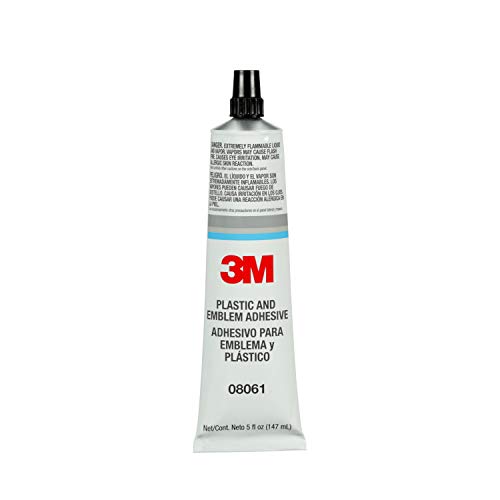
The weatherproof bond that holds emblems at highway speed and through the car wash.
Automotive trim and emblems face constant vibration, water spray, and temperature swings—most glues fail within weeks. This 3M formula sets in about 15 minutes and fully cures in 24 hours, creating a permanent bond rated for exterior use. Owners mention using it to reattach Honda emblems, Volvo steering wheel badges, and Kohler sink emblems, with one owner noting it held up through a car wash without any damage.
At 5 oz in a single tube, you get enough material for multiple emblem installations. It dries clear, so it works on transparent trim and painted surfaces. Effectiveness is the top praised aspect, with 150 owners calling it out. Adhesive quality comes second with 94 mentions.
The bond requires a 65-90°F application temperature range—cold weather applications will struggle. And the 24-hour full cure means you need to avoid washing the vehicle for a full day after applying.
Why it is trusted: 3M has built a reputation on automotive-grade adhesives, and the 4.6 stars across thousands of reviews confirms it holds up in real-world conditions.
Best for: Fastening automotive emblems, trim pieces, and interior panels where water and heat resistance matter.
Not for: Model assembly or clear acrylic projects—it is designed for automotive and exterior use, not fine hobby work.
8. Plastruct Plastic Weld with Needle Tip Bottles and Swabs

The full accessory kit with needle tips, a funnel, and swabs for precise application.
This set bundles Plastruct Plastic Weld with 3 Pixiss needle tip bottles, a small funnel, and Pixiss swabs—everything you need for controlled application. The needle tips let you place a single drop exactly where you need it, which is a major advantage for model car assembly where excess glue ruins details. One owner with severe hand tremors said this glue “grabs hold quickly so I can let go,” which speaks to the fast initial tack.
The kit includes 6 pieces total, giving you more tools than any single-tube adhesive on the list. It works on plastic, acrylic, styrene, and ABS. Quality is the top praised aspect, with 10 owners calling it out.
Delivery has been inconsistent for some—one owner reported a 2.5-month delay, though the packaging was secure. And the weld works on some plastics but not all, so check compatibility with your specific material before committing.
The value angle: You pay for a full system rather than just glue—the needle tip bottles and swabs make this the most complete kit on the list for detailed work.
Choose this if: You want a full application system with needle tips for precision work on model cars or crafts.
Pass if: You need a single reliable tube—the extra accessories add cost and complexity you may not use.
9. Games Workshop Adhesive for Plastic
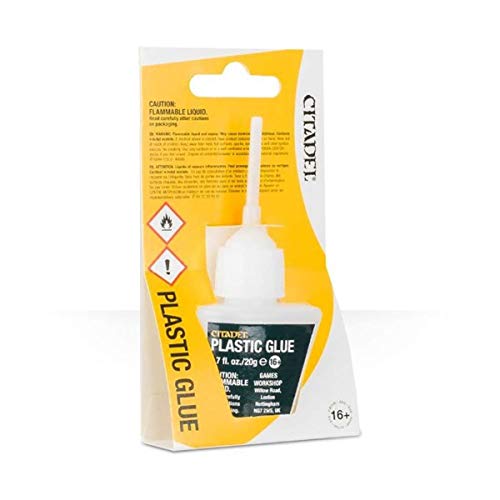
The nearly odorless solvent weld that miniature painters trust for tiny plastic joints.
Hobbyists who spend hours close to their work cannot tolerate aggressive fumes. This Games Workshop formula is described by owners as having “little to no smell” while still delivering the solvent-weld strength that fuses miniature parts together. One buyer called it the “best plastic glue for small projects” with “good viscosity for minis,” noting it dries relatively quickly and bonds with almost no odor.
The single bottle is simple—no mixing, no extras—just a liquid solvent that melts plastic on contact. Quality is the top praised aspect, with nearly 70 owners calling it out, followed by effectiveness at 83 mentions (though those effectiveness opinions are mixed, with some saying it works great and others reporting it does not work at all).
The main drawback is the metal nozzle, which tends to clog after the first use. Several customers note having to clear the nozzle before every session. And the brand has been rebranded from Citadel to Warhammer Colour, so the packaging may not match what you expect.
What makes it popular
- Very low odor compared to most plastic cements
- Good viscosity for applying to small model parts
- Solvent-weld action creates strong fusion at the joint
What to know before buying
- Nozzle clogs after first use—needs clearing each time
- Effectiveness is inconsistent across different users
- Single bottle only, smaller total volume than multi-tube options
Best for: Painting-friendly assembly where you do not want fumes interfering with your workspace.
Not ideal for: Larger structural repairs or multi-material bonding—this is a focused miniatures tool.
Understanding the Specs
Solvent-Weld vs. Epoxy vs. Cyanoacrylate
A solvent-weld cement (like the Testors, Tamiya, and Games Workshop picks) chemically melts the plastic surfaces together, creating a single fused joint. Epoxies (like J-B Weld) form a separate structural layer on top of the plastic, filling gaps and bonding dissimilar materials. Cyanoacrylate (super glue) bonds quickly but tends to be brittle on hard plastics and can leave a white haze on clear surfaces.
Full Cure Time and Working Time
Fast-setting cements (Testors at 2 hours, Tamiya at 3 hours) let you handle the part the same day, but they give you almost no repositioning time. Slower epoxies like J-B Weld take 30 hours to cure but offer 15 minutes of working time, which is essential for clamping large repairs or aligning parts. If you need the fix done fast, a solvent cement wins. If you need strength and gap-filling, an epoxy is the better call.
Compatible Materials
Every adhesive is formulated for specific plastics. ABS and polystyrene accept solvent cements beautifully. Acrylic needs a non-fogging formula like LITKO Craftics. Polypropylene and polyethylene resist nearly every common adhesive—you need a specialized two-part system or surface primer. Always check the “Compatible Material” field on the label before buying.
Application Tools
A brush applicator (Tamiya) gives precise control over thin cement on model seams. Needle tip bottles (Plastruct) let you place a single drop. Syringes (J-B Weld) ensure an exact 1:1 mix ratio for two-part epoxies. Standard squeeze tubes (Testors, Loctite) work for general application but can be harder to control on small parts.
FAQ
What adhesive works best on ABS plastic?
Can I use super glue on hard plastic?
How long should I let adhesive cure before putting weight on the repair?
What is the difference between plastic cement and plastic glue?
Will adhesive work on polypropylene or polyethylene plastics?
Which adhesive is best for clear acrylic without fogging?
How do I remove excess adhesive from hard plastic?
What adhesive should I use for 3D printed hard plastic parts?
Final Thoughts: The Verdict
Across the board, the adhesive for hard plastic winner is the Testors 290278 Cement because it delivers the fastest full cure time at 2 hours, the highest owner satisfaction near 4.8 stars, and the solvent-weld strength that bonds ABS and polystyrene permanently. If you need structural strength for automotive repairs, grab the J-B Weld Plastic Bonder. And for precision model assembly with a brush applicator, the Tamiya 87012 is the one to reach for.
How We Picked
We do not accept paid placement. Every pick is matched to a real buyer and a real use-case; we do not hands-on test units.
Sources & Methodology
Specifications: manufacturer listings and product documentation. Review insights: verified customer reviews, as of July 2026. Pricing: not shown on this page (it changes often); check the current price via the retailer link.
As an Amazon Associate, Gadgets Feed earns from qualifying purchases. This does not affect which products we feature.