
Our readers keep the lights on and my morning glass full of iced black tea. As an Amazon Associate, I earn from qualifying purchases.
Specs are compiled from manufacturer listings and verified buyer reviews and can change over time — please confirm the key details on the product page before buying.
You can see the detail on a distant bird, the action on a faraway field, or the stage at a concert without spending a small fortune. The trick is knowing which specs actually matter and which models deliver on their promises without breaking your wallet. This guide cuts through the noise to find the budget binoculars that give you the most for your money.
I’m Min — the founder and writer behind Gadgets Feed. This guide is built by comparing the manufacturers’ published specifications and the patterns across verified customer reviews, so you get each pick’s real strengths and trade-offs instead of marketing spin.
Whether you’re hiking a trail or heading to the stands, finding a pair of budget binoculars that balances magnification, light-gathering, and portability is the goal, and we have paired each choice to a specific use.
Our Picks at a Glance

How To Choose The Best Budget Binoculars
Picking a pair of binoculars on a budget depends on balancing three things: how much power you need, how steady your hands are, and where you plan to use them. A pair with high magnification is useless if the image is too shaky to enjoy. A small, light pair is perfect for travel but may struggle in the twilight hours. Here are the key considerations every first-time buyer should weigh.
Magnification vs. Objective Lens Size
The first number in a binocular’s name is the magnification — how many times closer an object appears. The second is the objective lens diameter in millimeters, which controls how much light enters. A larger lens (like 50mm) gathers more light, giving you a brighter image in low-light conditions. However, a bigger lens also means heavier, bulkier optics. For a general-purpose, budget-friendly pair, something like a 10×25, 15×30, or 20×50 can all be smart choices if they match your primary use case.
The Exit Pupil — The Key to Comfort
The exit pupil is the diameter of the beam of light that leaves the eyepiece and enters your eye. It is calculated by dividing the objective lens diameter by the magnification. A larger exit pupil (around 3mm to 5mm) delivers a brighter image, which is a huge advantage during dawn or dusk. A smaller exit pupil (under 2mm) can make the image feel dim and harder to hold steady, which is a common pitfall with budget “super-zoom” models.
Prism and Lens Coating
Good glass is the heart of any optic. BAK4 prisms are a cut above the cheaper BK7 prisms because they deliver a sharper, brighter image with a perfectly round exit pupil. Look for “fully multi-coated” or “FMC” lenses. This means every glass surface has been treated with multiple layers of anti-reflective coating, which dramatically improves light transmission and reduces glare. It is the single biggest difference between a washed-out view and a crisp one at this price level.
Quick Comparison
| Model | Best For | Magnification | Objective Lens | Field of View | Amazon |
|---|---|---|---|---|---|
| OPAITA 20×32★ Best Overall | Pocketable All-Around | 20x | 32mm | 235 ft | Amazon |
| POCZE 20×50Also Great | Low Light & Stability | 20x | 50mm | 341 ft | Amazon |
| occer 15×30 | Travel & Value | 15x | 30mm | 368 ft | Amazon |
| Sogries 10-30×50 | Variable Zoom Power | 10-30x | 50mm | 1000 ft | Amazon |
| Nocs Provisions 10×25 | Premium Pocketable | 10x | 25mm | 315 ft | Amazon |
In‑Depth Reviews
1. OPAITA 20×32 Compact Binoculars
Our pick — 4.5★ from 950+ verified ratings; the strongest balance of quality and price.
A pocketable powerhouse that hides in your coat until you need it.
You get 20x magnification in a frame small enough to disappear into a coat pocket with this OPAITA model. The 32mm objective lens (the second number in the name, which controls how much light the binoculars capture) and BAK4 prism (a high-density glass that delivers a sharper, brighter image than cheaper BK7 glass) deliver a bright, sharp image that owners consistently call crisp. The fully multi-coated lenses (anti-reflective layers on every glass surface that prevent glare) do their job in challenging light. It comes with a carry bag and strap, making it an easy grab-and-go companion for concerts, hikes, and casual birdwatching.
The trade-off for this slim build shows when you compare it to the POCZE 20×50. Its exit pupil (the beam of light reaching your eye) is 1.6mm, smaller than the POCZE’s 2.5mm, which makes the view dimmer in twilight or deep shade. The field of view is also narrower at 235 feet per 1000 yards (the width of the scene you can see from that distance), compared to the POCZE’s 341 feet. Still, for daylight use where portability is king, the praise is overwhelming — owners highlight it as “lightweight and easy to use with a wonderful outcome.”
The thing everyone raves about is the build quality, which stands out at this price point. It’s a popular choice with a stellar reputation for a reason: the crowd favorite is an entry-level optic that punches well above its weight.
Compact and portable
- Incredibly compact design that fits in a coat pocket with room to spare.
- BAK4 prism and multi-coated lenses produce a bright, clear image for daytime use.
- Lightweight enough for all-day carrying on a hike or trip.
Small objective lenses
- Small exit pupil means the view is less bright in low-light conditions than larger models.
- Eyepieces are small for glasses wearers, making it a bit fiddly to hold steady.
- No objective lens covers included, only eyepiece covers.
Lightweight choice: you want a compact, featherlight binocular for daytime travel, concerts, or birding and can sacrifice low-light brightness for portability.
Low-light limits: you regularly watch wildlife at dawn or dusk, or if you wear glasses and need a larger, more forgiving eyepiece.
2. POCZE 20×50 High Powered Binoculars
The low-light specialist that feels heavier than its price tag suggests.
If you chase the last light of the day, this is the budget binocular to grab. The 50mm objective lens and 2.5mm exit pupil (the diameter of the light beam reaching your eye) are larger than the OPAITA’s 1.6mm exit pupil, and it shows — buyers report surprisingly clear images in overcast conditions and the kind of dense tree cover that makes lesser optics go dark. The 20x magnification brings distant details right into your lap, though a tripod is a smart addition for long sessions.
It also features argon purging (an inert gas pumped inside to prevent fogging) and O-ring seals (rubber gaskets that keep water out), making it waterproof and fogproof for all-weather use. The non-slip rubber grip feels solid in the hand, and the oversized focus wheel is easy to turn with gloves on. As buyers put it: “They look very good at both close and long ranges, and the materials appear to be of very high quality.” It’s a shade heavier than the compact options, but that weight translates directly into stability and build quality.
The biggest praise centers on the image quality relative to the price. It earns top marks from the community for delivering a razor-sharp view that traditional 10x magnification binoculars simply cannot match, and its 341-foot field of view (the width of the scene you see at 1000 yards) is wider than the OPAITA’s 235-foot field of view.
High magnification
- Large 50mm objective lens excels in low-light scenarios like dawn and dusk.
- Waterproof and fogproof build with a durable, non-slip rubber exterior.
- Great clarity at both close and extremely long distances for the price.
Heavier build
- Heavier than compact models, so a tripod is helpful for steady long-range viewing.
- At 1.5 pounds, it is not a pocket binocular and needs a bag.
Long-range views: the outdoor enthusiast who needs a tough, bright binocular for low-light bird watching, hiking, or stargazing without spending premium money.
Shaky handheld: the ultralight traveler who prioritizes a pocketable form factor over low-light performance.
3. occer 15×30 Binoculars

The travel companion that delivers a surprisingly wide panorama.
This is the one to tuck into your daypack for a hike or a day at the game. The 15x magnification is a sensible middle ground — powerful enough for long-distance spotting, but not so high that hand-shake ruins the image. With a 30mm objective lens and a generous field of view (how wide a scene you can see at 1000 yards) of 368 feet (the widest on this list), it gives you a lovely expansive window into the action. The FMC (fully multi-coated) broadband coating and BAK4 prism are the real deal here — according to the maker, the coatings push light transmission to 96.48%.
It is noticeably lighter than the 50mm binoculars and fits easily in a large pocket or small bag. Owners love the smooth focusing dial that operates with one hand and the fact that it provides “amazing detail” and “good visibility in low light.” A couple of eagle-eyed users note the actual magnification may be a touch lower than 15x, but for the price, the clear, bright image and compact feel are hard to argue with.
What wins people over is the quality per ounce — you get BAK4 prisms, fully multi-coated lenses, and a wide view in a package that weighs just 12.8 ounces.
Wide field view
- Wide field of view of 368 feet makes scanning for birds or tracking sports easy.
- Very light at 12.8 ounces, perfect for long hikes and travel.
- Excellent light transmission with high-quality BAK4 prism and multi-coated lenses.
Fixed low zoom
- Some owners suspect the actual magnification is slightly less than the stated 15x.
- The diopter adjustment (a small ring that fine-tunes the focus for each eye) can drift over time and may need periodic re-setting.
Quick scanning: you want a lightweight, wide-angle binocular for travel, daytime birding, and sports that won’t weigh your bag down.
Distant detail: you need maximum light-gathering for true low-light or dusk viewing; you will want a 50mm lens instead.
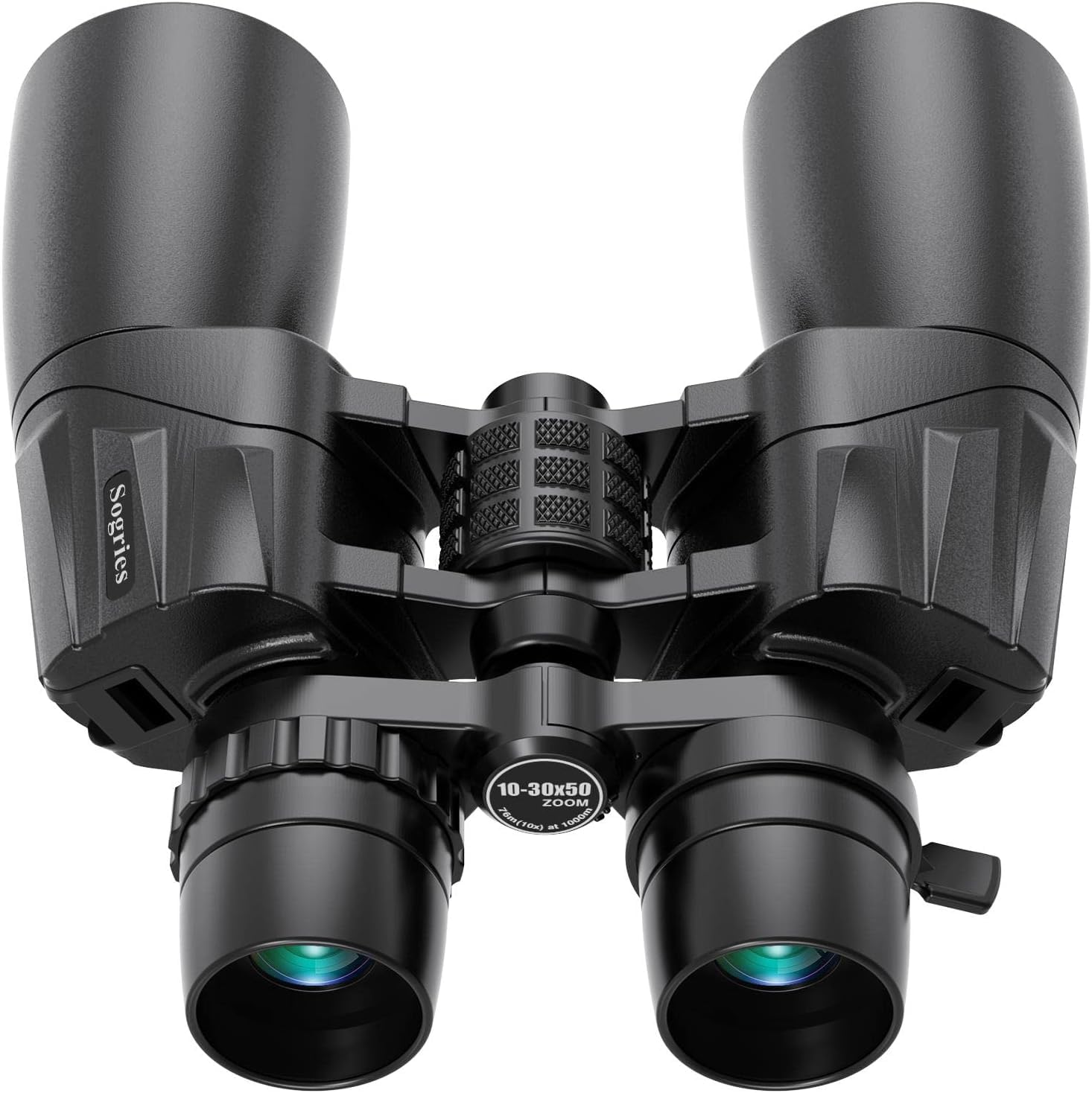
4. Sogries 10-30×50 Zoom Binoculars
The zoom that gives you a telescope and a wide view in one body.
This is the only variable magnification model on the list, and it serves a very specific buyer: someone who needs a wide overview at 10x and then wants to zoom right into a distant detail at 30x without swapping gear. The 50mm objective lens ensures it stays bright even as you crank the zoom, and the BAK-4 prism with an FMC (fully multi-coated) broadband green film, which the maker claims pushes light transmittance to 99.5% for truly crisp detail at high power.
There is a notable engineering choice here — the metal barrel makes it heavy enough that the maker itself recommends a tripod. This is not a grab-and-go binocular for a walk in the park. It is a deliberate, stable optic for birders, sports fans, and stargazers who can set it up on a steady surface. The 22mm eye relief (the distance from the eyepiece lens to where your eye should sit) is fantastic for glasses wearers, and the twist-up eyecups offer adjustment. The most common owner gripe is that the included lens covers are cheap, but the optical performance gets consistent praise, described as “incredibly clear” with a “smooth zoom feature.”
The biggest praise from owners centers on the zoom mechanism and the sheer detail accessible at 30x, making it feel like a spotting scope that can also do general scanning.
Versatile zoom range
- Variable 10-30x zoom provides class-leading versatility for a single set of binoculars.
- Exceptionally high light transmission of 99.5% for bright, detailed images, according to the maker.
- Long 22mm eye relief makes it very comfortable for eyeglass wearers.
Narrower FOV
- Hefty design essentially requires a tripod for steady viewing at high zoom.
- Lens caps are poorly designed and do not stay attached.
Variable uses: you want the versatility of a zoom for long-distance observation, birding, or stargazing and you have a tripod to support its size.
Image stability: you need a compact, lightweight binocular for casual, on-the-go use; a fixed-magnification model will serve you better.
5. Nocs Provisions Standard Issue 10×25

The rugged minimalist that survives a dunk and a lifetime of use.
This is the premium budget pick for a reason: it’s built to live in your car or backpack and take a beating. The fully multi-coated, Swiss-designed BAK4 prism optics deliver ten times magnification with “super clarity” that owners truly rave about. Its IPX7 rating (a standard meaning it can survive immersion in 3 feet of water for 30 minutes) means it can survive a drop in shallow water, and it is nitrogen-purged (inert gas inside) to be completely fog-proof. The rubberized Rugged Wave Grip feels great in hand and provides excellent purchase in wet conditions.
It is slightly bulkier than the OPAITA but still very compact at 7 inches long. The multi-stop twist-up eyecups make it easy to use with or without glasses. If there is a catch, it is the narrow field of view that some owners note; it sits at 315 feet, which is narrower than the wider-angle occer model. But for a rugged, sealed binocular that comes with a “No-Matter-What” lifetime warranty, the confidence and build quality are in a different league.
What impresses owners most is the combination of “unbeatable clarity” and a design inspiring connection to nature, with some taking it to 30 countries without issue.
Premium compact build
- IPX7 waterproof rating and fog-proof design can handle any weather.
- Lifetime “No-Matter-What” warranty makes this a true long-term investment.
- Fantastic clarity and color from Swiss-designed BAK4 prisms and multi-coated lenses.
Small exit pupil
- Field of view is narrower than some wide-angle models, making tracking fast action harder.
- It does not come with a hard case, just a drawstring bag, and the strap is a bit short.
Daytime hikes: the outdoor enthusiast who wants a stylish, bombproof binocular they can drop, soak, and rely on for years, backed by a lifetime warranty.
Dim conditions: you need the widest possible field of view for scanning large areas, or if you want more than 10x magnification.
Understanding the Specs
Exit Pupil & Low Light
The exit pupil is the diameter of the beam of light hitting your eye. It’s calculated by dividing the objective lens size by the magnification. A larger exit pupil (over 4mm) is a huge help in poor light like dawn or dusk. A smaller exit pupil (under 2.5mm) will work fine in the daytime but will look dim and require you to hold the binoculars perfectly still when the sun goes down. It is the single best predictor of a binocular’s low-light performance.
Field of View
Measured in feet at 1000 yards (or degrees), this tells you how wide a scene you can see. A wider field of view is a massive help for tracking birds in flight or following a fast-moving sports game. Narrower fields (under 300 feet) are more like looking through a straw and are better for stationary spotting, like studying a building or a distant animal. It’s a direct trade-off: more magnification usually narrows the view. The occer 15×30 gives you a wide 368 feet, while a high-zoom model will shrink it significantly.
FAQ
Can I use budget binoculars for stargazing?
Is 20x magnification too shaky for handheld use?
What does BAK4 mean in a binocular specification?
Are waterproof binoculars necessary for a budget pair?
Is a 10x binocular better than a 20x for a beginner?
What does fully multi-coated (FMC) mean on binoculars?
How important is the field of view for bird watching?
Will these budget binoculars work for glasses wearers?
Final Thoughts: The Verdict
If you want one dependable pick, the budget binoculars winner is the OPAITA 20×32 because it offers the best combination of compact portability, impressive daytime clarity, and outstanding overall value. If you want the most compact and versatile travel companion, grab the occer 15×30. And for a stylish, lifetime-warrantied optic you can toss in a bag and forget about, the Nocs Provisions 10×25 is the one to reach for.
How We Picked
We do not accept paid placement. Every pick is matched to a real buyer and a real use-case; we do not hands-on test units.
Sources & Methodology
Specifications: manufacturer listings and product documentation. Review insights: verified customer reviews, as of July 2026. Pricing: not shown on this page (it changes often); check the current price via the retailer link.
As an Amazon Associate, Gadgets Feed earns from qualifying purchases. This does not affect which products we feature.