
Our readers keep the lights on and my morning glass full of iced black tea. As an Amazon Associate, I earn from qualifying purchases.
Specs are compiled from manufacturer listings and verified buyer reviews and can change over time — please confirm the key details on the product page before buying.
If your voice gives out by the end of a lesson, a tour, or a training session, you aren’t imagining it — projecting for hours is exhausting for your throat and your energy. A voice amplifier projects your natural speaking level into clear, room-filling sound without straining your throat.
I’m Min — the founder and writer behind Gadgets Feed. This guide is built by comparing the manufacturers’ published specifications and the patterns across verified customer reviews, so you get each pick’s real strengths and trade-offs instead of marketing spin.
if you need a compact unit for daily classroom use or a powerful PA for small gigs and outdoor events, the right amplifier for voice can save your voice and make sure everyone hears you clearly, every single time.
Our Picks at a Glance


How To Choose The Best Amplifier For Voice
Choosing a voice amplifier isn’t just about picking the loudest option. What matters most is finding one that matches where and how you use it — and that means looking beyond the headline wattage number. Here is what genuinely makes a difference for teachers, tour guides, and presenters.
Wattage and Sound Coverage: Not Always What It Seems
A 50W unit can easily fill a standard classroom or a meeting room for 40 people. You only need higher wattage — 100W or more — for outdoor spaces or large halls where the sound has to travel further. More watts also means a bigger, heavier unit, so think about if you need to carry it around daily.
Battery life determines how long you can teach or present without recharging.
Look for at least 5 to 8 hours of continuous use. That covers a full teaching day or a long tour without needing to recharge mid-shift. If you are buying for a school or a busy touring schedule, a battery that lasts the whole shift is a non-negotiable.
Microphone Type and Wireless Reliability
The microphone type and wireless reliability directly affect your freedom of movement and audio clarity. A UHF wireless headset gives you hands-free movement without cables, while a handheld mic gives you more control. Look for systems that pair quickly and stay stable without dropouts — this is where real-world reviews tell the genuine story.
Portability and Build
For daily use, you want something that weighs under 8 pounds and comes with a shoulder strap or belt clip. A metal or rugged plastic casing adds durability if the unit gets knocked around in a bag or on stage. A handle or strap that makes carrying comfortable is worth paying attention to.
Quick Comparison
| Model | Best For | Output Power | Battery Life | Wireless Mics | Amazon |
|---|---|---|---|---|---|
| Coolmusic BP80★ Best Overall | Musicians & small bands | 100W | 6-8 hours | No (wired mic input) | Amazon |
| HW HAOWORKS S98Top Performer | Teachers & presenters | 50W | All-day | 1 UHF headset | Amazon |
| SANMIC S98Compact Pick | Budget classroom use | 40W | 5-8 hours | 1 UHF headset | Amazon |
| Rockville RPM45 | Small venue PA/mixing | 1800W peak | Corded only | No (4 XLR inputs) | Amazon |
| ResponseBridge S99 | Parties & events | 100W | 5 hours | 2 UHF | Amazon |
| WinBridge S97 | Karaoke & versatile use | 60W | 5+ hours | 2 (1 handheld, 1 headset) | Amazon |
| Rockville RPM80BT | Large venue mixing | 2400W peak | Corded only | No (8 XLR inputs) | Amazon |
| Coolmusic BP40D | Solo performers & buskers | 80W | 6-8 hours | No (wired mic input) | Amazon |
| Pyle PPHP155ST | Outdoor parties & events | 1500W peak | Corded only | 1 wired handheld | Amazon |
| Fender Acoustasonic 40 | Acoustic performers | 40W | Corded only | No (XLR/1/4″ inputs) | Amazon |
| Pyle PPHP28AMX | Full PA bundle | 300W peak | Corded only | 1 wired handheld | Amazon |
In‑Depth Reviews
1. Coolmusic BP80
Our pick — over 4.5★ from 700+ verified ratings; the strongest balance of quality and price.
The powerhouse that handles voice, guitar, and a full band without breaking a sweat.
Your voice gets priority treatment here, but this is also the unit you pull out when the event expands beyond simple speech. The 100W output is driven by an 8-inch woofer and a 3-inch tweeter, so your voice stays crisp and the low-end never turns muddy. It has 6 inputs total — that means you can connect two microphones alongside instruments, phones, or a computer all at once, with two independent EQ adjustments per channel to dial in your exact mix.
The battery life is the big win for daily mobile use: a full charge lasts 6 to 8 hours depending on volume, after about 5 hours of charging. At 21.8 lbs it’s portable enough to carry to a gig or between classrooms, and buyers report the sound stays clear even at high volume. The 48V phantom power switch means it supports condenser microphones, which is a feature normally found on expensive units.
What Owners Love Most
- Sound quality is the standout — the thing people talk about most is how clean and lifelike the audio projection is, even at full output.
- Build quality earns high praise, with the unit feeling solid and rugged through regular gigging and transport.
- Versatility is a real draw: one owner gigged with it for a full year, using it with a piano and wireless mics, and reported flawless performance.
One Thing To Know
- Some owners mention the exterior build feels a little less premium than the sound quality would suggest — it’s tough enough for gigging, but treat the casing with care.
Reach for this if: you need one rugged unit that covers voice amplification and live instrument performance — the 100W output and 6 input channels make it absurdly versatile for under.
Think twice if: you want a built-in wireless microphone; this is a wired setup only, so you’ll need to buy your own mic.
2. HW HAOWORKS S98 Voice Amplifier 50W
The everyday teacher’s assistant that frees your hands and saves your throat.
This 50W portable PA speaker is built specifically for voice work, and it shows. The UHF wireless headset microphone gives you a stable, low-latency connection that lets you walk around a classroom or stage without a single cable in the way. Owners mention that students hear every word clearly even in noisy environments, and that is the real test for any voice amplifier.
Bluetooth 5.3 means you can stream background music or lesson audio straight from your phone, and the unit also accepts USB, TF cards, AUX, and a second wired microphone input. The battery life is described as all-day by multiple owners, which tracks with the lithium-ion battery inside. At a compact size with an adjustable shoulder strap and a comfortable handle, this one slips into a backpack easily — one reviewer noted it fits perfectly for travel and quick setup.
The difference between the HAOWORKS and other units in this price range is the wireless mic quality: customers note no signal dropouts and clear, distortion-free projection even outdoors. As owners put it: the “50W output delivers clear, distortion-free sound indoors/outdoors.”
Honest trade-off: A few owners note that reliability can vary between units — most are flawless, but a small number mention needing a replacement. Buy from a seller with a good return policy and you are covered.
Best for: educators, trainers, and tour guides who need a lightweight, reliable voice amplifier with a wireless headset that stays connected all day. The 50W output is more than enough for standard classrooms and meeting rooms.
3. SANMIC S98 Bluetooth 5.3 Voice Amplifier 40W
A slim, 3.3-pound box that packs 40W of clear vocal power for the budget-conscious teacher.
At just 3.32 pounds and with dimensions that fit in a small bag, this is the unit you grab when you need voice amplification without the bulk. The 40W output is surprisingly loud for its size — reviewers point out it fills a classroom and projects clearly outdoors with no distortion, so long as the microphone is positioned correctly. The built-in 2600mAh rechargeable battery gives you 5 to 8 hours of use, easily covering a full day of classes.
A neat feature at this price is the LED screen, which lets you see the volume level at a glance. The Bluetooth 5.3 chip connects instantly to your phone for playing audio between speaking sessions. It also supports TF card, USB, and AUX input, plus a guitar input for added versatility. The wireless headset mic is comfortable for hours of wear, though some owners mention it needs a slight adjustment to sit perfectly for clear pickup.
Bottom line: The 40W output delivers strong, clear amplification for classrooms and small venues — buyers consistently say it reduces voice strain dramatically. The trade-off is that some units show minor reliability issues; the consensus is that when it works, it is excellent value.
Grab this if: you want a lightweight, affordable voice amplifier for daily teaching or presenting. It’s easy to transport and set up, and the LED screen is a thoughtful touch that bigger units lack.
4. Rockville RPM45 Powered 4-Channel Mixer Amplifier

A professional-grade mixer that turns your voice into a venue-filling tool.
This is not a portable voice amplifier you sling over your shoulder — this is a serious powered mixer designed for small venues, churches, and bands. The 1800W peak power (225W x 2 RMS at 8 ohms) gives you headroom for crisp voice projection across a medium hall. The 4 XLR inputs with 48V phantom power mean you can run condenser microphones without an external power supply, and each channel has independent bass, treble, and reverb controls.
Owners consistently praise its performance, with one noting it powered a full 5-piece band and another using it to drive two speakers in their church fellowship hall. The USB input and RCA AUX make it simple to play backing tracks between speeches. The wooden enclosure and fan cooling system keep it running reliably during long events, and at 18 lbs it’s manageable for a single person to carry to gigs.
Why It Shines
- Performance is the #1 reason owners choose this — it handles everything from a single microphone to a full band setup with ease.
- Value for money is outstanding for what you get: a powered mixer with effects, multiple inputs, and phantom power at a price that undercuts the competition.
Before You Buy
- It is corded only — no battery, so you need a wall outlet nearby.
- The fan noise is mentioned occasionally as noticeable in quiet settings, though it does not affect the audio output.
Perfect for: small venues, churches, and bands that need a reliable, affordable mixer-amplifier with enough inputs for multiple microphones and instruments. If you need battery power or extreme portability, look at the dedicated voice amplifiers above.
5. ResponseBridge S99 100W Voice Amplifier

Two microphones, 100 watts, and a metal body ready for the party and the classroom.
With a 100W output driven by a 6.5-inch woofer and a 2-inch tweeter, this unit fills outdoor spaces and large rooms with ease. The big differentiator here is the dual wireless microphones — both can operate simultaneously, and each has independent volume control. That means two teachers, two presenters, or a karaoke duo can use it without any cable tangles. The system also lets you choose from four sound effects modes (Acoustic, Profession, Popular, Hip-hop) to match the setting.
The battery is a 4000mAh unit that gives up to 5 hours of continuous playback, and Type-C fast charging gets you back up quickly. The metal casing and iron mesh grille give it a premium feel that the plastic competitors lack. Shoppers say that the voice clarity is exceptional, with no static or dropouts — one buyer mentioned it worked for 8 hours on a single charge.
The sound quality is the most-praised aspect, with owners calling it “powerful, clear sound for large rooms/outdoors” with no distortion.
Reach for this if: you need two wireless microphones for co-teaching, presentations, or karaoke. The 100W power and metal build make it a durable, loud option that still fits in a bag at 7.5 pounds.
6. WinBridge S97 60W Voice Amplifier

Two mic types, four effects, and a guitar input — this one adapts to almost any vocal gig.
The WinBridge S97 is a 60W portable PA system that comes with two different wireless microphones: a handheld mic with four vocal effects (Acoustic, Professional, Pop, Hip-Hop) and a detachable headset mic that can be worn as a headset, neckband, or used as a handheld. This flexibility is rare at this price point. It also has a dedicated guitar/instrument port, so singers who play along have a single unit to carry.
The speaker battery is a 4000mAh unit providing 5+ hours of use, the handheld mic gets 15+ hours, and the headset mic lasts 5+ hours. Owners consistently praise the sound clarity — one owner reported it “saves the throat” by projecting voice clearly without shouting. The LED display and four adjustable knobs give you fine control over mic volume, echo, instrument level, and master volume. At just over 4 pounds, it is light enough to fit in a backpack, which many teachers appreciate.
What wins people over: Sound quality is the top praise by a wide margin, followed closely by reliability — owners say it works flawlessly with both mic types and the battery holds up through full teaching days.
Ideal for: teachers who want a headset mic for hands-free work and also need a handheld mic for demonstrations or karaoke. The guitar input makes it a perfect all-in-one for singer-songwriters too.
7. Rockville RPM80BT Powered 8-Channel Mixer Amplifier

Eight channels of serious power for when your voice needs to reach the back of the hall.
This is the step-up from the RPM45 — it has 8 XLR and 8 1/4″ TRS inputs, Bluetooth streaming, a 5-band master EQ, and 2400W peak power. For voice work, the 8 channels mean you can run multiple microphones along with instruments and a backing track without needing an external mixer. The individual bass, treble, and reverb controls per channel let you tailor each microphone’s sound so every voice sits clearly in the mix.
Owners who use it for karaoke shows and small venues praise its build quality and connectivity. The Bluetooth integration is smooth, and the fan cooling system keeps it running reliably through long events. At 24 pounds, it is not something you carry daily, but it is perfect for permanent or semi-permanent installation in a venue. The sound quality feedback is mixed — some users find it warm and full, while others wish for more headroom. Pair it with efficient speakers, and it performs well for moderate-sized spaces.
Honest note: Build quality and value for money are the top positives — this is a solid, affordable board for multi-mic setups. If you need extreme volume for large venues, consider renting or stepping up to a higher-power system.
Best for: permanent installs or regular gigs at small-to-medium venues where you need multiple microphone channels. The Bluetooth and 5-band EQ give you flexibility that smaller mixers lack.
8. Coolmusic BP40D Powered Acoustic Guitar Amplifier 80W

Bose-like clarity in a rechargeable 80W package that musicians and speakers both love.
The BP40D is the slightly smaller sibling of the BP80, but it holds its own with 80W of clean power from dual 6.5-inch woofers and dual 2-inch tweeters. The sound quality is the thing owners talk about most — several describe it as “Bose-like” with rich, clear audio that rivals units costing hundreds more. For voice work, this means your spoken word comes through with natural warmth and none of the harshness that budget amps produce.
It has the same 6-input layout (4 instrument, 2 auxiliary) and 48V phantom power for condenser microphones as the BP80. The battery lasts 6 to 8 hours after a 5-hour charge, easily covering a full day of busking, teaching, or performing. At roughly 16 pounds, it is notably lighter than the BP80, making it a strong choice for solo performers who want excellent sound without the back strain. The blue finish is also a nice aesthetic touch.
Why Owners Choose This
- Sound quality is the most-praised feature — it is described as rich, clear, and Bose-like, with deep bass and crisp treble that makes vocals shine.
- Battery life is a close second — buyers report getting a full day of use on a single charge, with some saying it still has half battery left after 6 hours.
- Portability is excellent for the power output; it is light enough to carry to gigs and small enough to fit in a car trunk easily.
The Compromise
- It does not have built-in electric guitar modeling, so electric players will need their own effects. The reverb is also described by some as underwhelming compared to dedicated acoustic amps.
Perfect for: the acoustic performer or solo speaker who wants premium sound quality in a portable, battery-powered unit. If sound clarity is your top priority over raw volume, this is your pick.
9. Pyle PPHP155ST Wireless Portable PA Speaker System

A 15-inch subwoofer and 1500W of peak power for voice that needs to dominate a field.
When your voice needs to cover a large outdoor area — a job site, a park event, or a sports field — this Pyle system brings the heavy artillery. The 15-inch subwoofer and 1-inch titanium diaphragm tweeter deliver 1500W peak power (750W RMS), which is enough to project clear speech across a sizable outdoor space. It comes with a wired handheld microphone, a speaker stand, and Bluetooth connectivity for streaming background music.
The rear panel has a digital LCD display and rotary controls for master volume, mic volume, treble, and bass. With 6 inputs including XLR, RCA, USB, and SD card reader, it is flexible enough for a wide range of audio sources. At 46 pounds, it is not something you carry casually, but the included stand and wheels make transport manageable for one person. Owners praise the sound quality and value, with one noting it “matches specs of pricier speakers” in terms of RMS and frequency range.
One thing to know: Reliability is mixed — some owners mention units that stop working after a few uses, while others have had theirs running strong for years. The Bluetooth is also hit-or-miss, with some finding it excellent and others experiencing dropouts. Buy from a reputable seller with a good return policy.
Best for: outdoor events, large job sites, and anyone who needs massive sound coverage on a budget. If you need a reliable daily driver for classrooms, the smaller portable units above will serve you better.
10. Fender Acoustasonic 40 Acoustic Guitar Amplifier
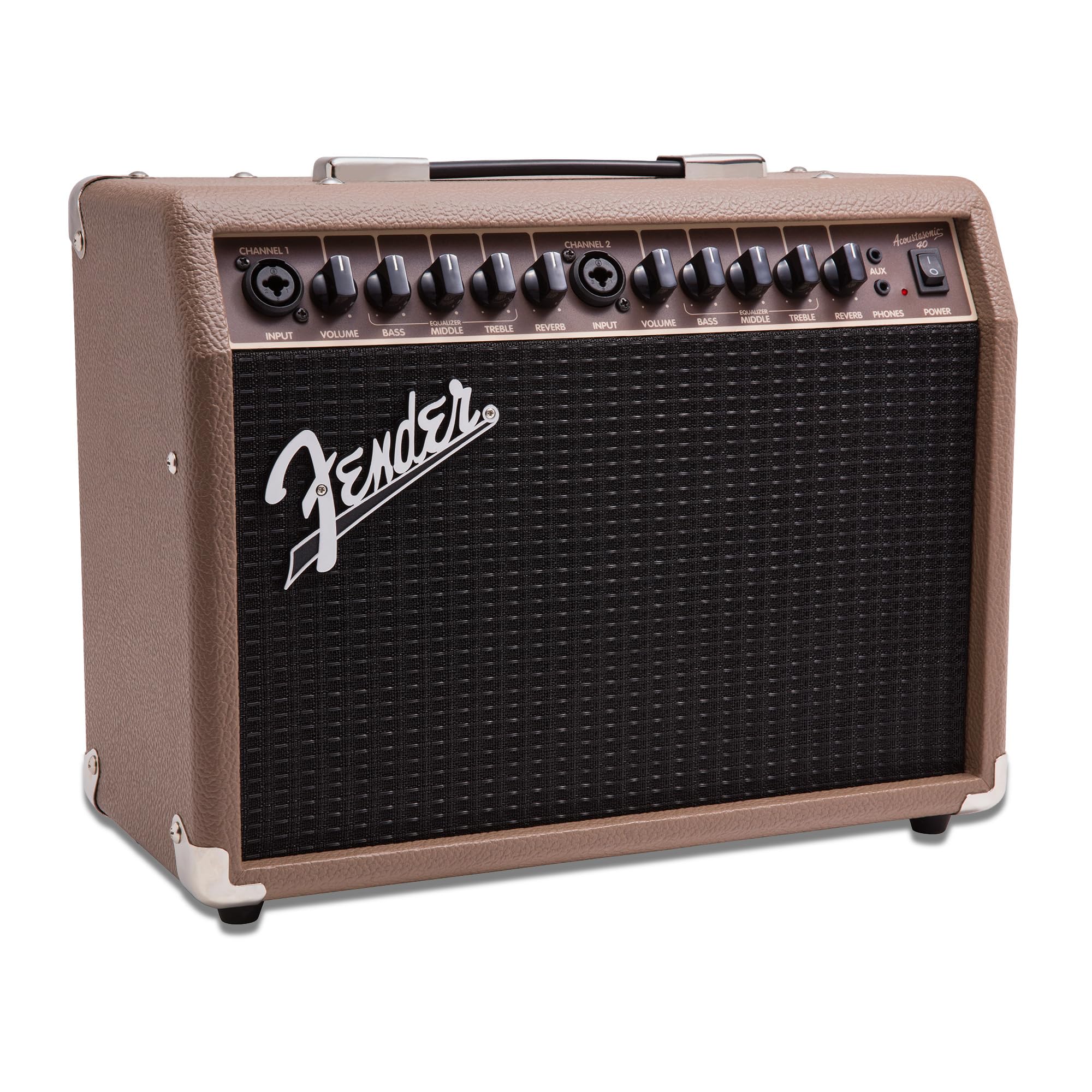
The legend of clean acoustic tone steps up for vocalists with dual-input flexibility.
Fender’s Acoustasonic 40 is a 40-watt combo amplifier that handles both an acoustic-electric guitar and a microphone through its combination XLR/1/4-inch inputs. While it is primarily an acoustic guitar amp, the twin 6.5-inch full-range speakers with whizzer cones give vocals detailed clarity across the frequency spectrum — making it a favorite among singer-songwriters doing coffee shop gigs and small rooms.
The built-in reverb adds a natural depth to both guitar and voice without needing external pedals. The 3-band EQ (bass, mid, treble) gives you enough control to dial in a warm, present vocal tone. The cabinet is a lightweight 5-ply plywood construction weighing under 20 pounds, making it easy to move between gigs. The classic Brown and Wheat Fender cosmetics are a bonus if aesthetics matter to you.
Owners rave about the sound quality for vocals — one buyer specifically calls out its “excellent for vocals with mids on both channels” and notes that it is loud enough for restaurant gigs at half volume. The 2-year limited warranty from Fender adds confidence that budget brands cannot match.
The catch: This is a corded amplifier — no battery, so you need a power outlet. It also lacks built-in effects beyond reverb, so if you need echo or delay, you will need external pedals. Some owners note occasional hiss or buzzing, but most find the tone and build quality far outweigh this.
Ideal for: singer-songwriters, acoustic duos, and coffee shop performers who want Fender’s legendary clean tone for both voice and guitar. The 40W output is perfect for small-to-medium rooms.
11. Pyle PPHP28AMX DJ Mixer Bundle
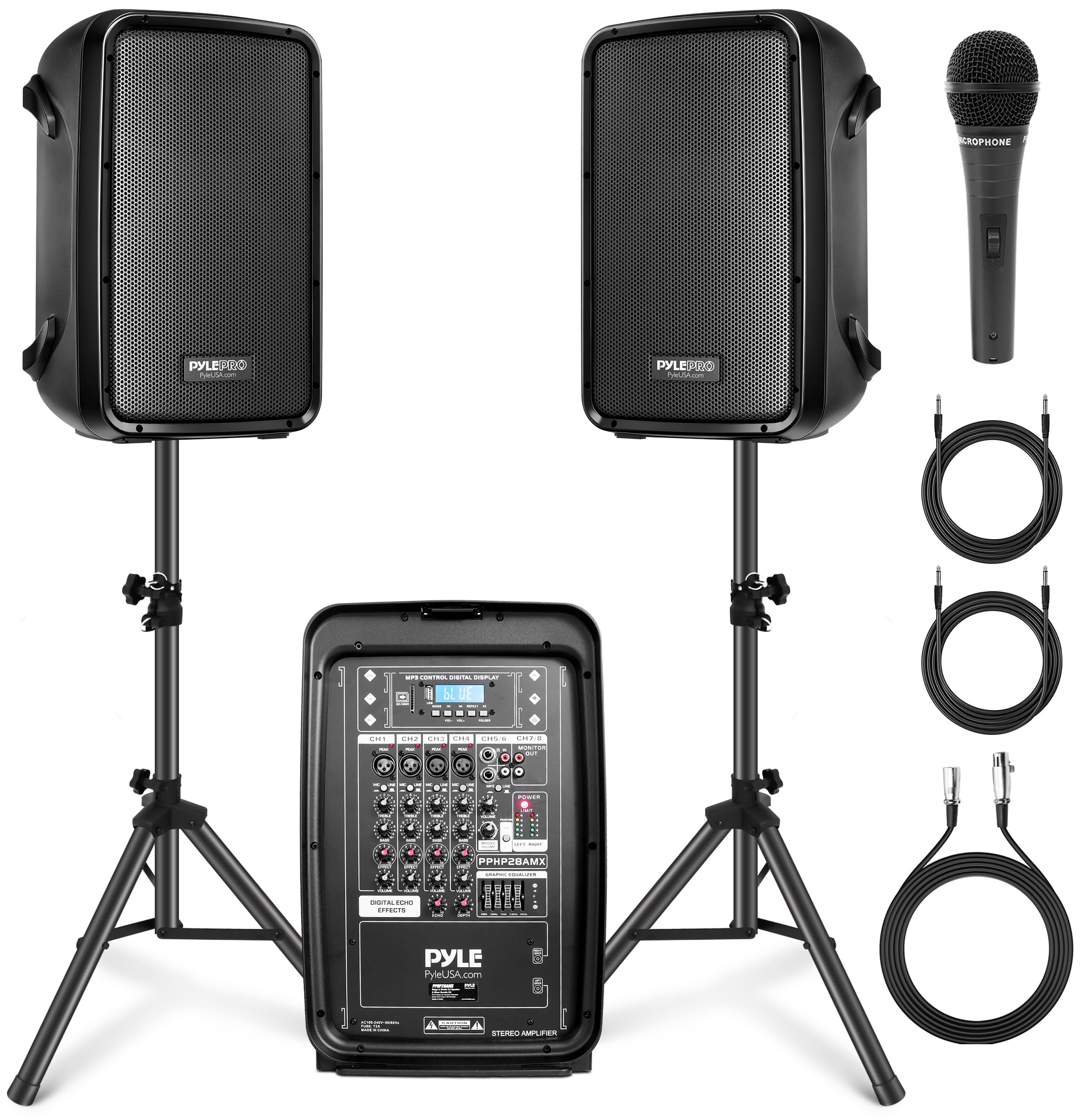
Everything you need for voice and music in one box — speakers, mixer, stands, and cables.
This is the complete PA starter kit. It includes two 8-inch PA speakers, an amplifier mixer console, a wired handheld microphone, two tripod speaker stands, and all necessary cables — everything except the extension cord. The 300W peak power from the 8-inch full-range subwoofer and 1-inch tweeter in each speaker gives you full-range stereo sound that works for both speech and music.
The mixer has 9 inputs: XLR, 1/4-inch jacks, USB, SD card, RCA, and Bluetooth streaming. This means you can run two microphones, a guitar, a backing track from a phone, and a laptop all at once. Owners find the Bluetooth connection easy to pair and the system simple to set up — one buyer had it running in under 10 minutes. The speakers have a 35mm mount that fits the included stands perfectly. For a small church, classroom, or party, this bundle is tough to top for convenience.
What Works
- Sound quality and value for money are the top positives — owners are impressed with the clarity and volume for the price.
- Portability is good: the speakers are relatively light, and the stands store easily. One buyer’s 11-year-old could set it up alone.
Watch For
- Build quality is mixed — the handles on the speakers are fragile, and some customers note issues with the amplifier failing after a few weeks.
- Durability concerns are the most common negative, so handle it carefully and keep your receipt.
Grab this if: you need a complete PA system for small events, school functions, or parties, and you want one box with everything included. The value for money is excellent, but treat the components gently and buy from a seller with a replacement policy.
Understanding the Specs
Wattage and What It Means for Your Voice
Wattage measures the amplifier’s power output. For voice amplification, 40W to 50W is plenty for a standard classroom or meeting room. You need 100W or more for outdoor spaces, large halls, or noisy environments. Higher wattage also usually means a heavier, bulkier unit — so balance your space needs with your carry comfort.
Battery Life and Runtime
Measured in hours of continuous use at moderate volume. A 5-8 hour battery covers a full workday. Corded units never run out of power but need a wall outlet. If you move between rooms or teach outdoors, battery-powered units give you freedom that cords cannot match.
Wireless Microphone Technology
UHF wireless microphones use a specific radio frequency band for stable, low-latency audio. They typically offer better range and fewer dropouts than Bluetooth microphones. A wireless headset frees both hands for teaching, presenting, or leading activities. Some systems include two wireless mics for duos or co-presenters.
Inputs and Connectivity
More inputs mean more flexibility. XLR inputs are professional-grade and used for most microphones. 1/4-inch inputs accept instruments like guitars. USB and SD card slots let you play pre-recorded audio. Bluetooth lets you stream music from your phone. If you only need one microphone, 1-2 inputs are enough. For band or multi-mic setups, look for 4+ inputs.
FAQ
What wattage do I need for a classroom?
How long should the battery last for a full teaching day?
Can I use a voice amplifier with a guitar or other instruments?
What is the difference between UHF and Bluetooth wireless mics?
Is a headset microphone better than a handheld mic for teaching?
Do all voice amplifiers work with condenser microphones?
How heavy is too heavy for a portable voice amplifier?
Can I connect my phone to play music between speeches?
What is phantom power and do I need it?
Is a dedicated voice amplifier better than using a regular Bluetooth speaker with a mic?
Final Thoughts: The Verdict
If you want one dependable pick, the amplifier for voice winner is the Coolmusic BP80 because its 100W output, 6-8 hour battery, and 6 inputs give you the flexibility to amplify voice alone or run a full small-band setup with crisp sound quality. If you need a lightweight, all-day wireless option for daily teaching, grab the Pyle PPHP28AMX is the one to reach for.
How We Picked
We do not accept paid placement. Every pick is matched to a real buyer and a real use-case; we do not hands-on test units.
Sources & Methodology
Specifications: manufacturer listings and product documentation. Review insights: verified customer reviews, as of July 2026. Pricing: not shown on this page (it changes often); check the current price via the retailer link.
As an Amazon Associate, Gadgets Feed earns from qualifying purchases. This does not affect which products we feature.