
Our readers keep the lights on and my morning glass full of iced black tea. As an Amazon Associate, I earn from qualifying purchases.
Specs are compiled from manufacturer listings and verified buyer reviews and can change over time — please confirm the key details on the product page before buying.
You plug your expensive headphones into your computer and hear it: a faint hiss, a hum, or just a thin, lifeless sound. That is your motherboard’s built-in audio chip — and it is the single biggest bottleneck between you and the music you paid for. A dedicated headphone amplifier takes that signal, cleans it up, and delivers the voltage and current your headphones actually need to sing, not just play.
I’m Min — the founder and writer behind Gadgets Feed. This guide is built by comparing the manufacturers’ published specifications and the patterns across verified customer reviews, so you get each pick’s real strengths and trade-offs instead of marketing spin.
Whether you are a desk-bound audiophile chasing the last 5% of clarity or a budget-conscious listener trying to defeat motherboard hum, the right amp for headphones transforms your listening by delivering clean power to every driver, from sensitive in-ear monitors to hungry 300-ohm planars.
Our Picks at a Glance


How To Choose The Best Amp For Headphones
Picking the right amplifier is less about price tags and more about matching your specific headphones and listening habits. The main things to check are how much power it delivers, what kind of connections it has (both from your music source and to your headphones), and whether its sound signature—clean and neutral vs. slightly warm—suits your taste.
Power Output and Your Headphones’ Impedance
The most critical spec is how many milliwatts (mW) the amp can push into your headphones’ impedance (measured in ohms). High-impedance headphones (like 250 to 600 ohm studio cans) need higher voltage—look for at least 100mW into 300 ohms for comfortable headroom. Low-impedance planars (often under 50 ohms) crave current; a balanced output delivering 1000mW or more at 32 ohms is the benchmark for them.
Connection Types: Inputs and Outputs
Your audio source (computer, TV, turntable, phone) determines the inputs you need: USB is universal, while optical/coaxial connect to TVs or CD players. On the output side, a 6.35mm single-ended jack works for most headphones, but a 4.4mm or XLR balanced output not only doubles the power but also reduces crosstalk and noise, giving you a wider soundstage and cleaner signal.
DAC vs. Pure Amp
Many amplifiers come with a built-in DAC (digital-to-analog converter), meaning you plug your computer directly into them via USB. A pure analog amp requires a separate DAC (or a source with analog outputs). If you are starting fresh, a DAC/amp combo is simpler and often better value; if you already own a high-end DAC, a standalone amp lets you keep that investment.
Quick Comparison
| Model | Best For | Power Output (Balanced) | DAC Chip | Balanced Output | Amazon |
|---|---|---|---|---|---|
| FiiO K11★ Best Overall | Entry-Level Desktop | 1400mW | — | 4.4mm | Amazon |
| SMSL DS100Compact Champion | Ultra-Compact Desktop | — | CS43131 | 4.4mm | Amazon |
| Fosi Audio SK02Value Powerhouse | Compact Powerhouse | 1100mW @ 32Ω | ES9038Q2M | 4.4mm | Amazon |
| Fosi Audio ZH3 | Full-Featured Preamp/DAC | 2570mW @ 32Ω | AKM4493SEQ | 4.4mm | Amazon |
| FiiO K7 | Versatile Mid-Range | 2000mW @ 32Ω | Dual AK4493SEQ | 4.4mm | Amazon |
| TOPPING DX5 II | High-End Versatility | 7600mW x2 | Dual ES9039Q2M | 4.4mm | Amazon |
| Rupert Neve RNHP | Studio-Grade Purity | — | None (Analog) | None | Amazon |
| aune S9c Pro | Reference-End All-in-One | >5700mW @ 32Ω | Dual ES9068 | 4.4mm & XLR | Amazon |
| Sennheiser HDV 820 | Flagship Pairing | — | ES9028PRO | XLR | Amazon |
In‑Depth Reviews
1. FiiO K11 DAC and Headphone Amplifier
Our pick — over 4.5★ from 700+ verified ratings; the strongest balance of quality and price.
The desk-friendly starter that punches well above its weight class.
The FiiO K11 delivers 1400mW through its balanced output — enough to drive most headphones up to 350 ohms clearly and loudly, so you hear bass punch and treble detail without distortion. Its clean, neutral sound and easy-to-read display showing sample rate and gain make it the all-rounder most buyers need. It accepts USB, coaxial, and optical inputs, plus a 4.4mm balanced and 6.35mm single-ended headphone jack, all in a slim 2.05 lb aluminum body.
Compared to the 0.39 lb SMSL DS100, the K11 is heavier and less portable at 2.05 lb, but that weight gives it a solid desk presence. Buyers consistently praise its sound quality (83 positive mentions) and build quality (60), giving it a 4.6-star rating. Buyers report the balanced output drives high-impedance headphones like the Sennheiser HD560s easily.
The honest trade-off: the digital filters can sound compressed to critical ears — most owners prefer Filter 4 or Filter 6 (bypass) for the most natural sound. If you are chasing absolute neutrality, you may want a more expensive unit. But for everyone else, the FiiO K11 is where the value peaks.
What Wins People Over
- Clean, detailed, and neutral sound that reveals new details in your music.
- Solid aluminum build with a smooth volume knob and bright display.
- Powerful 1400mW balanced output handles most headphones up to 350 ohms.
- Versatile inputs (USB, coaxial, optical) for computer, TV, or CD player use.
Worth Knowing
- Digital filters can sound compressed on some settings; most users prefer filter 4 or 6.
- May not satisfy purists seeking absolute transparency; its sound is slightly warm/neutral.
Reach for this if you want a one-box solution with enough power for 90% of headphones and a clean, enjoyable sound signature.
Think twice if you need ultra-portability (look at the SMSL DS100) or demand reference-level neutrality in every frequency band.
2. SMSL DS100 MQA DAC Headphone Amplifier
A palm-sized wonder that delivers studio-grade clarity without cluttering your desk.
Weighing just 0.39 lbs (about the weight of a deck of cards), the SMSL DS100 is easy to toss in a bag, yet it packs a Cirrus Logic CS43131 DAC chip that supports MQA decoding (a hi-res audio format used on Tidal) and delivers an extremely low distortion of 0.00017% (-115dB). That clean signal feeds both a 6.35mm and a 4.4mm balanced headphone jack, pushing 7 Vrms into 600-ohm headphones — plenty of voltage for high-impedance studio cans so they sound full and detailed.
Reviewers describe it as plug-and-play, driving IEMs (in-ear monitors) and Sennheiser HD58x without any fuss. The aluminum alloy build with gold-plated terminals feels premium, and its 3.5″ x 3.5″ footprint means it fits anywhere. The main caveat: Windows users need to download a driver from SMSL’s website before it works, so it is not a true out-of-box experience for PC gamers. Its clarity is excellent for the price, but the 0.39 lbs weight means it can slide around if your cable is stiff — add a small pad underneath.
Perfect desk companion: The DS100 is ideal for listeners who need a transparent, zero-noise DAC/amp that takes up almost no space, but be ready to install a driver on Windows before your first listen.
3. Fosi Audio SK02 DAC Amp Headphone Amplifier
Small box, huge sound — the SK02 feeds hungry planars without blinking.
The Fosi Audio SK02 delivers 1100mW of balanced power at 32 ohms — that is enough to drive demanding planar magnetic headphones (like the Hifiman Edition XS) to loud, clean volumes without strain. It uses an ESS SABRE ES9038Q2M DAC chip (known for detailed, clean sound) in a small CNC-machined aluminum chassis that fits in one hand. It gives you a 3.5mm single-ended output and a 4.4mm balanced output, plus USB and optical inputs.
Buyers love its clean, neutral sound with a slight emphasis on mid-to-high frequencies, and the fact that it requires no driver installation on Windows. Owners mention it easily drives 300-ohm Sennheisers to high volume without distortion. The catch: the volume indicator is a single LED light that changes color — no numeric display, which a few owners found vague. If you can live without a readout, the SK02 delivers more power per dollar than almost anything else here.
Pure power play: This is the pick for owners of demanding headphones on a budget who prioritize raw output and clean sound over a fancy display or remote control.
4. Fosi Audio ZH3 DAC Headphone Amp

An all-in-one command center with balanced XLR outputs, a remote, and adjustable EQ.
The Fosi Audio ZH3 combines a DAC (AKM4493SEQ chip), a headphone amp delivering 2570mW at 32 ohms balanced, and a preamp with XLR and RCA outputs — so you can drive both your headphones and powered speakers from one box. It supports bass and treble EQ adjustments, six filter types, and two swappable op-amps (operational amplifiers) for tailoring the sound. The 2.87 lb chassis feels substantial, and the included remote control is a rare luxury at this level.
Owners highlight its strong stereo imaging, with 33 positive remarks on sound quality. One reviewer called it “exceptional as a headphone amplifier” for powering hungry equipment. The honest trade-off: the chassis runs noticeably warm even at idle (a few owners noted it gets uncomfortably hot after 30 minutes), and the EQ adjustment only works on the headphone output, not the preamp outputs. If you need a clean, powerful all-in-one for both speakers and headphones, this is it.
Hub of your desktop: If you run both active speakers and headphones, the ZH3’s preamp outputs and remote make it the most versatile single-box solution in this lineup.
5. FiiO K7 Desktop DAC and Amplifier

The step-up that open up holographic imaging for your HD600 or Sundara.
The FiiO K7 uses two AK4493SEQ DAC chips paired with dual THX AAA 788+ amplifiers in a six-stage audio circuit — this design reduces distortion and noise for a cleaner signal. It delivers 2000mW of balanced power at 32 ohms, which reviewers call “clean and spacious without distortion.” The soundstage is noticeably wider than the K11 — one owner described “holographic imaging” — and the unit stays cool even after extended listening, unlike the warmer ZH3. It includes USB, optical, coaxial, and analog AUX inputs, plus 4.4mm balanced and 6.35mm single-ended outputs.
Compared to the FiiO K11, the K7 offers a significant power increase (2000mW vs 1400mW) and dual DAC chips for better channel separation. The K11 is the better value for most, but the K7 is the balance for owners of planar magnetics like the Hifiman Edition XS or Sennheiser HD 600s who want that extra layer of clarity. The volume knob doubles as a power switch and has an RGB indicator that changes color with sample rate. The honest note: the digital volume knob lacks an end-stop (it spins infinitely), which some owners find disorienting, but the built-in volume guard prevents sudden loud spikes.
Clarity upgrade:
6. TOPPING DX5 II Hi-Res DAC & Headphone Amp Combo
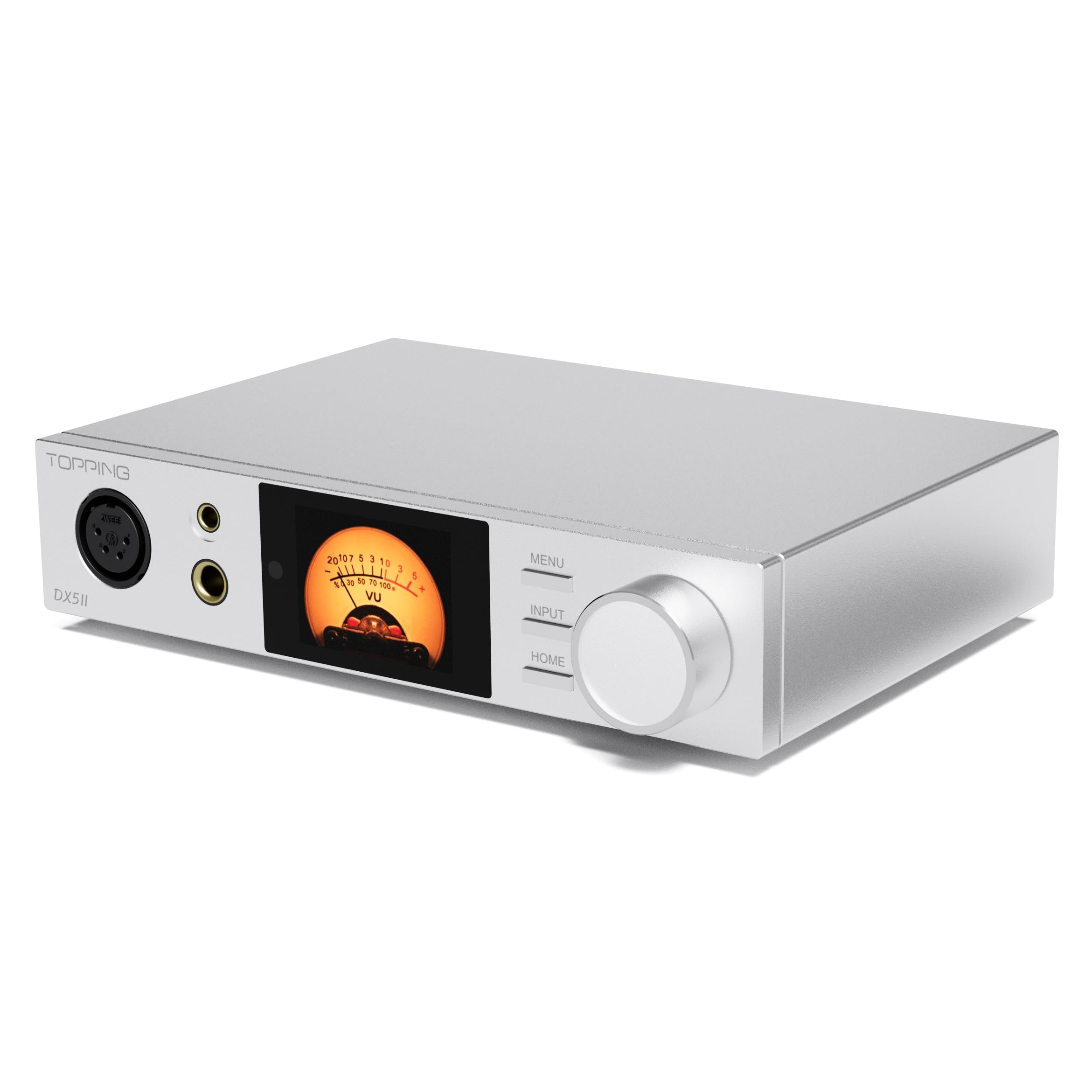
Ridiculous power and a built-in graphic EQ for tuning your system to perfection.
The TOPPING DX5 II uses dual ES9039Q2M DAC chips feeding an X-Hybrid amplifier that claims 7600mW x2 of balanced output — enough to drive virtually any headphone on the market. It also features a 10-band high-precision PEQ (parametric equalizer), which lets you tweak specific frequencies to correct room acoustics or headphone response. The 2.0″ Aurora UI full-color display with nine customizable themes is one of the best screens in this class.
Owners with demanding planars like the Hifiman Arya Stealth report ample headroom even at -28 dB on the volume dial. The unit supports Bluetooth 5.1 with LDAC, aptX Adaptive, and AAC, meaning you can stream wirelessly at near-CD quality. The DX5 II is also preamp-ready with a 12V trigger for smooth integration with a speaker system. The honest caveat: a few owners found the unbalanced 6.35mm output insufficient for very high-impedance headphones like the 250-ohm DT 880/990 — if you need massive power for single-ended high-impedance cans, go balanced.
Ultimate tool kit: The DX5 II is for the buyer who wants wireless streaming, a graphic EQ, a vivid display, and enough balanced power to drive anything — all in one clean box.
7. Rupert Neve Designs RNHP Stereo Precision Headphone Amplifier

Legendary console-grade sound in a minimalist, no-frills analog box.
The Rupert Neve RNHP is a pure analog headphone amplifier — no DAC, no Bluetooth, no EQ. It runs on a dedicated 24V power supply and offers a +4dBu line-level input via 1/8″ stereo jacks. Owners describe its sound as “crisp highs” and a “great soundstage,” replacing the shrill high frequencies they got from cheaper audio interfaces with tube-like warmth. Its 1.33 kg stainless steel chassis feels indestructible.
It pairs beautifully with 250-ohm Beyerdynamic DT 880 or 770 Pros, requiring near-max volume at normal line levels but delivering supreme fidelity. The trade-off is severe: no balanced output, no volume display, and it defaults to output A on power-up. One owner noted it “lacks a light dimmer,” and for 600-ohm headphones, you may want an amp with more voltage swing. This is a specialized tool for purists who value the Neve sound signature over raw power or features.
For the purist: If you already own a high-end DAC and want the legendary Rupert Neve analog sweetness — think warm, clear, and musical — the RNHP delivers a sound that rivals amps many times its price.
8. aune S9c Pro DAC with Headphone Amp
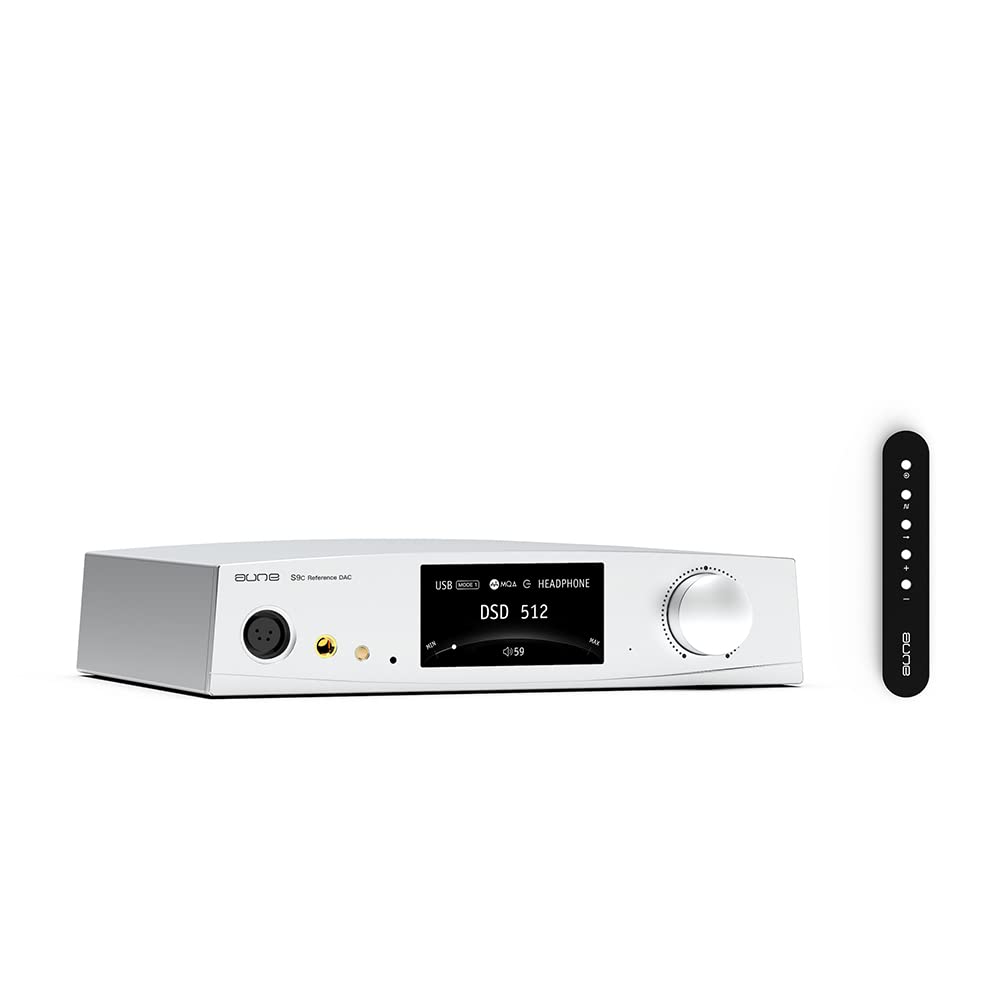
A heavyweight champion with a toroidal transformer and clock-sync tech for the obsessive listener.
The aune S9c Pro uses a massive 50W toroidal linear transformer and a 23900 μF capacitor array — this design provides clean, stable power for reference-grade sound. It delivers over 5700mW at 32 ohms and uses dual ES9068 DAC chips with a proprietary PLL clock synchronization system (2nd gen) for ultra-low jitter (timing errors), so the digital-to-analog conversion is highly accurate. It also has a 10MHz clock input for external master clocks, a feature usually found on units costing significantly more.
With a line output noise floor (the background hiss) of just 2.04 μV and THD+N (total harmonic distortion plus noise) of 0.00022%, this is a reference-grade device. Owners call it “the best all-in-one under K” and note it drives both the Meze 109 Pro and DCA Expanse easily. Its sound is analytical and punchy — not warm. The 10 lb chassis and toroidal transformer mean it stays cool and vibration-free. The negatives: the knob can feel wobbly, there is no analog input (so you cannot use an external DAC with it), and the remote has a very short range (about 4 feet). Some units had a left-channel crackling issue with sensitive IEMs, which the warranty covered.
Reference-level performer: If you demand the highest resolution, the lowest noise floor, and the ability to add an external clock, the S9c Pro is an end-game all-in-one that rivals separates costing twice as much.
9. Sennheiser Consumer Audio HDV 820 Reference Headphone Amplifier DAC

Sennheiser’s own flagship amp, built to wring every last detail from the HD 800S.
The Sennheiser HDV 820 is the brand’s official companion amplifier for the HD 800 series headphones. It houses an ESS 9028PRO Sabre DAC chip and provides both XLR balanced and 6.35mm single-ended outputs, along with USB, optical, and coaxial inputs. At 5 lbs, it is a substantial desktop piece with a premium brushed finish that matches the HD 800S design language. The specific synergy with Sennheiser’s own reference headphones is its main selling point — customers note that the balanced output is essential, with one noting a performance drop when using the single-ended jack with HD 800S.
Owners who love it call the sound “natural and full” and “the best headphone amp I have owned.” The honest downsides are significant for the price: it has the lowest average rating in this roundup (3.9 stars), with some owners experiencing driver installation failures on Windows and a noisy volume knob on refurbished units. One owner described a refurbed unit as “paired poorly with HD800S” and switched to an RME DAC. The HDV 820 is an option strictly for those building a Sennheiser flagship system and who value brand synergy over raw spec sheet value — there are more versatile, better-reviewed options for less.
Synergy over specs: The HDV 820 is for the dedicated Sennheiser HD 800S owner who wants the brand’s own tuning and aesthetics, but it is a specialist pick with notable compatibility caveats.
Understanding the Specs
Power Output (mW)
Measured in milliwatts (mW), this tells you how loud the amp can make your headphones. The higher the power, the more headroom you have before distortion kicks in. For most desktop headphones, look for at least 100mW into 300 ohms. For planar magnetics, aim for 1000mW or more at 32 ohms. A balanced output often doubles this figure compared to a single-ended one.
THD+N (Total Harmonic Distortion + Noise)
This spec measures how much the amp colors the sound. Lower numbers mean a cleaner signal. A THD+N of 0.001% is excellent and essentially inaudible—anything under 0.01% is transparent to human hearing. The S9c Pro’s 0.00022% is reference-level, while even budget units like the Fosi SK02’s 0.001% are already superb.
DAC Chip
The digital-to-analog converter chip is the brain of a DAC/amp combo. Common models include the ESS Sabre series (known for clean, detailed sound) and AKM chips (often slightly warmer). The chip alone does not determine sound quality—circuit design and power supply matter more—but a higher-end chip generally supports higher sample rates (like 768kHz/32bit) and lower noise floors.
Balanced vs. Single-Ended
A balanced output (4.4mm or XLR) uses separate ground wires for the left and right channels, which cancels out noise and crosstalk. This gives you a wider soundstage, lower noise floor, and up to double the power output compared to a standard 6.35mm single-ended jack. If your headphones have a balanced cable, use it—the improvement is often night and day.
FAQ
Do I need a headphone amp if I have a good computer?
What is the difference between a DAC and an amp?
Will a headphone amp make my headphones sound better?
What does balanced output mean?
How many mW do I need?
Can I use a headphone amp with a turntable?
Is a separate stack better than a combo unit?
What is MQA and do I need it?
Do I need a driver for the amp to work on Windows?
Final Thoughts: The Verdict
Across the board, the amp for headphones winner is the FiiO K11 because it delivers clean, powerful sound (1400mW balanced) and versatile inputs in a compact, well-built desktop design that earns unanimous praise for its sound quality. If you want a tiny, portable unit with MQA support, grab the SMSL DS100. And for the ultimate all-in-one with a 10-band EQ and Bluetooth, the TOPPING DX5 II is the one to reach for.
How We Picked
We do not accept paid placement. Every pick is matched to a real buyer and a real use-case; we do not hands-on test units.
Sources & Methodology
Specifications: manufacturer listings and product documentation. Review insights: verified customer reviews, as of July 2026. Pricing: not shown on this page (it changes often); check the current price via the retailer link.
As an Amazon Associate, Gadgets Feed earns from qualifying purchases. This does not affect which products we feature.