
Our readers keep the lights on and my morning glass full of iced black tea. As an Amazon Associate, I earn from qualifying purchases.
Specs are compiled from manufacturer listings and verified buyer reviews and can change over time — please confirm the key details on the product page before buying.
You need a rain jacket that keeps you dry without feeling like you are wearing a plastic bag. A true 3L (three-layer) jacket bonds the outer fabric, a waterproof membrane, and an inner liner into one piece of material, so it blocks the storm and lets sweat escape. The difference between a cheap shell that wets out in twenty minutes and a real 3L jacket that breathes depends on that bonded construction. This guide breaks down four real 3L jackets across different budgets and uses — from a lightweight hardshell for hiking to a golf-specific shell that lets you swing without restriction.
I’m Min — the founder and writer behind Gadgets Feed. This guide is built by comparing the manufacturers’ published specifications and the patterns across verified customer reviews, so you get each pick’s real strengths and trade-offs instead of marketing spin.
Finding the right 3l rain jacket means matching the hood type, breathability rating, and weight to how you actually move — something most shoppers don’t think about until they overheat or get soaked.
Our Picks at a Glance

How To Choose The Best 3L Rain Jacket
Three-layer jackets bond the outer fabric, the waterproof membrane, and an inner liner into one single piece of material. That construction makes them lighter, more breathable, and less prone to delamination (where layers peel apart) than cheaper 2L or 2.5L shells. But the right one for you depends on how you’ll wear it.
Breathability and Venting
A jacket that keeps rain out but traps sweat inside is miserable on the move. Look for underarm zip vents (often called pit zips) — they let you dump heat fast without taking the jacket off. Breathability ratings matter too: higher numbers mean more moisture vapor passes through the membrane.
Weight and Packability
If you carry your jacket in a daypack, every ounce counts. Lightweight 3L shells weigh around 13 to 14 ounces, while more feature-packed models come in heavier. Some jackets stuff into their own pocket, making them a no-excuse emergency layer.
Fit and Hood Design
A rain shell needs room for a mid-layer underneath but shouldn’t flap in the wind. An adjustable hood that moves with your head — not one that blocks peripheral vision — is a deal-maker. Check whether the hood fits over a helmet if you climb or ski.
Quick Comparison
| Model | Best For | Weight | Waterproof Rating | Key Venting | Amazon |
|---|---|---|---|---|---|
| Outdoor Research Foray 3L★ Best Overall | All-round hiking & travel | — | — | Pit zips | Amazon |
| Mountain Hardwear Threshold | Lightweight backpacking | 13.6 oz | — | Underarm zip vents | Amazon |
| Mammut Hardshell | Hiking & everyday use | 6.7 oz (190 g) | 20,000 mm | — | Amazon |
| Andrew Golf Jacket | Golf & high-mobility activity | 14.4 oz | — | — | Amazon |
In‑Depth Reviews
1. Outdoor Research Men’s Foray 3L Jacket
Our pick — 4.5★ from 30+ verified ratings; the strongest balance of quality and price.
The Foray handles everything from Alaska rain to city drizzle without missing a beat — thanks to pit zips that dump heat fast.
This 3L jacket from Outdoor Research is built for versatility. Pit zips (zippered vents under the arms) let you dump heat fast during active use, and the jacket is fully windproof. Buyers report it stood up to extreme Alaskan weather without wetting out (the outer fabric saturating so water stops beading). Build quality is the most consistent praise across owners, with many calling it a sharp-looking shell that feels substantial. If you need a hood, this one adjusts for a clear field of view — unlike the Andrew Golf Jacket which has no hood at all.
The catch is the fit. Multiple owners note the Foray runs slim through the chest and stomach, even in the standard cut. A 5’10”, 180-pound buyer who normally wears medium had to size up to large for a good fit. The torso also runs short while the sleeves run long, making sizing tricky for stocky builds. Waterproofing holds up well in light to moderate rain, though a few owners found heavy rain eventually seeps through after a year of use — they say using the manufacturer’s recommended soap restores the DWR (Durable Water Repellent) coating, the factory finish that makes water bead off the outer fabric.
Real-world versatility: A solid all-rounder if you size up and accept that the breathability works best with the pit zips open during activity.
Reach for it if: you want a do-everything 3L shell for travel, day hikes, and everyday commutes.
Look elsewhere if: you have a short, stocky build or plan to layer heavily underneath — the slim torso makes it a squeeze.
2. Mountain Hardwear Threshold Jacket

A featherlight 13.6-ounce 3L shell that disappears into a pocket when the sun comes back — nearly an ounce lighter than the Andrew golf jacket.
At just 13.6 ounces, the Threshold is the lightest jacket in this lineup. It packs into its own pocket, making it an ideal emergency layer for backpackers and travelers who want protection without the bulk. The three-layer construction uses underarm zip vents (zippered openings under the arms that release hot air quickly) to manage heat. Owners mention water beads cleanly off the surface in light to medium rain, keeping you dry during a sudden shower on a trail.
The downside is the cut. This is a women’s jacket, and several owners found the hem too short for full coverage in a downpour — water runs off the bottom and soaks your pants. The chest also runs tight on curvier figures, with one owner recommending going up two sizes for layering. As buyers put it: “beautiful quality and color, but short and not for women with a chest.” For slim builds who don’t need heavy layering, it fits true to size. Its lower weight and packability make it a smarter backup than the heftier Outdoor Research Foray, but that trade-off means less rain coverage.
What wins people over
- Packs into its own pocket — always ready to carry
- Underarm vents dump heat quickly during active use
- Water beads off the surface; holds up in moderate rain
Where it falls short
- Short hemline leaves your lower back exposed in heavy rain
- Tight chest fit for curvier builds; size up significantly if layering
Best for: ultralight backpackers and travelers who need emergency rain protection that stows away to nothing.
Skip if: you need full-coverage rain protection or have a larger chest — you’ll want a longer hem and roomier cut.
3. Mammut Mens Outdoor Hardshell Hooded Jacket
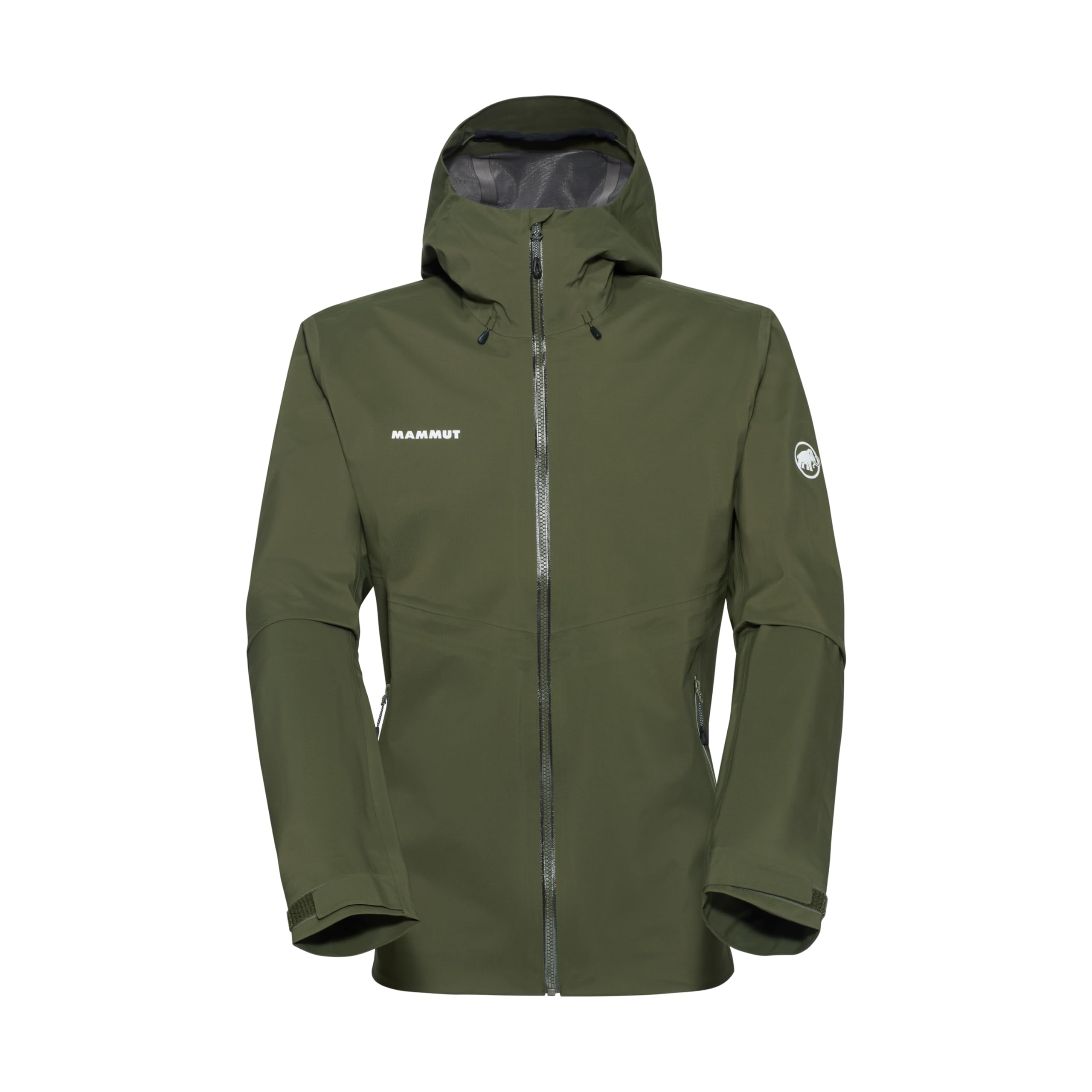
A 190-gram (6.7-ounce) hardshell with mountain-grade waterproofing that packs flat for the trail — the lightest pick in the lineup.
This Mammut jacket is the lightest in the whole lineup by a wide margin — just 190 grams (6.7 ounces) — while delivering a 20,000mm waterproof rating, meaning it can handle sustained heavy rain without letting moisture through. It uses Mammut’s own 3-layer Dry Active technology (the bonded face fabric, membrane, and liner that vents sweat while blocking water) and is made from 100% recycled polyamide, so you get technical performance from an eco-friendly build. The hood is helmet-compatible (adjusts to fit over a climbing helmet), the design is athletic without being restrictive, and owners consistently describe the fit as “perfect” and “good.” This jacket keeps you drier in a downpour than the Outdoor Research Foray because of its higher waterproof rating.
The trade-off is minimal venting. There are no pit zips on this shell, so if you hike hard uphill, you’ll need to stop and unzip to cool down. The streamlined design also means fewer pockets than some competitors. For cold-weather hiking and everyday use in steady rain, customers note it keeps them “absolutely dry” while looking sharp. One reviewer in Berlin called it the perfect thickness for cool days with enough room for a layer underneath.
What stands out
- Incredible 190g weight — barely noticeable in a pack
- 20,000mm waterproof rating handles sustained downpours
- Made from 100% recycled polyamide without cutting performance
What’s missing
- No pit zips for venting during high-output activity
- Limited pocket count compared to feature-rich jackets
Reach for it if: weight and waterproofness are your top priorities — you’ll barely know you’re carrying it until the sky opens up.
Think twice if: you run hot on climbs; the lack of pit zips means you’ll have to unzip to stay comfortable.
4. Andrew Waterproof Golf Jacket Men

A 14.4-ounce golf shell built for unrestricted swing and serious rain protection — the most specialized pick here.
This is the most specialized jacket in the group, and it shows. The Andrew jacket uses Pertex Shield Stretch fabric (a 3-layer construction with PFAS-free chemistry, meaning it’s made without certain long-lasting chemicals) combined with repositioned side seams and shaped sleeves so you can make a full golf swing without restriction. Buyers consistently report the stretch and cut are exceptional for rotational movement, calling it “the best rain jacket ever” for golf. The chest tabs let you cinch down the fit so the jacket doesn’t balloon during your swing, unlike a general hiking shell like the Mammut which is not designed for that motion.
The price is also the highest of the four. For golfers, the trade-off is straightforward: you pay more for a jacket that doesn’t bind during play. That said, the Andrew has no hood, which is a deliberate design choice for visual clearance on the course. A few owners also note the left-side zipper is an adjustment if you’re used to right-side zippers.
Specialist tool: If you play golf in wet conditions, this jacket is purpose-built in a way no general hiking shell can match — but it is overkill and under-featured for everyday rain use.
Reach for it if: you’re a dedicated golfer who needs unrestricted movement and absolute waterproofing on the course.
Look elsewhere if: you need a hood or a lower price for occasional rain protection — this is a niche piece for serious players.
Understanding the Specs
Waterproof Rating (mm)
This number tells you how much water pressure the fabric can handle before leaking. A rating of 10,000mm means the fabric can withstand a 10-meter column of water pressing on it. For everyday rain and moderate hikes, 10,000mm to 20,000mm is plenty. Higher numbers matter for sustained downpours or sitting on wet surfaces.
Breathability (g/m²/24h)
This measures how much moisture vapor (sweat) can escape through the fabric in a day. A higher number means you stay drier from the inside. For active use like hiking or running, look for at least 10,000 g/m²/24h. Many 3L jackets also add pit zips as a mechanical venting option — they’re a simple, reliable way to dump heat fast.
3L vs 2L vs 2.5L
Three-layer (3L) construction bonds the outer face fabric, the waterproof membrane, and a knit liner into one single piece. This makes the jacket lighter, less bulky, and more durable than two-layer (2L) jackets, which have a separate hanging liner. 2.5L jackets add a thin protective coating instead of a full liner, saving weight but often being less comfortable against skin.
Pit Zips
These are zippered vents under the arms that let hot air escape quickly without taking your jacket off. They are among the most effective ways to regulate temperature during high-output activity. If you plan to hike, climb, or run in your rain jacket, pit zips are almost a must-have — they prevent the “boil-in-the-bag” feeling that even the most breathable membranes can’t fully eliminate.
FAQ
What does 3L mean in a rain jacket?
Is a 3L jacket always waterproof?
How long does a 3L rain jacket last?
Can I wash a 3L rain jacket?
Why do some 3L jackets cost more than others?
Are 3L jackets breathable enough for running?
Can I wear a 3L jacket for skiing or snowboarding?
How do I know what size to buy in a 3L jacket?
What is the difference between a hardshell and a 3L jacket?
Can I use a 3L rain jacket for golf?
Final Thoughts: The Verdict
For most buyers, the top pick is the Outdoor Research Foray 3L because it balances real-world waterproofing, pit-zip venting, and a sharp look at a reasonable price — just remember to size up. If weight is your priority and you need a packable emergency shell, the Mountain Hardwear Threshold delivers 13.6 ounces that stuffs into its own pocket. For hardcore hikers who want mountain-grade waterproofing in an ultralight package, the Mammut Hardshell is class-leading at 190 grams. And if you’re a dedicated golfer who demands unrestricted movement on the course, the Andrew Golf Jacket is the specialist choice that justifies its premium price.
How We Picked
We do not accept paid placement. Every pick is matched to a real buyer and a real use-case; we do not hands-on test units.
Sources & Methodology
Specifications: manufacturer listings and product documentation. Review insights: verified customer reviews, as of July 2026. Pricing: not shown on this page (it changes often); check the current price via the retailer link.
As an Amazon Associate, Gadgets Feed earns from qualifying purchases. This does not affect which products we feature.