
Our readers keep the lights on and my morning glass full of iced black tea. As an Amazon Associate, I earn from qualifying purchases.
Specs are compiled from manufacturer listings and verified buyer reviews and can change over time — please confirm the key details on the product page before buying.
You can grab a real step up from cheap department-store binoculars for under $200 — a bright, sharp image in a body that handles a few bumps — while staying affordable. The hard part is filtering similar-looking specs to find the one that fits how you use them, whether that is scanning a field at dawn or stuffing them into a daypack for a hike.
I’m Min — the founder and writer behind Gadgets Feed. This guide is built by comparing the manufacturers’ published specifications and the patterns across verified customer reviews, so you get each pick’s real strengths and trade-offs instead of marketing spin.
The difference between a good and a bad pair depends on the glass and the build, and we have broken down the top contenders to find the best binoculars under $200.
Our Picks at a Glance


How To Choose The Best Binoculars Under $200
You want a clear, bright view that stays sharp in low light, feels good in your hands, and will not fog up on a humid morning. Once you know a few numbers, the choice gets much simpler.
8x vs 10x Magnification
This is your first big fork in the road. An 8x pair makes things look eight times closer, while a 10x pair brings them ten times closer. The trade-off is steadiness — 10x amplifies your hand shake, so it works best when you can rest your elbows on something. For most people, 8x is easier to hold steady and gives you a wider view, which makes following a moving bird or animal much less frustrating.
Objective Lens Size and Exit Pupil
The second number (like 42 in 8×42) is the diameter of the front lens in millimeters. A larger lens gathers more light, which is crucial in early morning or late evening. The exit pupil is that little disk of light you see when you hold the binoculars at arm’s length — it is the diameter of the light beam entering your eye. A bigger exit pupil (over 4 mm) makes it much easier to see a bright, full image, especially if your eyes are older or the light is fading.
Lens Coatings and Prism Quality
Good coatings reduce the light lost to reflections. “Fully multi-coated” means every glass surface has multiple anti-reflective layers, and that is the standard you want for bright, contrasty images. The prisms inside do the heavy lifting of flipping the image right-side up. BaK-4 prisms are a higher-grade glass that transmits more light than the cheaper BK-7, giving you a rounder, brighter exit pupil.
Quick Comparison
| Model | Best For | Magnification | Objective Lens | Field of View | Amazon |
|---|---|---|---|---|---|
| Vortex Copperhead HD 10×42★ Best Overall | Overall quality & value | 10x | 42mm | 334 ft | Amazon |
| Nikon PROSTAFF P3 8×42Best for Birding | Wide view & comfort | 8x | 42mm | 377 ft | Amazon |
| Nocs Provisions Field Issue 8×42 | Durable everyday carry | 8x | 42mm | 394 ft | Amazon |
| Celestron Nature DX ED 8×42 | Color fidelity & sharpness | 8x | 42mm | 7.5° | Amazon |
| Nikon PROSTAFF P3 10×42 | Lightweight 10x reach | 10x | 42mm | 367 ft | Amazon |
| Leupold BX-1 Rogue 10×25 | Ultra-portable hiking | 10x | 25mm | 5.6° | Amazon |
| Athlon Optics 8×42 Neos G2 HD | Smart budget workhorse | 8x | 42mm | 7° | Amazon |
In‑Depth Reviews
1. Vortex Copperhead HD 10×42 Binoculars
Our pick — over 4.5★ from 450+ verified ratings; the strongest balance of quality and price.
This 10×42 workhorse delivers near-premium clarity for a mid-range price, and owners consistently call it good glass for the money.
You get a 10x magnification paired with a 42 mm objective lens — a combination that brings distant deer or mountain ridges in tight while still gathering enough light for the dim edges of the day. The HD optical system uses fully multi-coated lenses, meaning every glass surface has anti-reflective layers to push as much light to your eyes as possible. The exit pupil (the light beam reaching your eye) is 4.2 mm, which works well for midday to late-afternoon glassing.
The build is waterproof, fogproof, and shockproof, with a rubber armor for a secure grip in rain. Buyers report that compared to the pricier Vortex Diamondback line, the Copperhead HD is “a little less crisp on edges and at lower light,” but for daylight hunting and scouting, 40 owners specifically praise the sharpness. The included GlassPak harness makes all-day carry easier, and the VIP warranty (unlimited, unconditional, transferable) means you will never pay for a repair if something breaks. This is the do-it-all 10×42 that punches above its price, backed by the best warranty in the business. The trade-off: some find it a touch heavy, though the overall build quality is the most-praised aspect.
The crowd loves
- Clarity and sharpness that rivals much more expensive glass.
- Rock-solid waterproof and fogproof build with a non-slip grip.
- The transferable, no-questions-asked VIP warranty.
The honest trade-off
- Not quite as crisp at the edges or in very low light as the pricier Diamondback line.
- A little on the heavier side for all-day neck carry.
Reach for these if: you want a sturdy 10×42 that handles hunting, scouting, and general wildlife viewing with clear, bright images — and you want a lifetime warranty that covers any mishap.
Look elsewhere if: you need the absolute lightest pair for ultralight hiking, or your primary use is dawn/dusk low-light observation where a larger exit pupil helps.
2. Nikon PROSTAFF P3 8×42 Binocular
The wide-view specialist makes tracking a moving warbler feel easy — its 8x magnification is easier to hold steady than any 10x pair.
If birding is your game, the 8×42 PROSTAFF P3 is built for exactly that. The 8x magnification is easier to hold steady than the Vortex Copperhead HD’s 10x, but the real star is the field of view — a generous 377 feet at 1000 yards (7.2 degrees). That wide vista lets you pick up a bird in flight and follow it without jerking the binoculars around, and it is the main reason dedicated birders praise this option most.
You get a very generous 20.2 mm of eye relief (the distance your eye can be from the eyepiece and still see the full image), which is ideal if you wear glasses. The 42 mm objective lens delivers bright, clear views even in overcast light, and the multilayer-coated optics keep reflections down. Several buyers mention the image quality is “in some ways better than far more expensive binoculars,” especially in how bright the shadows appear. At just 20.3 oz, it is lightweight for long hikes. The main sacrifice is the diopter adjustment (for focusing left and right eye individually) which a few owners find slightly stiff to turn — it is best set once and left alone.
The birder’s edge: The 377-foot field of view at 1000 yards is what sets this apart — you will spot and track movement that a narrower pair would miss.
The fine print: The diopter adjustment can be stiff to turn, so it is best set once for your eye and left alone.
Best for: birdwatchers, nature enthusiasts, and glasses-wearers who want a wide, steady view and bright optics in a lightweight package.
skip it if: you need maximum reach for long-range spotting on open terrain, where a 10x pair would be a better fit.
3. Nocs Provisions Field Issue Compact 8×42 Waterproof Binoculars
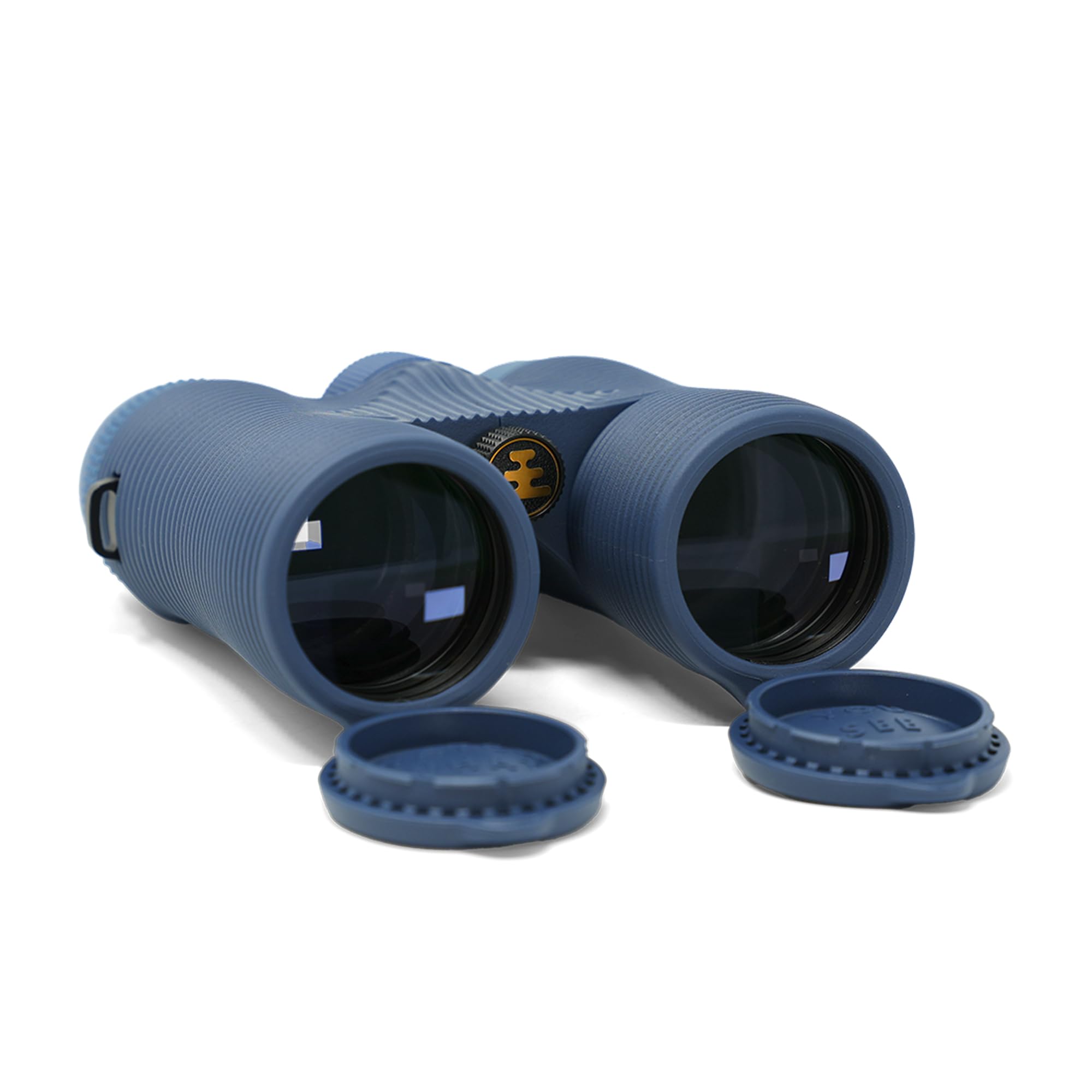
A 5.4 mm exit pupil gives you a bright, full image in low light.
Nocs Provisions uses Swiss-designed BaK-4 prisms and fully multi-coated optics to produce a crisp, bright image, with a wide 394-foot field of view at 1000 yards (7.5 degrees) that lets you scan landscapes without moving the barrels. That 394-foot field of view versus the Vortex Copperhead HD’s 334 feet, giving you an edge when tracking fast-moving wildlife.
The build stands out. It is IPX7 waterproof (meaning it can survive submersion in up to a meter of water for 30 minutes), and nitrogen-filled chambers prevent internal fogging. The patented Rugged Wave Grip makes it feel secure in wet hands, and the “No-Matter-What” lifetime warranty backs your purchase. With an exit pupil of 5.4 mm and eye relief of 20.4 mm, it is excellent for low-light use and for glasses wearers. At 1.3 lb, it is heavier than the Nikon PROSTAFF P3, but ergonomics and ruggedness — the most-praised quality — make it a joy on long trips. The only recurring owner note is that the included case and strap feel a bit basic for the price, but optics and build quality shine through.
The standout spec: A 5.4 mm exit pupil gives you a bright, full image in low light.
The honest limit: The included accessories are functional but not premium; plan to upgrade the strap for all-day carry.
Grab this if: you want a rugged, waterproof binocular with a lifetime warranty that is built for travel, hiking, and all-weather use — and you appreciate modern design.
Choose another if: you are on a tighter budget and a basic case and strap would bother you at this price point.
4. Celestron Nature DX ED 8×42 Premium Binoculars

The ED glass champion virtually eliminates color fringing for true-to-life views — a technology usually found in binoculars costing twice as much.
The key ingredient here is the Extra-Low Dispersion (ED) glass in the objective lenses. This does one specific thing: it virtually eliminates chromatic aberration — that annoying purple or green fringe around high-contrast edges like a bird against a bright sky. The result is razor-sharp images with outstanding, true-to-life color. Optical quality is the most-praised aspect of these binoculars.
Beyond the ED glass, you get a fully multi-coated system with phase-coated BaK-4 prisms that boost light transmission. The 8×42 configuration gives you a 5.25 mm exit pupil — right in the balance for dawn and dusk use — and a 7.5-degree field of view that is competitive with the wider options. The rubber-armored polycarbonate body is waterproof and nitrogen-purged, and it has built-in tripod adapter threads for shake-free viewing. The sacrifice is in the build quality of smaller parts: owners often flag the eyecups as a weak point, with some finding they do not stay in place securely. If you are careful with your gear, the optical performance is genuinely premium.
The optical edge
- ED glass virtually eliminates color fringing for crisp, true-to-life images.
- Phase-coated BaK-4 prisms for bright, clear views even in low light.
- Great value for the optical performance — a true step up from most sub-$200 bins.
The build caveats
- Eyecup stability is a recurring owner complaint — they can feel loose.
- Ergonomics are good but not as refined as some pricier competitors.
This is your pick if: you care most about pure optical quality — sharpness, color accuracy, and freedom from chromatic aberration — and you do not mind handling the eyecups with a bit of care.
Think twice if: you want a bombproof body with sturdy moving parts; the focus and eyecups feel less substantial than the optics deserve.
5. Nikon PROSTAFF P3 10×42 Binocular

At 20.6 oz, it is one of the lightest full-size 10×42 binoculars you can get — over a quarter-pound lighter than the Vortex Copperhead HD.
If you need the extra magnification of a 10x binocular to scan wide-open spaces but want to keep the weight down, this Nikon PROSTAFF P3 is a smart choice. The 42 mm objective lens still pulls in plenty of light for a bright image, and the 367-foot field of view at 1000 yards is on the wider end for a 10×42. The 15.7 mm eye relief is enough for most glasses wearers, and the close focus of 9.8 feet is useful for spotting butterflies or dragonflies up close.
The build is comfortable and waterproof, with an ergonomic rubber-armored body that feels solid. Owners call the optics “clear, sharp, and bright” — image quality is the second most-praised aspect, behind overall build quality. The honest trade-off compared to the 8×42 PROSTAFF P3 is that the 10x will be harder to hold steady for long periods, and the 4.2 mm exit pupil means it is not ideal for very low-light conditions. But for daytime long-range viewing, it is very capable and portable.
The key advantage: At 20.6 oz, it is one of the lightest full-size 10×42 binoculars you can get, making it much more travel-friendly than heavier competitors.
The honest trade-off: The 4.2 mm exit pupil and 15.7 mm eye relief are average; this is a daytime and midday performer, not a low-light specialist.
Best for: hikers and hunters who need 10x reach but refuse to carry a heavy pair — and who trust Nikon’s reputation for quality glass.
pass on it if: you birdwatch in dense forests with poor light, where an 8×42 with a larger exit pupil gives you a brighter view.
6. Leupold BX-1 Rogue Binoculars, 10x25mm (59225)

This pocket-sized 10x disappears into a jacket while delivering surprising clarity — the 10x25mm body is drastically smaller than any full-size pair.
Not everyone wants to lug around a full-size 42mm binocular. If your priority is portability — stuffing a pair into your hiking pack, your glovebox, or even a large jacket pocket — the Leupold BX-1 Rogue 10×25 is an excellent choice. It uses an inverted Porro prism design that keeps the body incredibly small and lightweight while still delivering good optical performance. The 10x magnification gives you real reach, though the 2.5 mm exit pupil makes it a daylight-only tool. Owners mention “these are great for the deer stand, you will even be able to see longer at last shooting hours,” meaning the optical system is efficient enough to stretch light a bit further than you would expect from such a small lens.
The build quality feels premium, with an aluminum housing wrapped in a durable rubber armor that provides a positive grip. It is 100% waterproof and fogproof, backed by Leupold’s customer care. Clarity is the most-praised aspect, with 82 owners mentioning it, and the compact size is the third most-praised feature. The trade-off: the small 25mm objective lens simply cannot gather as much light as a 42mm lens — its 2.5 mm exit pupil versus the Athlon 8×42’s 5.25 mm — so this is strictly a daytime companion. The 5.6-degree field of view is also noticeably narrower than the Athlon’s 7 degrees. For quick daytime scanning and everyday carry, it is tough to top.
The pocket advantage: The 10x25mm body is drastically smaller and lighter than any full-size pair, making it the one you will actually carry every day.
The light limit: With a 2.5 mm exit pupil versus the Athlon 8×42’s 5.25 mm, low-light performance is limited — this is strictly a daytime companion.
Your pick if: you want 10x optical reach in a truly compact, lightweight package that fits in a pack or pocket for hikes, travel, or the deer stand.
Look elsewhere if: you need to use your binoculars in low-light conditions at dawn or dusk — you will want a larger 42mm objective lens for that.
7. Athlon Optics 8×42 Neos G2 HD Binoculars

This budget-friendly 8×42 refuses to compromise on brightness and comfort — its 5.25 mm exit pupil is identical to the Celestron Nature DX ED’s 5.25 mm exit pupil.
The Athlon Neos G2 HD proves you do not need to spend a fortune to get a genuinely good full-size binocular. It uses multi-coated optics (not fully multi-coated, but close) and BaK-4 glass prisms that reflect more light to your eyes, giving you a brighter and sharper image than single-coated lenses. The 8×42 configuration gives you a very large 5.25 mm exit pupil — identical to the far pricier Celestron Nature DX ED. This means excellent low-light performance for the price.
One standout spec is the 17 mm eye relief, which is particularly important for eyeglass wearers because it lets you still see the entire field of view. The twist-up eyecups have intermediate stops so you can set them precisely. Owners praise the “crisp clarity at amazing distances” and note that the build is well-made, with one buyer reporting it was “durable after 15 months in rain, snow, heat.” The trade-offs are minor: the field of view is a bit narrower than the Nocs or Celestron at 7 degrees (though wider than the Leupold’s 5.6 degrees), and the weight is mixed — some find it light, others a bit cumbersome. At this price point, the value for money is undeniable.
The budget brilliance
- Large 5.25 mm exit pupil delivers bright views in low light.
- 17 mm eye relief and twist-up eyecups with intermediate stops make it very glasses-friendly.
- Proven durability: customers note it holds up after over a year in harsh weather.
The corners cut
- Multi-coated (not fully multi-coated), so light transmission is very good but not top-tier.
- Field of view is a bit narrow at 7 degrees — fine for spotting, less ideal for tracking fast movement.
Reach for this if: you want an affordable 8×42 that punches above its weight in low-light brightness and glasses-friendly eye relief, with proven durability.
Consider the step-up if: you are a dedicated birder who needs the widest possible field of view to track moving birds — the Nocs or Nikon P3 offer that advantage.
Understanding the Specs
Magnification & Objective Lens
The two numbers you see together (like 10×42) tell the story. The first number (10x) is the magnification — how many times closer the object appears. The second number (42) is the objective lens diameter in millimeters, which determines how much light the binocular gathers. A 42mm lens is considered full-size and is great for low light, while 25mm is compact but needs full daylight to work well. Bigger magnification also means more hand shake, so 8x is often a smarter choice if you are not using a tripod.
Exit Pupil and Eye Relief
Exit pupil is found by dividing the objective lens by the magnification (42 ÷ 8 = 5.25 mm). This is the diameter of the light beam that reaches your eye. A larger exit pupil (over 4 mm) gives you a brighter image, especially in low light. Eye relief is the distance your eye can be from the eyepiece and still see the full image — crucial for glasses wearers. Anything over 15 mm is good for glasses; over 17 mm is excellent.
Field of View
This is the width of the area you see at a specific distance. It is often listed in feet at 1000 yards, or in degrees. A wider field of view (like 377 feet or 7.2 degrees) makes it easier to find and follow moving subjects like birds or deer. A narrow field of view (like 5.6 degrees) is fine for stationary spotting but means you will have to pan around more to find your target.
Lens Coatings and Prisms
Lens coatings reduce light loss from reflections. “Fully multi-coated” means every air-to-glass surface has multiple layers, which is the best for brightness and contrast. Prisms are the internal glass that orients the image correctly. BaK-4 glass is higher quality than BK-7, giving a rounder, brighter exit pupil with less light loss. Phase-coated roof prisms further improve resolution and contrast in compact roof-prism binoculars.
FAQ
What is the best magnification for binoculars under $200?
Is 8x or 10x better for bird watching?
What does fully multi-coated mean?
How important is the exit pupil number?
Can I use these binoculars with glasses?
What is the difference between BaK-4 and BK-7 prisms?
How long do binoculars under $200 typically last?
What does fogproof mean for binoculars?
Final Thoughts: The Verdict
For most people, the binoculars under $200 winner is the Vortex Copperhead HD 10×42 because it gives you a brilliant HD optical system, a rock-solid waterproof build, and the best lifetime warranty in the business for a price that still feels like a steal. If you want the widest, most glasses-friendly view for birding, grab the Nikon PROSTAFF P3 8×42. And for a rugged, modern design with a lifetime warranty and a huge 5.4 mm exit pupil, the Nocs Provisions Field Issue 8×42 is the one to reach for.
How We Picked
We do not accept paid placement. Every pick is matched to a real buyer and a real use-case; we do not hands-on test units.
Sources & Methodology
Specifications: manufacturer listings and product documentation. Review insights: verified customer reviews, as of July 2026. Pricing: not shown on this page (it changes often); check the current price via the retailer link.
As an Amazon Associate, Gadgets Feed earns from qualifying purchases. This does not affect which products we feature.