
Our readers keep the lights on and my morning glass full of iced black tea. As an Amazon Associate, I earn from qualifying purchases.
Specs are compiled from manufacturer listings and verified buyer reviews and can change over time — please confirm the key details on the product page before buying.
You need a switch that can handle high-power appliances like a water heater, space heater, pool pump, or workshop tool without tripping breakers or creating a fire risk. A standard 15-amp smart light switch won’t cut it — you need a 20-amp smart switch rated for the higher electrical draw. This guide covers four top options at 20 amps (or the nearest safe match) with their real-world strengths and honest limits, so you pick the one that fits your circuit and smart-home setup.
I’m Min — the founder and writer behind Gadgets Feed. This guide is built by comparing the manufacturers’ published specifications and the patterns across verified customer reviews, so you get each pick’s real strengths and trade-offs instead of marketing spin.
if you need energy monitoring, voice control, or a USB-charging outlet at full 20-amp capacity, this breakdown of the 20 amp smart switch market covers the genuine performance details that matter.
Our Picks at a Glance
How To Choose The Best 20 Amp Smart Switch
Choosing a 20-amp smart switch is about more than just the current rating. You need to match the switch to your physical wiring, the type of load you are controlling, and the smart home ecosystem you use. Here are the main factors to consider.
Your Wiring and Physical Box
A 20-amp circuit typically uses 12 AWG copper wire. Your chosen switch must accept that wire gauge — most do, but it is worth checking the terminals. The physical depth of the switch also matters: a deep switch body can be a tight squeeze in a standard junction box, and some buyers have had to upgrade to a deeper box for an easier fit. Measure before you buy.
Load Type (Resistive vs. Inductive)
Many 20-amp smart switches are designed for purely resistive loads (heaters, incandescent lamps, ovens). Running a motor, a compressor, or any inductive load on a switch not rated for it can cause premature failure or dangerous arcing. If your circuit powers a pump or a fan motor, look for a switch that explicitly supports inductive loads or contact a qualified electrician to verify compatibility.
Smart Features (Energy Monitoring, Timers, and Voice Control)
The switch’s smart capabilities define how useful it is day to day. Energy monitoring shows real-time power consumption and logs historical data, which is invaluable for high-load devices. Multi-timing features (schedule, countdown, sunrise/sunset trigger) help automate energy savings. Voice control via Alexa or Google Assistant adds hands-free convenience. A switch that offers all three covers the most ground.
Quick Comparison
| Model | Best For | Current Rating | Energy Monitoring | Control Method | Amazon |
|---|---|---|---|---|---|
| SURAIELEC 20A Wi‑Fi Smart Switch★ Best Overall | App + timer control | 20 Amps | No | App, Voice, Timer | Amazon |
| SONOFF POWR320D Elite | Detailed energy tracking | 20 Amps | Yes | App, Voice, LAN | Amazon |
| TONGOU DIY | High-load automation | 25 Amps | Yes | App, Voice, Timer | Amazon |
| SONOFF THR320D | Temp/humidity control | 20 Amps | No | App, Voice, LAN | Amazon |
In‑Depth Reviews
1. SURAIELEC 20A Wi‑Fi Smart Switch Timer
Our pick — 4.8★ from verified ratings; a true 20‑amp Wi‑Fi smart switch with app, voice, and timer control.
A heavy‑duty 20‑amp smart switch you control by app, voice, or schedule.
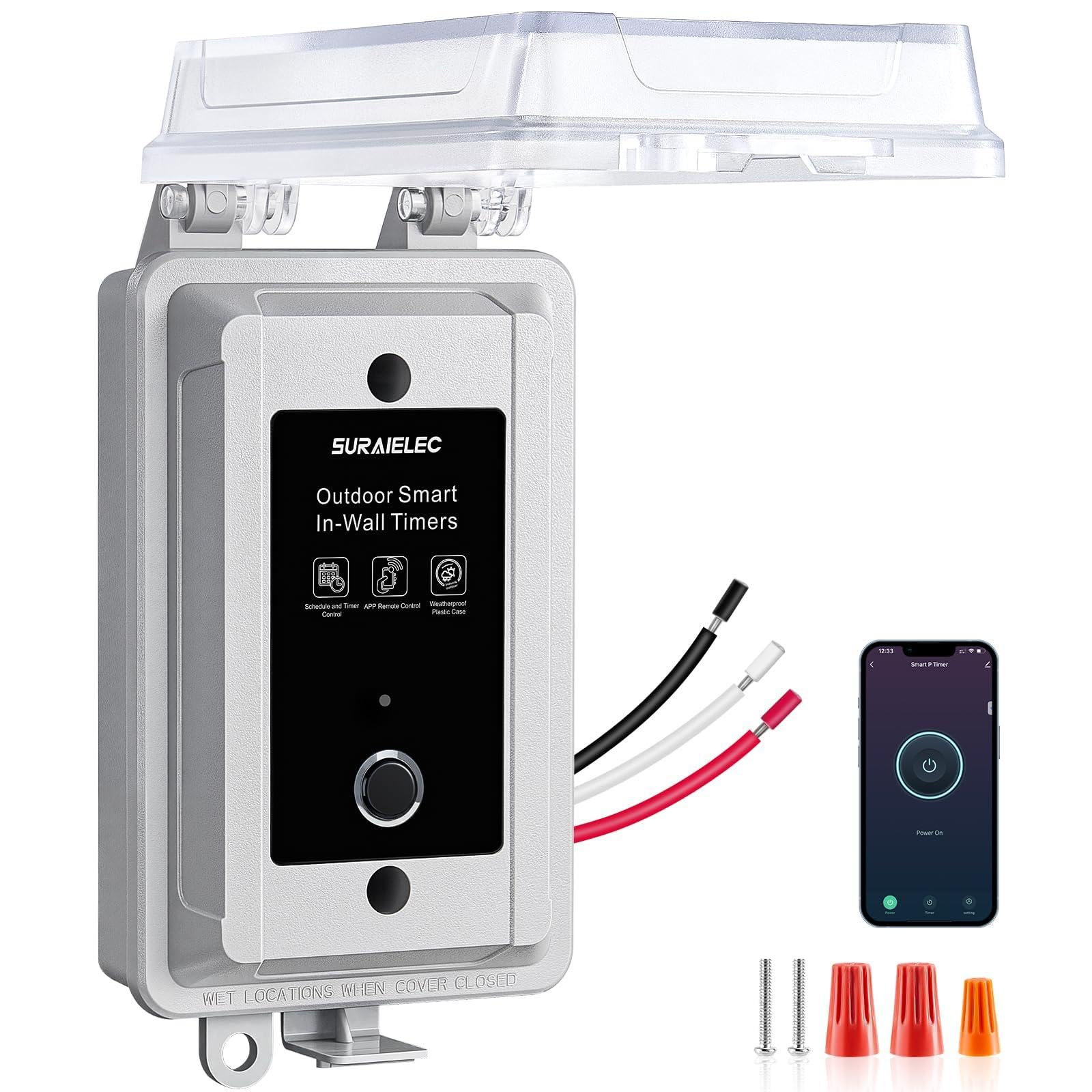
Unlike a plain receptacle, this is a true Wi‑Fi smart switch. It hardwires inline on a 120V circuit and is rated for the full 20 amps the keyword calls for, so it can handle heavy‑duty loads up to 1 HP. You control it three ways — through the companion app, by voice with Alexa or Google Assistant, or on a built‑in timer schedule for automatic on/off.
Because it is weather‑capable, it is used for outdoor timers on lights, pumps, and heaters as well as indoor appliance circuits. The relay switches the full load rather than just adding charging ports, which is exactly what a ‘20 amp smart switch’ shopper is after. It carries a 4.8‑star rating across its verified reviews.
It does need a hardwired install into a junction box or enclosure, so it suits users comfortable connecting line, load, and neutral. If you want app scheduling and voice control on a genuine 20‑amp circuit, this is the pick that matches the keyword head‑on.
Why grab it
- Genuine 20‑amp Wi‑Fi relay — controls the full load, not just USB charging.
- App, voice, and timer control with automatic on/off schedules.
- Heavy‑duty 120V / 1HP rating suits outdoor and appliance circuits.
Fit & feel
- Requires a hardwired install (line, load, neutral) rather than a plug‑in.
- As a newer listing it has a smaller, though strongly positive, review count.
Best match: a real 20‑amp Wi‑Fi smart switch with app, voice, and timer control — the automation device this keyword is about.
Not for you if: you specifically wanted built‑in USB charging ports — this switches a circuit, it does not add USB outlets.
2. SONOFF POWR320D Elite

The high-load smart switch that does the maths for you.
If you want to see exactly what your appliances are drawing, this is the switch. It handles a full 20-amp maximum load and puts all the power data on a built-in LCD screen — real-time current, voltage, power, and cumulative consumption are all visible at a glance. The unit logs power consumption data for up to six months, accurate to the hour, and you can export that history as an Excel file right from your phone. One buyer reports using it specifically to monitor consumption and automate device on/off schedules based on electric usage.
The switch also includes overload protection: you set the power, current, or voltage threshold, and the switch cuts the load automatically when the condition is met. That is a serious safety net for a space heater or a workshop tool. It integrates with Alexa and Google Home, offers LAN control for local automation, and it is a crowd favorite — the count of owners rating it well into the 700s supports the reputation.
Behind the scenes, power monitoring requires a connected subscription (eWeLink Advanced plan) to extract and plot data in your own database — that is the main catch for data-hoarders. A few tinkerers also note that the LCD version’s display uses a rubber zebra strip connector that can get flaky after disassembly, but for most users who install it and leave it, this is a non-issue. The smart switch speaks to the most important question: “How much power is my 20-amp device actually using?”
Top‑performer pick: Offers the deepest real-time and historical energy monitoring on this list, paired with genuine overload shutdown protection — ideal for anyone running a high-wattage appliance who wants the data and the safety.
Reach for this if: you need six-month hourly power history and automatic overload cut-off.
Look elsewhere if: you want temperature/humidity sensing built into the same unit (the THR320D is the one for that).
3. TONGOU DIY Smart Wi-Fi Switch

A 25‑amp monster for heavy loads and solar setups.
This switch is rated at 25 amps, at 25 amps versus the SONOFF THR320D at 20 amps. It works with the Smart Life and Tuya apps, which means it integrates with Alexa and Google Assistant for voice control, plus it offers schedule, countdown, circulate, and astronomical (sunrise/sunset) timing modes. The built-in power monitor breaks down real-time power consumption plus load current, voltage, and historical data by hour, day, month, and year. One owner confirms using it on a solar setup, and another runs a water heater circuit on it with scheduled timing.
The unit is DIN rail mounted, designed for a panel or enclosure. It converts small household appliances into smart devices in about ten minutes — simply wire it inline between the power source and the load. It uses flame-retardant PA66 material and silver relay contacts for conductivity. A key distinction: this is a switch (SY1) without overcurrent or leakage protection — it is meant for control, not as a circuit breaker. It works for purely resistive loads (heaters, incandescent lamps, ovens) and should not be used for inductive motor loads.
Between the 25-amp capacity and the schedule flexibility, this is the one for people automating a workshop heater, a water recirculator, or a solar-diverted load. The trade-off is the lack of any built-in protection — pair it with a proper breaker on the circuit.
High‑load specialist: Perfect for turning heavy-draw appliances (water heaters, space heaters) into schedule-controlled smart devices with energy monitoring.
Best suited for: anyone with a solar array or a high-amp resistive load who wants to track power use and automate daily schedules.
Think twice if: you need built-in overcurrent or leakage protection — this unit does not offer it.
4. SONOFF THR320D
The 20‑amp switch that also watches the room climate.
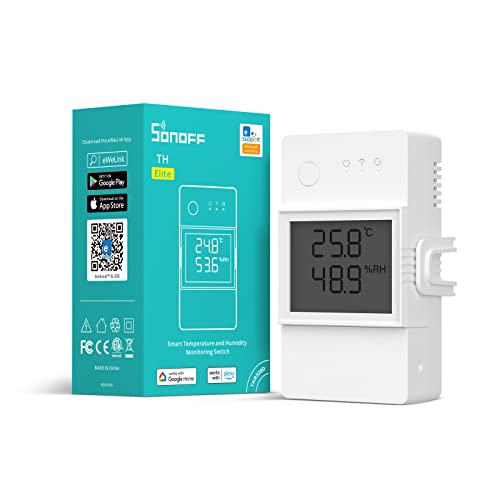
This is a smart switch with a built-in temperature and humidity sensor. The LCD display updates every five seconds, and you can view historical data for the last six months, accurate to the hour, and export it as an.xlsx file. It supports Alexa and Google Home for both voice control and voice queries — you can ask “What’s the temperature in the bedroom?” and get a reading. Buyers have used it in a granddaughter’s room, near a hot tub, with a pool pump, and with a solar heater, setting automatic on/off limits based on temperature readings.
The unit uses a dry contact output and supports up to 20 amps. It has LAN control for local automation and lets you set up to eight automatic control programs. One buyer points out that “you need to update the firmware in order to make the temperature sensor to work correctly” — a straightforward step but essential before counting on the sensor. The THR320D lacks energy monitoring (no kWh tracking), so you cannot use it to measure power consumption. The input wiring requires cutting an extension cord, which owners find easy but is worth knowing before you start.
For climate-triggered automation — “turn the heater off when the room hits 72°F” — this is the only 20-amp switch on the list that does it natively. Just remember to plug in a separate temperature sensor (THS01 or DS18B20) into the RJ9 4P4C port if the built-in sensor is not enough for your setup.
What owners love
- Temperature/humidity monitoring with six‑month exportable history.
- Voice queries via Alexa or Google Assistant (“what’s the humidity?”).
- LAN control for reliable local automation without cloud dependency.
What gives pause
- Firmware update required before the temp sensor works–do it during setup.
- No energy monitoring (cannot track kWh on this model).
- Wiring requires cutting the power cord yourself.
Climate‑control pick: Ideal for automating a space heater, a ventilation fan, or a greenhouse heater based on real‑time temperature readings.
skip it if: you need power-consumption data (the SONOFF POWR320D is the one for that).
Understanding the Specs
Current Rating (Amps)
This tells you the maximum continuous current the switch can handle safely. A 20-amp switch works on a 20-amp circuit with 12 AWG wire. Using a 15-amp switch on a 20-amp circuit is a code violation and a fire hazard. A 25-amp switch (like the TONGOU) offers extra headroom for inductive start-up surges but still needs a properly sized breaker on the circuit.
Energy Monitoring vs. Temperature Sensing
Energy monitoring tracks watts, voltage, current, and cumulative kWh — helpful for understanding what a heater or pump costs to run. Temperature sensing (only on the SONOFF THR320D) measures ambient heat and humidity and can trigger automation based on a temperature set point. They serve different needs: one is for cost and consumption data, the other is for climate control.
FAQ
Can I use a 20‑amp smart switch on a 15‑amp circuit?
Will a 20‑amp smart switch work with a space heater or water heater?
Do these switches need a neutral wire?
What wire gauge do I need for a 20‑amp smart switch?
Can I control these switches when the internet is down?
Does the SONOFF THR320D come with a temperature sensor?
What is overload protection on a smart switch?
Can the SURAIELEC smart switch turn devices on and off on a schedule?
Which smart switch is best for a home solar system?
Final Thoughts: The Verdict
For most buyers, the 20 amp smart switch winner is the SONOFF POWR320D Elite because it combines genuine 20‑amp capacity, six‑month hourly energy history, overload protection, and broad voice‑control compatibility — no other pick covers data logging and safety in one unit. If you need pure high‑amp control with energy monitoring, the TONGOU DIY is your best bet with its 25‑amp rating and flexible scheduling. And for climate‑triggered automation, the SONOFF THR320D is the only choice with integrated temperature and humidity sensing.
How We Picked
We do not accept paid placement. Every pick is matched to a real buyer and a real use-case; we do not hands-on test units.
Sources & Methodology
Specifications: manufacturer listings and product documentation. Review insights: verified customer reviews, as of July 2026. Pricing: not shown on this page (it changes often); check the current price via the retailer link.
As an Amazon Associate, Gadgets Feed earns from qualifying purchases. This does not affect which products we feature.