
Our readers keep the lights on and my morning glass full of iced black tea. As an Amazon Associate, I earn from qualifying purchases.
Specs are compiled from manufacturer listings and verified buyer reviews and can change over time — please confirm the key details on the product page before buying.
Shooting in 4K sounds simple — every camera claims it. It is about a sensor that handles shadows without getting noisy, a processor that keeps colors accurate, and stabilization that lets you move without making your audience dizzy. If you are looking to upgrade from a phone or an older camera, the decision depends on which trade-offs you can live with and which features genuinely matter for how you shoot.
I’m Min — the founder and writer behind Gadgets Feed. This guide is built by comparing the manufacturers’ published specifications and the patterns across verified customer reviews, so you get each pick’s real strengths and trade-offs instead of marketing spin.
Whether you are vlogging, filming action sports, or chasing the perfect travel shot, your next tool is in this roundup of the best 4k camera options available now, each chosen for a specific kind of shooter.
Our Picks at a Glance


How To Choose The Best 4K Camera
The best 4K camera for you matches the technology to your specific shooting habits, not the highest price tag. Your daily experience hinges on sensor size, stabilization, and autofocus performance.
Sensor Size and Low-Light Performance
A larger sensor captures more light, delivering cleaner footage in low-light conditions. A 1-inch or APS-C sensor will look noticeably better in dim conditions than a smaller 1/2.3-inch sensor, even if both say 4K. Prioritize sensor type if you frequently shoot at dusk or in shaded environments.
Stabilization: Built-in vs. Gimbal vs. Electronic
Action cameras use electronic or gyro-based stabilization (like HyperSmooth or HorizonSteady) that crops into the sensor to smooth out shaking. Larger mirrorless cameras often use in-body image stabilization (IBIS), which moves the sensor itself to counteract wobble. A gimbal camera physically steadies the whole rig. Each stabilization method handles walking, running, and static shots differently, so match it to your typical movement level.
Autofocus in Video
Not all cameras offer continuous autofocus during video recording. Smooth subject tracking requires phase-detection AF points on the sensor. Many newer cameras include subject detection (people, animals, vehicles) which can free you to frame the shot without worrying about focus pulls.
Quick Comparison
| Model | Best For | Sensor | Max 4K Frame Rate | Stabilization | Amazon |
|---|---|---|---|---|---|
| DJI Osmo Action 5 Pro★ Best Overall | All-day action & vlogging | 1/1.3″ | 120 fps | 360° HorizonSteady | Amazon |
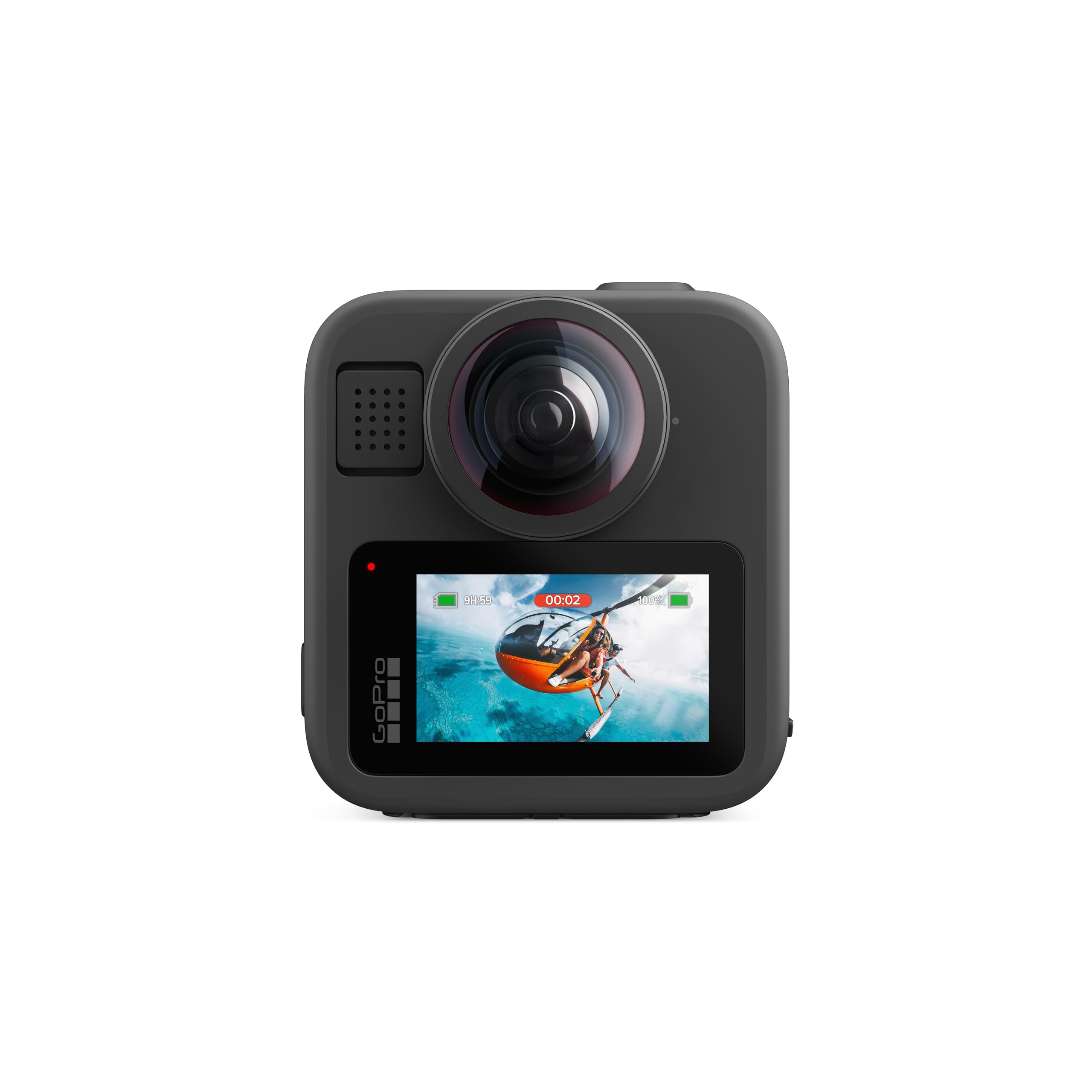
| GoPro MAX2Best 360 | 360° spherical video | Dual lens | 24 fps (8K 360) | HyperSmooth + Horizon Lock | Amazon |
| GoPro Hero Black CompactBudget Starter | Entry-level adventure | 1/2.3″ | 30 fps | HyperSmooth | Amazon |
| Canon PowerShot V10 | Pocket vlogging | 1″ CMOS | 30 fps | Movie IS (3 modes) | Amazon |
| Panasonic LUMIX FZ80D | Super-zoom wildlife | 1/2.3″ MOS | 30 fps | Power O.I.S. | Amazon |
| Canon EOS R100 Kit | Budget mirrorless learning | 24.2MP APS-C CMOS | 24 fps (cropped) | Lens-based IS | Amazon |
| Insta360 Luna Ultra | Cinematic gimbal vlogging | 1″ + 1/1.3″ dual Leica | 30 fps (8K) | 3-axis mechanical | Amazon |
| Canon EOS R50 Kit | Beginner mirrorless all-rounder | APS-C CMOS | 30 fps (oversampled) | Lens-based IS | Amazon |
| Canon PowerShot SX740 HS | Ultra-zoom pocket travel | 20.3MP 1/2.3″ CMOS | 30 fps | 5-axis (video) | Amazon |
| Canon VIXIA HF G70 | Traditional camcorder use | 1/2.3″ 4K UHD CMOS | 30 fps | 5-Axis Dynamic IS | Amazon |
| Sony Alpha 7 IV | Pro hybrid stills/video | 33MP full-frame Exmor R | 60 fps (Super 35mm) | In-body (IBIS) | Amazon |
In‑Depth Reviews
1. DJI Osmo Action 5 Pro Adventure Combo
Our pick — over 4.5★ from 900+ verified ratings; the strongest balance of quality and price.
The action cam that outlasts your longest shoot day and still looks great at dusk.
This is the camera that professional photographers grab when they need reliable, vibrant footage without fussing over housings or swapping batteries every hour. The 1/1.3-inch sensor with 2.4 µm pixels and 13.5-stop dynamic range means your evening runs and shaded woodland trails stay clean and colorful — a level of low-light performance that most action cameras simply cannot touch. And at 4K and 120 frames per second, you can slow down fast movement into smooth, dramatic slow-motion clips that the GoPro Hero Black Compact cannot match with its 30 fps ceiling.
The Adventure Combo is where the value really stacks. You get three 1950mAh Extreme Batteries, a multifunctional battery case that also charges your phone via USB-C, and a 1.5m extension rod. That trio gives you up to 12 hours of total record time, which easily covers a full day of skiing, a motorcycle road trip, or back-to-back vlogs without hunting for an outlet. The 360° HorizonSteady stabilization locks the horizon level even when you rotate the camera fully, so your footage stays smooth without that jello-wobble older action cams show on bumpy terrain.
It also slips into a pocket at a compact size, pairs wirelessly with the DJI Mic 2 with no extra receiver needed for clean audio, and the dual OLED touchscreens make framing a selfie or vlog shot genuinely easy. As owners put it: this is the “professional photographer’s favorite action camera.”
Why It Wins
- 4K/120fps for silky slow-motion — beats the GoPro Hero Black Compact’s 4K/30fps easily
- Three batteries in the box mean you shoot all day without a charger; owners call the battery life “outstanding”
- Integrated DJI Mic 2 support with no dongle — a real audio upgrade for vloggers
Heads Up
- The extension rod is well-built but lacks a shutter button — you use the Mimo app to trigger it remotely
- Generates some warmth after a few minutes of continuous 4K recording
Grab this if: you want the best blend of battery endurance, low-light quality, and slow-motion 4K in a rugged action cam.
Look elsewhere if: you specifically need 360° spherical video (the GoPro MAX2 is your pick) or a larger full-frame sensor for pro photography.
2. GoPro MAX2
Never aim the camera — capture everything around you and pick your angle later.
If you have ever missed a shot because you framed the wrong direction, this is your cure. The MAX2 records true 8K spherical 360 video, so you hit record once and decide where to look, how to zoom, and which horizon to level when you edit in the GoPro Quik app. That 8K capture gives you 21% more resolution than the previous generation, which means when you reframe a 360 clip into a 4K standard video, you keep crisp detail rather than soft, stretched pixels.
Switching between 360 mode and the traditional Hero mode is instant via the touchscreen, and the invisible mounting effect makes the pole vanish from your selfie footage as if a second person is filming you. The replaceable glass lenses are a practical upgrade — if you scratch a lens on a rock or during a crash, you swap just the lens cap, not the whole camera. Audio captures on six microphones with perspective shift and wind reduction, so your voice stays clear even when the camera is rotating.
The trade-off is heat. A few owners note the camera runs warm during extended recording, and battery life in 360 time-lapse runs about 50% per hour — acceptable but shorter than conventional action cams. For pure 360 creativity and that reframe-later flexibility, however, nothing else on this list competes.
Its Superpower: shoot once and get every angle — the 8K spherical sensor lets you reframe into 4K without quality loss, a capability the DJI Osmo Action 5 Pro cannot touch.
Its Limit: runs warm during long recording sessions, and the 1960mAh battery drains faster than a standard action camera in 360 mode.
Reach for this if: you shoot action sports, travel, or events where you cannot predict where the action will happen — you want to capture everything and compose later.
skip it if: you only need traditional front-facing 4K video and prefer longer battery runs with no heat concerns.
3. GoPro Hero Black Compact 50-in-1 Kit
A lightweight, no-fuss entry into 4K action with a huge accessory bundle.
Weighing only 3 ounces, this is the lightest 4K action camera in the lineup — small enough to forget you are wearing it on a helmet or chest mount. It captures UHD 4K video at 30 frames per second and 12MP stills, with HyperSmooth stabilization handling the bumps on a mountain bike trail or a bumpy car ride. The 50-in-1 accessory kit adds a 64GB card, tripod, cleaning kit, and mounts, so you do not need to buy anything extra to start shooting.
The battery is rated for about 1 hour of recording at the highest settings. That is enough for a hike or a single soccer match, but it falls well short of the DJI Osmo Action 5 Pro’s battery life if you are shooting all afternoon. The app compatibility can also be a sticking point — some owners found the GoPro Quik app would not work on older iPhones, which forced a return. For the price and the included gear, though, this is a solid way to dip into 4K action footage without overthinking it.
Biggest Draw: at 3 oz and with a 64GB card plus mounts in the box, you are ready to shoot 4K action the moment it arrives — no extra spending.
Biggest Trade-off: the 1-hour battery life is short compared to the DJI Action 5 Pro, and the non-removable battery means you cannot hot-swap on a long shoot.
Best for: first-time action camera buyers who want a complete kit and a light, simple camera for casual adventures.
Not for: anyone who needs all-day battery life or reliable phone app connectivity on older devices.
4. Canon PowerShot V10

A dedicated vlogging camera small enough to live in your fanny pack.
The V10 is purpose-built for vloggers who want something better than a phone but do not want to carry an interchangeable-lens rig. Its 1-inch CMOS sensor is significantly larger than the 1/2.3-inch sensors found in action cameras, which translates to noticeably cleaner footage indoors and in evening light. The fixed 19mm wide-angle lens (35mm equivalent) keeps your face and a generous background in the frame when you hold it at arm’s length, and the built-in stand folds out from the front or back for hands-free desk or tabletop recording.
Canon added three image stabilization modes (IS Off, IS On, IS Enhanced) via firmware, letting you tune how much the frame crops to smooth out walking shots. The stereo microphones include a third center mic to cancel background noise, so your voice cuts through in a coffee shop or park. The catch is battery life — buyers report 1 to 2.5 hours of recording, which is enough for a few vlog episodes but demands a midday charge if you film heavily. There is also no zoom, so your framing is fixed to that 19mm wide angle.
What it does best: slips into a pocket, starts recording fast, and uses a 1-inch sensor that beats phone cameras in low light without any lens swapping.
The honest limit: the battery drains in 1-2.5 hours, and the fixed wide-angle lens means you cannot zoom in on distant subjects at all.
Choose this for: daily vlogging, talking-head content, and travel clips where portability and simplicity matter more than zoom range.
Choose something else if: you need long recording sessions without recharging or you regularly shoot distant wildlife or sports.
5. Panasonic LUMIX FZ80D

A bridge camera that brings birds on a distant branch right into your frame.
With a 60x optical zoom lens that covers 20mm to 1200mm (35mm equivalent), the FZ80D is the camera for situations where you physically cannot get closer. Wildlife, airshows, sports from the nosebleed section — this lens reaches them all while you stand safely in one spot. The Power O.I.S. (Optical Image Stabilizer) suppresses hand-shake vibration at the telephoto end, so your 60x shots do not turn into a blurry mess. The 2,360K-dot Large LVF (Live View Finder) with 0.74x magnification makes composing those long shots easy even in bright sunlight when a rear screen washes out.
The 18.1MP 1/2.3-inch MOS sensor records 4K video at 30fps and includes a 4K Photo mode that lets you pull 8-megapixel stills from your video after the fact. The Post Focus feature is a clever trick — you touch which part of the image you want sharp after you have already taken the shot. The honest rub is low-light performance. The small sensor means images get grainy and soft as the light drops, and the interface is not the most intuitive. As a daytime superzoom for travel and nature, it is a lightweight, budget-friendly powerhouse.
Why it stands out: the 60x optical zoom crushes every other camera on this list for reach — at 1200mm you get wildlife shots an action cam or mirrorless kit lens simply cannot capture.
Its weakest spot: the 1/2.3-inch sensor struggles in low light, producing grainy images that serious photographers will find limiting after dusk.
Ideal for: hikers, birdwatchers, and travel photographers who want 4K video with extreme zoom range in a single lightweight body.
Not for: anyone who shoots indoors, at night, or needs tack-sharp image quality in dim conditions.
6. Canon EOS R100 Kit
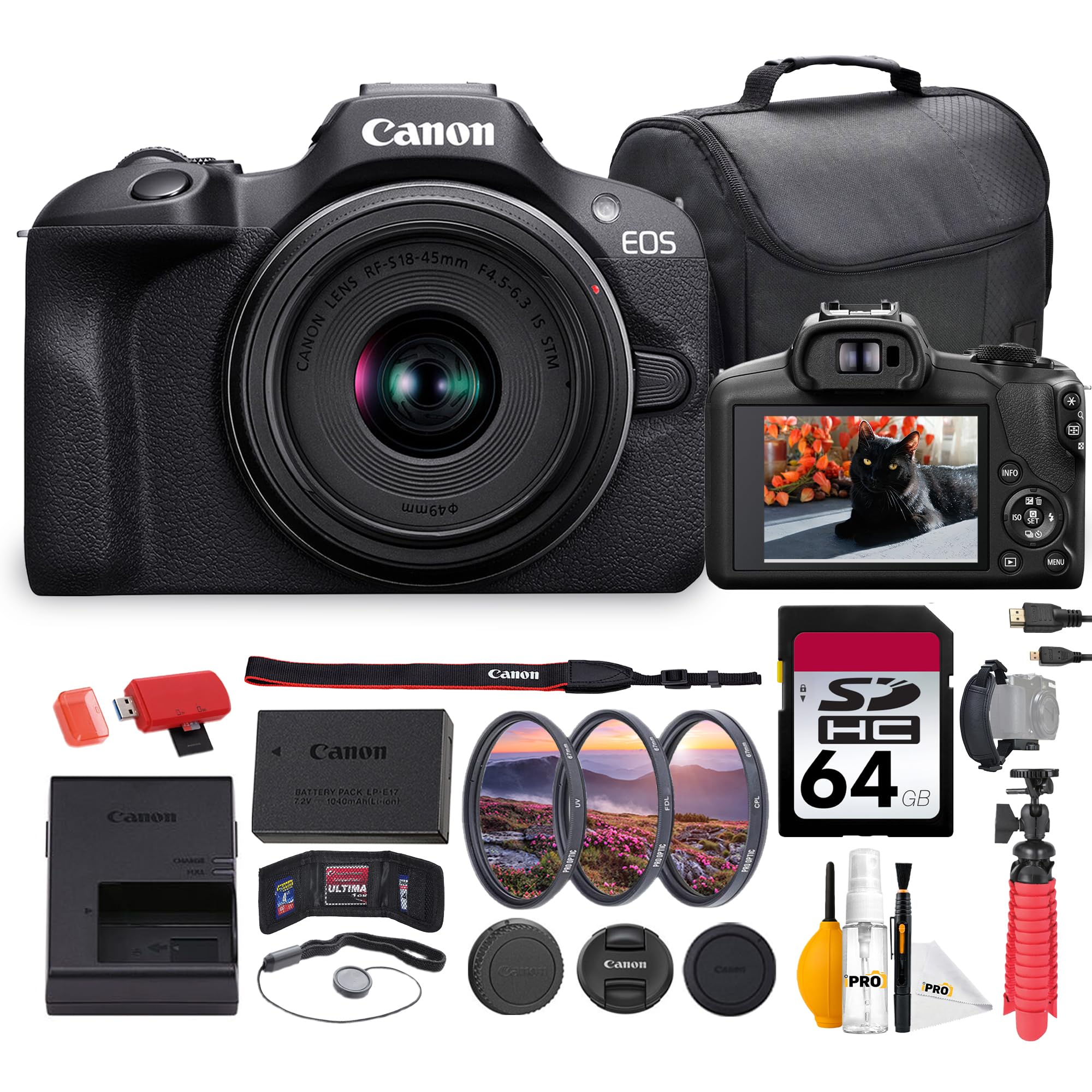
The most affordable gateway to a real interchangeable-lens 4K mirrorless system.
If you want to move beyond a point-and-shoot and into a proper mirrorless camera with lens options, the R100 is the lowest-cost entry point into Canon’s RF mount system. The 24.2MP APS-C CMOS sensor and DIGIC 8 processor deliver crisp stills and cropped 4K video at 24p, plus uncropped Full HD for everyday recording. The Dual Pixel CMOS AF covers 3975 autofocus points across 143 zones, with Eye Detection AF that locks onto a subject’s eye and keeps it sharp whether you are shooting a portrait or a vlog.
The bundle includes the RF-S 18-45mm f/4.5-6.3 IS STM lens, which covers a 29-72mm equivalent range — wide enough for landscapes and tight enough for portraits. The lens has optical image stabilization good for up to 4 stops of correction, and the STM motor is quiet, so it does not buzz in your video audio. Built-in Wi-Fi and Bluetooth let you transfer files or control the camera from your phone via the Canon Camera Connect app. The kit comes with a 64GB card, bag, tripod, and cleaning kit, making it a true everything-you-need starter package. The cropped 4K means the field of view is narrower in 4K mode than in Full HD, and there is no in-body flash, but for the price and image quality, owners consistently call it an excellent value.
What sells it: the 24.2MP APS-C sensor with Dual Pixel AF gives you genuine interchangeable-lens quality at a price that undercuts nearly every other mirrorless 4K option.
The gotcha: 4K video is cropped, so your wide-angle lens becomes less wide in 4K mode, and the camera has no built-in flash.
Perfect for: beginners who want to learn on a real mirrorless system with room to grow into better lenses and still get sharp 4K video.
Not great for: shooters who need uncropped ultra-wide 4K or prefer a fully self-contained camera with a flash.
7. Insta360 Luna Ultra
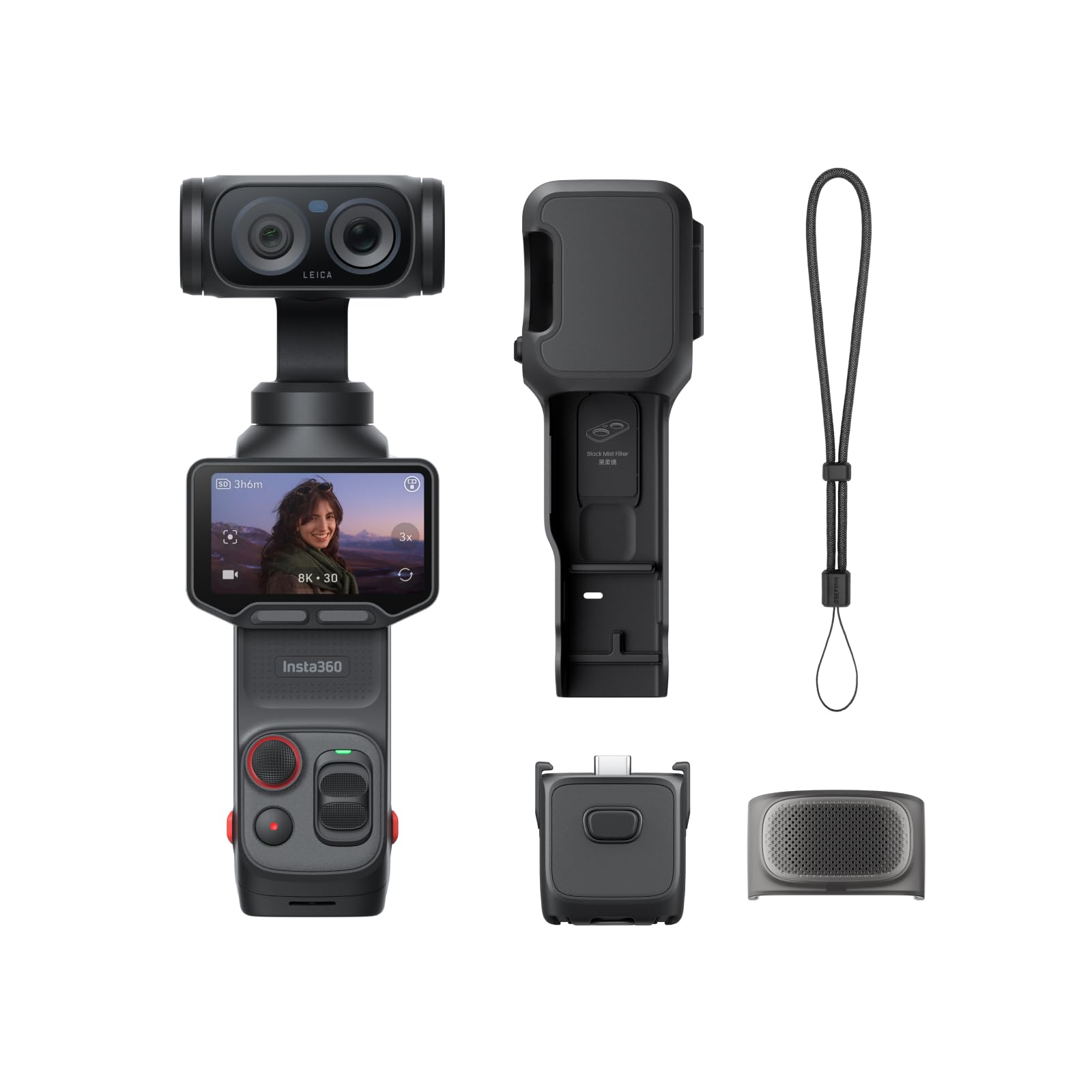
A pocket gimbal camera that shoots 8K with dual Leica lenses and a detachable remote screen.
The Luna Ultra is the closest thing to a complete vlogging studio that fits in a jacket pocket. It combines a 1-inch main sensor with a second 1/1.3-inch telephoto sensor (both Leica-engineered), giving you 6x lossless zoom and a 12x total zoom range with real optical background blur from the telephoto lens — no fake portrait mode. It shoots up to 8K video at 30fps with Dolby Vision HDR, capturing the kind of highlight-to-shadow detail (14 stops of dynamic range) that you usually need a much larger camera to get.
The detachable 2-inch OLED touchscreen is the standout feature for solo creators: you pop it off the camera body and control the framing and settings from up to 20 meters away, turning the camera into a remote-operated gimbal for group shots, car rollers, or tripod-free selfies. The 3-axis mechanical stabilization is silky — owners who shoot interior car vlogs and walking tours call it “incredibly smooth.” Battery life hits up to 4 hours on a single charge, and fast charging replenishes 80% in just 23 minutes. The trade-off is that it is not weatherproof or rugged, so you treat it more carefully than an action camera, and some owners note an occasional screen freeze. For cinematic vlogging and content creation, however, it is a serious creative tool.
Its killer move: the detachable 2-inch OLED screen that works as a wireless remote viewfinder up to 20 meters away — no other gimbal camera on this list offers that solo-shooting flexibility.
Its weakness: not weather-sealed or rugged, so it is better suited to controlled indoor or fair-weather outdoor shoots than extreme environments.
Made for: content creators who want 8K cinematic quality, smooth gimbal stabilization, and a remote screen for solo super-flexible filming.
Not for: action sports shooters who need a rugged, waterproof camera that can take a drop on rocks.
8. Canon EOS R50 Kit
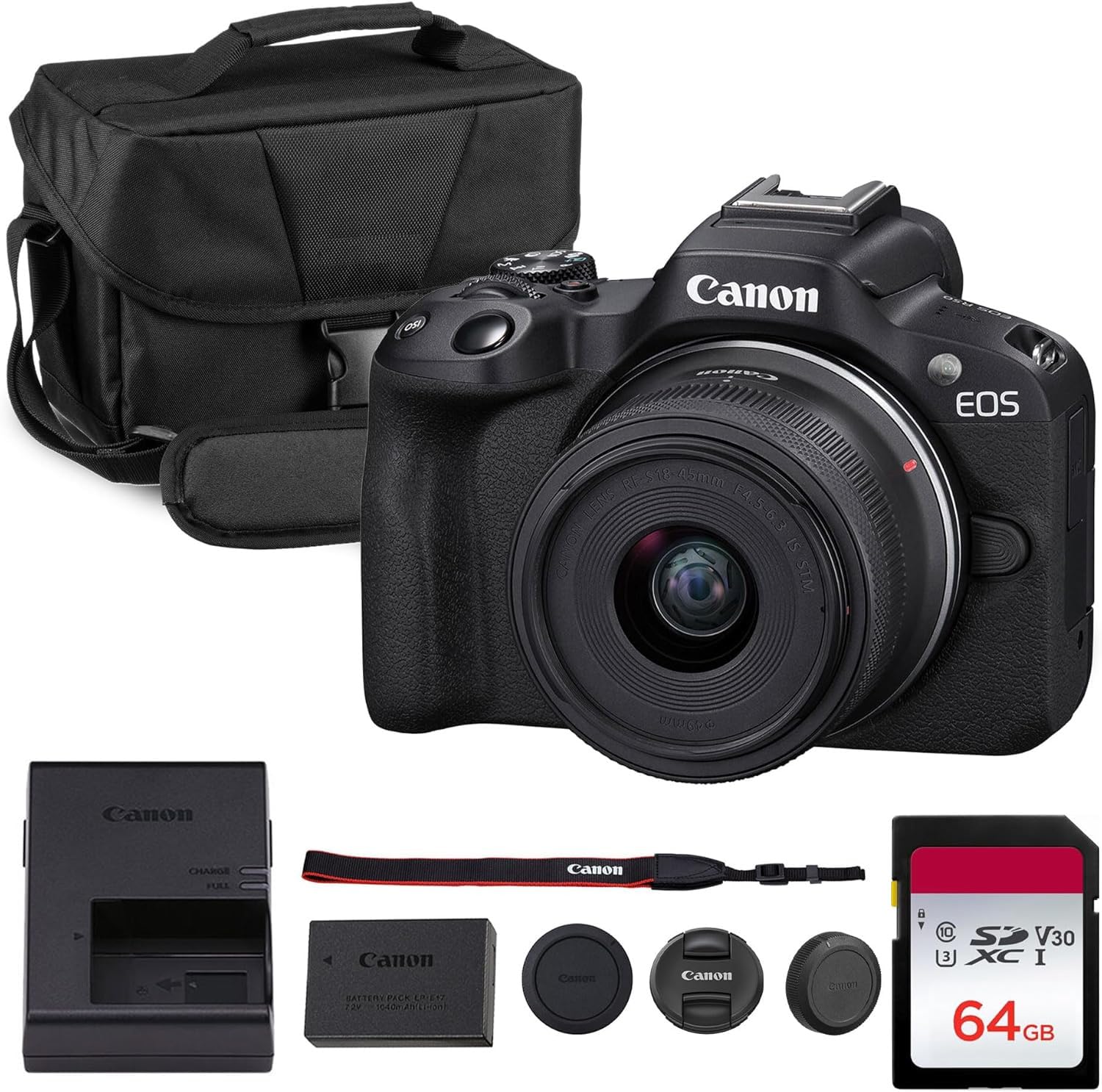
A lightweight mirrorless that shoots sharp 4K from the full sensor without cropping.
The R50 takes everything good about the R100 and pushes it further. Instead of cropping the sensor for 4K, it oversamples from the full APS-C area — that means your 4K video uses extra data from the sensor to create a sharper, more detailed image than a simple pixel-for-pixel capture. Combined with Dual Pixel CMOS AF II that tracks faces, eyes, and subjects reliably, you get smooth focus even when walking toward the camera or turning your head.
The kit includes the RF-S 18-45mm f/4.5-6.3 IS STM lens, the same one from the R100 bundle, and adds a shoulder bag and a 64GB UHS-I SDXC card. The vari-angle touchscreen flips out to face forward for vlogging, and the camera includes a Creative Assist mode with on-screen guides that walk beginners through exposure adjustments. Vertical video support means you rotate the camera and it automatically formats clips for TikTok or Instagram Reels. Owners call it “lightweight, easy to use, excellent image quality and colors.” The only real knock is the lack of in-body stabilization — you rely on the lens IS, which works for steady shots but does not smooth out walking as well as the Insta360 Luna Ultra’s mechanical gimbal.
Why beginners love it: the oversampled 4K gives you cleaner video than the R100, and the vari-angle touchscreen with Creative Assist makes learning exposure genuinely painless.
The one catch: no in-body stabilization — you depend on the lens IS, so walking shots can appear bumpy compared to a gimbal camera.
Pick this if: you are new to mirrorless and want a lightweight body that outputs sharp oversampled 4K with reliable autofocus and a flip-out screen.
pass on it if: you need smooth walking footage without a gimbal rig — look at the Insta360 Luna Ultra or an action camera instead.
9. Canon PowerShot SX740 HS
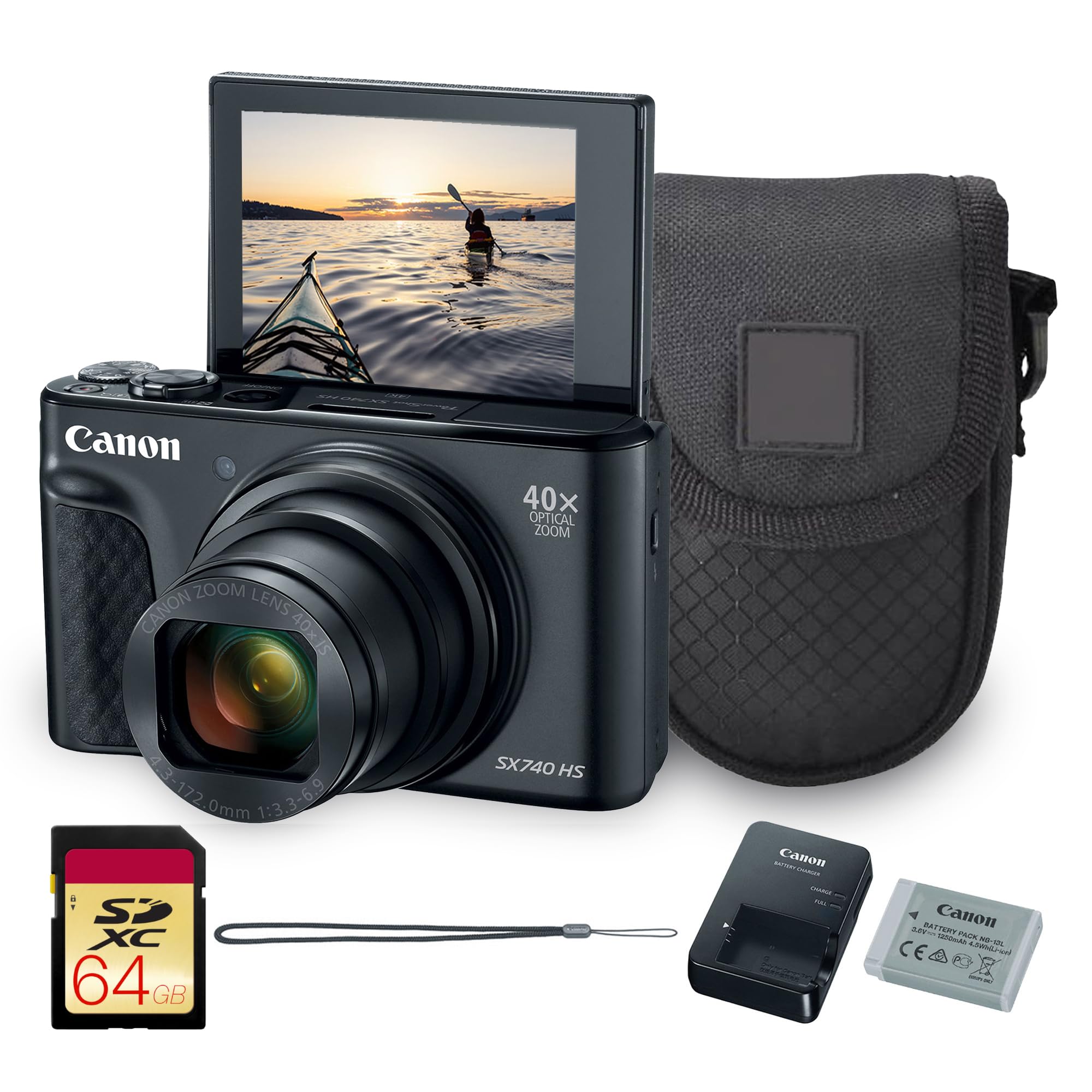
A 40x zoom that slides into a jacket pocket — perfect for travels where you need reach without bulk.
With a 40x optical zoom lens spanning 24-960mm (35mm equivalent), the SX740 HS packs more reach than the Panasonic FZ80D into a body that actually fits in a pants pocket. This is the camera you take to a safari, a concert, or a whale-watching trip where you cannot carry a big bag. It records 4K UHD video at 30p with 5-axis image stabilization built into the video mode, keeping handheld telephoto shots reasonably steady. The 20.3MP CMOS sensor and DIGIC 8 processor deliver vibrant colors and low noise in good light.
The flip-up screen helps for selfie-style recording, and Wi-Fi plus Bluetooth connect you to the Canon Camera Connect app for remote shooting and instant phone transfers. Owners consistently praise the photo quality as “better than an iPhone” and note the battery lasts a full 5-day trip without needing a charge. The size gets mixed feedback — some find it wonderfully compact, others say it is slightly larger than a true pocket camera. The low-light performance is decent for its class but does not match the 1-inch sensor of the Canon PowerShot V10 or the APS-C sensor of the R50. For a travel zoom that does 4K, this is the best balance of reach and portability.
Its a neat extra: the 40x optical zoom (24-960mm) in a body smaller than most bridge cameras — perfect for travel where you need range but not a second bag.
The trade-off: the 1/2.3-inch sensor means low-light video gets grainy faster than the 1-inch V10 or any APS-C mirrorless camera.
Best for: travelers, event-goers, and wildlife watchers who want 4K video with a long zoom lens in a packable size.
Not for: indoor or evening shooters who prioritize noise-free footage over zoom range.
10. Canon VIXIA HF G70

A dedicated camcorder with a proper zoom rocker and built-in time-stamp recording for event work.
While most of this list is action cameras and mirrorless bodies, the VIXIA HF G70 is a traditional camcorder — and that matters if your primary need is long-form recording with a real zoom control. The 20x optical zoom lens with 5-Axis Dynamic Image Stabilization gives you smooth, steady telephoto shots with a physical rocker switch, not a digital slider on a touchscreen. The 1/2.3-inch 4K UHD CMOS sensor paired with the DIGIC DV 6 image processor delivers crisp footage, and the 8-blade aperture creates cinema-style out-of-focus highlights in the background.
This camcorder is built for practical video use: dual SD card slots for uninterrupted recording, a UVC live-streaming mode that streams HD video directly to a PC or Mac via USB-C with no capture card needed, and an on-screen display (OSD) time-stamp function that embeds date, time, and timecode directly into the original video files — a feature essential for legal, educational, or archival recordings. Owners praise the “insane zoom” and point-and-shoot simplicity, but note that low-light performance is below average (gain becomes soft past ISO 4 and mushy past ISO 10) and there is no histogram or audio peaking indicator. For event videography, classroom recording, or outdoor sports, it is a purpose-built tool that handles like a camcorder should.
Its edge over mirrorless: the physical zoom rocker and dual SD card slots make it the only camera here designed specifically for long, uninterrupted video recording without swapping cards.
Its shortfall: low-light footage gets noticeably soft and noisy compared to any camera with a 1-inch or larger sensor, especially above moderate gain.
Choose this if: you need a dedicated video camera with a proper zoom lever, dual recording, live streaming UVC output, and time-stamp embedding.
Look elsewhere if: you shoot a lot in dim indoor settings or want a compact camera you can carry in a pocket.
11. Sony Alpha 7 IV

The full-frame hybrid that does not compromise between stills and 4K video.
If you need professional-grade stills and video in one body, the Alpha 7 IV is the camera that serious photographers and videographers point to. Its 33MP full-frame Exmor R back-illuminated CMOS sensor paired with the BIONZ XR processing engine delivers 4K video at up to 60fps in 10-bit 4:2:2 color depth, with full pixel readout in all recording formats. That means no pixel binning and no line-skipping — the sharpest possible 4K from a full-frame sensor. In 30p mode, the camera uses 7K oversampling to create supersampled 4K video with exceptional detail and reduced moiré.
The 693-point phase-detection autofocus system with real-time Eye AF for humans, animals, and birds is fast and sticky — owners call it “incredibly accurate.” The in-body image stabilization (IBIS) steadies handheld shots, and the S-Cinetone color profile (inherited from Sony’s cinema line) gives you beautiful color grading straight out of camera. The dual card slots (one CFexpress Type A, one SD UHS-II) give you flexible backup or overflow recording. Battery life is solid at over 2000 shots per charge. The honest caveat is the learning curve — the menu system is deep, and 4K 60fps video uses a Super 35mm crop rather than the full sensor width. For a camera that does everything at a near-professional level, it is the complete package.
What Makes It a Legend
- 33MP full-frame sensor with 7K oversampled 4K/30p — the sharpest 4K on this list
- S-Cinetone color profile for cinematic color grading without plugins
- 693-point phase-detect AF with reliable Eye AF for people, animals, and birds
Honest Complexity
- 4K 60fps is cropped to Super 35mm — not full-frame
- Deep menu system with a steep learning curve for new Sony users
Buy this if: you are a serious hybrid shooter who demands top-tier stills, professional 10-bit 4K video, and full-frame low-light performance.
it’s not for you if: you want a lightweight, simple point-and-shoot experience or only need basic 4K without investing in a lens system.
Understanding the Specs
4K Frame Rate (fps)
The frame rate tells you how many individual frames the camera captures each second at 4K resolution. Standard video runs at 24 or 30 fps, which looks natural and cinematic. A higher frame rate like 60 fps or 120 fps lets you slow the footage down in editing to create dramatic slow-motion clips without losing smoothness. Cameras like the DJI Osmo Action 5 Pro offer 4K at 120 fps, which is ideal for action sports where you want to replay a jump or a turn in slow, clear detail.
Oversampled 4K vs. Cropped 4K
Oversampled 4K uses more of the sensor’s surface area than it needs for a 4K frame — it reads a larger area (sometimes the entire sensor) and then downsamples the data to create a sharper, cleaner 4K image with fewer artifacts. Cropped 4K reads only a 4K-sized portion of the sensor, effectively making your lens less wide. The Canon EOS R50 oversamples for sharper 4K, while the Canon EOS R100 crops its 4K, meaning the same lens appears narrower in 4K mode.
FAQ
What does “oversampled 4K” actually mean for video quality?
Can I use a 4K camera as a webcam for live streaming?
How much storage space does 4K video use?
What is the difference between 4K 30fps and 4K 60fps?
Do I need a gimbal for smooth 4K video?
What does “full pixel readout” mean in 4K video?
Log profiles: what are they and do I need one?
How important is the bit depth for 4K video?
Should I buy an action camera or a mirrorless camera for 4K video?
Final Thoughts: The Verdict
For most people, the best 4k camera is the DJI Osmo Action 5 Pro Adventure Combo because it delivers the strongest all-around package of battery endurance, low-light quality, and slow-motion 4K at a price that undercuts premium mirrorless options. If you want the highest video quality and full-frame versatility for hybrid stills and professional 4K, the Sony Alpha 7 IV is the unrivaled pro choice. And for 360-degree creative flexibility where you capture every angle and compose later, the GoPro MAX2 is your ticket.
How We Picked
We do not accept paid placement. Every pick is matched to a real buyer and a real use-case; we do not hands-on test units.
Sources & Methodology
Specifications: manufacturer listings and product documentation. Review insights: verified customer reviews, as of July 2026. Pricing: not shown on this page (it changes often); check the current price via the retailer link.
As an Amazon Associate, Gadgets Feed earns from qualifying purchases. This does not affect which products we feature.