
Our readers keep the lights on and my morning glass full of iced black tea. As an Amazon Associate, I earn from qualifying purchases.
Specs are compiled from manufacturer listings and verified buyer reviews and can change over time — please confirm the key details on the product page before buying.
Stopping to swap a blown fuse on the side of the road, or while your trolling motor cuts out mid-lake, is a hassle a simple reset button eliminates. An automotive circuit breaker replaces that single-use glass or blade fuse with a switch you push back in, saving time, money, and the headache of carrying spare fuses for every amperage. This guide compares nine of the most reliable breakers on the market, from budget multi-packs to high-amperage units for serious audio systems and solar setups, so you can match the right one to your voltage, current needs, and mounting space.
I’m Min — the founder and writer behind Gadgets Feed. This guide is built by comparing the manufacturers’ published specifications and the patterns across verified customer reviews, so you get each pick’s real strengths and trade-offs instead of marketing spin.
The honest, research-backed breakdown of the best automotive circuit breaker for your boat, truck, RV, or car audio system starts right here.
Our Picks at a Glance

How To Choose The Best Automotive Circuit Breaker
Picking the right breaker depends on a few key decisions. You need a unit that handles your system’s voltage and peak current, fits where you plan to mount it, and offers the right reset style for how you use the vehicle or device.
Manual vs. Automatic Reset
A manual-reset breaker (Type III) pushes a button back in after it trips, which is perfect for troubleshooting a short or for use as a kill switch. An automatic-reset breaker (Type I) reconnects the circuit by itself once it cools, which is useful for headlights or bilge pumps where you want the device to come back on without driver intervention, but it can be dangerous if the short is still there.
Voltage and Current Ratings
Your breaker’s voltage rating must match or exceed your system voltage (12V, 24V, or 48V DC). The current rating should be slightly higher than the continuous draw of the device you’re protecting — a 50A breaker is a common fit for a trolling motor or a moderate car audio amplifier, while a 100A or 200A unit is necessary for high-power inverters or winch setups.
Form Factor and Mounting
Breakers come in two main shapes: inline cylindrical units with threaded studs for high-current runs, and blade-style (ATO/ATC or mini) replacements that plug directly into a standard fuse block. Your choice depends on whether you are replacing an existing fuse in a panel or adding a dedicated breaker on a power cable.
Quick Comparison
| Model | Best For | Current Rating | Voltage | Reset Type | Amazon |
|---|---|---|---|---|---|
| RED WOLF 50A★ Best Overall | Best Overall / Trolling motors | 50 Amps | 48 Volts | Manual | Amazon |
| BBTO 4 Pack 30ABest Value | Value / Multi-pack auto-reset | 30 Amps | 24 Volts | Auto | Amazon |
| Erayco 50AMarine Pick | Mid-range marine breaker | 50 Amps | 12 Volts | Manual | Amazon |
| Tocas 6PC ATO Blade | Diagnostic / Troubleshooting | 30 Amps | 32 Volts | Manual | Amazon |
| ERAYCO 150A | High-amperage audio/winch | 150 Amps | 48 Volts | Manual | Amazon |
| Nerites Mini Blade Kit | Vehicle fuse-box diagnostics | 30 Amps | 28 Volts | Manual | Amazon |
| Hamolar 3 Pack 100A | Value high-amp multi-pack | 100 Amps | 48 Volts | Manual | Amazon |
| Tocas E9 100A | Premium IP67 / Solar | 100 Amps | 48 Volts | Manual | Amazon |
| Tocas E9 200A | Heavy-duty / Large inverters | 200 Amps | 48 Volts | Manual | Amazon |
In‑Depth Reviews
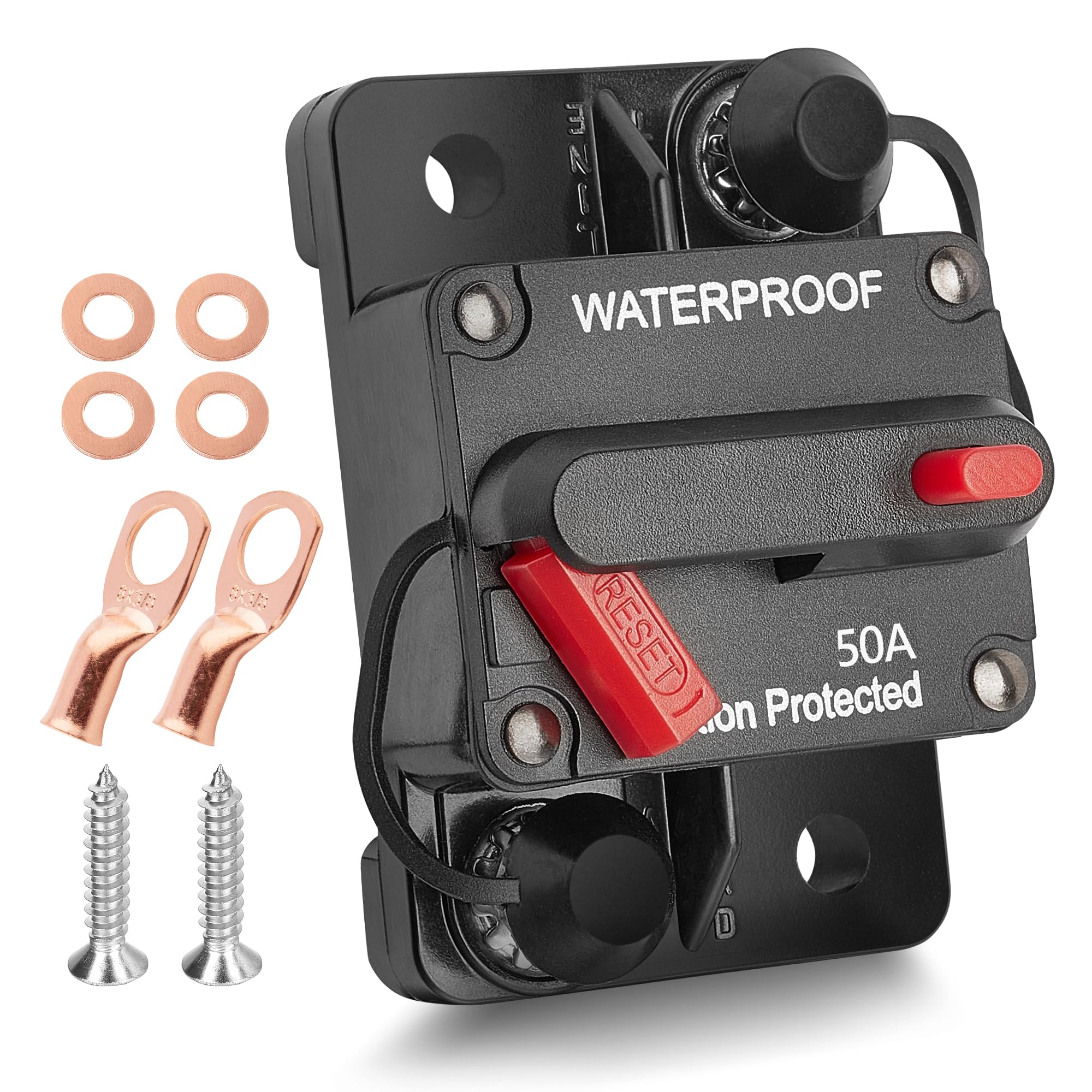
1. RED WOLF 50A Amp Circuit Breaker
Our pick — over 4.5★ from 700+ verified ratings; the strongest balance of quality and price.
The 50-amp inline that lives comfortably in both a boat and a solar setup.
This single-pole breaker handles a wide voltage range up to 48 volts DC, which means it works just as well on a 12V trolling motor as on a 36V lithium battery bank — one owner runs it with a 36-volt Rodan trolling motor and a 36-volt lithium battery. The manual reset button doubles as a kill switch, so you can disconnect power without pulling wires. Buyers call out reliability more than any other quality — 52 owners praise it — and the included ring terminals and copper core make the hookup straightforward.
The biggest knock across reviews is a mixed take on durability: some units show internal housing corrosion over time, especially in saltwater environments. That makes the waterproof housing a good barrier for occasional spray, but a fully submerged engine bay might push this breaker’s limits.
At roughly the same cost as the Erayco 50A below, the RED WOLF holds a clear edge in owner satisfaction — it has nearly 200 more ratings on Amazon and a tighter consensus around reliability.
High amp reliability
- Manual reset works as a kill switch — push to disconnect, no need to pull fuses
- Copper-core ring terminals included for a solid, low-resistance connection
- 48V DC rating covers 12V, 24V, and 36V systems without extra hardware
Bulkier design
- Mixed durability reports on internal corrosion in wet marine use
- Single-pole design only — not meant for AC or dual-battery isolation
Heavy-duty use: you need a single, trusted 50A breaker for a trolling motor, solar array, or accessory circuit and want manual-reset convenience across 12V to 48V systems.
Tight spaces: you operate in a fully submerged or heavy-salt-spray environment every day — a sealed IP67 unit (like the Tocas E9 100A) may hold up longer.
2. BBTO 4 Pieces DC 12V-24V Automatic Reset Circuit Breaker (30A)
Four breakers for the price of one — the automatic go-to for trailer circuits.
Each of the four 30-amp breakers in this pack uses a thermal automatic reset: when the circuit overloads, the breaker opens, cools, and reconnects the power on its own. That makes it a natural fit for a trailer plug, a bilge pump, or a bed-mounted inverter where you want the accessory to come back without reaching for a button. Buyers consistently mention value as the headline — one owner called a 30-amp version “just what I needed: 4 of these for the price of 1.”
The catch with an auto-reset breaker is safety: if the short is permanent, the breaker will keep cycling on and off until the problem is fixed, which can damage the device or wiring. That is why owners tend to install these on non-critical circuits where a brief power interruption is annoying but not dangerous. The three-pole design here is unusual — most auto-reset breakers are simple single-pole units — but the 1.37 x 0.74 x 2-inch footprint still fits compact panel mounts.
Multi-pack value: If you are wiring multiple trailer or accessory circuits and want automatic protection without blowing fuse after fuse, this pack is tough to beat on cost. Stick with manual-reset breakers for mission-critical gear like a trolling motor or amplifier.
Fleet installations: budget-conscious builds with multiple 12V or 24V circuits where automatic reconnection is acceptable, like trailer lighting or inverter outlets.
Manual control: you need a single 50A capacity or a manual kill switch — the 30-amp limit and auto-reset design won’t suit high-draw or safety-critical gear.
3. Erayco 50 Amp Circuit Breaker with Manual Reset
Solid everyday protection with an included waterproof boot for marine duty.
This three-pole breaker is built for 12-volt systems primarily — the voltage rating sits at 12 volts, a full 36-volt gap below the RED WOLF’s 48-volt range — so it is best matched to standard marine and automotive 12V accessories. The manual reset button doubles as a kill switch, and the included waterproof cover helps keep rust off the metal terminals. Reviewers call out reliability as the strongest feature; one owner uses it on a new lithium battery and trolling motor and reports it trips cleanly without drama.
The build quality gets mixed reactions: while many praise the solid feel, a smaller group notes the unit can feel budget-grade compared to premium brands like Blue Sea Systems. A buyer summed it up with “put on boat, seems ok, did trip once” — which reads as a normal function, not a flaw. The three-pole design gives you extra wiring options but takes up slightly more space than a single-pole unit.
Compared to the RED WOLF 50A at a similar price point, the Erayco runs on 12 volts only (vs. 48 volts) and has about 175 fewer reviews, but the included waterproof boot gives it an edge for open-boat decks.
Precision setups: you need a simple, reliable 50A manual-reset breaker for a 12V trolling motor, bilge, or accessory circuit and want the rust protection of a cover.
High current: your system runs at 24V or 48V — the 12-volt rating makes this incompatible with higher-voltage setups.
4. Tocas E39 6PC ATO ATC Blade Fuse Circuit Breaker

Six ATO blade breakers that plug straight into your fuse box for quick diagnostics.
Each of these six breakers fits standard ATO/ATC blade fuse slots — a direct swap for the glass or blade fuse in your car, truck, or boat. The manual reset button on top lets you push it back in when it trips, which is a huge time-saver when you are hunting a short and would normally burn through a dozen fuses. The amperage range runs from 5A up to 30A, covering most accessory circuits. Owners use them specifically for troubleshooting: one installed them in an automotive class and tested every breaker with an amp clamp and DSO (a digital storage oscilloscope that shows electrical waveforms), finding all of them opened at or near the rated current.
The trade-off is that they are built for intermittent diagnostic use rather than permanent high-current protection. A few owners note the fit can be slightly tight in some fuse blocks, and the plastic housing carries a UL 94V0 fire rating (meaning it self-extinguishes within 10 seconds after a flame is removed) but feels less rugged than a metal-studded inline breaker. At 32 volts DC max, these are strictly for 12V and 24V systems — never on a 48V battery bank.
Automotive circuits: mechanics, DIYers, and anyone who troubleshoots car or boat electrical gremlins — the resettable design saves fuse-box cash.
High power: you need a high-current main-line breaker for a trolling motor or solar array — the blade form factor maxes out at 30A and is not meant for continuous high loads.
5. ERAYCO 150 Amp Circuit Breaker with Manual Reset

The 150-amp cutoff for big winches, inverter banks, and car audio subwoofers.
When your system pulls more than 50 or 100 amps — think a 2000W inverter, a hydraulic winch, or a high-power car audio amplifier — this breaker handles the current. It is rated for 48 volts DC and carries the same ignition-protection certifications (SAE J1625, J1171, UL1500) as the smaller Erayco models. Owners install these as a main disconnect between the battery and a DC-to-DC converter, appreciating the ability to kill the whole system with one throw when storing a van or working on wiring.
The most common buyer caveat: the mounting plate is made from bakelite (a hard, early plastic that can be brittle) and can crack if you overtighten the fastener. One owner had to repair theirs with epoxy after the plate broke before the bolt was even snug. That is a one-off manufacturing complaint, but it is worth handling the studs gently during installation. The three-pole construction at this amperage is unusual — most 150A breakers are single-pole — so it may need more panel space than you expect.
Industrial loads: you need a 150A main shutoff for a high-power system and value the ignition-protection certification for marine or fuel-adjacent installs.
Compact builds: the bakelite mounting plate is brittle — use hand-tightening only, not a power driver, and consider a metal bracket if the install sees vibration.
6. Nerites ATM Mini Blade Manual Resettable Fuse Kit

Eight mini-blade resettable fuses that fit Toyota and standard ATM slots.
This kit covers the full range of low-amperage circuits from 5A up to 30A in the compact ATM (mini blade) form factor — the 2.9mm-wide blade that fits most modern vehicle fuse boxes. The manual-reset button on each lets you diagnose a short without blowing a single disposable fuse, and buyers report they are a “great tool for electrical diagnostics,” especially on Toyota fuse boxes. One technician noted they save time by allowing you to “throw a resetting fuse into the circuit in question and fix the issue without wasting fuses.”
The fit gets mixed reviews: some say the blades align perfectly while others find them slightly tight, which is fine for temporary troubleshooting but may not be ideal for permanent long-term installation. The voltage is capped at 28V DC, so these are strictly for 12V and 24V automotive systems. The kit does not include a storage case for the eight breakers, though the mixed color coding helps identify amperage at a glance.
Compact vehicles: techs and DIYers who need to quickly track down electrical gremlins in a car or boat fuse box without burning through blade fuses.
Frequent trips: you need a high-capacity inline breaker for accessory power runs — the mini-blade form is limited to 30A and a 28V ceiling.
7. Hamolar 3 Pack 100 Amp Circuit Breaker Manual Reset

Three 100-amp breakers for overland trucks, boats, and RV solar — one price.
This three-pack gives you a pair of spares or the ability to protect multiple high-amperage circuits at once. The manual-reset buttons work as individual kill switches, which owners love for isolating battery banks or inverters — one uses them on “several main power wires on my overland truck.” The voltage rating stretches to 48V DC and the ambient temperature range of -25°F to 180°F means it handles engine-bay heat and winter cold without trouble.
The reliability picture is complicated: 16 buyers mention reliability in reviews, and Amazon’s own summary marks it as mixed. Some owners mention the breaker tripping well below its nominal 100A rating — one said it popped at 65A despite being labeled for 100A. That suggests batch inconsistency, so it is worth bench-testing each unit before permanent installation. The included copper wire lugs and washers are a nice touch for the price.
Multiple circuits: budget-conscious overland or RV builds that need multiple 100A manual-reset breakers with spares on hand.
Automated systems: check each unit at your target load before full installation — reports of pre-mature tripping below 100A mean quality control varies.
8. Tocas E9 100A Circuit Breaker with Manual Reset

A fully sealed IP67 breaker for the nastiest marine and solar environments.
This UL-certified single-pole breaker is rated IP67, meaning it is dust-tight and can handle temporary immersion in water — a real advantage for bilge compartments, open boat decks, and exposed solar battery banks. It carries the full trio of ignition-protection certifications (SAE J1625, J1171, UL1500) and the thermoplastic housing is UL rated 94V0 for fire resistance. Owners use them with LiFePO4 battery banks and 2000W inverters, reporting reliable function and easy reset.
The main drawback is heat buildup at high loads: one owner noted the breaker got very hot well below its 100A trip rating, which forced them to upgrade to a Blue Sea Systems unit. That suggests the continuous-duty rating may be lower than the peak trip rating, so the 100A Tocas is best matched to systems that pull 70-80A sustained rather than a full 100A continuous. The 1/4″-28 threaded studs are common for this class but smaller than the 3/8″ studs on the 200A model below.
Compared to the Hamolar 3-pack, this single Tocas unit costs more per breaker but delivers real IP67 sealing and UL marks — an honest trade-off of cost vs. certification.
Medium loads: you need a waterproof, certified 100A breaker for a marine, solar, or RV system that lives outdoors or near water.
Budget builds: plan for ~70-80A continuous load to avoid heat buildup — treat the 100A rating as the trip ceiling, not a running spec.
9. Tocas E9 200A Circuit Breaker with Manual Reset

The 200-amp heavy lifter with 3/8-inch studs and a 2,500A interrupt rating.
This is the biggest breaker in the lineup, designed for systems that draw serious current — large inverters, hydraulic winches, heavy car audio builds, and RV house batteries. The 3/8-inch M10 stainless steel studs provide a much larger contact surface than the 1/4-inch or 5/16-inch terminals on smaller breakers, which reduces resistance and heat at high loads. It carries the same IP67 waterproof rating and UL 94V0 fire-resistant housing as the 100A Tocas, plus an interrupt capacity of 2,500 amps at 14V and 1,500 amps at 48V — meaning it can safely break a massive dead short.
Build quality is where this unit shines: owners consistently describe it as “very solid construction,” with one specifically noting it is the “opposite of a cheap RedWolf unit that broke during installation.” The button mechanism feels smooth and the case is noticeably heavier than budget alternatives. The trade-off is size — at 3.39 inches deep, it needs more mounting space than any other breaker here. The 200A rating also means it is overkill for anything below a 1000W inverter or a high-output alternator circuit.
High demand gear: heavy-DC systems like 2000W+ inverters, winch setups, and professional car audio where 3/8″ lug contact, IP67 sealing, and a 200A capacity are non-negotiable.
Small spaces: your system draws under 100A — the size and cost make a 100A breaker a better fit for moderate loads.
Understanding the Specs
Amperage Rating vs. Continuous Load
A breaker’s stamped current rating — 50A, 100A, 200A — is the point at which it trips under a sustained overload. You want a breaker rated at least 125% of your device’s continuous draw. A trolling motor that pulls 35A under load is fine on a 50A breaker, while a 1500W inverter drawing 125A continuous needs at least a 150A breaker to avoid nuisance trips.
Manual Reset (Type III) vs. Auto Reset (Type I)
A Type III breaker has a push button that stays open until you physically reset it — ideal for troubleshooting shorts or as a kill switch. A Type I breaker resets automatically once the internal thermal element cools, which is convenient for lights or pumps but dangerous for wiring because the circuit keeps trying to reconnect into a fault. Most automotive breakers in this guide are Type III for safety.
FAQ
Can I use a 48V breaker on a 12V system?
What is the difference between a circuit breaker and a fuse?
Will an automatic reset breaker damage my device?
What does IP67 mean on a circuit breaker?
How do I know which amperage to choose?
Can I wire a manual reset breaker backward?
What does UL 94V0 rating mean?
Why does my breaker trip at a lower current than the rating?
Can I use an automotive circuit breaker for solar panels?
What is ignition protection (SAE J1171 / UL1500)?
Final Thoughts: The Verdict
For the majority of shoppers, the best automotive circuit breaker is the RED WOLF 50A because it covers the widest voltage range (12V-48V), carries a strong 4.7-star consensus from 700+ owners, and gives you a manual reset that doubles as a kill switch for trolling motors, solar circuits, and accessory wiring. If you prefer a multi-pack for auto-reset convenience on trailer plugs, grab the BBTO 4-pack. And for heavy 200A systems with big inverters or winches, the Tocas E9 200A is the one to reach for — its 3/8-inch studs, IP67 sealing, and certified safety make it the premium choice for serious builds.
How We Picked
We do not accept paid placement. Every pick is matched to a real buyer and a real use-case; we do not hands-on test units.
Sources & Methodology
Specifications: manufacturer listings and product documentation. Review insights: verified customer reviews, as of July 2026. Pricing: not shown on this page (it changes often); check the current price via the retailer link.
As an Amazon Associate, Gadgets Feed earns from qualifying purchases. This does not affect which products we feature.