
Our readers keep the lights on and my morning glass full of iced black tea. As an Amazon Associate, I earn from qualifying purchases.
Specs are compiled from manufacturer listings and verified buyer reviews and can change over time — please confirm the key details on the product page before buying.
Spotting a quality aircon manifold gauge set requires more than glancing at the dial. A deceptive gauge can read 10 psi high or leak refrigerant through an unchecked seal. This guide focuses on build quality, real-world accuracy, and the specs that distinguish a trustworthy set from a disposable one. Whether you’re tuning superheat on an R410A mini-split or recharging a car’s R134A, you’ll learn which features truly matter and which are marketing hype.
I’m Min — the founder and writer behind Gadgets Feed. This guide is built by comparing the manufacturers’ published specifications and the patterns across verified customer reviews, so you get each pick’s real strengths and trade-offs instead of marketing spin.
We break down the best-selling aircon manifold gauge set options for 2025, separating the professional-grade digital tools from the budget-friendly analog workhorses to help you make a confident purchase.
Our Picks at a Glance

How To Choose The Best Aircon Manifold Gauge Set
Choosing the right gauge set depends on your refrigerants, required accuracy, and need for automatic superheat calculations. A professional installer working on high-pressure R410A needs a set rated for 800 PSI working pressure with accurate temperature clamps. A home mechanic recharging an older car with R134A can opt for a simpler, more affordable analog set.
Analog vs Digital Gauges
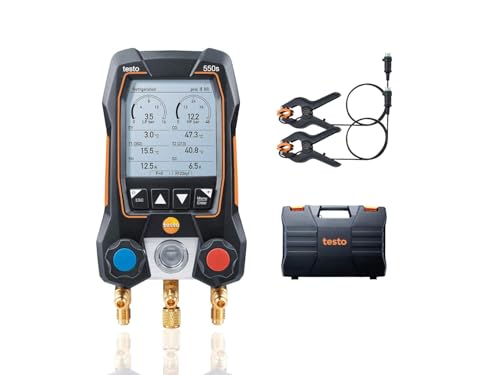
An analog manifold gauge set relies on a mechanical pointer and a printed dial. They’re durable and inexpensive, but you have to read the number yourself and calculate superheat using a separate thermometer and chart. Digital gauges, like the testo 550s, use electronic sensors to give you a precise number on a screen. They often calculate superheat and subcooling automatically, saving time and reducing errors — but they cost more and rely on batteries.
Refrigerant Compatibility and Pressure Ratings
Not every gauge set handles every refrigerant. R410A systems run at much higher pressures (often 800 PSI working pressure) than R134A or R22, so you need a manifold with a high-pressure gauge rated to 800 PSI and hoses that can take 4000 PSI burst pressure. Check the “About This Item” section: if the set lists R410A compatibility and has an 800 PSI gauge, it is safe for modern mini-splits and heat pumps. A set rated to only 500 PSI max is for older refrigerants.
Hose Length and Valve Configurations
Standard manifold gauge sets include three hoses: blue for low-side, red for high-side, and yellow for charging or evacuation. A 2-valve manifold is enough for basic service. A 4-valve manifold gives you more control, letting you isolate the vacuum pump or refrigerant tank without disconnecting hoses. Look for 5-foot hoses — they give you enough reach to hang the gauges on the condenser unit while you work on the service ports.
Quick Comparison
| Model | Best For | Refrigerants | Gauge Type | Hose Length | Amazon |
|---|---|---|---|---|---|
| Testo 550s★ Best Overall | Professional Performance | R-410A, R-22, R-404A, A2L | Digital with Bluetooth | Probes (no hoses) | Amazon |
| Lichamp R410ABest Value | High-Pressure Systems | R134, R22, R32, R410 | Analog | 5 ft | Amazon |
| Elitech LMG-10Digital Entry | Affordable Digital Entry | 88 Types | Digital | Hoses not included | Amazon |
| Shikha 5FT | Extreme Budget | R410A, R404A, R22, R134A, R12, R502 | Analog | 60 inches | Amazon |
| LIYYOO Refrigerant Charging | Value and Functionality | R410A, R22, R404 | Analog | 60 inches | Amazon |
| VEVOR 4 Way | Versatile Kit | R134A, R12, R22, R410A | Analog | 5 ft | Amazon |
| Lichamp Classic A301 | Balanced DIY Kit | R134A, R12, R22, R502 | Analog | 5 ft | Amazon |
| Yellow Jacket 42001 | Focused R22 Work | R22 (primarily) | Analog | Hoses not included | Amazon |
| BACOENG 3.6CFM Kit | All-in-One DIY (Mini Split) | R410A, R22 | Analog | 5 ft | Amazon |
In‑Depth Reviews
1. Testo 550s AC Manifold Gauge Set
Our pick — over 4.5★ from 800+ verified ratings; the strongest balance of quality and price.
The digital gauge that does the math for you, leaving fewer chances for error.
This is the tool that saves a professional technician time on every call. The testo 550s calculates superheat and subcooling automatically from its two wired temperature clamps, so you are not flipping through a P-T chart while balancing a MiniSplit. It scans most common refrigerants plus A2L types, and the Bluetooth connectivity lets you monitor the readings on a smartphone from the unit — perfect when you are standing at the outdoor unit and the gauges are inside the air handler cabinet. The housing uses ABS/PA/TPE materials, which is the stuff rugged drop-protection is made of.
The 550s measures pressure from -15 to 870 psi with a claimed accuracy of ±0.5% of full-scale value. That is a tighter tolerance than any analog needle. A large backlit display keeps the numbers readable in dark basements, though a few owners note the screen contrast drops in direct sunlight. The kit arrives with two wired temperature probes and a wireless vacuum probe, signed calibration docs — factory proof it was checked, not just boxed. Owners overwhelmingly call out the build quality and reliability as the standout traits.
Battery life is genuinely great — buyers report using it for weeks on multiple jobs without swapping cells. The only recurring complaint is that the included plastic case, while compact (8.3 x 4.8 x 2.4 inches — a fraction of the Shikha’s 108-inch bundle), lacks padding for the probes; you will want to wrap the clamps carefully. That is a minor packaging quibble from technicians who otherwise give the instrument top marks.
Why It Earns Top Billing
- Automatic superheat/subcooling calculation removes mental math errors.
- ±0.5% full-scale accuracy is genuinely pro-grade.
- Bluetooth app lets you watch pressure changes remotely.
- Supports A2L mildly flammable refrigerants — future-proofed.
A Few Realities to Know
- Screen can wash out in direct sunlight — backlight helps in darker spots.
- Plastic case is compact but offers less padding for accessories than a foam insert.
Reach for this if: you are a pro (or serious DIYer) who charges by the job and wants instant superheat/subcooling numbers without the math.
Think twice if: your total AC tool budget is under a hundred dollars — the 550s is a premium investment, and a budget analog set will still move refrigerant.
2. Lichamp R410A Manifold Gauge Set
The 4-valve workhorse that handles high-pressure R410A without breaking your budget.
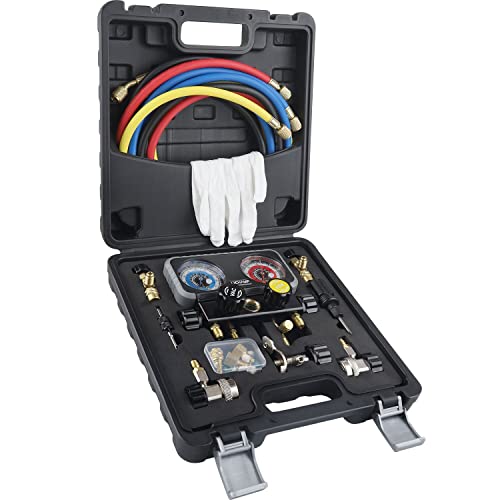
While the entry-level Lichamp Classic handles older refrigerants, this R410A version steps up to the modern high-pressure world. The gauges are rated to 800 PSI on the high side and 550 PSI on the low side, with hoses that claim an 800 PSI working pressure and a 4000 PSI burst rating — the same safety margin you would expect from a professional set. It comes with four 5-foot color-coded hoses and the extra adapters (R410A swivel adapter, liquid safety valves) that make it ready from the start for a residential mini-split system.
The 4-valve manifold design gives you an extra port, making it easier to connect a vacuum pump or recovery machine without disconnecting hoses mid-job. Owners mention the unit holds pressure well and purges air flawlessly on first use — a strong sign that the valve stems are well-machined. Quality and reliability are the two most-praised aspects across the owner base. The “Versatility” aspect draws positive attention because it includes everything for most common systems: both R22 and R410A adapters, a calibration screwdriver, valve core remover, and even a pair of gloves.
The honest trade-off: the gauges are well-made for the price point, but they are not lab-grade precision instruments. A few owners mention they “aren’t the most precise” compared to a digital set. One owner flagged that the hoses are stiff and cannot form a sling for ladder carry, which is a minor ergonomic point for tall work. But at this price level — sitting right in the mid-range — you get a durable, high-pressure-ready kit that covers 99% of HVAC service tasks.
Best pick for: high-pressure R410A and R32 system service where you need a 4-valve manifold and pro-level hose ratings without paying for a digital screen.
Best for: anyone working on mini-splits or modern heat pumps (R410A/R32) who wants a 4-valve manifold with 800 PSI gauges in an affordable package.
Look elsewhere if: you need the absolute highest accuracy for laboratory-level diagnostics — a digital gauge like the testo 550s is better for that.
3. Elitech Digital Manifold Gauge LMG-10
A digital gauge that undercuts the big brands in price, not in features.
The Elitech LMG-10 gives you the core advantage of a digital manifold — automatic superheat and subcooling calculations — without the four-figure price. It supports 88 different refrigerants, which covers virtually everything a home user or light commercial tech will encounter, from R134A in a car to R410A in a mini-split. The large digital display shows pressure in five units (psi, kg/cm2, kPa, MPa, bar) and temperature in °F or °C. The two included temperature clamps let you measure suction and discharge line temps at the same time as pressure.
The battery life is a standout: 200 hours of runtime on a single set of standard replaceable batteries. That means you can leave the unit in the truck for weeks without stressing it will be dead when you need it. The build quality gets consistently positive shout-outs — owners compare it favorably to Fieldpiece gauges. The unit is liquid-resistant and the service ports seal well with no leaks reported. Plus, the gauge remembers your settings (units, refrigerant type) after a power-down, saving you from reconfiguring every time.
The main shortcoming: it does not read vacuum in inches of mercury — instead it shows vacuum in negative PSI. That is fine once you know the conversion, but it is an extra step during evacuation. You also need a separate micron gauge for deep vacuum work because the LMG-10 does not measure microns. And it ships without hoses, so you need to buy a hose kit separately. For the price, those are fair compromises on an otherwise excellent digital entry point.
The Digital Advantage
- 200-hour battery life means you rarely worry about power.
- 88-refrigerant support covers nearly every common gas.
- Auto superheat/subcooling calculation with included temp clamps.
The Important Caveats
- Vacuum reads in negative PSI, not inches of mercury or microns.
- Ships without hoses — you must factor that into your total cost and check compatibility.
Reach for this if: you want digital convenience (auto superheat/subcooling) without paying Testo prices.
Think twice if: you already own high-quality hoses and just want the electronics — this is for you; if you need a gauge that reads microns, get a dedicated micron gauge too.
4. Yellow Jacket Mechanical Manifold Gauge Set (42001)

A straight-up analog gauge that has been trusted for years, with no screens or batteries to fail.
The Yellow Jacket 42001 is as old-school as it gets — a 2-valve mechanical manifold with no electronics, no Bluetooth, and no learning curve. It is a professional-grade tool that relies on a meticulously machined brass body and smooth valve stems. The build quality is the top praise from owners: “hi quality solid gauges,” as multiple long-time users put it. It is the kind of gauge you hand down to the next generation. The 2-valve design keeps it simple — open it, read the needle, close it — which is exactly what a seasoned technician who learned on analog wants.
This set is a clear winner for anyone working on R22 systems (still common in older residential units). It pairs well with quality aftermarket hoses. However, it ships without hoses, so you must buy them separately — do not buy this expecting a turnkey kit. The gauges are not specifically rated for R410A’s higher pressures, so this is really an R22/R134A tool. The value-for-money debate is real: some owners consider it pricey for what is essentially a bare manifold. Accuracy is another nuance — one owner reported a high-side gauge being about 30 PSI off, which is a bigger error than you want for a diagnostic tool, so check the gauges against a known reference when they arrive.
Best for: the technician who wants a bombproof analog manifold for R22 work and already owns quality hoses and temperature probes.
Get this if: you work primarily on R22 or R134A systems and prefer the tactile feel of a mechanical valve you can feel close with your hand.
skip it if: you need a modern R410A kit or a turnkey set with hoses — this is a partial solution that requires supplementary parts.
5. BACOENG 3.6CFM Vacuum Pump & Gauge Set

The one-box solution for a first-time mini-split installer — pump, gauges, hoses, bag.
This kit is designed for someone installing their first (or fifth) ductless mini-split system. It bundles a 3.6 CFM vacuum pump with a 3-way analog manifold gauge and three color-coded 5-foot hoses. The pump is a 1/4 HP unit with an all-copper motor and an aluminum housing, plus a built-in cooling fan and a sight glass for checking the oil level. For a DIYer, that means you can pull a vacuum on the line set, hold it, and verify the system is tight without buying a separate pump.
The gauge set handles R410A and R22 refrigerants — the two most common in residential mini-splits — and the hoses are rated to 800 PSI working pressure with a 4000 PSI burst pressure. The kit includes R410A adapters (1/4″ SAE Male to 5/16″ SAE Female) so you can connect to modern mini-split ports. Owners praise the functionality more than any other aspect; the consensus is that it saves serious money (one owner estimated -300 saved on the first installation alone). The pump pulls down fast and the gauges seal well enough to hold a vacuum overnight.
The catch is that this set is not designed for automotive R134A work. You would need separate R134A quick couplers and a can tap. Also, a minority of customers note occasional oil leakage from the pump during storage, so always store it with the drain valve closed. For the price, this is the most complete kit for a mini-split DIYer — you genuinely get everything needed in one bag.
Why This Kit Works
- Includes a 3.6 CFM vacuum pump, gauges, and hoses in one purchase.
- 800 PSI / 4000 PSI burst hoses are appropriate for R410A safety.
- All-copper pump motor and aluminum housing offer long-term durability.
Limitations to Know
- Not for automotive R134A systems — you need additional adapters.
- Store the pump upright and check drain valve; occasional oil seepage is reported.
Who this fits: the homeowner installing a mini-split who wants a single-purchase kit (pump + gauges) and does not want to piece together components.
Not for you if: you only need gauges and already own a vacuum pump — this bundle includes the pump, so it takes up more space and budget.
6. VEVOR 4 Way AC Manifold Gauge Set

A complete 4-way manifold kit for both car and home AC — with adapters for R134A and R410A.
The VEVOR 4 Way AC gauge set bridges the gap between simple home-user kits and professional gear. It comes with a 4-valve manifold, four 5-foot reinforced hoses, two quick couplers, three adapters (including a 1/4″ SAE to 5/16″ SAE for R410A and a 1/4″ SAE to 1/2″ ACME for can taps), a valve core wrench, and spare seals. With that inventory, you can connect a vacuum pump, a refrigerant tank, and a recovery cylinder simultaneously without swapping hoses. It is compatible with R134A, R12, R22, and R410A — covering car AC and residential HVAC.
The gauges use a dry-and-liquid-filled hybrid design, which improves readability in winter (no frozen dampener), and they have calibration screws for field adjustment. The claimed accuracy is ±1.6%, which is decent for a mid-range analog set. Functionality is the thing owners talk about most — they appreciate having the extra hose for the vacuum pump and the purge port on the refrigerant line. The build quality is solid, with brass and aluminum construction that feels substantial for the price.
Not everyone gets a perfect fit: some units ship with minor assembly issues — a fitting on one owner’s unit loosened and sprayed refrigerant, though tightening it solved the problem. A minority note one or two adapters missing from the box. But for the price, the completeness of the kit (16 pieces) and the accurate gauges make it a strong choice for anyone who services multiple types of AC systems.
Best for: the home mechanic who works on both a car’s R134A system and a house’s R22 or R410A AC, and wants adapters for both in one box.
This is for you if: you want a 4-way manifold with a huge assortment of adapters so you do not have to hunt for the right fitting mid-job.
Pass it by if: you demand lab-level precision — the analog gauges are good (±1.6%) but not digital-accurate.
7. LIYYOO Refrigerant Charging Hoses with Manifold Gauge Set

A budget set with surprisingly sturdy hoses that hold pressure and a manifold that sealed tight for many.
The LIYYOO set sits at a budget-friendly price point, but it punches above its cost in two important areas: hose safety and manifold sealing. The 60-inch, 1/4-inch hoses are rated to 800 PSI working pressure with a 4000 PSI burst pressure — the same spec as more expensive sets. The manifold has an aluminum alloy body with a sight glass, and it shipped with R410A connectors (5/16″ SAE) so it is ready for modern systems from the start. Functionality and quality are the most praised aspects equally.
Owners mention the brass fittings have smooth threads and the kit is easy for a first-time 410A recharge on a mini-split. The hoses held together during extended use and vacuum testing. For the budget price, this is a functional manifold that can complete a job. As one owner summarized: “good for a cheap gauge set.” The sight glass helps you see liquid refrigerant flowing during charging.
The trade-off that matches the price: gauge accuracy is inconsistent. The most detailed owner account notes that the low-side gauge reads zero at ~10 PSI and reads 30 inHg as only 20 inHg — that is a substantial error for diagnostic work (though the same owner confirmed the manifold itself held a vacuum). If you rely on absolute pressure numbers to diagnose a 10-psi difference between suction and discharge, this set can mislead you. It works for basic charging where you just need to see “pressure went up when I added gas,” but not for precise diagnostics.
The Upside
- Hoses meet professional safety specs: 800 PSI working, 4000 PSI burst.
- Brass fittings and smooth threads make for easy hookup.
- Included R410A connectors mean no adapter hunting for mini-splits.
The Accuracy Trade-Off
- Low-side gauge can have a zero-offset and reading error at vacuum — not trustworthy for precision diagnostics.
- Best viewed as a charging hose set with attached gauges, not a lab-grade measuring instrument.
Buy this if: you need an affordable set for basic refrigerant charging on R410A, R22, or R404 and can accept gauge readings as approximate.
Pass if: you diagnose system issues based on exact superheat/subcooling numbers — the gauge error here can lead to the wrong conclusion.
8. Lichamp Classic A301 Manifold Gauge Set
A budget analog set that earned genuine respect for its quality feel and accurate high-side readings.
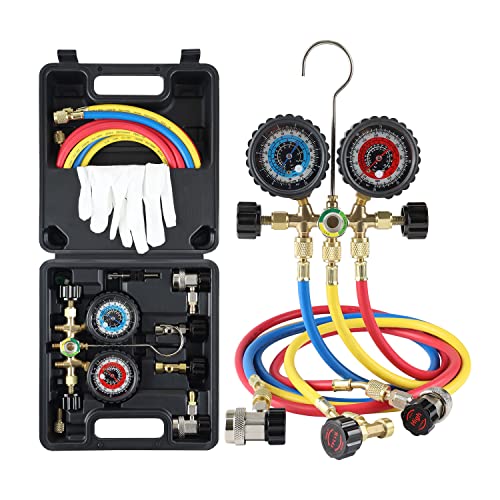
This classic 3-way manifold from Lichamp covers R134A, R12, R22, and R502 — the refrigerants you encounter in older cars and residential equipment. It includes two puncture-style can taps (one for self-sealing cans, one standard) and two adjustable R134A adapters. The hoses are 5 feet, rated to 600 PSI working pressure with a 3000 PSI burst pressure, which is sufficient for R134A and R22 but not the 800 PSI working pressure you want for modern R410A systems. The 500 PSI (red) and 350 PSI (blue) gauge max ranges confirm this is a set for older systems.
Owners praise the quality consistently — many mention the gauges do not feel cheap or flimsy, and that the connectors snap on and off with confidence. One owner compared the readings against a professional ROBINAIR machine and found the high-side gauge matched within one or two PSI. That kind of real-world accuracy at this price point is genuinely impressive. The extra-large colored dials make reading on a workbench easy.
The weak spot is the low-side hose connection: a few reviewers point out the blue hose leaks around one crimped end. It is not universal, but buy with the understanding that a single hose may need replacement. The can taps are functional but some owners found the plastic gaskets deteriorate quickly. For the price, this remains the most balanced budget set for older refrigerants if you check the crimp connections before first use.
What Makes It Worth It
- High-side gauge accuracy impressed owners — nearly matches a pro machine.
- Quality feel: brass and aluminum construction feels solid in hand.
- Complete set includes adapters and can taps for R134A cans.
What to Watch For
- The blue hose has an occasional leaking crimp — inspect and pressure-test before use.
- 600 PSI hoses and 500 PSI gauges are not rated for R410A systems.
Best for: DIY mechanics recharging R134A car AC or working on older R22 home equipment — the accuracy-to-price ratio is excellent.
Look elsewhere if: you need a manifold for modern R410A mini-splits — the Lichamp R410A version is the one to get for that.
9. Shikha 5FT AC Diagnostic Manifold Freon Gauge Set

The lowest-priced multi-refrigerant set in this list — and the one with the most mixed owner experience.
The Shikha set covers R410A, R404A, R22, R134A, R12, and R502 — a genuinely wide range of refrigerants. It features a brass testing manifold body with a metal casing and extra-large dial windows. The 60-inch hoses are color-coded and the gauge set has diaphragm valves that are supposed to provide a better seal. The price is the lowest in this guide, which is its main appeal for a homeowner who just wants to check a single system once.
However, the pattern across owner experience is mixed. Value for money is the most positively referenced aspect — when it works, it is an incredible deal. But the quality and reliability are consistently flagged as “mixed” by Amazon’s own analysis, meaning a significant portion of buyers encountered issues. Most notably, there are reports of the low-side valve leaking due to a torn seal from improper assembly. Another owner confirmed the manifold held vacuum but the gauges were not accurate — similar to the LIYYOO set. A few buyers received units missing the advertised adapters.
If you buy this set, plan to inspect the valve seals and brass fittings before connecting it to an expensive refrigerant system. The brass body is well-constructed — when the seals hold, the manifold itself is fine. But the recurring owner sentiment is that you may receive a fully functional unit or a flawed one, and the thin rubber seals are the weakest link. This is the set to get if your budget absolutely cannot stretch and you are willing to check and possibly replace a valve seal.
The Low-Price Appeal
- Widest refrigerant compatibility at the lowest price in this guide.
- Brass manifold body is inherently durable when assembled correctly.
The Quality Variance
- Seal defects and missing adapters are noted in a notable portion of deliveries.
- Gauge accuracy is unreliable — treat readings as approximate, not precise.
Get this if: your budget is absolute rock-bottom and you are willing to tighten bolts and possibly replace a seal before first use.
Spend more if: you cannot afford downtime on a refrigerant job — the LIYYOO or Lichamp Classic sets carry much less quality risk for a small step up in cost.
Understanding the Specs
Working Pressure and Burst Pressure
Hoses are rated for two numbers: working pressure (the maximum the hose is designed to hold during normal use) and burst pressure (the point at which the hose will fail catastrophically). For R410A systems, your hose working pressure should be at least 800 PSI and the burst pressure at least 4000 PSI. For R134A, a 600 PSI working pressure and 3000 PSI burst pressure is adequate. Never use a hose rated for R134A on a high-pressure R410A system — the hose could rupture.
Gauge Accuracy and Calibration
Analog gauge accuracy is typically stated as a percentage of full scale. A gauge rated ±1.6% of 800 PSI can be off by nearly 13 PSI at the top end — that is a significant error when you are aiming for a 15°F superheat target. Digital gauges typically have higher precision (like the testo 550s at ±0.5% of full scale). Some analog gauges have a calibration screw on the back; you can zero them against atmospheric pressure. Always check whether the needle rests at zero when disconnected from any system.
FAQ
Can I use one manifold gauge set for both R134A and R410A?
What is the difference between a 2-valve and a 4-valve manifold?
Why does my gauge read 0 PSI when the system is off but still has refrigerant?
Do I need a separate vacuum pump with a manifold gauge set?
What does “sight glass” on a manifold do?
How long should manifold gauge hoses last?
Is a digital gauge really better than an analog one?
What happens if I use the wrong refrigerant in my gauge set?
Can I leave my manifold gauges connected overnight to check for a leak?
Why is burst pressure important for refrigerant hoses?
Final Thoughts: The Verdict
For most people, the aircon manifold gauge set winner is the Testo 550s because it combines digital accuracy, Bluetooth connectivity, and automatic superheat/subcooling calculation in a package that has earned the trust of thousands of technicians. If you want a value-packed all-in-one kit for a mini-split installation, grab the BACOENG 3.6CFM kit. And for the budget-conscious DIYer working on R134A car AC or older R22 equipment, the Lichamp Classic A301 is the one to reach for — it offers surprisingly good high-side accuracy at a fraction of the cost of professional gear.
How We Picked
We do not accept paid placement. Every pick is matched to a real buyer and a real use-case; we do not hands-on test units.
Sources & Methodology
Specifications: manufacturer listings and product documentation. Review insights: verified customer reviews, as of July 2026. Pricing: not shown on this page (it changes often); check the current price via the retailer link.
As an Amazon Associate, Gadgets Feed earns from qualifying purchases. This does not affect which products we feature.