
Our readers keep the lights on and my morning glass full of iced black tea. As an Amazon Associate, I earn from qualifying purchases.
Specs are compiled from manufacturer listings and verified buyer reviews and can change over time — please confirm the key details on the product page before buying.
Choosing an art tablet with pen means deciding between two very different worlds: a standalone tablet you can use anywhere vs. a screen-less drawing pad that turns your computer into a canvas. The right pick depends on if you need portability for sketching on the go or the precision of a dedicated pen display for hours of illustration work. Every model here comes with a pen in the box, so you can start drawing from the moment it arrives.
This guide is built by comparing the manufacturers’ published specifications and the patterns across verified customer reviews, so you get each pick’s real strengths and trade-offs instead of marketing spin.
A good art tablet with pen should feel natural in your hand, respond to the lightest touch, and keep up with your workflow without lag or glitches.
Our Picks at a Glance


How To Choose The Best Art Tablet With Pen
Finding the right drawing tablet depends on a few key specs that determine how natural the pen feels and how well the tablet fits your creative space. Here is what matters most.
Pressure Sensitivity
This controls how your pen strokes change thickness and opacity based on how hard you press. More levels mean finer control over subtle shading and thin-to-thick lines. Most modern tablets offer 8192 or 16384 levels, which covers everything from sketching to professional illustration.
Active Area
The active area is the surface where your pen strokes register. A larger area lets you draw with wider, more natural arm movements, while a smaller one is better for tight desk spaces. If you use a big monitor, a larger active area matches your screen better.
Standalone vs. Connected
Some tablets, like the Lenovo Idea Tab and TCL NXTPAPER, run their own operating system so you can draw without a computer. Others, like most Wacom and XP-Pen models, must be connected to a laptop or desktop via USB or Bluetooth. Your choice boils down to needing a portable sketchpad versus a studio tool.
Quick Comparison
| Model | Best For | Active Area | Pressure Levels | Connectivity | Amazon |
|---|---|---|---|---|---|
| Lenovo Idea Tab★ Best Overall | Standalone sketching & study | 11″ 2.5K display | — | Wi-Fi, Bluetooth | Amazon |
| GAOMON WH851Wireless Value | Wireless budget drawing | 8 x 5 inches | 16,384 | USB, Bluetooth | Amazon |
| VEIKK A15ProBeginner’s Choice | First drawing pad with plenty of keys | 10 x 6 inches | 8,192 | USB | Amazon |
| HUION Inspiroy 2 | Versatile medium pad with scroll wheel | 8.7 x 5.4 inches | 8,192 | USB | Amazon |
| XP-Pen Deco Pro LW 2nd | Wireless creative workflow | 9 x 6 inches | 16,384 | USB, Bluetooth | Amazon |
| XENCELABS Medium | Professional feel with dual pens | 10.33 x 5.8 inches | 8,192 | USB, Bluetooth | Amazon |
| TCL NXTPAPER 11 Plus | Eye-friendly paper-like drawing | 11.5″ display | 4,096 | Wi-Fi, Bluetooth | Amazon |
| Wacom Intuos Pro Medium | Premium professional studio tool | Large 16:9 format | 8,192 | USB, Bluetooth | Amazon |
In‑Depth Reviews
1. Lenovo Idea Tab
Our pick — over 4.5★ from 550+ verified ratings; the strongest balance of quality and price.
Your creative companion that handles everything from note-taking to streaming.
The Lenovo Idea Tab gives you a full Android tablet experience with a pen and folio case included, so you can start sketching, annotating, or browsing the web straight away. The 11-inch 2.5K IPS display runs at 90Hz, which makes every scroll and stroke feel fluid. Under the hood, the MediaTek Dimensity 6300 processor paired with 8GB of RAM handles multitasking and moderate creative apps without bogging down.
Reviewers consistently point to its quality and value — the tablet feels solid with a metal back, the screen is bright and sharp, and the battery lasts up to 12 hours. The included Lenovo Tab Pen lets you circle items for instant search or translate text, adding a smart layer to your workflow. One reviewer noted they “love it” after only two days, praising the easy setup and how it fits into a backpack for travel. The main trade-off: you will not get the extreme pressure sensitivity of a dedicated drawing tablet, and this device is best for casual sketching and note-taking rather than professional illustration.
Portable creative companion: Students, casual artists, and anyone who wants one device for drawing, reading, and entertainment without needing a computer nearby.
Limited processing power: Not built for high-end digital painting — the pen lacks tilt support and high pressure levels available on dedicated pen tablets.
Best for note-taking: An all-around tablet that works for study, play, and light drawing.
Think twice if gaming: You need 8192 pressure levels or tilt sensitivity for professional art.
2. GAOMON WH851
A budget-friendly Bluetooth tablet that punches above its weight on pressure sensitivity.
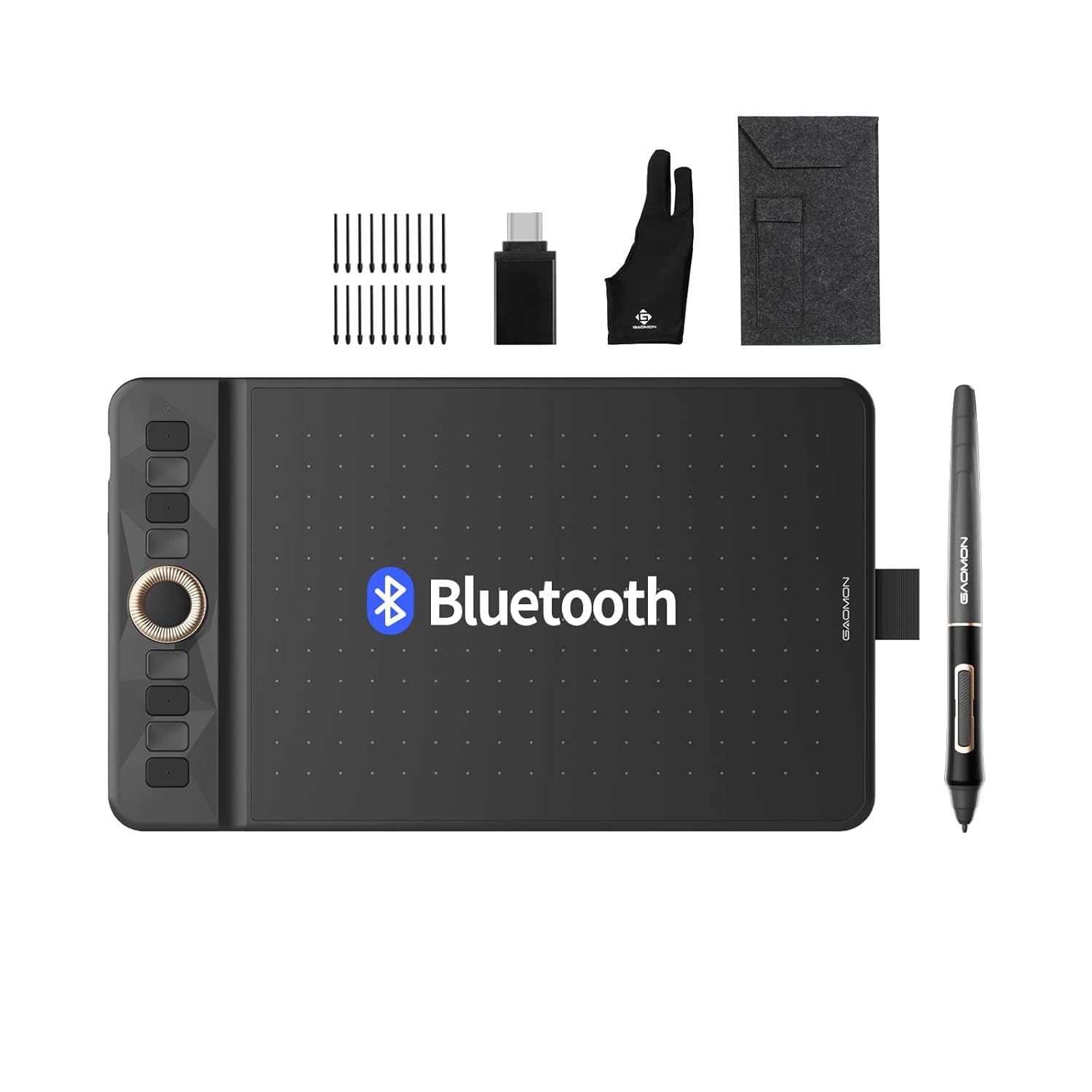
The GAOMON WH851 brings wireless freedom to your drawing setup while staying affordable. It connects via Bluetooth 5.0 or USB-C, and the large-capacity battery delivers up to 18 hours of continuous use — enough for several full days of sketching. The battery-free pen AP519 supports an impressive 16,384 pressure levels, the highest resolution available in this category, plus 60-degree tilt support for shading and angled strokes.
Its 8 x 5-inch active area is compact enough for a small desk, and the intuitive dial with 8 customizable shortcut keys speeds up your workflow. What wins people over is the build quality and reliable Bluetooth connectivity — it pairs quickly and stays connected. As owners put it: “Charges overnight, lasts days.” The size earns mixed feedback, with some finding it very portable and others wishing for a larger canvas. The Bluetooth connection can feel slightly sluggish compared to wired for very fast cursor movements, but wired mode resolves that entirely.
Reach for this if drawing: You want a portable, wireless drawing pad with top-tier pressure sensitivity at a low price.
Look elsewhere if premium: You need a large active area for wide arm movements or absolute zero-lag response.
3. VEIKK A15Pro
An ultra-large drawing area with more shortcut buttons than anything near its price.
The VEIKK A15Pro gives you a huge 10 x 6-inch active area — larger than most budget tablets — which matches the proportions of a standard widescreen monitor. The battery-free stylus offers 8192 levels of pressure sensitivity, so you never have to worry about charging the pen. It also supports 60-degree tilt, letting you shade naturally like a pencil on its side.
For workflow speed, there are 12 customizable soft keys plus a quick dial ring for brush size and canvas zoom. The tablet works with Windows, Mac, Linux, Chrome OS, and Android, making it among the most compatible options around. Reviewers praise it as a fantastic value, with one noting “Wacom experience at an extremely low price.” The main caveat is that some owners find the pen a bit too light, and diagonal line accuracy isn’t perfect for ultra-precise architectural work. It includes 28 spare nibs, so you will not need replacements anytime soon.
Best for beginners: Beginners and hobbyists who want a spacious canvas and plenty of programmable keys.
skip it if screen needed: You need flawless diagonal tracking for architectural drafting or plan to work wirelessly — this is USB only.
4. HUION Inspiroy 2 Medium

A medium-sized pad that earned its reputation as a go-to drawing tool for on-the-go creators.
The HUION Inspiroy 2 Medium hits a balance between size and portability, with an 8.7 x 5.4-inch active area that sits comfortably next to a laptop keyboard. Its PenTech 3.0 technology delivers smooth, lag-free tracking, and the PW110 stylus features a slimmer body with a silicone grip for long drawing sessions. The scroll wheel and 8 programmable press keys give you quick access to brush size, zoom, and canvas rotation.
Compatibility covers Windows, Mac, Linux, Android, and Chrome OS, so you can connect it to a smartphone or tablet via USB-C. Build quality and reliability are the most-praised traits, with one owner calling it their “go to drawing tablet for on the go.” The trade-off reported most often is that some users find the active area slightly small for expansive arm movements, and the button labels are dark and hard to read on the black surface. There is no Bluetooth, so you need the included USB cable at all times.
Reach for this if versatile: You work from a laptop and want a responsive, durable tablet with a physical scroll wheel.
Look elsewhere if durable: You need wireless connectivity or prefer a much larger canvas for wide strokes.
5. XP-Pen Deco Pro LW 2nd

A premium wireless pad that is designed to replace your mouse entirely with a sculpted metal build.
The XP-Pen Deco Pro LW 2nd stands out with its paper-thin design and metal back plate that helps with heat dissipation during long work sessions. The 9 x 6-inch active area is paired with the X3 Pro stylus, which delivers 16,384 levels of pressure sensitivity and 60-degree tilt support. The tablet offers three connection options: Bluetooth 5.0, a USB wireless receiver, or a USB-C cable, and the 1000mAh battery lasts over 10 hours.
A unique addition is the Wireless Shortcut Remote — a separate mini key-dial with 10 customizable keys that you can program for different apps. Build quality and pen sensitivity earn the most praise, with one senior 3D artist calling it a “great purchase with high value to price ratio.” The compatibility note worth knowing: Bluetooth wireless does not work with Android or Linux — you need wired for those systems. The driver can be buggy on Mac, requiring accessibility permission, and some users report hiccups with Bluetooth on Windows.
Best for wireless: Artists who want wireless freedom, high pressure sensitivity, and a separate shortcut remote for a cleaner desk.
Think twice if wired: You rely on Android or Linux for wireless drawing, or want the most stable driver experience.
6. XENCELABS Medium

A professional-grade tablet that ships with two pens, designed with input from working creatives.
The XENCELABS Medium is unusual because it includes two battery-free digital pens with different diameters and button layouts, so you can pick the one that feels most natural in your hand. The active area measures 10.33 x 5.8 inches with a true 16:9 aspect ratio that matches modern monitors perfectly. Both pens deliver 8192 pressure levels with tilt recognition and virtually no lag, and the surface has a fine frosted texture that creates a pen-to-paper feel.
At only 8mm thick, it is thinner than many competitors, and the gently curved palm rest keeps your wrist comfortable. Owners praise the build quality and the overall feel. The tablet connects via USB or Bluetooth, though artists note a minor lag on wireless and generally prefer wired for precision work. The software drivers are described as responsive but could use more polish. A small ergonomic gripe: the 3-button stylus has a button placement some find uncomfortable.
Reach for this if balanced: You want a premium drawing feel with the flexibility of two different pens for different grip preferences.
Look elsewhere if precision: You need a standalone display or rely heavily on wireless for studio work — wired is more reliable here.
7. TCL NXTPAPER 11 Plus

A standalone tablet with a screen so easy on the eyes, reading for hours feels easy.
The TCL NXTPAPER 11 Plus is a full Android tablet that uses NXTPAPER 4.0 technology to reduce eye strain, with TÜV-certified low blue light, an anti-glare coating, and DC dimming. The 11.5-inch 2.2K display runs at 120Hz, making scrolling and drawing feel smooth. It comes with the T-PEN stylus, which offers 4096 pressure levels — enough for note-taking, sketching, and digital notebooks.
Performance is handled by the MTK Helio G100 processor with 8GB RAM plus 8GB of virtual RAM expansion, and the 8000mAh battery provides all-day power. The tablet can even reverse-charge your phone or earbuds at 1.5A. Owners love the screen quality and the ability to switch between color mode and an e-ink-like black-and-white mode for reading. The device is thin at 0.26 inches and weighs only 1.08 lbs. The catch reported by a few users is that palm rejection is inconsistent in some drawing apps, and the included flip case uses a weak magnet that does not secure the front cover well.
Best for reading: Students and professionals who draw, take notes, and read for long stretches without wanting eye fatigue.
Think twice if video: You need very high pressure sensitivity (4096 is modest) or prefer a dedicated drawing pad with more programmable keys.
8. Wacom Intuos Pro Medium (2025)

The professional benchmark re-engineered for modern monitors with a magnetically customizable pen.
The Wacom Intuos Pro Medium (2025) sets the standard for professional graphic tablets. It features the Pro Pen 3, which lets you swap grips (slim, straight, or flared), adjust the balance weight, and reconfigure button placement to match your hand perfectly. The 8192 pressure levels and tilt support deliver the precision and lag-free tracking professionals expect. The active area adopts a 16:9 format that aligns perfectly with modern widescreen monitors, and the tablet itself measures just 4mm at its thinnest with a magnesium-alloy build.
Productivity tools include 10 customizable ExpressKeys and two mechanical dials located at the top of the tablet, all programmed through the Wacom driver. It connects via USB-C or Bluetooth 5.3, which works flawlessly on Mac. Owners highlight the compact size and customizability, with one noting “the pen is responsive and it also has a lot options.” The most-discussed downside is that Bluetooth can temporarily lose connection — keeping it plugged in via USB resolves this. The lack of touch sensitivity in the 2025 model is another change from previous generations that some users miss.
Reach for this if professional: You are a professional artist or designer who wants the most customizable pen, premium build, and proven driver ecosystem.
Look elsewhere if budget: You need a standalone screen, touch gestures, or a more affordable entry-level option.
Understanding the Specs
Pressure Levels
This number — 8192, 16384, or 4096 — tells you how many different pen-tip forces the tablet can tell apart. More levels mean your strokes can go from whisper-thin to bold with smoother transitions. For most artists, 8192 is plenty; 16384 is a bonus for ultra-fine control.
Active Area
The active area is the physical drawing surface where the pen registers. A 10 x 6-inch area lets you draw with your whole arm, while an 8 x 5-inch pad forces more wrist movement. Match the active area to your monitor size: larger screens pair better with larger active areas.
Tilt Support
Tilt support means the tablet senses the angle of your pen, just like a real pencil on paper. You can shade the side of a line or create calligraphic strokes by tilting the pen. Most models offer up to 60 degrees of tilt.
Battery-Free vs. Charged Pens
A battery-free pen draws power from the tablet surface through electromagnetic resonance, so it never needs charging and stays lightweight. A charged pen has an internal battery and must be recharged to function. Battery-free is the standard for professional tablets.
FAQ
Do I need a tablet with a screen or a pen tablet without a display?
What does 8192 pressure levels mean in real life?
Can I use a drawing tablet with my phone?
Is a battery-free pen better than a pen that needs charging?
How long do pen nibs last?
What is the difference between wired and wireless drawing tablets?
Will a drawing tablet work with Photoshop and Clip Studio Paint?
What active area size should I choose?
Does tilt support matter for drawing?
Why is the Wacom Intuos Pro so much more expensive than other tablets?
Final Thoughts: The Verdict
Across the board, the art tablet with pen winner is the Lenovo Idea Tab because it gives you a capable standalone tablet, a sharp 2.5K 90Hz display, a pen, and a folio case all in one package at a very approachable price. If you want a dedicated wireless drawing pad with extreme pressure sensitivity, grab the GAOMON WH851. And for professional studio work where every detail matters, the Wacom Intuos Pro Medium is the tool to reach for.
How We Picked
We do not accept paid placement. Every pick is matched to a real buyer and a real use-case; we do not hands-on test units.
Sources & Methodology
Specifications: manufacturer listings and product documentation. Review insights: verified customer reviews, as of July 2026. Pricing: not shown on this page (it changes often); check the current price via the retailer link.
As an Amazon Associate, Gadgets Feed earns from qualifying purchases. This does not affect which products we feature.