
Our readers keep the lights on and my morning glass full of iced black tea. As an Amazon Associate, I earn from qualifying purchases.
Specs are compiled from manufacturer listings and verified buyer reviews and can change over time — please confirm the key details on the product page before buying.
Dropping + on a window unit that actually has to tame a thousand square feet is a different kind of purchase. You are not cooling a bedroom — you are cooling a whole open floor plan or a ground-floor apartment where the sun hits all day. Get the wrong BTU rating and you end up with a unit that runs nonstop, never catches up, and spikes your electric bill.
I’m Min — the founder and writer behind Gadgets Feed. This guide is built by comparing the manufacturers’ published specifications and the patterns across verified customer reviews, so you get each pick’s real strengths and trade-offs instead of marketing spin.
This list covers four 18,000 BTU window units that are actually rated to handle roughly 1,000 square feet, with a focus on noise levels, energy use, and real owner experience. Think of it as your manual for finding the best air conditioner for 1000 square feet without getting burned by a bad install or inflated specs.
Our Picks at a Glance
How To Choose The Best Air Conditioner For 1000 Square Feet
Cooling a thousand square feet is a big job. A standard 12,000 BTU unit will run itself ragged trying, while an 18,000 BTU model hits the right balance of power and cycle time. Here is what actually matters when you are shopping in this weight class.
Three Critical Specs for a 1,000 Sq Ft Room
Cooling Capacity (BTU): An 18,000 BTU unit is the widely accepted target for roughly 1,000 sq ft under normal ceiling heights and insulation. Going smaller means the compressor runs constantly, wearing out faster and failing to dehumidify. Going bigger cycles too fast, leaving the room clammy. Stick to 18,000 BTU unless your space has extreme sun exposure or vaulted ceilings.
Voltage and Electrical Requirements: Nearly all 18,000 BTU window units run on 230V or 208V, not a standard 115V household outlet. You almost certainly need a dedicated circuit with a NEMA 6-20 outlet or a professional install to add one. Check your breaker panel before buying — this is the most common surprise in the reviews.
Annual Energy Consumption: This number, measured in watts, tells you how much electricity the unit burns over a year. Inverter models (like the LG 18K Dual Inverter) use around 1,590 Watts, while traditional compressor units (like the Midea) use 2,760 Watts. That is a 74% gap in annual energy consumption, so the inverter pays for itself in lower bills if you run the AC often.
Quick Comparison
| Model | Best For | BTU | Noise Level (Low) | Annual Energy | Amazon |
|---|---|---|---|---|---|
| LG 18K Dual Inverter (P1)★ Best Overall | Overall Balance | 18,000 | 52 dB | 1,590 Watts | Amazon |
| Midea 18K Inverter (P2) | Budget Entry | 18,000 | 48 dBA | 2,760 Watts | Amazon |
| ROVSUN 18K 4-in-1 (P3) | Heat & Cool Combo | 18,000 | 56 dB | — | Amazon |
| LG 18K Window with Heat (P4) | Premium Heating | 18,000 | — | — | Amazon |
In‑Depth Reviews
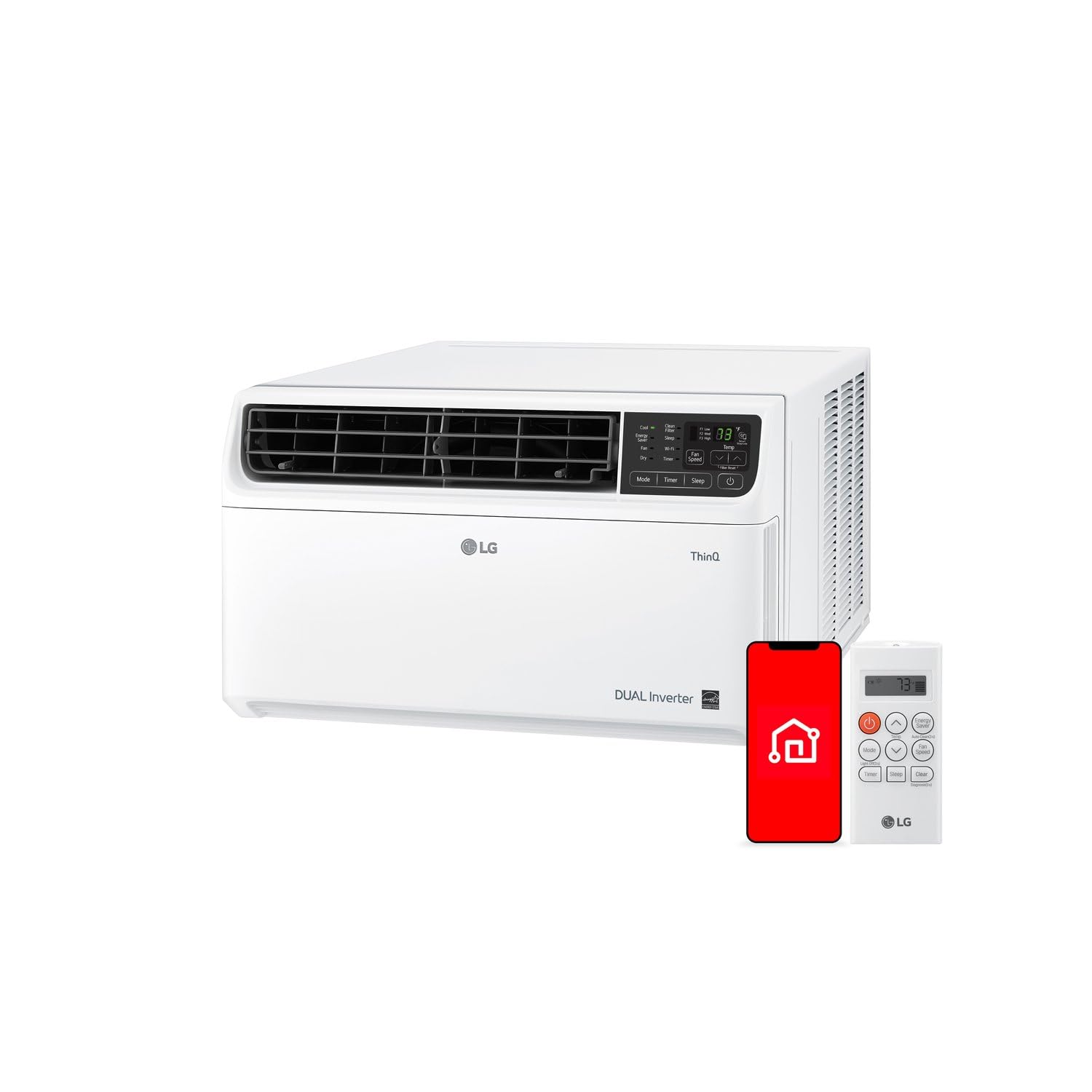
1. LG 18,000 BTU Dual Inverter Smart Window Air Conditioner, 230V
Our pick — over 4★ from 100+ verified ratings; the strongest balance of quality and price.
The crowd-favorite inverter that cuts your electric bill by running barely above a whisper.
You get a quieter living space because this unit uses a dual inverter compressor (a motor that runs at variable speeds to save energy and reduce noise) that drops to 52 dB on low mode — quieter than most standard window units and a step up from the 56 dB non-inverter models. Reviewers consistently call it “quiet and powerful,” noting you can hold a conversation right next to it without raising your voice.
On energy, this unit sips 1,590 Watts annually, which is where the inverter really shows its value. Compared to the Midea 18K at 2,760 Watts, that is a 74% gap — and it shows up in real bills. One buyer in a 90°F NYC apartment reports the electricity bill barely increased after running it. The LG ThinQ app lets you control it from anywhere, schedule cooling, and pair it with Alexa or Google Assistant.
The catch is the install. Multiple owners call it “a pain in the butt to install” and note it is very heavy — it requires two people and a platform underneath. Once it’s in, though, the performance is reliable year after year.
The Real Trade-Off: The install is a two-person job and it needs a 230V outlet, but the day-to-day quiet and energy savings make it the clear winner for 1,000 sq ft.
Reach for this if: You want the most energy-efficient, quietest cooling for a large room and can handle a heavy, permanent install.
Look elsewhere if: Your window cannot support a heavy unit or you do not have a 230V outlet — this is not a plug-and-play appliance.
2. Midea 18,000 BTU Smart Inverter Window Air Conditioner

The most affordable 18K unit on the list — if you can get past the reliability risk.
The Midea leads on paper with a claimed noise floor of just 48 dBA, which is quieter than the LG on low mode. It also boasts app and voice control, a 24-hour timer, and an Eco mode. Several owners confirm it cools a large area “very fast” and is “pretty quiet.” For the price, you get the same 18,000 BTU capacity that covers 1,000 sq ft.
The major caveat is reliability. Reliability is a mixed aspect with 7 mentions; one review reports the unit “worked great for about 3 weeks” before the display died and cooling stopped. Another buyer warns the listing is misleading about the plug type — this unit needs a 230V outlet, not a standard wall socket.
At 2,760 Watts annual energy consumption, it is far less efficient than the LG dual inverter — expect a noticeably higher electric bill if you run it daily.
The Honest Read: If you need the lowest upfront cost for an 18K unit and are willing to gamble on longevity, this fits. For long-term ownership, the LG is a safer bet.
Best for: A tight-budget buyer who needs 18,000 BTU of cooling right now and is handy enough to handle a potential swap.
Think twice if: Reliability matters more than price — the failure pattern in the reviews is real and frequent enough to give pause.
3. ROVSUN 18000 BTU Air Conditioner Window Unit with Heat, 4-in-1

The only 4-in-1 unit here that heats, cools, dehumidifies, and fans — all in one window frame.
For a 1,000 sq ft room that needs cooling and heating year-round, the ROVSUN 4-in-1 handles both: it is an 18,000 BTU cooler, a heater, a dehumidifier, and a fan. Summer buyers report it “cools awesome” and runs “quite.” The heating function is untested in most reviews, but having one unit cover both seasons saves major space in apartments or basements where a separate heater is impractical.
At 56 dB, it is louder than the LG and Midea — roughly the volume of a quiet conversation — but still acceptable for a living area. The install is described as straightforward with the included kit, which stands in contrast to the LG’s two-person ordeal.
The downside is consistency. One buyer received a damaged unit with a weird noise, and customer service was reportedly nonexistent. Given the very small review sample, it is hard to tell if this is a fluke or a pattern. The non-inverter compressor also means it is less energy efficient than the LG.
The Trade-Off: You get heating and cooling in one box, but the noise is higher and the reliability is less proven than the LG.
Reach for this if: You have a single window and need both AC in summer and heat in winter without storing a second appliance.
Look elsewhere if: Low noise is your priority or you want a well-established brand with deeper review history.
4. LG 18,000 BTU Window Air Conditioner with Heat, 230/208V
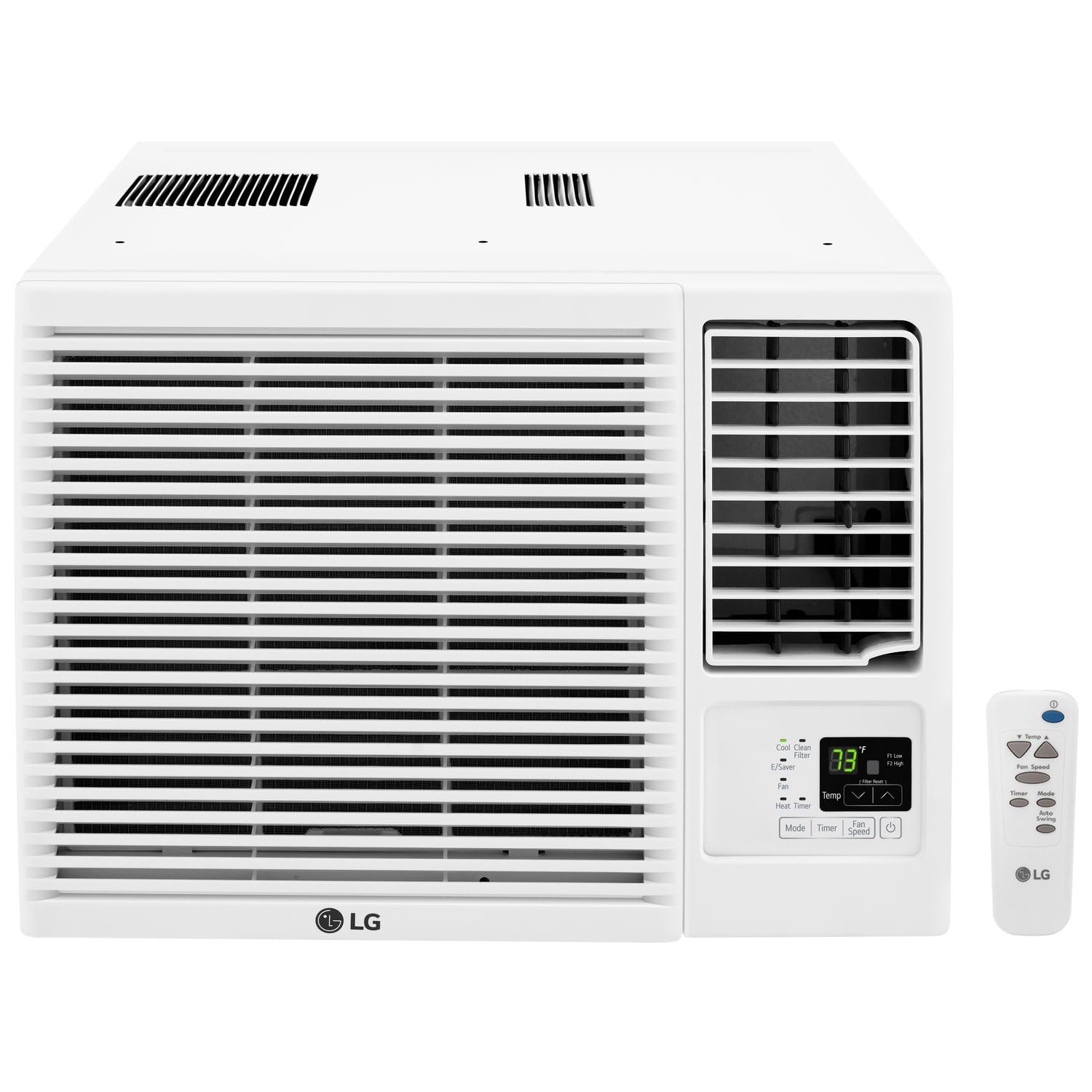
LG’s premium heat-and-cool combo with auto restart — but the noise reputation is a sticking point.
This is the priciest unit on the list, and it brings a higher air flow efficiency of 523 Cubic Feet Per Minute Per Watt and a solid SEER value of 11.2. The dual function is a genuine convenience: owners love having one unit that handles both seasons. “The heat warms the room faster than expected,” one buyer notes. The 24-hour timer, filter light reminder, and 4-way air deflection add genuine usability.
The friction comes from noise and durability. Noise level is flagged as negative by 7 customers, some describing it as “very loud.” Durability is negative with 9 mentions; multiple reports cite units failing after about a year. One review details three separate units failing within 1.5 months, with issues from loud fan noise to blown hot air. The weight is also noted as “extremely heavy,” requiring a 2-3 person install.
The auto restart feature is a nice safety net for power outages, and the ability to run both cooling and heating from one window unit is rare at this BTU level. But the noise and durability concerns give a cautious buyer pause.
The Honest Verdict: If you need a heat-and-cool unit and LG’s brand reliability is important, this offers it — but check your noise tolerance and prepare for a heavy install.
Best for: A buyer who insists on the LG name and wants year-round temperature control from a single window unit.
Think twice if: You are sensitive to noise or want a long-term ownership with minimal service calls — the reliability pattern is concerning.
Understanding the Specs
Annual Energy Consumption (Watts)
This is the spec that determines how much your electric bill jumps. It measures the total wattage the unit uses in a year. A lower number (like the LG’s 1,590 Watts) means the inverter compressor sips electricity. A higher number (like the Midea’s 2,760 Watts) means a traditional compressor draws more power every time it kicks on. Over a summer, that difference can be hundreds of dollars in many regions.
Noise Level (dB / dBA)
Measured in decibels or dBA, this is how loud the unit sounds to the human ear. A difference of 4-6 dB is clearly noticeable — 48 dBA is about the level of a quiet library, 52 dB is a soft conversation, and 56 dB is a normal conversation. If the unit is going in a bedroom or a room where you watch TV, aim for 52 dB or less on low mode. Non-inverter compressors tend to be louder because they cycle on/off abruptly rather than ramping smoothly.
FAQ
Will a 12,000 BTU unit cool 1,000 square feet?
Do all 18,000 BTU window units need a 230V outlet?
Is an inverter air conditioner worth the extra money for 1,000 sq ft?
How loud is too loud for a bedroom window unit?
Can a window air conditioner also heat a 1,000 sq ft room in winter?
How heavy are these 18,000 BTU window units?
Do these units come with a standard plug?
Can I install an 18,000 BTU window unit myself?
What is the SEER value and why does it matter?
How often should I clean the filter on a window AC?
Final Thoughts: The Verdict
For most buyers, the best air conditioner for 1000 square feet is the LG 18,000 BTU Dual Inverter because it uses the lowest annual energy consumption (1,590 Watts) while running at a quiet 52 dB — and real owners confirm its reliable performance year after year. If you want a heat-and-cool combo at a lower price, the ROVSUN 4-in-1 gives you year-round versatility. And for a premium heating solution from a trusted brand, the LG 18K with Heat is the one to reach for — just be ready for the weight and the noise level.
How We Picked
We do not accept paid placement. Every pick is matched to a real buyer and a real use-case; we do not hands-on test units.
Sources & Methodology
Specifications: manufacturer listings and product documentation. Review insights: verified customer reviews, as of July 2026. Pricing: not shown on this page (it changes often); check the current price via the retailer link.
As an Amazon Associate, Gadgets Feed earns from qualifying purchases. This does not affect which products we feature.