
Our readers keep the lights on and my morning glass full of iced black tea. As an Amazon Associate, I earn from qualifying purchases.
Specs are compiled from manufacturer listings and verified buyer reviews and can change over time — please confirm the key details on the product page before buying.
You have a room that bakes in summer and freezes in winter, but the thermostat feels fine everywhere else. The fix is not a bigger AC unit or a space heater — it is an automated air vent (a register booster fan) that pushes more of the air your HVAC system already makes straight into that room. The trick is finding the right size and speed control so you get the boost without the noise.
I’m Min — the founder and writer behind Gadgets Feed. This guide is built by comparing the manufacturers’ published specifications and the patterns across verified customer reviews, so you get each pick’s real strengths and trade-offs instead of marketing spin.
Below are the best automated air vents that actually solve the problem of rooms that never feel comfortable, with an honest look at what each one does well and where it falls short.
Our Picks at a Glance
How To Choose The Best Automated Air Vent
Choosing the right register booster fan depends on three things: the exact size of your duct opening, how much noise you can tolerate, and if you want app control or a basic remote. Here is what matters most.
Measure the duct opening, not the vent cover
The single most common mistake is measuring the old vent cover face. You need to remove it and measure the actual hole in the floor, wall, or ceiling — the duct opening. A fan neck that is too long or too wide simply will not fit, and a face that does not fully cover the hole leaves a gap. Every product here lists the exact neck dimensions and the required opening size. Pull out a ruler before you click buy.
Noise level and speed control
A booster fan lives in the room you occupy, so it needs to be tolerable at the speeds you actually use. Most units run as low as 18 dBA (decibels, a measure of sound) on the slowest setting — that is quieter than a whisper. On high speed, the same fan can hit 45 to 50 dBA, which is like a loud refrigerator. The best picks offer 10 speed levels so you can trade airflow for quiet when you are sleeping or watching TV.
Smart features versus simple reliability
Some fans pair with a phone app for scheduling and remote control, while others use a basic remote or wall panel. The app fans let you set temperature triggers from anywhere, but they also introduce Wi-Fi or Bluetooth hassles. A simple remote with a thermostat sensor (a sensor that detects room temperature) is often more reliable and skips the pairing frustration. Decide if you want smart-home integration or just a fan that turns on and off automatically based on room temperature.
Quick Comparison
| Model | Best For | Airflow | Noise Level | Speed Settings | Amazon |
|---|---|---|---|---|---|
| VELLEE Quiet 6″x10″★ Best Overall | Best Overall | 200 CFM | As low as 18 dBA | 10 | Amazon |
| AC Infinity AIRTAP T6Top Performer | Top Performer | 130 CFM | As low as 17 dBA | 10 | Amazon |
| VIVOSUN 4″x12″ App Control | Smart App Control | Not listed | As low as 18 dBA | 10 | Amazon |
| VIVOHOME 6″x10″ Quiet | Best Value | 120 CFM | As low as 18 dB | 10 | Amazon |
| VIVOHOME 6″x12″ Louver | Adjustable Louver | 120 CFM | As low as 18 dB | 10 | Amazon |
| Suncourt ZoneMaster 8″ | Motorized Damper | Not listed | Not listed | N/A | Amazon |
| Flair Smart Vent 4×10 | Smart Zoning System | Not listed | Not listed | N/A | Amazon |
In‑Depth Reviews
1. VELLEE Quiet Register Booster Fan 6″ x 10″
Our pick — over 4★ from 400+ verified ratings; the strongest balance of quality and price.
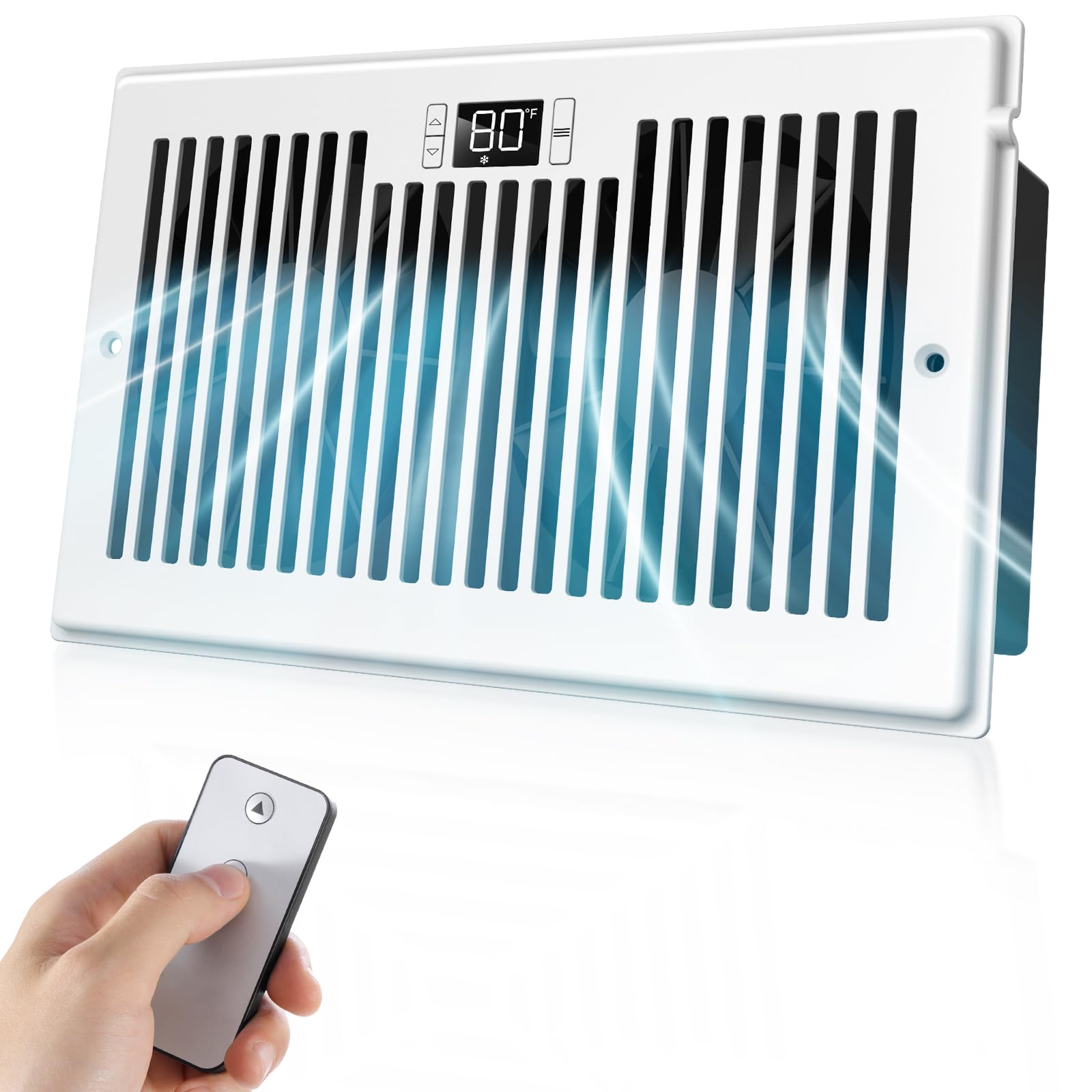
This VELLEE fan moves more air (200 CFM, or cubic feet per minute) than any other pick here while running as quietly as 18 dBA on its lowest setting — so it can cool a stubborn room without a loud drone.
That 200 CFM rating makes a real difference. Buyers report that it solved a top-floor bedroom sitting at 80-82°F while the thermostat read 70°F, with the room dropping to 74°F in just 30 minutes after installation. The 10-speed remote is refreshingly simple — no phone app to download, no Bluetooth pairing. You set a target temperature on the remote and the built-in sensor (a thermostat that reads the room air) handles the rest. Over a hundred owners single out how well it pushes air.
Unlike the VIVOSUN 4″x12″ that requires a phone app for advanced features, this one keeps everything on the remote, which means it is more reliable for someone who just wants the room to cool down without learning a new interface. The 12-foot cord gives you flexibility in where you plug it in, but it is a corded unit, so you do need a nearby outlet. The trade-off is that on higher speeds the fan produces a white-noise hum that some find noticeable, though most sleep through it fine.
What wins people over
- Highest airflow at 200 CFM outperforms every other fan here
- Quiet operation on low speeds at just 18 dBA
- No app required — simple remote with thermostat control
- Easy DIY installation with clear instructions
One thing to know
- Audible white-noise hum at higher speeds (common to all booster fans)
The one to buy if: you want maximum airflow for a stubborn room and prefer simple remote control over a smartphone app.
Think twice if: you need a Wi-Fi connected vent that integrates with a smart home system — this one stays offline by design.
2. AC Infinity AIRTAP T6 6″ x 10″
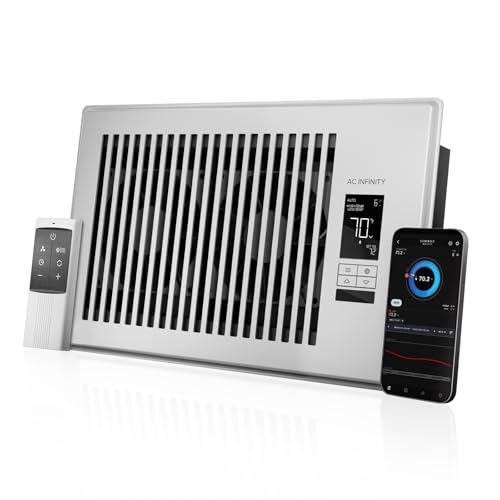
The AC Infinity AIRTAP T6 achieves a whisper-quiet 17 dBA on its lowest speed — one decibel quieter than the VELLEE fan, so it is the best pick for a bedroom where every bit of silence counts.
AC Infinity has a well-earned reputation in ventilation gear, and the AIRTAP T6 is their take on the register booster. It delivers a solid 130 CFM of airflow. The build quality stands out too with a premium anodized aluminum frame and CNC-machined detailing. Connectivity here is Bluetooth-only through the AC Infinity app (a short-range wireless connection), which lets you set heating and cooling triggers, view climate data, and set schedules. It is not Wi-Fi, so you cannot control it from outside the house, but within range the app works well.
Reliability is the top praised aspect across hundreds of owners, and cooling performance runs a close second. The fan reduced temperature differences from 5-7°F down to 1-2°F in many setups. At 130 CFM, it pushes less air than the VELLEE fan’s 200 CFM, but owners mention it is enough to make a real difference. The catch is that at maximum speed it can reach 49-50 dB, and level 8 apparently produces an odd noise for some. The power cord is also on the shorter side, so you may need an extension cord for ceiling or high-wall installs.
Build that lasts: the aluminum frame and Bluetooth app give this a more polished feel than the plastic competitors, but you trade the highest CFM for that refinement.
Reach for this if: you want a durable, quiet fan with app-based scheduling and a premium look that matches a finished room.
Look elsewhere if: your vent opening is not exactly 6″ x 10″ — this model only fits that one size, unlike some adjustable options.
3. VIVOSUN Quiet Register Booster Fan 4″ x 12″
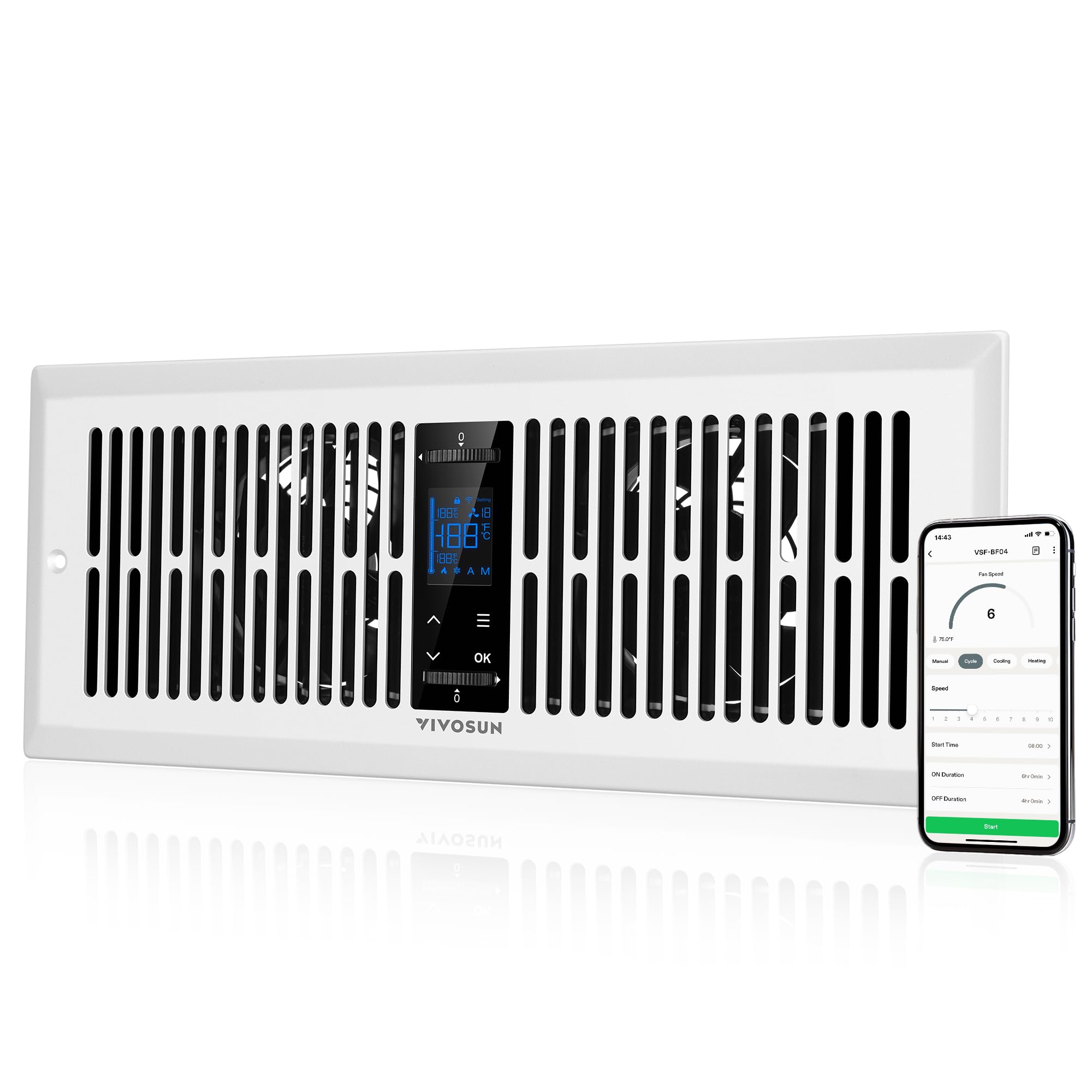
The VIVOSUN is the only fan here with true Wi-Fi app control and adjustable vanes (louvers) that direct airflow — so you can turn it on from your phone and aim the breeze where you want it.
That Wi-Fi connection is a genuine advantage over the Bluetooth-only AC Infinity model — you can adjust speeds and set temperature triggers from your phone while you are at work or in bed. The app also includes the ability to schedule cooling and heating triggers, which is a feature most fans in this price range skip. A standout feature is the adjustable airflow guide vanes that work like window blinds. You can direct airflow left or right, or close them completely to prevent dust buildup when the fan is idle.
Performance is the top-rated aspect among owners, with airflow a close second. Customers note that it helps keep bedrooms warmer in winter by continuing to pull warm air from the duct even after the furnace shuts off. The biggest honesty note is noise — owners say the fan is loud at any speed above 5 out of 10. At the lowest setting it runs at 18 dBA, which is quiet enough, but if you need high airflow during the day, prepare for some noticeable fan noise. It is also a 4″ x 12″ format, which is a less common vent size than the standard 6″ x 10″.
what separates it
- Full Wi-Fi app control with scheduling from anywhere
- Adjustable louvers for directional airflow or closure
- Thermostat sensor that continues pulling air after furnace cycles
Know before you buy
- Gets noticeably loud above speed 5 out of 10
- Fits only 4″ x 12″ duct openings — measure carefully
Best for the smart-home enthusiast: who wants to control every vent from a phone app and direct airflow where it is needed.
Not for you if: you have standard 6″ x 10″ vents or need whisper-quiet operation on the middle speeds.
4. VIVOHOME Quiet Register Booster Fan 6″ x 10″
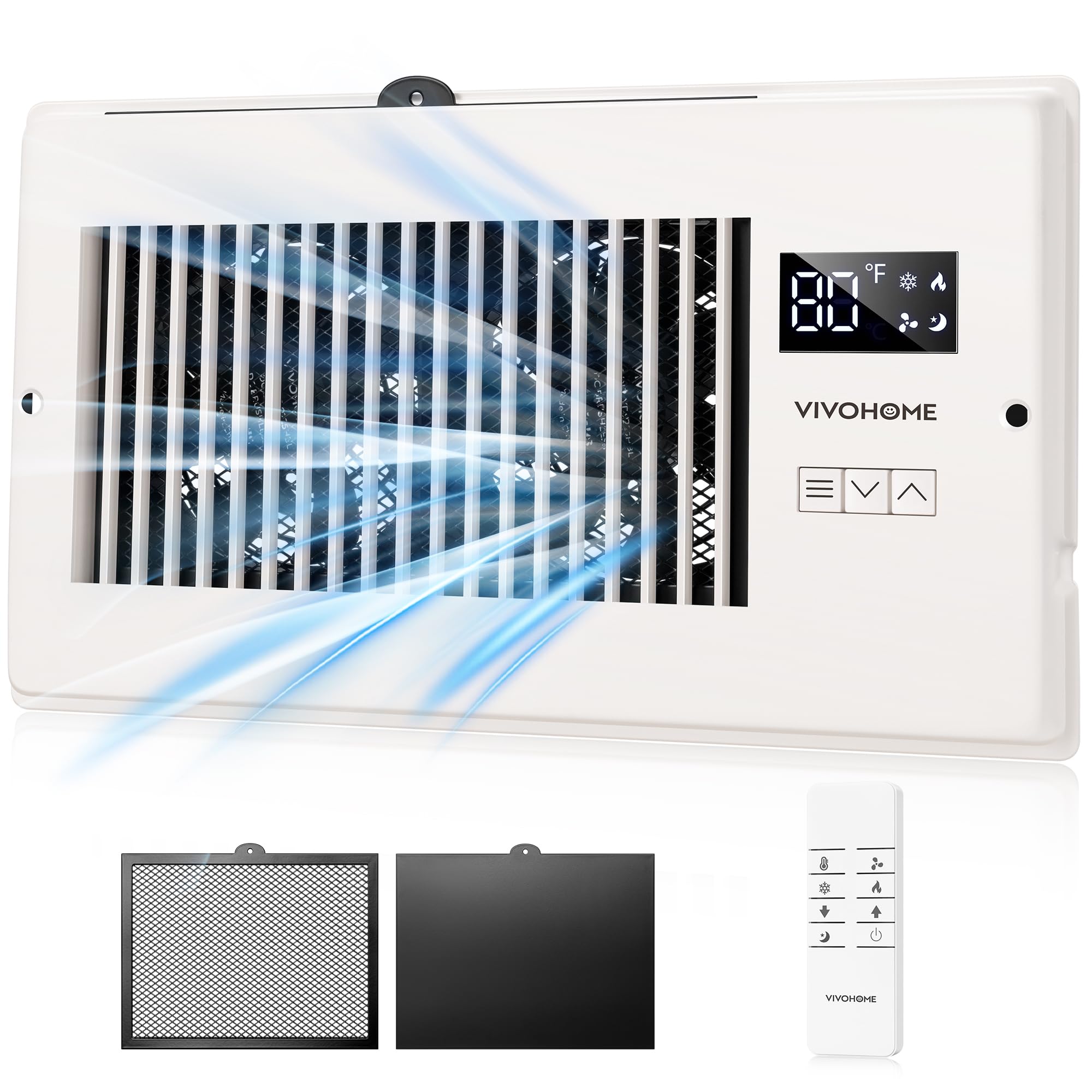
This VIVOHOME fan delivers 120 CFM at under 18 dB and includes a dust-proof mesh screen and a vent blocker — extras that the VELLEE and AC Infinity models do not include, making it a better deal for pet owners.
Those two accessories alone make this a stronger value proposition, especially for homes with pets or children. The fan itself delivers 120 CFM (cubic feet per minute) at under 18 dBA, which is competitive with the AC Infinity T6. The 10-speed remote and built-in thermostat are standard at this level, but the inclusion of memory recall after a power outage is a nice touch that the VELLEE does not advertise.
Functionality is the most-praised aspect, and reviewers point out the fan made a real difference in bedroom temperature balance. One owner reported they were able to raise their thermostat from 68°F to 73°F while keeping the room comfortable, which translates to real energy savings. The recurring negative is that the remote control has reliability issues for some buyers. A few owners found it simply did not work from the start. The fan itself performs well, but the remote quality control is inconsistent. Given the strong reviews on functionality and quiet operation, this is still a great pick — just check the remote upon arrival.
More in the box: the included dust mesh and vent blocker make this the best value pick if you want accessories without buying them separately.
Grab this for: a balanced option with good airflow, quiet operation, and useful accessories that other brands charge extra for.
skip it if: you need a guaranteed-function remote right away — test it while the return window is open.
5. VIVOHOME Register Booster Fan 6″ x 12″ with Adjustable Louver
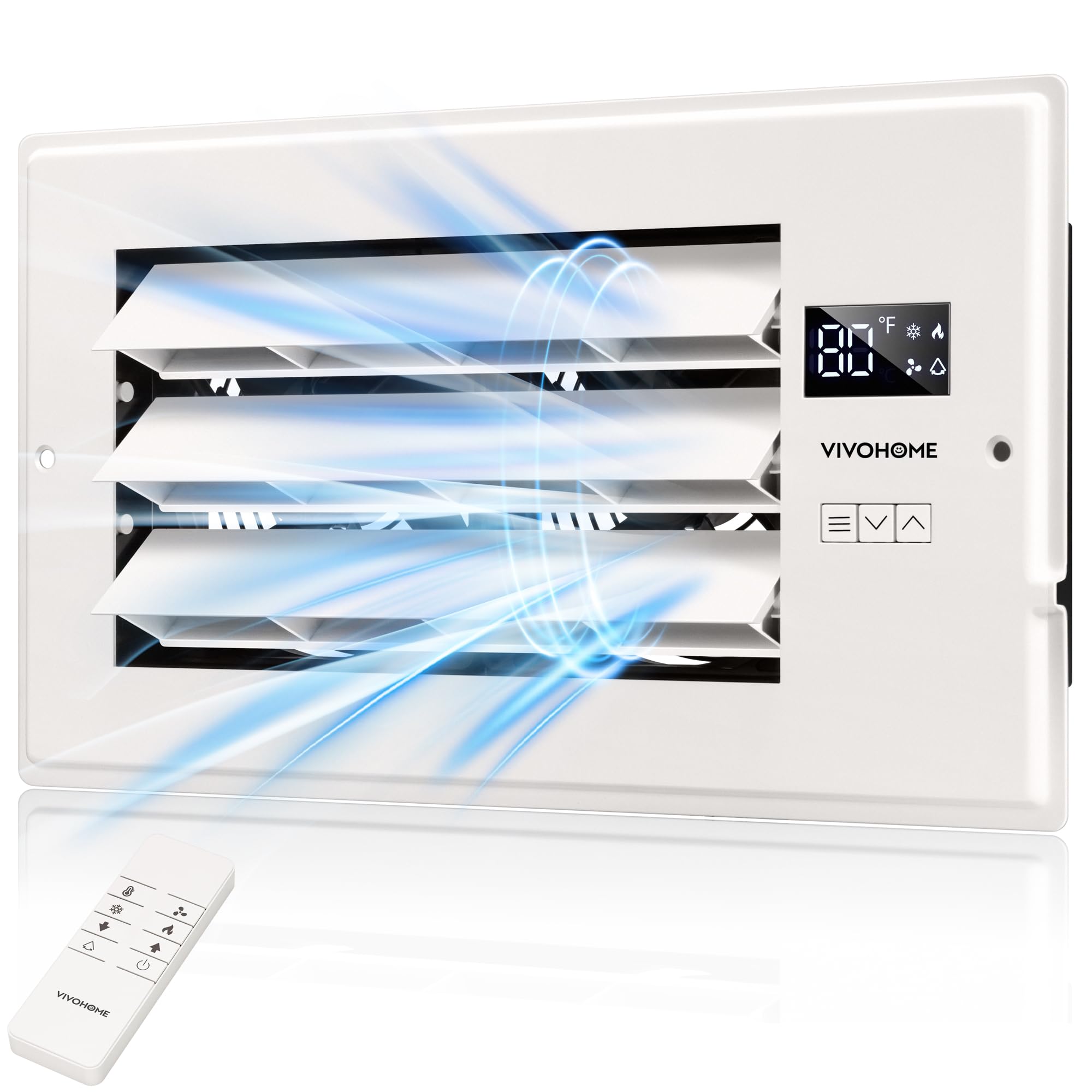
This VIVOHOME model uses motorized louvers (adjustable slats) that swing through a 60° to 120° range or close completely when the fan is off — a feature normally found on premium smart vents like the Flair, but at a much lower cost.
The louvers also have an auto-swing mode for full room coverage, which is great for offices where you want the air moving around rather than blasting in one spot. It uses an EC motor (an energy-efficient electronic motor) that keeps noise below 18 dBA on low speeds and pushes 120 CFM (cubic feet per minute). On speed 5 out of 10, one owner described it as blowing as fast as a mini fan while being silent. Reliability is the most-praised aspect here. Many buyers use it in Arizona summers to push cold air to far rooms, and it replaced louder portable AC units that were driving up electricity bills.
The honest downside is that the remote is not great — some owners find it unintuitive and one flatly rated it 0 out of 10 for ease of use. Also, when the fan is off the vent closes completely, which means if you forget to turn it on, no air gets into the room at all. A couple of owners reported the motorized vent fins breaking after a few months, so this is one to watch for long-term durability.
Why it stands out
- Motorized louvers with auto-swing for directional airflow
- EC motor is genuinely quiet on speeds 1-4
- Louvers close when off to seal treated air in the room
What to watch for
- Remote control is cumbersome to operate
- Vent fully closes when off — you must remember to turn it on
- Some reports of motorized fin breakage after a few months
The right fan if: you want directional control and the ability to fully close the vent when the system is not running.
Not the best bet if: you prefer a simple low-maintenance fan without moving parts that could eventually wear out.
6. Suncourt ZoneMaster 8-Inch Motorized Damper

The Suncourt ZoneMaster is not a register booster fan — it is an 8-inch inline duct damper (a valve inside your ductwork) that controls airflow to entire zones, so you can completely shut off unused rooms.
This makes it ideal for zoning systems where you want to stop airflow to certain rooms entirely when the furnace or AC is not calling for that zone. It is Normally Closed (power open), meaning it stays shut when unpowered and opens when it receives 24V (a typical low-voltage signal from a thermostat or zone controller). Performance is praised by owners who use it for fresh-air intake systems or to manage airflow between a wood furnace and a gas furnace.
The installation is a simple two-wire hookup, and it comes with a UL-listed 24VAC/20VA plug-in transformer (a power adapter that meets safety standards) so you do not need to buy extra parts. It can be wired into an existing zone control system or run independently. The patented 0°-90° adjustable coupler lets you fine-tune airflow even in the powered position. The repeated note in owner feedback is that the motor gets hot during operation — one owner measured it and noted it runs warm while in the open position. That is by design for a spring-return damper, but it is worth knowing if you are installing it in a tight, enclosed space. The 3-year warranty from Suncourt, who has been in business since 1988, provides some confidence.
A different tool: this is for homeowners who are comfortable with HVAC ductwork and want whole-zone control, not a per-room vent upgrade.
Buy this if: you are working on a home zoning project and need a reliable 8-inch inline damper with spring-return fail-safe.
Pass on this if: you are looking for a simple register booster fan that replaces a vent cover — this is a duct-level component, not a vent attachment.
7. Flair Smart Vent 4×10 (White)

The Flair Smart Vent opens and closes using a motorized damper (an internal valve) to regulate air in each room — rather than just boosting airflow — and uses a 915MHz radio (a low-frequency, long-range wireless signal) to communicate.
This is the most technically ambitious option here. Instead of just boosting airflow with a fan, they open and close to regulate how much air each room receives. The system uses a 915MHz radio to communicate with a Flair Bridge (a central hub, sold separately) and a Flair Puck temperature sensor (a wireless room sensor, also sold separately). You need both of those to make it work, plus a compatible thermostat for automation. When everything is connected, the system delivers impressive results. Shoppers say eliminating 5-6°F temperature differences between rooms and being able to set individual room schedules through the Flair app.
The temperature control and overall functionality are the most praised features, with the system providing more even heat distribution across the house. The vent itself is sturdy and installs without any wiring — you pull out the old vent and drop this one in. The honest reality is that reliability is the most-discussed aspect overall, and it is marked as Mixed, not positive. Connectivity issues, signal loss during AC use, and frustrating support are common themes. The setup can also be confusing, and the app has a learning curve. This is definitely not a pick up, install, and forget product — it rewards patience and technical comfort but frustrates people who want simplicity.
What it does well
- Opens and closes vents for room-level zoning (not just boosting)
- Strong app with 7-day scheduling and geofencing
- No wiring needed for installation — drop-in replacement
The real trade-offs
- Expensive ecosystem: Bridge and Puck sold separately
- Reliability issues with connectivity and support response
- Not a simple plug-and-play experience
This is for the smart-home tinkerer: who already has a Flair system or is willing to invest the money and time to dial in room-level zoning.
Stay away if: you want one product that works reliably from the start — the Flair is a commitment, not a quick fix.
Understanding the Specs
CFM (Cubic Feet per Minute)
This is the measure of how much air the fan moves in one minute. A higher number means more air is being pushed into the room. A fan rated at 200 CFM will move air noticeably faster than one rated at 120 CFM. That matters if you have a large room or a duct run that is very long. For a standard 12×12 bedroom, 120 CFM is usually enough. For a master bedroom or a room at the very end of a duct run, you will be happier with 200 CFM.
Noise Level in dBA
Listed in decibels (dBA), this tells you how loud the fan gets at its quietest setting. A rating of 17 or 18 dBA is barely audible — about the same as leaves rustling. Most of these fans get louder at higher speeds, often reaching 45-50 dBA, which is comparable to a refrigerator hum or a quiet conversation. The important number is the low-end rating because that is the speed you will use at night.
Temperature Sensor and Triggers
A built-in thermostat sensor lets the fan turn on and off based on the actual room temperature, not the central thermostat. You set a target temperature or a temperature differential, and the fan runs until the room reaches that point. This is the feature that makes a booster fan truly automated — without it, you would have to manually turn the fan on and off.
Speed Control and App Connectivity
All of these fans offer 10 speed settings, which gives you fine-grained control over airflow and noise. App-connected fans let you set schedules and triggers from your phone, but they add complexity. Some use Bluetooth (shorter range, no internet needed) and some use Wi-Fi (control from anywhere, but setup can be fussy). A simple remote with a thermostat sensor is often more reliable for someone who just wants the room to be comfortable.
FAQ
What size vent do I need for my room?
Will a booster fan damage my HVAC system?
How loud are these fans in a bedroom?
Can I install these in a ceiling vent?
Do I need a smart thermostat to use these fans?
How long do these booster fans last?
Can I use these in a bathroom for ventilation?
What is the difference between a booster fan and a smart vent?
Will these vents work if my ducts are not insulated?
How many vents should I install in a single room?
Final Thoughts: The Verdict
Across the board, the best automated air vent winner is the VELLEE Quiet Register Booster Fan because it delivers the highest airflow at 200 CFM while staying quiet enough for a bedroom, and the simple remote control means no app frustration. If you want app-based scheduling and directional louvers, grab the VIVOSUN 4″x12″. And for a rock-solid build with Bluetooth data monitoring, the AC Infinity AIRTAP T6 is the one to reach for.
How We Picked
We do not accept paid placement. Every pick is matched to a real buyer and a real use-case; we do not hands-on test units.
Sources & Methodology
Specifications: manufacturer listings and product documentation. Review insights: verified customer reviews, as of July 2026. Pricing: not shown on this page (it changes often); check the current price via the retailer link.
As an Amazon Associate, Gadgets Feed earns from qualifying purchases. This does not affect which products we feature.