
Our readers keep the lights on and my morning glass full of iced black tea. As an Amazon Associate, I earn from qualifying purchases.
Specs are compiled from manufacturer listings and verified buyer reviews and can change over time — please confirm the key details on the product page before buying.
You need a 3/8 hose, but the real question is what you are moving through it — water for the garden, fuel for a small engine, or a chemical spray for the farm. A 3/8-inch internal diameter is the balance between decent flow and manageable weight (the wall thickness and material change completely what it can handle). This guide covers nine hoses, from a recoil coil that fights tangles to a heavy-duty rubber line that laughs at 150 PSI, so you know exactly which one fits your spigot, your pressure, and your job.
I’m Min — the founder and writer behind Gadgets Feed. This guide is built by comparing the manufacturers’ published specifications and the patterns across verified customer reviews, so you get each pick’s real strengths and trade-offs instead of marketing spin.
if you need a durable rubber line for a sprayer, a compact recoil hose for a boat, or a long PVC tube for a pond pump, the right 3/8 hose depends on the pressure, temperature, and chemical exposure it will face day after day.
Our Picks at a Glance


How To Choose The Best 3/8 Hose
A 3/8-inch hose is a tool matched to its material, pressure rating, and environment. The three deciding factors are material, pressure rating, and exposure to sun, salt, chemicals, or cold.
Material: Rubber vs. PVC vs. Polyurethane
Rubber (especially EPDM) handles hot water, chemicals, and rough use better than any other material — it stays flexible in cold weather and resists cracking from UV rays. PVC tubing is cheaper, lighter, and clear (so you can see the flow), but it softens in direct sun and can burst under high pressure. Polyurethane (PU) sits in between: it coils up tight, fights kinks, and survives saltwater and sunlight, making it a favorite for boat and RV recoil hoses. NBR rubber is used for fuel lines because it resists gasoline and oil, but many owners warn that some NBR hoses degrade when fuel sits inside.
Pressure Rating: Working vs. Burst
Every hose has a working pressure (the safe continuous pressure) and a burst pressure (the point it blows apart). A garden hose that sees a typical household spigot (40–80 PSI) needs a working pressure well above 100 PSI to be safe. A fuel line or a sprayer hose that connects to a pump needs an even stronger rating — look for 150 PSI working or higher.
Temperature Range and UV Resistance
A hose left in the sun degrades fast unless it is rated for UV exposure. EPDM rubber and polyurethane typically handle sun better than standard PVC. For hot water drain or heater use, check the maximum temperature rating — some rubber hoses survive up to 190°F, while standard PVC can soften at much lower temps. If you live in a freezing climate, a hose rated to -50°F stays flexible instead of cracking.
Quick Comparison
| Model | Best For | Material | Length | Max Pressure (PSI) | Amazon |
|---|---|---|---|---|---|
| Abbott Rubber X1110-0381-25★ Best Overall | Sprayer & chemical transfer | EPDM Rubber | 25 Feet | 150 | Amazon |
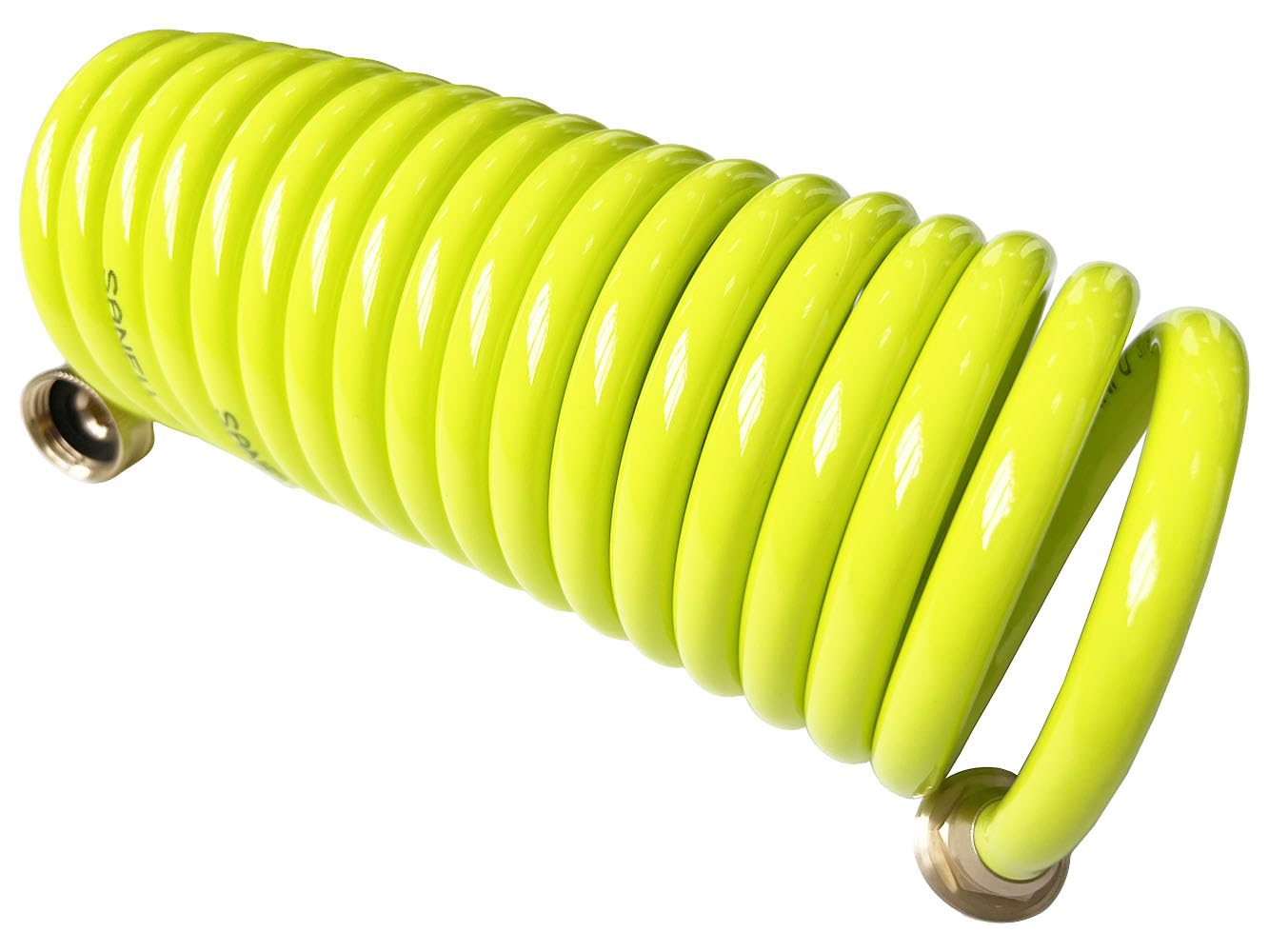
| SANFU PU Recoil 10ftCompact Coil | Boat & patio (compact) | Brass Polyurethane | 10 Feet | 145 | Amazon |
| SANFU PU Recoil 15ftMarine Ready | Trailer & RV wash-down | Brass, Polyurethane | 15 Feet | 145 | Amazon |
| SpringHose PUWE625B9-M-3-AMZ | Drinking water safe (RV) | Rubber | 25 Feet | — | Amazon |
| Alpine Corporation PVC Tubing | Pond & fountain circulation | Polyvinyl Chloride (PVC) | 100 Feet | — | Amazon |
| Pangda Fuel Line Hose | Small engine fuel supply | Rubber (NBR) | 20 Feet | 300 (working) / 1160 (burst) | Amazon |
| DAVCO Clear Vinyl Tubing | Aquarium & low-pressure transfer | Vinyl | 50 Feet | 30 | Amazon |
| SPECILITE Hot/Cold Coil Hose | Extreme temps (hot water drain) | Hybrid Rubber | 50 Feet | 200 ~ 600 | Amazon |
| Element SoakerPRO Kit | Root-level garden watering | Recycled rubber | 100 Feet | — | Amazon |
In‑Depth Reviews
1. Abbott Rubber X1110-0381-25 EPDM Rubber Agricultural Spray Hose
Our pick — over 4.5★ from 300+ verified ratings; the strongest balance of quality and price.
A real rubber hose that laughs at chemicals and works harder than the original part.
Grab this when plastic hoses keep splitting. It is made from EPDM rubber (a synthetic rubber that resists weather, ozone, and many chemicals) and handles a working pressure of 150 PSI, so it is tough enough for an ATV-mounted sprayer or a transfer pump. The hose is 25 feet long, black, and Made In USA — and at a 0.375-inch nominal wall thickness, it is substantially thicker than the thin recoil hoses below (a 3.0x gap).
What wins owners over is the build quality. The most common praise is “good hose durability,” and buyers report using it to replace a sprayer wand hose or modify a boom sprayer. “I had to replace the hose on my old sprayer,” one buyer sums up. “This stuff worked great. Appears to be better quality than the original hose.” The trade-off is that while most find it durable, a few report cracking or splitting over time (the durability aspect is mixed). The outside diameter listed as 1.13 inches is also inaccurate — owners note it is actually closer to 0.5 inches, so the spec error can cause confusion if you need a very precise fit.
Choose this for chemical sprayers, pressure washers, or any job where a kinked vinyl line would be a headache. It earns a strong rating across hundreds of owners.
What makes it great
- EPDM rubber resists chemicals, heat (-20°F to 190°F), and UV better than standard PVC hoses.
- At 150 PSI working pressure, it handles sprayer pumps and transfer jobs without bulging.
- Owners consider it better quality than most OEM original-equipment hoses they replaced.
Things to know
- The listed 1.13-inch outside diameter is wrong — the actual OD is roughly 0.5 inches, so measure your fitting before ordering.
- While most find it durable, some owners mention cracking and splitting over extended use.
Reach for this if: you are replacing a sprayer hose, pump line, or any application that contacts chemicals and needs real rubber durability.
Think twice if: you need a drinking-water-safe hose or a lightweight recoil coil for a boat — this is a straight rubber line meant for rugged transfer.
2. SANFU PU Recoil Garden Water Hose 3/8″ID x 10ft
A 10-foot recoil that turns into a 7.3-inch puck when you are done.
This polyurethane (PU) recoil hose is built for tight spaces — boat deck, RV hookup, or small patio. When not in use, it retracts into a coil that measures just 7.3 inches across, so it stows in a cubby or drawer. The 3/8-inch internal diameter keeps water flowing at 145 PSI, and the brass fittings use standard 3/4-inch garden threads, so they connect to any outdoor spigot without an adapter.
Owners who use this in direct Florida sun report it holds up well: “It’s been exposed to a lot of Florida sunlight this summer, and it is still in great condition.” Buyers consistently say the hose returns to its original shape after use — no saggy loops or memory kinks. The main caveat is that durability and leakage get mixed feedback. Some customers note leaks or that the material breaks down over time, so while many are happy, a minority find the hose doesn’t last.
The 10-foot length is short — enough for a few potted plants or a deck rinse, but not for reaching across a lawn. If you need more reach, the 15-foot version below is a better fit.
Best for small spaces: the tightest recoil in this list (7.3 inches stored) with solid 145 PSI pressure and brass fittings that won’t corrode in saltwater use.
Grab this for: boat wash-down, RV hookup, patio watering — anywhere storage is tight and you want a hose that coils itself.
Consider something else if: you need more than 10 feet of reach or plan to leave it under full sun year-round; the PU material can degrade over longer exposure.
3. SANFU PU Recoil Garden Hose Handy 3/8″ID x 15ft
A 15-foot recoil that survived sun and salt when pricier marine hoses failed.
This is the longer sibling of the 10-foot SANFU above, extending to 15 feet but coiling down to just 9 inches when not in use. The polyurethane material resists saltwater and corrosion, and the swivel brass fitting at the spigot end helps prevent the hose from twisting as you move around a boat deck or RV. Working pressure is 120 PSI — slightly lower than the 10-foot version — and temperature range is -10°F to 140°F.
The real story here is the saltwater test. One owner bought this to replace a West Marine hose that failed after a year in the Florida Keys: “I had to purchase this hose when a hose I had purchased from West Marine became useless after a little over a year in the sun and salt of the Florida Keys. This hose was much cheaper and has so far held up better.” The leak-proof fittings and stretchability earn consistent praise. But some reviewers point out the hose developing pinholes or kinking early, so while many are happy, there is a minority who found the quality disappointing.
Compared to the 10-foot SANFU, this one adds 5 feet of reach and a swivel fitting but has a slightly lower 120 PSI working pressure — the 10-footer runs at 145 PSI. Choose based on how much length you actually need.
Why it stands out
- Swivel brass fitting prevents the hose from twisting at the spigot — a big deal on a boat or RV where space is tight.
- At 15 feet extended / 9 inches coiled, it fits in a glove box or under a seat.
- Owners who use it in saltwater environments say it lasts longer than “marine” brands costing much more.
Watch for
- A minority of shoppers say pinhole leaks or kinking that stops water flow in a coiled hose.
- At 120 PSI working pressure, it is not meant for high-pressure sprayer or pressure-washer use.
Reach for this if: you need a 15-foot recoil for a boat wash-down or RV hookup and want brass fittings that fight corrosion.
skip it if: you plan to run it at higher water pressure (over 120 PSI) or need a hose for full-sun stationary use — the PU material has mixed durability reports.
4. SpringHose PUWE625B9-M-3-AMZ Light EVA Recoil Hose, 25-Foot

A 25-foot recoil that is safe for drinking water, but the durability is a real gamble.
This blue hose is Made in Canada from lead-free, lightweight material, so it is explicitly safe for drinking water — a big deal for RVers who fill their fresh tank or for family gardens. The recoil design coils into a compact shape after every use, and the 25-foot length gives you better reach than the 10 or 15-foot coils above. At 14.08 ounces, it is light enough for a senior or child to handle.
The catch is durability. More owners flag durability as a problem than any other feature — the count is the highest of any aspect for this hose, and it is the only product where durability is tagged as a negative by Amazon’s analysis. “Broke after 2 years of minimal use, likely due to sun damage,” one owner reports. Others mention plastic connectors (not the brass shown in some photos) and pinhole leaks. Some owners love it (used daily on a farm, withstands abuse), but the consensus is mixed-to-negative on how long it lasts.
If drinking-water safety is your top priority and you can protect the hose from direct sun, this is one of the few 3/8-inch recoil options that is lead-free. Just don’t expect it to survive years of full sun exposure.
Key spec: lead-free, drinking-water-safe material in a 25-foot recoil that weighs 14.08 ounces — the lightest way to run fresh water in an RV.
Pick this for: RV fresh-water fill, garden watering where kids or pets drink from the hose, or anywhere you need lead-free materials.
Think twice if: the hose will bake in full sun year-round or you need a brass-fitting hose that survives rough handling — many buyers report cracking and leakage.
5. Alpine Corporation 3/8 Inch ID PVC Tubing, 100 Feet
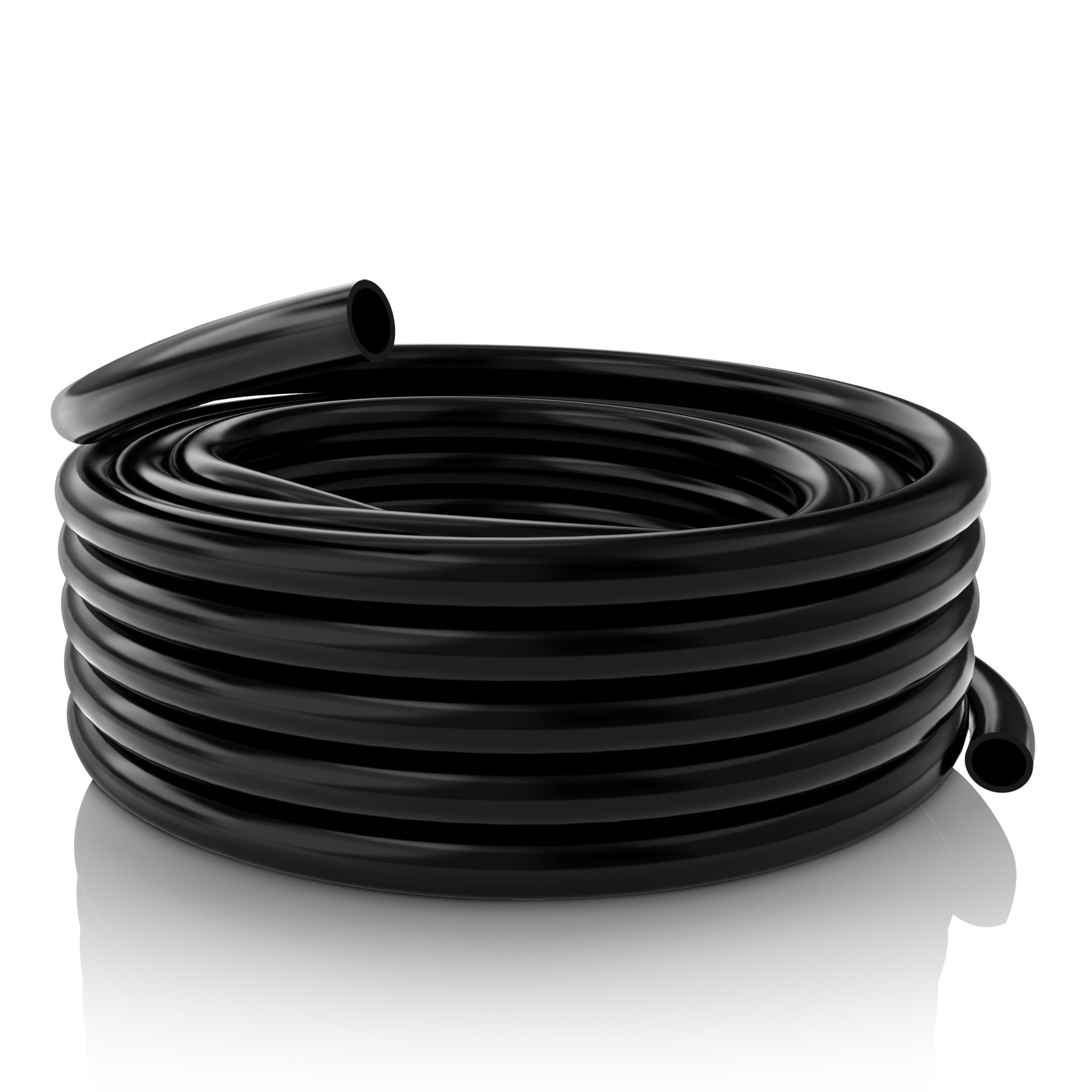
100 feet of flexible black PVC for ponds, pumps, and projects you can see through.
This is not a garden hose — it is 100-foot continuous PVC tubing with a 3/8-inch inner diameter and a 1/2-inch outer diameter. The 1/16-inch wall thickness is thin, so it is meant for low-pressure circulation (pond pumps, fountain returns, air conditioning drain lines). It is non-toxic and safe for fish, and the black color makes it nearly invisible in water.
Owners use it for everything from solar pool heaters to axolotl tank chillers. One reports: “This tubing is rigid enough not to kink! Works perfectly!” The quality and functionality are praised most. However, flexibility gets mixed reviews — some find it too soft in direct hot sun, causing it to sag or kink. Others report bursting after months of use. At 4.18 pounds for 100 feet, it is very light, but the thin wall means no rough handling.
This is the longest hose in the list by a wide margin.
What it does well
- 100 feet of continuous tubing means no connectors to leak — just unroll and cut to length.
- Non-toxic and fish-safe, so it is ideal for pond, fountain, and aquarium circulation.
- Black color hides underwater in ponds and resists algae growth better than clear tubing.
Watch out for
- Thin 1/16-inch wall can soften in direct sun or burst under higher pressure — not for sprayer or pump-discharge use.
- Some owners mention kinks that are stubborn to remove.
Reach for this if: you need a long, continuous PVC tube for a pond pump, fountain, chiller, or low-pressure water transfer.
Look elsewhere if: you need a pressure-rated garden hose for a sprayer or a heavy-duty line that can take sun and rough handling every day.
6. Pangda Fuel Line Hose NBR Rubber, 3/8″ x 20ft

A 20-foot NBR rubber fuel line that handles 300 PSI working pressure — but check what it is really made for.
This is NBR rubber (a synthetic rubber designed to resist fuel, oil, and grease) rated for 300 PSI working pressure and a burst pressure of 1160 PSI. It is sold as a fuel supply hose for small engines, motorcycles, and boats. The 3/8-inch inner diameter and 17-mm outer diameter make it a common replacement size for fuel lines on lawn mowers, generators, and outboards.
The quality and value for money are praised most. One owner says: “Excellent quality. Easy to use and install. The hose is perfect sized.” However, the fuel-friendliness of this specific hose gets strong negative feedback. Multiple owners warn that it deteriorates and leaks when fuel sits inside: “Not for fuel use; deteriorates and leaks brown liquid when fuel sits. May work as transfer hose.” This is a serious problem if you planned to use it as a permanent fuel line. It may work for short-term fuel transfer (like pumping gas from a can) but not for constant exposure.
If you need NBR rubber for oil or coolant transfer rather than gasoline, the pressure rating is excellent. For actual fuel line replacement, read the negative reviews carefully — many owners say it is not true fuel hose.
High pressure, low confidence for fuel: 300 PSI working pressure (three times the Abbott rubber hose) and 1160 PSI burst — but the “fuel-friendly” aspect is the most-negative-rated feature across all aspects for this product.
Consider this for: oil transfer, coolant lines, or short-term fuel transfer where the hose is not constantly filled with fuel.
Skip it for: a permanent gasoline fuel line on a vehicle or engine — customers note it deteriorates and clogs fuel systems.
7. DAVCO 3/8″ ID Clear Vinyl Tubing, 50 ft

A 50-foot clear vinyl line that lets you watch the flow — but keep the pressure low.
This transparent vinyl tubing is BPA-free and non-toxic, so it is safe for aquarium use, drinking water lines, and lab applications where you need to see the liquid moving. The 3/8-inch inner diameter and 50-foot length give plenty of reach for indoor water gardens, drip irrigation, humidifier overflow, and air conditioner drains. The material is flexible but has a maximum working pressure of just 30 PSI — this is strictly a low-pressure transfer hose.
What owners love is the clarity and quality: “Completely see-through! I am using this clear tubing to encapsulate an LED tape strip for submerging in my Koi pond.” The quality and functionality are praised most. Some note a chemical smell (the odor aspect is the most common negative), though it is BPA-free and typically dissipates. The included stainless clamps are a nice bonus, though some packages arrived without them.
Compared to the Alpine PVC tubing above (100 feet, thin PVC), the DAVCO is clearer, BPA-free, and includes clamps — but also shorter and only rated for 30 PSI. Use it where you need visibility and low pressure, not for a pump discharge.
What you get
- Transparent tubing lets you check for blockages, air bubbles, or water clarity without disconnecting.
- BPA-free and non-toxic, so it is safe for aquarium water changes and drinking water connections.
- Comes with 2 stainless steel clamps to secure the connections.
Limitations
- 30 PSI max pressure means it is not for garden hoses, pressure washers, or any pump that pushes hard.
- Some reviewers point out a temporary plastic smell when first used, and a few packages arrived without the advertised clamps.
Grab this for: aquarium systems, hydroponics, drinking water RV lines, or any application where seeing the flow is important.
Do not use for: high-pressure garden spraying, hot water over 140°F, or any job that exceeds 30 PSI — the thin vinyl wall will burst.
8. SPECILITE Hot/Cold Garden Water Coil Hose, 50 ft x 3/8
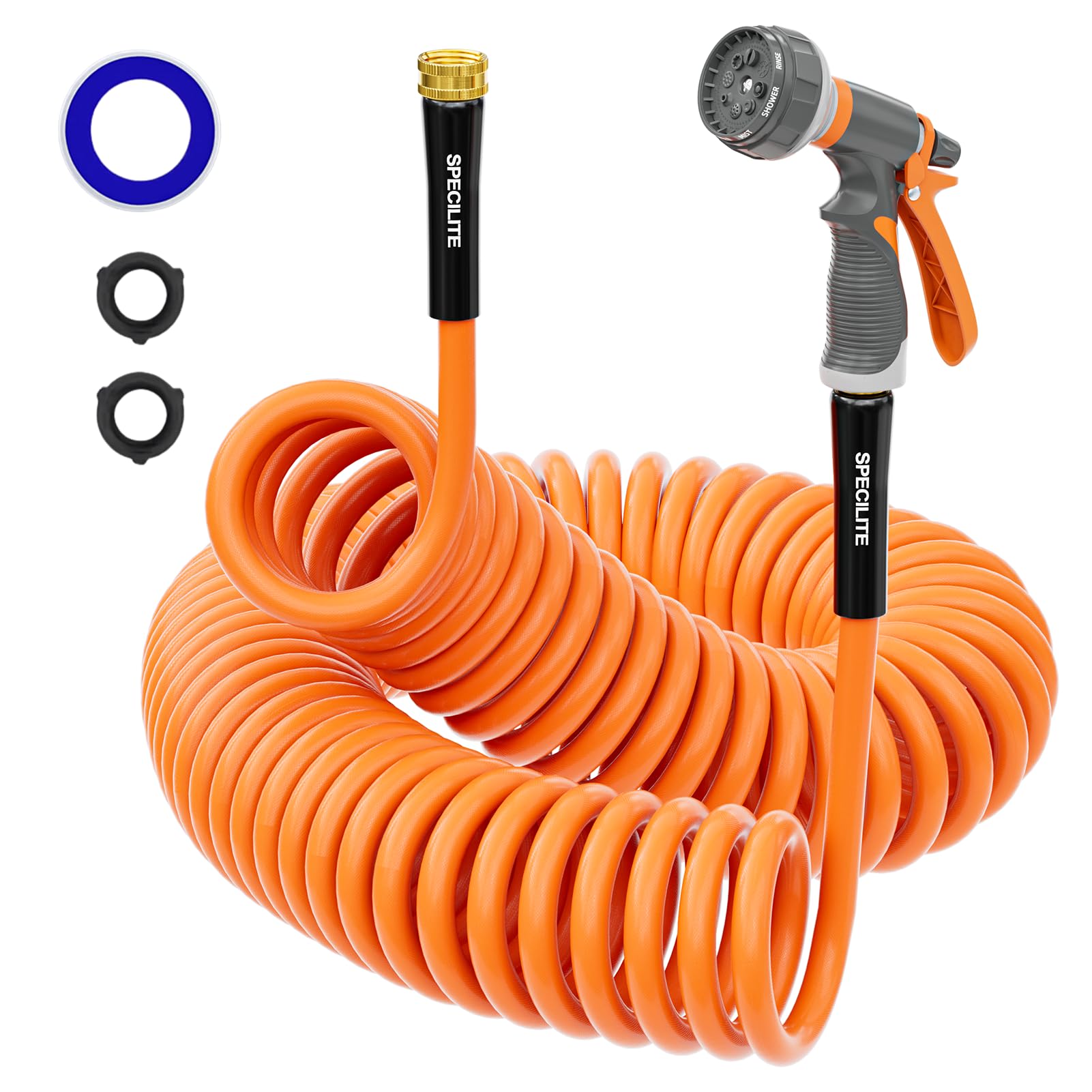
A 50-foot recoil that handles hot water drain and sub-zero cold without cracking.
This hybrid rubber coil hose is built for temperature extremes. It handles hot water up to 190°F (hot enough to drain a water heater or handle midday summer sun without melting) and down to -50°F without hardening or cracking. The 3/8-inch by 50-foot hose has a working pressure range of 200 to 600 PSI and includes an 8-pattern spray nozzle. The orange color makes it easy to spot.
The quality and performance earn the most praise. But the tangle-resistance is the most common negative aspect — owners say it kinks severely despite the coil design: “Kinks from shipping, needs twisting to straighten.” The weight is also a surprise to some: it is not as lightweight as expected. One owner notes it is “moderately heavy” and harder to coil than expected. The flexibility gets mixed feedback — some find it very flexible, others say it is stiff.
This is the best pick if you need a hot-water-rated hose (most hoses in this list max out around 140°F). Just know that the coil does not guarantee tangle-free use, and it may require extra effort to straighten out shipping kinks.
Standout spec: handles -50°F to 190°F — a temperature range that beats every other hose in this list by a wide margin.
Reach for this if: you need to drain a water heater, run hot water in cold weather, or want a single hose that survives both extreme heat and freezing temps.
Think twice if: kink-free performance is your top priority — many shoppers say stubborn kinks, and it is heavier than a standard garden hose.
9. Element SoakerPRO System Soaker Hose Kit, 100’ Length, 3/8″
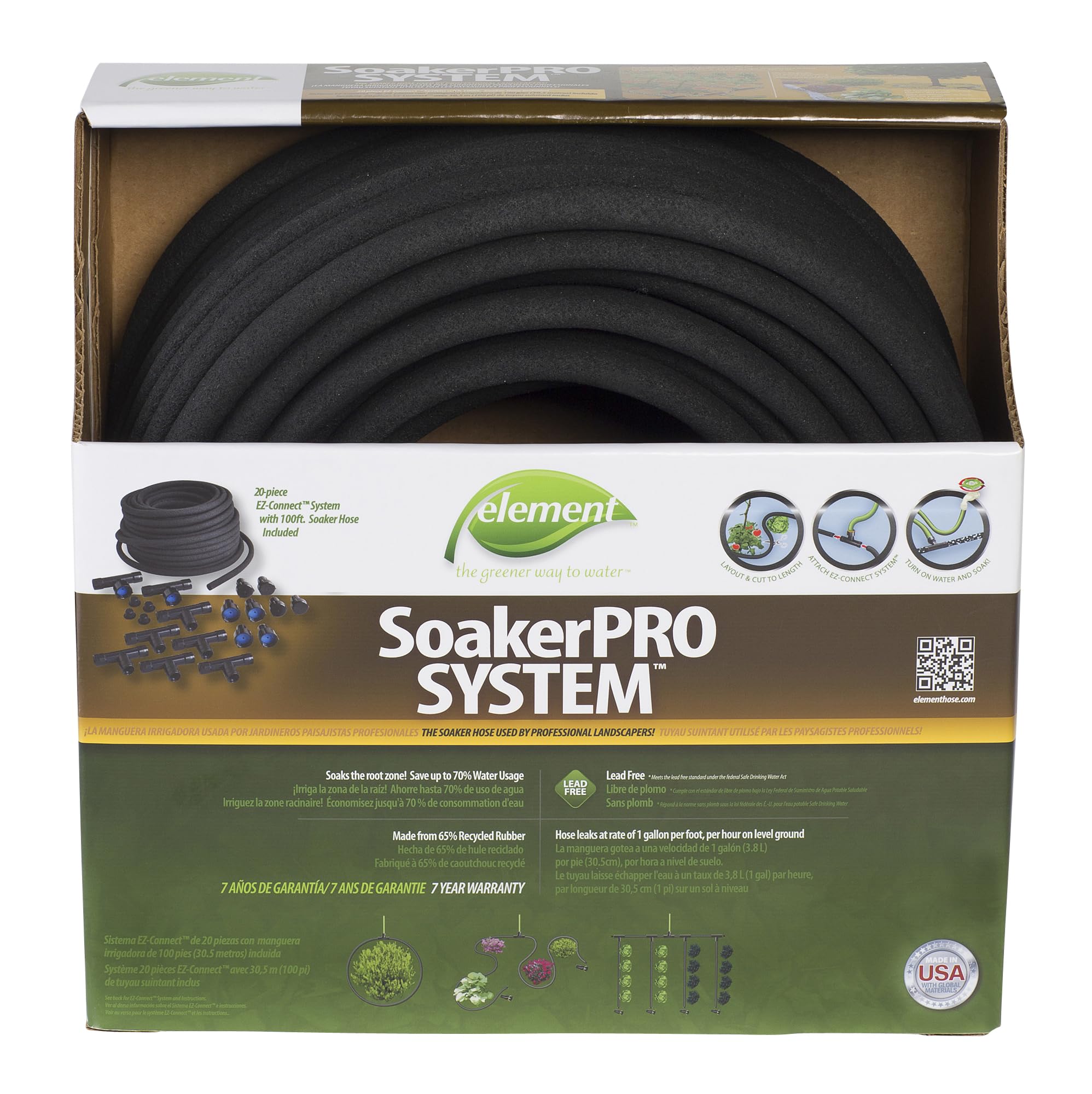
A 100-foot soaker system that waters roots directly and comes with 20 connectors to route it anywhere.
This is a soaker hose — not a standard water hose. The 3/8-inch diameter soaker hose releases water through tiny pores along its entire length at a rate of 0.5-1 gallon per foot per hour, directly to plant roots. It is made from 65% recycled rubber, meets lead-free standards under the Federal Safe Drinking Water Act, and comes with a 7-year warranty. The kit includes 20 EZ-Connect System Connectors (T connectors, female/male connectors, plugs) so you can customize the layout around trees, flower beds, or vegetable rows.
Owners find it easy to install and effective for deep root watering. The most common use is for trees and bushes, where slow watering at the canopy edge encourages root growth. “Versatile setup soaker hose. Works perfectly with water flow going evenly to plants,” one owner reports. The recycled rubber has a distinct smell when new (common with soaker hoses), and some note that in hot sun there is a potential for chemical leaching — though it meets the lead-free safety standards.
This is a completely different tool than the other hoses above — it is not for filling a bucket or spraying a car. It is for efficient, low-evaporation garden watering. The 100-foot length plus 20 connectors gives you enormous flexibility to snake it around a large garden.
Why it works
- 100-foot soaker hose with 20 EZ-Connect fittings lets you create a custom irrigation layout for a large garden or multiple beds.
- Made from 65% recycled rubber and meets lead-free standards for safe use around food plants.
- 7-year warranty gives long-term confidence that most hoses in this list do not offer.
Considerations
- This is a soaker hose, not a water hose — you cannot use it with a spray nozzle or for high-pressure washing.
- It requires low water pressure to work best; high pressure causes squirting from the pores instead of slow soaking.
Perfect for: deep-root watering of trees, shrubs, flower beds, and vegetable gardens with a customizable layout.
Not for: filling a bucket, washing a car, or any job that needs a spray nozzle or high water pressure.
Understanding the Specs
Working Pressure (PSI)
PSI stands for pounds per square inch — the measure of water pressure the hose can handle while in use. A garden spigot typically delivers 40-80 PSI, so a hose rated at 150 PSI (like the Abbott EPDM) is safe. The DAVCO clear tubing is only rated for 30 PSI, so you must not attach it to a standard spigot without a pressure reducer. The SPECILITE hose lists a range of 200-600 PSI, making it the strongest in this list.
Material: EPDM vs. PU vs. PVC vs. NBR
EPDM rubber is the most durable for outdoor and chemical use — it resists UV, ozone, and temperatures from -20°F to 190°F. Polyurethane (PU) is lighter and coils tightly, making it great for recoil hoses, but it can degrade in constant direct sun. PVC is the cheapest and clearest but has the lowest pressure rating and softens in heat. NBR rubber is formulated to resist oil and fuel, but some cheap NBR lines deteriorate with constant fuel exposure.
Nominal Wall Thickness
This is the thickness of the hose wall itself. A thicker wall (like 0.375 inches on the Abbott EPDM) means the hose is more rigid, resists crushing, and handles higher pressure. A thinner wall (like 0.125 inches on the SANFU 15-foot recoil or 1/16 inch on the DAVCO clear tubing) makes the hose lighter and more flexible but easier to kink or burst. Matching wall thickness to your pressure needs is the key trade-off.
Recoil vs. Straight Hose
A recoil (or coil) hose is designed to retract into a tight coil when not in use — great for boats, RVs, and patios where storage is limited. The trade-off is that recoil hoses tend to have slightly lower flow rates than a straight hose of the same diameter, and they can develop memory kinks. Straight hoses (like the Abbott EPDM or the Alpine PVC) deliver full flow and can be cut to exact length, but they require manual coiling and storage.
FAQ
Can I use a 3/8 hose on a standard garden spigot?
What is the difference between working pressure and burst pressure?
How long does a 3/8 polyurethane recoil hose last in full sun?
Can I drink water from any 3/8 hose?
Will a 3/8 hose fit my pressure washer or sprayer?
What is the best 3/8 hose for hot water?
Can I use a soaker hose at full spigot pressure?
How does a 3/8 hose compare to a 1/2 or 5/8 hose for flow?
Is a 3/8 fuel line hose safe for permanent gasoline use?
What is the best 3/8 hose for a boat?
Final Thoughts: The Verdict
For most people looking for the best
How We Picked
We do not accept paid placement. Every pick is matched to a real buyer and a real use-case; we do not hands-on test units.
Sources & Methodology
Specifications: manufacturer listings and product documentation. Review insights: verified customer reviews, as of July 2026. Pricing: not shown on this page (it changes often); check the current price via the retailer link.
As an Amazon Associate, Gadgets Feed earns from qualifying purchases. This does not affect which products we feature.