
Our readers keep the lights on and my morning glass full of iced black tea. As an Amazon Associate, I earn from qualifying purchases.
Specs are compiled from manufacturer listings and verified buyer reviews and can change over time — please confirm the key details on the product page before buying.
When the power goes out, your fridge stops, lights go dark, and the fan dies. A portable generator that puts out roughly 500 watts can fix that without the loud noise of a gas engine. These battery-powered units quietly run your phone, laptop, mini fridge, TV, and CPAP machine. You recharge them from a wall outlet, your car, or solar panels. There is no gas and no fumes. They fit in a cupboard, and you can carry one with a single hand.
I’m Min — the founder and writer behind Gadgets Feed. This guide is built by comparing the manufacturers’ published specifications and the patterns across verified customer reviews, so you get each pick’s real strengths and trade-offs instead of marketing spin.
You need backup for storms or quiet power for a tent. These picks handle both. Let’s find the right 500 watt generator for your next trip or emergency.
Our Picks at a Glance
How To Choose The Best 500 Watt Generator
Picking the right 500W power station depends on battery chemistry, recharge speed, portability, and which devices you want to keep running. Here is what to look at.
Battery Type — Standard Lithium vs LiFePO4
Standard lithium-ion batteries are common and affordable. LiFePO4 batteries (Lithium Iron Phosphate, a chemistry that lasts for thousands of recharge cycles) last much longer — think thousands of recharge cycles instead of a few hundred. If you want a unit that still works well a decade from now, a LiFePO4 pick is the smarter long-term investment, as it degrades slower over years of storage and use.
Recharge Time and Options
Most units charge three ways: from a wall outlet (fastest, often in 6-7 hours), from your car’s 12V port (similar time frame), or from solar panels (6-9 hours in full sun). Some premium models now do 0-80% in under an hour from a wall outlet — a huge leap when you need power back quickly after an outage.
Portability and Weight
A 500W power station typically weighs between 12 and 15 pounds. That is light enough to carry one-handed with a built-in handle and small enough to stow in a cupboard or behind a car seat. Heavier units around 15 pounds are still manageable but note if you plan to hike it to a campsite.
Output Ports and Device Compatibility
Most units include two 120V AC outlets (regular household-style plugs), several USB-A ports, a USB-C PD port (USB-C Power Delivery, for fast laptop charging), and a car port. A pure sine wave inverter (which produces electricity that mimics your home outlet’s smooth waveform) protects sensitive electronics — your laptop or CPAP machine will run smoothly without buzzing or damage. Units that offer a wireless charging pad on top are a nice bonus for tossing your phone onto.
Quick Comparison
| Model | Best For | Capacity (Wh) | Weight (lbs) | AC Recharge Time | Amazon |
|---|---|---|---|---|---|
| GRECELL EB500★ Best Overall | Best Overall Power Station | 519.48Wh | 14.1 | 6-7 hours | Amazon |
| GRECELL EB500 Gen 2 | Premium Backup Power | 519.48Wh | 15 | 6-7 hours | Amazon |
| Jackery Explorer 500 v2 | Longest Lifespan | 512Wh | 12.6 | 52 min (0-80%) | Amazon |
| GRECELL T-500 | Most Reviews / Proven Reliability | 519.48Wh | 14.1 | 6-7 hours | Amazon |
In‑Depth Reviews
1. GRECELL EB500 500W Portable Power Station
Our pick — over 4.5★ from 100+ verified ratings; the strongest balance of quality and price.
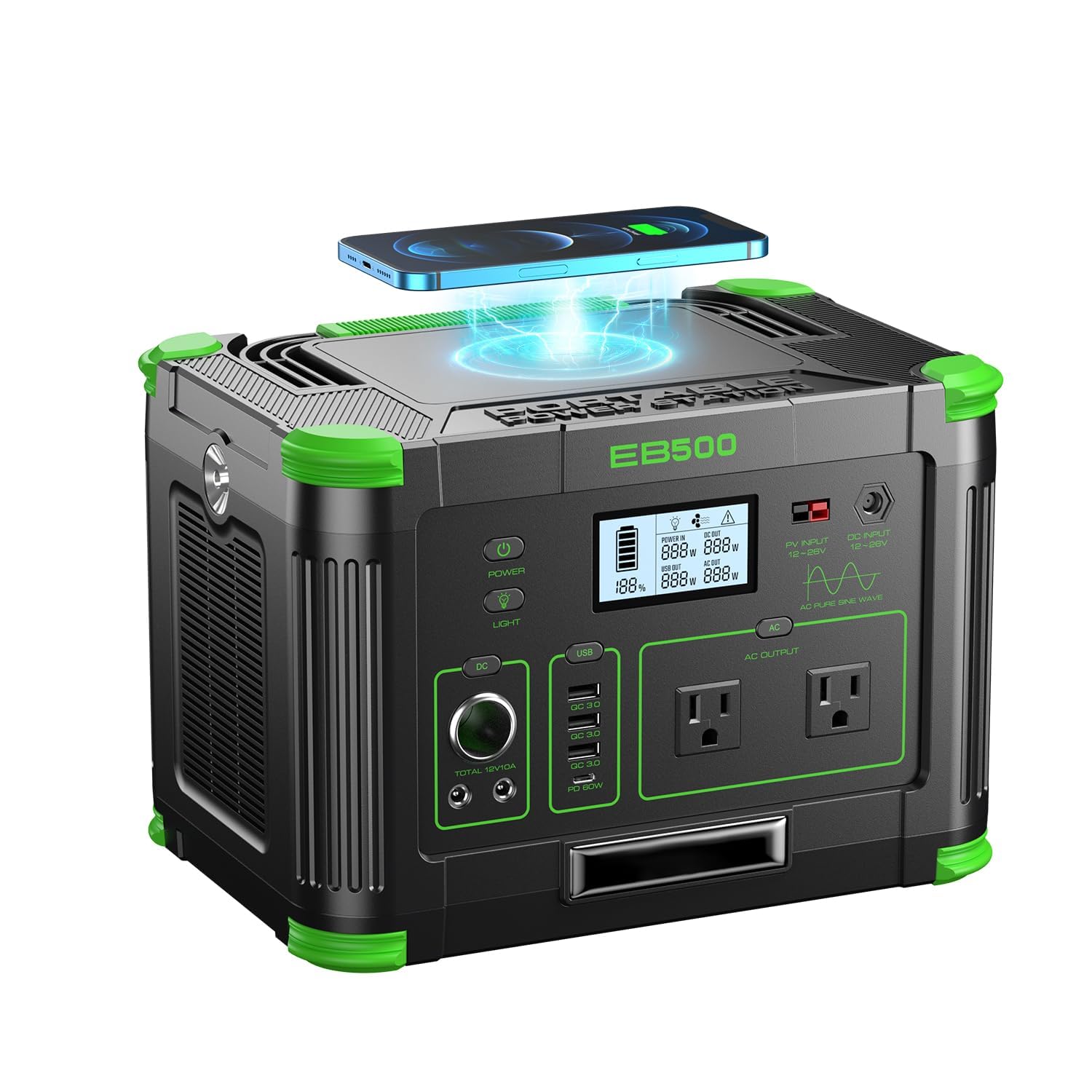
The GRECELL EB500 nails the balance of capacity, weight, and value — it offers a 519.48Wh battery at 14.1 pounds, making it the all-around pick for most people’s camping or emergency needs.
This unit packs a 519.48Wh battery into just 14.1 pounds — light enough to carry with its solid handle, yet powerful enough to run a phone, laptop, lights, fan, and even a CPAP machine overnight. The pure sine wave AC inverter (which produces clean electricity that matches your home outlet’s smooth waveform) protects sensitive electronics, so your laptop or medical device runs exactly as it should without buzzing.
Three recharge options give you flexibility: a wall outlet refills it in 6-7 hours, a car charger does the same, or a 100W solar panel tops it off in 6-9 hours of full sun. The 10 ports let you run up to ten things at once — a mini fridge, a fan, and several USB devices without juggling adapters. There is even a wireless charging pad on top for dropping your phone onto.
Value is where this GRECELL shines compared to more expensive brands. It delivers the same 519.48Wh capacity and 500W output as the higher-priced GRECELL T-500, at a lower cost. The built-in LED flashlight with strobe and SOS modes adds confidence during a blackout or tent setup at night.
What wins owners over
- Reliability is the most-praised aspect — owners find it dependable for both camping and power outages.
- Battery life earns strong marks; a full charge can power small devices for days, according to buyers.
- Portable at 14.1 lbs with a comfortable handle, easy to carry to a campsite or from the garage.
The honest trade-off
- Solar panel not included — you need to buy one separately for off-grid recharging.
- Standard lithium battery, not a LiFePO4; it won’t last as many recharge cycles as the Jackery, which has a LiFePO4 (Lithium Iron Phosphate) battery rated for 6000 cycles.
Reach for this if: You want the safest all-around choice — good capacity, light weight, clean power, and a fair price for weekend trips and home backup.
Look elsewhere if: You need the longest possible battery lifespan (10+ years) or you want ultra-fast AC recharging — the Jackery below is better for those.
2. GRECELL EB500 500W Portable Power Station (Gen 2)
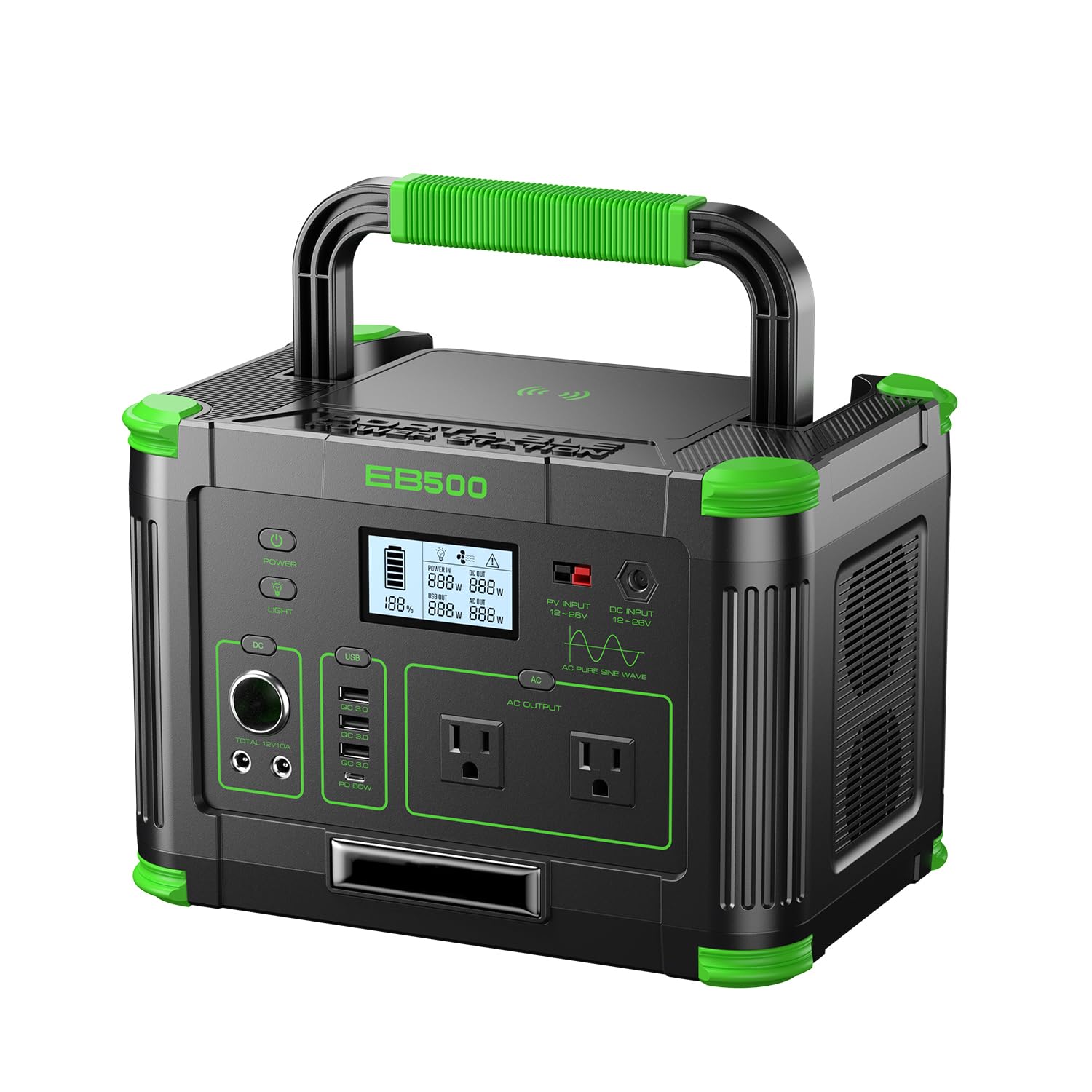
The Gen 2 gives you 1000W peak surge power — double the standard 500W peak — so it can kick-start small motor appliances the base model cannot.
This second-generation GRECELL matches its sibling with the same 519.48Wh battery and the same 10-port layout — two AC outlets, three USB-A QC3.0 ports, a USB-C PD port at 60W, DC ports, and a car port plus wireless charger. The difference is the peak surge: 1000W vs 500W. That extra surge lets it kick-start a small pump or motor-driven device that a standard 500W unit would trip on, while still delivering the same clean pure sine wave power to your laptop and CPAP machine.
It is fractionally heavier at 15 pounds compared to 14.1 pounds on the base model, and the dimensions are nearly identical (11.5″ x 7.9″ x 7.9″ vs 11.57″ x 7.95″ x 7.95″). The dark green finish and the included cable storage bag give it a slightly more organized feel for travel. Buyers report it holds a charge for five days of dry camping — running phones, fans, and headlamps — and that it recharges via solar panel when hooked to trailer power.
The built-in smart BMS (Battery Management System, a circuit board that monitors and protects the battery) adds temperature control, overvoltage, overcurrent, and short-circuit protection, which is the same safety suite as the base model. The LED flashlight with strobe-SOS modes is included too.
Peak power difference: The 1000W peak on this Gen 2 gives it an edge for starting small motor loads — unlike the base GRECELL, which is capped at 500W peak. It still carries the same capacity and port count, just with that extra headroom for starting a small fridge compressor or pump.
The one thing to know: It is slightly heavier than the base model (15 lbs vs 14.1 lbs). Also, the included parts list is more generous — it adds a 7909 solar charging cable, an AC charging cable, a car charging cable, and a cable storage bag, which the base model does not all include.
Grab this if: You plan to power something with a startup spike — a small fridge compressor or pump — and want the extra 1000W peak safety margin over the standard 500W peak.
skip it if: You do not need the surge headroom; the base GRECELL costs less and is lighter while delivering the same daily capacity.
3. Jackery Explorer 500 v2 Portable Power Station
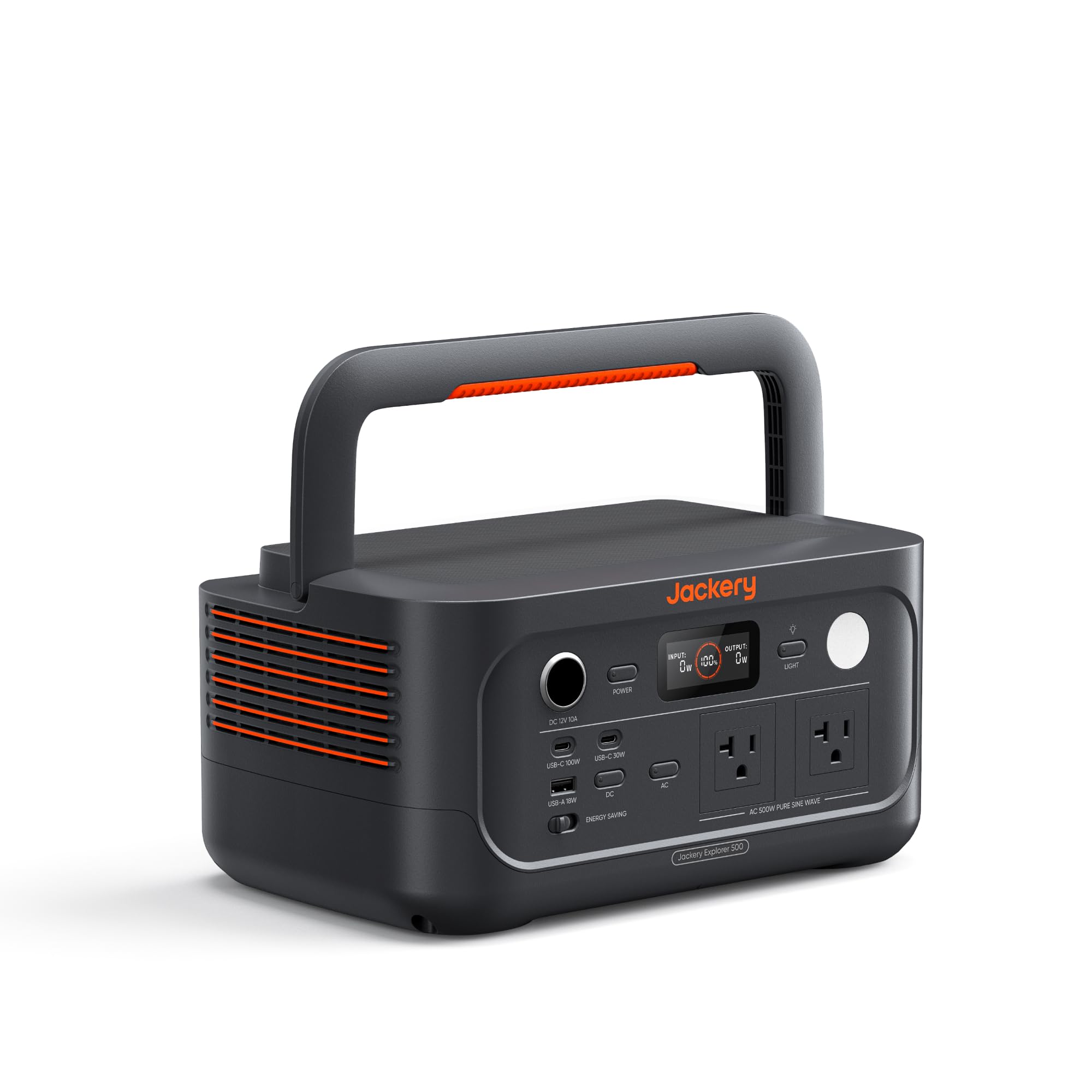
The LiFePO4 cell (Lithium Iron Phosphate battery) rated for 6000 cycles — this unit could still work for your grandkid’s camping trip, according to the maker.
Jackery built the Explorer 500 v2 around a LiFePO4 battery rated for 6000 charge cycles.. That is a massive leap over standard lithium-ion — The maker claims over 10 years of reliable use.. The Low self-consumption design drains only 5% during half a year of storage., so you can stash it in a closet and grab it when a storm comes without finding a dead battery.
The standout spec here is recharge speed: 0-80% in 52 minutes from a wall outlet.. That is dramatically faster than the GRECELL units, which need 6-7 hours for a full charge. When a power outage hits at 6 PM, you want your power station full by 7 PM — this gives you that. At 12.6 pounds it is also the lightest unit in this comparison, making it the easiest to carry.
The downside is the price — this costs significantly more than either GRECELL. You pay a premium for the LiFePO4 longevity and the rapid AC recharge. The capacity is slightly smaller at 512Wh vs 519.48Wh, but that difference is negligible in daily use. Owners confirm it charges fast and works as advertised for camping, powering small fridges overnight, and running lights and Wi-Fi during outages.
What makes it worth it
- LiFePO4 battery rated for 6000 charge cycles. — ten times more than standard lithium, meaning over a decade of service.
- Fast AC recharge from 0-80% in 52 minutes — the quickest refill of any unit here..
- Lightest pick at 12.6 pounds, making it truly portable for hiking or carrying upstairs.
What holds it back
- Significantly more expensive than the GRECELL units with near-identical 500W output and similar capacity.
- Smaller capacity at 512Wh vs 519.48Wh (though the difference is minor in the real world).
Buy this for: Long-term ownership — if you want a device that will still hold a strong charge a decade from now and can be recharged in under an hour.
pass on it if: Budget is a priority and you are okay charging overnight; the GRECELL EB500 costs less and still delivers reliable backup power for camping and outages.
4. GRECELL T-500 500W Portable Power Station

The T-500 is the model thousands of people have bought and relied on — over three thousand ratings back its durability.
This GRECELL T-500 has the largest owner community in this guide. With over three thousand ratings, it is the most-reviewed 500W power station of the group, and reliability is the dominant theme — it wins huge praise for just working when you need it. The 519.48Wh lithium battery powers up to ten devices at once through the same 2 AC outlets, 3 USB-A (QC3.0), USB-C PD at 60W, DC ports, car port, and wireless charging pad as the other GRECELL models.
The three recharge paths are identical to the EB500: 6-7 hours from the wall, 7-8 hours from your car, or 6-9 hours with a 100W solar panel. At 14.1 pounds and 11.6 x 7.9 x 7.9 inches, it is the same size and weight as the base EB500. The build quality gets solid marks — owners have used theirs for years, with some units still working after two-plus years even after warranty replacements for minor defects.
The honest caveat is that some high-draw appliances — like a Keurig fast-brew coffee pot — can trip the unit. It handles slower-heating coffee makers fine, and it runs modems, electronics, TVs, and small appliances without issue. The AC and DC toggles are separate, so you can turn off AC output to save battery when you are only charging USB devices.
The community verdict: With reliability cited more than four hundred times as a positive, this is the unit that a huge number of buyers trust for emergencies and camping. Owners mention it holds charge well for years and becomes a “lifesaver” during power outages and storms.
The trade-off: Some owners received units where the battery gauge stuck or the replacement was also defective — though customer support resolved those cases. It is also the most expensive GRECELL here, despite offering basically the same specs as the cheaper EB500.
Pick this if: You want the reassurance that tens of thousands of owners have bought the same model and most are very satisfied with its reliability and battery life.
Pass on it if: You want the best value — the GRECELL EB500 has nearly identical specs and costs less, which makes the T-500 harder to justify on price alone.
Understanding the Specs
Watt-Hours (Wh) — How long it runs
Watt-hours measure the total energy stored in the battery. A 519.48Wh unit running a 50W laptop lasts about 10 hours. Running a 100W mini fridge cuts that to around 5 hours. The number matters more than watts for real-world runtime — two units may both be “500W,” but a bigger Wh number means longer power before recharge.
Pure Sine Wave — Clean power for sensitive gear
A pure sine wave inverter (which produces electricity that mimics the smooth waveform from your home wall outlet) powers laptops, CPAP machines, TVs, and anything with a sensitive circuit board safely. Modified sine wave inverters can cause buzzing in audio equipment or damage to some medical devices — always look for pure sine wave if you plug in computers or health gear.
LiFePO4 vs Lithium-Ion — Lifespan difference
LiFePO4 (Lithium Iron Phosphate) batteries handle far more charge cycles — up to 6000 on the Jackery 500 v2 — compared to standard lithium-ion which typically lasts 500-1000 cycles. LiFePO4 also degrades slower during storage. Standard lithium-ion is cheaper upfront, but LiFePO4 pays off if you plan to keep the unit for years.
Charge Time — How fast you get back to full
Standard AC recharge takes 6-8 hours for a 500W-class power station. Premium models like the Jackery 500 v2 cut that to about 52 minutes for 0-80%. Car and solar charging are slower — typically 7-9 hours. Faster charging means less downtime during back-to-back outages or between camping sites.
FAQ
How long will a 500W power station run a mini fridge?
Can a 500W generator run a CPAP machine all night?
Will it run a Keurig or a coffee maker?
How long does it take to charge from empty using a solar panel?
Can I charge the power station while using it?
Is a 500W generator quiet?
What is the difference between rated power and peak power?
How often should I recharge a power station in storage?
Final Thoughts: The Verdict
For most people, the best 500 watt generator is the GRECELL EB500 because it nails the right balance of capacity, weight, and value — reliable power for camping and home backup at a fair price. If battery longevity over a decade matters more than upfront cost, the Jackery Explorer 500 v2 with its LiFePO4 cell and 52-minute recharge is worth the premium. And if you want the model thousands of other owners have already vouched for, the GRECELL T-500 has the deepest review history for confidence.
How We Picked
We do not accept paid placement. Every pick is matched to a real buyer and a real use-case; we do not hands-on test units.
Sources & Methodology
Specifications: manufacturer listings and product documentation. Review insights: verified customer reviews, as of July 2026. Pricing: not shown on this page (it changes often); check the current price via the retailer link.
As an Amazon Associate, Gadgets Feed earns from qualifying purchases. This does not affect which products we feature.