
Our readers keep the lights on and my morning glass full of iced black tea. As an Amazon Associate, I earn from qualifying purchases.
Specs are compiled from manufacturer listings and verified buyer reviews and can change over time — please confirm the key details on the product page before buying.
An 8-inch component speaker system splits the lows and highs between a dedicated woofer and a separate tweeter, giving you cleaner sound than a single full-range speaker. You want vocals that stand apart from the instruments, treble that sparkles without hurting your ears, and enough authority to fill a truck cab without a trunk full of subwoofers. The right pair balances power handling with a mounting depth that fits your door panel — that measurement is where most shopping trips go sideways. This guide sorts four sets worth your time.
I’m Min — the founder and writer behind Gadgets Feed. This guide is built by comparing the manufacturers’ published specifications and the patterns across verified customer reviews, so you get each pick’s real strengths and trade-offs instead of marketing spin.
These are the best 8 component speakers sorted for real vehicles and real budgets, from an older Miata craving modern fidelity to a full-size truck that needs to project across a parking lot.
Our Picks at a Glance
How To Choose The Best 8 Component Speakers
An 8-inch component speaker system splits the job between a dedicated woofer for the lows and mids and a separate tweeter for the highs. That separation alone delivers cleaner sound than a coaxial speaker because each driver (the speaker unit itself) only plays the frequencies it handles best. The real trick is matching the power numbers and the physical size to your car and your amplifier.
Know Your Power: RMS Over Peak
Peak power is the loudest burst a speaker can survive for a split second. RMS (Root Mean Square — a measurement of continuous power) is the steady wattage the speaker can handle while you drive it hard. A set with 250W RMS versus an 80W RMS model is built for a different kind of system. The first needs a serious external amplifier; the second works with a modest head unit or factory amp upgrade. Compare RMS ratings, not peak numbers, when you decide between models.
Mounting Depth and Door Fit
An 8-inch woofer is physically larger than the common 6.5-inch size, so the mounting depth (the distance from the mounting flange that screws into your door to the back of the magnet) is the critical measurement. A shallow-mount design of around 2.5 inches fits factory doors in cars like Mazda Miatas and some Porsche Caymans. Deeper baskets (the frame holding the speaker cone and magnet) need spacers, custom pods, or door panel modifications. Measure your current speaker’s depth or check a vehicle-specific forum before you order.
Separate Crossover: What It Does
A crossover is the small circuit board (or inline filter) that sends only the low frequencies to the woofer and only the high frequencies to the tweeter. A good built-in crossover saves you from buying one separately and simplifies wiring. Some advanced crossovers let you adjust the tweeter volume (a feature called attenuation) so the highs are not overpowering if the tweeter is mounted close to your ear.
Quick Comparison
| Model | Best For | RMS Power | Speaker Size | Key Feature | Amazon |
|---|---|---|---|---|---|
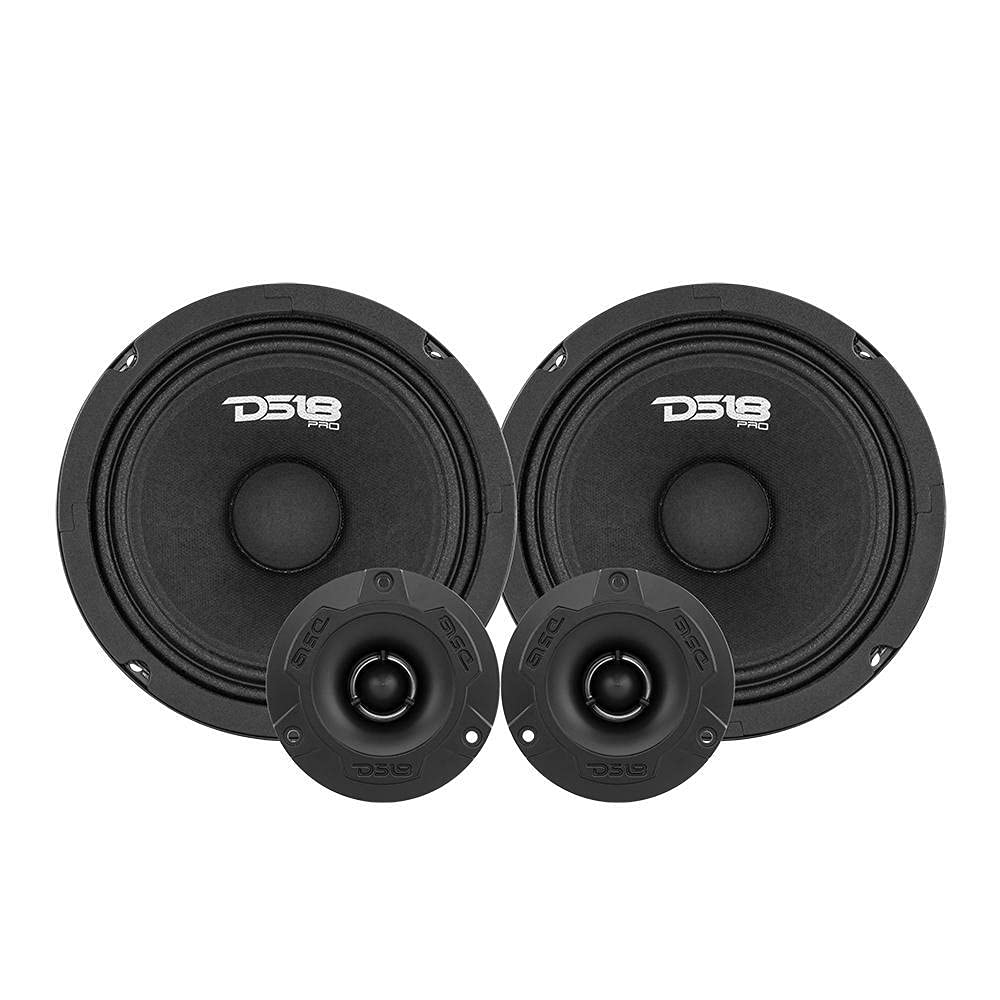
| DS18 PRO-GM8.4PK★ Best Overall | Loud, clear mids & vocals | 190W RMS mid / 200W RMS tweeter | 8 inches | Complete mid/tweeter package | Amazon |
| Rockville X8C | High-power systems & home theater | 250W per pair | 8 inches | Selectable tweeter attenuation | Amazon |
| Focal ISS-200 | Direct OEM replacement (Miata, etc.) | 80W | 8 inches | Shallow 2.5″ mount depth | Amazon |
| Focal ISU 200 | Premium aftermarket builds | 80W | 8 inches | Al/Mg inverted dome tweeter | Amazon |
In‑Depth Reviews
1. DS18 PRO-GM8.4PK Mid and High Complete Package
Our pick — 4.6★ from 488 verified ratings; a true 8-inch mid plus tweeters and crossovers in one box.
Two 8-inch mids, two bullet tweeters, and the crossovers to run them — the complete front stage in one box.
This is the 8-inch member of DS18’s PRO-GM family, and it ships as a full package: 2x 8-inch midrange loudspeakers and 2x 1-inch aluminum super bullet tweeters, each with a built-in crossover (a circuit that splits the audio signal by frequency so the mid and the tweeter each get only what they can handle). The PRO-GM8 driver is rated at 580W max with 190W RMS at 8 ohms — 8 ohms rather than the more common 4, which matters when you plan your amplifier wiring. The PRO-TW120 ferrite tweeter carries a 200W RMS / 300W max rating at 4 ohms and includes a capacitor filter to keep low frequencies out of it.
The reason to pick the 8-inch version over a 6.5-inch mid is cone area: more surface moving air means more midbass authority in a door, so vocals and guitars sit further forward without leaning on the subwoofer. DS18 lists the package at 17.72 x 8.66 x 4.33 inches shipped, and the drivers use a matte-black basket with aluminum tweeter housings. It holds a 4.6-star rating from 488 Amazon ratings — the largest review base of any set in this guide. Note that an 8-inch mid needs an 8-inch door opening or an adapter ring, so measure before you order.
Why It Wins
- Genuine 8-inch midrange drivers — the size this guide is about
- Everything in one box: mids, bullet tweeters, and built-in crossovers
- 200W RMS tweeter rating lets you push the highs hard
- 4.6 stars from 488 ratings, the largest owner base in the list
Fit Note
- Mid is 8 ohm, not 4 ohm — plan your amp channels and wiring accordingly
- An 8-inch driver needs an 8-inch opening or an adapter ring in most doors
- Pro-audio style midrange: it is not a full-range woofer, so you still want a sub
Choose this if: you want a genuine 8-inch front stage with matching tweeters and crossovers, and you are running a separate subwoofer for the low end.
Think twice if: your doors only take 6.5-inch drivers, or you need a single full-range speaker that reaches down to 40Hz on its own.
2. Rockville X8C 8″ Competition Car Audio Speakers

You get competition-grade output without a competition price tag if you have the amplifier to feed it.
This set delivers a huge 250W RMS per pair (peaks at 1000W) — at 250W RMS versus the Focal kits’ 80W RMS, so it can fill a large truck cab or a custom audio build with authority. The 8-inch mid-bass woofers use paper cones with aluminum bullets and 1.5-inch CCAW voice coils (copper-clad aluminum wire coils that handle heat well), keeping distortion low when you push the volume. The crossover includes selectable 0dB, -3dB, and -6dB tweeter attenuation (settings that lower the high-frequency volume by 0, 3, or 6 decibels). That means you can dial back the highs if the 2-inch titanium dome tweeters are mounted close to your ears and start to feel harsh — a problem the Focal ISS-200 does not solve without an external DSP.
Buyers report using these in a custom home theater and getting “fuller, louder sound than TV,” which shows the woofer’s ability to produce solid mid-bass without a dedicated subwoofer (a separate speaker for deep low frequencies). The shallow mounting depth helps it fit in most doors and rear decks, and the kit includes grilles and hardware. The trade-off is a moderate 4.0-star average from a smaller sample — a handful of owners say the build feels slightly less refined than premium European brands, but nobody disputes the raw output for the money. Choose this if your priority is sheer presence over subtle refinement.
What Powers This Pick
- Highest RMS power in the group at 250W — needs a serious amplifier but rewards with massive headroom for loud, clean playback
- Selectable tweeter attenuation lets you tune the highs to your ear’s comfort without extra gear
- Shallow mount design and included grilles make installation straightforward
The Honest Trade-Off
- Fewer reviews than the DS18 set, so the long-term reliability consensus is thinner
- Paper cones can degrade faster in humid climates than polyglass or treated-fiber alternatives found on the Focal models
Reach for these if: you are feeding them with an amp that can deliver 250W RMS and you want chest-thumping volume for a truck, van, or custom build.
Look elsewhere if: you are replacing factory speakers in a small coupe with your head unit’s built-in power — you will not get close to their potential.
3. Focal ISS-200 8″ 80 Watt RMS 2-Way Component Speakers

A drop-in replacement for factory 8-inch systems that raises fidelity without cutting your door panels.
If you drive a Mazda MX-5 Miata (NC or earlier models), a 2009 Porsche Cayman, or a similar car with factory 8-inch speakers, this Focal kit is engineered for your door. The key dimension is the 2.5-inch (63.5mm) mounting depth — shallow enough to fit where most 8-inch woofers cannot. Customers note a “direct fit in 2006 Mazda MX-5 (Bose system)” — the 8-inch polyglass woofer (a woven fiberglass cone that resists moisture) uses the existing screw holes, and the built-in inline crossovers simplify wiring. The kit includes two surface-mount tweeter housings and two angled surface-mount housings, giving you flexibility to aim the highs toward your ears for better staging (the sense of where sounds appear in the car).
At 80W RMS, this is not a speaker you push to parking-lot competition levels like the Rockville X8C. It is designed for high fidelity and neutrality, with a 91.4 dB sensitivity (a measure of how loud the speaker gets from one watt of power) that lets a modest factory amplifier drive it to satisfying volume. The frequency response (the range of audio frequencies the speaker can reproduce) stretches from 40Hz to 20kHz, so a small subwoofer is optional rather than mandatory — the woofer itself produces surprising low-end weight for its shallow frame. Sound quality and installation are the two most-discussed aspects among owners, and both earn positive marks. The one caution is authenticity: a single review warns of counterfeit units, so buy from a trusted seller. For anyone who wants a transparent upgrade that bolts into an existing 8-inch bay, this is the move.
What Makes It Work
- 2.5-inch shallow mount depth fits factory 8-inch doors with minimal or no modification
- Polyglass woofer cone with butyl rubber surround resists weather and humidity better than paper cones
- Two tweeter housing options (flush and angled) improve staging flexibility
One Thing to Know
- At 80W RMS, it is not designed for high-power systems — needs a clean, moderate amplifier to shine
- Woofer grilles are not included, so you will need to reuse factory grilles or buy separately
Ideal for: owners of cars with factory 8-inch speakers (especially Mazda MX-5, Porsche Cayman) who want a noticeable fidelity upgrade without cutting doors.
Not for: anyone planning a high-SPL build with 250W+ RMS — the voice coil and motor structure are not designed for that abuse.
4. Focal ISU 200 8 Inch 2-Way Component Kit
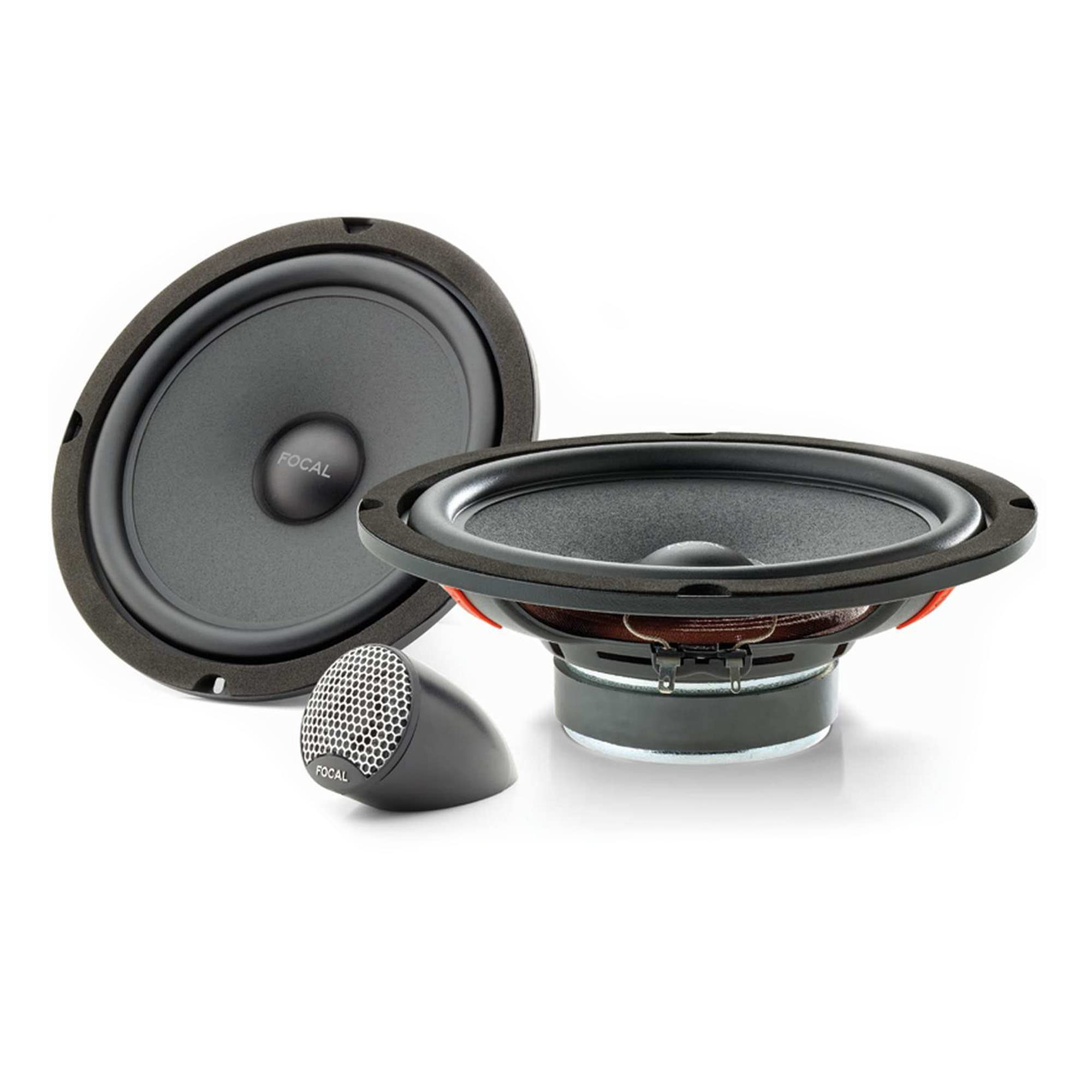
Highest sensitivity of the four, so it rewards a clean DSP (digital signal processor) with startling detail.
This is the top-tier Focal offering here, with an aluminum/magnesium inverted dome tweeter (a tweeter dome shaped concave rather than convex, made from lightweight metal) and a 93 dB sensitivity rating — the highest in the group. That sensitivity means it produces more volume from the same amplifier wattage, a real advantage if you run a modest amplifier or a factory system. The ISU 200 handles 80W RMS and peaks at 160W, putting it in the same power class as the ISS-200 but with different tonal character. Owners describe the bass as “deep enough to shake doors” and the highs as capable of giving “chills,” especially after adding a DSP for fine tuning.
The integrated 6dB/octave crossover (a filter that reduces frequencies at a rate of 6 decibels per octave — gentle, wide filtering) keeps wiring neat, and the kit is pre-wired with filters, making it nearly plug-and-play in vehicles that already have 8-inch openings. A buyer installed these in an MX-5 NB with minor modifications: the woofer fit perfectly with adhesive foam tape, but the tweeters needed hot glue to stay seated. The recurring honest note is that mids can feel slightly recessed and the highs can be harsh if the tweeter is not properly positioned — a contrast to the DS18’s naturally forward vocal tuning. That makes the ISU 200 a better pick for the enthusiast who plans to pair it with a DSP and take time tuning crossovers, rather than seeking a quick weekend swap. The Focal ISS-200 is simpler and cheaper for that job.
Why Go This Route
- Highest sensitivity (93 dB) means louder output per watt — great with moderate amplifiers
- Al/Mg inverted dome tweeter delivers airy, extended highs with less distortion than soft domes
- 8-inch woofer produces real door-shaking bass without a separate sub in many cars
Setup Consideration
- Mids can sound recessed, and the tweeter can be harsh — a DSP and careful crossover setup are recommended
- No mounting grilles included, adding to the overall cost
Best suited for: the audio enthusiast who already owns or plans to buy a DSP and wants a high-sensitivity 8-inch foundation with premium tweeter materials.
skip it if: you want a drop-in swap with no tuning — the Focal ISS-200 is simpler and cheaper for that job.
Understanding the Specs
RMS vs Peak Power
RMS is the continuous power a speaker can handle while you listen to music at normal volumes. Peak power is the maximum burst it can survive for a fraction of a second during a loud transient (a drum hit or an explosion in a movie). Always match the amplifier’s RMS output to the speaker’s RMS rating. If you feed a speaker more continuous RMS than it can take, the voice coil overheats and the speaker fails. The peak number is mostly a marketing figure — ignore it during comparison and focus on RMS.
Mounting Depth
This is the measurement from the flat mounting surface (the flange that screws into your door) to the deepest part of the magnet structure on the back. An 8-inch woofer is bigger than the common 6.5-inch size, so depth is what stops it from hitting the window mechanism or the door panel. A shallow 2.5-inch depth (like the Focal ISS-200) fits most factory enclosures. A deeper basket (3+ inches) usually requires spacers or modifications. Measure before you buy — it is the spec most commonly ignored and the one that causes the most returns.
FAQ
Will 8-inch component speakers fit in my car if it came with 6.5-inch speakers?
Can I run 8-inch component speakers off my factory head unit?
What is the difference between a 2-way component speaker and a 3-way component speaker?
Should I buy a set of component speakers or coaxial speakers?
How many watts RMS do I really need for daily listening?
Do these speakers come with grilles to protect them?
Can 8-inch component speakers work well for a home stereo or home theater setup?
What does the crossover’s tweeter attenuation switch do?
How do I know if a speaker is genuine and not counterfeit?
Do I need to sound deaden my doors when installing component speakers?
Final Thoughts: The Verdict
If you want one dependable pick, the best 8 component speakers are the Rockville X8C because they deliver competition-level power (250W RMS) with the flexibility of selectable tweeter attenuation — and at a price that beats any similarly specced competitor. If your main goal is vocal clarity and you are building a system with a separate subwoofer, grab the DS18 PRO-GM8.4PK, which holds a higher star rating from a much larger owner base. And for a factory-friendly upgrade that bolts into an 8-inch door without modification, the Focal ISS-200 is the one to reach for, especially if you drive a Miata or a Cayman.
How We Picked
We do not accept paid placement. Every pick is matched to a real buyer and a real use-case; we do not hands-on test units.
Sources & Methodology
Specifications: manufacturer listings and product documentation. Review insights: verified customer reviews, as of July 2026. Pricing: not shown on this page (it changes often); check the current price via the retailer link.
As an Amazon Associate, Gadgets Feed earns from qualifying purchases. This does not affect which products we feature.