
Our readers keep the lights on and my morning glass full of iced black tea. As an Amazon Associate, I earn from qualifying purchases.
Specs are compiled from manufacturer listings and verified buyer reviews and can change over time — please confirm the key details on the product page before buying.
For most EV owners, the biggest upgrade isn’t a faster car — it’s a faster driveway. A Level 2 charger at home turns a 38-hour trickle from a wall outlet into a full tank by morning. But the options range from a simple plug-in unit to a hardwired smart station with its own app, so picking the right one means matching your home’s electrical setup and how fast you really need to go.
I’m Min — the founder and writer behind Gadgets Feed. This guide is built by comparing the manufacturers’ published specifications and the patterns across verified customer reviews, so you get each pick’s real strengths and trade-offs instead of marketing spin.
Whether you drive a Tesla, Chevy Bolt, or Ioniq 5, these Level 2 chargers deliver real-world speed, reliability, and compatibility for your daily routine.
Our Picks at a Glance

How To Choose The Best At Home EV Chargers
An at-home EV charger needs to match two things: your car’s charging speed and your home’s electrical capacity. The wrong pick can mean slow fills or a tripped breaker.
Amperage and Power Output
Higher amperage means faster charging. Most Level 2 chargers run between 16 amps and 48 amps. A 48-amp unit on a 60-amp circuit can add up to 46 miles of range per hour, while a 24-amp unit on a 30-amp circuit adds between 15 and 20 miles per hour. Check your car’s onboard charger limit — a car that maxes out at 32 amps won’t charge faster on a 48-amp station.
Plug-in vs Hardwired
A plug-in charger connects to an existing 240V outlet (like a NEMA 14-50), so it’s easy to install and portable. A hardwired charger connects directly to the breaker panel, which often allows higher amperage and eliminates a potential failure point. Hardwired units typically need a licensed electrician.
Connector Type: J1772 vs NACS
Most non-Tesla EVs use the J1772 connector. Tesla vehicles use the NACS connector. Many chargers now include a J1772 plug with a NACS adapter, or a native NACS plug for direct Tesla compatibility. Check your car’s port before buying.
Smart Features and App Control
WiFi-connected chargers let you schedule charging during off-peak hours, track energy usage, and adjust current from your phone. Some offer RFID card access for security or dynamic load balancing to prevent overloading your home’s panel.
Quick Comparison
| Model | Best For | Amperage | Cable Length | Connector | Amazon |
|---|---|---|---|---|---|
| EVIQO NACS★ Best Overall | Native Tesla Charging | 48 A | 25 ft | NACS | Amazon |
| EMPORIA 48AReliable Workhorse | Energy Integrations | 48 A | 25 ft | J1772 | Amazon |
| Autel 50A HardwirePremium Smart Pick | Highest Home Amperage | 50 A | 25 ft | J1772 | Amazon |
| Lectron Level 2 | Budget Simplicity | 40 A | 16 ft | J1772 | Amazon |
| EVDANCE 24A | Dryer Outlet Users | 24 A | 25 ft | J1772 | Amazon |
| IYILO 48A | Load Management | 48 A | 25 ft | J1772 | Amazon |
| WOLFBOX 40A | Big Screen Info | 40 A | 25 ft | J1772 | Amazon |
| MACH 1 | Included Tesla Adapter | 40 A | 30 ft | J1772+NACS | Amazon |
| Splitvolt 50A | OCPP Compatibility | 50 A | 16 ft | J1772 | Amazon |
| Autel 40A Plug | Easy 5-Minute Setup | 40 A | 25 ft | J1772 | Amazon |
| Enphase HCS-50 | Commercial-Grade Durability | 40 A | 25 ft | J1772 | Amazon |
In‑Depth Reviews
1. EVIQO NACS Charger for Tesla 48 Amp
Our pick — over 4.5★ from 300+ verified ratings; the strongest balance of quality and price.
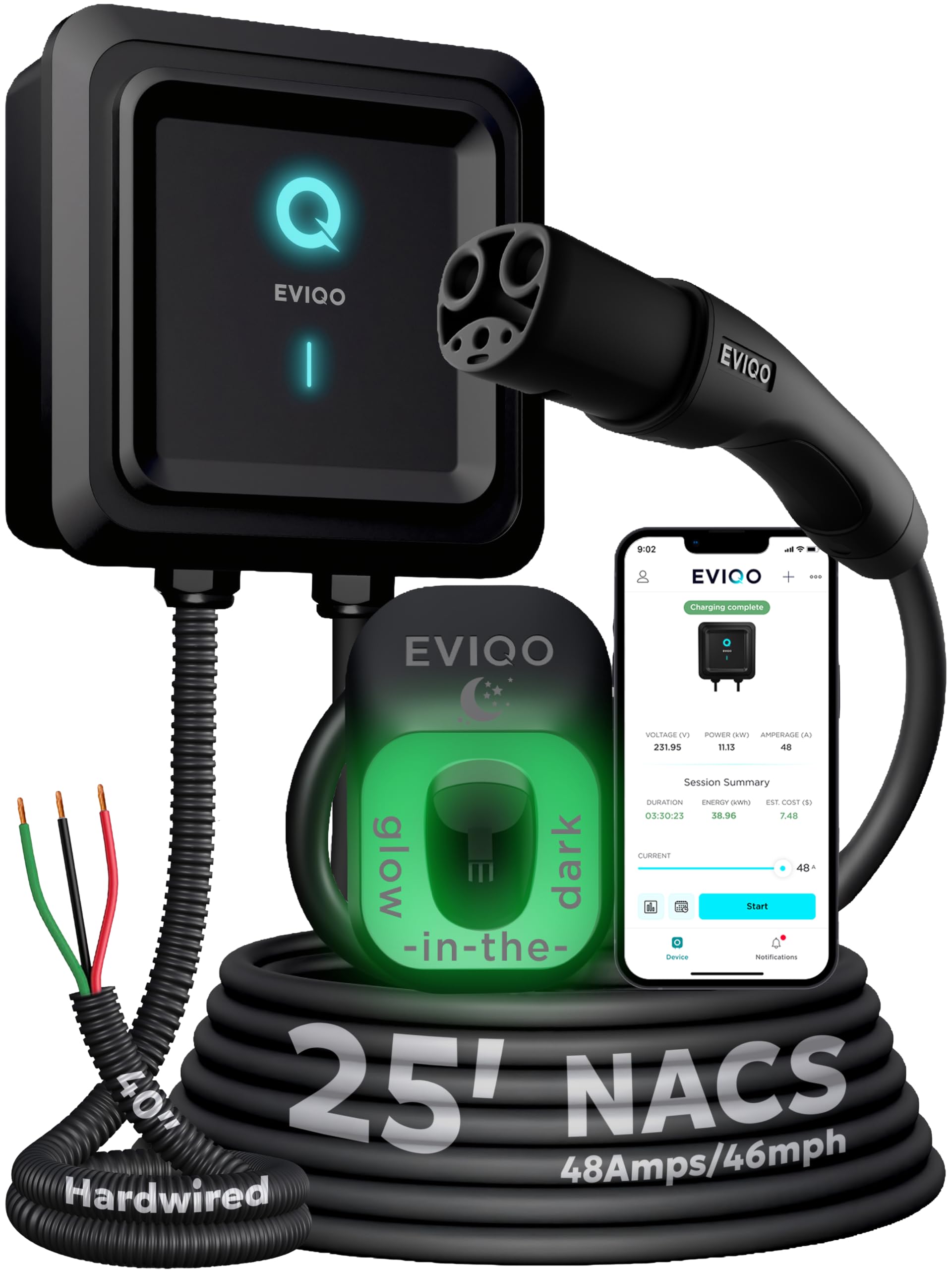
The fastest native Tesla plug with a glow-in-the-dark holster.
If you drive a Tesla, this is the simplest path to 48-amp home charging. The NACS connector plugs directly into your Tesla’s port — no adapter needed — and the holster glows after light exposure, so you can find it in a dark garage. It delivers up to 48A on a dedicated 60A circuit, which is enough to refill most Teslas overnight. Buyers report it “charges VW ID4 fully in 5-7 hours,” and the app lets you adjust current from 6A to 48A, track consumption, and estimate cost.
The build quality is a crowd favorite — functionality and quality are the top two praised aspects by a wide margin. It’s UL and ETL certified, and the IP66/NEMA-4 weatherproof enclosure means rain, snow, or dust won’t bother it.
The catch: it’s hardwired only, so you’ll need an electrician to install it. Also, the PC board is connector-specific — you cannot swap the NACS cord for a J1772 later without a converter.
Speed you can feel: At 48A, this is among the fastest home Level 2 chargers. The glow holster is a genuinely useful touch, not a gimmick.
One honest trade-off: Not plug-and-play. Installation requires hardwiring to a 60A (or optional 70A) circuit by a licensed electrician.
Grab this if: You own a Tesla and want a dedicated, high-speed home charger without fiddling with adapters every night.
Look elsewhere if: You need a plug-in unit to use an existing outlet, or you drive a non-Tesla EV without a NACS-to-J1772 adapter.
2. Emporia Level 2 EV Charger 48 Amp
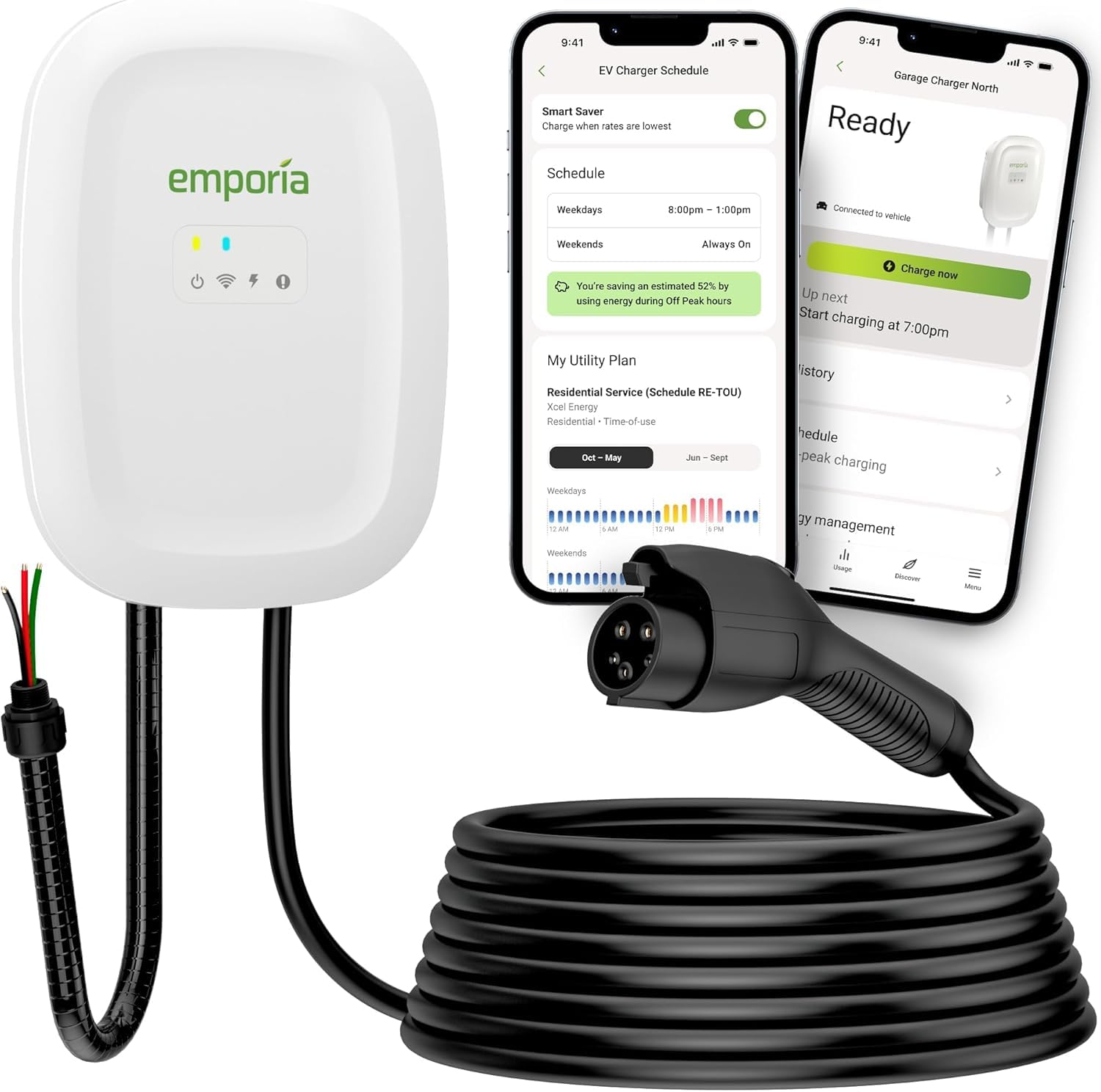
Tracks every kilowatt and schedules charging around your utility rates.
You get the most range per hour of any pick here — the Emporia delivers up to 46 miles of range per hour on a hardwired 48A connection (9 times faster than a standard wall outlet). Reliability is the single most-praised trait: owners across hundreds of reviews trust it to just work. The app separates it: it schedules charging during your cheapest off-peak hours, tracks kWh and dollar cost per charge, and integrates with Emporia’s Vue energy monitor for whole-house load management. Buyers who want a smart charger with the fastest home speed should pick this over the simpler Lectron.
Multi-car households will appreciate its power-sharing ability, and the 25-foot J1772 cable is flexible even in cold weather. The crowd also loves the build quality and ease of use — the two next most-discussed positives. It’s UL listed and Energy Star certified.
The minor pinch: the included mounting screws are reportedly cheap; a quick hardware store run solves it. And for advanced features like solar-only charging, a separate Emporia Vue monitor is needed.
What wins people over
- Reliable, no-fuss daily charging
- Excellent app with cost tracking and scheduling
- Integrates with Emporia Vue for solar and load management
Know before you buy
- Mounting hardware is low quality — plan to replace screws
- Advanced features require the Vue ecosystem add-on
Best for: Owners who want a rock-solid smart charger with deep energy tracking, especially if you already use Emporia’s energy monitor.
skip it if: You want a simple plug-in unit — this ships preconfigured for hardwired installation.
3. Autel Level 2 EV Charger 50 Amp Hardwired
A 50-amp hardwired charger for the fastest home fills, backed by Autel’s automotive legacy.
The Autel MaxiCharger Home is one of the few residential chargers that goes up to 50 amps (hardwired only). That means it can charge any EV or plug-in hybrid up to 9 times faster than a Level 1 outlet, with adjustable power from 6 amps all the way up. Owners of a 2020 Hyundai Ioniq EV report a full charge in about 6.5 hours at roughly 26-28 miles per hour. The Autel Charge app lets you track costs, start/stop sessions, and schedule around off-peak rates, and it connects via Bluetooth, WiFi, Ethernet, CAN, and RS485 — unusual versatility. Reliability and ease of installation are the most frequently praised aspects.
Safety-wise, it’s CSA certified to UL standards and carries a NEMA 4X rating for all-weather outdoor use. Autel, a company known for automotive diagnostic tools since 2004, backs it with a 3-year warranty.
The downside: some units shipped without the manual’s power-limit dial settings; the manual is available online, but it’s an annoyance. Also, the app’s early-unplug behavior (no abort-charge feature) is a small quibble for Ioniq 6 owners.
Blistering speed: 50 amps is the highest amperage available in this class — your car will hit its maximum charge rate as long as it supports the power.
The honest trade-off: It’s heavier than many competitors (almost 21 pounds) and hardwiring is mandatory for speeds above 40 amps.
Reach for this if: You want the fastest possible home charging and your EV can accept 48-50 amps.
Look elsewhere if: You need a plug-and-play unit for an existing 14-50 outlet, or you prefer a lighter, smaller wall box.
4. IYILO Level 2 EV Charger 48 Amp
The only charger here that safely shares one circuit between two units without overloading.
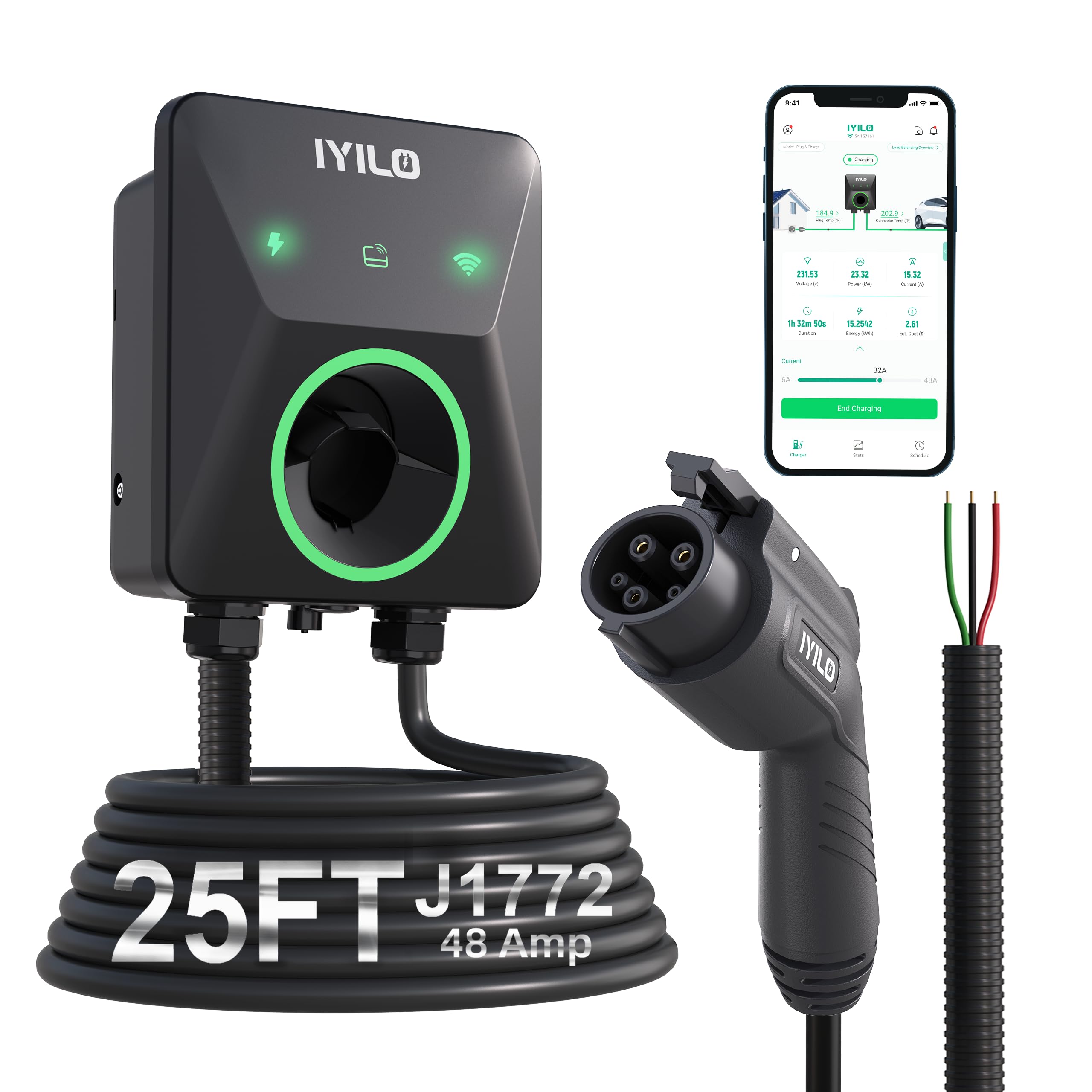
The IYILO brings two rare features: Power Sharing (two chargers on one breaker) and dynamic load balancing with an optional Energy Meter, which automatically adjusts charging speed so your home’s panel never trips. At a full 48 amps, it delivers up to 46 miles of range per hour. What wins owners over most is the temperature monitoring — a built-in NTC sensor tracks the connector’s temperature. If it exceeds 221°F, the system cuts power automatically to protect your EV. The app is intuitive for setting time-of-use rates, tracking cost, and using RFID card start/stop.
The build is solid with a metal locking clip (not plastic), a thick flexible 25-foot cable, and a NEMA 4 waterproof rating. It’s also listed on utility program portals like ComEd and PSEG for potential rebates.
The main hesitation: this is a newer company with a limited track record, and a small number of units arrived with missing installation hardware or scratched cables. Support was quick to resolve those cases.
Its standout tricks
- Power Sharing and dynamic load balancing avoid expensive panel upgrades
- Real-time connector temperature monitoring with auto-shutdown
- Metal locking clip and sturdy cable
Be aware
- Newer brand — quality control on packaging has been inconsistent for some buyers
- WiFi is 2.4GHz only; no 5GHz support
Best for: Multi-EV households with limited panel capacity who want to avoid spending thousands on an electrical upgrade.
Think twice if: You’re risk-averse about a newer brand and prefer a longer track record.
5. WOLFBOX Level 2 EV Charger 40 Amp

Features a 4.3-inch LCD screen that shows charging data in real time.
The WOLFBOX stands out with a 4.3-inch LCD screen that shows charging rate, time, voltage, and total kWh delivered — so you don’t need to pull out your phone to check progress. It’s a 40-amp plug-in unit (NEMA 14-50) that delivers 38 miles of range per hour, which is 7 times faster than a Level 1 charger. Functional performance and build quality are the top praised aspects among owners, and the app supports Alexa and Google Assistant voice control. The RFID card included means you can authorize a guest without sharing your app password.
The 25-foot cable gives plenty of reach across a two-car garage, and the CSA-certified NEMA 4X housing keeps it safe outdoors in all weather.
The WiFi connectivity gets mixed feedback — some owners found the initial connection tricky. And the RFID card stays active after a session, so anyone who knows the card code could restart charging without authorization.
At-a-glance data: That 4.3-inch screen is genuinely rare in this price range and keeps you informed without an app.
The honest catch: Time-of-use scheduling requires the car to be plugged in before the window starts; unplugging resets the schedule.
Reach for this if: You want a visible display of charging status and like the idea of voice control with Alexa.
Pass if: You need flawless WiFi connectivity — the mixed reviews on this point suggest it’s not for network-troubleshooting-averse buyers.
6. MACH 1 Level 2 EV Charger 40 Amp
Includes a 30-foot cord and a Tesla adapter — one charger for every EV in the driveway.
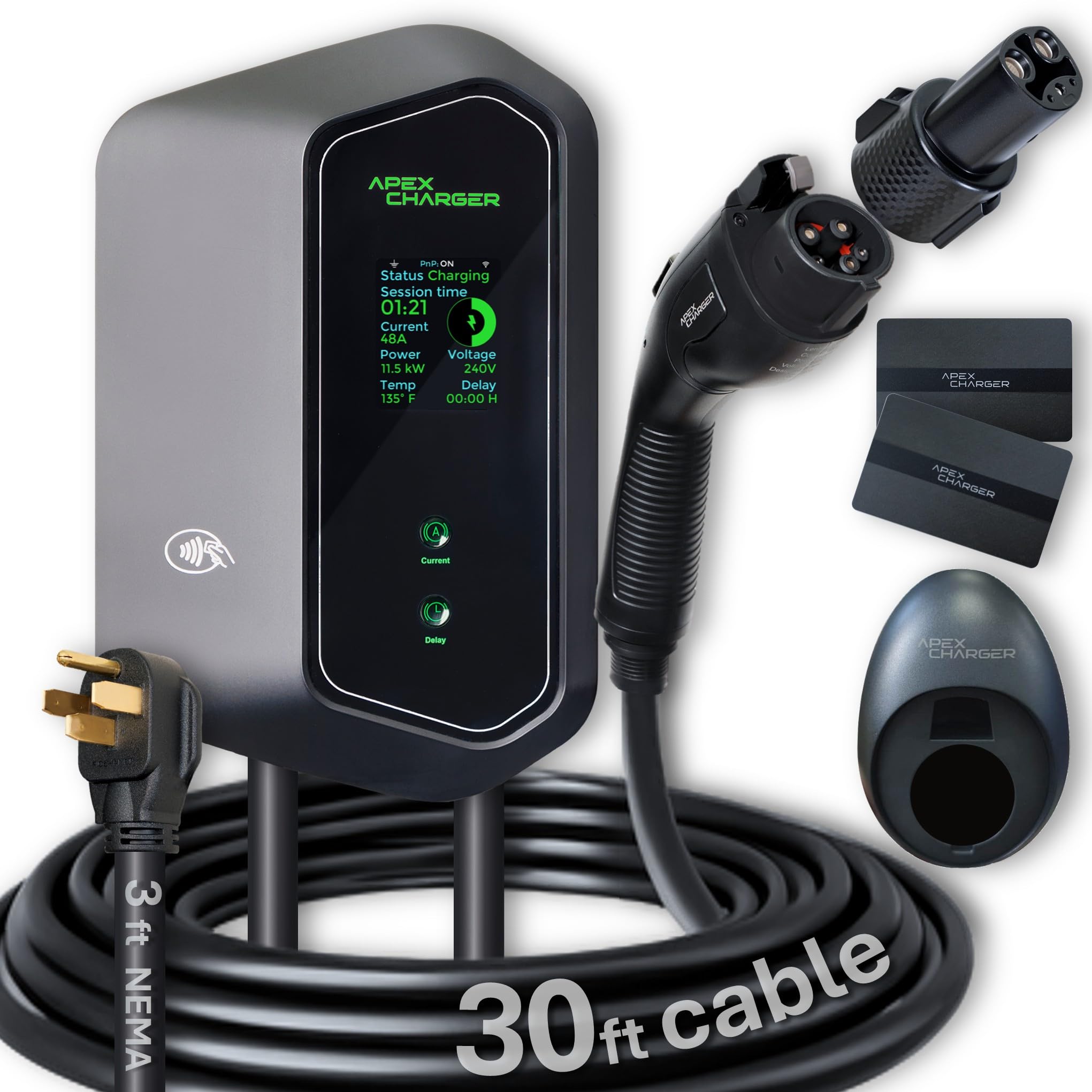
The MACH 1 from ApexCharger covers both major connector standards right from the start: a J1772 plug for most non-Tesla EVs plus a PRO 1 NACS adapter for Teslas. At 40 amps (or 48 amps when hardwired), it charges fast enough for daily use. The 30-foot cable is the longest in this lineup, giving you freedom to park anywhere in a two-car garage or even across the driveway. Build quality and reliability are the most praised attributes, and the 2.4-inch display shows essential charging info.
The unit is ETL certified and Energy Star certified, with a NEMA 14-50 plug for simple installation. Two RFID cards are included for security. Owners mention great customer support — one even got an overheating error fixed within an hour on a Sunday evening via email.
A few early reviews noted a time-of-day scheduling bug that was fixed in a firmware update around October 2024, so the current batch should be fine. The 2.4-inch display is not as large or detailed as the WOLFBOX’s 4.3-inch screen.
Why it’s a crowd-pleaser
- 30-foot cable is the longest in the guide — great for awkward garage layouts
- Includes a Tesla adapter, saving you –
- Responsive customer support even during weekends
Minor gripes
- Time-of-day scheduling still lacks individual day selection after the fix
- Screen is smaller than the WOLFBOX’s display
Best for: Multi-EV households with both a Tesla and a J1772 vehicle — one charger, no extra purchases.
Consider alternatives if: You need a compact unit or you don’t use scheduling features at all.
7. Lectron Level 2 EV Charger 40 Amp

No apps, no accounts — just plug it in and charge.
The Lectron is the simplest Level 2 experience you can buy — a 40-amp, 9.6kW charger with a NEMA 14-50 plug that connects to any J1772 EV. There is no WiFi, no app, no screen — just a status LED, and buyers love that. Reliability is the top praised aspect, followed closely by build quality. The 16-foot cable is 56% shorter than the EVDANCE’s 25-foot cord, so check that your outlet is close to your parking spot. Skip this if you need app scheduling or a longer reach; pick the Emporia instead for smart features.
It’s ETL and Energy Star certified, IP65 rated for dust and water resistance. The cord is thick enough that one owner accidentally ran over it without damage.
The durability gets mixed marks — a few reports of prongs oxidizing after months of sitting idle, though customer service handled replacements quickly. Also, the Lectron’s 16-foot cable is noticeably shorter than the EVDANCE’s 25-foot cord (a 56% gap), so it’s less forgiving of distant parking spots.
Zero-fuss operation: For anyone who hates smartphone sign-ups, this is the charger. It just works.
The trade-off: The 16-foot cable is the shortest here — plan your outlet location carefully.
Reach for this if: You want the cheapest reliable Level 2 charger without any smart features to configure or break.
pass on it if: Your outlet is far from your parking spot. The Lectron’s 16-foot cable may not reach.
8. EVDANCE Level 2 EV Charger 24 Amp
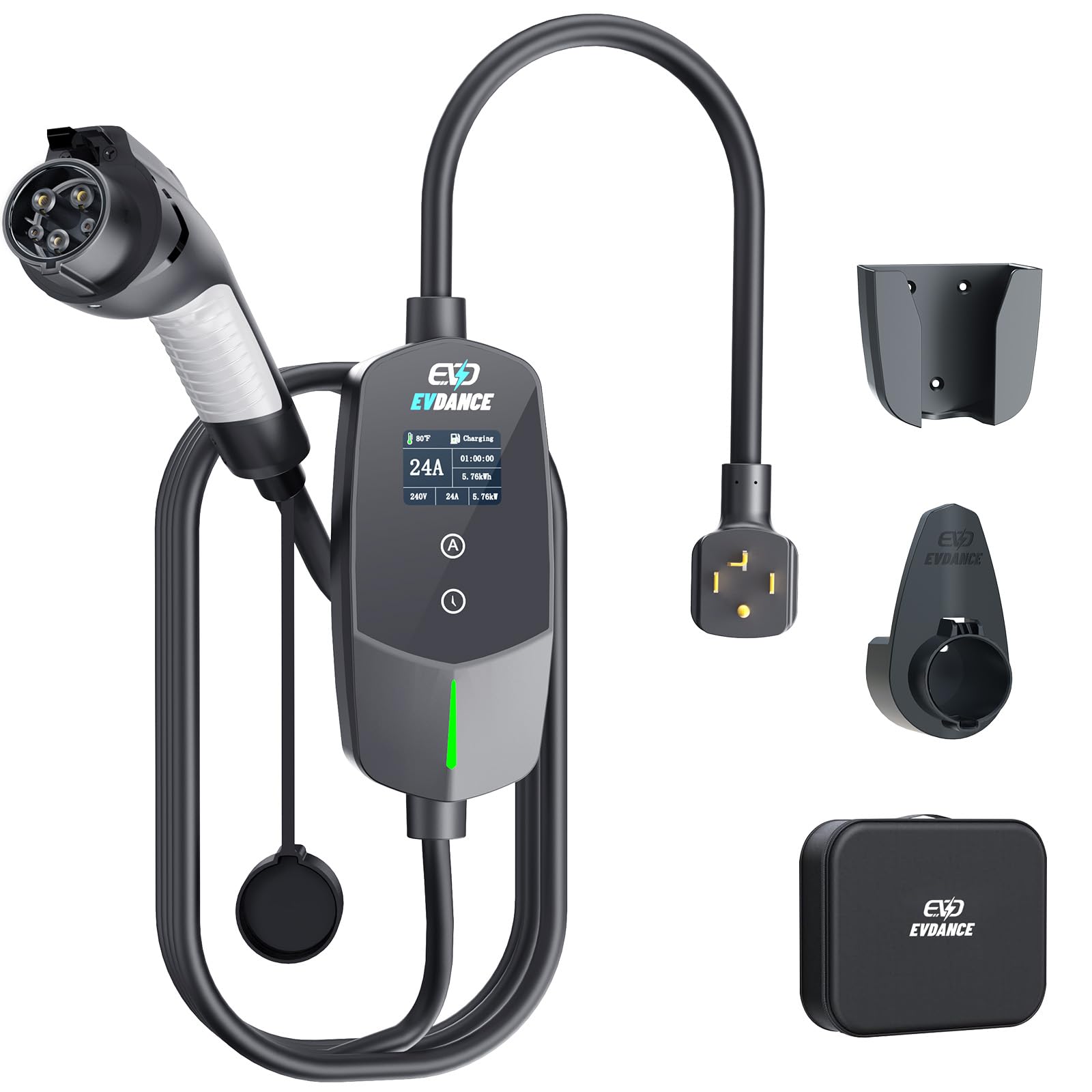
The one that plugs into your dryer outlet — no electrician, no costly rewiring.
Most Level 2 chargers assume you have a NEMA 14-50 outlet. But many homes have a NEMA 14-30 for the clothes dryer, and the EVDANCE is built specifically for that. It runs at 24 amps (adjustable down to 10 amps for older wiring) and can recharge a BMW i4 from 20% to 80% in about 9 hours. That’s still 75% faster than a standard 120V outlet. The 25-foot cable is a welcome feature — 56% longer than the Lectron’s 16-foot cord — so it can stretch from the laundry room to the garage.
Functionality and build quality are the most-praised aspects. The smart display shows real-time voltage, current, and power, plus safety alerts. An IP66 weatherproof rating means it works in rain and dust, and the UL 94 V-0 fireproof casing and silver-plated connectors add durability.
The narrow fit: it uses only NEMA 14-30 outlets — not 14-50, 6-50, or standard 5-15 outlets. And at 24 amps, it charges roughly half as fast as a 48-amp unit (a 2.0x gap). It’s a great fit for a specific scenario, not a universal speed demon.
What makes it special
- Works with existing 14-30 dryer outlets — no expensive electrical work
- 25-foot cable is generous for a plug-in unit
- Adjustable current from 10A to 24A for older or newer wiring
Its limits
- 24A is half the speed of 48A chargers
- Only works with NEMA 14-30 outlets — not a universal plug
Best for: Renters or homeowners with a 14-30 dryer outlet near the garage who want Level 2 speed without calling an electrician.
Not for: Anyone who owns a Tesla (needs a separate J1772 adapter) or drivers who need the fastest possible fill.
9. Splitvolt Level 2 Smart EV Charging Station 50A
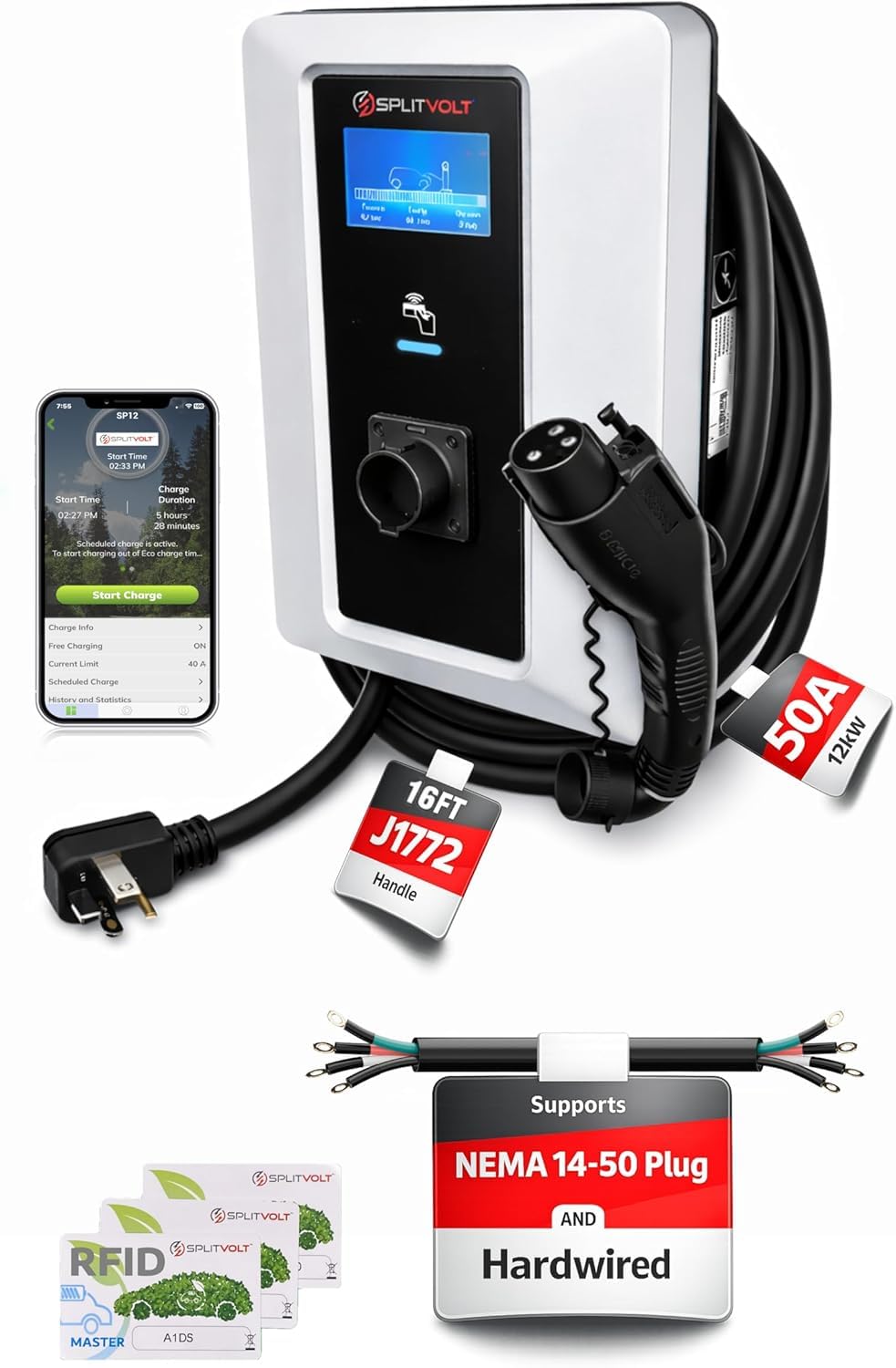
A commercial-grade charger that speaks OCPP for solar and fleet setups.
The Splitvolt is built for flexibility beyond a single car in a garage. It’s OCPP-compatible (the open standard for EV charging networks), so it can integrate with solar systems, smart grid programs, and energy management platforms. At 50 amps, it delivers 12 kW of power — up to 45 miles per hour — and the current is adjustable from 8 to 50 amps. It also supports power sharing so two chargers can run on one circuit. Functional performance is the top praised trait, along with charging capacity.
It’s a plug-and-play unit with a NEMA 14-50 plug, or you can hardwire it for the full 50-amp speed. The NEMA 3S weather rating means it handles rain, snow, and temperatures from -31°F to 131°F. RFID key cards add access control, ideal for shared driveways.
The durability receives mixed feedback — one unit failed after 13 months, which was just past the warranty period. The 16-foot cable is shorter than average, and the build has a plasticky feel that some owners note.
Network-ready: OCPP compatibility makes this unique — it can talk to solar controllers, utility programs, and even commercial charging networks.
The honest trade-off: That 16-foot reach limits placement options, and long-term durability is less proven than the Enphase or Emporia.
Reach for this if: You have solar panels, a home battery, or want to participate in utility smart-charging programs.
Pass if: You just need a simple, durable charger for one car and don’t care about network integration.
10. Autel Level 2 EV Charger 40 Amp Plug
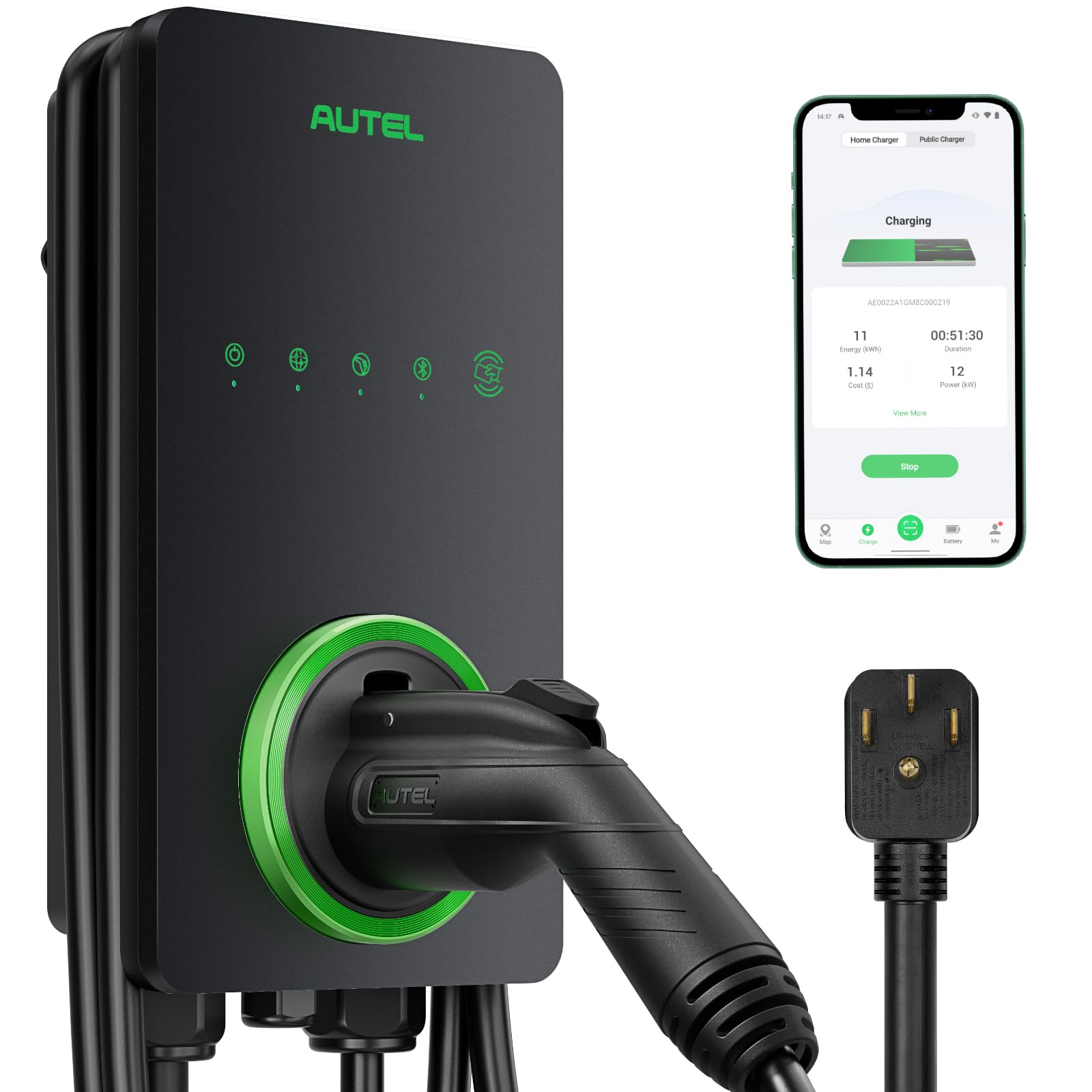
Mount it on the wall in five minutes and charge 9x faster than a wall outlet.
This is the plug-in version of Autel’s popular hardwired unit, designed for owners who want a quick, portable install. It connects to a standard NEMA 14-50 outlet and delivers up to 40 amps, adjustable from 16 to 40 amps via the Autel Charge app. Owners praise the charging performance and how easy it is to install — the two most common praise points. The app gives you start/stop control, scheduling, and cost tracking. The 25-foot J1772 cable is thick and flexible, and the NEMA 4X rating means it’s ready for outdoor mounting.
Autel backs it with a 3-year warranty and automatic OTA firmware updates, so the charger stays current without manual effort. The dark gray design is sleek enough to leave visible on a garage wall.
Connectivity gets mixed feedback — some owners had trouble with WiFi setup initially. Also, if you need to restrict the unit below 50 amps (say for a 30-amp circuit), you must remove multiple covers to set the internal DIP switch, which feels over-engineered.
Its best features
- True plug-and-play installation in under 10 minutes
- 3-year warranty and OTA updates
- Excellent build quality and app functionality
Things to know
- WiFi setup can be finicky for some users
- Internal DIP switch for current limiting is buried behind multiple covers
Best for: Owners who want Autel’s quality and app but prefer a plug-and-play unit they can take with them when moving.
Consider the hardwired version instead if: You have a dedicated 60-amp breaker and want the extra speed of a 50-amp unit.
11. Enphase HCS-50 40 Amp Plug-in EV Charger

Formerly ClipperCreek, this one was built to survive commercial parking lots — and it shows.
The Enphase HCS-50 (born from the legendary ClipperCreek) is the industrial-grade choice for outdoor installation. It delivers 40 amps / 9.6 kW via a NEMA 14-50 plug, built inside a NEMA 4 fully sealed enclosure (originally designed for commercial car charging stations) so it shrugs off rain, snow, dust, and extreme temperatures. Functionality and build quality are the most praised aspects by owners, and Enphase backs it with a 5-year limited warranty — the longest in this guide. The 25-foot cable is rugged, with an integrated cable wrap and wall-mounted holster. Customers note it is heavier and pricier than the Lectron, but worth it for harsh weather.
This charger is compatible with all plug-in EVs sold in the US, and it’s ETL certified to UL 2594 standards. The unit qualifies for state and federal rebates. One owner with a Chevy Bolt reports charging at 10% range per hour from a 50-amp RV outlet.
The biggest downside: that 12-inch input plug cord is very short — plan your 14-50 outlet placement carefully. And the 16-foot cable (listed in reviews) is actually 25 feet in the current spec — verify the version you buy. At this premium price, there’s no smartphone app or smart scheduling — this is an appliance, not a gadget.
Commercial-grade build: The NEMA 4 enclosure and thick cable are clearly over-engineered for home use, which means exceptional longevity.
The honest trade-off: No app, no scheduling, no WiFi — this is the opposite of a smart charger. Also, the 12-inch plug cord is frustratingly short for some garage layouts.
Reach for this if: You want the most durable, simplest, longest-lasting charger possible and you don’t care about smart features.
it’s not for you if: You need app control, time-of-use scheduling, or a longer input cord.
Understanding the Specs
Amperage and Charging Speed
The amperage rating of a Level 2 charger determines how fast it can fill your battery. A 48-amp charger on a 60-amp circuit adds about 46 miles of range per hour. A 24-amp charger on a 30-amp circuit adds about 15-20 miles per hour. Your car’s onboard charger also sets a limit — if your car maxes out at 32 amps, a 48-amp charger won’t charge it any faster than a 32-amp one would.
Plug-in vs Hardwired Installation
A plug-in charger uses an existing 240V outlet (usually NEMA 14-50) and can be moved easily — great for renters. A hardwired charger connects directly to the breaker panel, which often supports higher amperage (up to 48-50 amps) and eliminates the outlet as a failure point. Hardwired units almost always require a licensed electrician to install.
FAQ
What is the difference between Level 1 and Level 2 EV charging?
Can I install a Level 2 EV charger myself?
What size circuit breaker do I need for a 48-amp charger?
Will a J1772 charger work with a Tesla?
How long does it take to fully charge an EV with a Level 2 charger?
What is the difference between NEMA 14-30 and NEMA 14-50 outlets?
Do I need a smart EV charger with WiFi and an app?
What does IP66 or NEMA 4 mean for an outdoor EV charger?
Is dynamic load balancing worth paying extra for?
What is the 30% federal tax credit for home EV chargers?
Final Thoughts: The Verdict
For most buyers, the at home ev chargers winner is the EVIQO NACS Charger for Tesla because it delivers the full 48-amp speed with a native NACS plug and an innovative glow holster. If you want a rock-solid smart charger with deep energy tracking, grab the Emporia Level 2 Charger. And for drivers with a 14-30 dryer outlet who want fast Level 2 charging without an electrician, the EVDANCE 24-amp charger is the one to reach for.
How We Picked
We do not accept paid placement. Every pick is matched to a real buyer and a real use-case; we do not hands-on test units.
Sources & Methodology
Specifications: manufacturer listings and product documentation. Review insights: verified customer reviews, as of July 2026. Pricing: not shown on this page (it changes often); check the current price via the retailer link.
As an Amazon Associate, Gadgets Feed earns from qualifying purchases. This does not affect which products we feature.