
Our readers keep the lights on and my morning glass full of iced black tea. As an Amazon Associate, I earn from qualifying purchases.
Specs are compiled from manufacturer listings and verified buyer reviews and can change over time — please confirm the key details on the product page before buying.
You need a liquid that turns into a rock-solid or flexibly tough part in minutes—not hours. But not all two-part polyurethane rubber is the same. Some flow like water into the tiniest mold details. Others set so fast you have to race the clock. A few are brittle; a few are indestructible. This guide lines up the top 2 part polyurethane rubber options so you grab the right formula for your project—without wasting a single batch.
I’m Min — the founder and writer behind Gadgets Feed. This guide is built by comparing the manufacturers’ published specifications and the patterns across verified customer reviews, so you get each pick’s real strengths and trade-offs instead of marketing spin.
Whether you are casting figurines, fabricating prototype parts, or engineering custom gaskets, the right 2 part polyurethane rubber defines whether your project looks crisp and holds up or crumbles in your hands.
Our Picks at a Glance

How To Choose The Best 2 Part Polyurethane Rubber
Picking the wrong resin wastes material, ruins molds, or yields brittle parts. Here is what you need to match to your project.
Cure Time and Pot Life
The “pot life” is your working window after mixing part A and part B. Some formulas set in 1 minute—you must pour instantly. Others give you 15 minutes. Fast-cure resins let you batch-produce many parts in an afternoon. Slower-cure resins give beginners breathing room and let trapped air escape before the liquid hardens. Align cure time with your skill and mold complexity.
Hardness vs. Flexibility
Rigid resins (measured in Shore D, like 75D) produce a hard, machinable plastic—ideal for prototypes and figurines that need to hold a sharp edge. Flexible rubbers (measured in Shore A, like 80A) feel like a tough eraser or a rubber bushing and are better for gaskets, shock absorbers, or parts that bend. A flexible resin is not a “soft” resin—it is tough and springy.
Viscosity and Bubble Release
Low-viscosity resin flows like water into the finest mold crevices, capturing every detail. But thin liquid also traps air easily. Very fast-curing resin sets before bubbles can rise out, so you may need a vacuum chamber or pressure pot. Slower-setting, low-viscosity resin gives bubbles time to escape naturally. If your molds are simple and open-faced, you can skip the degassing gear.
Quick Comparison
| Model | Best For | Total Volume | Hardness | Cure Time | Amazon |
|---|---|---|---|---|---|
| SRC Model-Pro★ Best Overall | Detail casting & painting | 32 fl oz | Rigid | 15 min | Amazon |
| Pourpals Polyurethane ResinBest Value | Budget-conscious batch work | 60 fl oz | Rigid | 10-15 min | Amazon |
| Enduro Soft | Flexible, durable parts | 32 fl oz | Soft rubber | ~5 min pot life | Amazon |
| Enduro Flex | Bushings & motor mounts | 32 fl oz | 80 Shore A | ~7 min pot life | Amazon |
| LET’S RESIN | Mass-producing small parts | 60 fl oz | Shore 75D | 10 min | Amazon |
| Limino Polyurethane Resin | Large, detailed pours | 72 fl oz | Rigid | 10 min | Amazon |
| Bond Craftor | Fast jewelry & small casts | 64 fl oz | Shore 75D | 10 min | Amazon |
In‑Depth Reviews
1. SRC Model-Pro Off White 32 Oz
Our pick — over 4.5★ from 450+ verified ratings; the strongest balance of quality and price.
The model-maker’s go-to for crisp details and a ceramic-like finish.
This kit delivers a water-like viscosity (buyers call it “water like viscosity”) that flows into every engraved line of your mold, so even the tiniest textures pop. It sets in 15 minutes—fast enough to keep a project moving, slow enough that a beginner can pour without panic. The off-white color finishes with a slight shine, “reminds me of ceramic” as owners put it.
Quality is the single most-discussed reason people reach for this—49 buyers single it out. Effectiveness follows at 45 mentions. The durability feedback is genuinely split: some find it “very durable” while others describe it as “incredibly brittle.” The trick is in the use-case. For static figurines, props, and decorative casts that you paint and display, this resin is reliable. For parts that will take a beating, look elsewhere.
At 32 fluid ounces, you get less volume per kit than some of the budget-friendly options—but the higher quality and wider approval margin justify the trade-off. And it beats the Pourpals resin by a noticeable quality margin, with the review pages consistently praising its finish.
What Wins People Over
- Flows like water, captures razor-sharp mold detail
- 15-minute cure is forgiving enough for first-timers
- Off-white ceramic shine paints beautifully
The Real Trade-Off
- The brittleness split is real—this is not for load-bearing or flexible parts
- 32 oz kit is smaller than several competitors at the same price
Reach for it if: you need a reliable, fast-casting resin for detailed models or painting projects that won’t see heavy stress.
Look elsewhere if: the piece needs to flex, bend, or survive repeated impact—go for a flexible formula like the Enduro picks below.
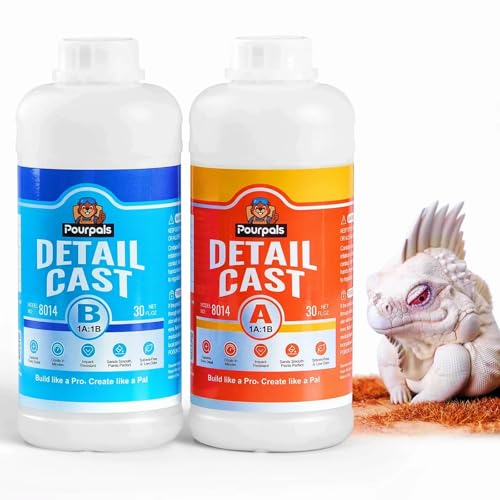
2. Pourpals Polyurethane Resin 60oz
Massive 60-ounce kit that works just as well as the premium brands.
You get 60 oz of material compared to the SRC Model-Pro 32 oz kit for a lower price—that is the headline. The resin cures to a “stark white” finish and sets in 10-15 minutes after a quick 10-second stir. Buyers who have used several casting resins say “this one is no lower quality than the costlier options.” The ultra-low viscosity means it captures every detail, and the low odor formula makes indoor work far more pleasant than typical polyurethane.
The catch is precision. Several owners warn that the 1:1 ratio must be exact—use a digital scale. One batch failed to cure until the user changed their mixing technique (pour back and forth between cups, stir until warm). And the bottles can arrive unevenly filled, which feels misleading at first glance even though the total weight is correct. Budget-minded builders should still grab this: it delivers professional-grade casts without the name-brand premium.
Best for volume casting: At 60 fluid ounces with a 10-15 minute cure, you can batch-produce pieces all afternoon while staying affordable.
Smart-buyer caveat: Verify your 1:1 ratio by weight, not just volume, to avoid a sticky fail.
Grab this for: high-volume model or prototype runs where cost-per-cast matters more than a few minutes of work time.
Think twice if: you want a forgiving, no-fuss beginner resin—the precision requirement and fast cure can trip up first-timers.
3. Enduro Soft – 2 Part Liquid Polyurethane Casting Rubber

Tough rubber that feels like a flexible eraser—not a brittle plastic.
This is a true casting rubber, not a rigid resin. Owners are emphatic: “I’m super impressed with the durability of this rubber.” It casts in an amber-clear color and has a smooth, eraser-like texture that holds up well to bending and impact. A beginner used it for waterproof cable splices and reported the result was “waterproof, tough, flexible”—the rubber bonded perfectly inside an HDPE mold without any mold release.
The working time is tight—about 5 minutes. A buyer with experience recommends mixing with a submerged drill for 45+ seconds to avoid bubbles, then letting it cure for 2 hours. Durability is the most mentioned aspect (9 mentions), but Amazon flags it as mixed: some owners find it holds up well, others report it can bond aggressively to a sculpture despite mold release. This is a fantastic rubber for functional parts, gaskets, and flexible molds, but it demands respect for the mixing and demolding process. Dye will ruin the batch; use epoxy pigment or mica powders instead.
Real talk on durability: The crowd is split—it is tough and flexible when used correctly, but bonding failures do happen. Follow the instructions to the letter.
Reach for this if: you need a soft, resilient rubber part that can flex and absorb shock—the opposite of brittle casting resin.
Skip if: you want a simple pour-and-walk-away material; this one requires aggressive mixing and precise timing.
4. Enduro Flex – 2 Part Liquid Polyurethane Casting Rubber

An 80 Shore A hard rubber that made motor mounts for an H3 Hummer.
This is not a decorative resin. It is a functional rubber formulation with an 80 Shore A hardness, and people use it for real mechanical repairs—engine mounts, bushings, and vibration-dampening parts. A verified buyer cast motor mounts for an H3 Hummer and found the rubber “slightly stiffer than OEM” but effective at absorbing vibrations. Another owner made thin 1-2mm parts that were “unrippable by hand.” The 1:1 mix ratio by weight and volume is straightforward, and the demold time is 2-3 hours.
The trade-off is plain: this resin requires discipline. The pot life is about 7 minutes at 74°F, and it cures faster in large pours due to exothermic heat. At cooler temperatures (69°F), the cure can take days. Bubbles are a real problem—you need slow stirring or a vacuum chamber/pressure pot for bubble-free casts. One owner summed it up: “Product works but there’s a lot of air bubbles. You need other equipment.” This is a specialist rubber for those who already own degassing gear and know how to manage exothermic reactions.
Who this is for: Repair engineers and advanced hobbyists who need a hard, tough rubber that can replace automotive bushings or machine mounts.
The honest limit: Not beginner-friendly—requires preheating, fast mixing, and vacuum/pressure equipment for consistent results.
Reach for this if: you have a mechanical repair that needs a vibration-resistant, 80 Shore A rubber part and you already own degassing kit.
Look elsewhere if: you just want to cast decorative figurines—this is overkill and the bubble management will frustrate you.
5. LET’S RESIN Polyurethane Resin, 60oz

A crowd-favorite polyurethane that artists trust for high-output casting.
Quality is the top reason people flock to this resin—67 owners highlight it. Curing speed (42 mentions) is right behind. This is a Shore 75D rigid plastic that cures in 10 minutes, and the low-viscosity formula means you can pour bubble-free without a vacuum chamber (as long as you work fast). It cures to an opaque white finish that is machinable, paintable, and waterproof. A resin artist calls it “the best polyurethane resin I have found.”
The catch is the 2-minute working window. That is very tight. You must have your mold ready, your pour planned, and your movements efficient. Buyers warn it “doesn’t work well with alcohol inks” and “you need to work quickly once you mix both parts up.” The value-for-money split (14 mentions, mixed) suggests that at this price, some owners expect more volume or less brittleness. For mass-producing small parts like 3D-printed terrain or figurines, the speed is a superpower—but one mistake costs a whole batch.
Why It Wins
- 67 buyers call out quality—the highest count in this comparison
- 10-minute demold time enables rapid batch production
- Low viscosity fills intricate details without a pressure pot
Where It Bites
- Only 2 minutes of working time—no room for hesitation
- Brittle after curing, so not for flexible or load-bearing parts
- Value-for-money feedback is mixed at this price point
Reach for this if: you are casting high volumes of small, rigid parts and can commit to a fast, disciplined workflow.
skip it if: you are a slow, careful pourer or need the final part to survive impacts without cracking.
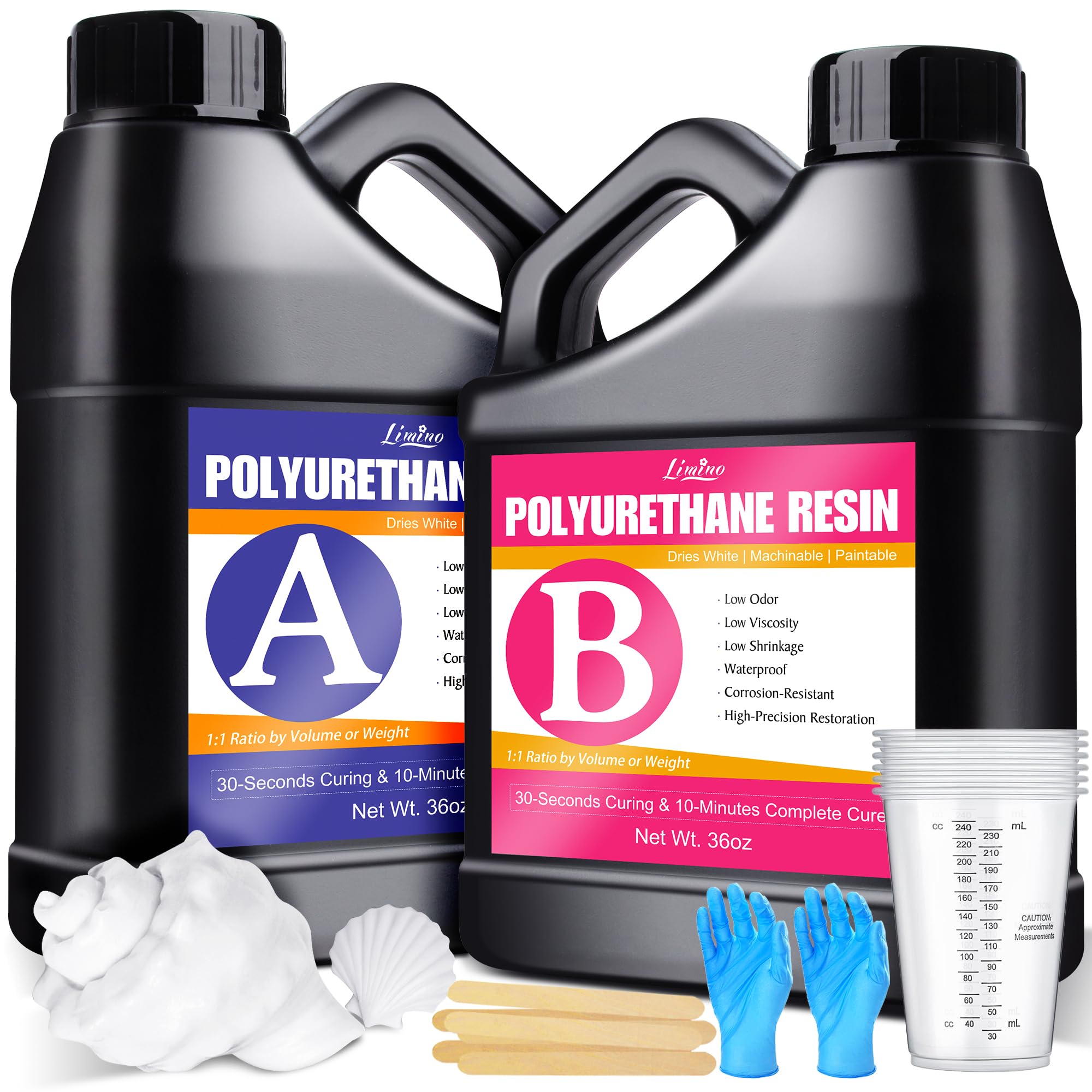
6. Limino Polyurethane Resin 72oz
The biggest kit on this list—72 ounces of fast-curing, detail-grabbing resin.
Volume alone sets this apart: 72 fluid ounces gives you the most material per purchase among all the picks here. It cures in 10 minutes with a 1:1 mix ratio by weight or volume, and the ultra-low viscosity seizes every crevice of a complex mold. A buyer who used it to fill structures says it “works amazingly good” for fast results. The 4.5-pound kit delivers a hard, rigid plastic that buyers describe as “nice hard PU.”
The speed comes with heat. One owner notes it “becomes massively exothermic when curing”—the chemical reaction pumps out heat, which can be a problem for thin molds or heat-sensitive silicone. Air bubbles are another price of speed: the fast cure traps bubbles before they escape. If you are filling large, open molds where heat dissipation and bubble visibility are manageable, this is a powerhouse. For fine jewelry molds or precision miniatures, the exothermic heat can be risky.
Best for big pours: The high volume and fast cure make this ideal for filling large molds or producing many copies quickly.
Caution: Manage exothermic heat and plan for bubbles—this is not a set-and-forget formula.
Reach for this if: you need maximum material volume and can work fast with large, simple molds.
Think twice if: your mold is small, delicate, or heat-sensitive—the exothermic reaction can warp or damage it.
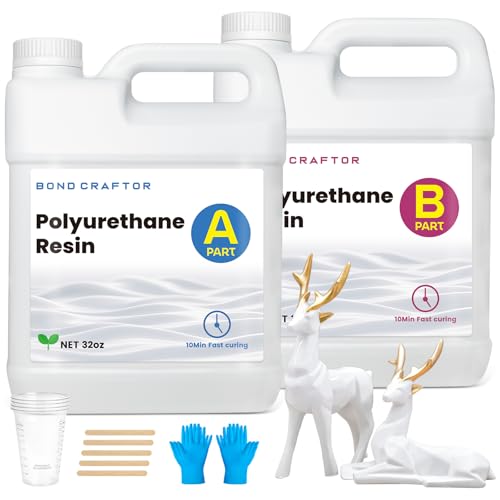
7. Bond Craftor Polyurethane Resin 64oz
A cost-effective 64oz kit that sets fast and releases cleanly from silicone molds.
Buyers consistently call this a “cost-effective alternative to name brand” resin. It sets in about 10 minutes—one owner observed it solidifying within 4 minutes—and demolds cleanly. The kit includes gloves, measuring cups, and stirring sticks, so a beginner has everything they need on first use. The 75D hardness means you get a rigid, lightweight plastic that is easy to grind and sand after curing, and “clear liquid dries white” for a uniform painting base.
Speed is a double-edged sword here too. The 2-minute operation window is short. A buyer noted that “within 4 minutes it starts to solidify,” which means you have to pour immediately after mixing. If you are making jewelry pieces, small prototypes, or home decor ornaments, this is a fantastic value—the empty bottles weigh 2.2 kg full, so you get a lot of usable material. The main limitation is that it cures to a rigid white plastic, not a flexible rubber, so it is not suitable for parts that need to bend.
Great for small-cast volume: 64 ounces goes a long way for pendant-sized molds or prototype runs—buyers who switched from brand names say they “will repurchase.”
Grab this for: DIY jewelry, home decor casts, and prototypes where cost-per-ounce matters more than brand reputation.
Skip if: you need a flexible rubber part—this is a rigid, Shore 75D plastic, not a flexible rubber.
Understanding the Specs
Shore Hardness (Shore D vs. Shore A)
This number tells you how hard the cured resin feels. Shore D (like 75D) is a rigid, machinable plastic—think of a hard hat or a prototype part. Shore A (like 80A) is a flexible rubber—think of a tire tread or a tough eraser. For decorative figurines, go with Shore D. For gaskets, handles, or bushings, go with Shore A. The scale is linear: higher numbers are harder.
Pot Life vs. Cure Time
Pot life is the time you have to pour after mixing. Cure time is when you can demold the part. A 2-minute pot life and 10-minute cure means you must be fast and prepared. A 10-minute pot life and 15-minute cure gives you breathing room. For complex molds with many cavities, choose a longer pot life. For simple molds you are filling repeatedly, a fast cure boosts productivity.
FAQ
What is the difference between 2 part polyurethane rubber and epoxy resin?
Can I use this in silicone molds?
How do I avoid bubbles in my cast?
Why did my resin not cure?
Can I paint over cured polyurethane resin?
How long does a 32 oz kit last?
Is it safe to use indoors?
What happens if I get it on my skin?
Can I machine or drill cured polyurethane resin?
How do flexible polyurethane rubbers differ from rigid resins?
Final Thoughts: The Verdict
Across the board, the best 2 part polyurethane rubber winner is the SRC Model-Pro Off White 32 Oz because it balances fast cure, razor-sharp detail capture, and a paint-ready ceramic finish that model-makers and hobbyists consistently praise. If you want the sheer volume for batch production, grab the Pourpals 60oz resin. And for a tough, flexible rubber part—the kind that absorbs vibration or acts as a bushing—the Enduro Flex 80 Shore A is the one to reach for, provided you own degassing gear and respect the heat.
How We Picked
We do not accept paid placement. Every pick is matched to a real buyer and a real use-case; we do not hands-on test units.
Sources & Methodology
Specifications: manufacturer listings and product documentation. Review insights: verified customer reviews, as of July 2026. Pricing: not shown on this page (it changes often); check the current price via the retailer link.
As an Amazon Associate, Gadgets Feed earns from qualifying purchases. This does not affect which products we feature.