
Our readers keep the lights on and my morning glass full of iced black tea. As an Amazon Associate, I earn from qualifying purchases.
Specs are compiled from manufacturer listings and verified buyer reviews and can change over time — please confirm the key details on the product page before buying.
That new compressor will burn up fast if debris from the old one is still rattling around inside your lines. The right flush tool separates a lasting repair from a six-month redo. This guide compares top AC flush tools for DIYers and pros, focusing on hose length, canister capacity, and operating pressure.
I’m Min from Gadgets Feed. This guide compares manufacturer specs and verified customer reviews to highlight each tool’s real strengths and trade-offs.
Whether you are retrofitting an R12 system or cleaning up a compressor burnout, the right ac flush tool turns a messy, half-day job into a straightforward 30-minute task.
Our Picks at a Glance


How To Choose The Best AC Flush Tool
An AC flush tool’s materials, fittings, and valve design determine whether the job goes smoothly or ends with solvent on your arms.
Canister Material and Capacity
Stainless steel resists solvent corrosion and repeated pressure cycles better than aluminum. Capacity matters, too: a 33-ounce tank is fine for a single hose or evaporator, but a 1-liter (roughly 34-ounce) canister gives you enough volume for multiple components without refilling.
Hose Length and Fittings
A 3-foot hose reaches the condenser on most cars, but SUVs and trucks with rear AC lines benefit from a longer hose—some kits go up to 59 inches. The fitting end is just as critical: 1/4-inch SAE and 1/4-inch NPT are the standards, and having both adapters in the box saves an extra trip to the hardware store.
Nozzle Design and Pressure Control
A rubber-tipped nozzle that seals against the pipe opening prevents solvent spray-back. An accurate pressure gauge helps you stay under the 150 PSI limit for safety.
Quick Comparison
| Model | Best For | Canister Material | Hose Length | Max Pressure | Amazon |
|---|---|---|---|---|---|
| CMTOOL AC Flush Kit★ Best Overall | Best Overall | Stainless Steel | 3.5 ft | 600 PSI | Amazon |
| ZJERYL GULL AC Flush KitBudget Champion | Budget Pick | Stainless Steel | 3.3 ft | 150 PSI | Amazon |
| OMT AC Flush KitPremium Build | Premium Build | Stainless Steel | 3.3 ft | 150 PSI | Amazon |
| POLIWELL AC Flush Kit | Longest Hose | Stainless Steel | 4.9 ft | 150 PSI | Amazon |
| Rossesay AC Flush Kit | Compact Storage | Aluminum Alloy | 35.4 in | 150 PSI | Amazon |
| FJC 2710 | Brand Trust | Steel | — | 150 PSI | Amazon |
| Mastercool 91046-A | Pro Shop Use | Aluminum | 36 in | 150 PSI | Amazon |
| Leak Saver Kit | No Compressor Needed | Pressurized Can | — | 140 PSI | Amazon |
| OEMTOOLS 37377 | Spray-Back Control | Steel | — | 150 PSI | Amazon |
In‑Depth Reviews
1. CMTOOL AC Flush Kit
Our pick — over 4.5★ from 250+ verified ratings; the strongest balance of quality and price.
Thickened stainless steel and zero leaks make this the crowd-favorite canister.
You get a thickened stainless steel canister that handles repeated pressure cycles without deforming, so it lasts. The 3.5-foot hose, at 3.5 ft versus the ZJERYL GULL kit’s 3.3 ft, gives you a bit more reach when routing to a condenser. Brass fittings resist corrosion, and the kit includes a pressure gauge with a 1/4-inch NPT air plug plus an SAE hose adapter (the standard fitting sizes for most air compressors). That means you can start flushing without hunting for extra parts.
Buyers report it “works like it should” and that the blow nozzle holds pressure until you pull the trigger—no dribbling solvent between the hose and the pipe. One owner noted the pressure gauge reads about 20 PSI off from other gauges at the low end, but the same reviewer called it “a nice tool for the price.” The recurring gripe is that the gauge span is off; treat it as a relative reference rather than an absolute reading. Compared to the budget ZJERYL GULL, this kit’s gauge (despite its quirk) and 22 buyer testimonials praising its functionality make it the safer long-term bet.
Built to Last
- Thickened stainless steel canister resists corrosion
- 3.5-ft hose gives extra reach vs many kits
- Includes spare O-rings, gaskets, and two adapter types
Know Before You Flush
- Pressure gauge reads ~20 PSI off at low pressure
- Warning sticker in Chinese only
The top dog: If you want a do-everything flush tool that over 270 buyers rate highly, this is the one to beat. The crowd favorite—4.6 stars across 270+ owners—backs up the “no leaks” claim.
Not for perfectionists: The inaccurate gauge may bug anyone who insists on precise PSI readings; you will need a secondary gauge for that.
2. ZJERYL GULL AC Flush Kit
Heavy duty stainless steel that holds pressure and sturdiness at a sharp price.
The kit includes an air safety valve (a pop-off valve that automatically releases if pressure exceeds a specified limit) — a safety touch rare at this price point. The 3.3-foot hose is shorter than the CMTOOL above but still reaches most under-hood connections. Owners mention it “holds pressure well and feels sturdy,” with one calling it “the best little setup for flushing A/C.” The improved nozzle is designed to reduce spray-back (solvent splashing back at you from the pipe opening), which is the main reason solvent ends up on your shirt. At 1.94 pounds, it is a touch lighter than the CMTOOL (2.03 pounds), so it is easier to maneuver in tight engine bays.
The feedback is overwhelmingly positive, though a small number of owners note the hose could be longer for trucks and SUVs. For a one-vehicle flush on a car, this kit delivers everything the pricier options do for less money. The safety valve alone makes it a smarter pick than the CMTOOL if your air compressor regulator is unreliable.
Bang for the buck: A well-built stainless steel flush kit with a safety valve that keeps you under pressure. Best if you are doing a one-vehicle flush and want reliable results without overspending.
The shortcut: For a quick flush on a single car system, this is all you need.
3. OMT AC Flush Kit (Orion Motor Tech)
A half-gallon canister with a high-performance spray head built for repeat jobs.
The 33.5-ounce (roughly 1-liter) canister holds more solvent than most kits, so you can flush the evaporator (the part inside the cabin that cools the air) and the condenser (the radiator-like part in front of the engine) on a full-size SUV without refilling. The heavy-duty stainless steel build and nylon-coated 3.3-foot hose are rated to 150 PSI (pounds per square inch, a measure of air pressure), and the kit includes a 1-year warranty. Owners say it “holds up to a half gallon of solution with maximum pressure” and call it “worth the price” because tool trucks (mobile tool vendors) sell comparable kits for over.
The spray head puts out a stream rather than a controlled mist, and a few buyers caution that it can empty the canister in seconds—only pour small amounts of solvent at a time to limit the mess. If you are doing a full system overhaul that needs sustained solvent flow, this canister’s capacity is a real advantage.
Volume matters: The large can capacity is ideal for multi-component jobs. Reach for it when you need to flush every line and the evaporator without stopping to refill.
Watch the flow: The fast-dump nozzle means you control the trigger, not the tool—a learning curve for first-timers.
4. POLIWELL AC Flush Kit

A 59-inch hose—SUV owners, this is yours.
This is the kit to grab if you are working on a large truck, a minivan with rear AC, or any system where the components sit far apart. The 59-inch hose (4.9 feet) is 88% longer than a standard 3.3-foot hose, which customers note makes reaching under-carriage pipes and rear evaporators (the parts behind the dashboard) genuinely easy. The stainless steel canister holds 150 PSI, a flush gun with a rubber tip seals the pipe opening, and dual pressure gauges plus a relief valve add redundancy. A plastic storage case keeps everything organized. It also works on refrigeration lines for residential HVAC, so you can use it on mini splits and home AC units too.
Owners mention a learning curve for setup and note that solvent is not included, but they call it “great value for DIY AC maintenance.” The only adapter issue: one buyer found the quick-connect was incompatible with their air hose and needed their own adapter. The near-perfect 4.9-star average across 28 ratings speaks for itself. Compared to the CMTOOL which has an inaccurate gauge, this kit’s dual gauges give you a second reference point for accuracy.
Why It Wins
- 59-inch hose reaches rear AC lines easily
- Dual gauges and relief valve for safety
- Includes storage case
A Heads-Up
- Quick-connect may not match your air hose
- Solvent not included
5. Rossesay AC Flush Kit
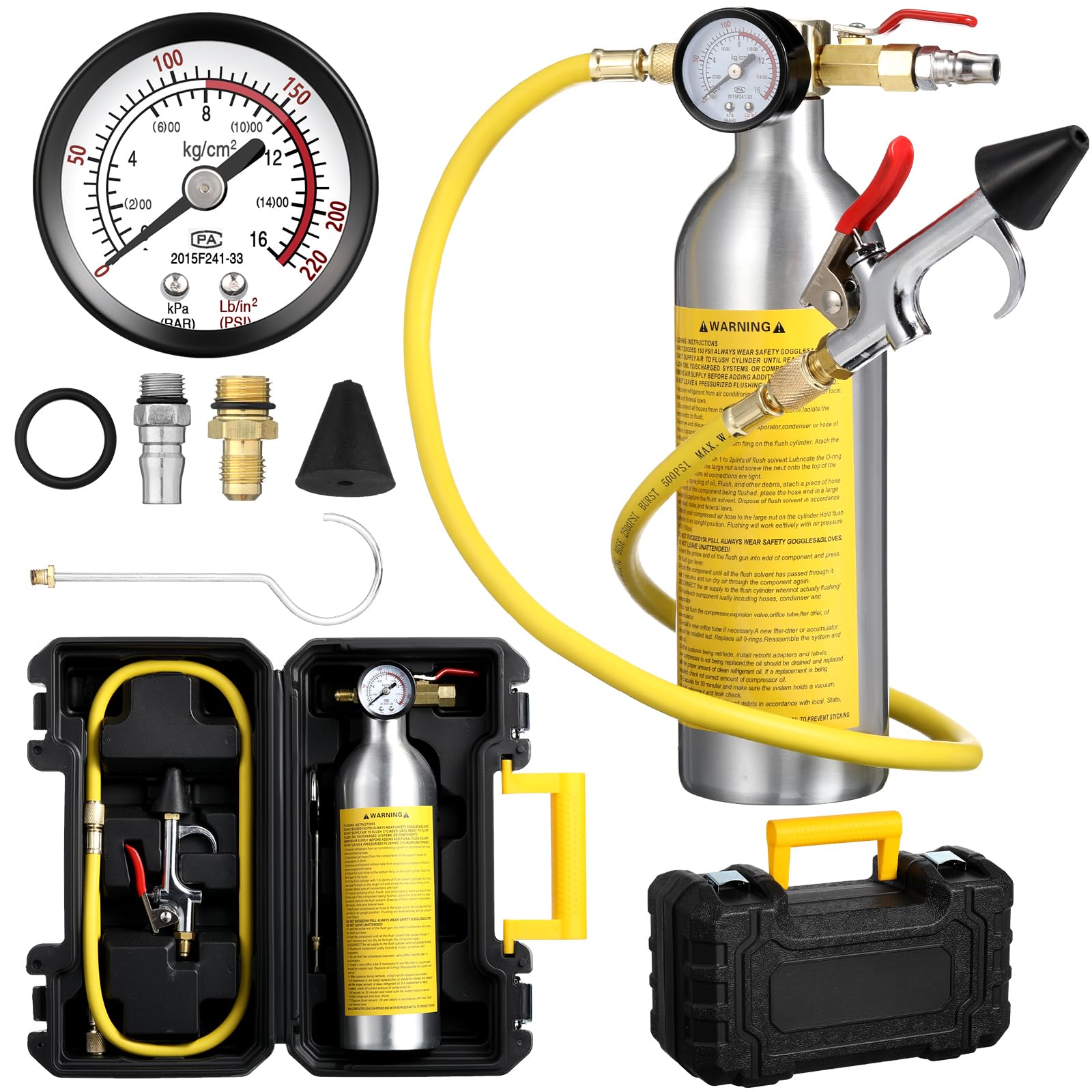
Thickened aluminum alloy makes this kit light and portable for mobile work.
The Rossesay kit uses a thickened aluminum alloy canister that resists leaks and corrosion while keeping weight low—ideal if you are lugging tools between job sites. The 35.4-inch hose is shorter than the POLIWELL but works fine for engine-bay connections on most cars and vans. It includes a flush head with a rubber conical tip to prevent solvent from spewing back, and the trigger design adapts easily to a blow gun hose. Owners say it “works great for clearing HVAC lines” and call it “every HVAC service man’s friend.” It also includes a plastic storage box to keep the adapters and O-rings from getting lost.
A few buyers working on semi-trucks found the canister too small for heavy-duty cleaning. For standard automotive and residential HVAC lines, this is a well-balanced kit that stores neatly. If you need a long hose like the POLIWELL’s 59-inch for a big rig, skip this.
Best for mobile techs: The aluminum body shaves weight, and the box keeps everything together. Great for occasional R12-to-R134a conversions on classic cars.
Not for big rigs: The canister is too small for semi-truck components—stick to passenger vehicles.
6. FJC 2710 A/C System Flush Kit

Decades of trust packed into a simple 18-ounce reusable canister.
FJC’s 2710 is a brand that techs have relied on for years. The kit includes a reusable 18-ounce steel canister and works with R12, R22, and R134A refrigerants (the different types of coolant used in older cars and homes). Buyers call it “reasonably priced, good quality” and note it is “a must have for doing car AC work.” It does not include a quick-disconnect air fitting, so you will need one from your shop or a hardware store. The canister is smaller than many competitors, which is fine for purging individual evaporator cores but means more refills for whole-system jobs.
One caveat: several owners found residual metal shavings from manufacturing in the canister and recommend a thorough rinse before first use. The O-ring (the rubber seal that keeps pressure in) durability also gets mixed marks, but for a tool that has been around this long, the overall effectiveness (98 positive mentions) outweighs the minor prep work. Unlike the CMTOOL’s 3.5-foot hose, this kit has no hose at all, so you provide your own.
Trusted name: FJC’s reputation is the main draw—pro techs and weekend DIYers alike reach for this because it just works.
Pre-work required: Clean out the canister before you start. Metal shavings are the last thing you want entering a freshly rebuilt AC system.
7. Mastercool 91046-A

Professional-grade hardware with no electronics—fewer parts to fail in the shop.
Mastercool has been manufacturing A/C service tools for over 40 years, and the 91046-A reflects that experience. The kit includes a flush gun, a 36-inch hose, a 33-ounce aluminum canister, and a canister adapter. It operates at 90–150 PSI using standard shop air and works with R134a, R1234yf, R12, R22, and R410a systems (covering both old car coolant and modern home HVAC coolant). There is no gauge, which means one fewer component to leak or break, but also means you need a separate regulator to monitor pressure. Reviewers point out it is “solid tool” and note that “many or all techs I know have one of these.”
The downsides: some shoppers say the flush gun seals wear out over time and start leaking, with one buyer buying a 5-pack of replacement guns to keep on the truck. A few others mention leakage issues with the seals. If you are a frequent user, plan to replace the gun periodically—or accept that the simplicity of the design compensates for the seal lifespan. It is the go-to for the shop that already owns a pressure regulator, unlike the POLIWELL which includes dual gauges for the DIYer.
Shop-Ready
- Proven design used by working techs
- Universal solvent compatibility
- No gauge to break
Plan for Wear
- Flush gun seals may leak over time
- No pressure gauge included
8. Leak Saver AC Flush Solvent Kit
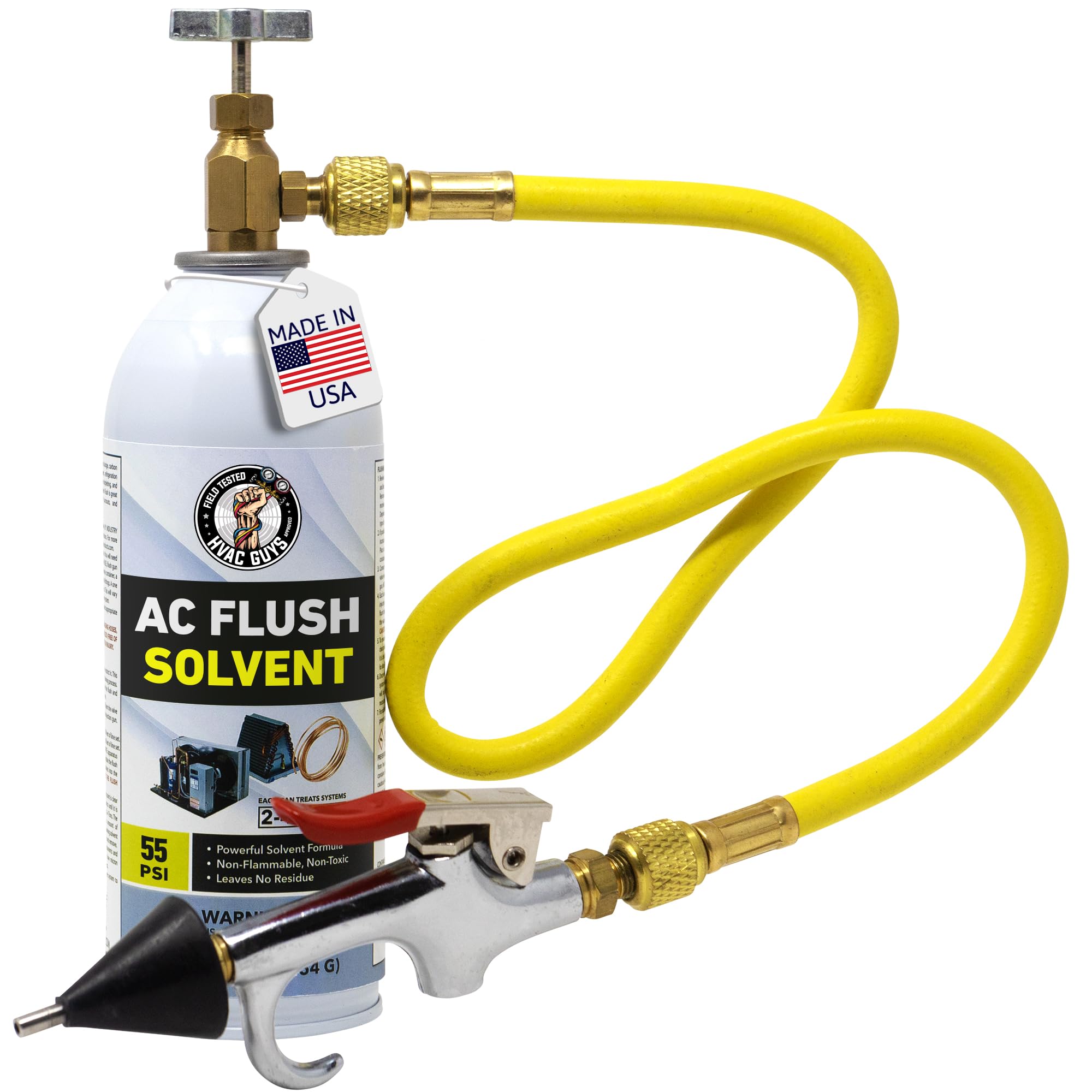
Pressurized solvent right out of the can—no air compressor required.
This is the only kit in the lineup that comes pre-filled and pressurized at 140 PSI, so you can flush a Mercedes C300 or any other system without owning a shop air compressor. The formula is specifically designed to flush oils, acids, water, and carbon residues from HVACR systems, making it ideal for compressor burnouts (when the compressor seizes and contaminates the system) and R22-to-R410A conversions. You still need a nitrogen purge afterward, but the initial flush is done in minutes. One reviewer noted it “worked great” and called it a “real flush kit, not the citrus oil ones they sell at the auto store.”
It is also the most expensive option here, and buyers point out the bottle volume is not enough to flush both supply and return lines on larger systems—you may need a second can. The hose also drew criticism for being flimsy. If you do not have an air compressor and only need to flush a single car system, this is a convenient solution. It is the only alternative to a traditional kit like the ZJERYL GULL if you lack shop air.
No air tools? Perfect: This is the only way to flush an AC system without a compressor. Excellent for apartment dwellers or emergency roadside work.
Volume limit: One can is not enough for a full dual-line flush—budget for a second can if your system has long line sets.
9. OEMTOOLS 37377

Attached blow gun nozzle that keeps solvent spraying forward, not back at you.
OEMTOOLS engineered this kit around a specific problem: spray-back (solvent splashing back at you) that leaves solvent dripping on your hands and floor. The attached air flush nozzle directs solvent only where you point it, which is especially helpful when you are flushing blind connections behind the dashboard. The kit includes a flush canister, drain hose, blow gun, rubber tip, and cylinder cap. Owners say it is “awesome and user-friendly” and works for A/C flushing as well as brake dust removal and degreasing.
The criticisms: threaded parts arrived clogged with metal shavings from machining—buyers strongly recommend a thorough cleaning before connecting it to any AC line. The rubber cone on the nozzle is also on the smaller side; one user with a larger pipe had to swap to a different nozzle and grommets to get a good seal. Unlike the Rossesay kit’s short hose, this kit has no hose at all in the basic package, so plan for your own. If spray-back is your main frustration, this kit solves that problem with a targeted nozzle design.
Mess Saver
- Attached nozzle stops solvent spray-back
- Versatile—works for brake dust and degreasing
Pre-Flush Prep
- Metal shavings in threads require cleaning first
- Rubber nozzle tip may be too small for larger lines
Understanding the Specs
Canister Material
The canister must withstand repeated pressure cycles without rusting or deforming. Stainless steel is the gold standard—it resists corrosion from flushing solvents and holds up better than aluminum under the 150 PSI working limit that most kits recommend. Aluminum is lighter but more prone to denting and corrosion over time. A thickened or heavy-duty wall rating is worth paying attention to; thin-gauge metal can bulge after a few uses.
Hose Length & Fittings
Hose length determines where you can position the canister relative to the component you are flushing. A 3.3- to 3.5-foot hose reaches most engine-bay connections, but SUVs, trucks, or systems with rear evaporators benefit from a 4.9-foot (59-inch) hose. The fitting type—1/4-inch SAE versus 1/4-inch NPT—determines compatibility with your air compressor; having both adapters in the box saves an extra trip to the store.
Operating Pressure
Most AC flush tools operate between 90 and 150 PSI. The working pressure should not exceed 150 PSI; going over risks rupturing the canister or blowing out seals. A reliable pressure gauge helps you stay in that window. Kits with a safety pop-off valve add a layer of protection—the valve releases automatically if pressure spikes.
Nozzle Design
Flush nozzles come with a rubber tapered tip that seals against the pipe opening. A good seal prevents solvent from spraying back at you, which is the most common complaint across all kits. Some nozzles produce a controlled mist; others dump the entire canister in seconds. If you are flushing a small line set, a nozzle that delivers a steady stream rather than a blast gives you more control and less cleanup.
FAQ
Can I use an AC flush tool with any solvent?
What PSI should I run my AC flush tool at?
Do I need an air compressor to use an AC flush kit?
How long does the hose need to be for an SUV or truck?
Can I flush a mini split or home AC system with these tools?
What should I do if my kit arrives with metal shavings inside?
How many times can I reuse a stainless steel flush canister?
Do I need nitrogen to complete the flush process?
What is the difference between a spray-back and a stream nozzle?
Will a budget AC flush tool work as well as a premium one?
Final Thoughts: The Verdict
For most people, the ac flush tool winner is the CMTOOL AC Flush Kit because it combines a thickened stainless steel canister, a generous 3.5-foot hose, and a reputation among 270+ buyers for zero leaks at a price that undercuts nearly everything else. If you need a long hose for a truck or SUV, grab the POLIWELL AC Flush Kit—its 59-inch hose is class-leading in this list. And for apartment dwellers or anyone without a shop air compressor, the Leak Saver Kit is the only option that works straight from the start, no compressor required.
How We Picked
We do not accept paid placement. Every pick is matched to a real buyer and a real use-case; we do not hands-on test units.
Sources & Methodology
Specifications: manufacturer listings and product documentation. Review insights: verified customer reviews, as of July 2026. Pricing: not shown on this page (it changes often); check the current price via the retailer link.
As an Amazon Associate, Gadgets Feed earns from qualifying purchases. This does not affect which products we feature.