
Our readers keep the lights on and my morning glass full of iced black tea. As an Amazon Associate, I earn from qualifying purchases.
Specs are compiled from manufacturer listings and verified buyer reviews and can change over time — please confirm the key details on the product page before buying.
Switching from lead-acid to lithium is the single biggest upgrade you can make for an RV, trolling motor, or solar setup—more usable capacity, half the weight, and no more topping off with distilled water. The catch is choosing the right one. This guide cuts through the cycle-life claims and BMS specs so you pick the 12 volt lithium battery that actually fits your space, budget, and power draw.
I’m Min — the founder and writer behind Gadgets Feed. This guide is built by comparing the manufacturers’ published specifications and the patterns across verified customer reviews, so you get each pick’s real strengths and trade-offs instead of marketing spin.
best 12 volt lithium battery options all use LiFePO4 chemistry, but their real-world differences come down to BMS protection, physical size, and cold-weather features that most specs pages gloss over.
Our Picks at a Glance

How To Choose The Best 12 Volt Lithium Battery
Not all 12V LiFePO4 batteries fit the same job. Your choice depends on where you are mounting it, how much power you draw at once, and if you need to charge below freezing. Here are the three specs that separate a good fit from a headache.
BMS (Battery Management System) Rating
The BMS is the brain that prevents overcharge, over-discharge, and short circuits. A 100A BMS lets you run a 1000W inverter or a high-draw trolling motor without tripping. If you plan to run a 2000W inverter or a heavier continuous load, step up to a 200A BMS. Pay attention to peak ratings too—some BMS units handle 500A surges for motor starts.
Physical Size and Group Size
Lithium batteries can be smaller than lead-acid, but the outer dimensions still need to fit your existing battery tray or box. Group 31 measures roughly 13 x 6.8 x 9 inches. Group 24 is smaller at about 10.2 x 6.6 x 8.2 inches. Measure your compartment before you buy—an inch too long and you are returning a 22-pound box. Some batteries also offer front-mounted terminals that make wiring in tight RV compartments much easier.
Low-Temperature Protection and Self-Heating
Standard LiFePO4 batteries cannot be charged below 32°F (0°C) without damage. If your battery sits in an unheated garage or you camp in freezing weather, look for either low-temperature cutoff (the BMS stops charging automatically) or built-in self-heating that warms the cells before accepting a charge. Self-heating usually needs at least a 10A charger to activate.
Quick Comparison
| Model | Best For | Capacity | BMS Rating | Weight | Amazon |
|---|---|---|---|---|---|
| Litime 12V 100Ah★ Best Overall | All-around upgrade | 100Ah | 100A | 22.2 lbs | Amazon |
| DUMFUME 12V 100AhBudget Pick | Budget build | 100Ah | 100A | 22.05 lbs | Amazon |
| Wattcycle 12V 100AhCompact Fit | Compact space | 100Ah | 100A | 23.2 lbs | Amazon |
| Power Queen 12V 100Ah | Trolling motor power | 100Ah | 100A | 22 lbs | Amazon |
| Redodo 12V 100Ah | Proven longevity | 100Ah | 100A | 22 lbs | Amazon |
| PUPVWMHB 12V 300Ah | High-capacity solar | 300Ah | 200A | 59 lbs | Amazon |
| ECO-WORTHY 12V 280Ah | Metal case durability | 280Ah | 200A | About 60 lbs | Amazon |
| TEMGO 12V 300Ah | Freezing climate camping | 300Ah | 200A | 64.9 lbs | Amazon |
In‑Depth Reviews
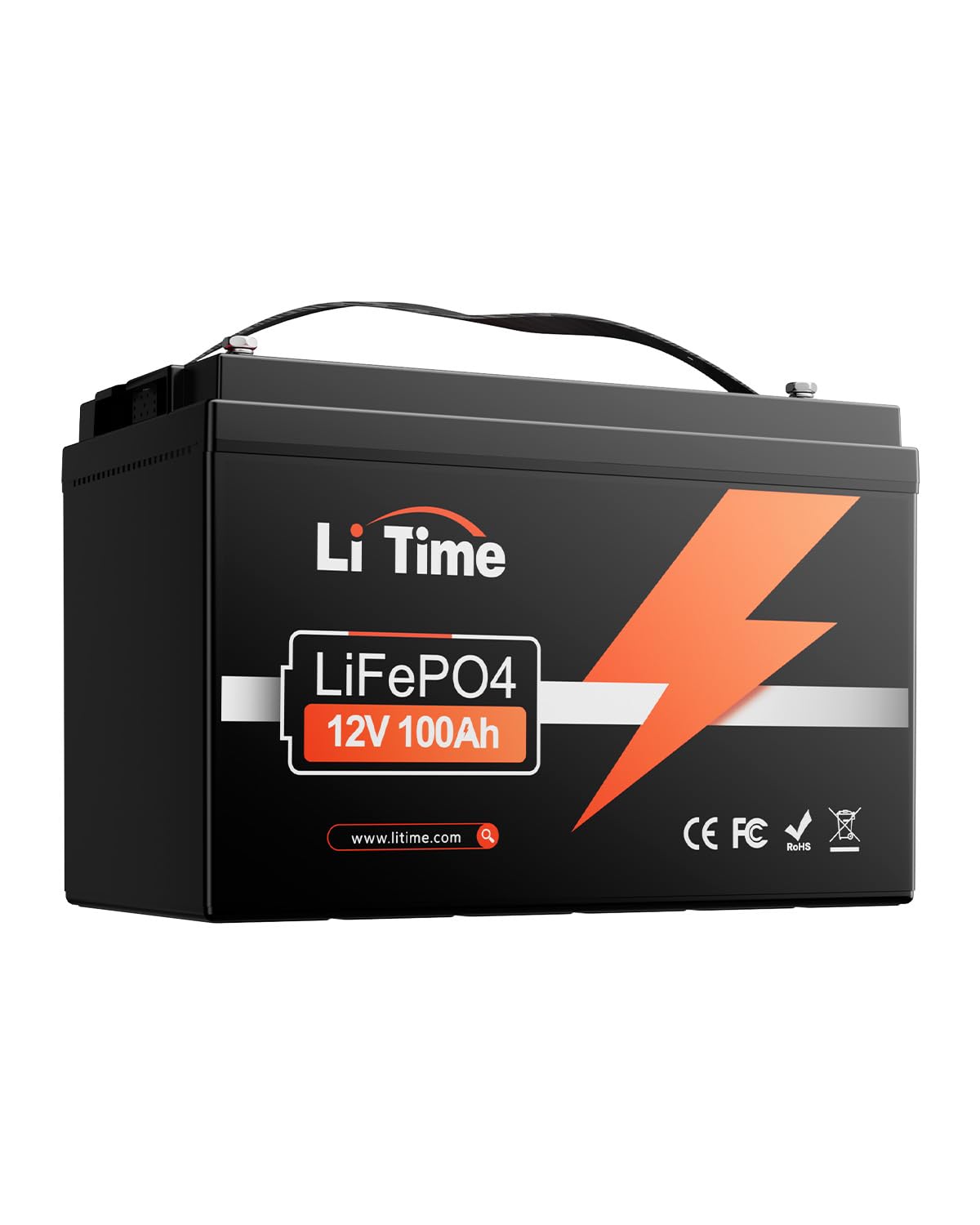
1. Litime 12V 100Ah Lithium Battery, Group 31 LiFePO4 Battery with 100A BMS
Our pick — over 4.5★ from 750+ verified ratings; the strongest balance of quality and price.
The crowd-favorite 100Ah that balances power, weight, and proven reliability.
Thousands of owners validate this 100Ah battery for its reliable performance and build quality. At 22.2 pounds, , so you can actually move it into place without calling for help. The built-in 100A BMS protects against overcharge and over-discharge, and the battery uses A+ grade automotive cells that deliver stable voltage. Owners running RVs and travel trailers consistently praise the build quality—the battery quality and battery life are the top two things buyers celebrate. One even noted it powered their A/C for several hours.
It scales up to 4P4S (51.2V 400Ah) for larger solar banks, and the 5-year support gives confidence. The physical dimensions measure 13 x 6.77 x 8.5 inches, fitting most Group 31 boxes. On the flip side, the BMS can shut down from a deep discharge—buyers report that after 1.5 years, one showed 0V and needed a reset by disconnecting the house load and recharging. That is a one-time recovery, not a pattern, but worth knowing for long-term storage. The LiTime also carries AIG Product Liability Insurance, an extra safety layer.
In short: this is the go-to for campers and solar users who want a 100Ah battery with a long track record and strong support.
Why owners stick with it
- Rated for 4000 cycles at 100% depth of discharge and up to 15000 cycles at 60%
- Weighs 22.2 lbs, making repositioning simple
- Shipped with UL and FCC certifications for trusted safety
The fine print to know
- No Bluetooth monitoring on the standard model—you get no state-of-charge on your phone
- A deep discharge event can trip the BMS and require a manual reset procedure
Reach for this if: you want the best-reviewed 100Ah drop-in replacement for RV or solar, with a long cycle life and a 5-year support promise.
Look elsewhere if: you need Bluetooth or self-heating—this model skips both.
2. DUMFUME 12V 100Ah LiFePO4 Battery Group 31 Lithium Battery 100A BMS
A low-cost entry that still brings 1.28kWh and low-temperature cutoff.
If your budget is tight but you refuse to go back to lead-acid, this DUMFUME 100Ah delivers the core LiFePO4 benefits at a noticeably lower price. It packs 1280Wh of energy (the same as the more expensive 100Ah units), weighs only 22.05 pounds, and includes a 100A BMS with low-temperature protection that stops charging when it gets too cold. That is a feature usually reserved for pricier batteries. The ABS casing is impact-resistant and fire-resistant, so it can handle rough road travel.
Build quality gets the most praise from owners, and many call it a great value for the money. That said, the battery life category draws mixed feedback—some owners mention six hours of runtime while one found it dead after 10 months. Customers note that one unit shut down under load at 11V idle, with the BMS cutting off and support being difficult to reach. That leans more toward a variance than a pattern, but it means you should verify your charger can supply 14.6V as recommended. The physical size is 13 x 6.69 x 8.62 inches, fitting Group 31 boxes.
A budget-friendly 100Ah battery with low-temperature cutoff for solar and camper builds. DUMFUME recommends charging the battery once every 6 months to prevent damage from disuse.
What the price gets you
- 1.28kWh usable energy in a compact footprint at a sub-premium price
- Low-temperature cutoff included—rare at this price point
- Fire-resistant ABS casing for added safety during vibration
Trade-offs to weigh
- Customer support responsiveness has been inconsistent for some owners
- Mixed reports on long-term reliability beyond 10 months
Ideal for: first-time lithium buyers on a budget who still want low-temp protection and decent energy density.
Skip if: you plan to deep-cycle daily in a critical system—a mid-range battery with more consistent support is safer.
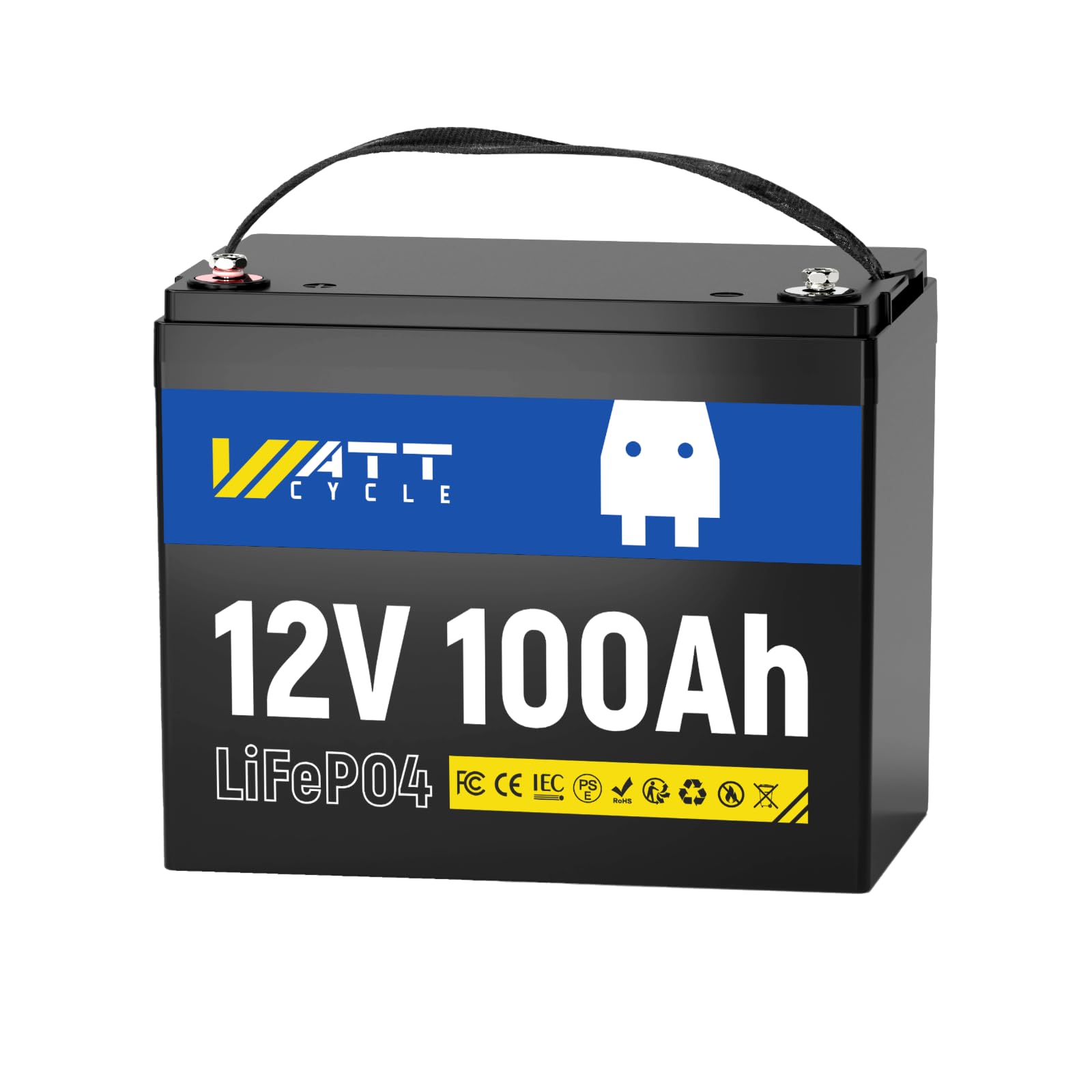
3. Wattcycle 12V 100Ah LiFePO4 Lithium Battery – BCI Group 24
A Group 24 body that is 27% more compact than standard Group 31 batteries.
Space is precious in a boat console or a small RV compartment. The Wattcycle 100Ah measures 10.2 x 6.6 x 8.2 inches—that is a sizable difference compared to the Litime at 13 x 6.77 x 8.5 inches. It fits a BCI Group 24 battery box perfectly, making it a clean drop-in replacement where a larger battery simply will not go. Despite the smaller shell, it still carries a 100Ah capacity (12.8V) and a built-in 100A BMS with a peak cutoff at 300±50A. The battery can endure up to 15000 cycles and operates between -4°F and 158°F.
Owners praise the quality and performance, especially for trolling motors. One noted it recharged from 75% depth of discharge in about 12.5 hours with a 6A charger. The catch: the terminal bolts are short (M8 x 16mm needed for parallel connections), so you will likely need to buy longer stainless steel bolts and washers. The battery has no Bluetooth built-in—you would need to add a third-party monitor. It carries SDS, UN38.3, FCC, CE, and ROHS certifications.
The compact Group 24 size fits tight battery compartments where Group 31 batteries won’t. The rest of the specs hold up well against the bigger batteries, and the price is mid-range competitive.
Why the size wins
- Fits a BCI Group 24 box that many standard 100Ah lithium batteries cannot
- A+ grade cells with 15000 cycles possible at lower depth of discharge
- Operates down to -4°F for cold-climate users
Gotchas to note
- Included terminal bolts are too short for parallel setups—plan on buying M8 replacements
- No Bluetooth; you will need a separate monitor to track state of charge
Choose this if: you have a Group 24 battery tray and need full 100Ah capacity without custom mounting.
Pass on it if: you want out-of-the-box parallel wiring or phone-based monitoring.
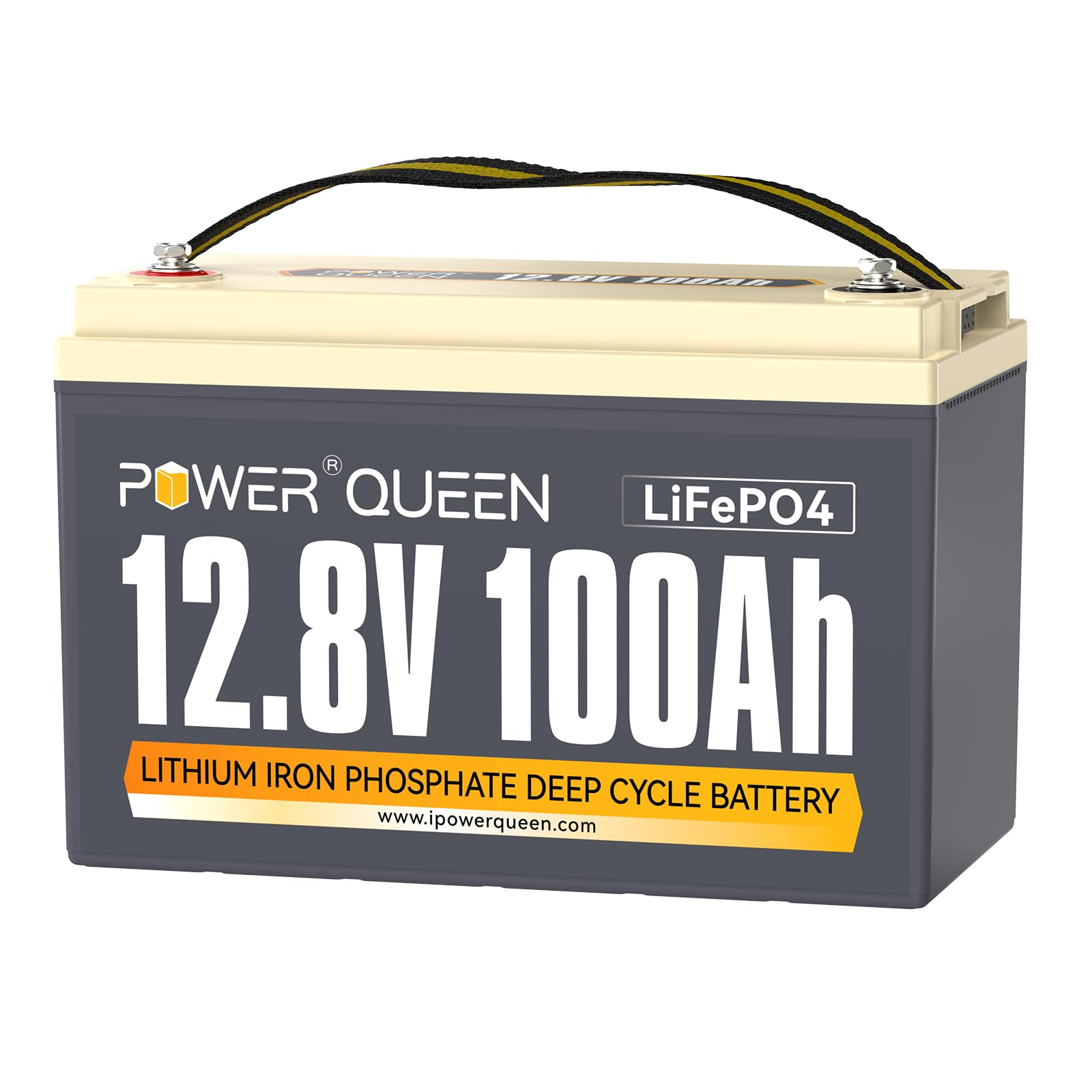
4. Power Queen 12V 100Ah LiFePO4 Battery, Group 31 Lithium Battery with 1280Wh
The battery many anglers swear by for all-day trolling motor runs.
Battery life is the single most-discussed aspect of this Power Queen 100Ah—by a significant margin. Owners consistently report it powers trolling motors, fish finders, and cabin lights for multiple days between charges. One noted it ran 6 miles on three trips and could have done three more. The battery delivers 1280Wh of usable energy from its Grade-A LiFePO4 cells, and the 100A BMS protects against overcharge, over-discharge, and short circuits. At 24 pounds (Group 31 size), it is about a third of the weight of an equivalent lead-acid battery.
The IP65 rating means it resists splashes and dust, which matters on a boat. It supports up to 4S4P configurations for 51.2V 400Ah systems, so you can expand later. On the less positive side, a few owners note the 6mm terminal bolts feel easy to cross-thread if you over-torque them—consider using an adapter kit. The temperature control category shows a mixed verdict, so it is not the best pick for extreme heat or cold. Power Queen backs it with a 5-year warranty.
A trusted 100Ah marine battery with strong battery-life reviews and IP65 water resistance.
What keeps buyers happy
- Reported real-world capacity tested above 100Ah (one owner measured 102Ah)
- IP65 rating adds water resistance for wet boat compartments
- 5-year warranty offers long-term confidence
Heads-up from the water
- Some owners found the 6mm terminal bolts easy to strip—use care or a torque adapter
- Not ideal for environments with extreme ambient temperatures
Best for: anglers and boaters who need reliable, multi-day power for trolling motors and electronics.
Not for: setups that will see very high heat—this battery runs at a higher temperature than some competitors.
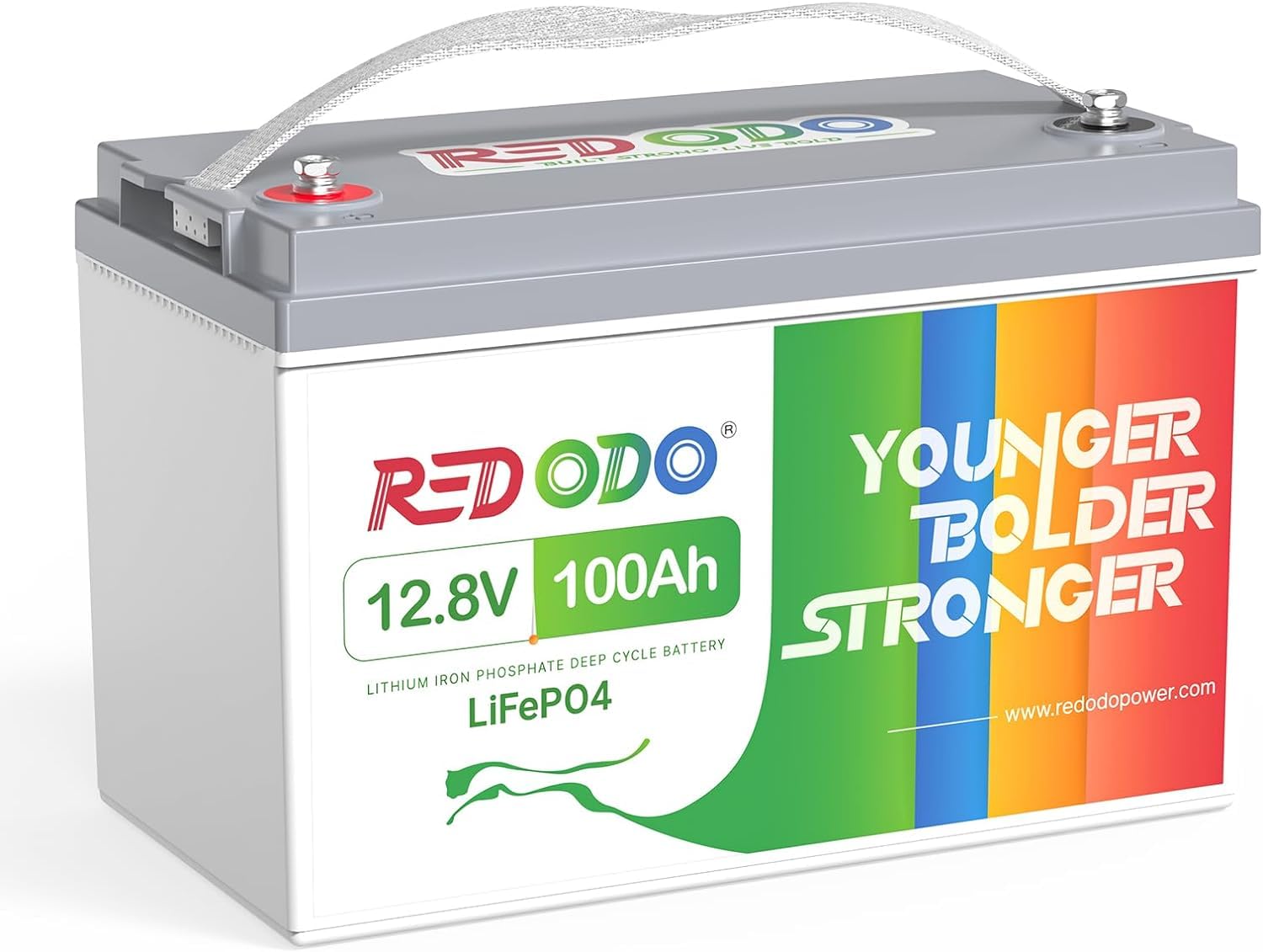
5. Redodo 12V 100Ah LiFePO4 Battery, Rechargeable Lithium Iron Phosphate Battery with 100A BMS
A 100Ah that has been reliably powering boats and mowers for years.
The Redodo 100Ah has one of the highest quality and reliability scores among mid-range LiFePO4 batteries. It uses automotive-grade cells, has a 100A BMS, and claims 4000 cycles at 100% depth of discharge up to 15000 cycles at 60% DOD. That is a 10-year lifetime estimate. Real-world owner stories back it up: one commercial pool company replaced their lead-acid batteries (which failed every 3-4 months) with Redodo units and reported the lithium packs lasting all day with consistent voltage and no midday swaps. Another owner used it for 3 years on a boat, had a charging failure, and received a replacement within days under warranty.
The battery measures 12.99 x 6.82 x 8.46 inches and weighs 22 pounds—about 60% lighter than a comparable lead-acid battery. It supports series and parallel connections up to 4S or 4P for a maximum of 400Ah or 48V. On the downside, one long-term owner (4 years) found the battery eventually would not charge after a deep BMS cutoff, though Redodo honored the warranty even near the 4-year mark. It is not suitable for starter or golf cart batteries per the manufacturer. The battery fits Group 31 boxes.
A proven 100Ah workhorse with responsive warranty support and high owner reliability ratings. The number of glowing reviews from heavy-use scenarios (trolling motors, electric mowers, pool service) is compelling.
Why it earns trust
- High owner-rated reliability—over 900 ratings with a 4.5-star consensus
- Warranty support is responsive; several reviewers point out replacements shipped quickly
- Only 3% self-discharge per month, so it stores well between uses
What to watch for
- Not for starter or golf cart applications per the manufacturer
- After 4 years of heavy use, some units may need a warranty replacement
Reach for this if: you need a 100Ah workhorse that has proven reliable across thousands of owners and the company stands behind it.
Look elsewhere if: you need Bluetooth, self-heating, or a compact Group 24 size.
6. PUPVWMHB 12V 300Ah LiFePO4 Lithium Battery with Bluetooth and 200A BMS

Triple the capacity of a standard 100Ah for serious solar or van power.
When 100Ah is not enough, the PUPVWMHB 300Ah steps in with 3840Wh of energy and a 200A BMS that can handle a 2000W inverter with ease. Owners using it in vans and on trawlers report it runs two fridges for days and keeps voltage above 13.2V overnight—compared to 11.8V with their old AGM bank. The Bluetooth app (via Xiaoxiang or Overkill Solar apps) lets you monitor cell voltages, state of charge, and temperature from your phone, and the BMS allows a manual load-side cutoff.
The physical size is 13.58 x 7.48 x 9.64 inches at 59 pounds, so it is much heavier than a 100Ah pack but still far lighter than equivalent lead-acid. It can be connected in series and parallel up to 1200Ah and 51.2V (max 61.44kWh). That said, the Bluetooth app is basic and some owners note the included manual is generic with no warranty details. One unit arrived DOA and was replaced in 6 days. The cells appear decent internally based on a teardown, but the brand has less of a long-term reputation than Litime or Redodo.
A 300Ah battery with Bluetooth and 200A BMS for large solar banks and van electrical systems.
What the extra capacity buys
- 3840Wh of usable energy—runs fridges and inverters for days
- 200A BMS handles heavy continuous loads without tripping
- Bluetooth cell monitoring helps you catch imbalance early
Things to check first
- The BMS app is basic and may need third-party software (Xiaoxiang) for better data
- Warranty documentation is not provided in the box—verify before buying
Ideal for: van lifers and off-grid solar users who need 300Ah capacity and Bluetooth monitoring at a competitive price.
Not for: users who cannot handle a generic manual or who rely on sturdy manufacturer support.
7. ECO-WORTHY 12V 280Ah Metal Case LiFePO4 Lithium Battery with Bluetooth
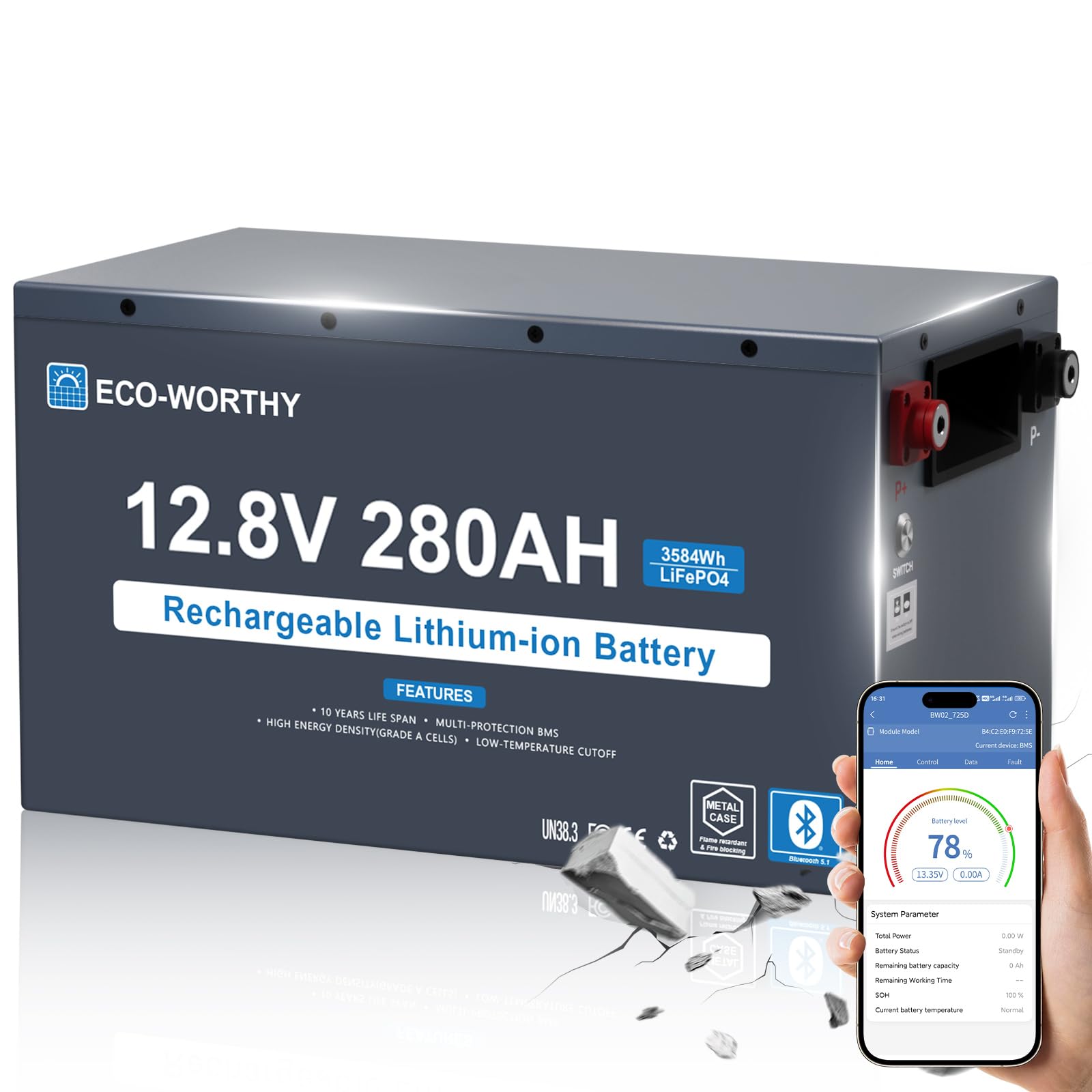
A rugged metal case that stands up to road vibration and eliminates battery boxes.
The ECO-WORTHY 280Ah is built differently: instead of plastic, it uses a heavy-duty metal enclosure that resists heat and fire, plus it has four mounting feet so you can screw it directly to your RV floor without an extra battery box. The built-in 200A BMS handles overcharge, over-discharge, and short circuits, with low-temperature protection that cuts off charging below 20°F. A weak-current power switch lets you kill output with one touch for maintenance. Buyers confirm it exceeds rated capacity and that the JBD-DP04S007 BMS works with the Overkill Solar app for advanced monitoring.
Owners running two 280Ah batteries in a travel trailer (560Ah total) report flawless performance for months. Under a 5000W AC load, voltage dropped only from 13.79V to 13.45V—showing the 200A BMS and Grade A cells hold up well. The front terminals make wiring in tight RV compartments much easier. On the downside, the battery weighs approximately 60 pounds, so it is not a lightweight. Internal cell holders keep the cells stable during driving, and the metal case also resists impacts.
A rugged metal-case 280Ah battery with Bluetooth and mounting feet for vibration-prone RVs.
What the metal shell delivers
- Heat-resistant metal enclosure with mounting feet—no extra battery box required
- Front terminals simplify wiring in tight RV compartments
- 200A BMS with low-temperature cutoff and Bluetooth via JBD app
Considerations
- About 60 lbs, so moving it is a two-person job
- Two exterior label styles shipped at random—identical internally but may not match visually
Best for: off-road RVs and camper vans where vibration resistance and a rigid mounting solution matter.
Not for: lightweight solar setups where every pound counts.
8. TEMGO 12V 300Ah Self-Heating LiFePO4 Lithium Battery with Smart Touch Screen & Bluetooth
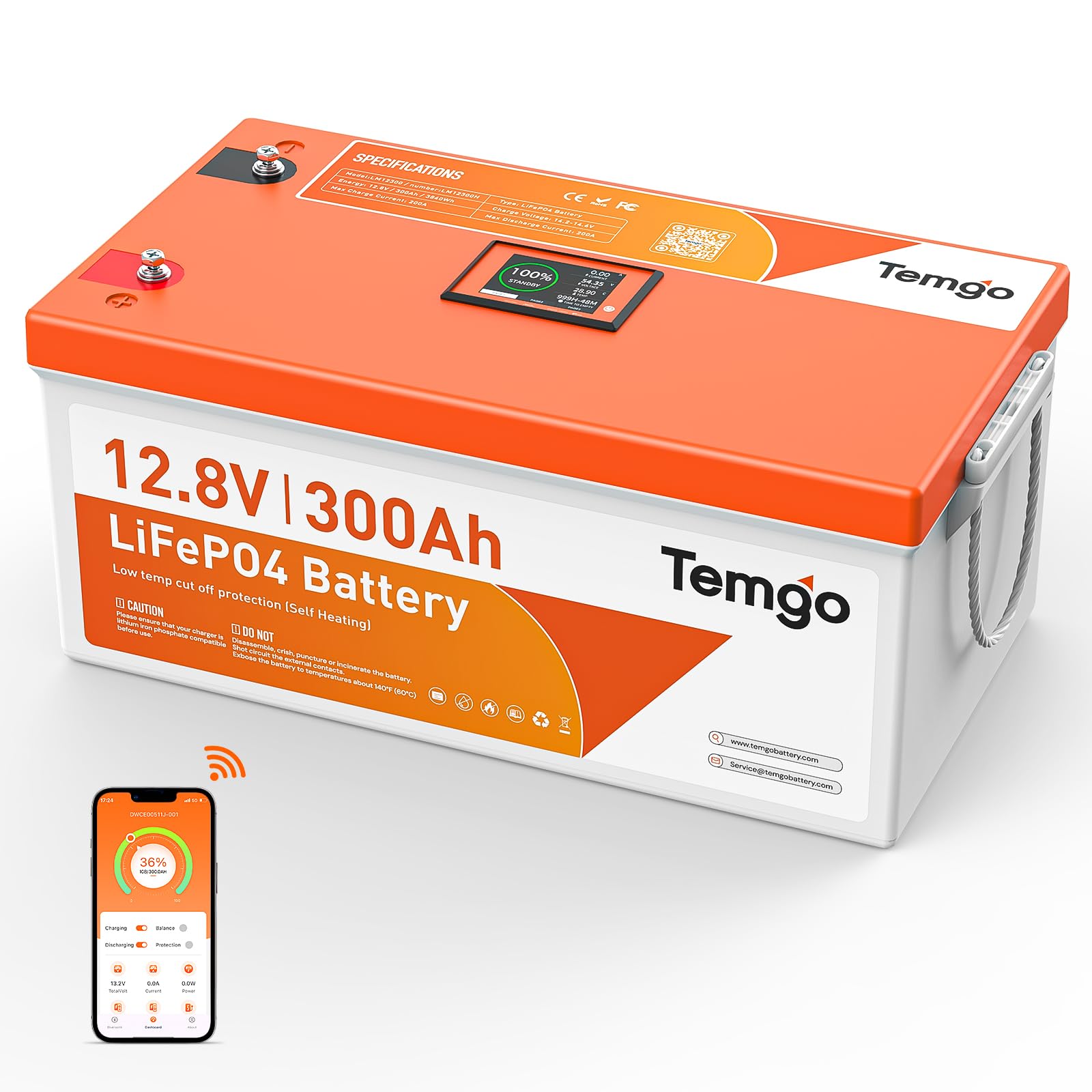
A 300Ah pack that warms itself up so you can charge in freezing weather.
A 300Ah battery with self-heating, touch screen, and Bluetooth for cold-weather camping. The TEMGO 300Ah includes a built-in smart touch screen that shows remaining charge, voltage, current, and estimated runtime—no phone needed unless you want to. The Bluetooth app lets you monitor and even shut down the BMS remotely. The headline feature is self-heating: when the battery temperature drops below 32°F (0°C), it automatically warms the cells before accepting a charge, stopping at 41°F (5°C). This is critical for winter camping or unheated garages. It carries a 200A BMS with 5000+ cycle life and 3840Wh of energy.
Owners running two in a Winnebago confirm the rated capacity and call the self-heating essential for solar charging in cold weather. One test showed it handling 6+ hours of heavy 12V load at 80% charge. The battery fits a 4D box (20.47 x 10.59 x 8.66 inches) and weighs 64.9 pounds. The cons: the BMS ignores loads under 800mA, so very small draws will not register. The Bluetooth app is clunky and the password is irreversible once set. Paint scuffs easily too. The warranty is 1 year, shorter than some competitors.
For anyone parking their rig in freezing temps, this is the most complete cold-weather solution. The touch screen and self-heating alone set it apart from every other 300Ah on this list.
What makes it unique
- Self-heating function allows safe charging down to 32°F without extra gear
- Built-in touch screen displays voltage, current, and remaining runtime instantly
- Bluetooth app gives remote monitoring and BMS shutdown capability
Trade-offs to know
- BMS ignores loads under 800mA, so parasitic drains may not be tracked
- Only a 1-year warranty—shorter than the industry standard of 5 years for lithium batteries
Reach for this if: you camp in sub-freezing weather and need self-heating for reliable charging plus a built-in display.
Consider alternatives if: you want a longer warranty or need the BMS to track very small power draws.
Understanding the Specs
BMS (Battery Management System)
The BMS is the safety controller inside every lithium battery. It prevents overcharging, over-discharging, short circuits, and overheating. A 100A BMS can supply 100 amps of continuous current. A 200A BMS handles 200 amps, which you need for bigger inverters (2000W+) or multiple heavy loads at once. Peak ratings matter too: some BMS units can handle 300-500A for a few seconds to start motors.
Depth of Discharge (DOD) and Cycle Life
DOD means how much of the battery’s capacity you use before recharging. A battery rated for 4000 cycles at 100% DOD can be fully drained 4000 times before its capacity drops to 80%. If you only use 60% of the battery, the cycle life can jump to 15000 cycles. This is why running a smaller battery harder (deeper DOD) wears it out faster than a larger battery used more gently. For daily use, aim for a battery with at least 4000 cycles at 80% DOD.
FAQ
Can I replace my lead-acid battery with a lithium one without changing my charger?
How do I know what physical size battery will fit my RV or boat?
What happens if I charge a LiFePO4 battery below 32°F (0°C)?
How long will a 100Ah lithium battery run a 1000W inverter?
Can I connect multiple lithium batteries in series or parallel?
What is the difference between a 100A BMS and a 200A BMS?
How often should I charge my lithium battery during storage?
Is Bluetooth monitoring worth paying extra for?
Can I use a 12V lithium battery as a starter battery for my engine?
Final Thoughts: The Verdict
For most people, the best 12 volt lithium battery winner is the Litime 12V 100Ah because it combines A+ cells, a sturdy 100A BMS, a 10-year cycle life, and a 5-year support promise at a mid-range price that thousands of owners have validated. If you need a compact fit for a Group 24 tray, grab the Wattcycle 12V 100Ah. And for cold-weather camping, the TEMGO 12V 300Ah with self-heating and a built-in touch screen is the one to reach for.
How We Picked
We do not accept paid placement. Every pick is matched to a real buyer and a real use-case; we do not hands-on test units.
Sources & Methodology
Specifications: manufacturer listings and product documentation. Review insights: verified customer reviews, as of July 2026. Pricing: not shown on this page (it changes often); check the current price via the retailer link.
As an Amazon Associate, Gadgets Feed earns from qualifying purchases. This does not affect which products we feature.