
Our readers keep the lights on and my morning glass full of iced black tea. As an Amazon Associate, I earn from qualifying purchases.
Specs are compiled from manufacturer listings and verified buyer reviews and can change over time — please confirm the key details on the product page before buying.
When the power cuts and the cell towers go quiet, a dead phone is worse than useless — it is a problem you cannot solve. That is when a simple, rugged, battery-powered radio becomes the one tool that actually keeps you informed and connected. This guide cuts through the noise to find the models that do real work in a blackout, a storm, or a long camping trip, from ultra-compact pocket companions to heavy-duty emergency stations with enough juice to charge your phone for days.
I’m Min — the founder and writer behind Gadgets Feed. This guide is built by comparing the manufacturers’ published specifications and the patterns across verified customer reviews, so you get each pick’s real strengths and trade-offs instead of marketing spin.
if you need a bedside companion or an emergency kit anchor, prioritize a unit that is loud, clear, and built to keep running. Here is the definitive guide to finding the best battery powered radio for your exact needs.
Our Picks at a Glance


How To Choose The Best Battery Powered Radio
A battery-powered radio is an essential tool you only miss when the power goes out. Focus on power sources, band coverage, and portability for your specific use case.
Power Sources and Battery Capacity
Multiple power options ensure you stay connected. A unit that can run on standard AA or D batteries gives you a fallback when the internal battery dies. Models with a hand crank or a solar panel can keep you going even when you have no spare cells. Capacity matters here — a 12000mAh battery can recharge a smartphone several times over, while a 2000mAh unit is mainly for keeping the radio itself alive.
Quick Comparison
| Model | Best For | Battery Capacity | Bands | Power Sources | Amazon |
|---|---|---|---|---|---|
| Roxicosly CR1030★ Best Overall | Emergency / Power bank | 12000mAh | AM / FM / NOAA | Solar, Crank, USB-C, AAA | Amazon |
| Panasonic RFP-150DPocket Champion | Pocket / Bedside | 2x AA | AM / FM | Battery only | Amazon |
| FosPower A1Top Performer | Value emergency kit | 7400mWh (2000mAh) | AM / FM / NOAA | Solar, Crank, USB, AAA | Amazon |
| Rychi 10000mAh | Extended run times | 10000mAh | AM / FM / NOAA | Solar, Crank, USB-C, AAA | Amazon |
| Panasonic RF-2400D | Home / Senior-friendly | 4x AA | AM / FM | Battery or AC adapter | Amazon |
| Mesqool 12000mAh | Camping / Off-grid use | 12000mAh | AM / FM / NOAA | Solar, Crank, USB-C, AAA | Amazon |
| Sangean PR-D9W | Superior audio quality | 3x AA (NiMH) | AM / FM / NOAA | Battery or AC | Amazon |
| Sangean HDR-14 | HD Radio travel | 3x AA | AM / FM / HD | Battery only | Amazon |
| C. Crane CCRadio-2E | AM DX / Ham band | 4x D (250 hrs) | AM / FM / Weather / 2-Meter Ham | Battery or AC | Amazon |
In‑Depth Reviews
1. Roxicosly CR1030 Emergency Radio
Our pick — over 4.5★ from 400+ verified ratings; the strongest balance of quality and price.
The one box that keeps your phone alive and the news coming for days on end.
This is not just a radio — it is a full survival comms station in a 6.8-inch body. The real 12000mAh battery is the standout, holding enough power to charge a smartphone several times over while running the radio and lights. For reference, the FosPower A1 holds a 7400mWh (2000mAh) power bank, so this Roxicosly offers significantly more backup capacity. The unit itself measures 6.8″ x 2.88″ x 4.74″.
The 8500mm² monocrystalline solar panel charges faster than typical decorative panels, and the hand crank puts out power faster than standard models — a 1-minute crank is enough for an emergency call or light. Buyers report it “ran 18 hours on full lights and FM before low battery auto-shutdown,” which is a real confidence builder for a multi-night outage. The IPX6 waterproof rating means a sudden downpour won’t take it out.
Sound quality and functionality are what owners praise most — the audio is clear for a preparedness device, and the NOAA alerts with a 9-second alarm give you genuine advance warning before a storm hits. The main honest trade-off is the rubber charge port flap, which a few units arrived with a loose fit. It is a minor annoyance on an otherwise rock-solid emergency tool.
What wins people over: The sheer battery stamina is the headline — 12000mAh means you stop worrying about finding an outlet and start worrying about the weather. The solar and crank options back that up with real-world charging speed.
Who should skip it: If you need a pocket-sized radio for daily walks or a simple bedside unit, the Roxicosly is larger and more feature-dense than necessary. It is built for emergencies, not everyday carry.
Reach for this if: you want a single emergency device that handles radio, lighting, and phone charging without external power — it is the most capable all-rounder on this list.
Look elsewhere if: your use case is purely casual listening — the extra battery and weather features add bulk you will not use.
2. Panasonic RFP-150D
The featherweight that slips into a jacket pocket and runs for a month on two AAs.
Simple designs often deliver the most reliable performance. This Panasonic is the opposite of the emergency brick above — it measures roughly 6.2″ x 2.1″ x 2.9″ and weighs almost nothing, making it the perfect bedside or go-bag companion. Its defining achievement is the battery life: owners mention “over 1 month battery life (5 hrs/night)” from just two AA cells, which is absurdly efficient. It also has a 3.5mm headphone jack for private listening.
The reception is excellent for a pocket radio — the AM band holds a signal overnight, and the FM tuner locks in without needing an antenna. The red tuning light and classic analog dials make it dead simple to use. Size and compact size are the most-praised aspects by a wide margin. The trade-off? Sound quality and the tuning control get mixed feedback; the audio is fine for talk radio and news, not for music, and the dial can feel awkward until you get used to it.
The brilliance
- Remarkable battery life — over a month of nightly use
- Truly pocket-sized and lightweight
- Excellent AM reception for a small unit
The honest caveats
- Sound quality is acceptable for voice but not music
- Tuning control is small and takes practice
- No NOAA weather band
Best for: anyone who needs a no-fuss, reliable radio for daily bedside listening or a tiny emergency backup that fits in any bag.
skip it if: you want weather alerts, phone charging, or rich audio — this is a pure AM/FM companion.
3. FosPower NOAA Emergency Weather Radio A1
The crowd-favorite emergency radio that packs a power bank into a compact orange shell.
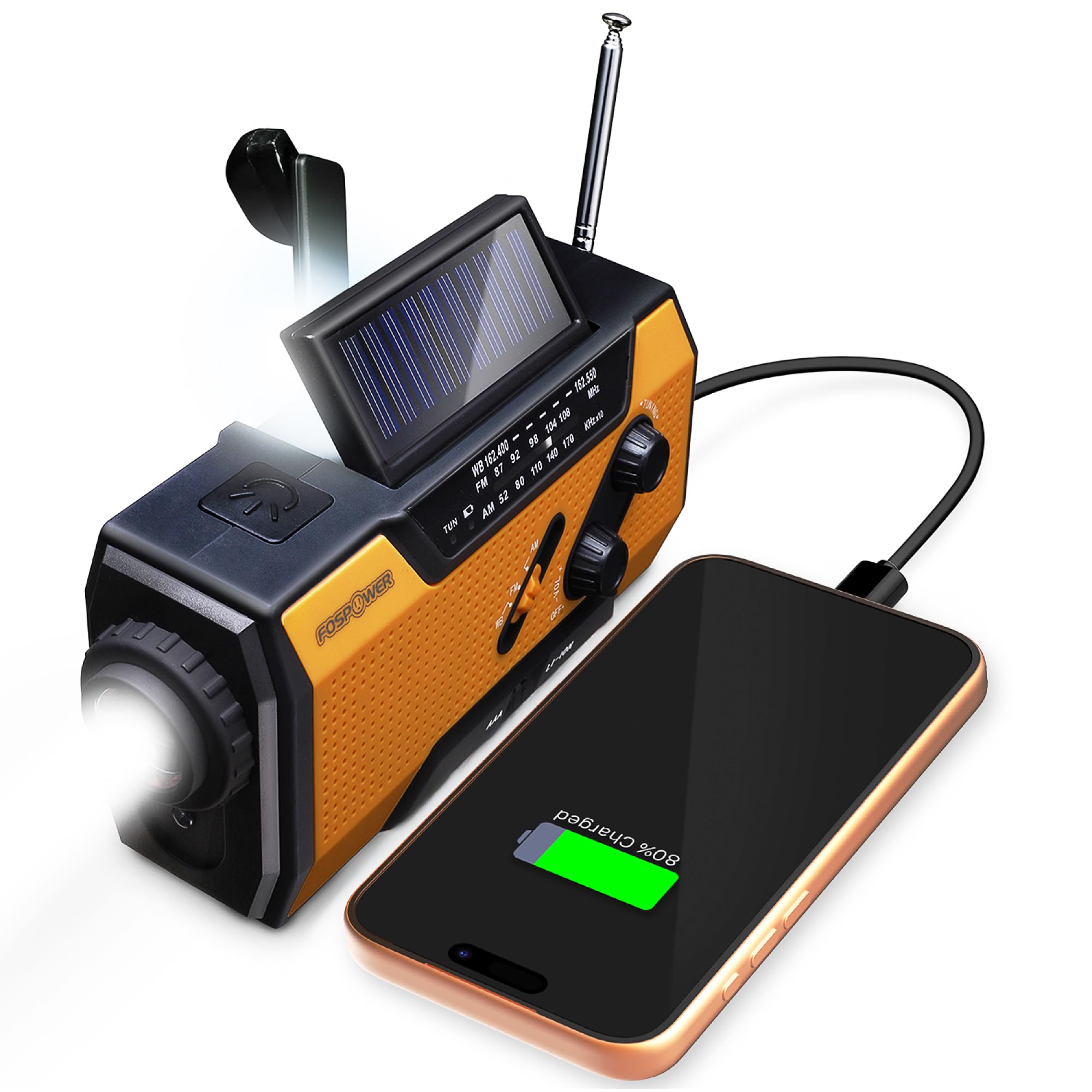
This is the radio that tens of thousands of owners trust for hurricane season. The 7400mWh (2000mAh) internal power bank is enough to give a phone a meaningful emergency top-up, and you have three ways to recharge the radio itself: solar, hand crank, or AAA batteries. The 4-LED reading light and 1W flashlight mean you don’t need a separate torch. Weighing 14.8 ounces and measuring 6.2″ x 2.1″ x 2.9″, the FosPower is notably more compact than the Roxicosly — about 10% thinner — which makes it easier to toss into a go-bag.
Functionality and build quality are the two most-praised aspects, with owners calling it durable and easy to operate right from the start. The limited lifetime warranty adds real confidence. The main recurring note is that charging performance can be mixed — the solar panel works best in direct sun, and the crank requires steady effort for a full charge. But for the price, this is the most trusted emergency radio on the market.
The case for it: This is the ultimate “buy once and forget it” emergency radio. The build quality and warranty mean it will be ready when you need it, and the compact size means it fits in any disaster kit.
The honest caution: The solar and crank are backup methods, not primary charging — plan to keep the internal battery topped off via USB before a storm. Also, sound quality is functional rather than rich.
Ideal for: families building a first emergency kit — it is reliable, affordable, and simple enough that anyone can use it.
Not for: audiophiles or anyone who wants a primary music radio — this is a utility tool.
4. Rychi 10000mAh Emergency Radio

A massive 10000mAh battery that delivers up to 25 hours of radio or 40 hours of flashlight.
This Rychi sits in a balance between the Roxicosly and the FosPower. The 10000mAh battery is smaller than the Roxicosly’s 12000mAh but still enough to charge a phone several times over, and the run times are excellent — 25 hours of radio at medium volume, 30 hours on the reading lamp, and 40 hours on the flashlight alone. It weighs 1.2 pounds and measures 6.69″ x 2.83″ x 3.26″, making it slightly more compact than the Roxicosly while still packing serious battery capacity.
Build quality and functionality are what owners praise most — the unit feels solid and the hand crank is smooth. The extended 7-section antenna helps pull in AM, FM, and NOAA stations clearly. The honest drawback is that the solar panel is considered less useful for normal daily charging; it works best as a trickle charger in direct sunlight. A few owners also report that the solar function stopped working after a year of use. For power outages and camping, though, the run time on the internal battery is tough to top.
What stands out
- Excellent battery capacity for extended off-grid use
- Smooth, well-built hand crank mechanism
- Impressive run times for radio, flashlight, and lamp
The trade-offs
- Solar panel is slow and best as a backup
- A few units have had solar failure after a year
- Heavy for backpacking at 1.2 lbs
Reach for this if: you need the longest possible run time from a single charge for multi-day camping or extended power outages.
Look elsewhere if: you need reliable solar charging or a lighter unit for long-distance hiking.
5. Panasonic RF-2400D

The old-school analog radio with a big dial and a fluorescent pointer that glows in the dark.
The Panasonic RF-2400D proves that simplicity can be brilliant. The large analog tuning dial with a fluorescent pointer makes it easy to see and operate in the dark, which is why seniors and those with limited dexterity love it. It runs on 4 AA batteries or the included AC adapter, giving you flexibility for home or power outages. Owners say it pulls in stations from 70 to 100 miles away with crystal clarity, and the sound quality is a step above pocket radios. Over three thousand owners praise the sound quality specifically.
The RF-2400D is a long-running top seller and a proven workhorse. The volume wheel (not a knob) is a minor design quirk, and the AM band lacks tone adjustment, but for a simple reliable radio that just works, this is the one. It is heavier and larger than the RFP-150D, so it is a home radio, not a pocket radio.
The standout feature: The large analog dial with a glowing pointer is genuinely useful in a blackout — no menus, no backlight batteries to die, just a clear target.
Who should skip it: If you need portability or weather alerts, this is a desktop radio through and through.
Perfect for: seniors, anyone who hates digital menus, or as a dedicated home radio for news and music.
Not for: backpackers or emergency-go-kit users who need a compact, multi-band unit.
6. Mesqool 12000mAh Solar Radio
A 12000mAh powerhouse with an oversized solar panel that charges even in cloudy weather.
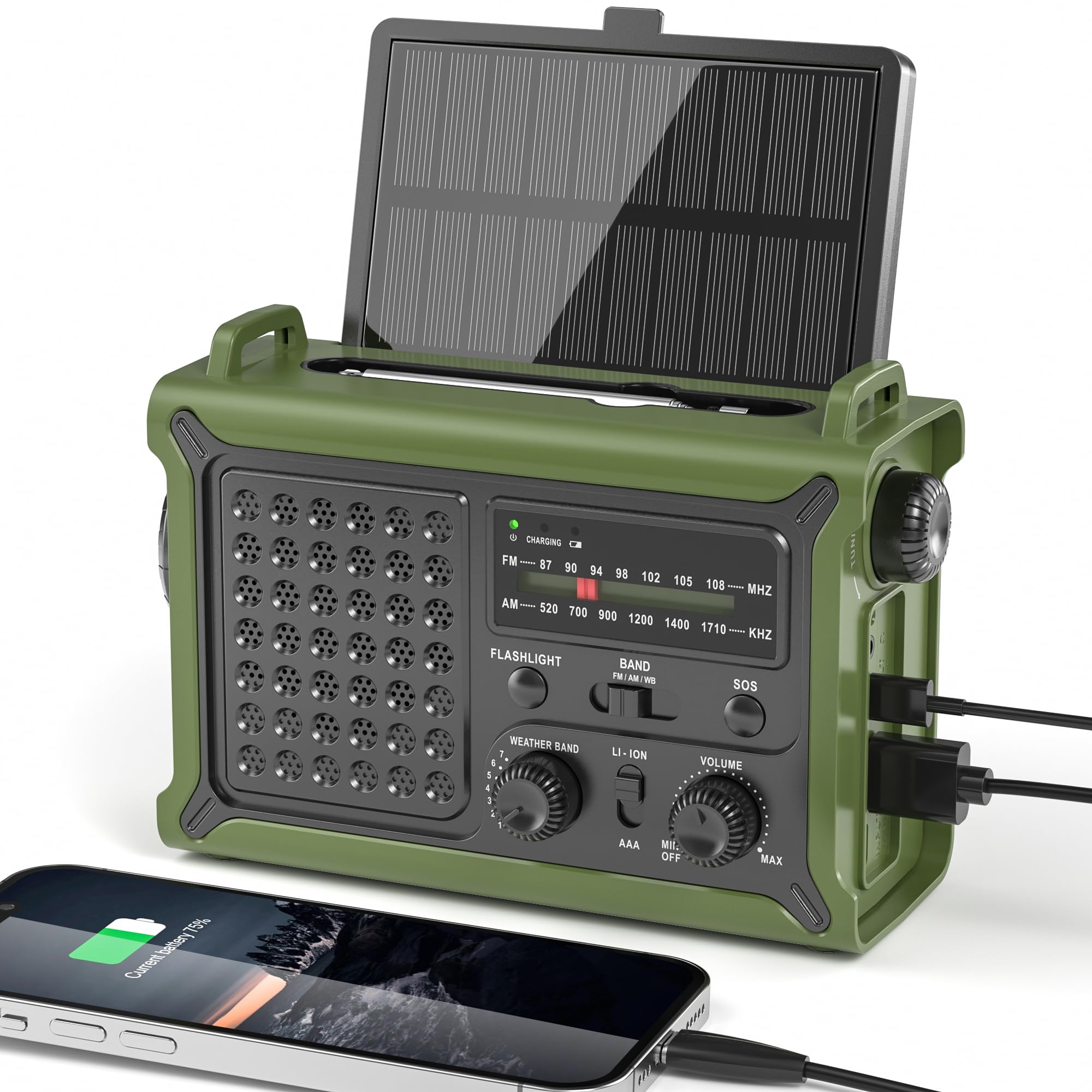
This Mesqool mirrors the Roxicosly in battery capacity (12000mAh) and solar panel size (8500mm²), but adds a few design touches that make it a strong contender. The flashlight casts a focused beam up to 260 feet — useful for dark trails or emergency navigation — and there is a separate frosted reading lamp for a softer glow. The ergonomic shape with a non-slip grip is genuinely comfortable to hold, and the large tuning knob and clear labels make it easy to operate in the dark.
Quality and functionality are the top praises, with 157 owners calling out the build quality. The hand crank and solar panel both work well, and the unit offers 5 power sources including AAA batteries. Customers note using it daily without ever plugging it in, relying on solar through a window. The only missing piece is a battery level indicator — you have to guess how much charge remains. At 1.6 pounds, it is the heaviest compact unit here, but the trade-off is that you may never need to plug it in during normal use.
What impresses
- Large solar panel that works in low light conditions
- Excellent build quality and ergonomic grip
- Powerful flashlight with 260-foot beam
The honest limits
- No battery level indicator — you don’t know remaining charge
- Heavier than most at 1.6 lbs
- Not designed for backpacking due to weight
Reach for this if: you want a premium emergency radio with reliable solar charging and a sturdy feel — it is built to live in a car or a home emergency kit.
Look elsewhere if: weight and portability are your top priorities.
7. Sangean PR-D9W

Room-filling audio and superb reception in a compact case that recharges its own batteries.
For superior audio quality, the Sangean PR-D9W sets the benchmark. Owners consistently praise its “room filling audio” and outstanding reception across AM, FM, and NOAA bands — 201 owners single out the sound quality as the top feature. The built-in NiMH battery charger means you can recharge AA batteries inside the unit, which is a smart convenience. It also has 19 memory presets including a dedicated “My Favorite Station” button, a loud NOAA weather alert system with a flashing red LED, and a dual alarm with wake-to-radio.
The PR-D9W is compact at 6.34″ x 1.55″ x 4.17″, making it easy to place on a nightstand or kitchen counter. The main compromises are that battery life with standard NiMH cells is just okay — Eneloop batteries improve it significantly — and a few units have experienced a lock icon malfunction after extended use. The Sangean reputation for quality is strong, but the PR-D9W has a slightly higher rate of reliability complaints than the other picks here.
The standout spec: The room-filling sound quality in a compact package is rare — most emergency radios sound tinny, but this one handles music well.
The honest caution: A small number of reviewers point out a lock button issue after months of use. It is not widespread, but it is worth knowing. Battery life also depends heavily on which NiMH cells you use.
Ideal for: someone who values audio quality and wants a compact radio with excellent reception for home use during a power outage.
Not for: budget buyers or those who need a rugged, drop-proof emergency unit.
8. Sangean HDR-14 HD Radio

The pocket-sized HD Radio that pulls in digital stations where others fall silent.
This Sangean is for the radio enthusiast. It receives both analog AM/FM and HD Radio digital broadcasts, which means you get the extra sub-channels (HD2, HD3) that many stations now broadcast. The HD sound quality is noticeably clearer than standard FM, though the HD range is about half that of analog FM. With 40 memory presets (20 FM, 20 AM), it is built for someone who wants to save every station they find. The compact size — 5″ x 1.25″ x 3.03″ — makes it genuinely pocketable.
Sound quality and reception are the top praises, with 232 owners calling out the audio. It supports emergency alerts, which is a plus for weather safety. The honest downsides are that the internal speaker is weak and mediocre for its size — you will want headphones for the best experience. The user interface also takes some getting used to, and there is no NOAA weather band, AUX input, or Bluetooth. Battery life is mixed depending on usage.
Why it stands out
- Excellent HD Radio sensitivity for picking up weak digital stations
- Very compact and pocket-sized
- Great battery life for an HD radio
The trade-offs
- Internal speaker is weak — headphones recommended
- No NOAA weather band, AUX, or Bluetooth
- UI can be confusing at first
Best for: HD Radio enthusiasts and travelers who want the best digital reception in a tiny package.
pass on it if: you need a powerful built-in speaker or weather alerts — this is a specialist HD receiver.
9. C. Crane CCRadio-2E

The heavyweight champ of AM reception with a 250-hour battery life on four D cells.
If you live far from AM stations or just want the absolute best AM reception money can buy, the C. Crane CCRadio-2E is the end of the road. The Twin-Coil Ferrite Antenna is legendary among DX enthusiasts for pulling in distant stations with no static. It weighs 4 pounds and runs on 4 D batteries for up to 250 hours, or you can use the included AC adapter. The build quality is “silly simple to set up,” as one owner put it, and the metal enclosure feels substantial.
It covers AM, FM, NOAA Weather Band (with alerts), and even the 2-Meter Ham band — a niche but critical frequency for getting information during natural disasters. The sound quality is surprisingly good for a mono speaker, and the tone controls let you shape the audio. The main complaints are that it is a battery hog compared to simpler LCD-free radios, and the value for money is a point of debate given the price tag. A few units have had reliability issues, but C. Crane’s customer service is well-regarded for replacements.
The defining spec: 250 hours of run time on D batteries means you can leave it on round the clock during a week-long power outage without worrying about recharge.
Who should skip it: This is heavy, expensive, and oversized for casual use. Buy it only if you genuinely need the best AM reception available in a portable form.
Reach for this if: you are a serious AM DX listener, live in a remote area, or need the most sensitive receiver for emergency ham band monitoring.
Look elsewhere if: your needs are simple — a radio will serve you just fine.
Understanding the Specs
Battery Capacity (mAh vs mWh)
This is the most important number for emergency radios. mAh (milliamp-hours) tells you how much energy the battery holds — a 12000mAh battery can charge a typical smartphone (3000-4000mAh) about three full times. mWh (milliwatt-hours) is another way to measure energy; the FosPower A1 is 7400mWh, which is roughly 2000mAh. For daily use radios running on AA batteries, look for battery life in hours — the Panasonic RFP-150D gets over a month of nightly use, while the C. Crane runs 250 hours on D cells.
NOAA Weather Alert
This feature turns the radio into a lifeline during severe weather. The radio continuously monitors the seven NOAA weather frequencies, and when the National Weather Service issues a warning, the radio sounds a loud alarm (usually 9 seconds) and switches to the weather broadcast. Not all battery-powered radios have this — the Panasonic pocket models and the Sangean HDR-14 skip it. If you live in hurricane, tornado, or flood-prone areas, it is the single most important feature to look for.
FAQ
How long will a battery powered radio last during a power outage?
Can a solar powered radio charge my phone?
What is the difference between AM, FM, and NOAA bands?
How does a hand crank work for powering a radio?
Can I use a battery powered radio while it is charging?
Are battery powered radios safe to use in a bathroom or outdoors in rain?
What does HD Radio do that regular FM cannot?
How do I choose between a pocket radio and a larger emergency radio?
Final Thoughts: The Verdict
For the majority of shoppers, the best all-around battery powered radio you can buy is the Roxicosly CR1030 because its real 12000mAh battery, NOAA alerts, and multiple charging methods cover every emergency scenario without compromise. If you want a pocket-sized daily companion with absurd battery life, grab the Panasonic RFP-150D. And for the absolute best AM reception and a 250-hour run time, the C. Crane CCRadio-2E is the gold standard for serious listeners.
How We Picked
We do not accept paid placement. Every pick is matched to a real buyer and a real use-case; we do not hands-on test units.
Sources & Methodology
Specifications: manufacturer listings and product documentation. Review insights: verified customer reviews, as of July 2026. Pricing: not shown on this page (it changes often); check the current price via the retailer link.
As an Amazon Associate, Gadgets Feed earns from qualifying purchases. This does not affect which products we feature.