
Our readers keep the lights on and my morning glass full of iced black tea. As an Amazon Associate, I earn from qualifying purchases.
Specs are compiled from manufacturer listings and verified buyer reviews and can change over time — please confirm the key details on the product page before buying.
Picking the wrong gear oil makes your differential howl, your transmission snag, and your weekend ride feel like a money pit. The difference between a smooth drivetrain and a noisy one often depends on choosing the right 80W-90 gear oil from a shelf full of look-alikes. This guide reviews the nine best 80W-90 gear oils for cars, trucks, motorcycles, and marine drives, highlighting each one’s strengths and weaknesses.
I’m Min — the founder and writer behind Gadgets Feed. This guide is built by comparing the manufacturers’ published specifications and the patterns across verified customer reviews, so you get each pick’s real strengths and trade-offs instead of marketing spin.
Whether you are topping off a vintage differential or servicing a high-horsepower outboard, the 80w-90 gear oil you choose directly affects how long your gears, bearings, and synchronizers survive the miles ahead.
Our Picks at a Glance

How To Choose The Best 80W-90 Gear Oil
Choosing 80W-90 gear oil is straightforward when you focus on three factors: API service rating, limited-slip additive needs, and vehicle type. Getting these three right prevents howling differentials, grinding shifts, and premature wear.
API GL-4 vs. GL-5 — The Yellow Metal Rule
The most common mistake is using GL-5 oil in transmissions with brass or bronze synchronizers (yellow metals). GL-5 oil contains higher levels of extreme-pressure additives that can corrode those soft metals over time. GL-4 is safe for classic manual transmissions and gearboxes with yellow-metal parts. GL-5 is correct for modern differentials, hypoid gears, and most axles. Some oils cover both ratings—always check the label before use.
Limited Slip Differentials — Built-in or Bottled?
Most limited-slip differentials (LSDs) require a friction modifier additive to prevent clutch chatter during turns. Some 80W-90 oils come with that additive already blended in — labeled “LS” or “Limited Slip Ready” — saving you a separate purchase and the guesswork of how much to add. If your vehicle has a standard (open) differential or a manual transmission, you do not need the LS additive, and in some transmissions it can actually interfere with smooth shifting.
Conventional vs. Synthetic — Real-World Temperature Range
Conventional 80W-90 handles most daily driving and towing conditions, but it thickens noticeably in extreme cold and breaks down faster under prolonged high heat (heavy towing, off-road, marine use). Synthetic or synthetic-blend oils flow better at low temperatures and resist thermal breakdown longer. For a daily driver in moderate climate, conventional is fine. For a boat, a race truck, or a vehicle that works hard in both deep winter and summer heat, the extra cost of a synthetic blend pays off in extended drain intervals and less wear.
Quick Comparison
| Model | Best For | Volume | API Rating | Base Oil | Amazon |
|---|---|---|---|---|---|
| STAR BRITE Star Tron Synth Blend★ Best Overall | Marine lower units (100+ HP) | 32 fl oz | GL-5 / MT-1 | Synthetic Blend | Amazon |
| TRIAX Gear Premium LS 80W-90Limited Slip Ready | Limited-slip differentials & heavy duty | 32 fl oz | GL-5 | Synthetic | Amazon |
| Quicksilver 80W-90 Motorcycle OilShaft Drive Spec | Shaft-drive motorcycles & ATVs | 32 fl oz | GL-5 / MT-1 | Conventional | Amazon |
| STAR BRITE Star Tron High Viscosity | Marine outboards & stern drives | 32 fl oz | GL-5 | Conventional | Amazon |
| Penn Grade 1 Classic GL-4 80W-90 | Classic transmissions with yellow metal | 32 fl oz | GL-4 | Mineral | Amazon |
| Valvoline High Performance 80W-90 | Conventional differentials & manual gearboxes | 1 gallon | GL-5 / GL-4 | Conventional | Amazon |
| Ford Motorcraft XY-80W90-QL | Ford axles & limited-slip differentials | 96 fl oz (3 pack) | GL-5 | Mineral Oil | Amazon |
| Ultra1Plus SAE 80W-90 GL-5 | Heavy-duty axles & BMW spec | 1 gallon | GL-5 / GL-4 | Oil | Amazon |
| Yukon Gear & Axle 3 Qt. 80W90 + Additive | Positraction / limited-slip differentials | 3 quarts | GL-5 | Conventional | Amazon |
In‑Depth Reviews
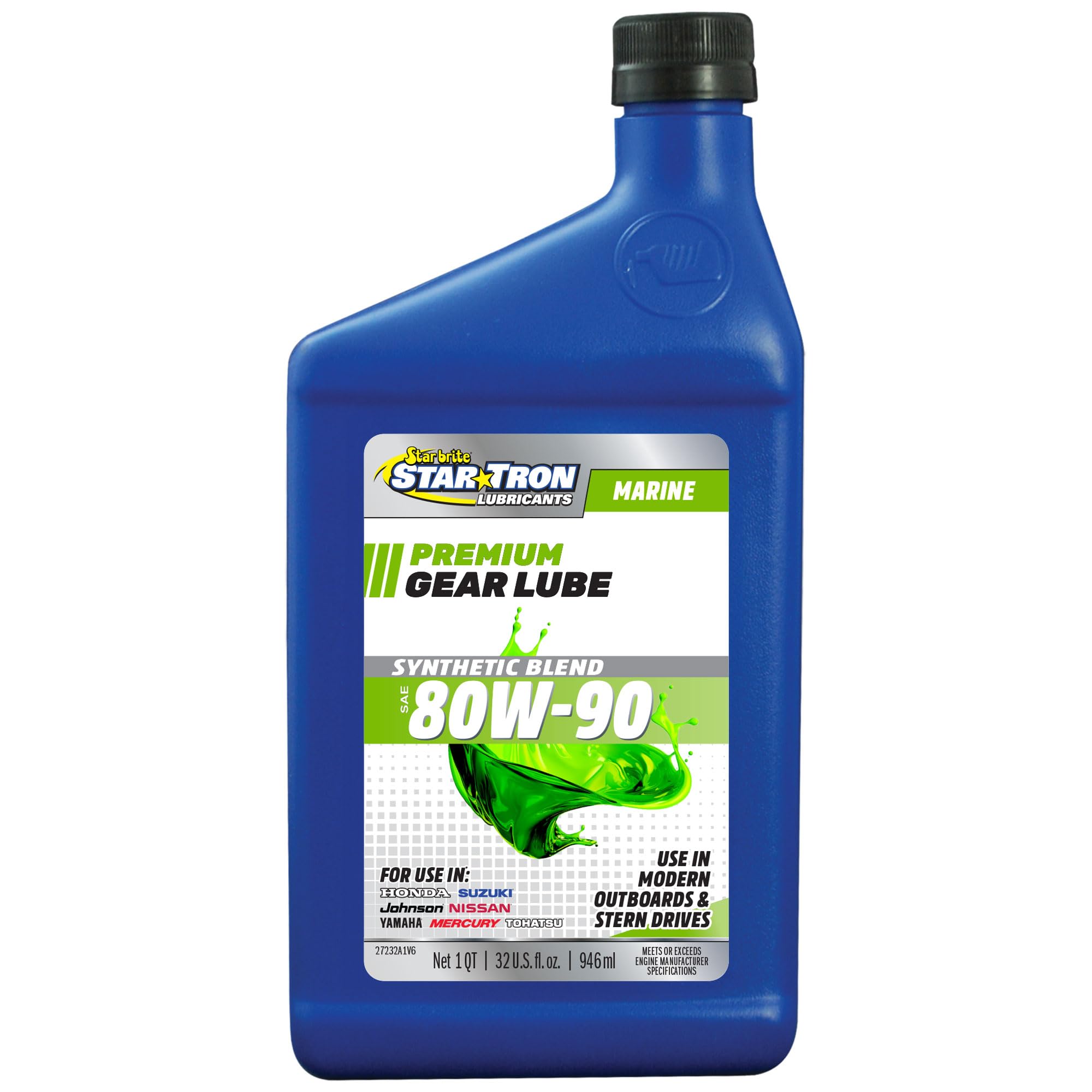
1. STAR BRITE Star Tron Synthetic Blend Lower 80W-90 Unit Gear Lube
Our pick — over 4.5★ from 850+ verified ratings; the strongest balance of quality and price.
The marine-grade synthetic blend that keeps high-horsepower outboards running season after season.
If you own an outboard or stern drive with a motor over 100 HP, this is the oil that owners trust to keep saltwater and corrosion at bay for years. The crowd favorite — an exceptional rating across a huge number of owners — puts it at the top for good reason. It is a synthetic blend 80W-90 that meets API GL-5, API MT-1, SAE J2360, and Mack GO-J, meaning it shrugs off the thermal stress of a long WOT run and still clings to gears when you are idling back to the dock. The extreme-pressure additives in the STAR BRITE blend are specifically for high-horsepower marine engines, which is a different demand than your pickup truck’s differential faces. “I have been using this now for a few years and have had no issues with the motor,” buyers report — that kind of long-haul confidence is exactly what you want when a lower unit failure means a tow.
At 32 fluid ounces in a single bottle, it is a direct replacement for the quart-sized fills most outboards take. Owners consistently praise the quality, with that specific aspect earning the most mentions by far. The only honest caveat: because this is a marine-specific product, the additive package is designed for the water environment and is pricier per quart than a basic automotive GL-5. In a car or truck differential it would work perfectly fine, but you are paying for the marine-grade corrosion protection you do not need on dry land. Keep it where it was designed to go — outboards and stern drives — and it delivers exactly what it promises.
Why owners stay loyal: The synthetic blend resists the moisture and thermal breakdown that kills lower units, and it does not cost as much as the OEM branded bottles at the marina.
Keep it on the water if: You have a 100+ HP outboard, I/O, or stern drive and want corrosion protection without the dealer markup.
Look elsewhere if: You need a cheap fill for an old lawn tractor gearbox or a car differential — you are paying for marine additives you will not use.
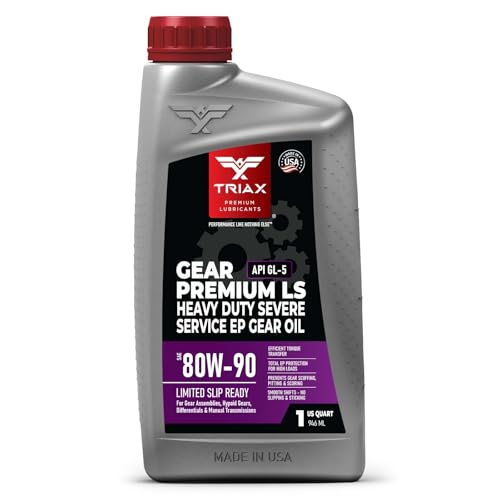
2. TRIAX Gear Premium LS 80W-90, GL-5 Limited Slip Ready
The synthetic GL-5 with the friction modifier already blended in — no extra bottle needed.
TRIAX sells itself on the widest OEM specification range on the market, and the owner feedback backs it up: this oil goes into everything from Kawasaki Brute Force 300 transmissions (used as a rebuild break-in oil) to Jeep TJ axles to heavy-duty towing rigs. The built-in limited slip additive is the headline here — it handles all limited-slip differentials including those with wet brakes, so you never need to buy a separate bottle of friction modifier and guess the dosage. That is a real convenience win over the Yukon pack below, which gives you the additive as a separate 4 oz bottle you have to measure yourself.
The liquid volume is 1 quart, but at a entry-level price this oil takes the value crown: you get a fully synthetic GL-5 with polyphosphate EP additive technology that exceeds Load Stage 13 requirements beyond 120 lbs per square inch. Quality is the aspect owners single out most often, and value-for-money is a close second. The trade-off? It is not rated GL-4, so do not put it in any transmission with brass or bronze synchronizers — the extreme-pressure chemistry is too aggressive for those soft yellow metals and can cause corrosion over time. Stick to differentials and non-synchronized gearboxes and you are golden.
Best for the DIY diff service
- Built-in limited-slip additive means no guesswork — pour it and go
- Synthetic formula withstands high-load towing without viscosity breakdown
- Covers an unusually wide range of OEM specs, from full-size trucks to ATVs
Not for yellow-metal gearboxes
- Only GL-5 rated — do not use in synchro transmissions that call for GL-4
- 0.95 quarts vs a full quart means you might need a second bottle for a large differential fill
The diff-and-go choice for: Anyone servicing a limited-slip differential on a truck, SUV, or ATV who wants synthetic protection at an entry-level price.
Not for: Classic manual transmissions with brass synchronizers, or anyone who needs a full gallon for a big gearbox fill.
3. Quicksilver 80W-90 Motorcycle Hypoid Gear Oil, 1 Quart
The factory-fill spec for shaft-drive motorcycles — exactly what old Hondas and Suzukis need.
Quicksilver’s 80W-90 is the right pick when your motorcycle’s service manual says “GL-5 hypoid gear oil” and you want a full quart for a single fill (it is 1 quart versus the TRIAX’s 0.95 quarts). Owners run it in everything from a 1984 Honda Nighthawk 650 rear end right up to a 2006 Suzuki C50C final drive, and the consensus is that it delivers smoother shifting and noticeably reduced gear noise under load. The “all gear oil absolutely stinks,” as one long-term owner put it — that is the extreme-pressure sulfur smell you get with any GL-5, and it is normal. It meets or exceeds API GL-5 and MT-1 plus SAE J236, so it handles the shear stress of a shaft-drive final drive without breaking down.
What wins owners over is the quality and the price point — it is trustable at a budget-friendly level compared to buying the same spec from the motorcycle dealer. The only catch is the strong odor when you open the bottle and the fact that it is a conventional oil, not synthetic, so in extreme cold climates the shift feel stiffens up a little until the oil warms. For a weekend cruiser or a vintage shaft-drive bike ridden in moderate seasons, that is a non-issue. For a year-round commuter in the north, a synthetic blend (like the STAR BRITE above) flows better on cold mornings.
Why riders keep coming back: It is the exact spec older Honda, Suzuki, and Yamaha shaft-drive manuals call for, at a price that beats the dealer every time.
The right oil for: Shaft-drive motorcycles and ATVs with separate clutch transmissions that specify GL-5 80W-90.
skip it if: You ride in sub-freezing temperatures regularly — a synthetic blend handles cold starts better.
4. STAR BRITE Star Tron High Viscosity Lower Unit Gear Lube 80W90

The budget-friendly marine 80W-90 that covers almost every outboard brand on the water.
This is the conventional counterpart to the synthetic-blend STAR BRITE above — same 32-ounce bottle, same marine purpose, but with a lower price tag. It is formulated with anti-wear additives and rust and corrosion inhibitors, and it is recommended for Mercury, Mercruiser, Johnson, Evinrude, OMC, Force, Mariner, Nissan, Suzuki, Yamaha, and Volvo engines. That is about every outboard and stern drive you are likely to encounter. Owners running it in a 150 HP Evinrude report top-notch oil quality, and the squeeze tube with a cuttable nozzle makes a tight, leak-free fit on vintage lower units dating back to the 1970s. It will not void manufacturer warranties either — a nice confidence boost for warranty-conscious owners.
The honest trade-off versus the synthetic-blend version: this is conventional oil, so it does not have the same thermal stability under the continuous high-load, high-heat conditions that a large outboard putting out 150+ HP endures on a long offshore run. For a recreational boater with a 50-115 HP outboard doing weekend lake trips, this is more than enough protection. For a high-performance offshore rig or a boat that sees heavy commercial use, the synthetic blend version handles the heat better and extends the change interval.
The practical choice for: Weekend boaters who need a reliable GL-5 for a Mercury, Evinrude, or Yamaha outboard without paying a premium for a synthetic formula they do not need.
Best for: Classic and modern outboards up to around 115 HP that need a simple, reliable GL-5 fill.
Trade-off: Conventional base means less heat tolerance than the synthetic-blend version — heavy users should step up to the Star Tron synthetic blend.
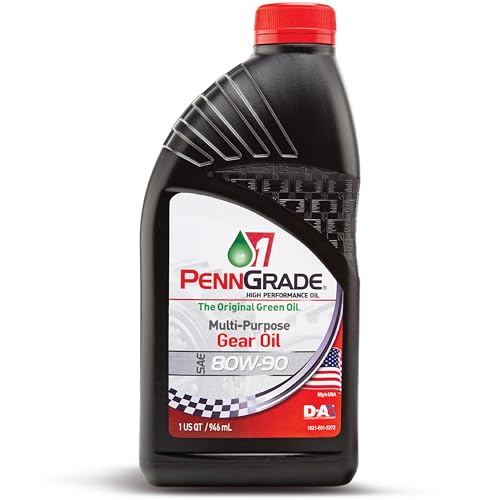
5. Penn Grade 1 Classic Multi-Purpose GL-4 Gear Oil SAE 80W-90
The GL-4 specialist for classic transmissions with brass synchronizers — exactly what a Muncie or Toploader needs.
This is the only GL-4 oil on the list, and it exists for a very specific reason: classic manual transmissions and transaxles with yellow-metal components (brass, bronze, copper) are damaged over time by the high levels of extreme-pressure additives in GL-5 oils. Penn Grade 1 is blended with premium mineral base stocks and select additive technologies that lubricate brass synchronizers, bushings, and thrust washers without corroding them. Owners running Ford Toploaders, Muncie SM465 four-speeds, and vintage Willys Jeep differentials report smooth gear changes right away and noticeably better performance than using a standard GL-5. It is also a popular choice for some Harley transmission applications that specify GL-4. The ratings are nearly perfect here — the highest of any product on this list — and the quality aspect is the thing owners mention most by a wide margin.
The big caveat is in the name: this is GL-4 specifically and should not be used in applications that require API GL-5 extreme-pressure lubrication, such as modern hypoid differentials or heavy-duty truck axles. Penn Grade 1 is also explicitly not intended for limited-slip differentials — it lacks friction modifiers, and adding them would defeat its purpose. This is a niche product, but if you own a classic car with a four-speed or a vintage truck with a non-hypoid rear end, it is the right choice and it is hard to find in stores.
Built for the classics
- GL-4 rating is compatible with brass/bronze synchronizers — safe for Muncie, Toploader, T10 transmissions
- High-quality mineral base oil with outstanding owner satisfaction
- Each bottle ships individually bagged and boxed to prevent leaks
Modern drivetrains need not apply
- Not GL-5 rated — do not use in hypoid differentials or limited-slip axles
- Does not contain friction modifiers for limited-slip clutches
For classic car and truck owners: If you have brass synchros in a Muncie, Toploader, or T10, this is the correct oil — do not risk a GL-5.
Not for: Any modern vehicle that calls for GL-5 in the differential or limited-slip additive in the axle.
6. Valvoline High Performance SAE 80W-90 Gear Oil 1 GA

The gallon jug economy that Valvoline’s name has backed for years — a solid, no-surprises GL-5.
When you need a full gallon for a truck differential or shop use, Valvoline High Performance is the reliable name that mechanics have trusted for decades. It is formulated with extreme-pressure additives that minimize gear wear from shock loads and scuffing, and it protects against severe temperatures. It covers both GL-5 and GL-4 applications, which gives it real flexibility: you can use it in conventional hypoid differentials and non-synchronized manual transmissions in passenger cars, light trucks, SUVs, vans, and heavy-duty trucks. At 1 gallon and 7 pounds per jug, this is the bulk option for folks who do multiple changes a year. Owners repeatedly note the “Valvoline quality” and the value of buying by the gallon instead of individual quarts.
There is one notable discrepancy in the listing: the description says “Synthetic” but the container itself says “Conventional.” Multiple owners flagged this, so treat it as a conventional 80W-90 oil and you will be fine — the performance is still excellent for normal driving and towing. If you specifically need a full synthetic for extreme cold or severe service, the listing label is misleading and you should pick the TRIAX above instead. For a standard differential fill or a shop that goes through gear oil regularly, this gallon is tough to top on price-per-quart.
The practical bulk buy for: Anyone doing a differential or gearbox fill on a pickup, SUV, or van who wants a known brand in a gallon jug.
Grab a jug if: You need a full gallon for a truck or heavy-duty application and Valvoline’s reputation matters to you.
Double-check if: You require a true synthetic — the container says conventional despite the listing, so read the label before pouring.
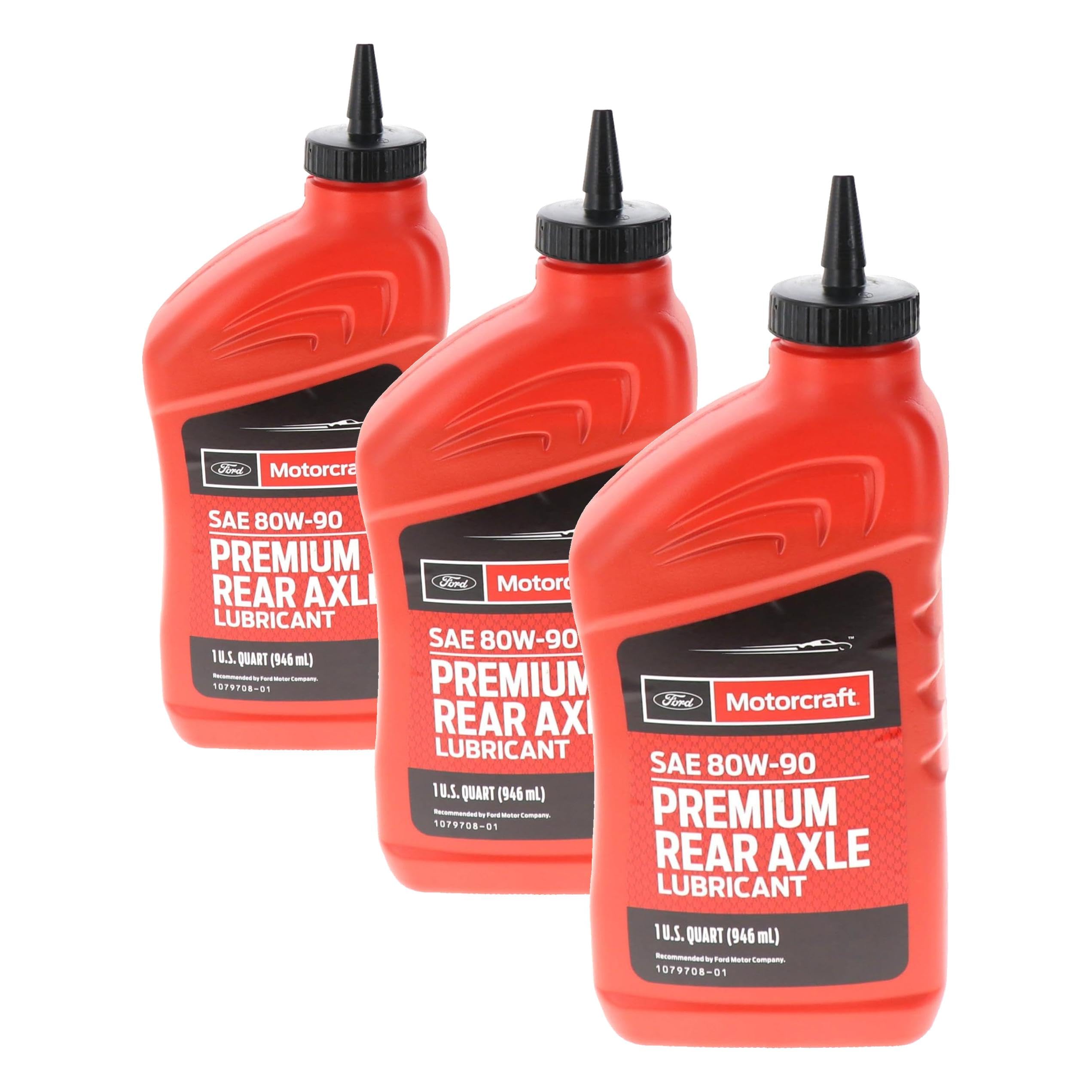
7. Genuine Ford Fluid XY-80W90-QL SAE 80W-90 Premium Rear Axle Lubricant
The factory-recommended 80W-90 for Ford differentials — zero guesswork for F-150, Ranger, and other Blue Oval axles.
If the words “use Motorcraft SAE 80W-90 Premium Rear Axle Lubricant” appear in your owner’s manual, this three-pack is exactly what you need. It is a genuine Ford Fluid product with the XY-80W90-QL part number, recommended for conventional and limited-slip differentials in passenger cars, light trucks, vans, and buses. Owners confirm it for F-150 differential flushes at 145,000 miles and 1995 Ranger rear ends — no second-guessing whether the friction modifier balance is right. Ford explicitly states it for limited-slip axles, which means the additive package is already calibrated to prevent clutch chatter during turns, unlike the separate-additive approach of the Yukon kit. At 96 fluid ounces total (three quarts), it covers most Ford rear axle fills in one go, and you have a spare quart for another service.
The value here is strong compared to buying single quarts of Motorcraft from the dealer parts counter. The trade-off is simple: this is Ford-specific. It works perfectly in Ford and Lincoln products, and it meets the GL-5 spec that many other brands also require, but the additive balance is tuned for Ford’s clutches and gear sets. In a GM or Ram rear end, an aftermarket oil like the TRIAX or Valvoline gives you a more universal additive package designed for broader compatibility. Stay within the Blue Oval family and it is the best choice on the list.
The peace-of-mind pack for: Ford and Lincoln owners who want the exact Motorcraft spec without paying dealer per-quart markup.
Buy it for: F-150, Ranger, Mustang, Explorer, or any Ford vehicle that calls for Motorcraft 80W-90 in the rear axle.
Skip it for: GM, Ram, Toyota, or other brands — the additive tuning is specific to Ford’s limited-slip clutch packs.
8. Ultra1Plus SAE 80W-90 Gear Oil Heavy Duty API GL-5, 1 Gallon

The gallon that BMW owners and off-road rigs both reach for — heavy-duty protection at a working-class price.
Ultra1Plus is not a household name like Valvoline, but it has carved a strong following among BMW owners who need a specific 80W-90 GL-5 for their differentials and among off-roaders running front and rear lockers. The oil is API GL-5 and GL-4 rated, with advanced anti-wear additives formulated to prevent pitting, spalling, and scouring on gear teeth. It is also advertised to fight corrosion and chatter. The flash point is 210 °C (410 °F), which is solid for a conventional oil running in a heavy-duty axle under high-torque conditions. Owners mention it works perfectly for BMW differential applications (one specifically calls it “required by BMW”) and for full-size truck lockers. At a gallon jug, this is another strong economy play for anyone who goes through gear oil in quantity.
The most honest negative comes from a packaging issue: a few bottles arrived leaking because the jug cap is not always sealed tightly inside the shipping box. That is a packaging/transit problem, not a quality problem, but it means you should inspect the bottle on arrival and wipe it down before storing. The other note is that Ultra1Plus publishes fewer OEM approvals than the major brands, so if you need a specific manufacturer certification number (e.g., for a warranty claim), go with the Valvoline gallon or the Ford Motorcraft pack. For general heavy-duty use in an axle that just wants a clean GL-5, this does the job well at a very competitive gallon price.
The versatile heavy lifter for: BMW differentials, truck lockers, and any axle that needs a solid GL-5 at a better gallon price than the big-name brands.
Reach for it if: You need a gallon of GL-5 for a BMW, heavy-duty truck, or SUV and do not mind a less famous brand with a good track record.
Check the seal if: The jug arrives with any signs of leakage — packaging is the weak link here, not the oil itself.
9. Yukon Gear & Axle 3 Qt. 80W90 Conventional Gear Oil with Friction Modifier Additive

The posi-kit special from Yukon — three quarts of conventional 80W-90 plus a 4 oz bottle of friction modifier.
Yukon Gear & Axle is a known name in differential parts, and this kit bundles three quarts of their conventional 80W-90 with a separate 4 oz bottle of Yukon Positraction additive. The idea is that you pour the oil into the differential, then add the friction modifier as needed depending on whether you have composite clutches and how much chatter you experience. Owners who bought Yukon ring-and-pinion sets say this is exactly what the manufacturer recommends for break-in and normal use on their own differentials. The quality aspect and effectiveness are the most-discussed positives among owners.
The catch compared to the TRIAX above: the TRIAX has the limited-slip additive already blended in, so you do not have to measure and pour a separate bottle. Here you get to do a little DIY mixing, which is fine if you are experienced but adds a step for a novice. A few owners note the oil appears to be relabeled Phillips 66 conventional gear oil — which is fine oil, but if you expected a proprietary Yukon formulation, the label is a surprise. If you are building a Yukon differential from scratch, this kit is the easy button. If you just need standard 80W-90 for a regular fill, the non-LS oils above do the same job at a lower overall cost.
Convenient for Yukon builds
- Three quarts cover most passenger-car and light-truck differential fills
- Separate additive bottle lets you adjust friction modifier dosage for your specific clutch pack
- Trusted as the manufacturer-recommended fill for Yukon differential components
Extra step vs. blended oils
- Requires you to measure and mix the friction modifier manually — more work than a pre-blended LS oil
- Some customers note the oil is relabeled Phillips 66, not a proprietary Yukon blend
- Higher overall cost than buying conventional 80W-90 on its own if you already have friction modifier
The exact fill for: Anyone installing a Yukon differential or gear set — this is what the manufacturer recommends for break-in and regular service.
Look elsewhere if: You just want to top off an existing limited-slip diff without the hassle of mixing additive — the TRIAX LS is pour-and-go.
Understanding the Specs
API GL-4 vs GL-5
The American Petroleum Institute’s gear oil classifications tell you two things: the load capacity and the chemical aggressiveness. GL-4 is designed for moderate-load gearboxes and has lower levels of extreme-pressure (EP) additives, making it safe for brass and bronze (yellow metal) synchronizers found in older manual transmissions. GL-5 has higher EP additive levels for the severe sliding action of hypoid gears in modern differentials. The extra sulfur-phosphorus chemistry in GL-5 can corrode yellow metals over time, so using GL-5 where GL-4 is called for can destroy synchronizers. Using GL-4 where GL-5 is required can cause gear scuffing and failure under heavy load.
Limited Slip Additive (Friction Modifier)
Limited-slip differentials use clutch packs to distribute torque between the wheels. Without a friction modifier, those clutches can grab and release in a jerking motion called “chatter” during tight turns. Some gear oils like the TRIAX LS have the modifier already blended in. Others, like the Yukon kit, supply it as a separate bottle. If your vehicle has a standard (open) differential or a manual transmission, do not use an LS oil — the friction modifier can cause synchronizers to slip and prevent crisp gear engagement.
FAQ
Can I use 80W-90 gear oil in my manual transmission?
What happens if I use GL-5 gear oil in a GL-4 transmission?
How often should I change 80W-90 gear oil in a differential?
Is 80W-90 the same as SAE 90 gear oil?
Can I mix 80W-90 gear oil with a different weight like 75W-90?
Does 80W-90 gear oil expire or go bad?
Can I use 80W-90 gear oil in my boat’s lower unit?
What does “hypoid” mean in gear oil applications?
Can 80W-90 gear oil be used in an ATV or UTV?
Final Thoughts: The Verdict
For most buyers, the 80w-90 gear oil winner is the STAR BRITE Star Tron Synthetic Blend because it combines the thermal stability of a synthetic blend with the marine-grade corrosion protection that high-horsepower outboards demand, all backed by the strongest owner satisfaction on the list. If you need a synthetic GL-5 with built-in limited-slip additive for a truck or ATV differential, the TRIAX Gear Premium LS is your best bet — no separate friction modifier bottle needed. And for the vintage car owner with a Muncie or Toploader, the Penn Grade 1 Classic GL-4 is the only safe choice that protects your brass synchronizers from chemical damage.
How We Picked
We do not accept paid placement. Every pick is matched to a real buyer and a real use-case; we do not hands-on test units.
Sources & Methodology
Specifications: manufacturer listings and product documentation. Review insights: verified customer reviews, as of July 2026. Pricing: not shown on this page (it changes often); check the current price via the retailer link.
As an Amazon Associate, Gadgets Feed earns from qualifying purchases. This does not affect which products we feature.