
Our readers keep the lights on and my morning glass full of iced black tea. As an Amazon Associate, I earn from qualifying purchases.
Specs are compiled from manufacturer listings and verified buyer reviews and can change over time — please confirm the key details on the product page before buying.
Picking the right 3D print material is less about brand names and more about one thing: consistency. A spool that prints exactly the same from the first layer to the last, without tangles, clogs, or a surprise change in diameter, is worth more than any flashy claim on the box. This guide breaks down the top contenders across PLA, PETG, ABS, and resin, focusing on the real-world behavior that separates a smooth project from a frustrating table-pounder.
I’m Min — the founder and writer behind Gadgets Feed. This guide is built by comparing the manufacturers’ published specifications and the patterns across verified customer reviews, so you get each pick’s real strengths and trade-offs instead of marketing spin.
Whether you are printing functional parts that need to hold a load, or decorative models that need a high-gloss finish, finding the right 3d print material means matching the filament’s properties to your specific printer and project demands.
Our Picks at a Glance
How To Choose The Best 3D Print Material
Start with what you are printing. A simple figurine or a sign for the garage? PLA is your easy-going friend. Need a part that sits in a hot car or takes a bit of a beating, like a bracket or a jig? Then you need the heat and impact resistance of PETG or ABS. For tiny, high-detail models like tabletop miniatures or jewelry, a UV-sensitive resin is the path, though it requires more handling and post-processing steps.
The Plastic Trinity: PLA vs. PETG vs. ABS
Think of PLA as the trusty sedan. It is odorless, doesn’t need a heated bed for small prints, and sticks to itself beautifully at temperatures between 180°C and 210°C. It is the go-to for everyday fun and prototypes. PETG is the SUV. It is stronger, takes a little more heat (up to around 70°C), but still prints fairly easily with fewer fumes than ABS. It is a reliable middle-ground for functional parts. ABS is the work truck. It is tough and handles high heat, but it is fussy. It needs an enclosure to prevent warping and often smells strong enough in use that you might want a good window open.
The Number That Lies: Dimensional Accuracy
Look for that ±0.02mm or ±0.03mm stat. This is the filament’s diameter tolerance. A tighter tolerance, like ±0.02mm, means the filament’s width is extremely consistent as it feeds into your printer’s hotend. This drastically reduces the chance of under-extrusion (a weak, wispy layer) or over-extrusion (a blobby, ugly mess). Inconsistent tolerance is the main cause of print failures that have nothing to do with the model itself.
Resin: The Specialist’s Domain
If you own an LCD or DLP printer using a 405nm UV light source, you are in the resin game. The benefit is insane detail and a smooth surface finish straight off the build plate. The trade-off is messier cleanup with isopropyl alcohol (IPA), proper ventilation for the fumes, and a post-curing step under UV light. It is fantastic for miniatures and jewelry, but not for something that needs to withstand a lot of torque or impact over a large surface area.
Quick Comparison
| Model | Best For | Material Type | Dimensional Accuracy | Weight | Amazon |
|---|---|---|---|---|---|
| HATCHBOX PLA★ Best Overall | Reliable Daily Printing | PLA | ±0.03 mm | 1 kg | Amazon |
| Polymaker PETGSpeed Demon | High-Speed Functional Parts | PETG | — | 1 kg | Amazon |
| ELEGOO ABS-Like ResinDetail King | High-Detail Miniatures | UV Resin | — | 2000g | Amazon |
| Creality ABS | Tough, Heat-Resistant Builds | ABS | — | 1 kg | Amazon |
| LANDU Silk Tri-Color PLA | Decorative & Display Models | Silk PLA | ±0.02 mm | 1 kg | Amazon |
| FLASHFORGE ABS Pro | Advanced ABS with Low Odor | ABS | ±0.02 mm | 2.2 lbs | Amazon |
| ELEGOO PETG 2KG | Bulk Value & Durability | PETG | ±0.02 mm | 2 kg | Amazon |
| Dynta PLA 6-Color Bundle | Beginners & Multi-Color Projects | PLA | ±0.02 mm | 1.5 kg | Amazon |
| SUNLU PETG 4KG Bundle | Heavy-Duty Outdoor Parts | PETG | ±0.02 mm | 4 kg | Amazon |
In‑Depth Reviews
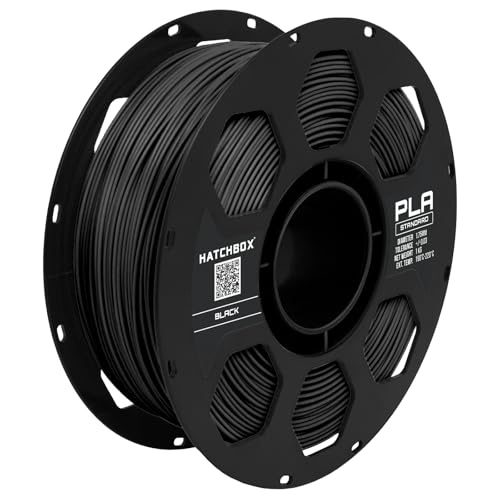
1. HATCHBOX 1.75mm Black PLA
Our pick — over 4.5★ from 40,500+ verified ratings; the strongest balance of quality and price.
The crowd-favorite PLA that sets the standard for consistency across thousands of spools.
HATCHBOX PLA sets the benchmark for consistent quality across thousands of spools. With an extrusion temperature range of 180°C to 210°C, it works on nearly every hobbyist FDM printer right from the start. Its verified ±0.03 mm diameter tolerance ensures your first layer looks identical to your hundredth. It is vacuum-sealed with desiccant, so you avoid the pops and zits caused by moisture. Buyers report that after dozens of spools, the reliability remains the top reason to come back, making it the safe bet for both a student’s first print and a maker’s production run.
Thousands of owners praise the clean, consistent prints it delivers. Its formulation minimizes warping and odor, and it prints small parts without a heated bed. A rare complaint is an improperly wound spool that can cause mid-print tension issues. Think of it as a reliable daily driver, not a specialty material.
What Makes It a Legend
- Proven track record — thousands of reviews point to consistent print quality and reliable diameter
- Clog, bubble, and tangle-free formulation saves you from mid-print headaches
- Works great for both beginners and experts without needing a heated bed for simple prints
The Honest Caveat
- Rare manufacturing defect — a very occasional spool arrives with a winding issue that can affect feeding
- Adhesion can be mixed depending on your specific bed surface and temperature settings
The All-Rounder Winner: This is the spool you grab when you cannot afford a failed print and just need it to work, day in and day out.
Consider Another If: You need the extra heat resistance of PETG or the raw toughness of ABS for a part that will sit in a hot car.
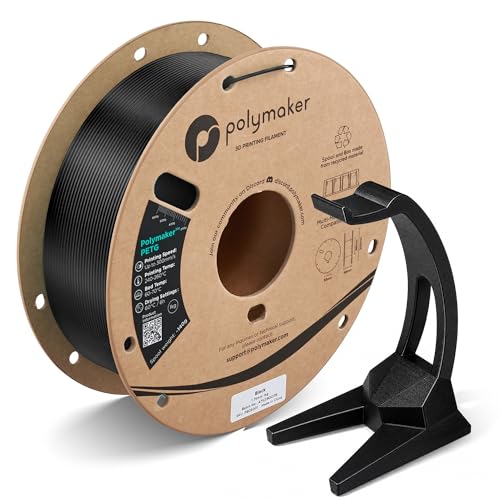
2. Polymaker PETG Filament 1.75mm Black
Reformulated PETG that prints fast without sacrificing that crucial layer adhesion.
Polymaker PETG delivers PETG strength without the long print times. Polymaker’s high-speed formula is rated for up to 300mm/s, making it a perfect match for modern fast-core printers. The material can also handle temperatures up to 70°C HDT, meaning brackets and jigs won’t sag in a warm environment. Its standout feature is consistent layer adhesion, with parts resisting cracking and delamination under stress. The spool is also AMS-ready, feeding smoothly through multi-material systems without clogging or snapping.
Owners mention that Polymaker “did a great job when they reformulated their PETG,” which is high praise for a material that often has a reputation for being stringy. The consensus is that it prints clean, with a nice surface finish that looks more vibrant than cheaper alternatives. A few owners do note that it can become brittle if not stored properly, which is a general PETG trait. The spool is neatly wound and vacuum-sealed, so it is ready to go from the start for functional, weatherproof parts.
Why It Speeds Ahead
- High-speed formula rated for up to 300mm/s without compromising quality
- Excellent interlayer bonding leads to durable parts that resist cracking
- AMS-compatible and warp-free for easy, reliable feeding
A Thing to Watch
- Like all PETG, it can become brittle over time if not kept in a dry environment
- A minority of users report occasional tangling on the spool
Reach for This If: You own a fast printer (like a Bambu or a high-speed Ender) and need strong, heat-resistant parts without the fuss of a full enclosure.
Think Twice If: You are on a very tight budget, as the entry-level options offer more volume for the same investment.
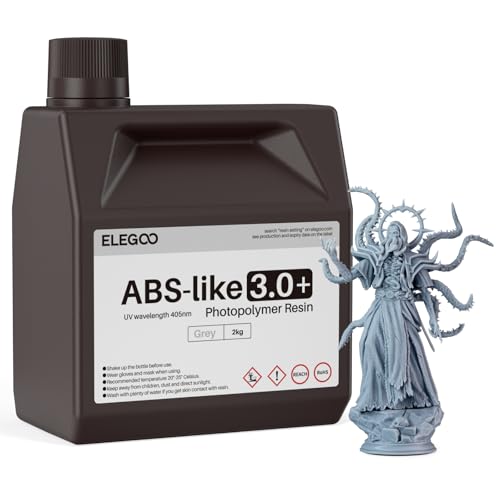
3. ELEGOO ABS-Like Resin 3.0+
Resin that bends a bit before it breaks, finally bringing true toughness to high-detail prints.
If you print miniatures or prototypes that need sharp features, this is a top contender. This is an upgraded photopolymer formula (version 3.0+) that cures fast under standard 405nm UV light, with exposure times around 1.8-2.2 seconds per layer. The key upgrade here is the “ABS-Like” toughness — it is non-brittle enough that a dropped model survives, and the prints can actually be tapped and drilled without cracking. It also handles heat better than standard resin, remaining stable up to about 55°C.
What wins people over is the reliable, consistent quality across many bottles. Owners note the low odor compared to other resins, fast curing times, and ease of cleanup with IPA. The review pages sum it up: “not a single failed print so far.” The high precision means near-invisible layers at 0.05mm height. The catch? It is still a resin. You need a proper ventilation setup, gloves, and a UV curing station. It is also heavier than a plastic part, but for that crisp, polished look, it is tough to top.
Three Standout Traits
- Fast curing at 1.8-2.2 seconds per layer without sacrificing detail
- High impact resistance — models survive drops and can be drilled for post-processing
- Low odor and easy IPA cleanup improve the overall workshop experience
Resin Reality Check
- Requires a 405nm UV printer, proper ventilation, and a post-curing station
- Still more brittle than FDM nylon prints — not ideal for high-stress mechanical parts
The Verdict: This is the go-to for any resin user who is tired of brittle, chalky models and wants prints with legitimate structural integrity.
Not For: FDM printer owners, or anyone who doesn’t already have a dedicated, ventilated workspace for handling liquid resin.
4. SUNLU PETG Filament 1.75mm 4KG Bundle

Four kilos of tough, weather-resistant PETG that makes bulk printing a no-brainer.
This bundle is for the heavy user. Four 1kg spools of PETG at a price that works out to a great per-spool value. The filament itself is engineered for strength and outdoor use, with UV and moisture resistance that makes it ideal for planters, drone frames, and anything that lives outside. The ±0.02mm dimensional accuracy means a consistent melt flow, reducing stringing and blobbing. The recommended nozzle temperature of 240-260°C and a bed of 60-70°C put it squarely in the standard PETG balance.
Customers note the print quality is amazing for the price, with “strong, clean prints” and excellent layer adhesion. The taped end on each spool is a thoughtful touch that prevents the filament from springing loose and jamming your AMS system. Durability is mixed in the review consensus, with some finding it very sturdy and others noting a spool that was wound too tightly. The occasional poor layer adhesion report suggests you should dial in your first layer height carefully for the best results.
Why It’s a Great Deal
- Four spools at a compelling price-per-kilo, perfect for volume printing
- UV and moisture resistant, suitable for outdoor and functional parts
- Consistent ±0.02mm diameter ensures a smooth, clog-free extrusion
Small Compromises
- Layer adhesion can be finicky and might need a bit of temperature tuning
- An occasional user reports a spool that is wound too tightly from the factory
Best for: Makers who burn through material quickly and need a reliable, cost-effective PETG for functional projects.
Consider Alternative If: You are a beginner — starting with a single spool is usually a better way to learn the ropes without a big investment.
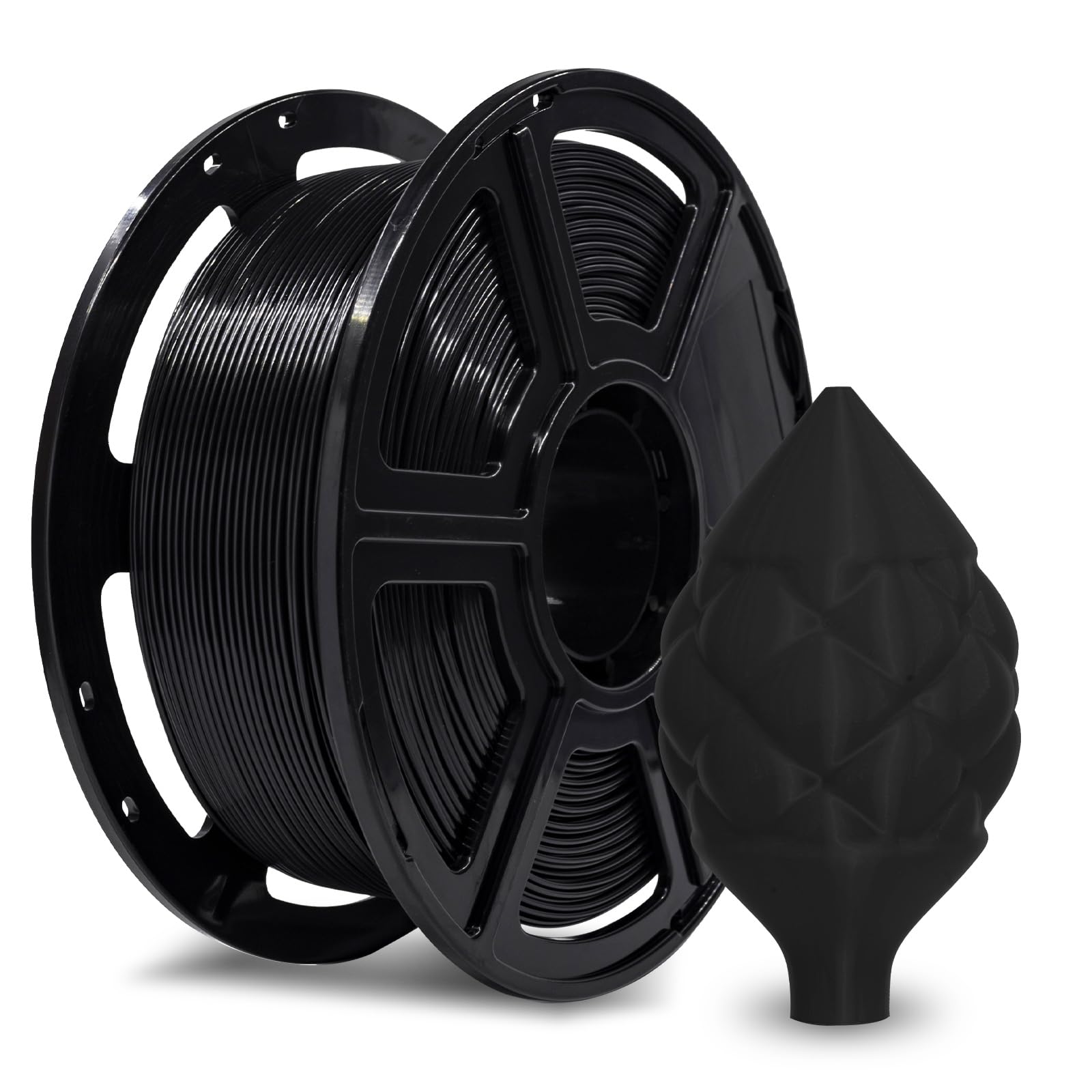
5. FLASHFORGE ABS Pro Filament 1.75mm
ABS that minimizes the headaches, reducing odor and warping without losing any toughness.
This is an advanced ABS formula designed to address the two biggest pain points of standard ABS: the smell and the warping. It has a low-odor profile that makes it more comfortable to use with an enclosure, and the reduced shrinkage means large parts are less likely to curl off the build plate. It still needs an enclosure, but the improved stability earns it high marks. The heat deflection is rated below 90°C, and the ±0.02mm dimensional accuracy (99% size accuracy per the maker) ensures tight, precise parts. It is perfect for functional items like action camera mounts or tool housings.
Reviewers point out this is a “massively better choice than eSun ABS+,” with better appearance and none of the layer cracking. It withstands real-world heat (like the inside of a car on a summer day) without deforming. The printability is praised, and it prints right out of the bag without needing pre-drying or parameter fiddling. The main competitive note is that the spool width might not fit a Bambu AMS 2 without a separate despool, so check your printer’s spool compartment dimensions.
What It Does Well
- Low odor and reduced warping compared to standard ABS, making it easier to work with
- Excellent heat resistance with a hot deformation point below 90°C for functional parts
- Precise ±0.02mm diameter means consistent layers and no clogs
Trade-Offs to Know
- Still requires an enclosed printer for best results, unlike PLA or PETG
- Some users report the spool does not fit the Bambu AMS 2 without a workaround
The Right Pick For: Anyone with an enclosed printer who needs the heat resistance of ABS but wants a less obtrusive, smelly experience.
Look Elsewhere If: You do not have an enclosed printer or are looking for a material that prints on an open-frame machine.
6. ELEGOO PETG Filament 1.75mm 2KG

A solid, straightforward PETG two-pack that focuses on value and consistency for functional prints.
This bundle gives you two 1kg spools of PETG at a price that makes it a smart choice for printers who go through material on brackets, clamps, and mechanical parts. The PETG formulation is designed to combine the best of PLA and ABS — offering durability and high impact resistance without the warping of ABS. The dimensional accuracy is held to ±0.02mm, and each spool is full mechanical wound and manually inspected to minimize tangles. It is widely compatible with most 1.75mm FDM printers, including Neptune and Ender series.
Owners are emphatic about the quality, with one calling it “the only black petg I use” and noting they have purchased it many times. The finish is clean, it prints beautifully, and the colors are true to the description. The mixed feedback comes from adhesion and stringing, which can happen with PETG if your printer’s temperature and retraction settings are not dialed in perfectly. It is an excellent mid-range choice for someone who wants a reliable workhorse material in bulk.
Why It Works
- Great value for a two-pack, perfect for frequent printing while staying affordable
- Tough and impact resistant for functional, durable parts
- Well-wound spools and consistent ±0.02mm tolerance reduce printing failures
A Small Hiccup
- PETG’s inherent stringing and adhesion require careful slicer tuning to get the best finish
- A few reports of mixed experience with bed adhesion across different printer brands
Who It’s For: The value-conscious maker who needs a reliable, strong PETG at a price that makes stocking up easy.
Not For: Someone looking for a specialty or cosmetic-grade filament — this is a workhorse, not a show pony.
7. Creality ABS Filament 1.75mm

Standard ABS that excels at printing parts that must handle vibrations and strain.
This is a solid, no-frills ABS from a major printer brand. It is designed to be tough, hard, and rigid, and buyers confirm it is “very good for builds that may get vibrations and strain.” The material has better fluidity than standard ABS, reducing issues like layer separation and warping on large parts. The recommended print temperature is high (around 240°C with a bed at 80°C), so an enclosed printer is necessary. The excellent impact and heat resistance make it suitable for engineering prototypes.
Shoppers say that you must double-check your nozzle temperature settings, as overheating past 250°C can cause fogging and fumes. It works best in a high-temp enclosed printer like a Qidi Plus4. The prints come out with a smooth, glossy black finish. The consensus is that it is reliable and produces solid layer adhesion, but you absolutely need an enclosure and good ventilation. It is a strong pick for the experienced ABS user who wants a reliable, affordable option from a trusted brand.
Three Strong Points
- Excellent impact and heat resistance for functional, durable parts
- Improved printing results with reduced warping compared to cheaper ABS
- Creality support includes a 12-month after-sales service
Handling Notes
- An enclosed printer is mandatory to prevent warping and ensure dimensional accuracy
- Fumes are present despite claims — good ventilation is a must, not an option
Reach for This If: You already have an enclosed FDM printer (like a Voron or Qidi) and need a dependable ABS for structural projects.
Pass If: You are printing on an open-frame machine — the warping and shrinkage will frustrate you.
8. LANDU Silk Tri-Color PLA Filament

A single spool that paints your print in a shifting gradient of three colors.
This is for the artist, not the engineer. The LANDU Silk Tri-Color PLA blends red, blue, and green into a single filament, so your model comes off the build plate with a rainbow gradient. The silk texture delivers a glossy, polished finish without any sanding or post-processing. It is formulated for low stringing and clog-free printing, making it manageable even on long decorative runs. The diameter tolerance of ±0.02mm ensures that even with the color transitions, the flow remains stable and smooth.
What wins people over is that the colors match the photos closely, and the transitions are smooth, creating a “striking visual impact.” It performs well and feels durable for a decorative print. The primary compatibility note is that some users mention issues with the Bambu AMS system, so check your setup if you rely on an automatic material system. The filament is a bit brittle compared to standard PLA, so handle the spool with care. For vases, dragon sculptures, or any display piece, this is the filament to reach for.
Why It’s a Showstopper
- Triple-color gradient creates a unique, eye-catching effect with zero post-processing
- High precision ±0.02mm tolerance ensures smooth flow despite the color changes
- Clog-free and low stringing, making it usable for long, complex decorative prints
Consider This First
- Not a structural material — the silk finish and tri-color blend are for looks, not load-bearing parts
- Compatibility issues with some AMS systems — check your printer’s material handling
Best for: Makers who want to produce stunning display pieces, gifts, or art with an easy gradient finish.
Not For: Functional or mechanical parts, or anyone who needs a single, solid color.
9. Dynta PLA 3D Printer Filament Bundle 250g
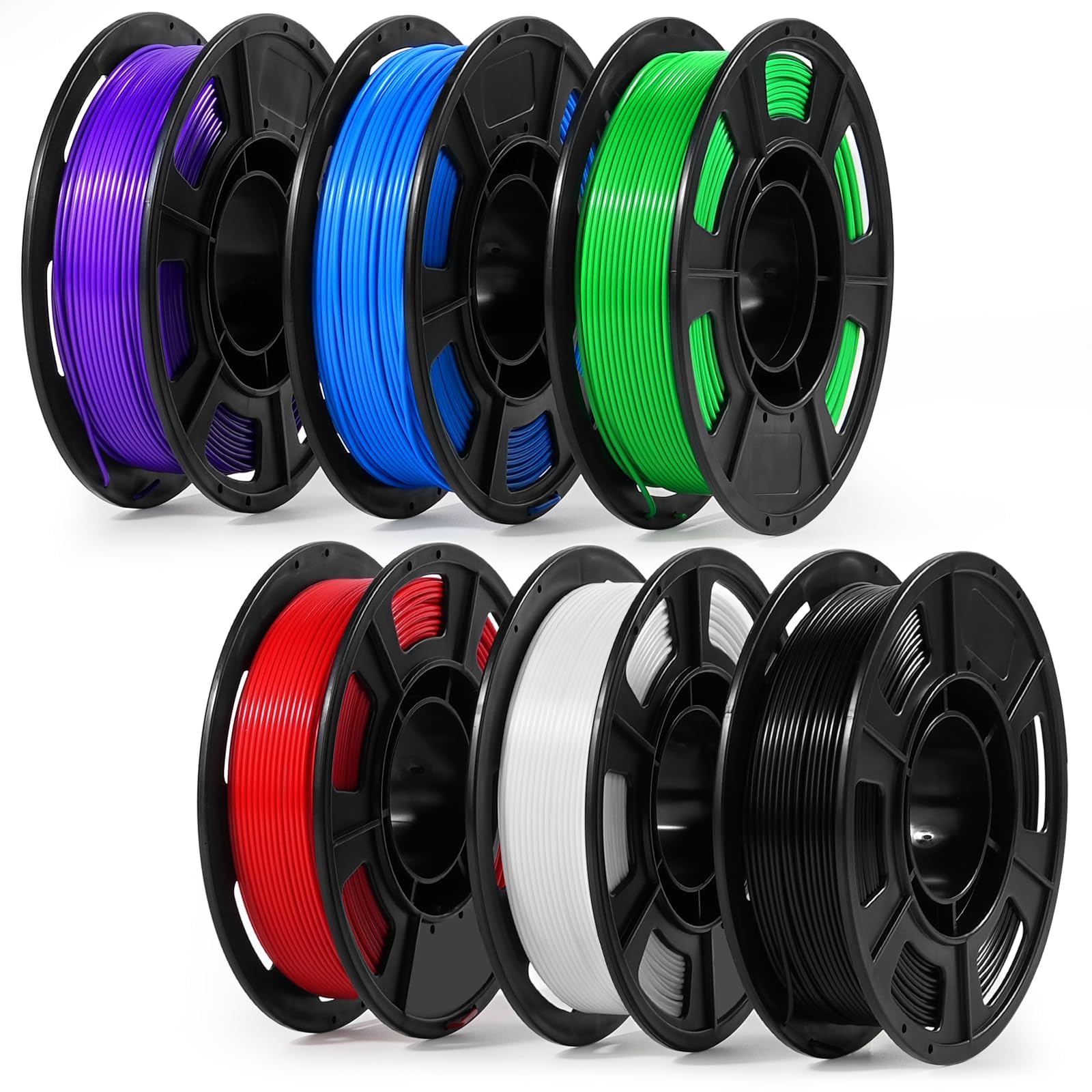
Six small spools of PLA that let you explore colors without committing to a full kilo.
This is the perfect entry point for a new printer owner. The bundle gives you six 250g spools (black, white, red, green, blue, purple), totaling 1.5kg of PLA. Each spool is individually vacuum-sealed with desiccant, so they stay dry even if you open one at a time. The 53mm universal spool diameter is designed to fit most standard FDM printers, including the Bambu Lab A1 mini and the Creality Ender-3 V3 series. The printing recommendation is a nozzle temperature of 190–230°C with a bed at 45–60°C.
Buyers find the quality to be good for the price, especially for beginners. The colors are vibrant, and the filament feeds smoothly without tangling. The main honest caveat is the spool size; they are small, and some users found they do not fit ultra-compact closed spool cabins. A few owners also report that a single spool (usually the white one) can be defective. The material is made from renewable plant resources, which adds an eco-friendly angle. It is a great way to sample different colors for small projects.
Why It’s a Great Start
- Six popular colors in manageable 250g spools, perfect for testing and learning
- 53mm universal spool fits a wide range of mainstream FDM printers
- Vacuum-sealed with desiccant to keep the filament dry and tangle-free
Things to Know
- Small spools are not ideal for large, single-color prints — you will run out fast
- An occasional defective spool (usually white) suggests batch variance
The Right Buyer: A complete beginner or a hobbyist who wants to try multiple colors for small toys, keychains, and sample prints.
Not For: Heavy users who need to print large functional parts — they will burn through these spools too fast.
Understanding the Specs
Dimensional Accuracy (Tolerance)
This is the filament’s diameter tolerance, printed as ±0.02mm or ±0.03mm. A smaller number here means the filament’s width is more consistent as it feeds through your hotend. A ±0.02mm tolerance is considered premium and significantly reduces the risk of under-extrusion (weak, thin layers) or over-extrusion (blobby, rough surfaces). It is the single most important factor for getting a clean, dimensionally accurate print without constant fiddling with your slicer settings.
PLA vs. PETG vs. ABS
PLA is the easiest to print — it smells like waffles, doesn’t need a heated bed for small parts, and has a low melting point (180-210°C). PETG is a step up in toughness and heat resistance (up to ~70°C), but it is more prone to stringing and requires a bed adhesive. ABS is the rugged option with high heat and impact resistance, but it is fussy — it needs an enclosed printer (to prevent warping) and adequate ventilation (fumes can be strong). Choose based on what your printed part needs to endure.
FAQ
Can I use any filament with my 3D printer?
What is the difference between PLA and Silk PLA?
Do I really need an enclosure for ABS filament?
How do I store my filament to keep it dry?
What does a ±0.02mm tolerance actually mean for my print quality?
Which is stronger, PETG or ABS?
What is the best material for outdoor prints?
Can I print resin on an FDM printer?
What is a 53mm universal spool?
Why does my PETG keep stringing?
Final Thoughts: The Verdict
Across the board, the best 3d print material to start with is the HATCHBOX PLA because it maintains a legendary track record for consistent quality with minimal hassle. If you want high-speed functional parts that can take a bit of heat and impact, grab the Polymaker PETG. And for tiny, high-detail models that need to survive a drop, the ELEGOO ABS-Like Resin is the one to reach for.
How We Picked
We do not accept paid placement. Every pick is matched to a real buyer and a real use-case; we do not hands-on test units.
Sources & Methodology
Specifications: manufacturer listings and product documentation. Review insights: verified customer reviews, as of July 2026. Pricing: not shown on this page (it changes often); check the current price via the retailer link.
As an Amazon Associate, Gadgets Feed earns from qualifying purchases. This does not affect which products we feature.