
Our readers keep the lights on and my morning glass full of iced black tea. As an Amazon Associate, I earn from qualifying purchases.
Specs are compiled from manufacturer listings and verified buyer reviews and can change over time — please confirm the key details on the product page before buying.
You cannot see or smell it, but the air inside your home is packed with invisible chemicals, particles, and gases that can mess with your sleep, focus, and long-term health. An air quality sensor for home turns that invisible problem into clear numbers you can act on — it measures CO₂ (the gas that makes you drowsy), PM2.5 (tiny particles from cooking or wildfire smoke), and more. This guide cuts through the jargon to help you pick the right sensor for your actual living space, if you want better sleep, a safer nursery, or fewer headaches at your home desk.
I’m Min — the founder and writer behind Gadgets Feed. This guide is built by comparing the manufacturers’ published specifications and the patterns across verified customer reviews, so you get each pick’s real strengths and trade-offs instead of marketing spin.
You will walk away knowing exactly which air quality sensor for home fits your budget, your room size, and your biggest indoor air worry — from CO₂ and VOCs to fine dust and formaldehyde.
Our Picks at a Glance

How To Choose The Best Air Quality Sensor For Home
Every home has a different air problem — maybe it’s a stuffy bedroom, a kitchen full of cooking fumes, or a new piece of furniture off-gassing formaldehyde. The right sensor measures the specific pollutant you are actually dealing with, and you do not need to spend a fortune to get reliable data.
Know Your Pollutant
CO₂ is the most common issue in bedrooms and home offices, where exhaled air builds up overnight and causes drowsiness and headaches. PM2.5 and PM10 are tiny particles from cooking, candles, or wildfire smoke that can irritate lungs. TVOC and HCHO (formaldehyde) come from paint, furniture, and cleaning products. A monitor that covers all three categories gives you the full picture, but if you only care about room ventilation, a dedicated CO₂ sensor is often enough.
Sensor Technology Matters
Not all sensors are equally reliable. NDIR (non-dispersive infrared) sensors are the gold standard for CO₂ — they last for years and stay accurate without drift. Photoacoustic sensors (like the Swiss-made Sensirion in the U UNNI) are compact and very good, but may cost less. For particles, a laser particle sensor (common in monitors that detect PM2.5 and PM10) is what you want — avoid cheaper units that use a simple light-scattering bulb.
Portability vs. Always-On Monitoring
A battery-powered monitor you can carry from room to room is perfect for spot-checking air quality after cooking or when you arrive at a new space. But if you want continuous, 24/7 data that triggers automations (like turning on a purifier or alerting your phone), you need a Wi-Fi-connected unit that plugs into the wall. The trade-off is real: portable units run out of battery, while wired units are stuck in one spot.
Quick Comparison
| Model | Best For | Key Pollutant | Sensor Type | Power | Amazon |
|---|---|---|---|---|---|
| KDWKD AK23CA★ Best Overall | Overall Winner | CO₂, PM, HCHO, TVOC | Multiple (NDIR + Laser) | Battery (9h) | Amazon |
| U UNNI UN0601SBest Value CO₂ | Best Value CO₂ | CO₂ | Photoacoustic | USB (Battery Backup) | Amazon |
| Temtop C1Compact Pick | Compact & Portable | CO₂ | NDIR | Battery (rechargeable) | Amazon |
| GoveeLife H5106 | Smart Home Integration | PM2.5 | Laser | Wired (Type-C) | Amazon |
| SwitchBot Meter Pro CO2 | Long Battery Life | CO₂ | NDIR | Battery (12 months) | Amazon |
| LifeBasis 11-in-1 | Budget 11-in-1 | CO₂, PM, HCHO, TVOC | Multiple (NDIR + Laser) | Battery (11h) | Amazon |
| GoveeLife H5140 | Premium Smart CO₂ | CO₂ | Photoacoustic NDIR | Wired (Type-C) | Amazon |
| YNAK AK22A | Best Large Display | CO₂, PM, HCHO, TVOC | Multiple | Battery (8h) | Amazon |
| AirKnight AT1000 | US-Based Support | CO₂, PM, HCHO, TVOC | Multiple | Battery (3000 mAh) | Amazon |
In‑Depth Reviews
1. KDWKD AK23CA Indoor Air Quality Monitor
Our pick — over 4.5★ from 950+ verified ratings; the strongest balance of quality and price.
The lab-in-a-box that tracks everything from cooking smoke to paint fumes.
This is the most complete sensor you can buy for the price, measuring CO₂, PM0.3, PM0.5, PM1.0, PM5.0, PM10, HCHO, TVOC, temperature, and humidity — all in real time. The seven-level AQI display uses color and optional audible alerts to tell you exactly when pollution hits unhealthy levels, so you do not have to stare at numbers all day. It is the crowd favorite — 4.7 stars across nearly a thousand owners — and the thing that wins people over is quality: 28 owners specifically praise how well it is made.
The built-in rechargeable battery runs for up to 9 hours, so you can carry it from the kitchen during frying to the baby room after a renovation without hunting for an outlet. Buyers report that it gives “confidence to be able to continuously monitor the air in the house,” especially when opening windows, cooking, or dealing with pets. One caveat: the companion app is basic (mostly for time sync), and some owners note the temperature reads 2-3°F high compared to a separate device. If you want deep smart-home automation, this is not the unit; if you want the most thorough portable air lab on the market, this is it.
Unlike the Temtop C1 below, which focuses purely on CO₂, this KDWKD unit gives you particle counts across six size ranges — a huge advantage if wildfire smoke or dust is your concern. And versus the LifeBasis 11-in-1, it holds a higher average owner rating by a noticeable margin.
Accurate CO2 readings
- class-leading sensor breadth — CO₂ through PM10 to HCHO
- Truly portable with 9-hour rechargeable battery
- Color-coded AQI with optional audible alerts
Limited sensor range
- App is basic — no advanced features or easy °C/°F toggle
- Temperature reads 2-3°F high for some owners
Best for precision: you want one monitor that covers every indoor pollutant and you need to move it room to room.
Skip for multi-gas: app-based smart home automation is a must-have.
2. U UNNI CO2 Monitor UN0601S
A Swiss sensor inside a budget shell that punches far above its price.
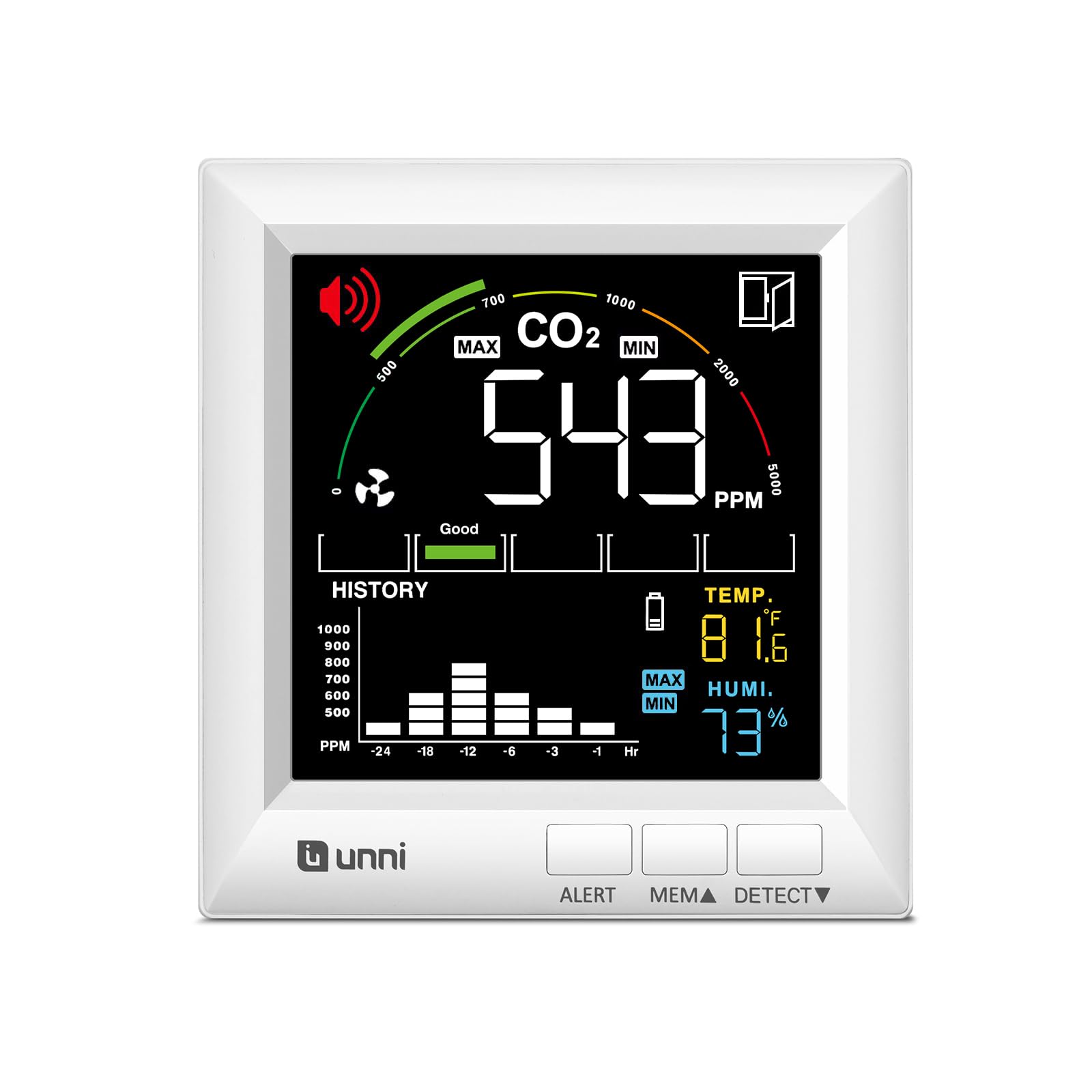
This little monitor is all about one thing: accurate CO₂ readings, and it delivers with a Swiss-made Sensirion photoacoustic sensor that captures CO₂ from 400 to 5000 PPM with an accuracy of ±5% + 50 PPM. The display is what buyers praise most — 49 owners call it out for being big, bright, and readable from across a room. It also shows temperature and humidity, with a 24-hour history chart so you can see how air quality changes while you sleep.
The setup is simple: plug it in via USB (or run on 3 AAA batteries as backup), and it starts reading immediately. Owners mention that outdoor readings sit around 401 ppm and indoor readings rise to 568 ppm with activity — exactly what you want for ventilation decisions. It has three adjustable alert volumes and three backlight levels, plus the ability to mount it on a wall. The honest trade-off: it only measures CO₂, not particles or VOCs. If that is all you need — and for most bedrooms and offices it is — this is the best bang for your buck.
Compared to the Temtop C1, it holds a slightly higher owner rating (4.4 vs 4.3) and has more total reviews (275 vs 662, but the U UNNI is newer).
Affordable CO2 monitor
- Swiss photoacoustic sensor for accurate CO₂ readings
- Large, dimmable display visible from across a room
- USB-powered with optional battery backup
No display backlight
- No PM2.5, no TVOC — CO₂ only
- Battery backup requires 3 AAA batteries (not included)
Budget pick: The purest CO₂ sensor under that you can trust to tell you when to open a window.
Skip for dark rooms: anyone who also needs to track smoke, dust, or chemical fumes from a single device.
3. Temtop C1 CO2 Monitor
A pocket-sized CO₂ meter that fits in a nursery or a grow tent.
The Temtop C1 packs a Swiss-engineered NDIR sensor into a slim, 4.96-ounce body that you can mount on a wall or set on a nightstand. Its accuracy is ±40 ppm + 5% of reading in the 400-2500 ppm range, with a fast 5-second refresh rate that catches sudden changes — like a room filling up with people. It also acts as an indoor thermometer and hygrometer, covering -10°C to 60°C and 0-99% RH.
Functionality is the number-one reason owners buy this — 46 people call it out positively. The rechargeable battery holds a charge well, and the device can be set to disable both audio alerts and display illumination for undisturbed sleep. One honest caveat: readability gets mixed feedback. Twenty owners mention the display is not always easy to read from an angle or in bright light. Also, a few customers note the CO₂ reading stops auto-updating after weeks of use, requiring a button press to refresh. If that happens, the unit may need replacement.
It holds a 4.3 average from 662 ratings — a solid, proven track record. Compared to the U UNNI, it uses more precise NDIR technology and refreshes faster, but the U UNNI has the larger, brighter screen that owners prefer.
Compact and portable
- Reliable NDIR CO₂ sensor with fast 5-second refresh
- Lightweight and portable at under 5 oz
- Can sleep with alarms and backlight fully disabled
Slow response time
- Screen can be hard to read from certain angles
- Rare reports of CO₂ readings freezing after extended use
Travel-friendly: you need a compact, accurate CO₂ spot-checker for a nursery, greenhouse, or desk.
Skip for fast checks: you want a large, always-on dashboard display for the whole family to see.
4. GoveeLife H5106 Smart Air Quality Monitor

The sensor that talks to your purifier so you never have to touch a button.
If you already own GoveeHome appliances — air purifiers, humidifiers, fans — this is the missing link. The H5106 measures PM2.5, temperature, and humidity with a fast 2-second refresh (PM2.5 accuracy is ±15 µg/m³). It connects via 2.4 GHz Wi-Fi and Bluetooth, so you can set target air quality levels and your GoveeLife purifier will turn on and off automatically when the air changes.
Functionality is the top reason people buy this — 113 owners praise it. It stores 13 days of data online and lets you export up to 2 years of CSV reports. The switchable display shows a clock or PM2.5, and the LED indicator lights up in four colors for ambient air quality. It does not have a battery, so it needs a Type-C cable plugged in at all times — that is the trade-off for continuous 24/7 monitoring. Accuracy gets mixed feedback (67 mentions), with some owners finding it slightly sensitive to humidifier mist, which can trigger false PM2.5 spikes.
With 4.4 stars across 990 ratings, this is the most-reviewed smart air sensor on the list and the obvious choice if you want remote monitoring and automation. The GoveeLife H5140 (below) adds CO₂ at a higher price, but the H5106 is your entry point into the Govee ecosystem.
Smart home integration
- Automates GoveeHome purifiers, humidifiers, and fans
- Fast 2-second refresh with 2-year data export
- Clear switchable display with 4-color AQI indicator
Requires app setup
- No battery — must stay plugged in
- PM2.5 can spike falsely near ultrasonic humidifiers
Smart home choice: The smart-home bridge that turns passive air monitoring into active air management — best for anyone already in the Govee ecosystem.
Skip for standalone: anyone who wants CO₂ or TVOC readings from a single device.
5. SwitchBot Meter Pro CO2

Set it on a shelf and forget about charging for a whole year.
Most air quality monitors need a recharge every few days. The SwitchBot Meter Pro CO2 runs on AA batteries for up to 12 months. Inside is a Swiss-made NDIR sensor that measures CO₂ every 1 second with an accuracy of ±50 ppm, covering a range of 400-9000 ppm. The 92mm screen shows CO₂, temperature, humidity, time, date, and a comfort level all at once.
Compatibility is the top reason owners pick this — 33 people note how well it integrates with Home Assistant and other smart platforms. It offers three alert methods: an on-board buzzer, visual screen alerts, and app notifications (though the app requires a SwitchBot Hub for remote access). It is light at 4.8 ounces and comes with wall-mount holes and an adjustable bracket. One recurring note: accuracy is mixed for about 39 owners — some find it spot-on, others say it reads 50-100 ppm higher than a reference monitor. Also, the CO₂ reading can freeze for hours when left plugged in (it works properly on battery at 5-minute intervals).
It holds a 4.4 average from 292 ratings. Compared to the U UNNI, it offers longer battery life and more alert options, but costs more and has less universal agreement on accuracy.
Sleek minimalist design
- Up to 12 months on AA batteries
- Swiss NDIR sensor with 1-second refresh
- Works with Home Assistant and smart hubs
No data export
- Mixed accuracy reports — some units vary by 50-100 ppm
- Reading freezes when plugged in (works fine on battery)
Desk-friendly: you want a near-set-and-forget CO₂ monitor that you change batteries once a year.
Skip for logging: you need guaranteed pin-point accuracy for medical or scientific use.
6. LifeBasis 11-in-1 Air Quality Monitor

An 11-parameter lab that fits in your pocket — for under the price of a dinner out.
This is the most parameter-dense budget sensor on the list. The LifeBasis 11-in-1 tracks AQI, CO₂, PM1.0, PM2.5, PM10, HCHO, TVOC, temperature, humidity, and particles, using an NDIR infrared CO₂ sensor, a laser particle sensor, and semiconductor sensors. It has a 2500mAh battery that delivers 11-12 hours of continuous use, so you can carry it all day without charging. The LCD screen uses color-coded icons — green for good, yellow for moderate, orange for poor, red for abnormal — and an audible ticking alert that activates when any parameter exceeds normal.
Ease of use is what owners praise most (17 mentions), and portability follows (12). Reviewers point out it detected wildfire smoke quickly and matched professional monitors for CO₂. The honest trade-off: accuracy is the most-discussed topic (46 mentions) and it is mixed — some owners find the CO₂ reading skews high, and ultrasonic humidifiers trigger false PM2.5 spikes. Also, there is no Wi-Fi or Bluetooth, so you cannot export data or check readings remotely.
It holds a 4.2 average from 192 ratings — solid for a budget multi-sensor. If you want broad coverage for cheap and do not need smart features, this is the pick.
Wide sensor variety
- 11 parameters in one portable unit with 11-hour battery
- Color-coded icons and audible alerts for quick understanding
- Detects real events like wildfire smoke and paint fumes
Bulky footprint
- No Wi-Fi or Bluetooth — no remote monitoring or data export
- Some shoppers say CO₂ reads high; PM2.5 can spike near humidifiers
Multi-parameter: The cheapest way to get a full air panel that covers VOCs, particles, and CO₂ — but accept the accuracy limits.
Skip for small spaces: data nerds who want app-based charts or precise laboratory-grade readings.
7. GoveeLife H5140 CO2 Detector
The smarter, CO₂-capable sibling of the H5106 — built for the bedroom.
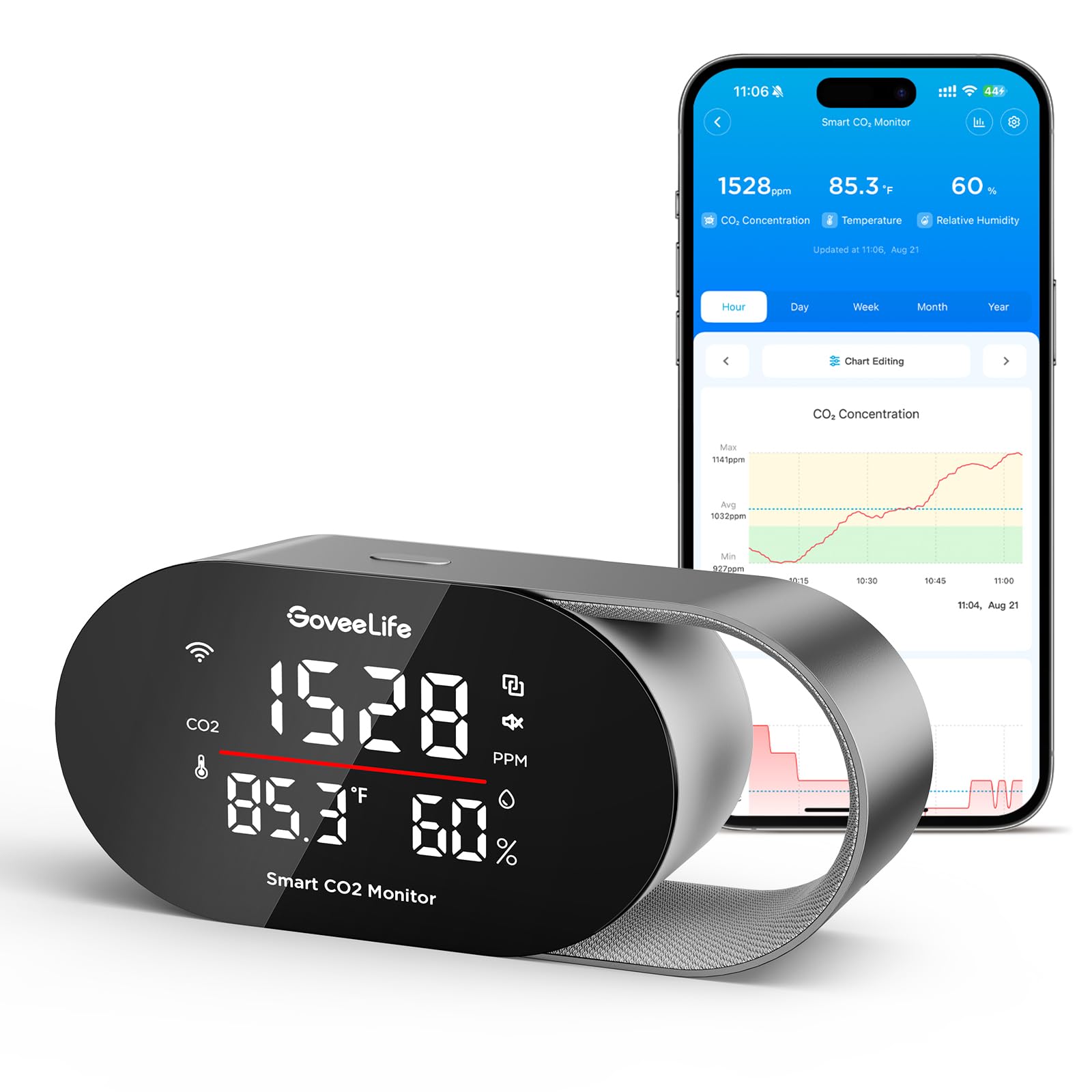
The GoveeLife H5140 uses the Sensirion SCD4x sensor — a photoacoustic NDIR CO₂ sensor with built-in pressure compensation for any altitude — to deliver CO₂ accuracy of ±(40ppm + 5%) with a 5-second refresh rate. It measures CO₂, temperature, and humidity, and shows them on a 4.82-inch LED display with a customizable tri-color light bar that automatically dims for day and night.
Quality is the top reason owners buy this (27 mentions) — the build feels solid, and the display is easy to read from a distance. The triple alert system (buzzer, app notification, email report) means you never miss a high-CO₂ event. Like the H5106, it integrates with Alexa and Google Assistant and can trigger GoveeLife humidifiers and fans. Unlike most other sensors, it is powered by a standard outlet (AC power) for 24/7 operation — no batteries to swap. The trade-off: Wi-Fi connectivity gets mixed feedback (12 mentions), with a few owners finding it drops signal if placed far from the router.
It holds a 4.5 average from 188 ratings. Compared to the H5106, it adds CO₂ — making it the better choice for bedrooms and offices where CO₂ buildup is the primary concern.
CO2 alarm feature
- Premium SCD4x CO₂ sensor with pressure compensation
- Triple alert system (buzzer, app, email)
- Auto-dimming display for night-time use
No Wi-Fi connectivity
- Wired-only — no battery for portability
- Wi-Fi can be unreliable if placed far from router
Safety alert: you want the most accurate CO₂ smart monitor for a home office or nursery and already use GoveeHome gear.
Skip for remote monitoring: you need to also track particles or VOCs from a single device.
8. YNAK AK22A 16-in-1 Air Quality Monitor
A giant 7-inch dashboard that the whole family reads without an app.
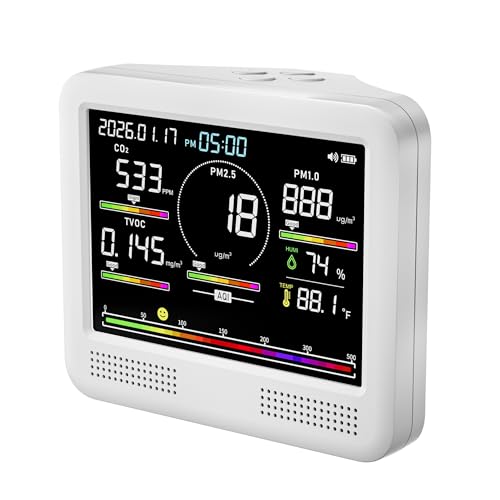
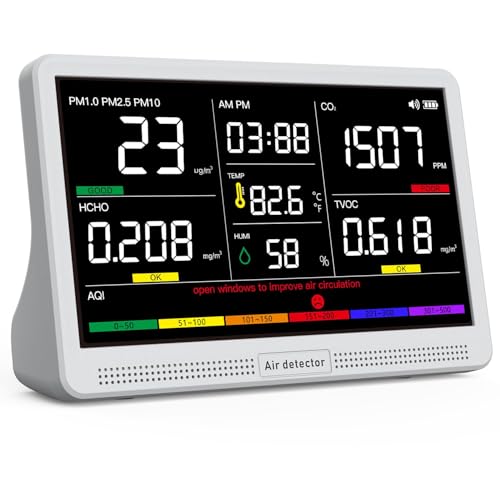
The YNAK AK22A does not need a phone app — its 7-inch LED display shows CO₂, PM2.5, PM1.0, PM10, HCHO, TVOC, temperature, humidity, AQI, and the time all at once. Three brightness settings let you tune it for any light, from a bright kitchen to a dim bedroom. It detects 9 key parameters plus has 7 distinct AQI alert buzzers (hence “16-in-1” — a combo of 9 parameters and 7 alert types). The battery gives up to 8 hours of cordless use, and the included adapter and USB-C cable keep it charged.
Air quality monitoring is the top reason owners buy this (59 mentions), and accuracy follows (57). Buyers report the sensor picks up fast changes from cooking, candles, and even hairspray. The display is “surprisingly accurate, painfully honest” and “easy for whole family to read without app.” It doubles as a clock, and the color-coded AQI line runs from green to red. The honest trade-off: reliability gets mixed feedback (55 mentions) — some units stop working after a while, though most owners mention it works well. It is also the heaviest in the list at 1.48 pounds, so not ideal for pocket carry.
It holds a 4.3 average from 342 ratings. Compared to the KDWKD pick above, it has a larger screen and no-app readability but weighs more and has a smaller battery life (8h vs 9h).
16 sensors included
- Enormous 7-inch display — no app needed for reading
- 9 parameters with 7 distinct AQI alert buzzers
- Fast response to cooking, candles, and wildfire smoke
Complex interface
- Mixed reliability reports — some units fail over time
- Heavy at 1.48 lbs — not a pocket portable
All-in-one: For the visually driven buyer who wants every reading up at once on a big, clear screen without pulling out a phone.
Skip for simplicity: anyone who needs a compact, lightweight sensor to carry room to room all day.
9. AirKnight AT1000 Premium Monitor
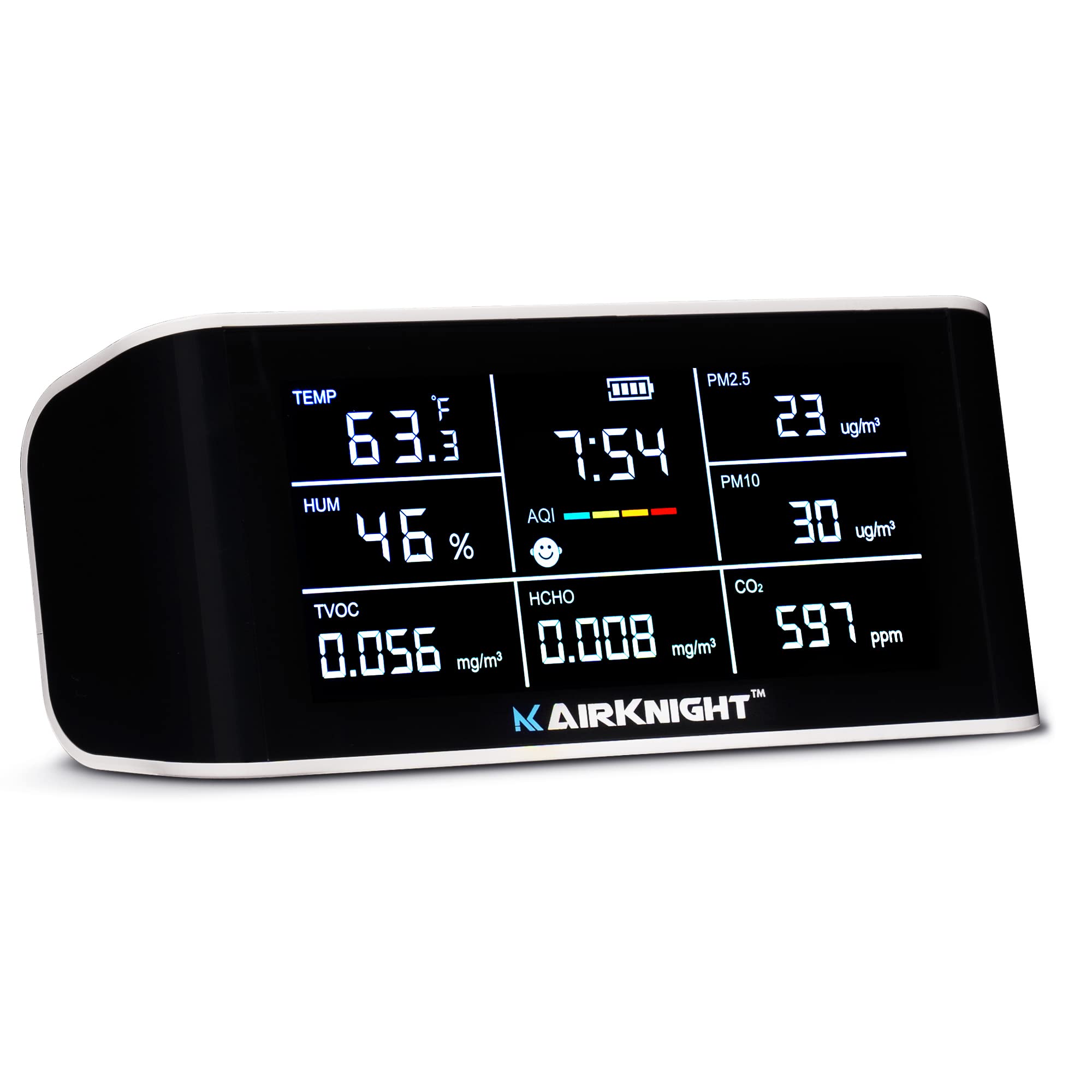
A US-run brand with a 3000 mAh battery that keeps monitoring all day.
The AirKnight AT1000 is a 10-in-1 monitor that detects CO₂, PM2.5, PM10, TVOC, HCHO, temperature, and humidity on a large, easy-to-read LCD screen. Its standout feature is a 3000 mAh rechargeable lithium-polymer battery — the biggest in this lineup — giving you extended portable use. It is designed with wildfire season in mind, alerting you when PM2.5/PM10 and VOCs spike from outdoor smoke or older appliances. AirKnight Monitoring is a US-based business with US-based phone support and a free extended warranty offer.
Air quality monitoring is the top reason owners buy this (9 mentions), and the display is praised for readability. Buyers use it near 3D printers and to test air purifier effectiveness. One honest trade-off: reliability is mixed (8 mentions) — some units have an auto-shutoff after roughly 12 hours (acceptable for intermittent use) and a few customers note the device shutting off unexpectedly. It also has no app or data export, so you cannot track trends over time or check readings remotely. One experienced user with multiple VOC monitors noted it is “the only one that didn’t zero-lock,” meaning it recovers from sensor saturation without needing a reboot — a real plus for VOCs.
It holds a 4.3 average from 112 ratings — a newer product with a small but satisfied owner base. If US-based customer support and a free warranty matter to you, this is worth a look.
Premium build quality
- Largest battery in the lineup (3000 mAh) for all-day portable use
- US-based brand with phone support and free extended warranty
- Reliable VOC/HCHO detection — avoids sensor “zero-lock”
High price tag
- No app or data export — monitor-only
- Some reviewers point out unexpected auto-shutoff
Luxury option: you want a US-supported monitor with a monster battery for portable use near 3D printers, workshops, or wildfire-prone areas.
Skip on budget: app-based data tracking or WiFi automation is essential for your daily routine.
Understanding the Specs
NDIR vs. Photoacoustic vs. Laser Particle Sensors
NDIR (non-dispersive infrared) is the most common and reliable technology for detecting CO₂. It shines infrared light through an air sample and measures how much is absorbed — simple, long-lasting, and drift-resistant. Photoacoustic sensors (like the Sensirion SCD4x) use sound waves generated by light heating the gas — they are compact and accurate but can be more sensitive to environmental noise. For particles (PM2.5, PM10), laser particle counters are the standard: they shoot a laser through the air and count the number of particles that scatter light. Cheaper units sometimes use a simple light bulb instead, which is far less accurate.
CO₂ Range and Accuracy
The human body exhales CO₂ constantly, and levels above 1000 ppm can cause headaches, drowsiness, and reduced cognitive function — especially in bedrooms and home offices. Most sensors measure from 400 ppm (clean outdoor air) up to 5000 or 9000 ppm. Look for an accuracy spec like ±40 ppm + 5% of reading: that means at 1000 ppm, the reading could be off by up to 90 ppm either way. A 5-second or faster refresh rate is ideal for catching sudden changes when a room gets stuffy quickly.
PM2.5 and Particle Detection
PM2.5 refers to particles smaller than 2.5 micrometers — small enough to enter your lungs and bloodstream. Common sources include cooking smoke, candle soot, wildfire smoke, and dust. A good sensor should detect particles down to PM0.3 and across multiple size bins (PM1.0, PM2.5, PM10) so you know whether it is fine smoke or larger dust. Accuracy for particle counters varies widely: ±15 µg/m³ is a reasonable spec for a consumer-grade laser sensor.
TVOC and HCHO (Formaldehyde)
TVOC stands for Total Volatile Organic Compounds — a broad category that includes fumes from paint, new furniture, cleaning products, and even cooking oil. HCHO is formaldehyde, a specific VOC found in pressed-wood furniture and some building materials. Many budget sensors claim to detect TVOC but use a simple semiconductor sensor that can be fooled by cooking or alcohol. If formaldehyde is your specific concern (new home, new furniture), look for a sensor that explicitly lists HCHO in its spec sheet, not just “TVOC.”
FAQ
Can an air quality sensor detect carbon monoxide (CO)?
Where should I place an air quality monitor for the most accurate reading?
How often do I need to calibrate the sensor?
Will a Wi-Fi-connected sensor drain my home network?
What is a healthy CO₂ level in a bedroom?
Can an air quality sensor help with wildfire smoke?
How long does a rechargeable battery last in daily use?
Do air quality sensors work in grow tents and greenhouses?
Final Thoughts: The Verdict
For most people, the air quality sensor for home winner is the KDWKD AK23CA because it is the one monitor that covers CO₂, PM2.5, PM10, TVOC, and HCHO in a portable, 9-hour battery package at the highest owner rating (4.7). If you only need CO₂ monitoring for a bedroom or office, grab the U UNNI UN0601S for its Swiss sensor and bright display at a budget-friendly price. And for smart-home owners who want automation with their GoveeLife purifiers, the GoveeLife H5140 is the one to reach for. With nearly 4,000 combined owner experiences backing these picks, you can choose with confidence.
How We Picked
We do not accept paid placement. Every pick is matched to a real buyer and a real use-case; we do not hands-on test units.
Sources & Methodology
Specifications: manufacturer listings and product documentation. Review insights: verified customer reviews, as of July 2026. Pricing: not shown on this page (it changes often); check the current price via the retailer link.
As an Amazon Associate, Gadgets Feed earns from qualifying purchases. This does not affect which products we feature.