
Our readers keep the lights on and my morning glass full of iced black tea. As an Amazon Associate, I earn from qualifying purchases.
Specs are compiled from manufacturer listings and verified buyer reviews and can change over time — please confirm the key details on the product page before buying.
The right 220cm kayak paddle separates a smooth day on the lake from a frustrating battle with your gear. A heavy paddle fatigues your arms quickly, a poorly breaking-down paddle creates storage headaches, and a wobbly shaft ruins every stroke. This guide highlights models that deliver smooth, efficient paddling for calm river floats to weekend touring.
I’m Min — the founder and writer behind Gadgets Feed. This guide is built by comparing the manufacturers’ published specifications and the patterns across verified customer reviews, so you get each pick’s real strengths and trade-offs instead of marketing spin.
Whether you are a first-time buyer or a paddler upgrading from a basic set, here is exactly what separates a good 220cm kayak paddle from one you will want to replace by mid-season.
Our Picks at a Glance

How To Choose The Best 220cm Kayak Paddle
Choosing the right kayak paddle hinges on three factors: shaft material, blade shape, and breakdown design for storage. A mismatch in any of these turns a fun paddle into an unwanted workout.
Shaft Material: Your Arms Will Thank You
The shaft is what you grip for hours on end. Aluminum shafts are budget-friendly and tough, but they are noticeably heavier than the alternatives. Fiberglass shafts shave off significant weight while keeping decent stiffness, which makes them a popular mid-range choice. Carbon fiber shafts are the lightest option on the market, transferring less fatigue to your arms over a long day of paddling — ideal if you plan to be on the water for more than two hours at a time. The trade-off is that carbon fiber usually costs more, and very thin carbon walls can be brittle if you abuse them against rocks.
Blade Shape and Feathering: How the Paddle Moves Through Water
Blade shape directly influences stroke smoothness. A dihedral blade has a ridge running down the center, which helps stabilize the paddle and reduce flutter — the annoying wobble that happens when the blade catches the water unevenly. An asymmetrical blade is shaped to equalize the force on both sides, again reducing twisting in your hands. Feathering refers to rotating one blade relative to the other (commonly 0° or 60°). When you paddle into a headwind, feathering lets the raised blade slice through the air instead of pushing against it, reducing wrist fatigue. Beginners often prefer a 0° (unfeathered) setting as it is more intuitive.
Number of Pieces: Storage and Portability
Paddles break down into two, three, or four sections for storage. A two-piece paddle is the simplest and often feels the most solid when assembled, with the least wobble at the joint. A three-piece paddle fits inside a standard car trunk or a kayak’s day hatch more easily, making it the most popular choice for recreational kayakers. A four-piece paddle packs down the smallest — it stows in a dry bag or under a deck hatch, which makes it the go-to for serious touring paddlers who need a spare paddle within reach. More pieces usually introduce a little more play at the connections, so you trade absolute stiffness for portability.
Quick Comparison
| Model | Best For | Shaft Material | Length Range | Pieces | Amazon |
|---|---|---|---|---|---|
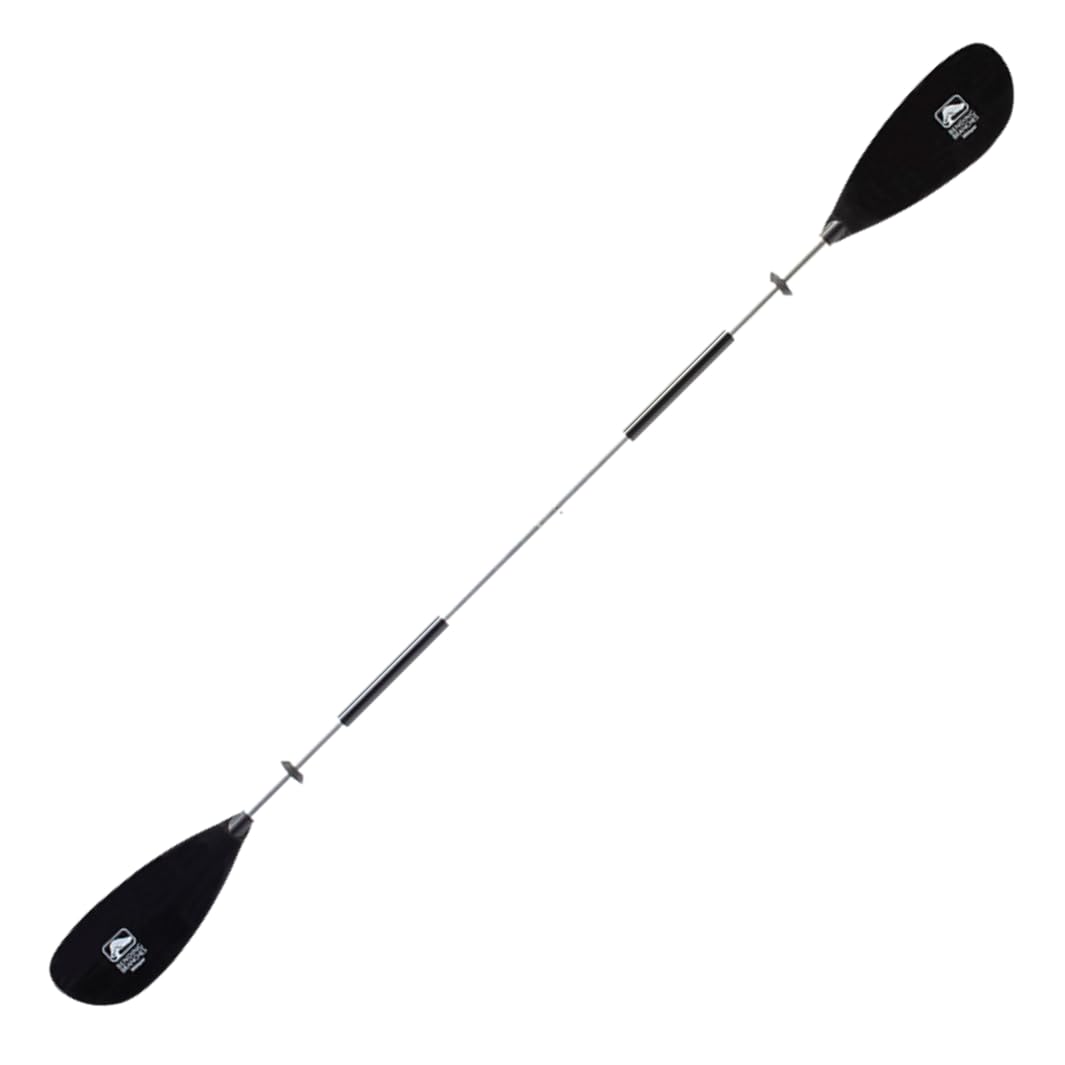
| Bending Branches Whisper★ Best Overall | Best Overall | Aluminum | 220 cm | 2 | Amazon |
| Carlisle Day TripperTough & Durable | Tough & Durable | Aluminum | 220 cm | 2 | Amazon |
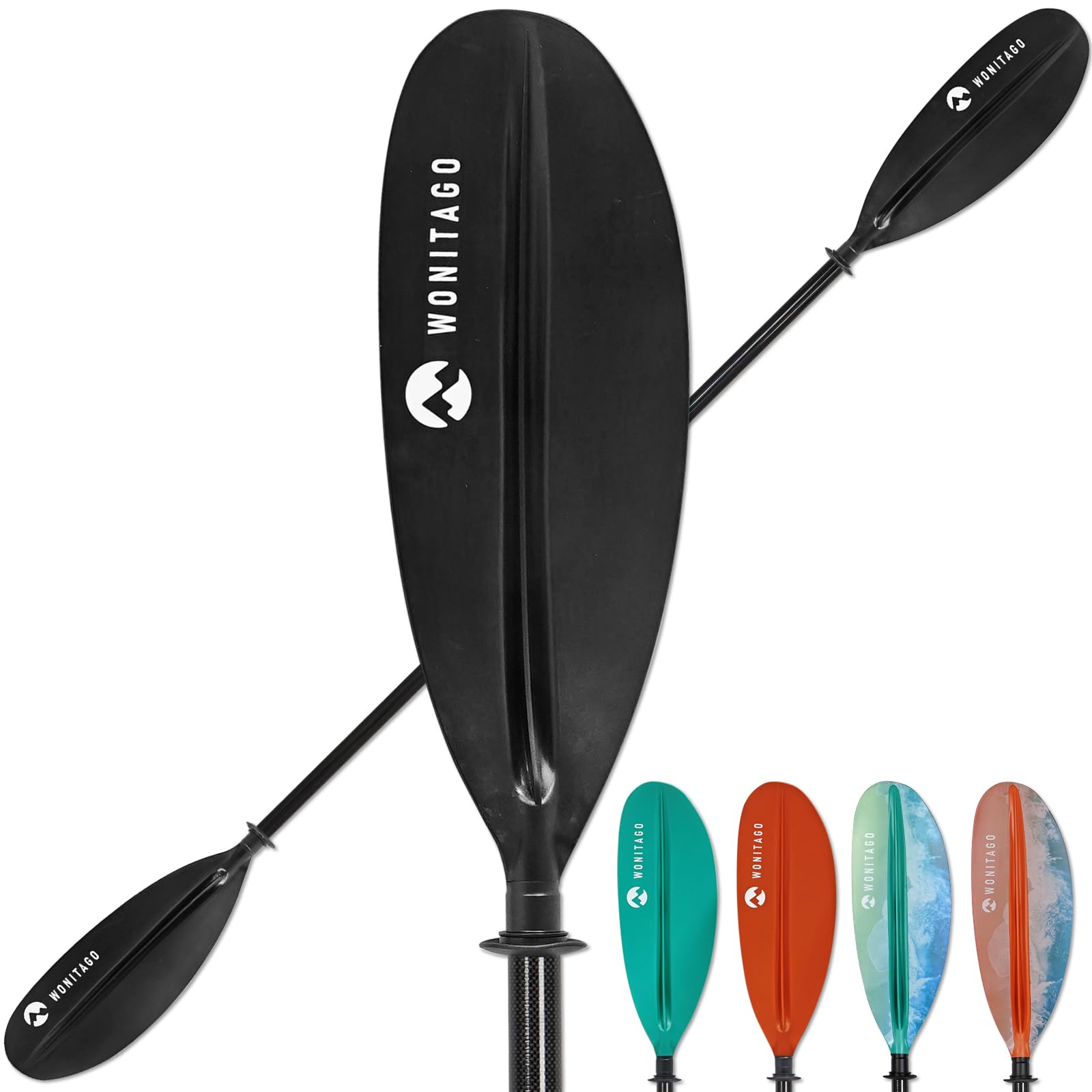
| WONITAGO Carbon Fiber (P6)Lightweight Value | Lightweight Value | Carbon Fiber | 220–240 cm | 3 | Amazon |
| OCEANBROAD Carbon Fiber | Adjustable All-Rounder | Carbon Fiber | 220–240 cm | 3 | Amazon |
| WONITAGO Fiberglass (P2) | Budget-Friendly Entry | Fiberglass | 210–230 cm | 3 | Amazon |
| Airhead 4-Piece | Backup/Spare Stowage | Aluminum | 220 cm | 4 | Amazon |
| HIKULA Carbon Fiber | Compact Travel | Carbon Fiber | 220–230 cm | 4 | Amazon |
| WONITAGO Fiberglass (P4) | Tall Paddlers | Fiberglass | 240–260 cm | 3 | Amazon |
| CN6 CROSSNOVA Greenland | Ultralight Performance | Carbon Fiber | 220 cm | 2 | Amazon |
In‑Depth Reviews
1. Bending Branches Whisper Kayak Paddle
Our pick — over 4.5★ from 650+ verified ratings; the strongest balance of quality and price.
Handcrafted in Wisconsin, the crowd favorite for lake cruising.
This two-piece aluminum paddle is the one buyers return to year after year. The shaft uses a snap-button ferrule that gives you a choice of 0° or 60° feathering for either hand, so you can adjust your stroke to match the wind without fighting the paddle. The polypropylene blades feature a dihedral design — that center ridge keeps the blade tracking straight through the water with minimal flutter, making each stroke feel predictable and efficient.
At a package weight of 1.07 kg, it is noticeably lighter than many aluminum rivals, which buyers confirm, with one calling it “light for aluminum.” The two-piece connection locks up tight with no wobble, a detail that owners of multi-piece paddles know is not guaranteed. Quality earns the most praise in the reviews, and durability is a close second. Many owners use it as a reliable backup to far more expensive carbon fiber paddles, proof of how well it holds up.
The clear trade-off is that this is a fixed 220 cm length — there is no adjustability for different paddlers or kayak widths. If you need to fine-tune the length for a taller paddler or a wider boat, you will want to look at one of the adjustable options below. But for the majority of recreational paddlers, the Whisper delivers the best blend of build quality, weight, and reliable performance at a price that undercuts expectations.
What Owners Love
- Rock-solid two-piece connection with zero wobble — rare at this price.
- Dihedral blade design provides a smooth, flutter-free stroke for beginners and intermediates alike.
- Very light for an aluminum paddle, making it easy on the arms for a full afternoon out.
The One Trade-Off
- Fixed 220 cm length — not adjustable for different kayak widths or paddler heights.
Your best bet if: You want a rock-solid, fixed-length paddle built to last for every lake and calm river trip you take.
Think twice if: You need length adjustability to share the paddle between different paddlers or fit a very wide kayak.
2. Carlisle Day Tripper Aluminum Kayak Paddle
The aluminum workhorse that takes rock-poling and whitewater abuse.
The Carlisle Day Tripper is built around an anodized aluminum shaft with an oval construction — that oval shape gives your hands a tactile cue to the blade angle without looking down. It uses asymmetrical polypropylene blades to reduce twisting, producing smooth, efficient strokes whether you are on a lake or pushing through tight mangroves. This paddle measures 220 cm (87 inches) in a two-piece design, with a pushbutton takedown that lets you feather the blades at 60° or keep them inline.
Owners consistently praise its toughness. Quality is the top-mentioned aspect, with value for money running a close second. Several reviews note that this paddle survives impacts that would crack a carbon fiber blade — pushing off rocks, poling through shallows, even whitewater rafting. One long-term owner reported it lasted six years of regular use. The trade-off is that the broad blade is built for maneuverability and power, not all-out speed, so distance paddlers on open water may find it heavier than a carbon alternative.
The connection is solid, with no wobble reported even after months of weekend use. If you fish from a sit-on-top kayak and need a paddle that can double as a push pole, this is your best bet.
Built to take a beating: The Carlisle survives rock contact, whitewater, and years of abuse that would end a carbon paddle.
The weight reality: Heavier than carbon, but owners find it light enough for comfortable all-day use given the price.
Reach for this if: You paddle in rocky shallows, fish from a kayak, or need a paddle that can handle rough use without complaint.
Look elsewhere if: You are an ultralight touring purist who measures every gram — a carbon shaft will save you significant weight.
3. WONITAGO Carbon Fiber Kayak Paddle (P6)
A carbon fiber shaft at a price that undercuts the premium brands.
This is the paddle that brings the weight-saving advantage of a carbon fiber shaft down to a mid-range budget. At just 2 lbs (0.9 kg) total weight, it is significantly lighter than any aluminum paddle, which translates directly to less arm fatigue on longer trips. The 220-240 cm adjustable range gives you 20 cm of play to dial in the right length for your kayak width and paddling style. The ±60° quick-pin-button lock lets you feather the blades for headwind days or go flat for casual paddling.
The PP-and-fiberglass reinforced blades float in both salt and fresh water, a useful safety feature if you ever drop it overboard. The adjustable three-piece design breaks down small enough for storage in a compact hatch or car trunk. Quality is the top praise from owners, closely followed by the lightweight feel. That said, a minority note that the joint connection can have a slight wiggle — a common trade-off with adjustable, multi-piece paddles at this price.
Compared to the OCEANBROAD carbon paddle below, this one is a couple of ounces lighter on paper but does not include a safety leash in the box. For lake and river paddlers on a budget who want carbon-level lightness, this is the strongest value pick in the list.
What Makes It A Value Win
- Carbon fiber shaft at a price that competes with fiberglass paddles.
- Adjustable 220-240 cm range covers most kayak widths and paddler heights.
- Blades float, so a drop in the water does not mean a lost paddle.
The Fit Note
- The three-piece connection can have a slight play — not an issue for recreational paddling, but noticeable for aggressive strokes.
Best for: The budget-conscious paddler who wants carbon fiber lightness without paying premium-brand prices.
skip it if: A perfectly rigid, wobble-free joint is non-negotiable for your paddling style.
4. OCEANBROAD Adjustable Carbon Fiber Kayak Paddle

Comes ready to paddle with the accessories you usually have to buy separately.
This paddle combines a carbon fiber shaft with fiberglass-reinforced PP blades, weighing 35 oz — light enough to reduce arm fatigue during extended adventures, as owners consistently confirm. The standout feature is the inclusion of a safety leash, drip rings, and a 3-position angle lock right in the box. You do not need to buy a leash separately or fuss with aftermarket drip rings; everything is pre-attached and ready to go. The adjustability spans 220-240 cm across five settings, and the three-piece breakdown makes transport simple.
The reviews highlight weight as the most-discussed positive — owners find it noticeably easier to handle than aluminum paddles, with one describing it as “lightweight carbon fiber that reduces fatigue.” Weight and durability are the two most praised aspects, and the paddle holds up well against the abuse of children, according to one owner. At a package weight of 1.41 kg, it is heavier than the WONITAGO carbon paddle, but the extra accessories and the 3-position angle lock justify the difference for many buyers.
If you are buying your first adjustable paddle and want everything included from day one — no extra trips to the store for a leash — this OCEANBROAD is the most complete package for the money.
All-in-one readiness: Includes a safety leash, drip rings, and a three-position angle lock — accessories most paddles charge extra for.
The slight weight edge goes to: The WONITAGO carbon paddle above is a few ounces lighter, though it lacks the included accessories.
Reach for this if: You want a complete, adjustable carbon paddle kit with no aftermarket accessories needed.
Look elsewhere if: Minimum weight is your only priority — the WONITAGO carbon is lighter, even without the extras.
5. WONITAGO Fiberglass Kayak Paddle (P2)
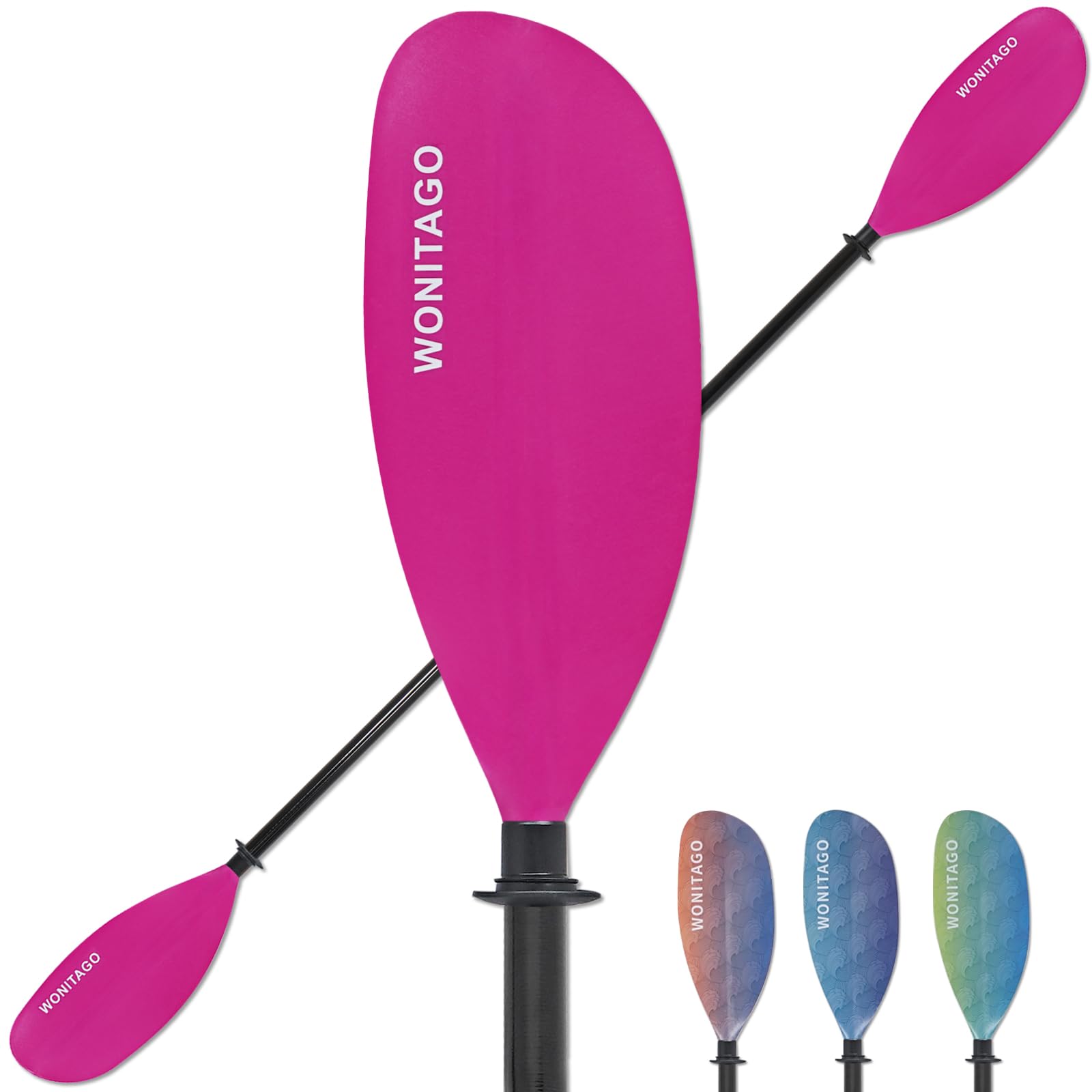
A fiberglass paddle that brings better toughness than aluminum without the carbon price tag.
Fiberglass sits in a balance between aluminum and carbon fiber — it is lighter than aluminum and stiffer than entry-level plastic, but it costs less than carbon. This WONITAGO paddle exploits that gap well. The fiberglass shaft has a ribbed surface for extra grip when your hands are wet, and the 16.5″ x 7″ nylon blades provide good surface area for a solid catch on each stroke. The three-piece design breaks down to a portable size, and the quick-pin button lock lets you adjust the overall length from 210 cm to 230 cm.
Quality and weight are the top positive aspect among owners. The paddle pairs well with inflatable kayaks, among the most common use cases mentioned in reviews. The fiberglass and nylon construction makes it corrosion-resistant in both saltwater and freshwater. The one catch is that the blade’s printed design can chip at the edges over time — a cosmetic issue that does not affect performance but bothers some owners. Comfort also receives mixed feedback, so consider adding thin padding if you have long days planned.
At the entry-level end of the price spectrum, this paddle delivers a clear step up in weight and feel compared to basic aluminum models, making it the smart choice for beginners who want better performance without a premium investment.
Why It Works
- Fiberglass shaft is lighter than aluminum and stiffer than basic plastic — a genuine upgrade for under.
- Three-piece breakdown and adjustable length make it versatile for different paddlers and storage spaces.
- Corrosion-resistant for low-maintenance use in saltwater.
The Small Gripes
- The printed design on the blades can scuff and peel at the edges with normal use.
- Comfort is a mixed point — longer sessions may reveal the need for padded gloves.
Best for: The first-time buyer who wants a noticeable upgrade in feel and weight over an aluminum paddle, without paying carbon prices.
pass on it if: Cosmetic condition matters to you, or you need a paddle that feels perfectly rigid from the start.
6. Airhead Kayak Paddle, 4 Section

The most compact breakdown on the list — stows where nothing else fits.
The Airhead splits into four sections, collapsing to a package small enough to stash inside a dry bag or under a kayak hatch. That compact storage is the whole reason to buy this paddle. It uses an anodized aluminum shaft with asymmetrical plastic blades reinforced with fiberglass, and the blade angle is adjustable via a spring-loaded pin. At 220 cm when assembled, it covers the standard recreational length.
Quality scores well in the feedback, but the durability picture is mixed — the most-discussed aspect. The paddle is serviceable for light use and emergency backup duty, with owners noting that it survives a 200-mile trip including portages, but the shaft can crack under hard stress. The general sentiment is that this is a great spare or a low-cost starter, not a paddle you would choose for aggressive touring. Portability is a genuine strength: it fits in the smallest storage spaces, which is why many kayakers carry it as an insurance policy.
The lower star count (mid-4.3 range) relative to other picks here reflects the mixed durability feedback. Buy it for the storage convenience, not for heavy daily use.
Stow-it-anywhere design: The four-piece breakdown is the smallest in this roundup, perfect for hatch storage.
Expectation check: Treat it as a lightweight spare or a beginner’s first paddle, not a primary tool for heavy use.
Reach for this if: You need a spare that disappears into a dry bag or you are a casual paddler on a tight budget.
Look elsewhere if: You need a primary paddle for rough conditions or consistent daily use.
7. HIKULA Carbon Fiber Shaft Kayak Paddle
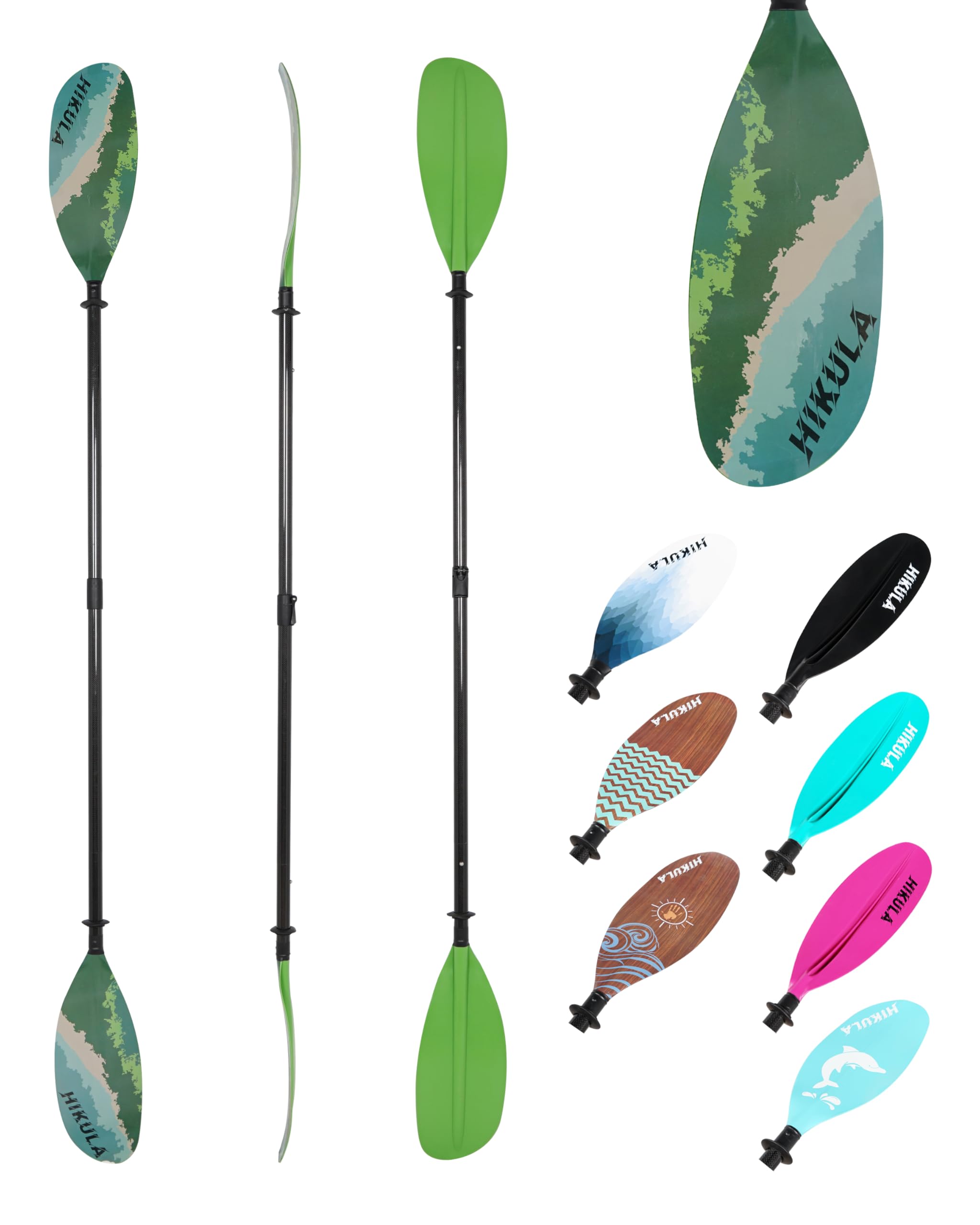
A four-piece carbon fiber paddle for the paddler who values packability above all else.
This HIKULA paddle combines a carbon fiber composite shaft with fiberglass-reinforced PP blades, keeping the total weight at just 33 oz (just over 2 lbs). The 4-piece design is the key feature here — it breaks down into segments that fit into a compact carry bag, making it ideal for air travel or for storing in a small hatch. The length adjusts from 220 cm to 230 cm in 10 cm increments, with a ±60° quick-pin button lock for feathering.
Reviews praise the quality and adjustability, with several owners noting it is a great starter option for whitewater and stillwater paddling. One builder pointed out it even includes a built-in fish ruler and hook retrieval system — a niche bonus for fishing kayakers. The lighter carbon shaft delivers a noticeable improvement over aluminum, though one experienced owner notes it is “not as light as high-end Werner,” which is a fair comparison for the price. The durability feedback is mixed: some owners find it strong enough for class 2 rapids, while a small number report breakage after limited use.
If you fly to paddling destinations or need a compact backup, the four-piece carbon construction is the reason to choose this over the cheaper multi-piece aluminum alternatives.
What Stands Out
- Four-piece breakdown packs smaller than any three-piece paddle on this list.
- Carbon fiber shaft at 33 oz is noticeably lighter than aluminum travel paddles.
- Includes a built-in fish ruler and hook retrieval for anglers.
Consider This
- Durability feedback is split — it handles class 2 rapids fine, but some owners experienced breakage under heavy use.
- Not the lightest carbon paddle available; high-end dedicated brands are lighter.
Best for: The traveling kayaker who needs a compact, lightweight paddle that fits in a suitcase.
it’s not for you if: You need a main paddle for hard, daily use — the small number of breakage reports should give heavy users pause.
8. WONITAGO Fiberglass Kayak Paddle (P4)

A fiberglass paddle with an extra-long adjustment range for wider kayaks and taller paddlers.
This model shares the same fiberglass shaft and PP-blade design as P2 above, but its length range is different — it stretches from 240 cm to 260 cm, making it the longest option in this guide. If you paddle a wide sit-on-top kayak or you are over 6 feet tall, the extra length prevents your knuckles from hitting the hull as you stroke. The three-piece breakdown and ±60° quick-pin lock are identical to the P2 version. At 2.2 lbs (1.0 kg), it is very light for its size.
The buyer feedback here is a mixed bag relative to most other picks. Some buyers report good value and reduced fatigue, while a meaningful number of reviews — particularly from a rental operator — note that the paddle snapped under normal conditions when extended to its full length. The connection quality is also a point of criticism, with mentions of a loose fit. This paddle makes sense specifically for the niche of tall paddlers who need extra length, but the build quality concerns mean it carries more risk than the tighter-reviewed options above it.
If you are a standard-height paddler with a standard-width kayak, skip this and go for the P2 version instead — it offers the same materials with a more appropriate length range and much stronger overall feedback.
Its reason to exist: The 240-260 cm length range is essential for wide kayaks or taller paddlers who need more leverage.
The honest concern: Multiple verified reports of the paddle snapping when extended fully — treat the max length with care.
Reach for this if: You are over 6 feet tall or your kayak is exceptionally wide and you need the extra centimeter.
Look elsewhere if: You are a standard-size paddler — the P2 version is more reliable and better reviewed for general use.
9. CN6 CROSSNOVA Greenland Paddle
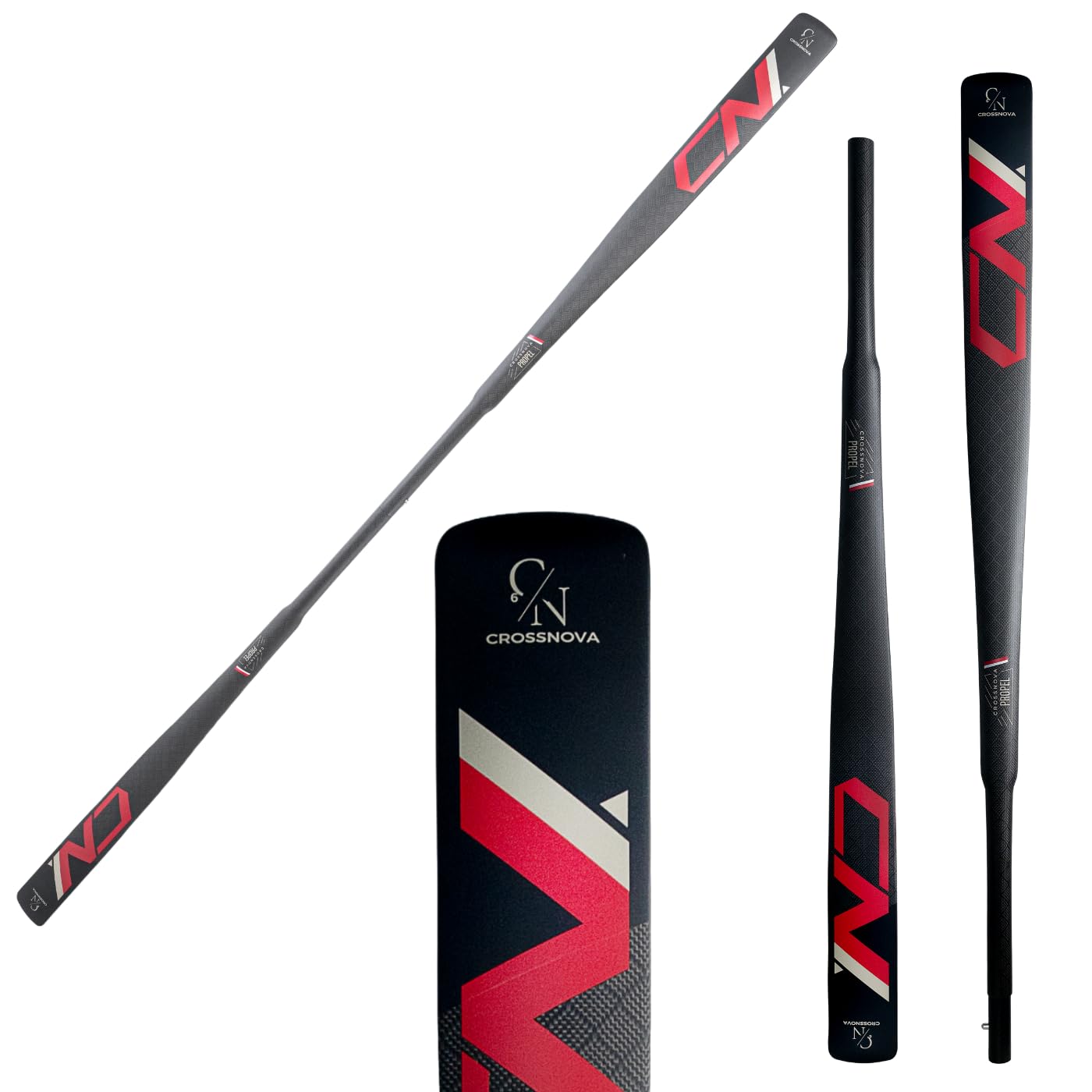
Weighs just 1.3 lbs — the lightest paddle in this entire guide by a wide margin.
The Greenland-style paddle is a completely different design philosophy from the Euro blades above. It features long, narrow blades with a peaked center, designed to slide in and out of the water with minimal resistance. This one-piece full carbon fiber version weighs only 1.3 lb (604 grams), making it featherlight in the hand. The narrow profile performs exceptionally well in high winds, where wider blades catch the air and fight you. The shoulder design — a subtle ridge near the blade base — gives you instant tactile feedback on the blade’s orientation without looking down.
The buyer consensus is overwhelmingly positive on the weight and build quality. The diamond weave carbon fiber finish is a point of pride for several owners. The paddle reduces shoulder strain compared to wider blades, a benefit noted by paddlers who have switched from a standard Euro design. The durability feedback is solid, though the thin carbon edge is more vulnerable to rock impacts — this is not a paddle for pushing off boulders. A small number of owners note that the joint can be hard to separate at first and that the paddle lacks hand padding, which can cause thumb discomfort on long sessions.
If you are a traditional Greenland-style paddler, a roll enthusiast, or someone who prioritizes featherlight performance over everything else, this is the premium choice. For the vast majority of recreational paddlers, the learning curve of a Greenland blade is steeper than the standard dihedral designs above.
Why Paddlers Love It
- 1.3 lb total weight is significantly lighter than any other paddle on this list — a genuine breakthrough for arm fatigue.
- Narrow Greenland blade design slices through wind and water with minimal resistance.
- Beautiful full carbon fiber construction with a diamond weave finish.
The Niche Factor
- Greenland-style blades require a different paddling technique that takes time to learn.
- No hand padding — can cause thumb discomfort on very long trips.
- Not for pushing off rocks or aggressive maneuvering in shallow water.
Best for: The experienced paddler who values ultralight performance and is already comfortable with a Greenland-style stroke.
look elsewhere if: You are a beginner or prefer the standard wide blade design of a Euro paddle — the learning curve is real.
Understanding the Specs
Feathering Angle (0° vs. 60°)
Feathering refers to offsetting one blade relative to the other. When you paddle into the wind, the raised blade can be turned edge-on to slice through the air instead of pushing against it like a sail. A 60° offset is common; 0° (unfeathered) is simpler for beginners because you do not need to rotate the shaft in your grip between strokes. Many adjustable paddles let you switch between the two as conditions change.
Blade Design (Dihedral vs. Asymmetrical vs. Greenland)
A dihedral blade has a raised spine running down the center that helps the paddle track straight and reduces flutter. An asymmetrical blade is taller on one side to equalize the water pressure as you pull, which reduces twisting in your hands. A Greenland blade is long, narrow, and smooth — it slips through the water cleanly with less resistance but requires a different, looser paddling technique. Each serves a different purpose: dihedral for stability, asymmetrical for efficiency, Greenland for stealth and endurance.
FAQ
What length kayak paddle do I need for a 220 cm size?
Is a carbon fiber shaft worth the extra cost over aluminum?
What does “feathering” mean on a kayak paddle?
How many pieces should my kayak paddle break into?
Will a 220 cm paddle fit an inflatable kayak?
What is the difference between a dihedral blade and an asymmetrical blade?
Can I use a 220 cm paddle in saltwater?
How do I know if a 220 cm paddle is the right length for me?
What is a Greenland-style paddle and how is it different?
How do I maintain my kayak paddle?
Final Thoughts: The Verdict
The 220cm Kayak Paddle that earns the top spot is the Bending Branches Whisper because it delivers the most reliable build quality and smoothest stroke at a price that undercuts expectations — the kind of paddle you buy once and forget about. If you want the featherlight feel of carbon fiber on a budget, the WONITAGO Carbon Fiber Kayak Paddle is your pick. And for the paddler who needs a paddle that survives rocky shorelines and doubles as a push pole, the Carlisle Day Tripper is the one to reach for.
How We Picked
We do not accept paid placement. Every pick is matched to a real buyer and a real use-case; we do not hands-on test units.
Sources & Methodology
Specifications: manufacturer listings and product documentation. Review insights: verified customer reviews, as of July 2026. Pricing: not shown on this page (it changes often); check the current price via the retailer link.
As an Amazon Associate, Gadgets Feed earns from qualifying purchases. This does not affect which products we feature.