
Our readers keep the lights on and my morning glass full of iced black tea. As an Amazon Associate, I earn from qualifying purchases.
Specs are compiled from manufacturer listings and verified buyer reviews and can change over time — please confirm the key details on the product page before buying.
Car audio power ratings are often just a big number printed on a box. A true 5000 watt amp delivers clean, sustained bass that shakes your mirrors without overheating or damaging your subwoofers. This guide cuts through the inflated wattage claims so you know which amplifier will actually survive your build.
I’m Min — the founder and writer behind Gadgets Feed. This guide is built by comparing the manufacturers’ published specifications and the patterns across verified customer reviews, so you get each pick’s real strengths and trade-offs instead of marketing spin.
Whether you are chasing an SPL (Sound Pressure Level, a measure of how loud your system gets) record or just want daily bass that hits hard, understanding the difference between peak power and RMS (Root Mean Square, the continuous power an amp can sustain) is the key to finding the right 5000 watt amp for your system and your budget.
Our Picks at a Glance

How To Choose The Best 5000 Watt Amp
A 5000W amplifier is serious gear. It needs the right electrical support, the correct impedance wiring (matching your subwoofer’s resistance to the amp’s stable range), and honest power ratings. Here is what to check before you buy.
RMS Power vs. Peak Power
Peak power is a marketing number — it tells you what the amp can do in a split-second burst. RMS (Root Mean Square, the continuous power the amp can sustain) is what matters for real performance. A true 5000W amp delivers 5000 watts RMS at its rated impedance. If you only see a peak number much higher than the RMS figure, treat the rating with serious suspicion.
Impedance Matching and Stability
An amplifier’s output changes with the load you connect. Running at 1 ohm gives you more power than 2 ohms from the same amp. A 0.5 ohm stable amp is a different beast — it demands a much stronger electrical system. Choose an amp whose stable impedance matches your subwoofer wiring plan (how you wire your subs in series or parallel).
Your Electrical System Prep
Full power from a 5000W amp pulls enormous current (over 400 amps). You likely need a high-output alternator (a part that generates more electricity than your stock one), a battery bank upgrade, and the “big three” wiring upgrade (thicker cables for your alternator-to-battery, battery-to-chassis, and engine-to-chassis connections) to keep voltage stable. Without that foundation, the amp cannot reach its rated output and may trigger protection or fail early.
Quick Comparison
| Model | Best For | RMS Power (continuous sustained wattage) | Impedance Range (the electrical load it handles) | Weight | Amazon |
|---|---|---|---|---|---|
| Taramps Big Boss 5 Black★ Best Overall | Best Overall / 0.5 Ohm Builds | 5000W RMS | 0.5 – 2 Ohm | — | Amazon |
| Stetsom Bravo Bass 5000Premium Pick | Premium Clean Power | 5200W RMS (14.4V) — a bit above 5000 | 1 Ohm | 9.5 lbs | Amazon |
| Orion HCCA5000.1DSPLXSPL Monster | SPL (Sound Pressure Level) Competitions | 5000W RMS | 1 Ohm | 31.2 lbs | Amazon |
| Taramps MD 5000.1 | Mid-Range Versatility | 5000W RMS | 2 Ohm | 9.28 lbs | Amazon |
| Audiopipe APHF-5000D-H1 | Full Range + Budget | 5000W RMS (1 Ohm) | 1 Ohm | — | Amazon |
| Gravity Audio E5000.1D | Compact Power | 1681W RMS (4 Ohm) | 1/2/4 Ohm | 10.14 lbs | Amazon |
| Precision Power ICE5000.1D | Entry Level | 2500W RMS (1 Ohm) | 1 Ohm | 12.82 lbs | Amazon |
| Banda Viking 15000 | Extreme SPL (Sound Pressure Level) | 15000W RMS (1 Ohm) | 1 Ohm | 29.8 lbs | Amazon |
In‑Depth Reviews
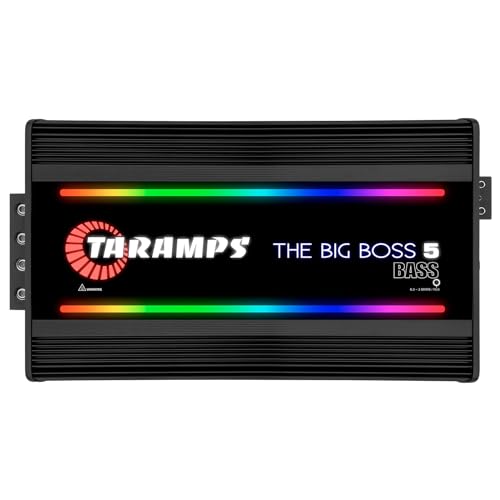
1. Taramps The Big Boss 5 Black 5000W RMS Monoblock
Our pick — over 4.5★ from 80+ verified ratings; the strongest balance of quality and price.
This amp runs cool at 0.5 ohms while delivering a true, clean 5000W RMS — the most flexible impedance range in this guide.
Taramps packed its exclusive Smart Technology into this monoblock (a single-channel amp for subs), so it delivers the full 5000W RMS across any impedance from 0.5 to 2 ohms. You do not need to swap amplifiers if you change your subwoofer wiring — the Big Boss 5 adapts to whatever load you throw at it. The crowd favorite among owners is its quality — nearly everyone comments on how reliably it puts down power. Buyers report it “runs cool at 0.5 ohms powering two Orion HCCA 12s,” a feat that would tax lesser amps into thermal shutdown.
On the bench it exceeds its rated power with no RCA noise (interference from the signal cables). The built-in 108 RGB LED effects let you customize the look, but the real star is the efficiency: the Class D high-current design keeps fans quiet and the chassis manageable. The only fitment catch is the set screws — they are too short for 1/0 gauge wire, so plan on picking up M8x1.25 10mm screws for a proper clamp. This amp demands a serious electrical build — think a high-output alternator and battery bank — before it reaches full output, more so than the Stetsom Bravo because of its 0.5-ohm capability.
Owner-Proven Strengths
- True 5000W RMS from 0.5 to 2 ohms — no swap needed
- Accepts 2/0 gauge power wire for high-current builds
- Runs cool even at demanding 0.5 ohm loads according to owner reports
- RGB VU meter (a visual volume display) adds flair without gimmick behavior
Installation Caveats
- Set screws too short for 1/0 gauge wire — plan for replacement hardware
- Gain is very sensitive and output starts around 44V minimum
- Requires a stout electrical system (alternator, battery bank, big three) to reach full potential
Reach for this if: you want a single amp that handles any load from 0.5 to 2 ohms with honest 5000W RMS and proven thermal headroom.
The honest trade-off: the terminal screws need an aftermarket upgrade for thick power wire, and this amp demands a serious alternator and battery setup before it reaches full output.
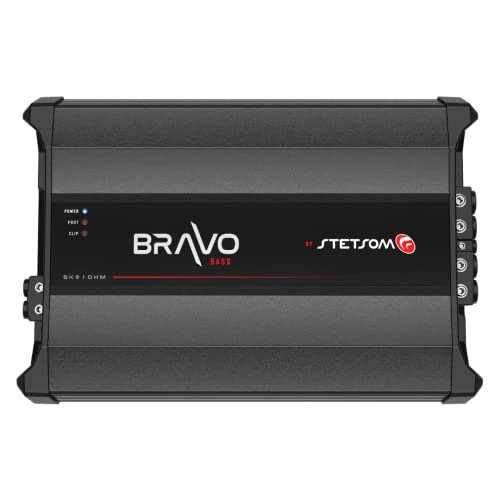
2. Stetsom Bravo BASS 5000 1 Ohm Mono Subwoofer Amplifier
A compact 5200W RMS Brazilian-style amp that is so clean and powerful it can destroy subwoofers not rated for its output.
Stetsom rates the Bravo 5K at 5200W RMS at 1 ohm (14.4V), which puts it a tick above the 5000W mark and makes it one of the densest power plants in this class — more powerful than the Taramps Big Boss 5 by 200W RMS at its rated impedance. The monoblock chassis measures just over 9 inches per side — small enough to fit tight spaces — yet the aluminum construction and smart cooler handle long listening sessions. Multiple owners note that it sets off car alarms and shakes the whole vehicle without clipping (distortion). The review pages sum it up: “Extremely powerful amp that can blow subs not rated for its output.”
Controls include a variable LPF (low-pass filter, which blocks high frequencies so only bass goes to your subs, adjustable 30Hz-250Hz), a subsonic filter (blocks very low frequencies that waste power), and bass boost with adjustable frequency and boost level. The power and ground terminals accept 00 AWG (2/0) wire, and the speaker terminals accept 7 AWG. Wiring it properly is straightforward for a medium-skill installer. The caveat you need to hear: this amp is so clean and powerful that it will damage subs that cannot handle its true output. Dial the gain with an oscilloscope (a tool that shows the audio waveform), not by ear.
Who it fits: enthusiasts who want legitimate 5200W RMS in a compact chassis and understand they must pair it with subs rated well above 5000W to stay safe.
The catch you need to hear: the raw output can easily fry subs that are not built for this power level — proper subwoofer selection and gain tuning are non-negotiable.
3. ORION HCCA5000.1DSPLX High Performance Class D Monoblock
A 31.2-pound Korean-built beast that owners say dyno-tests show over-delivers at 6500W RMS — making it a true overachiever versus the Taramps Big Boss 5’s straight-rated performance.
The Orion HCCA name has meant serious SPL hardware for decades, and this 5000W RMS monoblock justifies the heritage. Measuring 21.3 inches long and weighing over 31 pounds, it is a physically large amplifier with a die-cast aluminum cover and an illuminated Orion badge. Owners mention it puts out 6500W RMS at 0.5 ohms with 13.5V input — meaning it comfortably exceeds its rating. The consensus among the owner community is consistent: “Performance” is the most-praised aspect, followed closely by sheer power.
It includes a low-pass filter (40Hz-300Hz), a subsonic filter, and a bass boost control, plus a MOSFET power supply (metal-oxide-semiconductor field-effect transistor — a type of efficient switching transistor) with fault and protection monitoring. The amp is power-hungry — the “big three” electrical upgrade is a must, and several owners run 320-amp alternators and extra batteries to keep the voltage stable. The genuine trade-off here is size and thirst: it is a large, heavy unit that needs a spacious mounting location and a premium electrical system to behave itself. The bass knob has a known quirk where the clip LED stays lit with power — a minor annoyance in an otherwise hard-hitting package.
Grab this for: SPL enthusiasts and record-chasers who want an oversized, overachieving amp with Korean build quality and dyno-proven headroom.
Skip this if: your vehicle cannot accommodate a 21-inch-long, 31-pound amplifier or you do not want to invest in a high-output alternator and battery bank.
4. Taramps MD 5000.1 Amplifier 2 Ohms 5000W RMS Monoblock
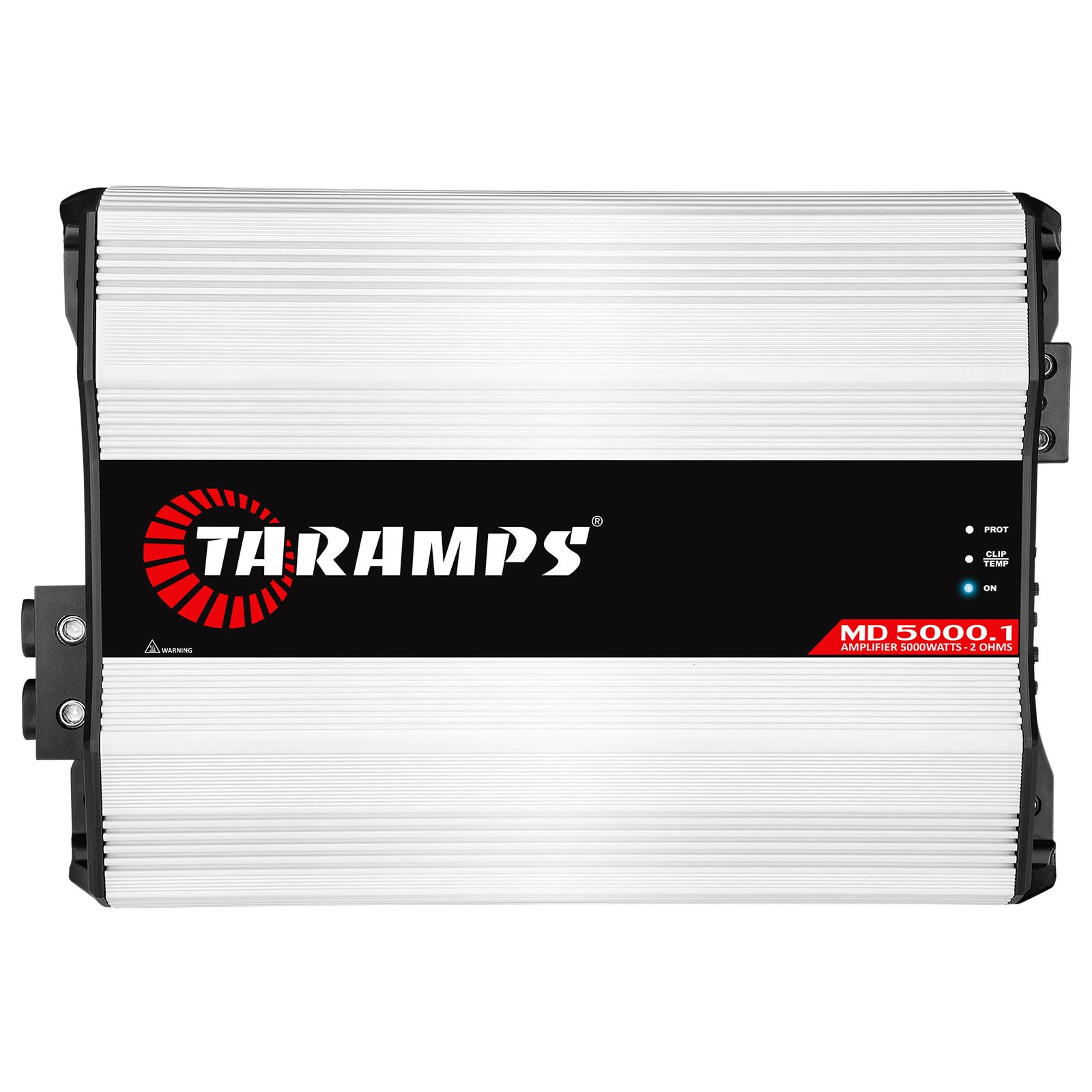
The mid-range workhorse that powers two big 15-inch subs with reserve to spare — but stick to the Big Boss if you need 1-ohm stability.
The MD 5000.1 delivers 5000W RMS at 2 ohms and is designed as a full-range monoblock, meaning it can handle anything from subwoofers to mids and vocals with a frequency response of 10Hz to 10kHz. At just 9.28 pounds, it is significantly lighter than the Orion (31.2 lbs) while still packing enough punch for demanding builds. The best part about it, as owners consistently note, is the quality — it earns the most praise from the community, and a typical owner says it “powers two 15-inch Skar VXF subs perfectly with plenty of reserve power.”
It includes variable high-pass and low-pass crossovers (filters that split frequencies to different speakers) and a switchable bass boost. The Smart Cooler system with active fans keeps temperatures down — one owner reported 78°F chassis temp after two hours of full tilt at 55°F ambient, with the external fans never even kicking on. The catch is reliability: about a third of the feedback is mixed, with some units failing early, particularly when shipped as returns. The crossover setup can also be confusing since the amp is full-range, not a dedicated subwoofer amp. Budget buyers should note this is a 2-ohm amp, not 1-ohm like the Big Boss, so plan your subwoofer wiring around a 2-ohm final load.
Strengths Owners Confirm
- Quality build that powers large subwoofer setups with reserve headroom
- Full-range capability (10Hz-10kHz) for flexible system tuning
- Smart Cooler keeps temperatures surprisingly low during extended play
- Accepts 2/0 AWG power wire for high-current installations
Honest Warnings
- Reliability is mixed — some units arrive as returned products and fail early
- Full-range crossovers are confusing if you only need a subwoofer amp
- Demands a battery upgrade and adequate electrical system at this power level
Who this works for: budget-conscious builders who have a beefy electrical system and need 5000W RMS at 2 ohms for a subwoofer bank, especially if they want full-range tuning flexibility.
Look elsewhere if: you want a 1-ohm load or cannot risk receiving a customer return — buy directly from Taramps or a known dealer instead of third-party marketplace listings.
5. Audiopipe 5000 Watts Full Range Class D MOSFET Amplifier (APHF-5000D-H1)

A Brazilian-style amp that brings full-range sound and BTL bridging to the 5000W class — but owner feedback suggests real-world output may fall short.
The Audiopipe APHF-5000D-H1 uses advanced pulse-width modulation (PWM, a switching technique in Class D amps) with MOSFET circuitry and a BTL (Bridge Tied Load, a design that combines two amp sections for more power) to deliver up to 5000W RMS at 1 ohm in a compact 10.2 x 9 x 2.9-inch footprint. It is a Brazilian-style amplifier, which means it is engineered for high power density but also demands careful electrical prep. The remote bass control knob includes a clip LED (distortion indicator) so you can monitor distortion in real time without a separate tool.
The honest feedback from owners is split. Some call it “extremely hardcore bass” and praise the dealer support, while others report it clips easily and underperforms the 5000W claim. One owner said “it doesn’t really feel like a true 5k and clips a lot no matter how I tune it,” and another claimed the output was well under 3000W after bench testing. The overload, over-voltage, and under-voltage protection circuits (16V max, 9V min) give it a safety net, but the variance in owner experience makes it a pick for those willing to gamble. Compared to the Taramps Big Boss 5, the output consistency is much less reliable.
Best for: audiophiles on a tighter budget who want full-range capability and a compact physical footprint for a moderate-output daily system.
Think twice if: you need a guaranteed 5000W RMS for competition or SPL — the owner feedback suggests real-world output varies and tuning is tricky to get clean.
6. Gravity Audio E5000.1D Warzone 5000W True RMS Car Amplifier
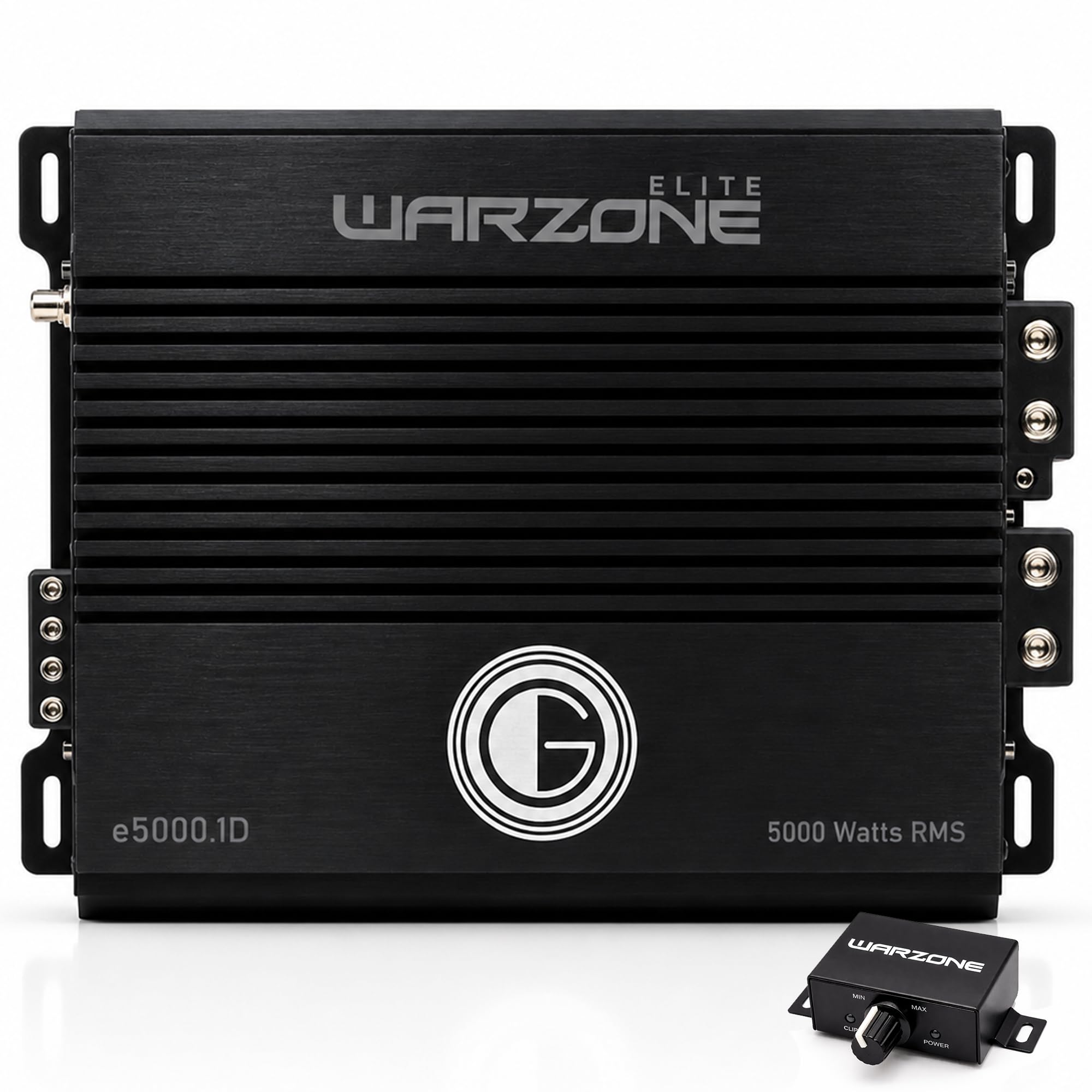
A full-bridge amp with a tiny footprint and surprising power density — but a higher risk of defects than the more proven Stetsom Bravo.
The Gravity E5000.1D uses a full-bridge topology (a circuit design that boost power in a small chassis) to pack 5000W true RMS at 1 ohm into a chassis much smaller than the Orion or even the Stetsom. It has dual 0-gauge inputs and dual 8-gauge speaker terminals. The claimed RMS numbers are 5000W at 1 ohm, 2964W at 2 ohms, and 1681W at 4 ohms — measured numbers that some owners have confirmed with clamped testing.
The protection circuitry (high voltage, low voltage, overcurrent, high temperature) is comprehensive and auto-resets after a fault. Owners who have run the amp for years praise its value and power. However, the feedback is sharply divided: about half the customers note that the amp performs poorly in cold weather and that the manual is confusing. One owner, after contacting the manufacturer, was told to return it immediately. The strongest advocates note that it requires serious car audio knowledge — “big three” wiring, correct fusing — to avoid a fire risk, and some units arrive with minor rust on screws. This is a high-risk, high-reward pick for experienced builders only.
Only for: experienced installers who already have a sturdy electrical system and want a compact amp with impressive power density at a mid-range price point.
Not for: beginners or anyone who values out-of-box reliability — the defect rate and cold-weather issues make it a gamble.
7. Precision Power ICE5000.1D Black Ice Series 5000W Class D Monoblock

A budget-friendly entry point for beginners, but real-world output — as low as 700W in one clamped test — falls far short of the 5000W rating.
Precision Power’s ICE5000.1D offers direct short, thermal, and overload protection circuits plus variable 12dB high, low, and subsonic crossovers (filters that shape which frequencies reach your speakers), making it a technically complete amplifier. It accepts either high-level (200mV-6V) or low-level RCA input, so it works with factory and aftermarket head units. At 12.82 pounds and 17 inches long, it is physically substantial — heavier than the Taramps MD 5000.1 (9.28 lbs).
The honest truth from the owner feedback is that this amp is best viewed as a beginner’s 2500W amp, not a true 5000W unit. One owner who clamped it reported only 700 watts at 1 ohm, saying it is “fine for beginner but not good for a competition builder.” Another lasted only two months before burning out. There are positive voices — some reviewers point out running it strapped on four 18-inch subs without issue — but the variance in performance is wide. Treat this as an affordable starter amplifier that may satisfy a moderate daily system, not a 5000W contender for serious SPL.
Best for: total beginners who want to learn about high-power car audio without spending much, and who have modest expectations about real-world output.
Do not buy if: you need honest 5000W RMS for competition, SPL, or demanding subwoofer setups — the clamped power numbers suggest it delivers a fraction of its rating.
8. Banda Audioparts Viking 15000 Car Audio Monoblock Amplifier
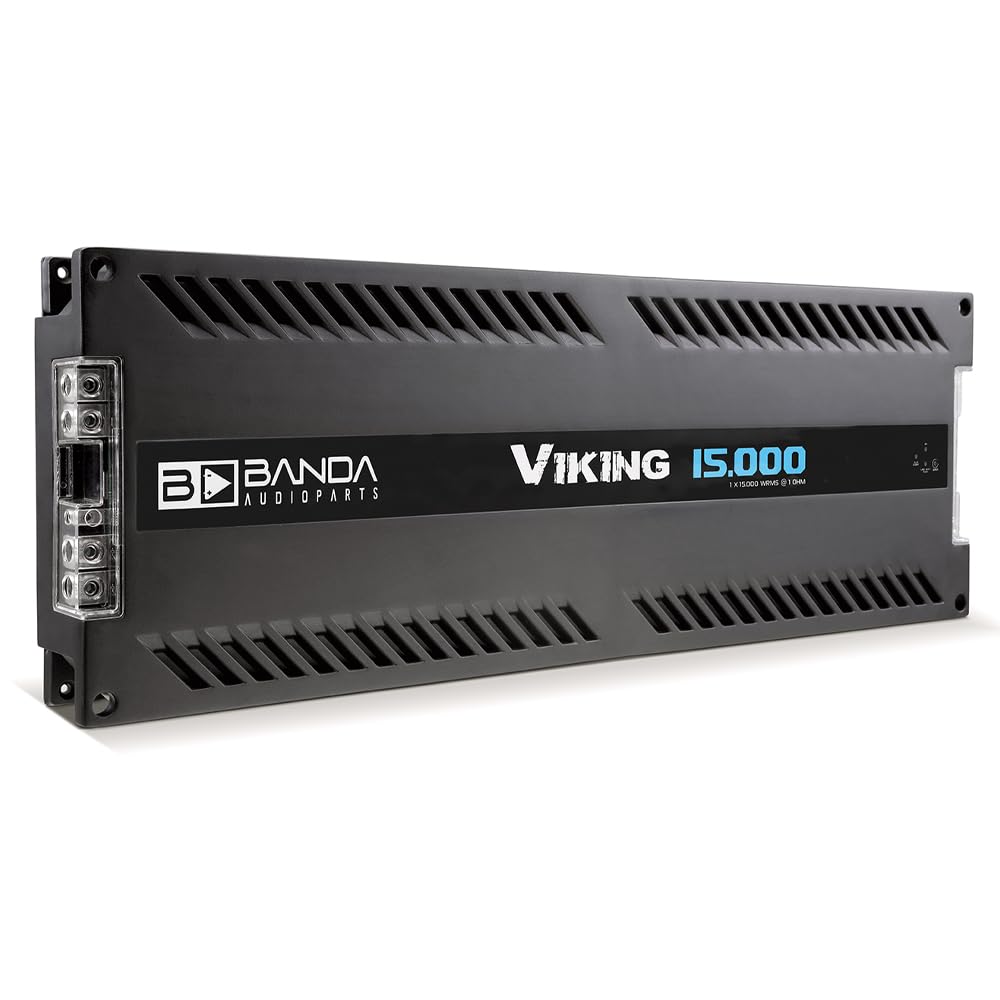
A 15000W RMS competition-grade monoblock for SPL builds that need absurd power density — three times more than any other pick here.
The Viking 15000 is in a different league — it delivers 15000W RMS at 1 ohm, making it three times as powerful as the other picks here. Designed for competition-grade sound systems, it features a heavy-duty aluminum chassis that measures 29.65 inches long and weighs 29.8 pounds. The frequency response is tuned for deep bass at 18Hz–3kHz (-3dB), and the 73% efficiency rating is respectable for an amplifier at this power level.
Owners who got a working unit describe it as “very powerful and clean sounding” and “a beast.” However, the failure rate is concerning. Several shoppers say receiving damaged units that arrived non-functional — one professional installation yielded no sound despite power and fan lights. The 1/0 gauge power terminal is also undersized and does not fit standard 1/0 OFC (oxygen-free copper) wire or reducers, which is a significant design flaw for this amplifier. This is a true SPL tool for racers and competitors who need 15,000W and can work around the terminal issue, but the quality control issues make it a high-stakes purchase.
Only for: serious SPL competitors and car audio professionals who need a massive 15000W RMS platform and can address the undersized power terminal themselves.
Steer clear if: you want a plug-and-play 5000W amp for a daily driver — the failure rate, size, and terminal problem make it unsuitable for casual use.
Understanding the Specs
RMS vs. Peak Power
RMS (Root Mean Square) measures the continuous power an amplifier can deliver to your speakers over time. This number tells you how loud and clean the amp actually plays. Peak (or “max”) power is a brief burst rating that marketing uses to make numbers look bigger. When comparing 5000W amps, always compare RMS values — a true 5000W amp delivers 5000W RMS, not 5000W peak with a tiny RMS number underneath.
Impedance and Ohm Load
Impedance, measured in ohms, is the electrical resistance your subwoofers present to the amplifier. A 1-ohm load demands more current than a 2-ohm load and typically produces more power — but it also stresses the amplifier and your electrical system more. An amp rated “1 ohm stable” can safely run at 1 ohm, while a “0.5 ohm stable” amp requires an even more sturdy power supply. Always match your subwoofer wiring (series/parallel — ways to combine subwoofer coils) to the amp’s stable impedance range.
Class D Amplifier Topology
Class D amplifiers use pulse-width modulation (PWM, a rapid switching technique) to switch the output transistors on and off fast, achieving much higher efficiency (often above 80 percent) than traditional Class A/B designs (50-60 percent). This means less power is wasted as heat, allowing Class D monoblocks to be smaller and run cooler while delivering high wattage. Almost all 5000W car audio amps today are Class D for this reason.
Electrical System Requirements
A 5000W RMS amplifier can draw over 400 amps of current at full output. Your vehicle’s stock alternator (typically 80-150 amps) cannot supply this alone. You need a high-output alternator (200+ amps), an upgraded battery or battery bank (often lithium for high-current applications), and the “big three” wiring upgrade (thicker cables for alternator-to-battery, battery-to-chassis, and engine-to-chassis grounds). Skipping this preparation leads to voltage drop, clipping (distortion), overheating, and premature amplifier failure.
FAQ
Do I need a special alternator for a 5000 watt amp?
Can I run a 5000W amp at 0.5 ohms safely?
What gauge power wire do I need for 5000 watts?
Will a 5000W amp drain my car battery when the engine is off?
What is the difference between a monoblock and a multi-channel amp for 5000W?
How do I set the gain on a 5000W amplifier correctly?
Is a 5000W amp too much for a stock car electrical system?
Can I use a 5000W full-range amp for mids and highs?
How long do 5000W car amplifiers typically last?
What does BTL mode mean on a car amplifier?
Final Thoughts: The Verdict
Across the board, the 5000 watt amp winner is the Taramps Big Boss 5 Black because it delivers honest