
Our readers keep the lights on and my morning glass full of iced black tea. As an Amazon Associate, I earn from qualifying purchases.
Specs are compiled from manufacturer listings and verified buyer reviews and can change over time — please confirm the key details on the product page before buying.
You want to scare off intruders or wildlife without keeping a real dog. A device that barks when something moves sounds like the simple answer. But some of these alarms are so loud they upset your neighbors. Others die after one rainstorm. A few trigger on every passing leaf and drive you crazy. This guide finds the barking dog alarms that actually hold up, sound most realistic, and you can rely on day after day.
I’m Min — the founder and writer behind Gadgets Feed. This guide is built by comparing the manufacturers’ published specifications and the patterns across verified customer reviews, so you get each pick’s real strengths and trade-offs instead of marketing spin.
These are the seven best models for anyone looking for a barking dog alarm that genuinely protects a garden, porch, or chicken coop without becoming a headache itself.
Quick Picks
- SENKEFEI Solar Outdoor Motion Sensor Alarm — Best Overall
- HULPPRE Solar Outdoor Motion Sensor Alarm — Best Value
- ChunHee Solar Motion Sensor Alarm — 2-Pack Value
- Generic Dog Barking Motion Detector (SUNYOU) — Long Range King
- S SELDORAUK Motion Sensor Door Chime — Body Heat Expert
- Qualirey Solar Outdoor Motion Sensor Alarm — 4-Pack Coverage
- Safety Technology Electronic Barking Dog Alarm — Indoor Specialist
How To Choose The Best Barking Dog Alarm
The right alarm depends entirely on what you want to scare away and where you need to put it. A device built for a suburban front door is very different from one for a large rural garden. Here is what actually matters when comparing them.
Loudness vs. Neighbor Relations
The biggest spec on every box is the decibel level (a unit that measures sound intensity) — typically 110 to 130 db. A 130 db alarm is genuinely painful to stand next to and will carry far across an open yard so it reaches animals at the back of your property. That is great for deterring deer and coyotes but terrible for a small property with close neighbors. If your property is compact, look for an alarm with adjustable volume levels so you can dial it down without losing the deterrent effect entirely.
Power Source: Solar vs. Battery vs. Wired
Solar units are the easiest — you mount them and forget them. The catch is they need direct sunlight every day. If you live in a cloudy region or place them under a porch, the battery drains fast and the alarm goes silent. Battery-only units (AA or alkaline) are more reliable in shade but require regular swaps. Plug-in units are the most dependable for indoor use but limit where you can place them. Some hybrid models offer both solar and a USB backup, which is the safest combo so your alarm keeps working even after cloudy days.
Sound Library and Realism
Critters and intruders get used to a single sound over time, a process called habituation. The best alarms cycle through multiple sounds — dog barks, gunshots, sirens — so the threat always feels fresh. Some models offer 6 to 13 different sounds. For realism, look for mentions of “real-dog-recorded” barks versus electronic tones. The more variety and the more authentic the bark, the longer the alarm stays effective.
Quick Comparison
| Model | Best For | Max Range | Peak Loudness | Sound Variety | Amazon |
|---|---|---|---|---|---|
| SENKEFEI Solar Motion Sensor Alarm | Reliable outdoor predator deterrence | 26 feet | 130 db | Dog bark & gunshot | Amazon |
| HULPPRE Solar Motion Sensor Alarm | Budget-friendly variety | 26 feet | 130 db | 13 sounds | Amazon |
| ChunHee Solar Alarm 2-Pack | Covering two areas simultaneously | 33 feet | 129 db | Dog bark & siren | Amazon |
| Generic Dog Barking Motion Detector | Long-range wireless coverage | 1000 feet | 110 db | 6 sounds | Amazon |
| S SELDORAUK Motion Sensor Door Chime | Body-heat detection with remote | 656 feet | 110 db | 6 dog barks + 5 chimes | Amazon |
| Qualirey Solar Alarm 4-Pack | Large-property perimeter defense | — | 129 db | 13 sounds | Amazon |
| Safety Technology Electronic Barking Dog Alarm | Indoor entryway alert | 10 feet | 120 db | Bark, chime, alarm | Amazon |
In‑Depth Reviews
1. SENKEFEI Solar Outdoor Motion Sensor Alarm

The most trusted pick for stopping predators cold, backed by thousands of real owner experiences.
This is the crowd favorite because 60 buyers specifically mention it successfully protecting chickens, gardens, and fruit trees from predators. It fires off a 130 db (decibel) dog bark or gunshot sound — so loud it is painful to stand next to, which buyers report deters even coyotes at night. The solar panel keeps it charged during the day, and you can also plug in via USB when the sun hides for a full charge. The detection range reaches 26 feet, which gives you a comfortable warning zone around a coop or garden bed. The adjustable volume is a nice touch — you can turn it down near neighbors without killing the deterrent effect. Owners mention it works in -20°F weather without skipping a beat.
The main trade-off is reliability over the long haul. A number of owners found it stops working after the first use or within a few months, and battery life under constant use is limited to about two weeks. The sensor can also be triggered by wind or fog if you mount it in an exposed spot. But the sheer number of positive reviews — where people call it “effective” and “scary loud” after two years — tells you the hit rate is high. It is sharper at night than the HULPPRE because the SENKEFEI has a record-your-own-sound feature for custom deterrence.
What wins people over
- Loud 130 db output with adjustable volume levels
- Solar-powered with USB backup for cloudy stretches
- Record-your-own-sound feature for custom deterrence
The honest limits
- Mixed reliability — some units stop working within months
- Two-week charge life under constant triggering
- Sensor can false-alarm on wind and fog
Reach for this if: you need a reliable outdoor guard for chickens, fruit trees, or a garden — the predation-prevention record here is the strongest in the lineup.
Look elsewhere if: you need something truly weatherproof in constant rain or fog, or you want a zero-maintenance unit that never needs a battery top-up.
2. HULPPRE Solar Outdoor Motion Sensor Alarm
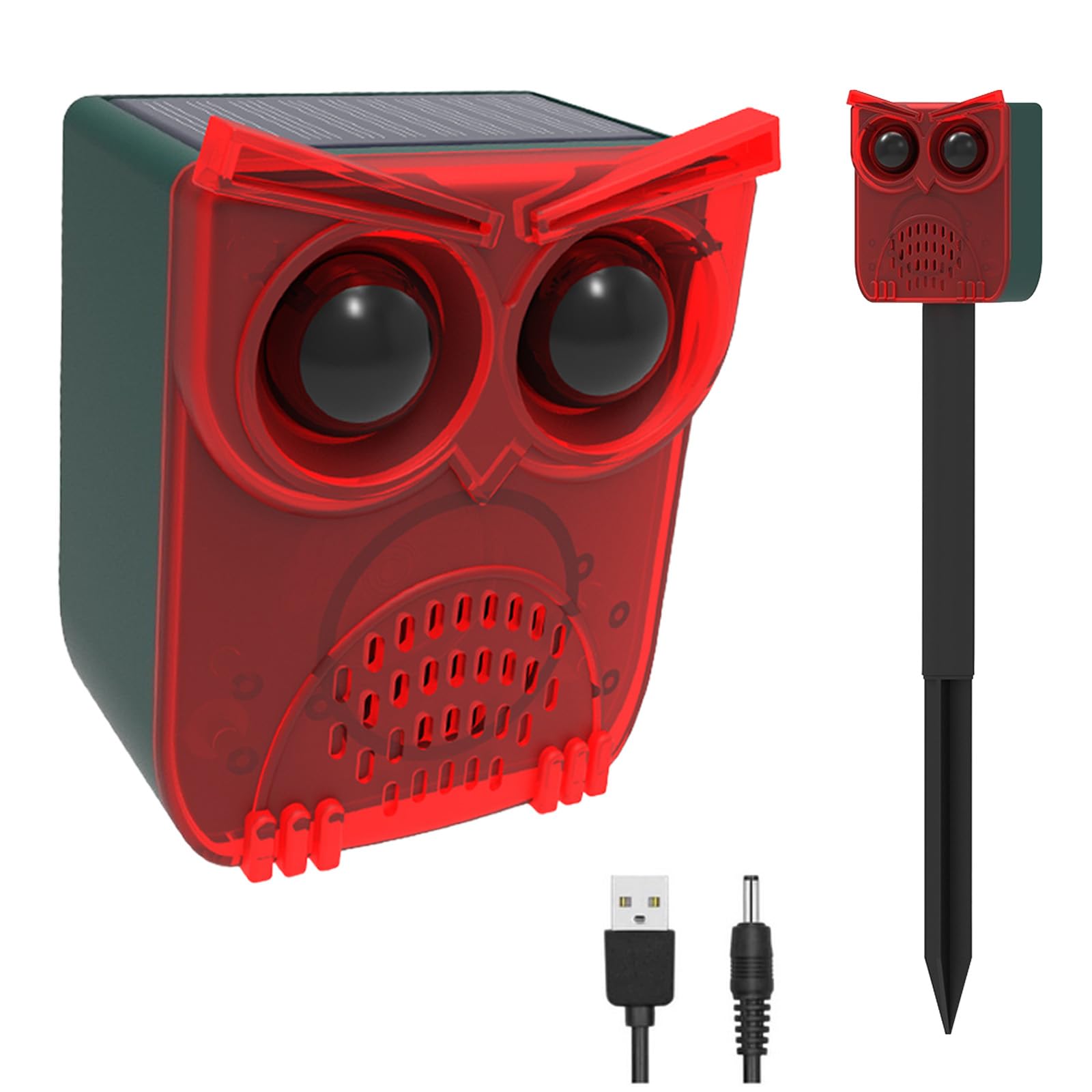
Thirteen rotating sounds at a price that undercuts almost everything else.
What makes this budget pick stand out is the sound library (the collection of pre-recorded audio files). Most cheap alarms play one bark on repeat, which animals learn to ignore within days. This one cycles through 13 different sounds — dog barks, gunshots, sirens — so the threat stays unpredictable. It hits 130 db, which buyers describe as “very loud” and needing tape over the speaker if neighbors are close. The HULPPRE is a full 130 db vs the SENKEFEI’s 130 db, so on paper they are equally piercing, but the HULPPRE’s extra sounds give it an edge against smart critters like raccoons that get used to a single bark.
The headline catch is water resistance. Multiple customers note it fails in rain — specifically, 0.3 inches of rain caused the sound to stop working entirely. The unit is not weatherproof, so it belongs under a covered porch rather than in an open garden. The reliability score is still solid (10 positive mentions), and buyers who keep it dry find it works great for scaring squirrels, cats, and raccoons. It also comes with a 24-month warranty, which is generous at this price point.
Smart budget move if: you need a loud, multi-sound alarm under a covered area and want the security of a two-year warranty.
Not for you if: the unit will sit in open rain — look at the IP65 (ingress protection rated against rain jets) ChunHee instead.
3. ChunHee Solar Motion Sensor Alarm
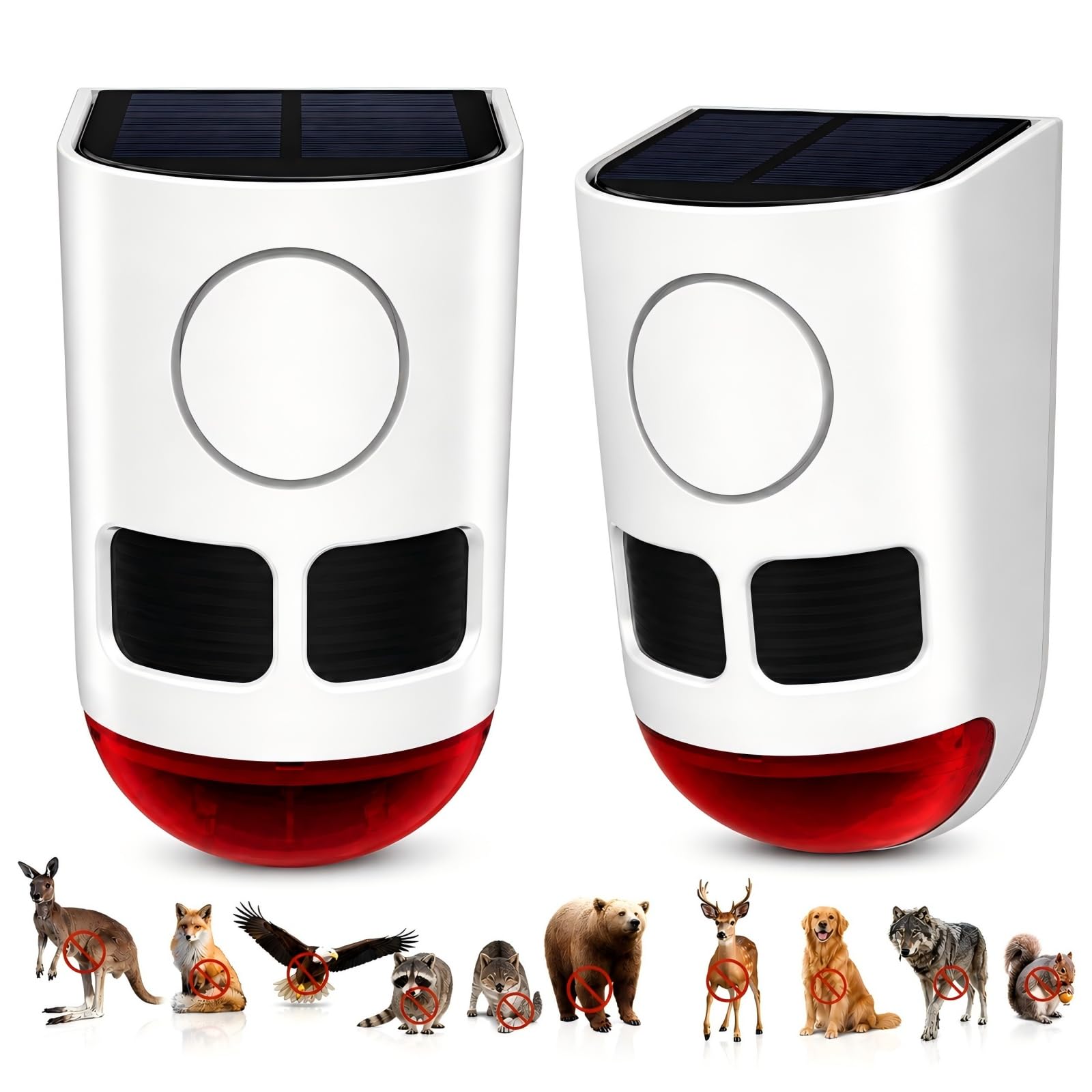
A two-pack with IP65 weather sealing and the longest detection range on the list.
This is the pair to buy if you need to cover two entry points at once — say the front gate and the back garden. The standout spec is the 33-foot maximum range, versus 26 feet for the SENKEFEI and 26 feet for the HULPPRE. That means it catches movement earlier, so you get more warning before an animal reaches your coop. It pumps out 129 db, while the top picks are 130 db — barely noticeable to the human ear but note on paper. The IP65 rating (a standard for solid dust and water jet protection) means it is sealed against rain and snow, so you can mount it in an open field without worrying about water damage. The solar panel handles daytime charging, and USB backup keeps it alive after several overcast days. The ChunHee’s 129 db is sharp enough that one owner reported hearing it 75 feet away inside a brick house.
Reliability is a mixed bag here. Some owners call it “great” and “sensitive,” while others report it stopped working after two weeks. The button is hard to access once mounted, which makes changing modes frustrating. But for the price of a two-pack — covering twice the area for roughly the same cost as a single SENKEFEI — the value is undeniable. Owners who got a good unit report it keeping stray cats away and the artificial dog bark sounding convincing enough to deter raccoons.
Best for: buyers who want weatherproof coverage for two separate areas (driveway + chicken coop, front + back yard) without paying for two individual units.
The catch: the button placement is awkward once mounted, and an occasional unit arrives defective — test it before permanent install.
4. Generic Dog Barking Motion Detector (SUNYOU)

A wireless design that pushes detection up to 1,000 feet from the receiver.
If you need to know when something moves at the far end of a large property, this is the one. The sensor talks to the receiver from up to 1,000 feet away, while the SENKEFEI model has a 26-foot range. That covers a long driveway or a distant barn without needing extra units. The six realistic dog barks include recordings that owners say sound just like a German Shepherd — one buyer remarked “it’s like she is there” when they are away. The volume reaches 110 db, which is quieter than the 130 db SENKEFEI and HULPPRE models. That is enough for indoor alerting but falls short for scaring off animals in a big open field.
The biggest issue is false triggers. The sensor is very sensitive — wind-blown leaves, birds, and insects set it off constantly. Owners note that a blocking shield barely helps. The outdoor sound carry is poor even at max volume, making it better suited for a porch or barn interior than a wide-open yard. The reliability score is mixed (21 mentions), with some units stopping after a month.
Reach for this if: you need to monitor a long driveway, a far corner of a field, or a detached garage — the 1,000-foot range is class-leading.
Think twice if: you need raw volume to scare predators outdoors — the 110 db output, compared to 130 db on the solar-powered units.
5. S SELDORAUK Motion Sensor Door Chime
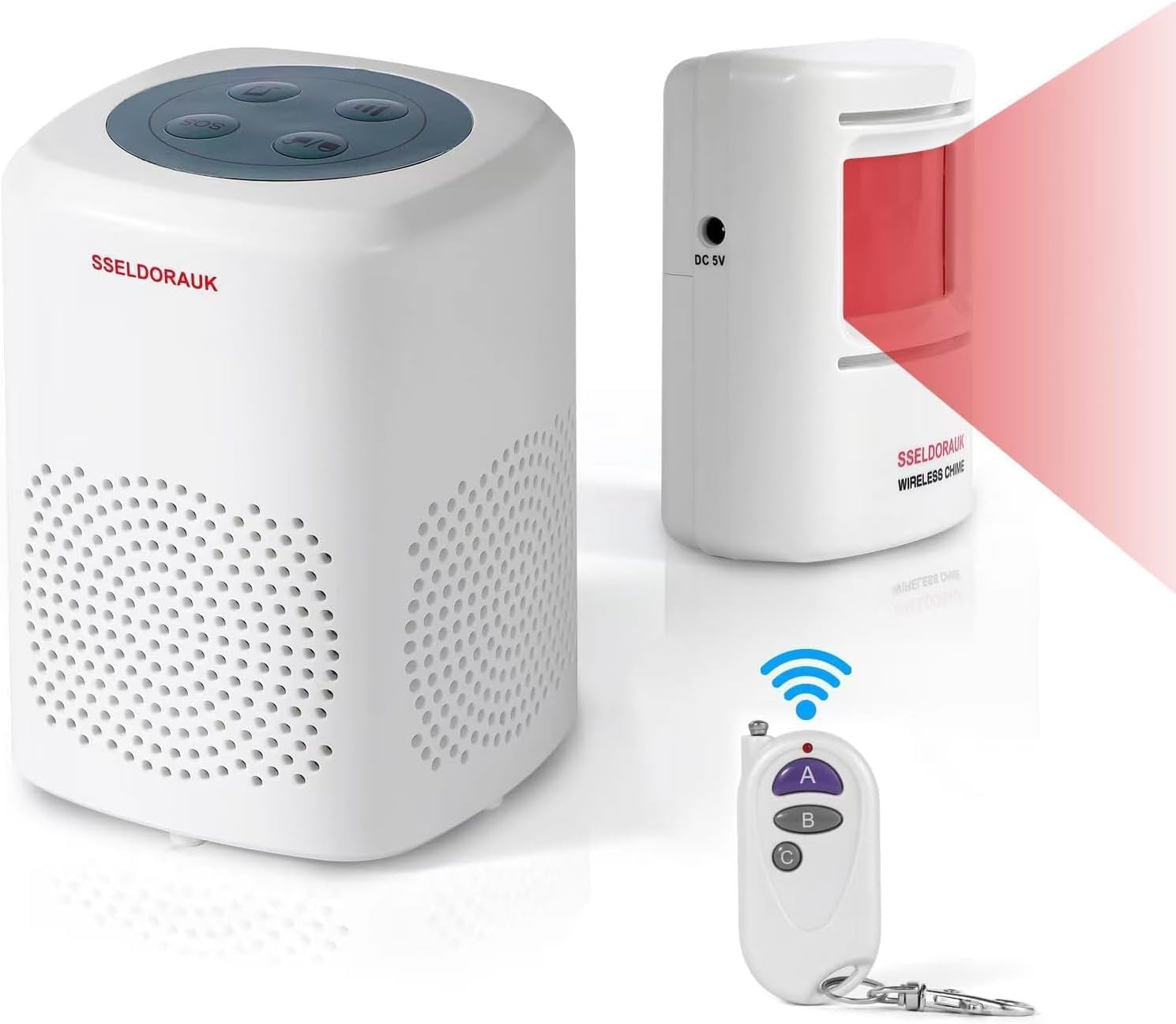
A doorbell-style alarm that uses body heat to avoid wind-triggered false alarms.
This unit uses a PIR sensor (a passive infrared sensor that detects living body heat) instead of a standard motion detector. That means it ignores swaying branches and only fires when a warm-blooded creature walks past — so you do not get false alarms from leaves or wind. It offers six real-dog-recorded barks plus five chime modes, giving you 11 total sounds to choose from. The receiver range reaches 656 feet, while the SUNYOU reaches 1,000 feet — but the detection distance is shorter at 23 feet. The max volume is 110 db, matching the SUNYOU for indoor-level loudness. One buyer who uses it to deter coyotes reports the body-heat detection avoids false triggers from distant activity while still catching the coyote.
The mixed feedback here is real. Some owners love the barking function and find it realistic, while others say the sound is short, repetitive, and distorts at high volume because of a low-quality speaker. The remote key fob is handy for arming and disarming, but it cannot trigger the barking itself — only the sensor can. For selective detection that ignores the wind, the S SELDORAUK is a smarter buy than the Generic SUNYOU, which triggers on every breeze.
Best for: covered porches, patios, and indoor entryways where wind-triggered false alarms from other sensors are a problem.
The honest downside: the barking audio quality is average and distorts at the highest volume setting — not ideal for large open spaces.
6. Qualirey Solar Outdoor Motion Sensor Alarm

A four-pack of solar alarms for covering a large perimeter in one purchase.
This is for the buyer with a big garden, multiple fences, or a rural property that needs several lines of defense. The package includes four solar-powered units, each delivering a 129 db output with 13 rotating sounds — the same sound variety as the HULPPRE but spread across four devices. Owners find it effective against deer, with one buyer noting tracks that showed deer turning away. Each unit is so loud that one owner described hearing it 75 feet away inside a brick house. The solar charging keeps them running with no wiring, and the easy setup is praised even by first-time users.
The volume is a sticking point. It is so loud that one owner described hearing it 75 feet away inside a brick house. That is great for open rural areas but too much for tight suburban lots. The control button is reported to malfunction when the battery runs low, and after several months, some units start false-alarming randomly. The package also lacks in-ground stakes, so you will need to mount them on a fence or wall. For the four-pack price, you get quadruple the coverage of a single unit, but the individual build quality is not as consistent as the SENKEFEI.
Reach for this if: you need to protect a large rural property with multiple zones (vegetable garden, chicken run, front yard) and want one-box convenience.
Look elsewhere if: you only need one or two units — a two-pack or single premium unit will give better build consistency for less money.
7. Safety Technology Electronic Barking Dog Alarm

A plug-in indoor alarm with a microwave sensor that sees through walls.
This is the only unit designed specifically for indoor use. It uses a microwave signal (which can travel through thin walls) to detect someone approaching from over 10 feet away — on the other side of a door or wall. That means it can alert you before someone even opens the door, unlike a standard motion sensor that needs a direct line of sight. It offers three modes: barking dog, chime, or alarm, giving you options for different situations. The 120 db output is loud enough to alert you inside the house but falls short of the outdoor 130 db units for scaring off determined animals or intruders.
The biggest limitation is that the sensor cannot detect motion through solid wooden doors or walls thicker than a few inches. Owners who bought it expecting outdoor coverage were disappointed — it only triggers when someone opens the door and walks directly in front of it. It also loses its memory during a power outage, resetting to a default beeping sound instead of the barking mode you set. For a dedicated indoor entryway alert — say a workshop or side door — it works fine. For anything else, the outdoor solar units are a better fit.
Best for: alerting you when someone approaches an indoor door or window — think a basement, workshop, or side entrance.
skip it if: you need outdoor weatherproofing or reliable detection through walls thicker than a typical interior door.
Understanding the Specs
Decibel Rating (db)
This is the measure of loudness. A normal conversation is about 60 db. A barking dog alarm at 130 db is roughly as loud as a military jet at takeoff — painful to stand next to and audible across a large property so animals at the far end still hear it. That is what you want for scaring off coyotes and raccoons. A 110 db alarm is more like a rock concert: still very loud but less effective at long range or in open fields. If you have close neighbors, adjustable volume is critical so you can turn it down without losing all deterrent power.
Detection Method: PIR vs. Standard Motion
Most outdoor alarms use a standard motion sensor that detects any movement within its field of view — leaves, birds, wind. That causes false alarms. PIR sensors (passive infrared sensors that measure body heat) only trigger on warm-blooded animals or people. If you mount an alarm near bushes or trees, a PIR sensor saves you from a constant stream of false triggers. The trade-off is that PIR sensors have a shorter detection range and cannot see through glass or solid obstacles.
Sound Variety and Habituation
Animals are smart. If they hear the same bark every time they pass, they learn it is not a real threat within days or weeks — this is habituation. Alarms with 6 to 13 different sounds cycle through the library randomly, so the threat always sounds new and unpredictable. That is why a model with 13 sounds can outperform a louder model with a single bark — the variety keeps the scare fresh. Look for libraries that include dog barks, gunshots, and sirens for maximum unpredictability.
Wireless Transmission Range
Some alarms have separate sensor and receiver units. The sensor detects motion and sends a wireless signal to the receiver, which plays the sound. The transmission range — measured in feet or meters — tells you how far apart they can sit. A 1,000-foot range covers a long driveway or a distant barn. But that range is measured in open air with no obstacles. Walls, metal siding, and hills reduce it significantly. For most home uses, 26 to 33 feet is plenty for covering a garden or yard.
FAQ
Will a barking dog alarm work through walls or windows?
How long does a solar-powered barking dog alarm last before needing a recharge?
Can I use a barking dog alarm to deter specific animals like deer, raccoons, or coyotes?
Are barking dog alarms weatherproof?
How do I stop false alarms from wind, leaves, and birds?
What is the ideal decibel level for an outdoor barking dog alarm?
Can I add more sensors to a barking dog alarm system?
How do I install a solar barking dog alarm?
Final Thoughts: The Verdict
For most people, the barking dog alarm that balances proven effectiveness, adjustable volume, and solar reliability is the SENKEFEI Solar Outdoor Motion Sensor Alarm, because it has the strongest track record for preventing predation backed by the most owner experiences. If you need to cover a large property without spending a fortune, the four-pack Qualirey Solar Alarm gives you perimeter-wide coverage in one box. And for buyers who want something simple to alert them inside the house, the Safety Technology Electronic Barking Dog Alarm plugs in and sees through interior walls — just do not expect it to work outdoors.
How We Picked
We do not accept paid placement. Every pick is matched to a real buyer and a real use-case; we do not hands-on test units.
Sources & Methodology
Specifications: manufacturer listings and product documentation. Review insights: verified customer reviews, as of July 2026. Pricing: not shown on this page (it changes often); check the current price via the retailer link.
As an Amazon Associate, Gadgets Feed earns from qualifying purchases. This does not affect which products we feature.