
Our readers keep the lights on and my morning glass full of iced black tea. As an Amazon Associate, I earn from qualifying purchases.
Specs are compiled from manufacturer listings and verified buyer reviews and can change over time — please confirm the key details on the product page before buying.
You are buying a 4K UHD dash cam because you want that one critical piece of evidence when you need it — a license plate number, a road sign, the exact moment something happens. But not every camera that says “4K” actually delivers plates you can read on the screen. Some blur in low light, some drop frames, and some are a pain to install. The real trick is pairing a true 4K sensor with good night optics and a parking mode that works.
I’m Min — the founder and writer behind Gadgets Feed. This guide is built by comparing the manufacturers’ published specifications and the patterns across verified customer reviews, so you get each pick’s real strengths and trade-offs instead of marketing spin.
Below I have walked through the top models — from value dual-cams to premium three-channel rigs — to show you what matters most in a 4k uhd dash cam and which one actually earns its place on your windshield.
Our Picks at a Glance

How To Choose The Best 4K UHD Dash Cam
Picking the right dash cam is about matching the sensor to your driving reality. A 4K recording means you are capturing 3840×2160 pixels, which is enough to read a plate from a few car lengths away — but only if the lens, the sensor, and the image processing all work together. Here are the three specs that separate a useful camera from a fuzzy one.
The Sensor: STARVIS 2 vs Standard CMOS
The image sensor is the heart of the camera. Sony’s STARVIS 2 generation (the IMX678 for the front, IMX675 for the rear) captures more light per pixel, which means you get usable colour footage in dim conditions where older sensors produce black-and-white noise. A standard CMOS sensor may still record 4K, but the detail in shadows and at night will be noticeably softer. If you drive after dusk regularly, STARVIS 2 is the spec to prioritise.
Field of View and Lens Quality
A wider field of view catches more of the road — 140 to 170 degrees is typical — but it also distorts the edges slightly. A 170-degree lens covers three or four lanes, which is excellent for capturing a side-impact, while a 140-degree lens produces a more natural image with less fisheye curve. Look for multi-layer glass lenses (often described as “7-layer” or “F1.5-aperture”) because plastic lenses scratch easier and degrade image sharpness over two or three years.
Parking Mode and Power
Parking mode keeps the camera running when the engine is off. Some cameras use a G-sensor to wake on impact, while others use low-bitrate time-lapse or a radar trigger. All parking modes require a hardwire kit that connects the camera to your car’s fuse box — without it, the camera drains your battery in a few hours. If you park on the street, prioritise a model that supports either a buffered event mode (recording 15 seconds before and after an impact) or radar-based wake-up to save battery.
Quick Comparison
| Model | Best For | Front Resolution | Field of View | WiFi | Amazon |
|---|---|---|---|---|---|
| 70mai A800SE★ Best Overall | Best Overall Value | 4K (3840×2160) | 140° | WiFi 6 | Amazon |
| Pelsee P1 ProWidest View | Ultra-Wide Coverage | 4K HDR | 170° | 5.8GHz WiFi | Amazon |
| 70mai T800E3-Channel Pro | 3-Channel Recording | 4K (3840×2160) | — | WiFi 6 | Amazon |
| REDTIGER F7N Pro | Compact Dual Cam | 4K (3840×2160) | 170° | 5.8GHz WiFi | Amazon |
| Cobra SC 250R | Connected Safety Alerts | True 4K | 140° | WiFi | Amazon |
| ROVE R2-4K Dual PRO | Sharpest Night Clarity | 4K (3840×2160) | 150° | WiFi 6 | Amazon |
| REDTIGER F17 Elite | Full-Colour 3-Ch | 4K (8MP) | — | 5.8GHz WiFi | Amazon |
| WOLFBOX G900 PRO-N | Mirror-Replacement | 4K (3840×2160) | — | 5.8GHz WiFi | Amazon |
| VIOFO A229 Pro | Best 3-Ch HDR | 4K | 160° | 5GHz WiFi | Amazon |
| VIOFO A329S | Rideshare Pro Setup | 4K (3840×2160) | 210° cabin | WiFi 6 | Amazon |
| THINKWARE U3000 PRO | Radar Parking Mode | 4K HDR | 147.2° | 5GHz WiFi | Amazon |
In‑Depth Reviews
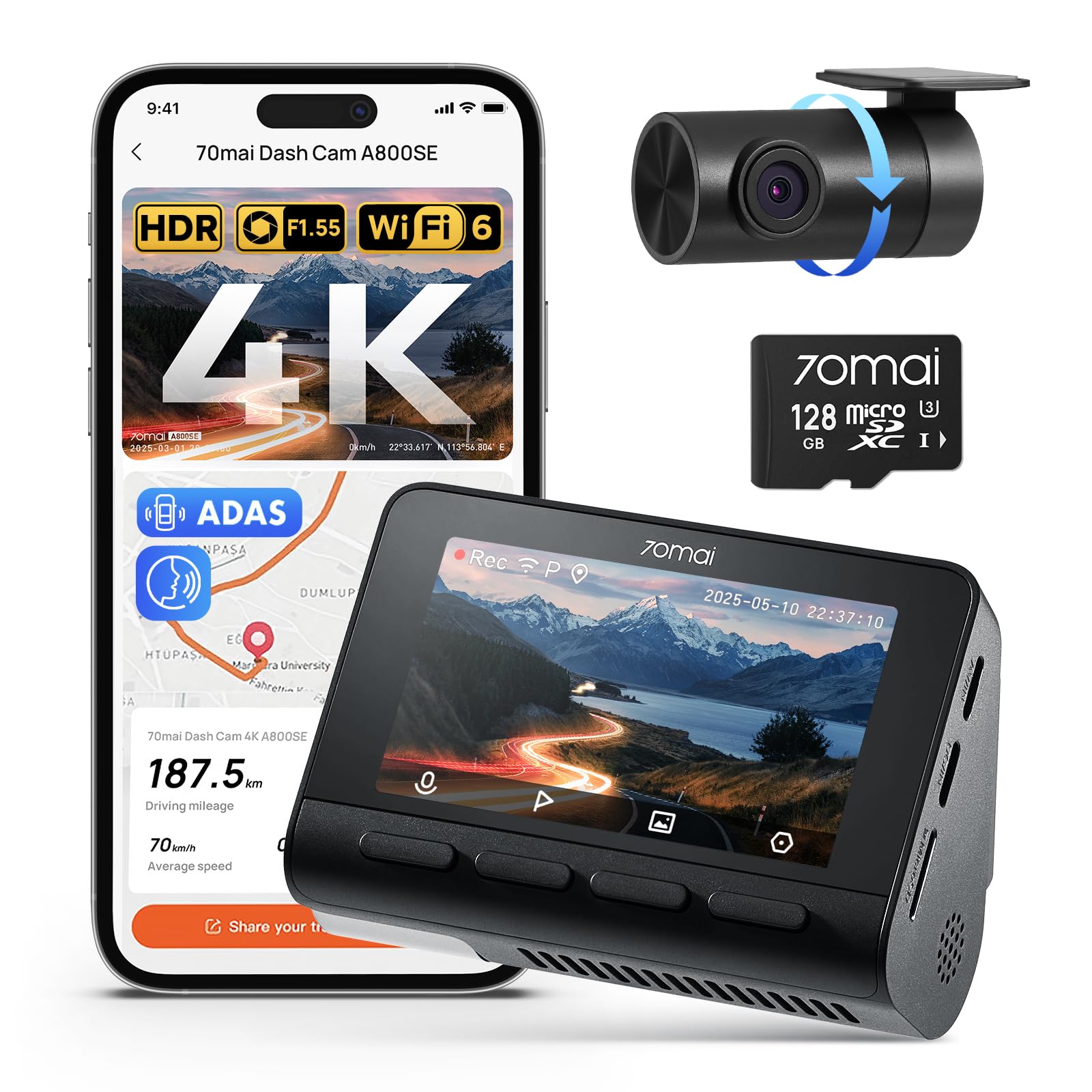
1. 70mai A800SE 4K Dash Cam Front and Rear
Our pick — 4.5★ from 700+ verified ratings; the strongest balance of quality and price.
The 70mai A800SE gives you true 4K front coverage with a bundled 128GB card at a price that undercuts most competitors
This dual-cam system records 4K at the front and 1080p out back, with an F1.55 aperture and dual HDR (High Dynamic Range, which balances bright sky and dark road in the same frame). The rear camera lens adjusts, so you can point it inside the cabin instead of out the back if you are ridesharing. People who run it praise the “quality” — it is the single most-sung spec, followed closely by video clarity that keeps plates readable in sunlight.
WiFi 6 (the latest wireless standard) makes pulling a clip onto your phone noticeably faster than older dash cams, and the companion app draws a lot of compliments for being intuitive. The caveat about reliability comes in as the most-discussed mixed point — it is not a widespread failure, but a minority of owners have had glitches with the camera not starting. The included 128GB card (expandable to 512GB) is a real saving, and at 24 FPS or 30 FPS you get smooth playback without heavy file sizes.
Why it wins the spot: It delivers the broad owner approval — across many hundreds of ratings — with a combination of features (WiFi 6, parking mode, ADAS lane-departure and forward-collision alerts) and included storage that leaves little to buy separately. The 140-degree field of view is narrower than some picks (the Pelsee P1 Pro captures a 170-degree span), so you trade a little peripheral capture for better edge-to-edge sharpness.
Reach for this if: You want a proven, fuss-free dual camera with strong daytime 4K and the fastest wireless downloads in the mid-range tier.
Think twice if: You need ultra-wide coverage or the absolute clearest night plate-reading — the 140° lens and the less advanced night sensor mean the Pelsee and ROVE are sharper after dark.
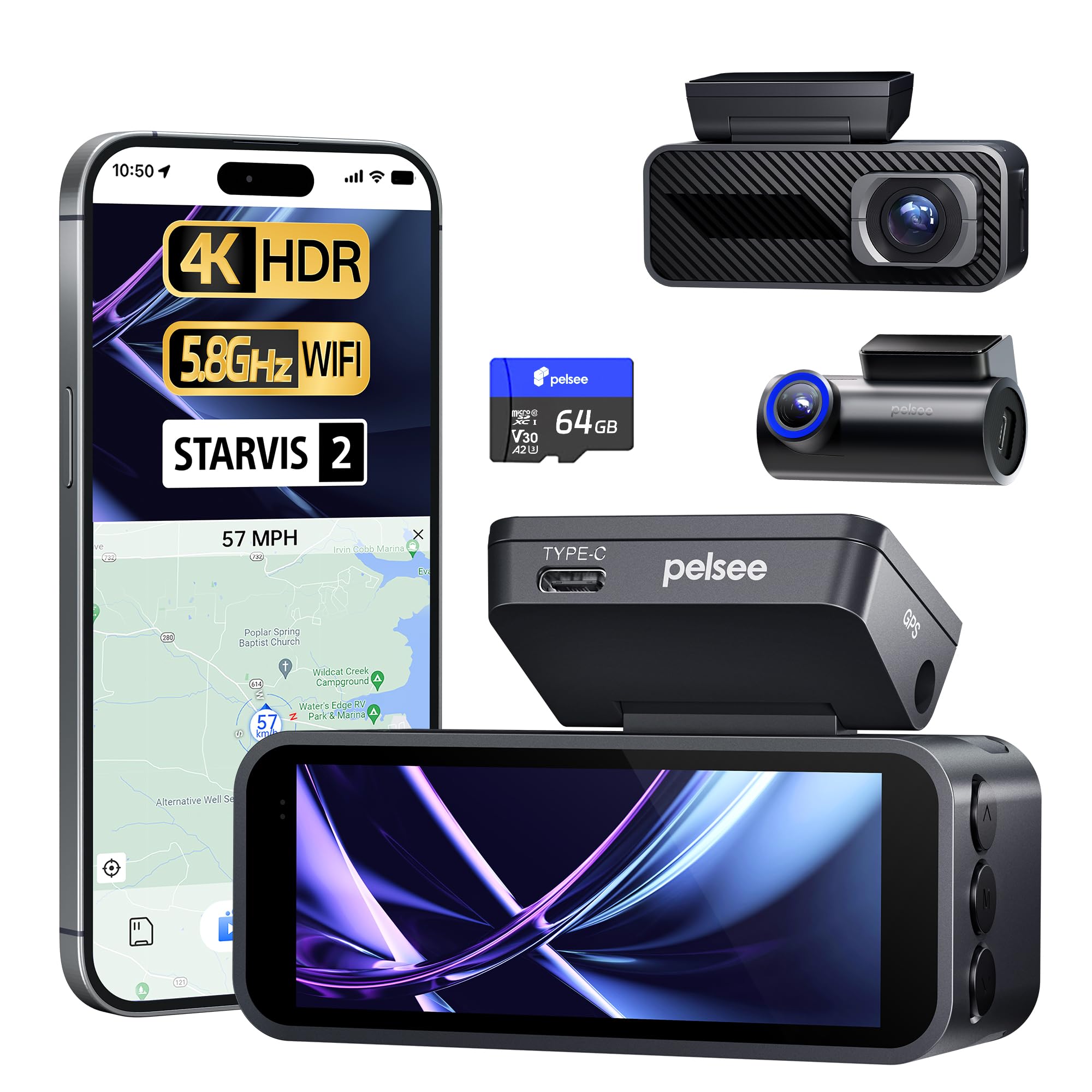
2. Pelsee P1 Pro 4K Dash Cam Front and Rear
A 170-degree field of view plus a Sony STARVIS 2 sensor make the Pelsee P1 Pro a night-vision specialist
The front camera captures 21% more of the road than a 140-degree camera — which means you see the car three lanes over trying to merge, not just what is directly ahead. The STARVIS 2 sensor (Sony’s latest generation) delivers what the brand calls “4x greater low-light sensitivity,” and owners confirm that license plates at normal distance stay readable after sunset. The rear camera runs at 1080p with WDR (Wide Dynamic Range, for balancing backlit tunnels).
Installation is genuinely tool-free: the camera clips onto a static sticker, and the cable-hiding tool is included. The 5.8GHz WiFi is faster than older 2.4GHz connections, though a few owners mention the lighter adapter that ships with it can be finicky. The Pelsee Cam app and the voice controls (“Lock the video!”) get consistent praise. A 64GB card is pre-installed, and the slot accepts up to 512GB.
Standout spec: The combination of a 170° lens and the STARVIS 2 sensor means you are covering both more road and more of the night than the 70mai A800SE. The trade-off is a slightly bulkier camera body and a power adapter that some swap for a better-fitting one.
Grab it for: Parking in tight urban spots or driving on multi-lane highways where side-swipe events are the real risk.
skip it if: You are working with a very tight budget — the 70mai is cheaper and still gives you great daytime 4K.
3. 70mai T800E 4K 3-Channel Dash Cam
A 4K front, a 1080p cabin with switchable IR, and a 1080p rear — purpose-built for rideshare drivers
This three-channel system records the road ahead, what is happening inside the cabin, and the traffic behind. The interior camera has switchable infrared LEDs, so if you are driving for Uber or Lyft at night, the cabin footage stays detailed even when the interior is pitch black. The front sensor uses an F1.55 aperture and HDR with 3D noise reduction, so license plates stay visible in tunnels and rainy conditions.
It uses a super capacitor instead of a lithium battery, which holds up from 14°F to 140°F — no battery bulge in summer heat. The built-in 5-mode GPS tracks route, speed, and location, and the Wi-Fi 6 transfers files at up to 10 MB/s. A 64GB SD card ships in the box. The reliability aspect draws mixed feedback, with a handful of owners reporting intermittent disconnections. The overall rating is solid, and owners call the video clarity for all three views “crisp.”
What works well
- True 3-channel coverage in one unit — no second device needed
- Switchable IR interior cam is rare at this price tier
- Super capacitor means no battery heat failure in hot cars
The honest trade-off
- App connectivity is reliable but not instant — occasional pairing hiccups
- The 64GB card will fill faster with three cameras running; plan to upgrade to 128GB or 256GB
Best for: Anyone who needs cabin recording for professional rideshare or for keeping an eye on a teenage driver.
Look elsewhere if: You only need front-and-rear coverage — the 70mai A800SE gives you the same front 4K for less money.
4. REDTIGER F7N Pro 4K Dash Cam Front and Rear
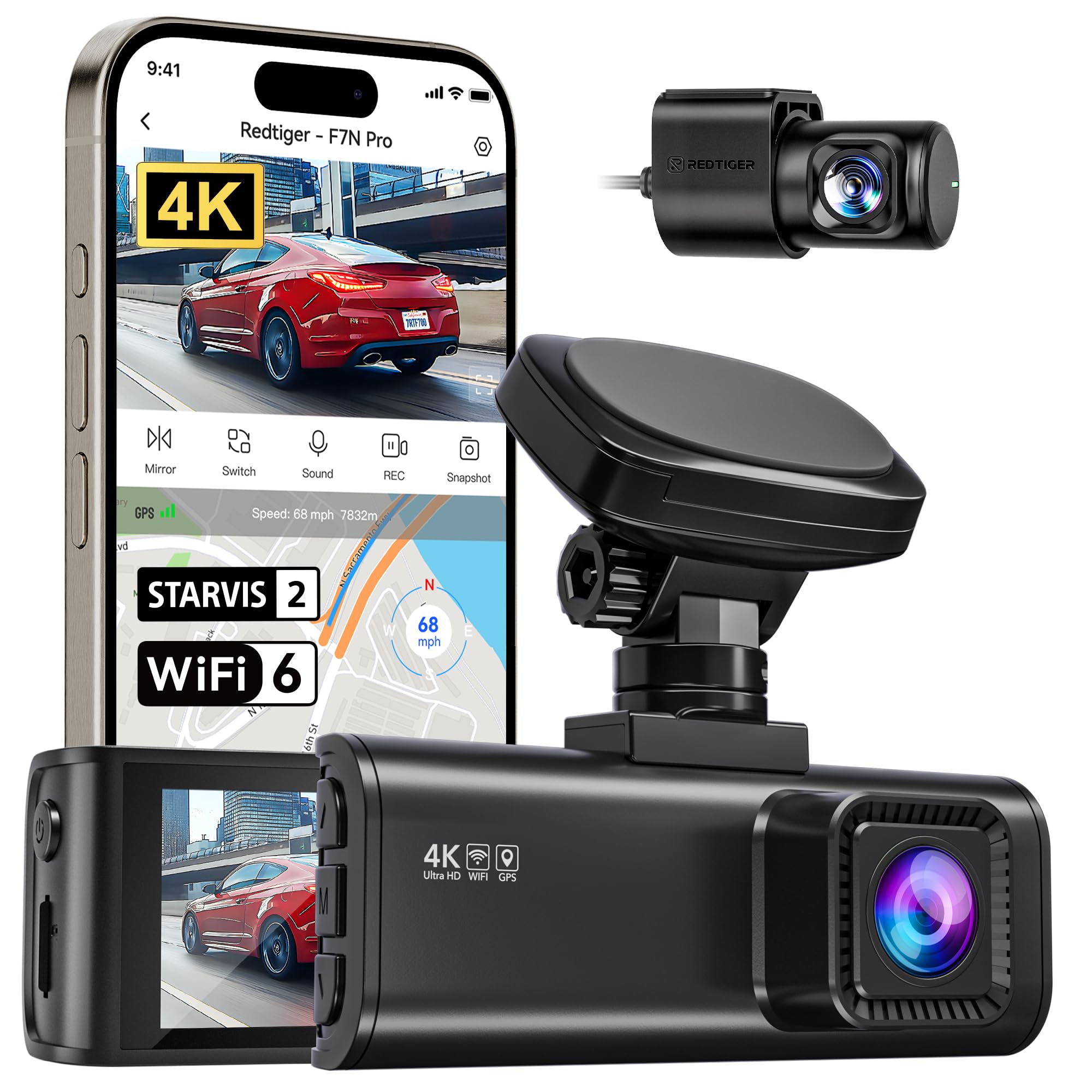
The REDTIGER F7N Pro brings dual STARVIS 2 sensors and a 170-degree front lens at a price that punches above its tier
The front camera records at 4K (3840×2160) at 24 FPS with a 170-degree angle, while the rear captures 1080p across 140 degrees. Together with the STARVIS 2 sensor and an F1.5+F1.8 aperture pair, the camera handles low-light conditions notably better than earlier REDTIGER models — owners consistently call the video quality “excellent” for both day and night. The 3.18-inch display is smaller than some competitors but gives you a clear live view during setup.
WiFi connectivity gets the most mixed reactions: it works, but the connection is sometimes spotty and the app is not as polished as the 70mai or VIOFO apps. No SD card is included (the brand recommends its own high-endurance card), so factor that -20 into the total cost. Installation is straightforward in about 30 minutes, and the cable length (11.5 feet for power, 21.3 feet for the rear cam) is generous for SUVs and trucks.
The defining strength: Image quality per dollar is tough to top here — the same STARVIS 2 sensor that powers cameras lives inside a device. The catch is the app experience and the missing bundled card.
Reach for this if: You want the best possible video quality on a mid-range budget and do not mind buying a separate memory card.
Think twice: If smooth app connectivity matters to you — the more expensive VIOFO and ROVE models have faster, more reliable wireless.
5. Cobra SC 250R Smart Dual View Dash Cam

Cobra’s SC 250R wraps true 4K recording in a full ecosystem of live traffic alerts and Mayday emergency response
This is not just a dash cam — it connects to the Drive Smarter network to warn you of red-light cameras, speed traps, and crowdsourced radar-detector alerts ahead. It supports CarPlay and Android Auto, so directions appear on the dash cam screen. True 4K resolution (not upscaled) captures the road in detail, and a 140-degree field of view covers the front without excessive fisheye. An optional third camera adds cabin coverage.
It powers via an OBD-II adapter (the port your mechanic uses), so installation is as simple as plugging it in — no fuse-box hardwiring. The Parking Live View feature lets you check a live feed remotely through the Drive Smarter app. The catch here is the subscription layer: the real-time alert features require a Drive Smarter subscription, and the initial 32GB SD card is small for 4K. Owners praise the ease of installation and the brand’s reliability but note the app connection can be slow.
Why it stands out
- Live police and speed-camera alerts via crowdsourced network
- OBD-II power means plug-and-play install for any car made after 1996
- Incident Reports share video directly with your insurance
The honest trade-off
- The most important safety alerts (red-light cameras, speed traps) require a paid subscription
- 32GB card fills fast — expect to replace with a 128GB card
Ideal for: Commuters who want live traffic-law alerts integrated into the dash cam, and anyone who values super-simple installation.
Skip if: You want a no-subscription device with the largest possible built-in storage — the 70mai or ROVE models include bigger cards upfront.
6. ROVE R2-4K Dual PRO Dash Cam
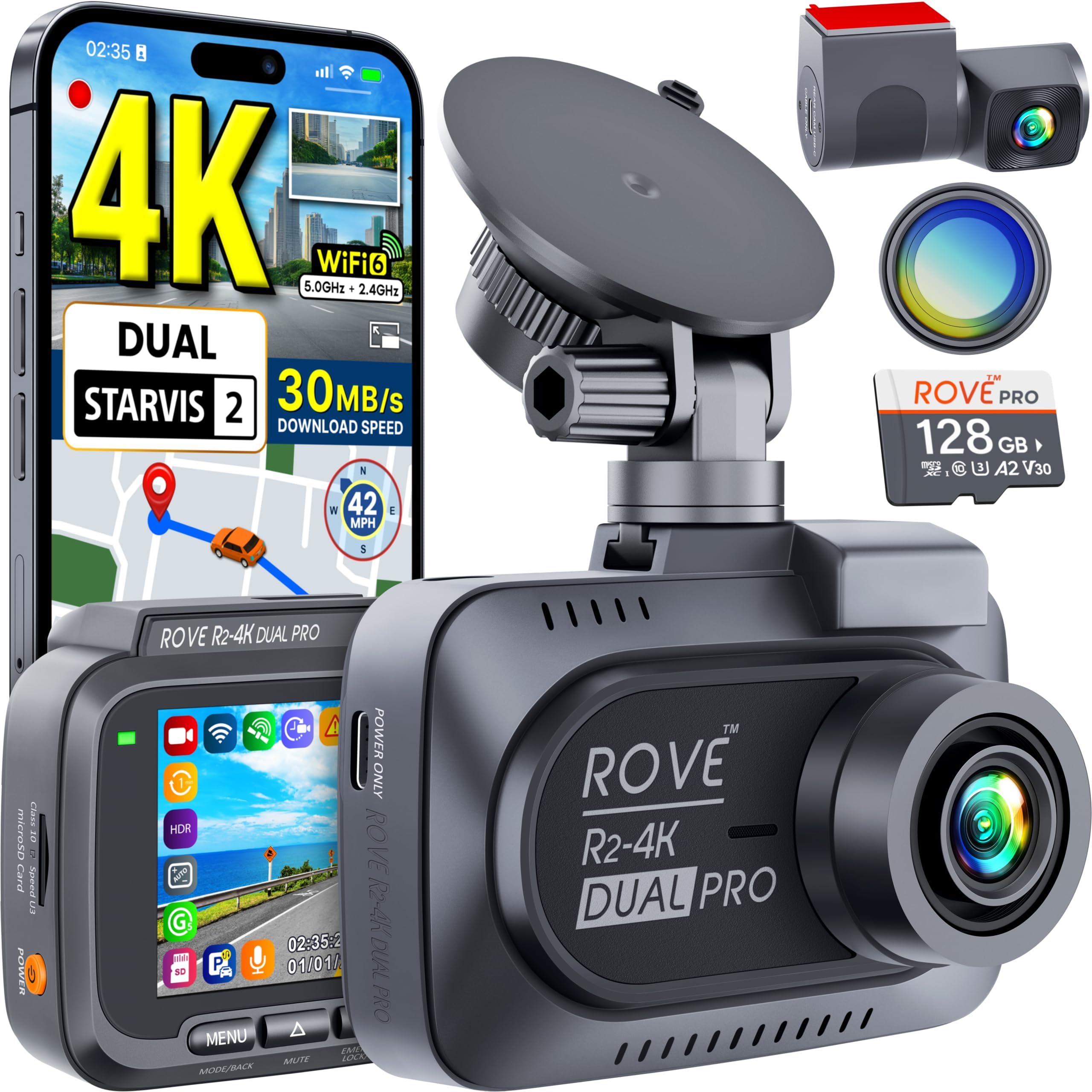
The ROVE R2-4K Dual PRO uses Sony’s top STARVIS 2 sensors on both the front and rear cameras for class-leading low-light capture
This is the only dash cam in the list that pairs the STARVIS 2 IMX678 (8MP) on the front with the IMX675 (5MP) on the rear — both run at a native 4K and 2K resolution respectively. The result is footage that stays smooth and detailed in tunnels, under streetlights, and on unlit highways, with reduced motion blur from the higher light sensitivity. The front lens is a 150-degree wide angle with an F1.7 aperture; the rear covers 140 degrees at F1.55.
WiFi 6 dual-band (2.4GHz and 5GHz) moves a 1-minute 4K clip to your phone in seconds. The bundle includes a 128GB ROVE PRO microSD card and a CPL (Circular Polarizing Lens) filter that cuts windshield glare — both are often optional add-ons with other brands. Parking mode offers three options: time-lapse, motion detection, and collision detection, each recording a full 1-minute locked event. Reliability is the top mixed point, with a small number of owners reporting glitches that ROVE’s US-based customer support typically resolves.
top-tier detail: the dual STARVIS 2 setup beats every other dual-cam here for night-time plate reading, and the included 128GB card plus CPL filter saves you about in accessories that the REDTIGER and 70mai models would need you to buy separately.
Choose this for: The sharpest possible 4K video at night — if you frequently drive after dark, this is the one.
Consider another if: You want a 3-channel setup (cabin view) — this is front and rear only; the REDTIGER F17 Elite or VIOFO A229 Pro add the interior camera.
7. REDTIGER F17 Elite 4K 3-Channel Dash Cam
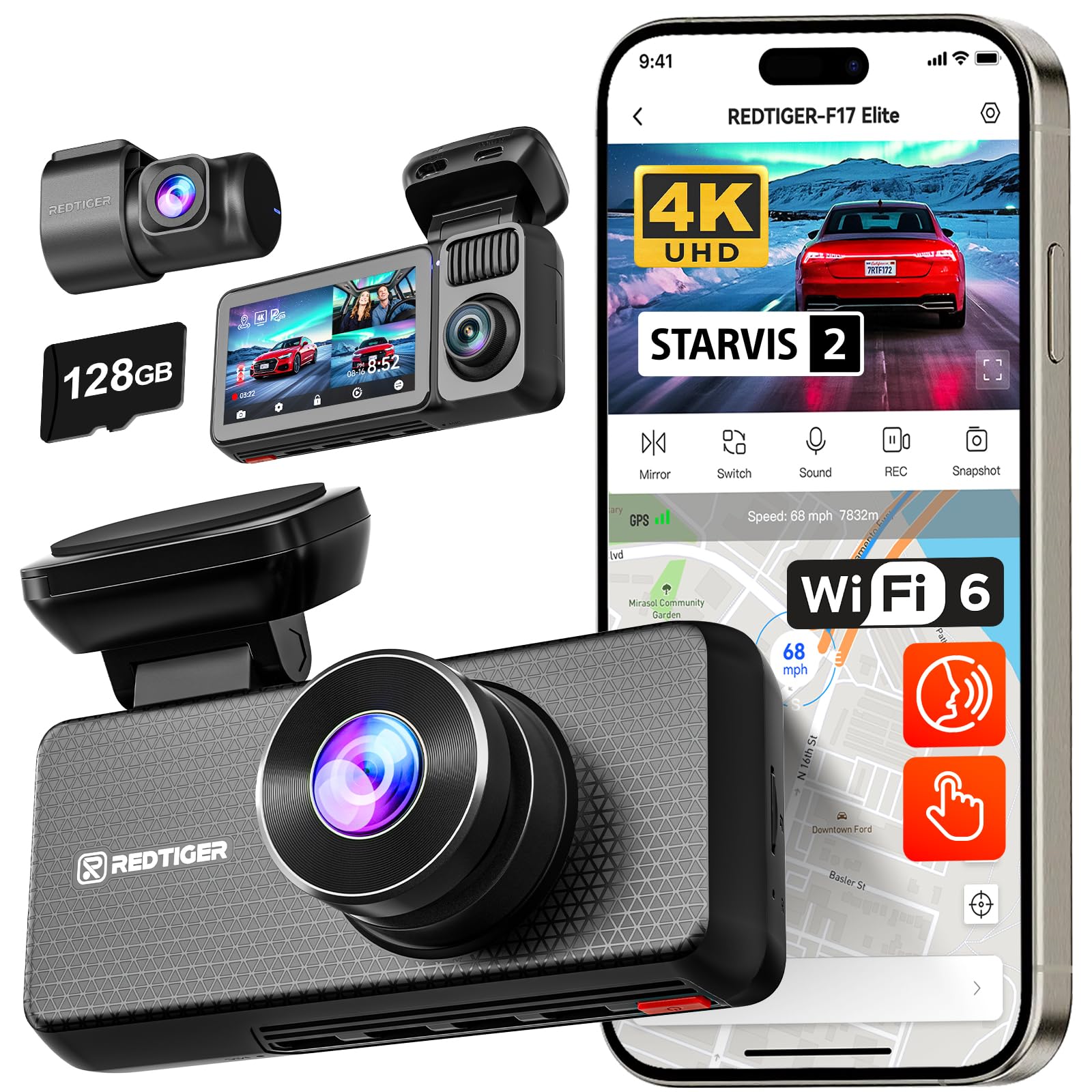
Full-colour night vision on both the front and cabin cameras sets the REDTIGER F17 Elite apart from the usual black-and-white IR designs
The front camera packs an 8MP IMX678 STARVIS 2 sensor (true 4K), the rear runs at 2.5K with an IMX675, and the cabin camera records 1080p — all three channels with HDR. What makes this unusual is the full-colour night vision on the front and interior cameras: instead of switching to grainy black-and-white infrared, the STARVIS 2 sensor and enhanced processing keep the image in colour, even in near-darkness. That is useful for identifying faces or car colours in a parking lot.
The 5.8GHz WiFi 6 connection transfers files at up to 30MB/s, and the pre-installed 128GB card gives you good capacity from the start. The touchscreen and voice controls make operation easy without fumbling. The most common reliability questions come from a small number of owners who had units fail in extreme heat — the super capacitor is rated for a wide temperature range, but a handful of units did not survive very hot summers. REDTIGER’s 18-month warranty covers that.
What wins people over
- True full-colour night vision on front and interior, not black-and-white IR
- Front 4K + rear 2.5K resolution is the highest total-res 3-channel setup here
- 128GB card and 5.8GHz WiFi 6 included
The honest trade-off
- A small percentage of buyers report heat-related failures in very hot climates
- At 6.88 ounces, it is heavier than the 70mai T800E — the adhesive mount needs firm pressure on the windshield
Reach for this if: You want a three-channel system with colour night vision for identifying people or vehicle colours around your parked car.
Think twice if: You live in a desert climate where interior temps regularly exceed 140°F — the ROVE or VIOFO picks may be more heat-tolerant.
8. WOLFBOX G900 PRO-N Mirror Dash Cam
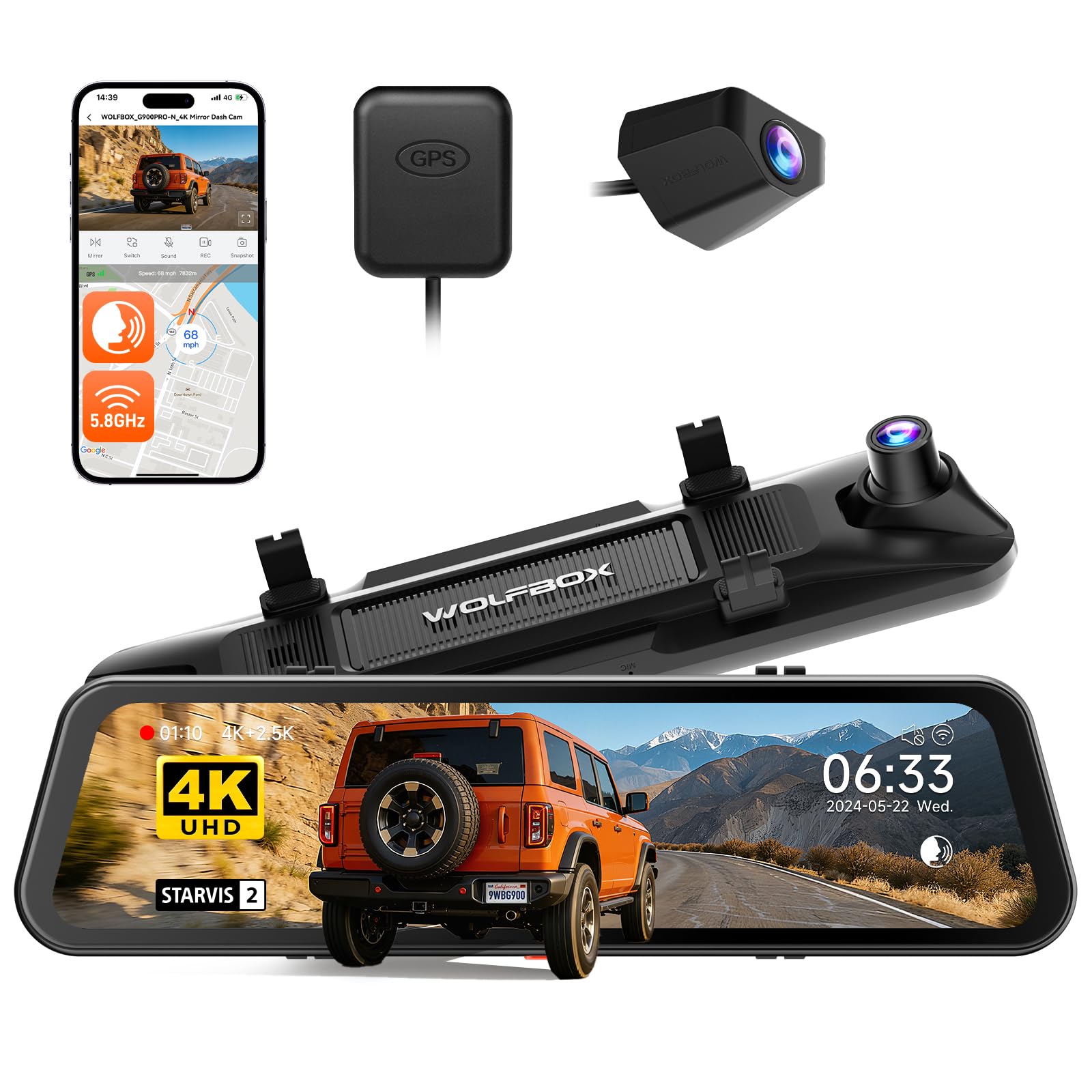
A 12-inch mirror-mounted camera that replaces your entire rearview with a 4K front and 2.5K rear digital feed
The WOLFBOX clips over your existing rearview mirror and turns the whole thing into a 12-inch display. The front camera records at 4K (3840×2160) with a STARVIS 2 IMX678 sensor, and the rear camera shoots 2.5K (2560×1440). the strength here is the rearview feed: instead of a small mirror, you get the full-width 12-inch screen showing what is behind you without blind spots from headrests or pillars. It also supports split-screen, showing both front and rear at the same time.
The 5.8GHz WiFi is fast, and voice control lets you lock clips or switch cameras without touching the screen. Installation is more involved than a standard dash cam — you run a 21.3-foot cable to the rear camera — but owners with SUVs and trucks love the elimination of blind spots. The biggest recurring ask from owners is for a brighter display in daylight. The strap mount works for most vehicles, but some Ford models need a separate bracket.
Ideal use-case: Trucks, vans, or SUVs where the factory rearview mirror has poor visibility. The 12-inch display eliminates the “headrest blocking the back window” problem completely.
Grab this if: Your current rearview is mostly useless because of cargo, tall passengers, or a spare tire cover.
Look elsewhere if: You want a discreet, low-profile dash cam — this mirror camera is substantial and replaces your entire mirror.
9. VIOFO A229 Pro 4K 3CH Dash Cam

VIOFO’s A229 Pro is the enthusiast’s three-channel dash cam — HDR on every lens, STARVIS 2 sensors, and buffered parking mode
This is a favourite among the dash-cam community because it records HDR on all three channels simultaneously (front 4K, rear 2K, cabin 1080p), not just selecting one at a time. The buffered parking mode is the gold standard: when a moving object or impact is detected, the camera saves 15 seconds before the event and 30 seconds after, so you see what led up to the hit, not just the impact itself. The front lens has a 160-degree field of view.
It includes a CPL (Circular Polarizing Lens) filter pre-installed on the front lens to reduce dashboard reflections. The app uses 5GHz WiFi, which is fast enough to preview clips without removing the card. No SD card is included, and VIOFO recommends its own high-endurance cards for reliability (the card is the most common source of issues in any dash cam, and VIOFO is particular about compatibility). Reliability is the most-discussed mixed aspect — the camera itself is well-built, but card-related errors can occur if you use a cheap SD card. The Quad-Mode GPS logs location and speed across four satellite systems.
What makes it a reference pick
- True multi-channel HDR — not many cameras do this on rear and interior simultaneously
- Buffered parking recording (15s before / 30s after) is the most useful parking mode
- VIOFO has the strongest community support and firmware update history
The honest catch
- No SD card included — you need to budget -50 for a compatible high-endurance card
- The interior cable is long and the ferrite core on the power cable can bulge the headliner if not routed carefully
Best for: Enthusiasts who want the most advanced parking protection and full multi-channel HDR, and who understand that a quality SD card is part of the system.
Skip if: You want a simple out-of-the-box kit with no extra purchases — the 70mai T800E or REDTIGER F17 Elite are more complete packages.
10. VIOFO A329S 4K+2K+2K Dash Cam

A 210-degree cabin fisheye and support for an external SSD up to 4TB make the A329S the ultimate rideshare or fleet dash cam
This is the newest generation of VIOFO’s flagship. The front camera records 4K at 30fps with the STARVIS 2 IMX678, the cabin camera uses a 210-degree ultra-wide fisheye (so it captures both front seats and the rear seats without mounting in the middle of the windshield), and the rear runs at 2K on the IMX675. All three channels use HDR. The fisheye eliminates the blind spots that a standard cabin camera leaves in a minivan or SUV.
The headline feature is storage: it supports microSD cards up to 512GB, but also external SSDs up to 4TB via the USB-C port, which gives you over three weeks of continuous recording without overwriting anything. The WiFi 6 moves a 1-minute 4K clip in under 10 seconds — the fastest wireless of any camera on this list. The power-saving parking mode draws very little current and wakes only on collision detection. The main caveat is the price, and the fact that the adhesive for the interior camera can loosen in very hot glass.
The standout feature: 4TB SSD support means you never delete footage on a road trip — just keep everything. No other consumer dash cam offers this.
Reach for this if: You run a rideshare or a small fleet and need to store weeks of footage without touching the memory card.
Pass if: You are on a tighter budget and just need front-and-rear coverage — the 70mai A800SE covers that for a fraction of the price.
11. THINKWARE U3000 PRO 2CH Dash Cam
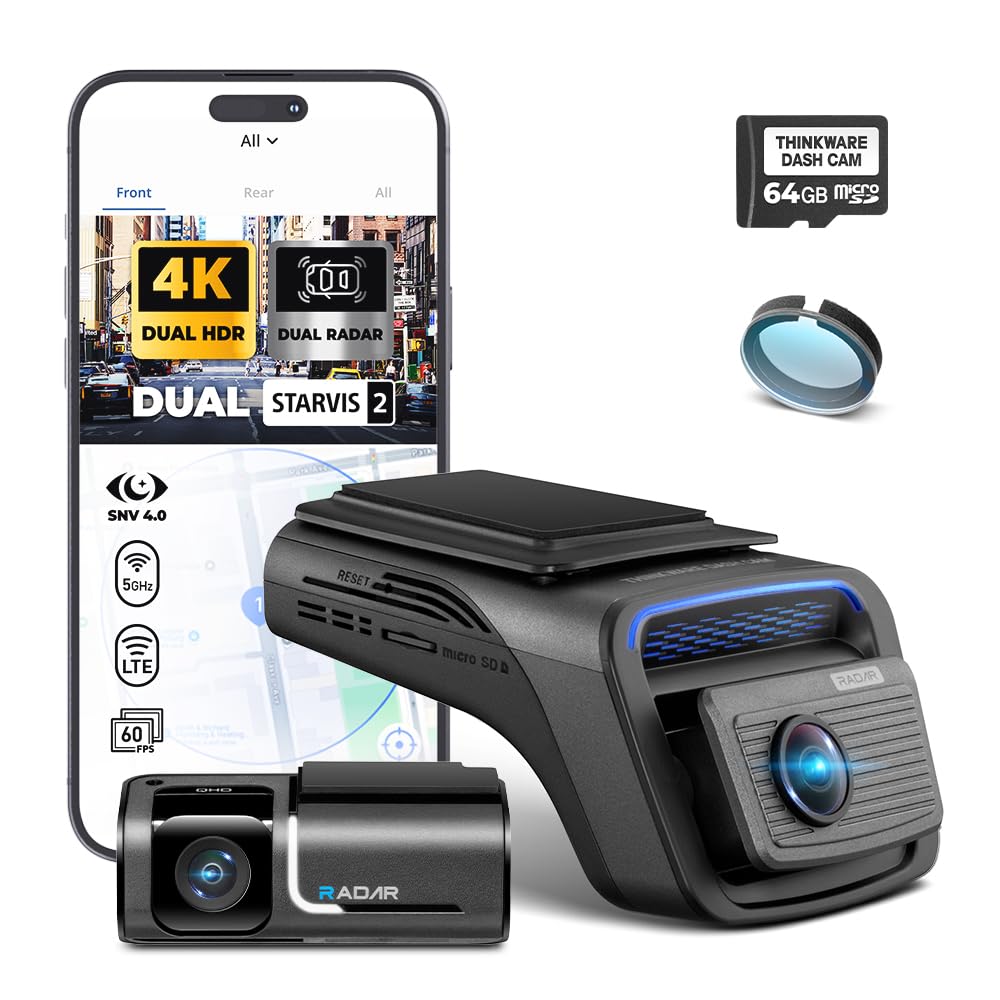
Thinkware’s U3000 PRO uses built-in radar instead of a G-sensor for parking, saving battery while still catching every door-ding
The front camera captures 4K HDR with a Sony STARVIS 2 sensor and an Ambarella CPU (the processor that handles the image pipeline), while the rear records 2K. What makes this a premium pick is the radar-based parking mode: instead of running the camera continuously, a radar sensor detects motion around the vehicle and wakes the camera only when someone approaches. It records a 20-second clip (10 seconds before and 10 seconds after the trigger). This uses far less battery than time-lapse or impact-only modes, and owners consistently call the parking mode “outstanding.”
It comes with a 64GB microSD card (the smallest in-box card of any premium model here) and an OBD-II cable for simple power connection. A hardwire kit is also included. The thermal protection circuit prevents overheating, which helps longevity in sunny climates. The brand reliability is well-regarded — Thinkware is one of the oldest names in dash cams — though the app receives consistent feedback that it is not as polished as VIOFO’s or 70mai’s, and some owners find the dual-app setup confusing. A few owners also report the rear radar does not always trigger as expected.
Why it earns its premium price
- Radar parking mode extends battery coverage dramatically — weeks of parking on a single charge is possible
- Thermal protection and 64GB card plus both OBD and hardwire cables included
- Thinkware has the longest reputation for reliability in the dash-cam industry
The trade-off
- The app experience is behind the competition — slower connection and less intuitive menus
- At this price, a 64GB card feels undersized; budget for a 256GB or larger upgrade
Ideal for: Parking in high-traffic street spaces where a dent is likely and battery drain matters. The radar mode is a genuine advantage over G-sensor-only cameras.
Consider the VIOFO A229 Pro instead if: App usability and easy video sharing are your priority — the VIOFO app is faster and simpler.
Understanding the Specs
STARVIS 2 Sensor
A Sony image sensor that captures significantly more light per pixel than standard CMOS sensors. In practice, that means your dash cam keeps recording usable colour footage in dim parking garages, under tree cover at dusk, and on unlit back roads — conditions where older sensors produce noisy black-and-white or useless black frames. Every camera on this list priced above uses either a STARVIS 2 or a similarly capable sensor; budget models that omit it will look noticeably grainier after dark.
Field of View (FOV)
Measured in degrees, this is how much of the road the lens can see side to side. A 140-degree FOV covers roughly three lanes of traffic with minimal fisheye distortion. A 170-degree FOV covers four lanes or more but curves the edges slightly. More coverage is not always better — the extreme edges of a 170-degree lens can make a car merging from the side look farther away than it is. For most drivers, 140-150 degrees is the balance between coverage and natural-looking footage.
FAQ
Do I really need 4K or is 1080p enough for a dash cam?
What is a hardwire kit and do I need one for parking mode?
Will a 4K dash cam drain my car battery in parking mode?
Which memory card should I use for a 4K dash cam?
What does a wider field of view actually mean for my footage?
Can I add a third camera to a 2-channel dash cam later?
How important is voice control for a dash cam?
What does the G-sensor in a dash cam do?
Is a dash cam with a super capacitor better than one with a battery?
What does Wi-Fi 6 in a dash cam do for me?
Final Thoughts: The Verdict
The choice really depends on where and how you drive. For the vast majority of drivers, the 4k uhd dash cam that balances everything — quality, included storage, fast Wi-Fi, and a proven track record across many hundreds of owners — is the 70mai A800SE, because it delivers true 4K daytime clarity and night vision that is good enough for most commutes, all with a bundled 128GB card and the most intuitive app in the category. If your priority is sharpest night-time footage, the ROVE R2-4K Dual PRO leads with dual STARVIS 2 sensors. And for the ultimate in parking protection with minimal battery drain, the THINKWARE U3000 PRO with its radar-based wake-up is the one to reach for.
How We Picked
We do not accept paid placement. Every pick is matched to a real buyer and a real use-case; we do not hands-on test units.
Sources & Methodology
Specifications: manufacturer listings and product documentation. Review insights: verified customer reviews, as of July 2026. Pricing: not shown on this page (it changes often); check the current price via the retailer link.
As an Amazon Associate, Gadgets Feed earns from qualifying purchases. This does not affect which products we feature.