
Our readers keep the lights on and my morning glass full of iced black tea. As an Amazon Associate, I earn from qualifying purchases.
Specs are compiled from manufacturer listings and verified buyer reviews and can change over time — please confirm the key details on the product page before buying.
A power outage hits, and you are scrambling in the dark with a flashlight, trying to remember which switch to throw. That is the reality a 200 amp transfer switch is supposed to fix — a single, safe device that handles the handoff between the grid and your generator. But the real question is if you want that handoff to happen automatically or if you are fine walking outside to flip a lever yourself.
I’m Min — the founder and writer behind Gadgets Feed. This guide is built by comparing the manufacturers’ published specifications and the patterns across verified customer reviews, so you get each pick’s real strengths and trade-offs instead of marketing spin.
Wiring a whole-house generator for the first time or replacing a tired manual switch? The right 200 amp transfer switch depends on three things: your generator’s controller type, your budget, and how much hands-off automation you truly need.
Our Picks at a Glance
How To Choose The Best 200 Amp Transfer Switch
You are not just buying a box with a lever or a relay. The choice between automatic and manual governs everything from your generator’s wiring to your daily convenience when the lights go out. Here is what to lock in before you click “buy”.
Match the Switch to Your Generator’s Controller
An automatic transfer switch (ATS) needs to talk to your generator’s brain. Some units require the generator to have an Evolution or Nexus controller; if yours does not, the switch will sit there doing nothing when the power drops. A manual transfer switch needs no smarts — just you and a strong arm.
Manual vs. Automatic: Which Real-World Trade-Off Matters to You
Manual switches are simpler, cheaper, and have no electronics to fail. But you have to be home and awake to throw the lever. Automatic switches handle the whole sequence — sensing a loss of utility power, telling the generator to start, and transferring the load — without you lifting a finger. The trade-off is complexity and cost.
Enclosure and Weather Rating
If the switch lives outdoors, you need a NEMA 3R enclosure at minimum. That rating (a standard for weather resistance) protects against rain, sleet, and wind. Galvanized steel and aluminum are the two common shell materials — steel is heavier and more sturdy, aluminum resists corrosion and is lighter for wall mounting.
Quick Comparison
| Model | Best For | Type | Enclosure | Weight | Amazon |
|---|---|---|---|---|---|
| Generac Transfer Switch★ Best Overall | Automatic whole-home integration | Automatic | — | — | Amazon |
| KUTTOLE 200A Manual | Budget-conscious manual backup | Manual Double-Throw | Galvanized Steel, NEMA 3R | — | Amazon |
| Digowers 200-Amp Manual | Heavy-duty manual with sturdy build | Manual Double-Throw | Galvanized Steel, NEMA 3R | 15 pounds | Amazon |
| MXLTYMX 200 Amp Automatic | Generac-compatible ATS on a budget | Automatic | Aluminum, NEMA 3R | 29 pounds | Amazon |
In‑Depth Reviews
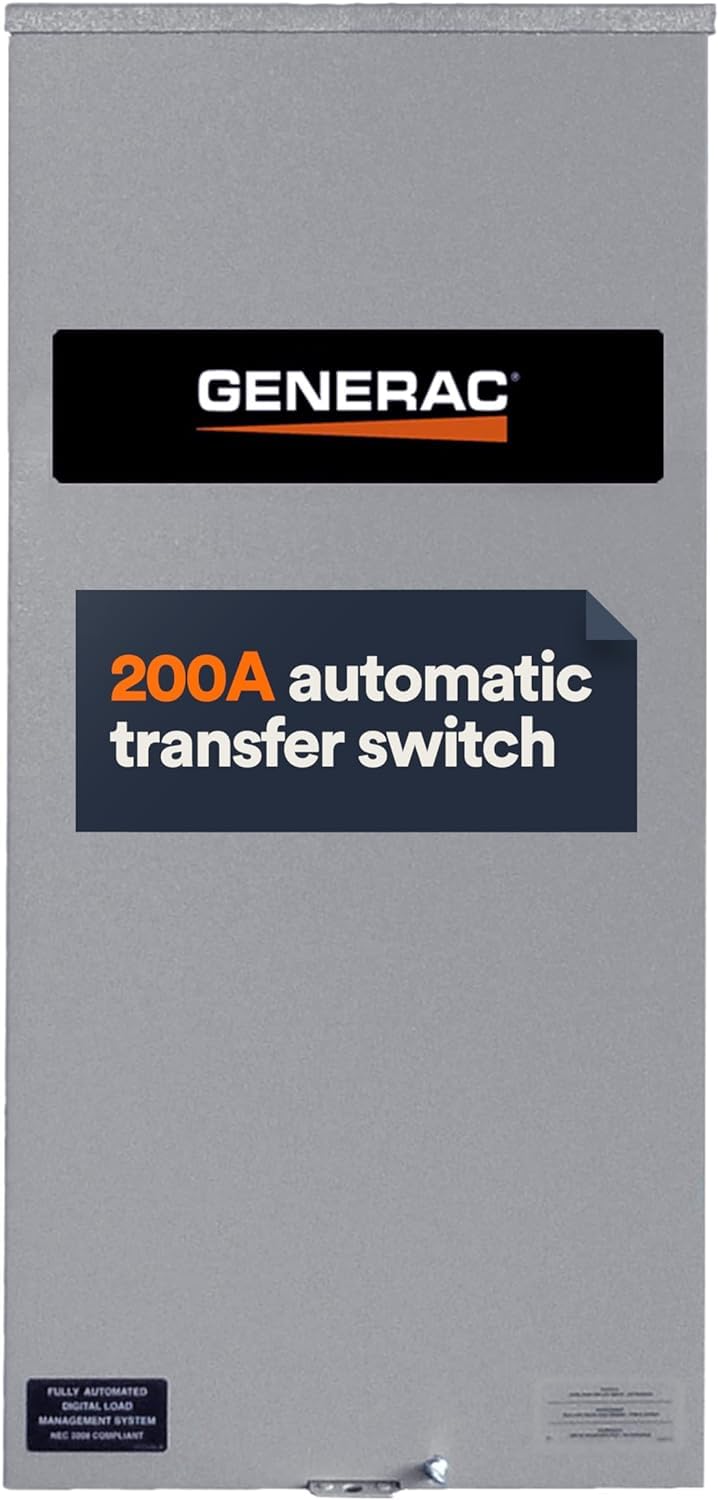
1. Generac Transfer Switch
Our pick — over 4.5★ from 300+ verified ratings; the strongest balance of quality and price.
A hands-off automatic switch that talks to your generator’s brain so you never touch a lever.
This is the set-and-forget option. The Generac unit handles the entire transfer sequence on its own — when the utility power fails, the switch senses it and automatically tells your generator to start, then switches the load over without you in the room. It works specifically with single-phase generators that have an Evolution or Nexus controller, which is the ecosystem you need if you want full automation.
What owners consistently praise is how clean the install looks. One reviewer noted it “took the place of a manual switch” and required no sub-panel because the switch does the distribution itself. The unit has a rotary actuator and uses an X-10 connectivity protocol for control. For homes that see frequent power drops, the consensus is that the switch performs “flawlessly” even when cycling multiple times a week.
The crowd favorite by a wide margin — with a 4.6-star average across hundreds of owners — the main thing people report is that it simply works as advertised. The recurring theme is that it is easy to install and functions exactly as described.
Why You low-maintenance
- Automatic transfer — no manual intervention when the power goes out
- Rated for 200A with a 3-way circuit for smooth load switching
- Buyers report it works reliably even with frequent outage cycling
The One Catch
- Requires a generator with an Evolution or Nexus controller — not universal
- Discontinued product, so availability may be limited
Grab this if: you have a compatible generator already and want a hands-free automatic setup that the whole family can rely on.
Look elsewhere if: your generator lacks an Evolution or Nexus controller, or you prefer a simpler, non-automatic switch.
2. KUTTOLE 200A Generator Transfer Switch

A no-frills manual double-throw that gets your whole house back on while staying affordable.
This is a pure mechanical switch — no electronics, no controllers, no automation. You walk to the box, shift the lever from “line” to “gen”, and your home’s 200A service is running on generator power. It handles up to 48,000 watts, which is enough for heavy appliances like dryers and stoves. The enclosure is NEMA 3R rated, meaning it can sit outdoors in rain or hail and still function.
The build surprised owners. Owners mention it is “heaver built than expected” and that the heavy-duty cabinet feels solid. A few also noted it was an affordable solution after major storms like Hurricane Helene. One owner mentioned it was the “perfect solution” for powering essentials — fridge, freezer, lights — through a single cord and 50A inlet box. The key practical detail is the lockout hasp at the bottom that prevents accidental shutoff during normal power supply.
The main frustration is the cramped wiring space. One buyer found it “really hard to wire” with “not enough room” for 200A conductors. This is a realistic heads-up — budget for extra install time or an electrician who is patient with tight bending space.
What Wins People Over
- Big savings over automatic switches — manual simplicity keeps the price low
- 48,000W capacity handles the whole house, including high-demand appliances
- Weatherproof galvanized steel with NEMA 3R rating stands up to the elements
What to Know Before You Buy
- Limited interior space makes wiring 200A cable a tight fit, per installers
- Manual throw means you have to be home and awake to switch it
Reach for this if: you are on a tight budget, have a pro electrician handling the install, and are okay walking to the box during an outage.
Think twice if: you want an automatic failover or need generous wiring space for large-gauge cable.
3. Digowers 200-Amp Manual Transfer Switch
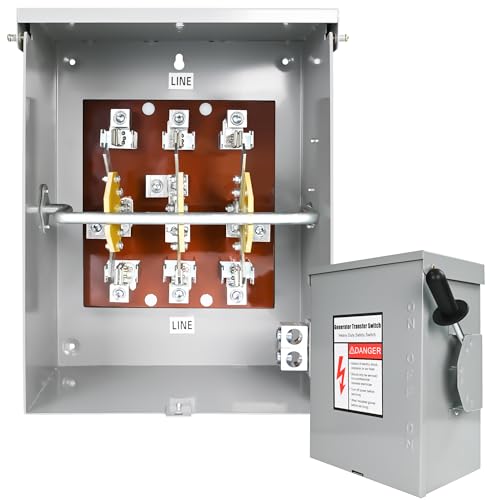
A seriously heavy manual switch with 1.5mm steel that feels more like a vault door than a transfer box.
The first thing you notice lifting this unit is the weight — 15 pounds of galvanized steel with an upgraded 1.5mm thickness and a protective coating. Owners describe it as a “beast” and “super heavy and well made.” One buyer specifically bought it to “transfer power from Main to solar for a critical loads panel” and was impressed by how solid the lugs and switch mechanism felt. The arc extinguishing cover is another standout — it limits arc time and distance during switching, a meaningful safety detail for manual operation.
Like the KUTTOLE, this is a manual double-throw rated for 200A and 48,000W. The enclosure meets both NEMA 3R and IP55 standards, so it can handle rain, snow, hail, and sun exposure outdoors. The unit has AL-CU connections, making it suitable for both aluminum and copper wiring. The clamshell design and pre-drilled holes of various sizes aim to simplify the install.
The honest trade-off is that the internal build quality has mixed feedback. Some buyers found the screws holding load wire connectors too small — when torqued, the terminals twist on the insulation back plate. One buyer mentioned the internal connections “did not line up” when switching between line and generator. It is not a reliability failure, but it means the install requires a careful wrench technique to keep terminals from spinning.
Heavy-duty feel, lighter touch needed: The steel shell and arc cover inspire confidence, but the terminal hardware demands a patient installer.
Pick this for: a setup where the switch lives outdoors in harsh weather and you value a thick steel enclosure.
Skip it for: an install that needs ample internal wiring space for 200A conductors or a switch where every terminal holds still under torque.
4. MXLTYMX 200 Amp Automatic Transfer Switch
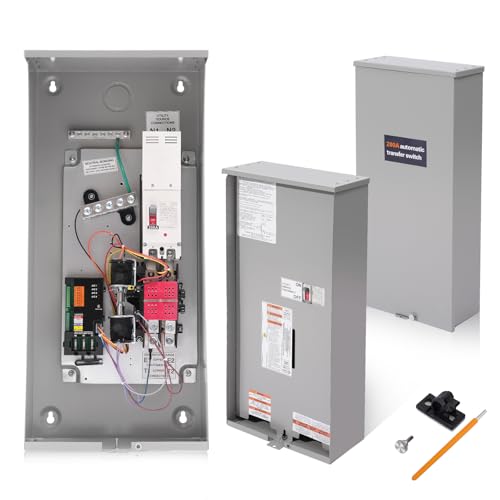
A Generac-compatible ATS that does the same job as the big-name box.
This is the automatic alternative for anyone who wants hands-off failover but does not want to pay Generac’s price premium. It is designed as a replacement for the Generac RXSW200A3, and owners confirm it works as an exact functional swap — one buyer used it “in place of a big name unit that was twice the price” and could not see a real difference. The key spec is compatibility: it works with single-phase generators that have an Evolution or Nexus controller (the brain of the generator that manages startup and shutdown), just like the Generac unit.
The box uses an aluminum NEMA 3R enclosure, so it is lighter than steel at 29 pounds but still weather-ready for outdoor mounting. A standout feature is the integrated load management technology — the switch can manage four individual HVAC loads without needing extra accessories. That means your air conditioner circuits get prioritized without a separate load-shedding module.
Build quality is described as “okay, not much to brag about” by some owners, but the unit gets the job done reliably. One electrician-level reviewer flagged that it does not meet UL or CSA standards, calling it a Chinese knockoff. That is a serious note for anyone who needs a certified component in a permitted install. Others found it worked fine for their use and called it an “exceptional value.”
What Makes It a Smart Value
- Fully automatic transfer for single-phase Generac-compatible generators
- Integrated management of four HVAC loads with no extra hardware
- Aluminum NEMA 3R enclosure resists corrosion and stays relatively light
The Real Concern
- Lack of UL/CSA listing raises questions for code-inspected installations
- Build quality is functional but not premium — some owners describe the contactor as potentially counterfeit
Best for: the budget-conscious homeowner who already has a compatible generator and wants automatic failover without spending twice as much.
Not for: any install that requires a UL-listed or CSA-certified device, or anyone who wants a premium-feeling build quality.
Understanding the Specs
Automatic vs. Manual Transfer Switches
An automatic transfer switch (ATS) uses a controller to sense when utility power drops below a safe level. It then signals your generator to start and switches the load over — all without you touching anything. A manual transfer switch is a simple double-throw lever you operate by hand. The ATS is more convenient but requires your generator’s controller to be compatible (like Evolution or Nexus). The manual switch works with any generator and has zero electronics to fail, but you have to be present to throw the lever.
NEMA 3R and IP55 Enclosures
NEMA 3R is a weather-protection rating established by the National Electrical Manufacturers Association. It means the enclosure protects against rain, sleet, and wind — sufficient for outdoor wall mounting. Galvanized steel and aluminum are the two common materials; steel is heavier and more impact-resistant, while aluminum is lighter and resists corrosion. IP55 is an international rating that adds dust protection to the weather sealing. Both ratings mean the switch can live outside without problems.
FAQ
Can I install a 200 amp transfer switch myself?
Do I need an automatic or manual transfer switch?
Will any 200A transfer switch work with any generator?
What does NEMA 3R mean for outdoor mounting?
How many watts can a 200 amp transfer switch handle?
What is the difference between a service-rated and non-service-rated transfer switch?
How long does a manual transfer switch last?
Can a 200A transfer switch work with a 50A generator inlet?
What wire size do I need for a 200A transfer switch?
Are budget 200A transfer switches safe?
Final Thoughts: The Verdict
For the majority of shoppers, the 200 amp transfer switch winner is the Generac Transfer Switch because it delivers automatic, hands-off power switching that thousands of owners trust for whole-home backup. If you want a budget-friendly manual switch that handles 48,000W with a solid NEMA 3R enclosure, grab the KUTTOLE 200A Manual Switch. And for a cost-saving automatic replacement that works with Generac-compatible generators, the MXLTYMX 200 Amp Automatic Switch is the one to reach for — just be aware of the UL-listing caveat.
How We Picked
We do not accept paid placement. Every pick is matched to a real buyer and a real use-case; we do not hands-on test units.
Sources & Methodology
Specifications: manufacturer listings and product documentation. Review insights: verified customer reviews, as of July 2026. Pricing: not shown on this page (it changes often); check the current price via the retailer link.
As an Amazon Associate, Gadgets Feed earns from qualifying purchases. This does not affect which products we feature.