
Our readers keep the lights on and my morning glass full of iced black tea. As an Amazon Associate, I earn from qualifying purchases.
Specs are compiled from manufacturer listings and verified buyer reviews and can change over time — please confirm the key details on the product page before buying.
You want lights that turn on when you need them and off when you don’t — without thinking about it, without getting up, and without coming home to a dark house. An auto light timer cuts the cord from the switch by letting you schedule, sense, or remotely control lamps, string lights, holiday decorations, and even small appliances. But the difference between a timer that actually vanishes into your routine and one that frustrates you every single day depends on a few specific specs: how many settings you can program, whether it can sense dusk on its own, and if the remote works from across the yard or through walls.
I’m Min — the founder and writer behind Gadgets Feed. This guide is built by comparing the manufacturers’ published specifications and the patterns across verified customer reviews, so you get each pick’s real strengths and trade-offs instead of marketing spin.
After reading thousands of owner experiences and stacking the specs of the most reliable plug-in timers for lighting, this guide has narrowed the field to this shortlist of the best auto light timer picks that actually earn their spot in your home.
Our Picks at a Glance

How To Choose The Best Auto Light Timer
An auto light timer sounds simple, but the wrong one can be a pain to program or die in a single season of rain. Here is what actually matters when you are comparing them.
Mechanical vs Digital vs Sensor
The biggest fork in the road is how you set it. A mechanical timer uses a rotating dial with push-in pins — you set on and off times in 15- or 30-minute chunks, and it repeats the same schedule daily. A digital timer lets you program multiple on/off blocks, often with separate weekday and weekend schedules. A sensor-based timer uses a photocell (a small light-sensitive eye) to turn lights on at dusk and off at dawn, or a motion sensor to detect when you enter a room.
Number of Outlets and Power Handling
Most plug-in timers give you one or two grounded outlets. A few outdoor units pack three or even six outlets, which is a huge win for holiday decorations. Check the wattage or amperage rating — most handle 15 Amps or 1875 Watts for resistive loads, more than enough for lamps and string lights, but you need to leave headroom if you are running a space heater or a fountain pump.
Weather Resistance and Build
For outdoor use, you need a timer with a weather-resistant housing (look for terms like “waterproof” or “IP65” rating). Mechanical timers lose their programming during a power outage, while many digital models have a battery backup to remember your schedule. A remote control that uses radio frequency (RF) rather than infrared works through walls and from 100 feet away.
Compatibility With Bulbs and Fixtures
If you are buying a dimmer timer for string lights, make sure it supports dimmable LED bulbs and the wattage of your setup. A motion-sensing wall switch needs to be compatible with the type of bulbs in your fixture — some require a minimum load to function without flickering.
Quick Comparison
| Model | Best For | Number of Settings | Outlets | Key Feature | Amazon |
|---|---|---|---|---|---|
| Syantek Outdoor Light Timer★ Best Overall | Outdoor dusk-to-dawn automation | 6 | 3 | 100ft remote + photocell sensor | Amazon |
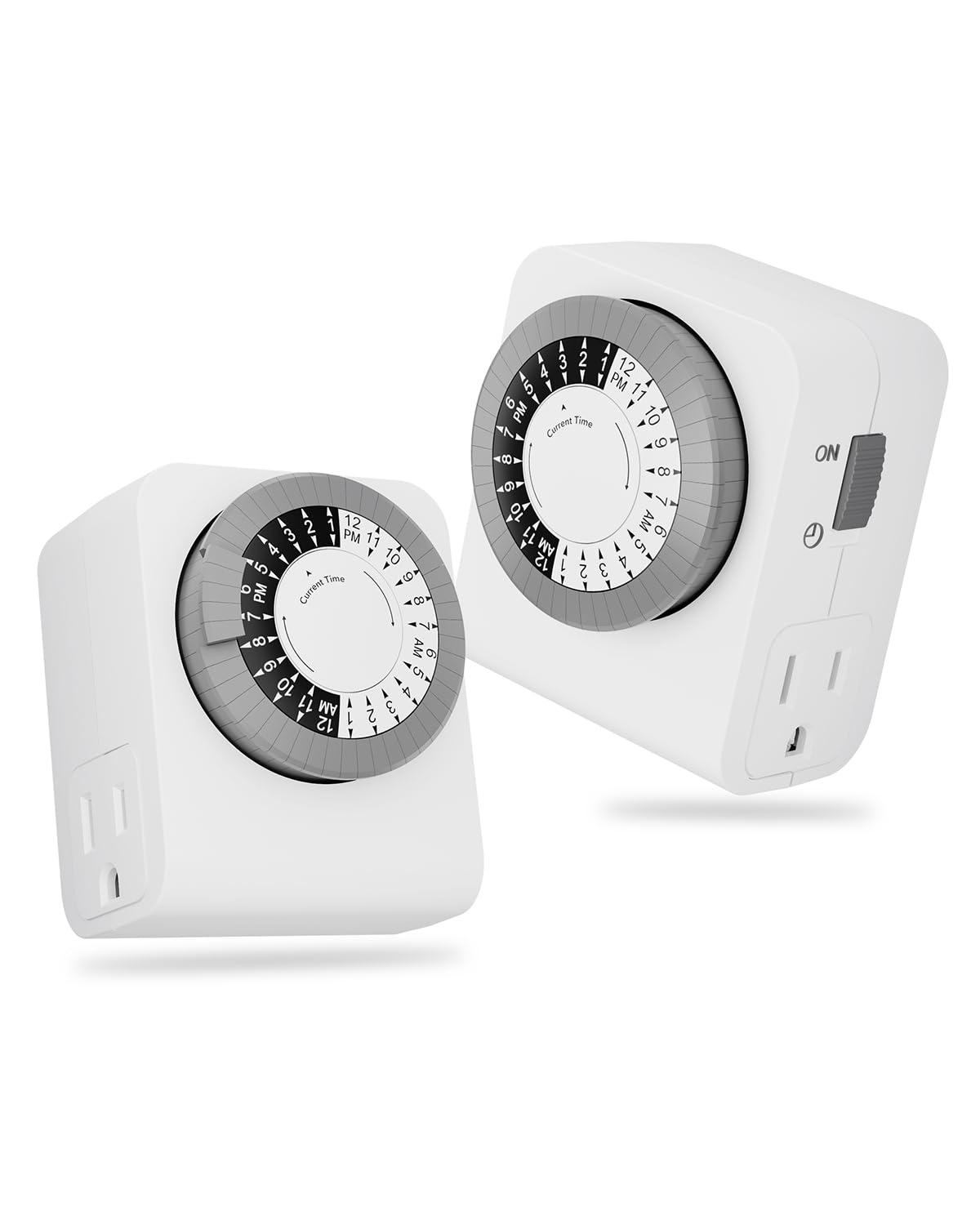
| BN-LINK Mechanical Timer 2-PackBest Value | Simple indoor daily schedules | 48 | 2 per unit | Mechanical pins, 30-min intervals | Amazon |
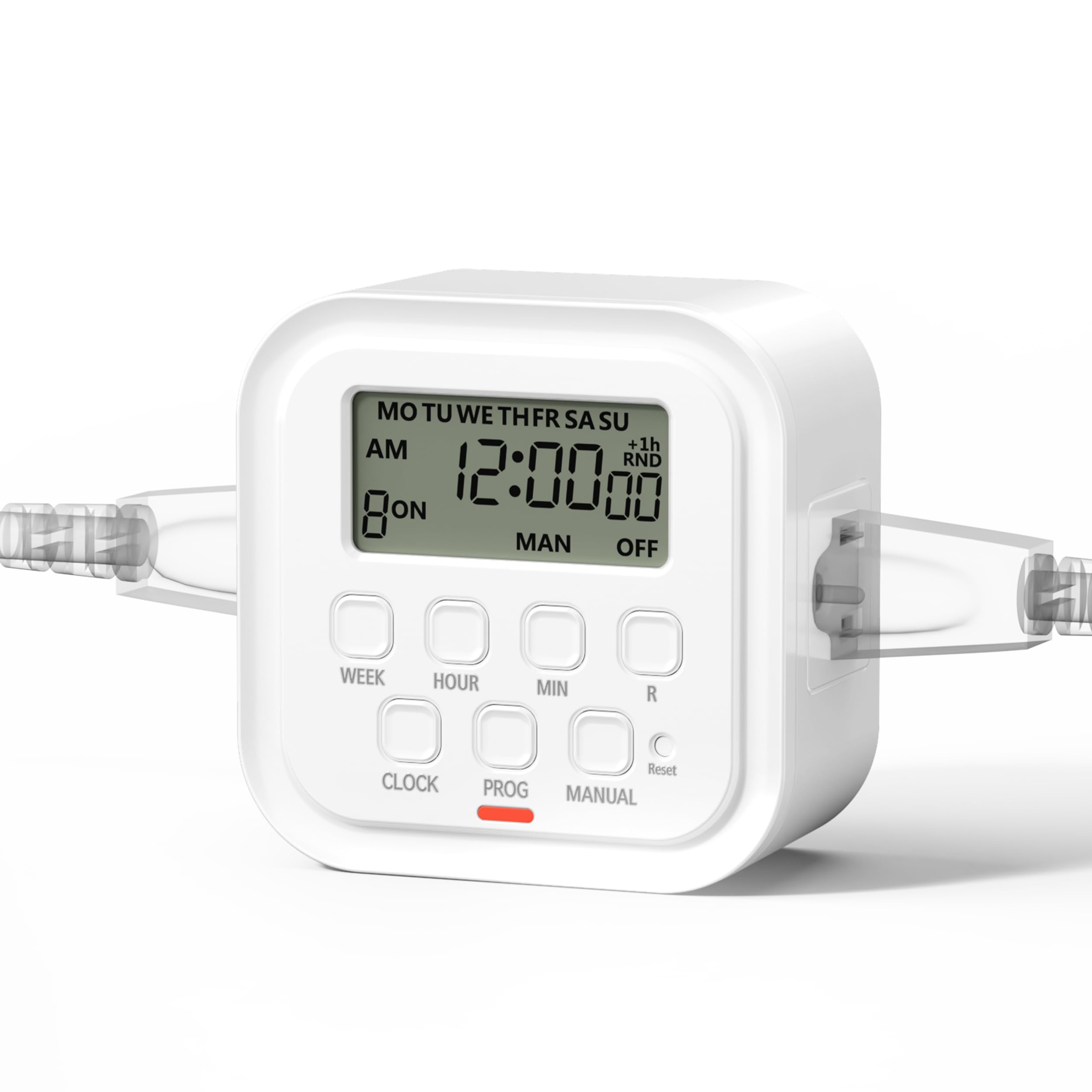
| HBN Digital Outlet TimerMost Versatile | Flexible weekday/weekend schedules | 8 | 2 | 7-day programming + vacation mode | Amazon |
| GE 24-Hour Mechanical Timer | Weather-resistant outdoor duty | 3 | 2 | Weather resistant, 30-min intervals | Amazon |
| Minetom Lights Plug Timer | Three-outlet holiday lighting | 3 | 3 | Photocell + remote, 100ft range | Amazon |
| Lutron Maestro Motion Sensor Switch | Bathroom/garage hands-free control | — | 1 | Occupancy/vacancy sensor, 1-30 min delay | Amazon |
| TiFFCOFiO Outdoor Power Strip Timer | Multi-outlet holiday decor | 11 | 6 | 6-ft cord, waterproof cover, remote | Amazon |
| Palawell Outdoor Dimmer Plug | Dimmable string lights with timer | 4 | 1 | IP65, 560W capacity, 100ft remote | Amazon |
| Honeywell Sunrise Sunset Timer Switch | Permanent wall-switch automation | — | 1 | Auto sunrise/sunset, 3-way compatible | Amazon |
In‑Depth Reviews
1. Syantek Outdoor Light Timer
Our pick — over 4.5★ from 850+ verified ratings; the strongest balance of quality and price.
The remote that keeps working long after the holiday lights come down.
What makes this auto light timer the top pick is how it blends three genuinely useful features into one unit that the crowd of owners find reliable. It has a built-in photocell sensor (a small light-sensitive eye that detects daylight) that turns your lights on at dusk and off at dawn. It also gives you a countdown timer that keeps the lights on for 2, 4, 6, or 8 hours after dark. And it includes a remote control that works from 100 feet away, through walls and doors, using radio frequency rather than line-of-sight.
Owners plug in three grounded devices at once — yard lights, a fountain, and holiday decor all run from the same weatherproof box. The reliability is excellent and the range of the remote is among the most-discussed positives. As owners put it: “No issues in over a year now.” The catch is that durability gets mixed feedback — some units handle the elements for years, while a few report trouble after a couple of months.
Decisive winner: For the price of a single timer, you get a remote, a dusk sensor, a countdown timer, and three outlets in one waterproof package — the best combination of convenience and value in this list.
Reach for this if: you want to control outdoor holiday lights, a porch lamp, or a fountain from inside the house with zero programming fuss.
Look elsewhere if: you need a daily programmable schedule with different on/off times each day — this works best as a dusk-to-dawn or countdown timer, not a multi-schedule device.
2. BN-LINK Timer Outlet 2-Pack
Two timers for the price of one, and dead simple to set.
This is the mechanical-pin timer (a rotating dial with little plastic tabs you push down for on, leave up for off) that owners call “very accurate” and “quiet.” It offers 48 on/off settings in 30-minute intervals, which means you can set your lights to come on every half hour if you really want. Each unit has two grounded outlets, and you get two units in the box, so you can control four devices total for very little money.
The setup takes about two seconds — push the pins down for the hours you want the lights on, pull them up for the hours you want them off. The BN-LINK timer is a favorite for aquarium lights, plant lights, and Christmas decorations. One owner used it for vacation aquarium lighting: “I have 2 aquariums and wanted to have the lights go on and off when I’m on vacation.” The noise level is one of the few mixed aspects — some hear a slight hum or click from the mechanical movement.
Best deal in this list: You get two independent timers, each with two outlets, for a price that usually gets you a single unit.
Best for: anyone who wants a no-brainer indoor timer for lamps, plant lights, or Christmas trees and values simplicity over digital features.
One real trade-off: power outages reset the dial — you will need to push the pins back in after a blackout.
3. HBN Digital Outlet Timer
The digital brain for one-minute precision across a whole week.
When you need different schedules for weekdays versus weekends — or you want your lights to turn on for exactly one minute at a specific time — the mechanical timers cannot do it. This HBN digital timer lets you program up to 8 on/off events across a 7-day cycle, with settings as short as one minute. It also supports Daylight Saving Time adjustment and a “Random” vacation mode that varies light times to make your home look occupied.
The functionality is the top reason owners pick this model, and ease of use comes close behind. The thing everyone raves about is quiet operation. The two outlets let you control separate devices on independent schedules. The HBN unit is bulkier than the mechanical timers — it measures 3.3 inches deep and wide against the BN-LINK’s shallower 2.6 inches. The instructions get mixed feedback; some find them clear while others find the programming steps confusing at first.
Standout feature: The vacation randomizer is a security move no other plug-in timer in this price range offers, and the one-minute minimum interval beats every mechanical model.
Reach for this if: you want separate weekday/weekend schedules, a one-minute timer, or vacation security.
Think twice if: you want something you can hand to someone who hates reading manuals — the initial programming requires a few minutes with the instructions.
4. GE 24-Hour Mechanical Timer
Four New England winters and still clicking on time.
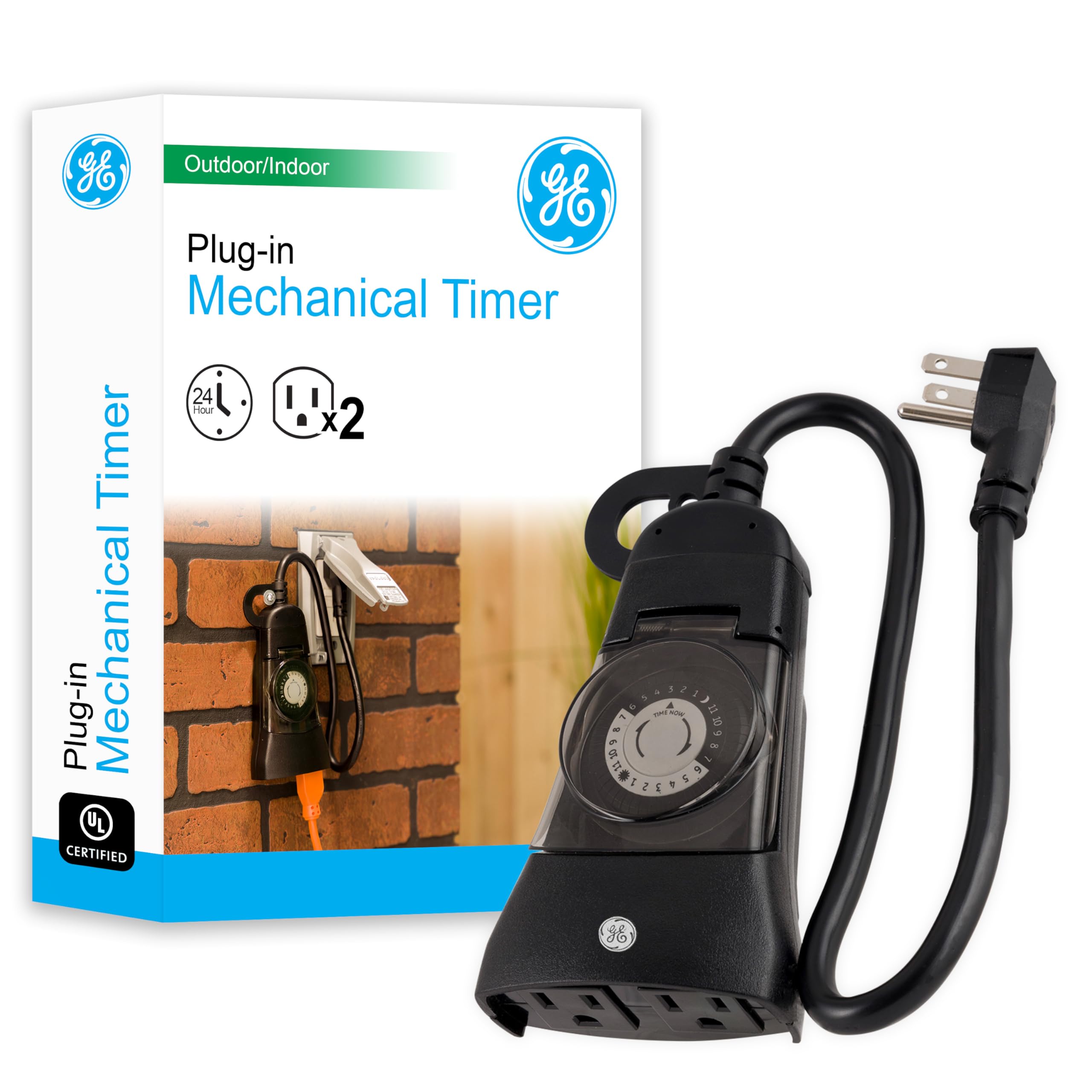
This GE timer has a hard-earned reputation for surviving outdoor use. The weather-resistant construction handles rain, ice, snow, and freezing temperatures. Buyers report it working for 3 to 4 years of continuous outdoor exposure without cracking or shorting out. The mechanical dial sets in 30-minute intervals and repeats a 24-hour cycle daily. Two grounded outlets handle 15 Amps resistive and 10 Amps tungsten, compatible with LED, CFL, incandescent, and halogen bulbs.
The reliability is the mixed bag here — some owners mention it stopping after 4-5 months, while others praise it for lasting years. The on and off switch also gets mixed feedback; the pin direction can be confusing at first because you push pins down for “on” on this model (opposite to some other brands). One owner summed it up: “I have tried different brands — they last about a year. Will see if GE lasts longer.”
Best reason to buy it: The same brand-name build that has survived ice and snow for thousands of owners, backed by GE’s long history in household controls.
Get this for: outdoor patio lights, landscape lighting, or Christmas decorations that face real weather.
skip it if: you need a remote control or a dusk sensor — this is strictly a timed schedule with no wireless features.
5. Minetom Lights Plug Timer

Three cords, one dial, and a remote that reaches the back fence.
The Minetom timer pairs a dusk-to-dawn photocell sensor with a 100-foot RF remote in a UL-listed housing. You dial the countdown to 2, 4, 6, or 8 hours after dusk, and the lights turn off automatically. The remote sends a strong radio signal through walls and doors, which owners love for turning Christmas lights on and off from inside the house without braving the cold. Three grounded outlets let you run string lights, a yard ornament, and a spotlight from one box.
The reliability is the top positive feature — owners trust it to keep holiday decor on schedule through December. One owner called it “terrific outdoor auto timer” and specifically praised being able to plug three cords in at once. The only mixed note is durability: a few found the build less sturdy for permanent outdoor installation. No programming is required — you just plug in, set the dial, and use the remote to override if needed.
Smart trade-off: One dial replaces a multi-step programming process, making this the easiest dusk-to-dawn timer for seasonal use.
Best for: holiday decorators who want to plug multiple decorations into one timer and control them from the couch.
Consider another pick if: you need a permanent, hardwired outdoor solution for year-round use.
6. Lutron Maestro Motion Sensor Switch
Walk in, lights on. Walk out, lights off. No app, no dial.
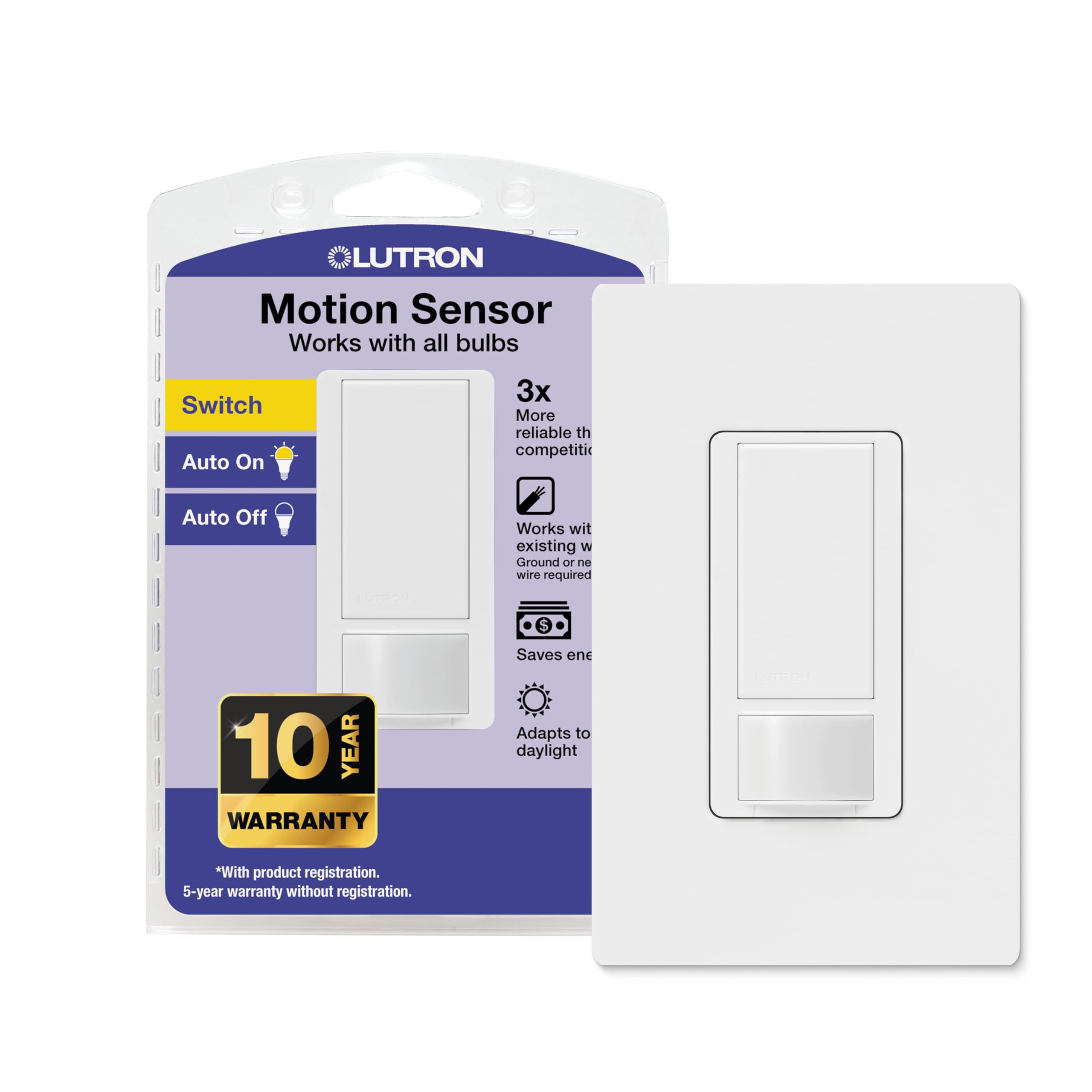
This is a different category of light timer entirely — a motion-sensing wall switch that replaces your existing light switch. It works in two modes: Occupancy (auto-on when you enter, auto-off when you leave) and Vacancy (you turn it on manually, it shuts off automatically). The delay-off timer adjusts to 1, 5, 15, or 30 minutes after the room empties. It installs in about 15 minutes and works without a neutral wire, which is a huge plus for older homes.
The Lutron Maestro is the top choice for bathrooms, garages, laundry rooms, closets, and pantries. The functionality and installation are the most discussed positives. One 77-year-old owner called it “easy peasy” to install after watching an online video. The motion sensitivity and the audible click of the relay draw mixed reactions — some wish the sensor were slightly more sensitive, and the click is noticeable in a quiet room. It handles up to 150-Watt CFL/LED or 250-Watt incandescent bulbs.
The killer feature: No neutral wire required means it fits in older wiring setups where many smart switches cannot — and the 30-minute max delay is perfect for a garage or pantry.
Get this for: any room where you walk in with your hands full and want the lights to handle themselves.
Not for: outdoor outlets or holiday lights — this replaces a wall switch for indoor fixtures only.
7. TiFFCOFiO Outdoor Power Strip Timer
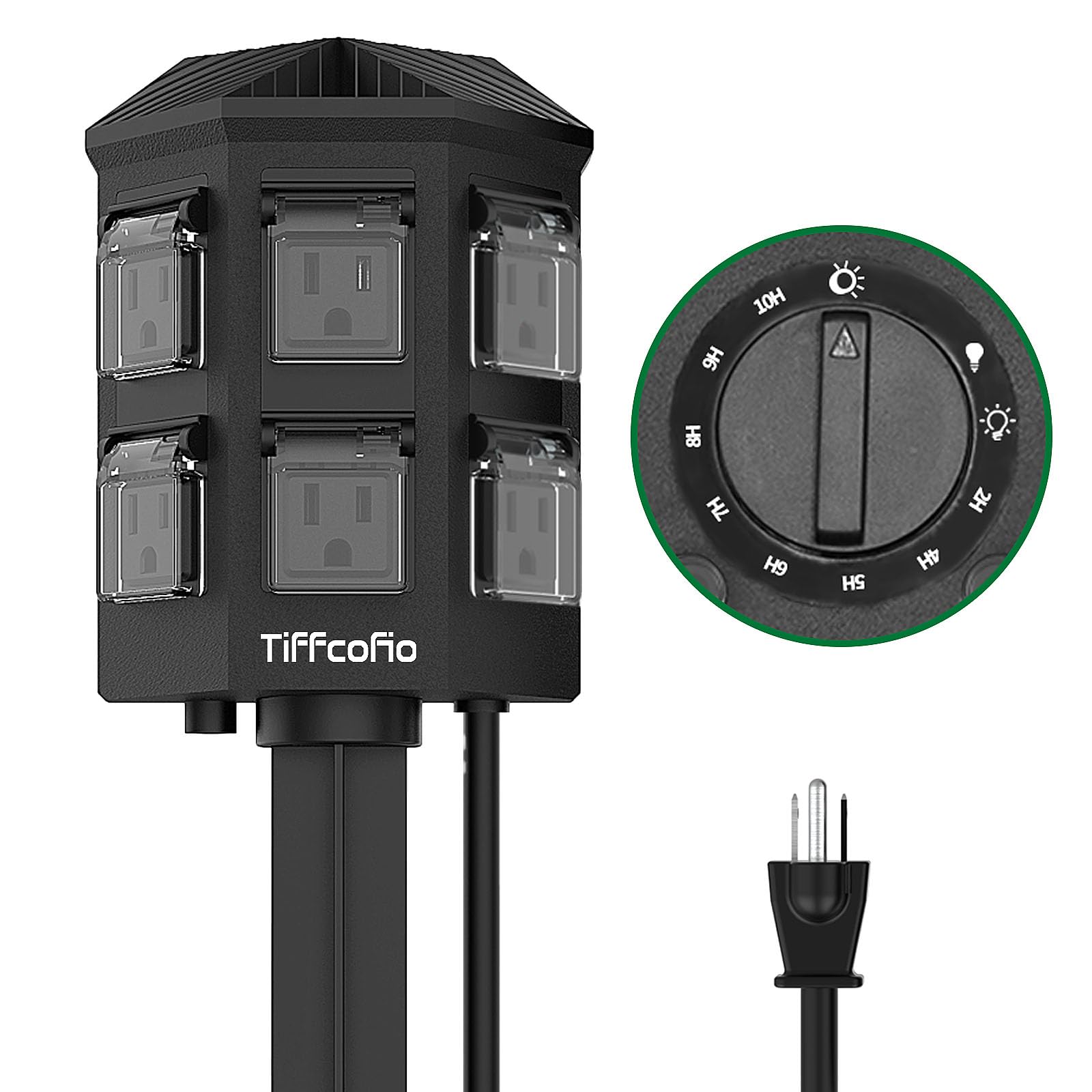
Six outlets in one package, with a timer dial simpler than any app.
For a full yard of holiday decorations, the TiFFCOFiO power strip timer is the most outlet-rich option in this guide. It packs 6 grounded outlets on a 6-foot extension cord with a built-in timer control panel at the plug end. The timer offers 11 functions including ON, OFF, dusk-sensor mode, and countdown options of 2, 4, 5, 6, or 8 hours. A separate waterproof cover seals each outlet individually, and the ETL-listed build uses ABS and polycarbonate materials rated for outdoor weather.
Quality and versatility are the most-praised aspects. Owners love the long cord and the angled plug design that fits alongside other large adapters on a single wall outlet. The functionality is the most-discussed overall, but Amazon marks it as mixed — while most owners find it works great for Christmas lights, a few found the timer function confusing to set at first. Durability and weather resistance also get mixed feedback; some report it failing after a single season of permanent outdoor exposure.
Why it stands out: Six outlets is more than any other timer in this list — you can run a full inflatable Santa, string lights, a spotlight, and a wreath light from one box.
Reach for this if: you decorate heavily for holidays and want one timer for half a dozen cords.
Think twice if: you need a permanent outdoor timer for year-round use — treat this as a seasonal tool that benefits from being stored between holidays.
8. Palawell Outdoor Dimmer Plug

The only timer here that also dims your patio lights to exactly the mood you want.
This is for the person who wants more than on/off — the Palawell dimmer plug lets you adjust brightness from 25% to 100% using either four preset buttons or a continuous +/- dimmer on the remote. It supports up to 560 Watts of dimmable LED string lights or incandescent bulbs, which is enough for a large patio setup. It also includes a daily timer with 2, 4, 6, and 8-hour countdowns, plus a memory function that remembers your last brightness level and schedule after a power cut.
The IP65 waterproof rating (dust-tight and protected against water jets) means this lives outdoors full-time. The unit has a V0-grade fireproof PC shell with internal silicone filling for heat dissipation. The reliability and dimmer performance are the top praised aspects. Some owners found the remote control hit-or-miss — occasional flickering is also noted with certain LED bulbs.
Standout capability: No other timer here dims your lights. If your string lights are dimmable, this combines a timer, a dimmer, and a remote in one outdoor-rated plug.
Get this for: a patio, deck, or pergola where you want dimmed mood lighting on a daily schedule.
pass on it if: your lights are non-dimmable, you need more than one outlet, or you prefer a simple on/off timer without the extra features.
9. Honeywell Sunrise Sunset Timer Switch

The wall switch that tracks the sun, no internet required.
This is the most advanced option — a programmable timer switch that replaces your wall switch and uses your latitude and longitude to calculate exact sunrise and sunset times for your location, automatically adjusting throughout the year. It works in single-pole and 3-way circuits (two switches controlling the same light), so you can install it in a hallway or stairwell with two switches. It has no battery — it stores its program using a capacitor that draws a tiny amount of power from the AC line.
The functionality and ease of use are the top praises, with installation close behind. Owners love the automatic DST (Daylight Saving Time) adjustment and the manual override that does not disrupt the program. The instructions are the one mixed note — with so many features, the manual is lengthy and some find the button sequence confusing initially. It requires a neutral wire in the wall box, and it needs at least a 10.5W LED load to operate correctly.
top-tier feature: The sunrise/sunset calculation based on your geographic coordinates means your outdoor lights follow the actual daylight year-round, not a fixed schedule.
Reach for this if: you want a permanent, hardwired solution for outdoor security lights or porch lights that tracks the changing seasons.
Not for: renters or anyone who wants a plug-and-play setup — this requires wiring into your home’s electrical system.
Understanding the Specs
Number of Settings / Programs
This tells you how many on/off events the timer can handle in a day. A mechanical timer with 48 settings means you can push pins into 48 different half-hour blocks across the dial — you get flexibility in 30-minute chunks. A digital timer with 8 programs means you can set 8 separate on/off events across a week. For most home use, you only need 2 to 4 settings (one on in the morning, one off at night). The extra capacity helps if you want mid-day or multiple zone schedules.
Photocell Sensor vs Mechanical Dial
A photocell sensor detects ambient light and triggers the timer to turn lights on when it gets dark and off when the sun rises. This is ideal for outdoor lights because the schedule changes with the season automatically. A mechanical dial follows a fixed 24-hour schedule — your lights come on at the same time every day regardless of whether the sun sets early in December or late in June. The photocell wins for outdoor use; the mechanical dial wins for indoor routines you want identical every day.
FAQ
Will an auto light timer work with LED bulbs?
Can I use an indoor light timer outdoors?
Do mechanical timers lose their schedule during a power outage?
What is the difference between occupancy and vacancy mode on a motion sensor switch?
Can I use a timer with a space heater or air conditioner?
Does a dusk-to-dawn timer work if the sensor is covered or in shade?
Can I program different on/off times for weekdays and weekends?
How far does the remote control work on a light timer?
Can I use a 3-way wall switch timer on a single-pole circuit?
What does the ETL or UL listing mean for a light timer?
Final Thoughts: The Verdict
For most buyers, the best auto light timer winner is the Syantek Outdoor Light Timer because it combines a dusk sensor, a 100-foot remote, three outlets, and low-maintenance operation in a waterproof housing that satisfies both holiday decorators and daily porch-light users. If you want a simple indoor timer for lamps and grow lights, grab the BN-LINK 2-Pack for unbeatable value. And for a permanent wall-switch solution that tracks sunrise and sunset year-round, the Honeywell Sunrise Sunset Timer Switch is the one to reach for.
How We Picked
We do not accept paid placement. Every pick is matched to a real buyer and a real use-case; we do not hands-on test units.
Sources & Methodology
Specifications: manufacturer listings and product documentation. Review insights: verified customer reviews, as of July 2026. Pricing: not shown on this page (it changes often); check the current price via the retailer link.
As an Amazon Associate, Gadgets Feed earns from qualifying purchases. This does not affect which products we feature.