
Our readers keep the lights on and my morning glass full of iced black tea. As an Amazon Associate, I earn from qualifying purchases.
Specs are compiled from manufacturer listings and verified buyer reviews and can change over time — please confirm the key details on the product page before buying.
You haul a heavy bag home, punch it open, and hope your tomatoes, ferns, or monsteras get the right start. But the wrong bagged soil rots your roots with bad drainage, invites gnats, or leaves your plants hungry. The right mix gives you steady nutrients, room for roots to spread, and water that drains at the right pace. This guide compares nine bags so you match the mix to the plant without guessing.
I’m Min — the founder and writer behind Gadgets Feed. This guide is built by comparing the manufacturers’ published specifications and the patterns across verified customer reviews, so you get each pick’s real strengths and trade-offs instead of marketing spin.
FoxFarm Ocean Forest is the top pick for most buyers because its 1.5-cubic-foot bag of pre-mixed nutrients and sandy loam drainage consistently fuels heavy feeders like tomatoes and cannabis without extra ingredients.
Our Picks at a Glance


How To Choose The Best Bagged Soil
Bagged soil is not one-size-fits-all. The mix that makes a succulent thrive will drown a fern. Focus on three things: what you are planting, if you need drainage or water-holding, and the organic versus synthetic question. Skip the marketing on the front of the bag and look at the ingredient list on the back.
Drainage vs. Moisture Retention
Plants like monsteras, orchids, and succulents need a chunky, fast-draining mix so their roots get air. Leafy vegetables and moisture-loving flowers prefer a soil that holds water longer, typically with more peat or coir. The product descriptions here tell you which profile each bag has — match that to your plant’s natural habitat.
Volume and Coverage
A 1.5-cubic-foot bag covers about three 10-inch pots. A 1-quart bag is enough for a single 5-inch nursery pot. Compare the volume, not the bag’s visual size, to avoid running short mid-project or overbuying for a single houseplant.
Organic vs. Conventional Feeding
Organic mixes feed through ingredients like worm castings, kelp, and compost — they release nutrients slowly and improve soil life. Conventional mixes often include synthetic slow-release fertilizer (feeding for up to 6 months). Neither is universally better: organic is gentler on seedlings, while synthetic gives a quick visible boost.
Quick Comparison
| Model | Best For | Volume | Weight | Key Ingredients | Amazon |
|---|---|---|---|---|---|
| FoxFarm Ocean Forest★ Best Overall | Heavy feeders & container gardens | 1.5 cu ft | 34 lb | Aged forest, crab meal, earthworm castings | Amazon |
| Gardenera Monstera MixMonstera Master | Aroids & drainage-sensitive houseplants | 1 qt | — | Peat, perlite, coco coir, biochar, bark | Amazon |
| Midwest Hearth PremiumSeed Starter | Seed starting & small pots | 4 qt | 1.94 lb | Peat moss, vermiculite, perlite | Amazon |
| Coast of Maine Veg & Tomato | In-ground veggies & raised beds | 20 qt | — | Composted manure, sphagnum peat, organic compost | Amazon |
| Espoma Veg & Flower Garden Soil | In-ground amendments & transplants | 1 cu ft | — | Earthworm castings, mycorrhizae (Myco-Tone) | Amazon |
| Michigan Peat Baccto Premium | Large container & raised-bed projects | 50 lb | 50 lb | Reed sedge peat, perlite, sand, slow-release fertilizer | Amazon |
| Espoma Organic Potting Mix | All-purpose indoor & outdoor containers | 2 cu ft | — | Sphagnum peat, humus, perlite, worm castings, kelp meal | Amazon |
| Miracle-Gro Potting Mix (3-Pack) | Quick-growing annuals & convenience | 24 qt (3 x 8 qt) | — | Peat, coir, wetting agent, synthetic slow-release fertilizer | Amazon |
| Miracle-Gro Moisture Control | Heavy drinkers & busy plant parents | 2 cu ft | 40.5 lb | Sphagnum peat, coir, wetting agent (AquaCoir) | Amazon |
In‑Depth Reviews
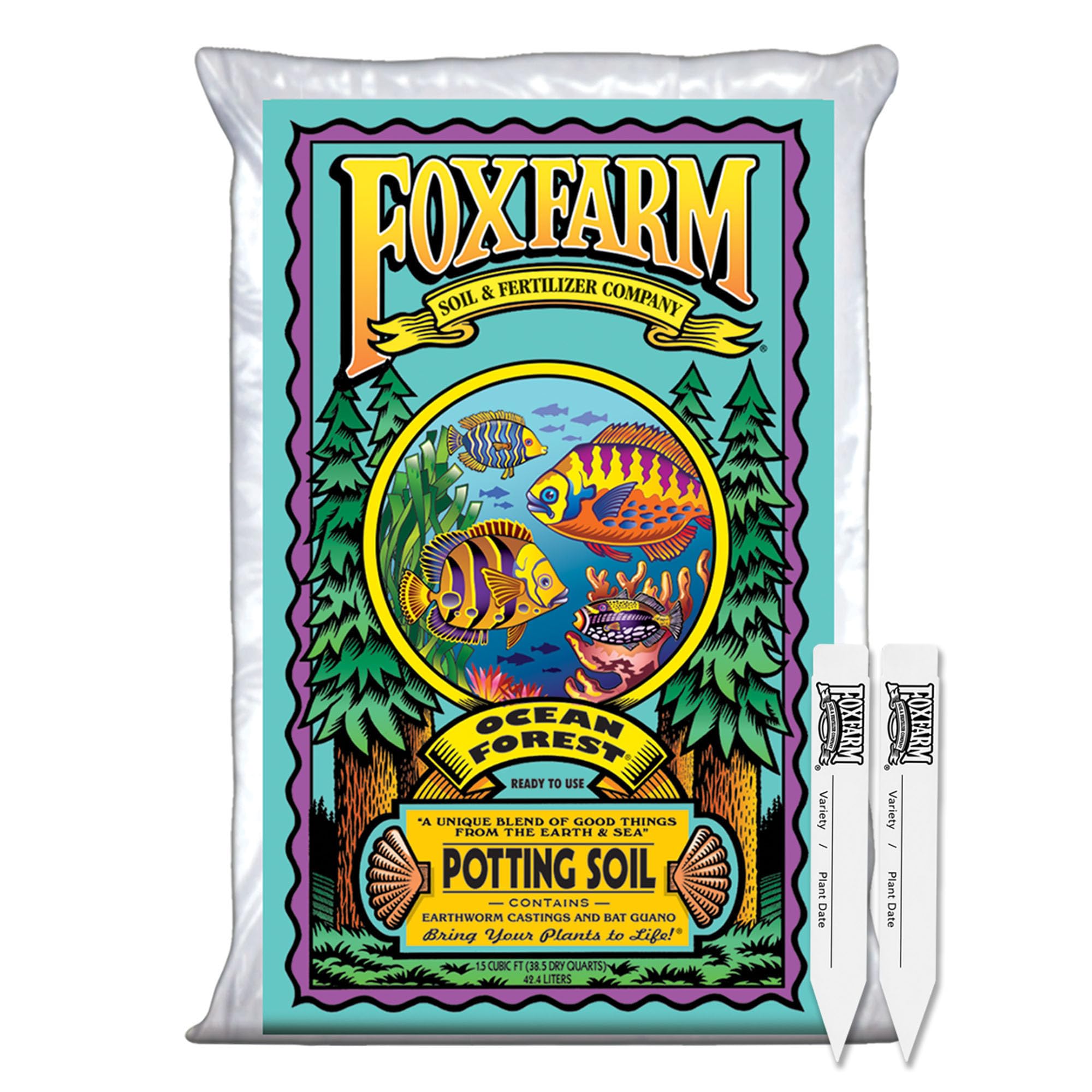
1. FoxFarm Ocean Forest Potting Soil with 2 Plant Tags, 1.5 cu ft
Our pick — over 4.5★ from 10,000+ verified ratings; the strongest balance of quality and price.
The powerhouse bag that makes side-by-side plant tests embarrassing for the competition, especially Miracle-Gro.
You get a 1.5-cubic-foot bag (34 pounds) pre-loaded with aged forest products, sphagnum peat moss, perlite, and sandy loam. That gives you excellent drainage that helps prevent root rot, while the aged forest products hold moisture around the root zone. The nutrient lineup is rich: fish emulsion, crab meal, shrimp meal, earthworm castings, kelp meal, and oyster shell. Buyers report FoxFarm outperformed Miracle-Gro in a direct tomato-plant test — same watering schedule, same seed-start size — but FoxFarm plants simply flourished. Over 480 buyers call the quality the reason their plants thrive. The honest trade-off is that many find it expensive for a bag of soil, and a smaller group flags occasional bug resistance issues. Owners mention: “a bit pricey however, this is the best soil. Your plants will thank you.” If you are on a tight budget or only need a quart for one houseplant, skip it.
Plants love it
- Pre-mixed and ready to use — no extra ingredients needed
- Crab, shrimp, and kelp meal create a nutrient profile that fuels heavy feeders
- Excellent drainage from sandy loam prevents the common problem of root rot
The trade-offs
- Price is the most-discussed downside — not a budget-friendly bag
- A minority report bugs in their bag, so check before using indoors
- At 34 pounds, it is a heavy bag to carry from delivery
Grab this for: container vegetables, cannabis, or any heavy feeder that wants a rich, ready-to-go foundation.
Look elsewhere if: you are on a tight budget or only need a quart of mix for one houseplant.
2. Gardenera Premium Monstera Potting Soil – Quick Drain Potting Soil, 1 Quart Bag
The chunky, aerated fix for monsteras prone to yellow leaves and root rot — far more specialized than FoxFarm’s generalist mix.
This 1-quart bag is a precision tool for aroids (Monstera Deliciosa, Albo, Adansonii, and others). It blends peat moss, perlite, coco coir, biochar (IBI-certified to help retain nitrogen and phosphorus), worm castings, and bark. The biochar is a porous charcoal-like material that holds onto nutrients so your plant absorbs more. The mix is sterile and non-toxic, so pests are unlikely. The volume is small — a single bag handles a 5-inch pot with some leftover, as customers note. But for a single monstera or a small aroid collection, the drainage and aeration here are purpose-built. Quality is the most-mentioned aspect, and the consistent owner report is that plants perk up within days. If you have multiple large monsteras, you will need several bags. skip it if you are planting vegetables or anything outside the aroid family.
One-bag plants: Perfect for a single repot of a 5- to 6-inch monstera or a small aroid collection.
Bigger projects: You will hit the volume limit fast — this is not for raised beds or multiple large pots.
Reach for this if: your monstera has brown spots or drooping leaves and you want a mix that prevents overwatering.
pass on it if: you are planting vegetables, perennials, or anything outside the aroid family.
3. Premium Potting Soil Mix with Peat Moss, Vermiculite, Perlite (Made in USA) (4 Dry Quarts)
The light, fluffy bag that germinating seeds love because it refuses to turn into concrete — lighter than FoxFarm’s dense 34-pound bag.
This 4-quart bag from Midwest Hearth weighs just 1.94 pounds and uses the same formulation professional growers favor: peat moss, vermiculite, and perlite, pH-balanced for a wide range of plants. The texture is light and airy, so young root systems push through easily and water drains without pooling. Buyers specifically call it a great seed starter for germinating petunias, praising its ability to stay loose without hardening around the roots. Quality is the top-mentioned aspect, followed by plant health. The bag is resealable, which helps if you use only a portion. The most common note is that the 4-quart size feels small for the price — several wish the bag were bigger. For starting herbs or flowers from seed it is a strong buy, but skip it for raised beds or large pots.
Grows strong roots: Vermiculite and perlite keep the mix from compacting, so roots spread freely instead of circling.
Goes fast: The 4-quart bag covers a few small pots — for large projects, buy multiples.
Best for: starting herbs, flowers, and vegetables from seed, or repotting a handful of small containers.
Not for: filling raised beds, large pots, or projects that need bulk volume.
4. Coast of Maine Organic & Natural Planting Soil for Vegetables & Tomatoes, 20 Qt

The Maine-made organic that gives tomatoes and zucchini a visible growth spurt within days — OMRI-listed so you know it is certified for organic food gardens.
This 20-quart bag is OMRI-listed (Organic Materials Review Institute, which certifies products for organic farming) for organic use. It blends composted manure with sphagnum peat moss to balance moisture retention with drainage. It is designed for in-ground vegetable gardens and containers, and owners find it lightweight and high in nutrients. Quality earns the top praise, with plant health second. Reviewers point out visible growth within days after transplanting tomatoes, zucchini, and peppers in 5-gallon pots. One experienced gardener noted the mix contains aromatic wood material that seems to deter insects. A common honest note is that the bag may contain undecomposed twigs — pick them out if you are planting fine-root crops like carrots. Several owners experienced fungus gnat infestations or mold, so inspect your bag before indoor use. Not ideal for indoor houseplants where you want to avoid gnats.
OMRI-listed: Certified for organic gardening, so you can use it confidently in a food garden.
Watch for: Occasional twigs and the risk of fungus gnats — vent the bag or screen it if you are sensitive to bugs.
Ideal for: heirloom tomatoes, peppers, and squash planted in containers or amended in-ground beds.
Not ideal for: indoor houseplant use where you want to avoid any chance of gnats.
5. Espoma Organic Vegetable & Flower Garden Soil, 1 Cubic Foot Bag

The amendment that turns tired garden soil into a fertile bed without synthetic chemicals — it has Myco-Tone, a blend of fungi that help roots absorb nutrients.
This 1-cubic-foot bag from Espoma is designed to be mixed with native garden soil when planting, not used solo in containers. It contains earthworm castings and Myco-Tone — a proprietary mix of endo and ecto mycorrhizae (beneficial fungi that attach to plant roots and help them absorb more water and nutrients). Owners say plants in Espoma clearly outperformed those in a store-bought organic alternative, with better moisture retention and stronger early growth. Quality is the top aspect, followed by plant health. Some bags have arrived bug-free and suitable for outdoor use, though a few indoor users reported soil gnats. The manufacturer recommends mixing it with your existing soil rather than using it straight. It is not a standalone potting mix.
Myco-Tone advantage: The endo and ecto mycorrhizae improve root uptake, especially in compact or poor native soil.
Container limitation: This is an in-ground or raised-bed amendment — less effective as a standalone potting mix.
Use it for: enriching a flower bed, a new vegetable row, or transplanting into native soil that needs organic matter.
Hold off if: you need a standalone potting mix for containers — pick a purpose-made potting mix instead.
6. Michigan Peat Baccto General All Purpose Premium Potting Soil with Perlite, 50 Pounds

The 50-pound workhorse that veteran gardeners have trusted for decades — far better value per pound than FoxFarm if you are filling many pots.
This is the bulk option for large-scale container growing. The 50-pound bag from Baccto (Michigan Peat) combines rich dark reed sedge peat with perlite and sand, plus starter and slow-release fertilizers. It is pre-blended and ready to use straight from the bag — no mixing required. Long-time gardeners with 50+ years of experience call it the best potting soil they have found, using it for more than 200 dozen flowers each year. Quality is the most-praised aspect, followed by value for money. The weight and texture are heavier and wetter than typical potting mix, and it compacts more after watering. Moisture retention is good, but some owners say it holds too much water for plants that prefer drier feet. The bag size is ideal for large repotting sessions, and the price per volume is strong compared to smaller bags. Not for succulents or indoor houseplants that need a light, fast-draining mix.
Bulk economy: At 50 pounds, this is one of the best value-per-pound options for large container gardens.
Heavy wet feel: The peat-and-sand blend is denser and holds more moisture than fluffy potting mixes — better for thirsty annuals than succulents.
Perfect for: filling dozens of outdoor pots, planters, or raised beds with a proven, all-purpose blend.
Think twice if: you need a light, fast-draining mix for succulents or indoor houseplants.
7. Espoma Organic Potting Soil Mix, All Natural, 2 Cubic Foot Bag

The organic chunky mix that keeps houseplants happy and does the same for outdoor containers — it has Myco-Tone fungi just like Espoma’s garden soil, but formulated for pots.
This 2-cubic-foot bag is a versatile organic potting mix for indoor and outdoor container plants. It blends sphagnum peat moss, humus, and perlite with earthworm castings, alfalfa meal, kelp meal, and feather meal, plus Myco-Tone. The texture is loamy and chunky — it does not get dense or crusty over time, and owners say it provides a clean base for adding your own bark, perlite, or sand to customize drainage. Quality is the top aspect, and versatility comes second — it handles everything from a 25-year-old heirloom houseplant to a seasonal vegetable pot. The common feedback is that the mix could use more perlite for aeration, and some bags have arrived with bug issues. Owners who appreciate organic-only ingredients say it is worth the premium price. Compared to other brands, buyers find fewer large sticks or wood chunks. Pricier than big-box brands like Miracle-Gro, so budget accordingly.
No synthetic chemicals: Feeds through worm castings, kelp, and alfalfa meal — gentle on sensitive indoor plants.
Perlite shortfall: Several owners note the mix is low on perlite, so you may want to add more for aeration-loving plants.
Best for: container gardens that mix indoor and outdoor plants, or repotting a sentimental houseplant with quality organic soil.
Budget note: Pricier than big-box brands — the organic ingredients drive the cost up.
8. Miracle-Gro Potting Mix – For Container Plants, 8 qt. (3-Pack)

The three-bag bundle that takes the heavy lifting out of potting day for annuals and herbs — easier to carry than FoxFarm’s single 34-pound bag.
This 3-pack contains three 8-quart bags of Miracle-Gro’s classic potting mix, which includes synthetic slow-release fertilizer that feeds container plants for up to 6 months. Each 8-quart bag fills two 8-inch containers, so the bundle covers a decent number of seasonal pots. Owners appreciate that the smaller bags are easy to handle — no wrestling a 50-pound sack. The soil is well-draining and resists compaction. Quality is the most-praised aspect, with plant health and versatility close behind. The main points of mixed feedback are the bag size (some wish the 8-quart bags were larger) and the value proposition (price per quart sits higher than bulk bags). For a handful of patio pots, this split-pack format is convenient. For large-scale projects, a single larger bag like Michigan Peat Baccto is more economical.
Easy handling: Three 8-quart bags are far easier to lift and store than one 2-cubic-foot bag.
Small-bag math: The price per quart is higher than bulk — you pay for the convenience of the split format.
Good for: a weekend container-gardening session with a few annuals, herbs, or shrubs.
Better options: If you are filling a large raised bed, a single bulk bag beats this on price and volume.
9. Miracle-Gro Moisture Control Potting Mix, Protects against Over- and Under-Watering, 2 cu. ft.

The bag that keeps busy plant parents from killing their peppers with kindness — it has AquaCoir, a blend that protects against over- and under-watering.
This 2-cubic-foot bag uses Miracle-Gro’s exclusive AquaCoir Formula, which protects against both over-watering and under-watering and feeds plants for up to 6 months with synthetic slow-release fertilizer. The volume is large enough to fill two 14-inch containers. Quality and plant health are the top aspects owners praise, and value for money is a strong point — the 2-cubic-foot bag delivers good coverage per dollar. The feedback on moisture retention is split: some shoppers say their soil stays soaked for up to 8 days, while others find it terribly dry and need to water more frequently. The high peat content means you need to be careful with the first watering to avoid seed rot. The mix has few sticks and a fine texture that works well for seed starting. Bag durability is noted as good, and Amazon ships in a cardboard box to protect the bag during transit. Reach for this if you forget watering for a few days or grow heavy drinkers like peppers and tomatoes. Skip it for cacti, succulents, or houseplants that need to dry out between waterings.
AquaCoir technology: Protects against over- and under-watering, giving you a bigger margin for error on watering schedules.
Peat-heavy character: The high peat content holds moisture aggressively — terrific for thirsty annuals, risky for succulents or seedlings if you overwater.
Reach for this if: you tend to forget watering for a few days or grow heavy drinkers like peppers, tomatoes, and flowering annuals.
Skip if: you grow cacti, succulents, or houseplants that need to dry out completely between waterings.
Understanding the Specs
Volume (Cubic Feet vs Quarts)
Volume tells you how many pots a bag will fill. A 1.5-cubic-foot bag is roughly 38 dry quarts and handles three 10-inch containers. A 1-quart bag handles a single 5-inch nursery pot. Match the bag to your project scale — buying a 50-pound bag for one houseplant is wasteful, and a 4-quart bag for a raised bed will leave you short.
Drainage & Aeration
Drainage comes from ingredients like perlite, sand, bark, and coco coir. Aeration means roots can breathe. Fast-draining mixes (often labeled for cacti or aroids) prevent root rot. Water-retentive mixes (high in peat or coir) support moisture-loving plants. The bag’s ingredient list tells you which profile it has — sandy loam and perlite mean fast drainage; peat and coir mean holds water.
FAQ
What is the difference between potting mix and garden soil?
How long does bagged soil last before it goes bad?
Can I use bagged soil directly from the bag without mixing?
Why do some bags of soil have gnats or bugs?
How much soil do I need for a 10-inch pot?
Is organic bagged soil better than conventional?
What does “feeds up to 6 months” actually mean?
Can I reuse bagged soil from last year’s pots?
Why does my bagged soil smell like ammonia or sour eggs?
Final Thoughts: The Verdict
For most people, the bagged soil winner is the FoxFarm Ocean Forest because its 1.5-cubic-foot bag of pre-mixed nutrients and sandy loam drainage fuels heavy feeders without extra ingredients, backed by a very strong owner consensus. If you want a specialist mix for aroids, the Gardenera Monstera Mix is the right call with its biochar-enhanced drainage. And for bulk container projects on a budget, the Michigan Peat Baccto gives you 50 pounds of proven quality that earns its place in veteran gardeners’ carts year after year.
How We Picked
We do not accept paid placement. Every pick is matched to a real buyer and a real use-case; we do not hands-on test units.
Sources & Methodology
Specifications: manufacturer listings and product documentation. Review insights: verified customer reviews, as of July 2026. Pricing: not shown on this page (it changes often); check the current price via the retailer link.
As an Amazon Associate, Gadgets Feed earns from qualifying purchases. This does not affect which products we feature.