
Our readers keep the lights on and my morning glass full of iced black tea. As an Amazon Associate, I earn from qualifying purchases.
Specs are compiled from manufacturer listings and verified buyer reviews and can change over time — please confirm the key details on the product page before buying.
A ballet barre is the cornerstone of home dance practice, but the difference between a wobbly prop and a true training tool depends on how it holds up when you actually lean into it. The right barre supports your weight through pliés, stabilises balances during développés, and stays put so you focus on form, not on catching a tipped stand. The wrong one skids across the floor or flexes under load, making every exercise a fight against the equipment.
I’m Min — the founder and writer behind Gadgets Feed. This guide is built by comparing the manufacturers’ published specifications and the patterns across verified customer reviews, so you get each pick’s real strengths and trade-offs instead of marketing spin.
if you need a permanent wall-mounted fixture for serious training or a portable stand that tucks under the bed, these are the best ballet barre options for home use in 2025 — each chosen for how it handles real daily practice.
Our Picks at a Glance


How To Choose The Best Ballet Barre
Three factors separate a useful barre from a frustrating one: mount type, material, and height adjustability. Your room, your practice style, and who else uses it all play a role.
Wall-Mounted vs. Freestanding
A wall-mounted barre bolts directly into wall studs, creating an anchor that never shifts under full body weight. It is the gold standard for serious ballet practice at home — zero wobble, zero floor space wasted beneath the base. The trade-off: you need a drill and the ability to find studs, and the barre stays put. A freestanding barre sits on the floor with its own base, so you can move it between rooms or pack it away. Freestanding models range from lightweight portable stands to heavy-duty frames that support 350 lbs or more. The catch is that freestanding barres can slide or tip if the base lacks rubber pads or is too narrow for vigorous work.
Barre Material and Diameter
Most barres use either solid wood or powder-coated metal for the rail. Wood feels warm and offers a natural grip that dancers often prefer for long practice sessions — it does not get cold or slippery. The ideal diameter for comfortable grip across all hand sizes is 1.5 inches. Metal rails (usually aluminum or steel) are lighter and more portable but can feel slicker, especially if your hands sweat. Some metal barres come with a powder-coated satin finish that improves traction. For home use, a sanded solid wood barre is the most popular choice among regular practitioners.
Height Adjustability
A single-height barre works if only one person uses it, but most dancers benefit from adjustability. Standard ballet barre height is 42 inches from the floor to the top of the barre. For children or shorter users, a barre that adjusts down to 32 inches or lower is useful. Many home barres offer a range of roughly 32 inches to 46 inches. Freestanding double-barre models let you set one rail at hip height and the other at waist height, accommodating different exercises or multiple users in one session.
Quick Comparison
| Model | Best For | Type | Rail Material | Height Range | Amazon |
|---|---|---|---|---|---|
| VITA Barre Classic WB15★ Best Overall | Permanent Home Studio | Wall-Mounted | Solid Wood | Fixed (42″) | Amazon |
| VITA Barre ProdigyPremium Pick | Portable Double-Barre Studio | Freestanding | Aluminum | 6″ – 46″ | Amazon |
| SELEWARE 4-12 FT Wall MountBest Value | Solid Wall-Mount Value | Wall-Mounted | Solid Wood | Fixed | Amazon |
| Dolibest Wall Mounted Space Saver | Adjustable Wall-Mount | Wall-Mounted | Solid Beech Wood | 5 levels | Amazon |
| Dolibest Freestanding Pink | Kids & Beginner Home Use | Freestanding | Steel Tubing | 11″ – 47″ | Amazon |
| SELEWARE Freestanding | Heavy-Duty Freestanding | Freestanding | Alloy Steel / Wood | 11″ – 47″ | Amazon |
| UMEKEN Portable | Portable with Carry Bag | Freestanding | Aluminum / Solid Wood | Up to 46″ | Amazon |
| Costzon Portable | Lightweight Portable Pink | Freestanding | Iron / ABS | 7″ – 46″ | Amazon |
| Kipika Wall Mounted | Compact Wall-Mount | Wall-Mounted | Solid Wood | 5 levels | Amazon |
In‑Depth Reviews
1. VITA Barre Wall-Mounted Single Ballet Barre, Classic WB15
Our pick — over 4.5★ from 550+ verified ratings; the strongest balance of quality and price.
The wall-mounted rock that turns a hallway into a real studio corner.
This is the barre that serious home practitioners gravitate toward — and the numbers back it up. Quality and durability are the two things owners praise most, with good reason: the rail is 1.5-inch diameter solid wood, sourced and crafted in South Carolina, sanded smooth but left unfinished so you get a natural grip that only improves with use. It supports 100 lbs. per linear foot when bolted into studs, meaning a 4-foot section holds 400 lbs. of static load without flexing. The heavy-gauge steel brackets have a powder-coated finish that resists rust and scratches, and each system ships with the lag bolts and hardware you need for basic wood-stud installation.
Installation takes about an hour for a confident DIYer, and the consensus is clear: once it is up, it is rock-solid. Owners note that the brackets are larger and better-looking in person than product photos suggest, and the wood arrives well-sanded with no rough patches. The fixed height (the standard 42 inches for a single barre) means you are committing to a single user’s optimal height, which is the main trade-off. If you have multiple dancers at different heights in the house, you might consider a portable or adjustable model.
Studio-grade anchor: For anyone who wants a permanently installed barre that feels exactly like a professional studio, the VITA Classic is the one. The craftsmanship and stability justify the price.
Height-locked reality: If you need one barre that serves a child at 32 inches and an adult at 42 inches on the same day, you would be better served by an adjustable freestanding model.
Reach for this if: you own the wall space and want the most stable, American-made barre a home studio can have.
Look elsewhere if: you are a renter who cannot drill into studs or you need a barre that adjusts between multiple users.
2. VITA Barre Portable Freestanding Double Ballet Barre, Prodigy
The premium portable that brings real studio double-barre versatility to any room.
The Prodigy is VITA’s freestanding answer to the Classic — and it earns its premium status through a combination of build quality, thoughtful design, and a 10-year warranty. It features two 1.5-inch-diameter aluminum bars that adjust independently from 6 inches to 46 inches off the floor, so you can set one low for stretching and one at hip height for barre work, or both at the same height for a class with multiple stations. Assembly requires no tools — the frame locks together by hand and the bars tighten with knobs. At 5 feet wide, the Prodigy comfortably accommodates two to three users.
The honest trade-off is stability. The most-discussed aspect in owner feedback is stability, and it is a mixed verdict rather than a pure positive. On a level hardwood floor, the barre holds steady for basic ballet and light stretching. Under heavier load (over 200 lbs. of leaning force) or on a slick surface, the base can slide. Owners frequently recommend adding small weights to the base legs or placing the barre on a rug to lock it in place. The upside is that at 11.4 lbs. overall, it is genuinely portable — you can pack it in a car, set it up at a park, or fold it away mid-season without losing your mind.
top-tier portability: If you need a freestanding double barre that packs down and travels well, the Prodigy’s ease of assembly, smooth aluminum finish, and warranty are class-leading in this category.
Stability caveat: On hard floors without a mat or weights under the base, expect some shift during intense practice. This is the nature of every freestanding barre, not a defect.
Ideal for: traveling dance teachers, home users who need to store the barre between sessions, and anyone who values USA-made quality in a moveable frame.
Think twice if: you plan to hang your full body weight on the barre for pull-ups or acrobatic training — a wall-mounted barre is the safer choice.
3. SELEWARE 4-12 FT Wood Ballet Barre Wall Mount
A wall-mounted barre that costs less but feels every bit as heavy-duty.
The SELEWARE wall-mount punches above its price point with specs that rival barres costing twice as much. The brackets are made from 5mm thick metal with a matte black powder-coated finish that is rust-proof, and the 4-foot version tested here supports up to 550 lbs. The wood rail is solid and sanded smooth, and the connection between bracket and bar is flat and flush — no sharp transitions. Quality and sturdiness are the most-praised aspects, with owners consistently calling it “rock solid” once mounted into studs.
The 4-foot model uses two-hole brackets, while longer sizes (80 inches and up) get three-hole brackets for added security. For a single user, two-hole brackets are perfectly adequate — one owner notes it holds full body weight during squats and lunges without any flex. The 4-foot length is ideal for solo practice but too short for two adults to use simultaneously. As buyers report: “4ft perfect for one person, sturdy enough for thera band. Not suitable for two users.” If you need a two-person barre, step up to the 6-foot or longer version.
Solid at any price
- 550 lb. static capacity — stronger than most wall-mounts at this price
- 5mm steel brackets with flush wood-to-metal connection
- Rust-proof matte black finish on all metal parts
Know before you buy
- Some units arrive in boxes that look repurposed, with minor cosmetic scratches
- 4-foot version only has two mounting holes per bracket; longer sizes are more secure
Best for: one dancer who wants a permanent, near-indestructible wall barre without spending premium money.
Not for: two simultaneous users at 4 feet, or anyone who wants step-by-step photo instructions — the manual is sparse.
4. Dolibest Space Saver Wall Mounted Ballet Barre
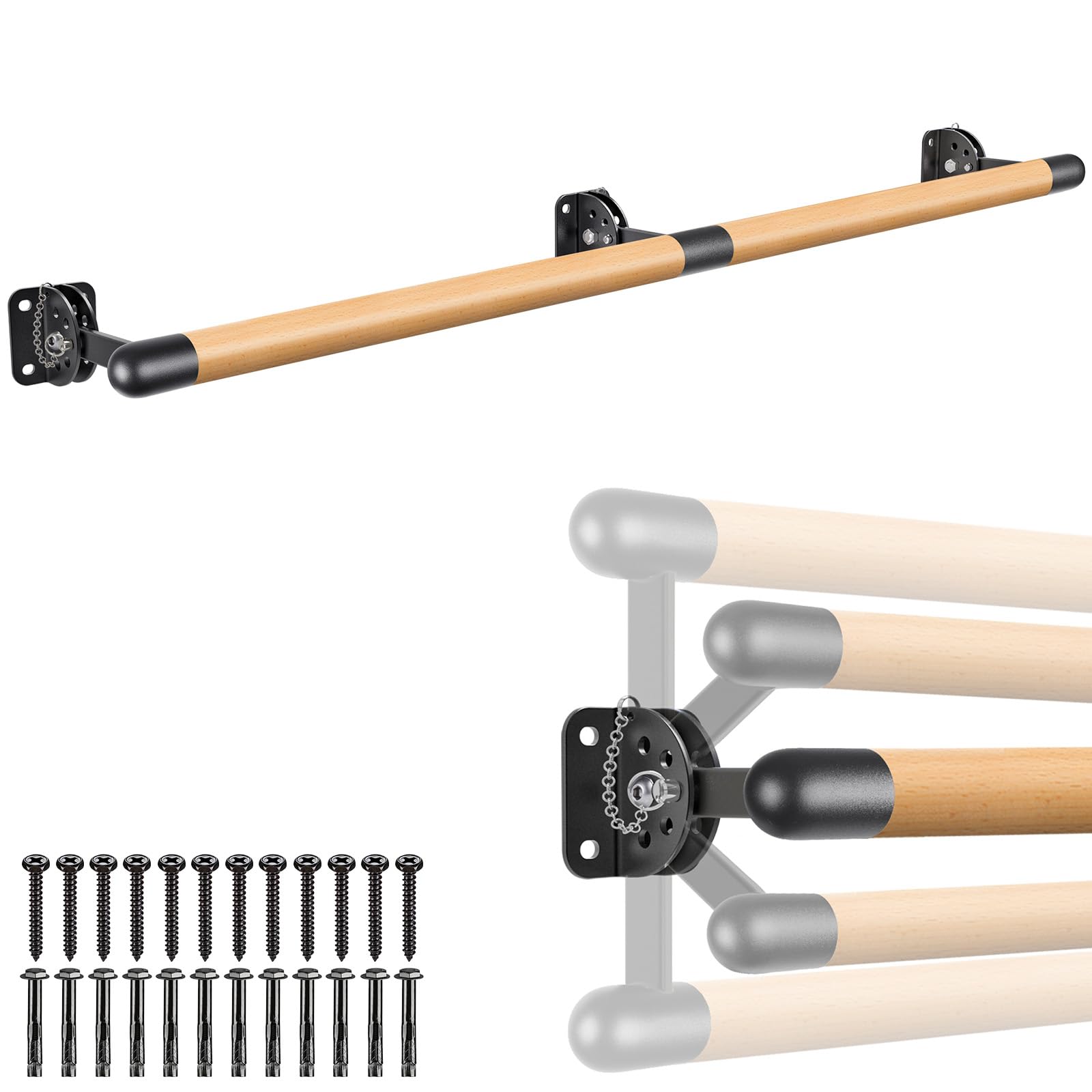
A solid beech wood wall barre that folds down when practice is over.
The Dolibest wall-mount solves one of the biggest problems with permanent barres: they eat wall space even when you are not using them. Its metal bracket uses a loading-pin design that lets the barre flip up for practice and fold flat against the wall for storage. It adjusts to five different heights, so a single installation can serve a 4-year-old beginner in the morning and an adult doing physical therapy at night. The barre itself is solid beech wood, finished smooth enough that owners note you can slide your fingers from the wood to the metal without catching a seam.
Durability and quality are the two most-praised aspects, and owners confirm the barre holds up well even after six months of heavy use by children who climb on it. The bracket has four mounting holes per side, which provides more stability than the two-hole designs found on cheaper wall-mounts. The catch is installation: as with most wall-mounts, the bracket spacing does not always align with standard 16-inch stud spacing. Several owners solved this by first mounting a board (plywood or lumber) to the studs, then attaching the barre brackets to that board. This adds about 30 minutes to setup but results in a rock-solid anchor.
Fold-and-forget design: If you need a barre that disappears when not in use, the Dolibest Space Saver is the most thoughtfully engineered option at this price. The beech wood and four-hole brackets give it longevity.
Stud alignment hurdle: Do not expect the brackets to line up perfectly with your wall studs. Plan on buying a piece of lumber as a backer board to avoid frustration.
Reach for this if: you have multiple family members at different heights and need one barre that adjusts — and folds out of the way.
Look elsewhere if: you want the simplest possible install — this one rewards a little extra planning.
5. SELEWARE Height Adjustable Freestanding Ballet Bar

The freestanding barre that feels as planted as a wall-mount during practice.
Stability is the single most-discussed aspect of this SELEWARE freestanding barre, and it is unanimously positive — a rare feat for a portable stand. The frame is built from alloy steel tubing with a matte black paint finish, and it supports up to 350 lbs. The wood crossbars are the same smooth, natural-finish wood used in SELEWARE’s wall-mount line. Assembly takes about 10 minutes, and owners consistently describe it as “extremely easy.” The height range of 11 inches to 47 inches, adjusted via star-shaped hand knobs, covers everyone from a young child to a tall adult. At 4 feet wide, it is compact enough for a bedroom but wide enough for barre exercises that require side-to-side movement.
The barre comes with anti-slip mats on the base that keep it from sliding on hardwood or laminate floors. Owners confirm it does not wobble during practice, even when leaning into a deep lunge or using resistance bands attached to the rail. The 10-year limited warranty adds confidence that cheaper portable barres simply do not offer. The main trade-off is the metal texture of the knobs and frame — a handful of owners note that if you have sensory sensitivity, the feel might not be ideal. For most buyers, the combination of stability, easy assembly, and long warranty makes this the go-to freestanding option.
Why it wins
- 350 lb. capacity with great anti-slip base — stays put on hard floors
- 10-minute no-tool assembly, adjustable from 11 inches to 47 inches
- 10-year warranty is a strong statement of build confidence
The small print
- Metal hand knobs feel industrial; may not suit tactile-sensitive users
- Some owners mention screw holes that need a slight alignment nudge during assembly
Best for: home users who want the stability of a wall-mount barre but need the flexibility to move or store it.
Not ideal for: dancers with textile sensitivities to metal textures — consider a fully wood-grip barre instead.
6. Dolibest Freestanding Ballet Bar, Pink 4ft

A sturdy pink stand that turns practice into something kids actually look forward to.
The Dolibest freestanding barre is aimed squarely at young dancers, and it nails the brief. The pink coating on the steel tubing is vibrant and consistent — owners describe it as “ballet pink,” a shade that matches the aesthetic of studio leotards and tutus. Beyond the color, the barre is genuinely well-built: the steel frame feels solid, and the four large rubber pads on the base prevent slipping during use. Quality is the most-praised aspect, followed by ease of assembly. The height adjusts from 11 inches to 47 inches via a simple knob mechanism, so the barre can grow with a child from beginner through intermediate levels.
Owners consistently report that the barre is sturdy enough to support an adult’s weight during light stretching, making it a shared family tool rather than a toy. The 4-foot width is appropriate for a single child or an adult but will feel cramped for two users. The rubber pads protect hardwood floors from scratches, a detail parents appreciate. The only minor complaint across reviews is that one of the plastic adjustment knobs can crack if over-tightened, though owners note this does not affect the structural durability of the barre itself.
Perfect for young dancers: The pink color and 13.5 lb. weight make it easy for a child to move on her own, while the steel frame handles real practice without wobbling.
Adult use note: Fine for adult stretching and light barre work, but the pink finish is the main draw here — theater-conscious parents and their dancers love it.
Ideal for: a child who takes ballet seriously and deserves a barre that matches her passion — without taking over the living room.
Not for: adult-only studios; the pink aesthetic is cheerful but not what most gym spaces call for.
7. UMEKEN Wood/Aluminum Ballet Barre 4 Foot Portable
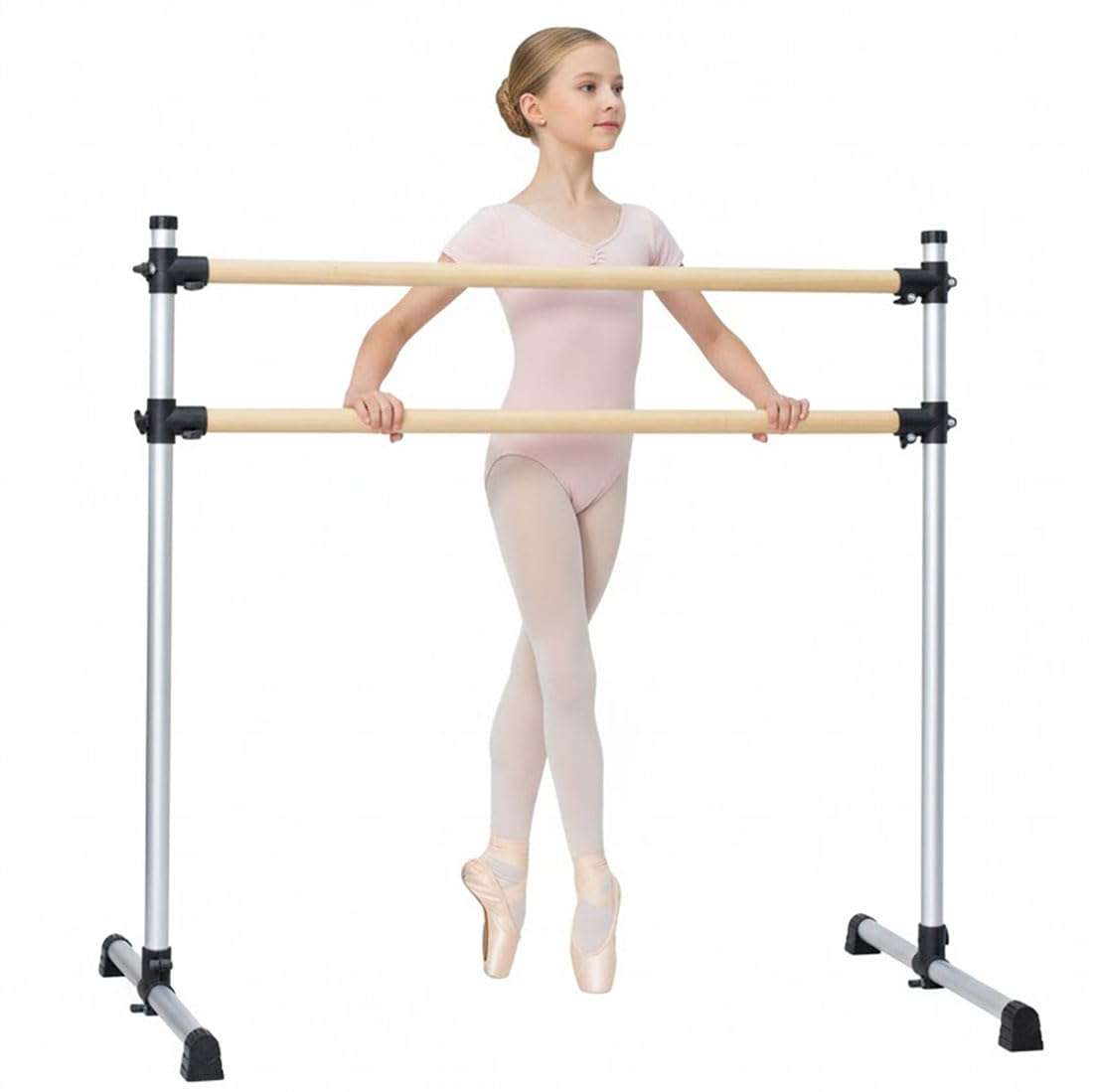
A lightweight portable barre that travels as well as it trains.
The UMEKEN portable barre is built around a simple insight: if you are going to move your barre between rooms, studios, or even to a park, it needs to be genuinely light without sacrificing real weight capacity. The rail is solid wood, but the supporting frame is premium aluminum with a powder-coated finish, keeping the total package light enough to carry easily. It supports up to 350 lbs. and adjusts from the bottom to 46 inches via hand-tightened knobs — no tools required. The barre comes with a carry bag, which is a practical addition that most portable barres skip.
Assembly is the most-praised aspect: owners say a 13-year-old can put it together alone in minutes. The wood bar itself is smooth and comfortable for long practice sessions. The honest trade-off, echoed in many reviews, is that freestanding barres without a wide base can shift if you lean hard or apply lateral force. Owners note that the bars can slide down with heavy leaning — “that’s expected of any barre not actually anchored to anything,” as one buyer put it. The rubber pads on the bottom do help prevent tipping, but for intense ballet practice involving full-body weight on the barre, a wall-mounted unit is still the safer bet.
Travel-friendly build
- Aluminum frame keeps weight low; carry bag makes it genuinely portable
- 350 lb. capacity in a package that assembles without tools
- Smooth wood rail feels great for stretching and light barre work
Stability limits
- Bars can slide down under heavier leaning — not suitable for intensive adult ballet
- Base knocks out of place if you bump it; needs careful positioning
Best for: virtual ballet classes, travelers, and home users who need a barre that stows in a closet between sessions.
skip it if: you plan to put full body weight on the barre for advanced barre work or acrobatics.
8. Costzon Portable Ballet Barre, 4ft Freestanding Double Bar
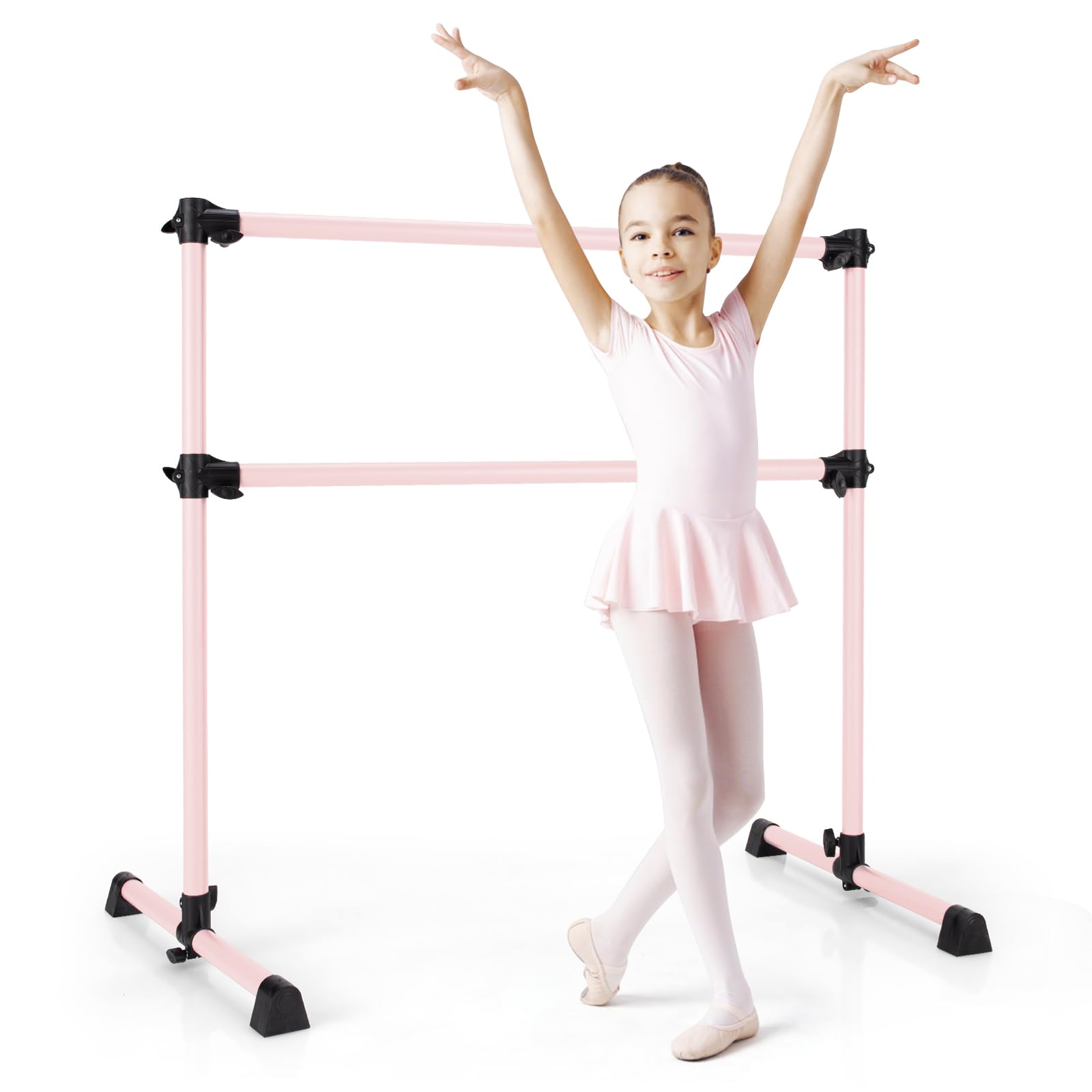
A budget-friendly double-barre stand that outperforms pricier rivals.
The Costzon portable barre is the most affordable way to get a double-barre setup — two rails at different heights on a single freestanding frame. The base is 4 feet wide, and both bars adjust from 7 inches to 46 inches via simple knobs. The frame is made from iron with ABS plastic connectors, and the whole unit weighs just 13.5 lbs., making it easy to slide under a bed or carry to another room. Home use is the most-praised aspect; owners love that it fits in a small apartment and comes together in minutes. Stability gets strong marks too — customers note it never shakes even when putting full weight on the bar.
The double-bar design is genuinely useful: you can set one low for yoga stretches and one at hip height for barre exercises, or use both at different heights for two children practicing side by side. The light pink color and compact frame make it especially popular with parents of young dancers. The trade-off, mentioned by a few owners, is that the bottom legs (the base feet) can get in the way of your own feet during floor work if you stand too close to the frame. It is a minor spatial adjustment, not a flaw in the build. Some owners also note that one plastic piece can crack from over-tightening, though the structure remains functional.
Double barre for the price of one: Two adjustable rails for under is exceptional value. The iron frame keeps the barre stable without adding bulk.
Foot-space note: The base legs extend roughly 12 inches from the frame, so you need to be mindful of where you plant your standing foot during floor stretches.
Ideal for: budget-conscious families with two kids or an adult who wants both stretching and barre heights in one unit.
Not for: heavy daily use in a professional studio — the ABS connectors wear faster than all-metal construction.
9. Kipika Wall Mounted Traditional Solid Wood Ballet Barre

A short, sturdy wall-mount that fits tight spaces without compromising function.
The Kipika wall-mount is the shortest of the permanent options at 3 feet, which makes it ideal for narrow hallways, beside a mirror, or in a child’s bedroom. The barre is solid wood with a polished, painted finish that is smooth to the touch and free of burrs. The metal support bracket adjusts to five different heights via a solid metal regulator, so a family of varying heights can share one installation. It supports up to 300 lbs. when mounted correctly into studs or concrete using the included hardware. Quality is the most-praised aspect, and buyers call it “very very nicely made” and “heavy duty.”
The biggest caveat is the installation experience. The instructions are minimal — buyers describe it as lacking step-by-step guidance. The mounting brackets are not always aligned for standard 16-inch stud spacing, meaning you may need to mount a board to the wall first and attach the barre to that. Some purchases have also arrived with two identical (left or right) brackets instead of a left-right pair, which forces a creative mounting approach. Despite the setup hassle, owners consistently say the finished product is excellent and worth the extra effort. As one buyer put it: “sturdy, easy wall mount (~1 hr) but lacks step-by-step instructions.”
Space-efficient performer
- 3-foot length fits tight spaces where longer barres cannot go
- Five height adjustments with a sturdy metal regulator, 300 lb. capacity
- Solid wood surface is smooth and comfortable for grip
Installation quirks
- Minimal written instructions; requires power tools and some DIY problem-solving
- Bracket spacing may not align with wall studs — backer board recommended
Best for: a small room or hallway where a longer barre would overwhelm the space, and for users who are comfortable with a bit of DIY installation.
Think twice if: you want a quick, tool-free mount — this one demands patience and a power drill.
Understanding the Specs
Weight Capacity
This tells you how much load the barre can safely support during use. A wall-mounted barre that says “100 lbs. per linear foot” means a 4-foot section can hold 400 lbs. without the bracket or rail failing. Freestanding barres typically list a single total capacity, often 300 to 550 lbs. For light stretching and barre work, 250 lbs. is plenty. If you plan to hang your full body weight or use resistance bands anchored to the barre, look for 350 lbs. or more.
Rail Diameter
The standard ballet barre diameter is 1.5 inches. This is not a random measurement — it matches the grip span of an average adult hand, allowing for a secure hold without overstretching the fingers. A thinner rail (common on cheaper kids’ barres) can cause hand fatigue. A thicker rail makes it harder to wrap your fingers around. Stick with 1.5 inches unless you have specific hand-size needs.
Bracket Thickness and Mounting Holes
For wall-mounted barres, the bracket metal thickness and the number of mounting holes directly affect stability. A 5mm thick bracket with four mounting holes is significantly more secure than a thin bracket with two holes. Two-hole brackets are fine for a single adult user doing light-to-moderate exercise. Four-hole brackets distribute load better and are worth the upgrade if the barre will see heavy daily use or multiple users.
Height Adjustment Mechanism
On wall-mounted barres, adjustability means a bracket with multiple slots or pins that let you move the rail up or down by a few inches. On freestanding barres, it is usually a telescoping tube locked by a hand-tightened knob or a star-shaped dial. The best mechanisms use metal-on-metal contact rather than plastic parts, which wear out faster. Check that the locking mechanism feels tight when engaged — a loose joint will make the barre feel unstable even if the base is solid.
FAQ
Can I install a wall-mounted ballet barre into drywall without finding studs?
What is the standard height for a ballet barre?
How much weight can a freestanding ballet barre hold?
Is a wooden barre better than a metal barre?
How long does a wall-mounted ballet barre take to install?
Can a freestanding ballet barre be used on carpet?
What is the difference between a single-barre and a double-barre freestanding setup?
Why do some wall-mounted barres have fewer mounting holes than others?
Can I use a ballet barre for pull-ups or hanging exercises?
Does a ballet barre need to be perfectly level to be safe?
Final Thoughts: The Verdict
For most users, the best ballet barre winner is the VITA Barre Classic WB15 because it delivers the most stable, permanent, and high-quality wall-mounted barre a home studio can have — backed by American craftsmanship and overwhelming owner satisfaction on quality and durability. If you want a freestanding barre that feels as solid as a wall-mount, grab the SELEWARE Height Adjustable Freestanding Bar with its 10-year warranty and 350 lb. capacity. And for a portable double-barre setup that travels easily, the VITA Barre Prodigy is the one to reach for, with its tool-free assembly and 46-inch adjustability range.
How We Picked
We do not accept paid placement. Every pick is matched to a real buyer and a real use-case; we do not hands-on test units.
Sources & Methodology
Specifications: manufacturer listings and product documentation. Review insights: verified customer reviews, as of July 2026. Pricing: not shown on this page (it changes often); check the current price via the retailer link.
As an Amazon Associate, Gadgets Feed earns from qualifying purchases. This does not affect which products we feature.