
Our readers keep the lights on and my morning glass full of iced black tea. As an Amazon Associate, I earn from qualifying purchases.
Specs are compiled from manufacturer listings and verified buyer reviews and can change over time — please confirm the key details on the product page before buying.
Finding the right camera that delivers professional results while staying affordable is a balancing act between sensor quality, autofocus speed, and video capability. In a market flooded with options, the real challenge is pinpointing the one that matches your specific needs, whether that’s blazing-fast action tracking or cinematic 4K video.
I’m Min — the founder and writer behind Gadgets Feed. This guide is built by comparing the manufacturers’ published specifications and the patterns across verified customer reviews, so you get each pick’s real strengths and trade-offs instead of marketing spin.
Whether you are upgrading from a smartphone or stepping into interchangeable lenses for the first time, we have analyzed the top contenders to help you find the perfect camera under 1500 that fits your creative workflow.
Our Picks at a Glance


How To Choose The Best Camera Under 1500
Choosing the right camera under depends on understanding three core pillars: the type of photography or video you do, the sensor size that fits your needs, and the autofocus system that keeps your subjects sharp. A poor choice can leave you with blurry action shots or flat-looking video.
Sensor Size: APS-C vs. Full-Frame vs. Micro Four Thirds
The sensor is the heart of the camera. A larger sensor (Full-Frame) captures more light, which means better performance in dim conditions and more control over background blur. APS-C sensors are a fantastic middle ground, offering a significant upgrade over smartphones and most Micro Four Thirds (MFT) cameras, which are smaller but allow for incredibly compact bodies and lenses.
Autofocus: The Speed That Saves Your Shot
If you photograph kids, pets, or sports, autofocus (AF) is arguably more important than megapixels. Look for phase-detection AF points, which are fast and accurate. The number of AF points (e.g., 425 vs 9) gives you a sense of how much of the frame the camera can track a subject across. Mirrorless cameras often have an edge over DSLRs here because the AF works directly on the image sensor.
Video Capabilities: More Than Just 4K
If video is your priority, check the specifications carefully. Many cameras under offer 4K resolution, but some crop the sensor when recording, which reduces your lens’s field of view. Look for features like headphone jacks for monitoring audio, high frame rates for slow motion (like 120p), and log profiles for color grading in post-production.
Quick Comparison
| Model | Best For | Megapixels | Autofocus Points | Video Specs | Amazon |
|---|---|---|---|---|---|
| Sony Alpha a6400★ Best Overall | Best Overall / Hybrid Shooters | 24.2 MP | 425 | 4K | Amazon |
| Canon EOS Rebel T7Budget Champion | Budget Starter Kit | 24.1 MP | 9 | 1080p | Amazon |
| OM SYSTEM E-M10 Mark IVCompact Artist | Compact Travel / Retro Style | 20.3 MP | 121 | 4K/30p | Amazon |
| Nikon D5100 | Value DSLR / Beginners | 16.2 MP | 11 | 1080p HD | Amazon |
| Panasonic Lumix G7 | 4K Video Value | 16 MP | 49 | 4K/30p | Amazon |
| Panasonic Lumix GH4 | Pro Video (Body Only) | 16.05 MP | 49 | 4K/24p Cinematic | Amazon |
| Nikon D5600 | Intermediate DSLR | 24.2 MP | 39 | Full HD 1080/60p | Amazon |
| Fujifilm X-M5 | Travel & Film Simulations | 26.1 MP | — | 6.2K Video | Amazon |
| Canon EOS RP | Entry-Level Full-Frame | 26.2 MP | — | 4K UHD | Amazon |
| Nikon Z50 II | All-in-One Travel Kit | 20.9 MP | 231 | 4K/60p | Amazon |
| Sony Alpha a6700 | Top Performer / Hybrid Pro | 26 MP | 759 | 4K/120p | Amazon |
In‑Depth Reviews
1. Sony Alpha a6400 APS-C Mirrorless Camera Body 4K Black
Our pick — over 4.5★ from 600+ verified ratings; the strongest balance of quality and price.
Its 425-point autofocus locks onto subjects in 0.02 seconds.
This mirrorless body is the crowd favorite for a reason—owners praise its “fast, accurate autofocus” and the “vibrant colors” from the 24.2MP sensor above nearly everything else. The 425 phase-detection points cover 84% of the sensor, which means it can lock onto a bird in flight or a running child without hunting. You get up to 11fps continuous shooting, so you can rattle off a burst of RAW images and still pick a sharp keeper.
At this price, it is also a formidable video tool. The 180-degree tiltable LCD flips up for vlogging, and you can create time-lapse movies or slow-motion clips without external software. The real-world trade-off is that the 4K footage suffers from a pronounced rolling shutter (the “jello effect” when you pan quickly), and there is no headphone jack for audio monitoring. Owners call it “compact for travel” and note the wide Sony E-mount lens ecosystem. It is small enough to slip into a jacket, yet the quality rivals cameras that cost hundreds more.
For a dedicated camera that feels modern, fast, and capable across both stills and video, this is the one to beat. The kit does not include a lens, so you will want to budget for a good E-mount lens right away.
What Wins People Over
- Blazing 0.02 sec autofocus with real-time tracking over 425 points—stays locked on moving subjects.
- 24.2MP sensor delivers crisp, natural colors and excellent detail straight out of camera.
- Compact body with a flip-up screen makes it a genuine everyday carry for creators.
The Honest Trade-Offs
- No in-body image stabilization—you will rely on IS lenses or a gimbal for smooth video.
- Severe rolling shutter in 4K mode; fast pans produce a wobble.
- Touchscreen is finicky and the menu system can feel overwhelming with “a million features.”
Reach for this if: you are a hybrid shooter who needs class-leading autofocus and a compact body that travels well.
Look elsewhere if: smooth, professional-grade 4K video or in-body stabilization are non-negotiable for your work.
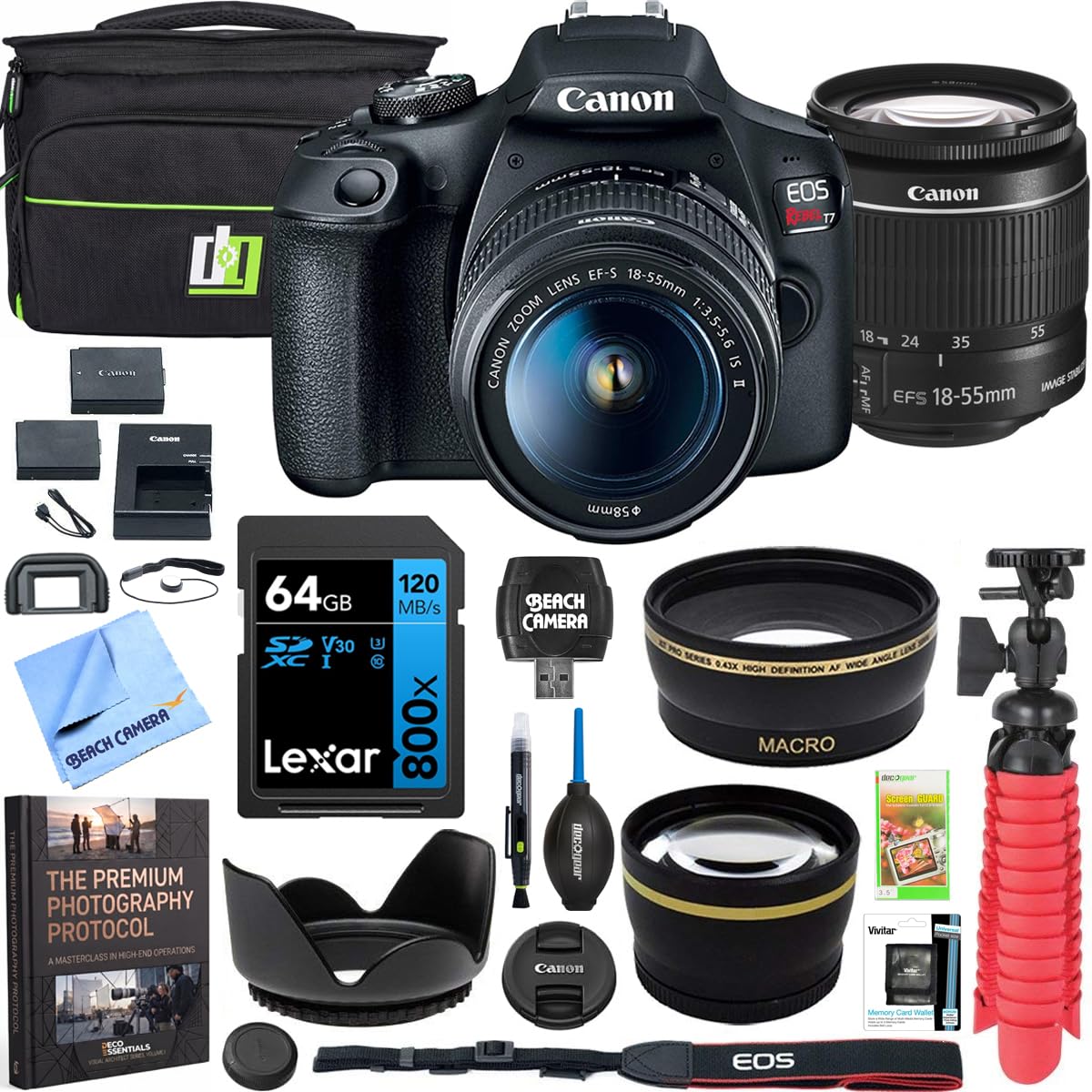
2. Canon EOS Rebel T7 DSLR Camera Bundle with EF-S 18-55mm is II Lens
This bundle includes a camera, lens, bag, and accessories for a complete starter setup.
This bundle is designed to eliminate the “now what?” feeling after you unbox a camera. It comes with a 24.1MP CMOS sensor and the versatile 18-55mm kit lens, but the real value is in the extras: a Deco Gear bag, spare battery, a 64GB SDXC card, a tripod, and cleaning tools. The 9-point autofocus system is a generation or two behind modern mirrorless cameras, but for portraits, landscapes, and everyday shots, it works reliably. Owners consistently say the “photo quality is amazing” for the price and that it is “easy to use” for beginners.
The honest catch here is performance in dynamic situations. The 9 autofocus points feel sluggish when tracking anything faster than a casual walk, and a few buyers report the battery has been known to drain quickly—one noted only eight shots after a full charge, though this seems to be an occasional defect. The accessory bag is also tight for the bundled items. This is not a camera for sports or fast action, but for someone stepping up from a phone, the value per dollar is undeniable.
The bottom line: A complete learn-and-shoot package if you want to explore DSLR photography without spending extra on accessories. skip it if you need fast autofocus or plan to shoot fast-moving subjects.
Best for: beginners who want a turnkey bundle and are learning the basics of composition and exposure.
Think twice if: you need a camera for action, sports, or anything that requires more than 9 autofocus points.
3. OM SYSTEM Olympus E-M10 Mark IV Silver Micro Four Thirds System Camera
Its 5-axis IBIS enables sharp 1-second handheld exposures in a compact retro body.
This camera is the choice for anyone who wants to carry a powerful camera without carrying a bag. The 20.3MP Micro Four Thirds sensor paired with the 5-Axis In-Body Image Stabilization is its standout feature, capable of 4.5 shutter speed steps of compensation. That means you can take 1-second handheld exposures that would be impossible on most other cameras—owners confirm this feature delivers. The flip-down monitor enables a dedicated selfie mode, a rare and genuinely useful touch for a compact system camera.
The 121 contrast-detect autofocus points are accurate for still subjects, but the system can hunt in lower light. The body is small and lightweight, and paired with the 14-42mm EZ pancake lens, it is “almost pocketable” for a jacket pocket. The main downside reported by owners is reliability—some units arrive with the camera failing to recognize the lens or simply not powering on. This is a risk, though most units appear to function well. It is a fantastic creative tool for travel, street, and family photography where size and stabilization matter most.
Why It Wins
- 5-Axis IBIS lets you shoot 1-second handheld exposures—a superpower for low-light scenes.
- Incredibly small and light, especially with the pancake kit lens; genuinely fits a coat pocket.
- 20MP sensor with 16 Art Filters (including Instant Film) gives creative looks in-camera.
Why to Be Cautious
- Reliability is the most-discussed negative; some units have lens recognition or power-on failures.
- Contrast-detect autofocus (121 points) is not as snappy as phase-detect for tracking moving subjects.
- No external charger included, and it uses a proprietary port, not USB-C.
Reach for this if: your top priorities are a compact, stylish body and the best in-body stabilization in this price bracket.
Look elsewhere if: you need rock-solid reliability from the start or phase-detect autofocus for action.
4. Nikon D5100 Digital SLR Camera with 18-55mm f/3.5-5.6 AF-S DX VR Nikkor Zoom Lens

This 16.2MP DSLR remains a reliable, highly-rated choice for beginners.
The Nikon D5100 is an older model, but it remains among the most highly-rated DSLRs in its class for a simple reason: it delivers. The 16.2MP DX-format CMOS sensor produces crisp, tack-sharp images, and the 11-point AF system with 3D tracking punches well above its spec sheet. A huge number of owners praise its “crystal sharp image quality” and ease of use. The side-articulating 3-inch LCD with 920,000 dots is a boon for waist-level or awkward-angle shots, and the camera can shoot 1080p HD video.
The real standout for this camera is its community—over 860 ratings with a nearly perfect average score, making it the most-validated budget pick on this list. It shoots up to 4 frames per second continuous, and with ISO expandable to 25600, it handles low-light situations like a champ. The main limitation is its age: the video is limited to 1080p, the autofocus in live view is slow, and the sensor resolution is outclassed by newer 24MP cameras. But if you want a tank-like DSLR that teaches you photography and delivers excellent stills for a price that leaves room for great glass, this is it.
Our read: The best value option for purists who value image quality and durability over the latest specs. Not the choice for 4K video or blistering burst rates.
Best for: beginners and budget-conscious photographers who want a reliable, proven DSLR with excellent image quality.
pass on it if: you need 4K video, high-speed continuous shooting, or the latest autofocus technology.
5. Panasonic LUMIX G7 4K Digital Camera with 14-42mm Mega O.I.S. Lens

This mirrorless delivers 4K/30p video and 4K Photo modes at a budget-friendly price.
This camera is often called the king of budget 4K for a reason. The 16 megapixel Micro Four Thirds sensor (with no low-pass filter for extra sharpness) captures 4K QFHD video at 3840 x 2160, and the 4K Photo modes let you extract 8-megapixel stills from that video stream—great for catching a split-second moment. Owners rave about the “incredible 4K video capabilities” and call it a “perfect vlogging device.” The high-resolution OLED live view finder (2,360K dot) and the 3-inch tilt/swivel touchscreen are crisp, even outdoors.
The body weighs a very light 400g, making it easy to rig for video, and it features a 3.5mm external mic port. The main trade-off reported by owners is weak performance in low light, where ISO 1600 is “barely usable.” There is also no in-body stabilization—you rely on the lens’s O.I.S. or a gimbal. The autofocus is fast in good light but becomes “unreliable” in dim conditions. This is a video-first camera that handles stills well for the price, but it suits a controlled environment better than a dark concert hall.
What You Get
- Excellent 4K/30p and 4K Photo modes with high bitrate (100Mbps) and easy-to-edit MP4 files.
- Light body (400g) with a superb grip, dual control dials, and customizable buttons.
- 3.5mm external mic input for dramatically better audio in vlogs and interviews.
The Limitations
- Poor low-light performance—barely usable at ISO 1600.
- No in-body image stabilization; you will need a gimbal or stabilized lens for smooth handheld video.
- Autofocus is not reliable in low light; better suited for controlled studio environments.
Reach for this if: you are a vlogger or videographer on a budget who needs 4K video and external audio recording.
Look elsewhere if: you shoot mostly in low light or need reliable autofocus in dim conditions.
6. Panasonic LUMIX DMC-GH4KBODY 16.05MP Digital Single Lens Mirrorless Digital Camera (Body Only)

This body offers true 4K/24p cinematic video and 96fps slow-motion for filmmakers.
The GH4 is a piece of video history. It was the first mirrorless camera to offer true 4K 24p cinematic video (4096 x 2160) at a consumer-friendly price, and it still delivers. The magnesium alloy body is built for professional use, with a high-speed 49-area autofocus system tune for both photo and video. Owners praise its “crisp, highly grade-able 4K image” and the 96fps slow-motion in 1080p, which is a legitimate tool, not a gimmick. The camera is also highly customizable, with focus peaking, zebras, and other pro video aids built in.
Where the GH4 shows its age is low-light performance, which is “unusable above ISO 1600” according to owners. The 2.5x crop factor in 4K mode is severe—your wide-angle lens becomes a standard lens. The micro HDMI port is also fragile, and the Wi-Fi connectivity with Mac is problematic. This is a body-only purchase, so you will need to invest in Micro Four Thirds glass. It remains a brilliantly capable tool for controlled video work, but superior low-light and IBIS in modern cameras have overtaken it.
The verdict: A fantastic choice for a dedicated videographer who can work around its low-light limits and crop factor. Not a good pick for general stills photography.
Best for: filmmakers and video creators who want true 4K cinematic video and 96fps slow-motion on a budget.
it’s not for you if: you need good low-light performance, in-body stabilization, or a versatile all-around camera.
7. D5600 DX-Format Digital SLR w/AF-P DX NIKKOR 18-55mm f/3.5-5.6G VR

A lightweight DSLR that gives you full control without the bulk of a pro body.
The 24.2MP DX sensor delivers crisp photos, and the 39-point autofocus system with phase detection is responsive and reliable for everyday shooting. The 3.2-inch vari-angle touchscreen with 1.037 million dots is one of the best in its class, making it easy to compose from high or low angles. It records Full HD 1080p video at 60 fps, giving you smooth slow-motion playback in post.
Owners praise its “crystal-sharp optics” and find it “lightweight and easy to use.” The connectivity is a mixed bag—Wi-Fi via SnapBridge is useful for remote shooting and transferring images, but the app is “buggy” and requires airplane mode to function. One reviewer noted that the single command dial makes full manual mode more cumbersome than on a dual-dial DSLR. For the price, it is an excellent photographer’s camera that prioritizes still image quality over video, and it leaves you with budget for a great 50mm f/1.8 lens.
Solid pick for: the enthusiast photographer who wants a lightweight body, a brilliant touchscreen, and a proven Nikon lens system. Less ideal for video-centric creators.
Reach for this if: still photography is your focus and you value a lightweight body with a large, articulating touchscreen.
Look elsewhere if: you need 4K video, in-body stabilization, or a more sturdy manual-control workflow.
8. FUJIFILM X-M5 Mirrorless Digital Camera XC15-45mmF3.5-5.6 OIS PZ Lens Kit – Black

The smallest X-series body packs a professional 26.1MP sensor and 6.2K video—a travel dream.
The Fujifilm X-M5 is a featherweight powerhouse at just 12.5 oz (around 355g including the battery). It uses the same 26.1MP APS-C X-Trans 4 CMOS sensor found in the revered X100V, delivering stunning image clarity and rich colors. The X-Processor 5 handles image processing and autofocus with speed, and the camera can record cinematic 6.2K video. The 20 Fujifilm Film Simulations (eight accessible via a dedicated dial) are a huge draw for anyone who loves getting a unique look straight out of the camera.
Owners are thrilled with the “tiny, excellent for travel” form factor, noting you can “do some professional work with it.” The build quality is praised, but the flip screen (rather than a tilting one) feels “flimsy” to some. The app integration is a bit finicky and does not always work. This camera is for the photographer who values style, in-camera looks, and portability above all else. It is a niche pick, but for travel and street photography, it is magical.
Why It Stands Out
- 26.1MP APS-C X-Trans 4 sensor (same as the X100V) for stunning color and low-light performance.
- 6.2K video capability—a huge and rare feature at this weight and price.
- 20 Fujifilm Film Simulations create iconic, ready-to-share looks in-camera.
The Nitpicks
- Flip screen design feels a bit fragile compared to a standard tilt screen.
- App integration is finicky and does not always connect reliably.
- Camera is new with limited owner feedback; long-term reliability is unproven yet.
Best for: travel photographers and style-conscious creators who want a pocketable camera with professional image quality.
Think twice if: you need a fully rugged build or a reliable app connection for image transfer.
9. Canon EOS RP Full-Frame Mirrorless Interchangeable Lens Camera + RF24-105mm Lens F4-7.1 is STM Lens Kit

The most affordable way to step into a full-frame sensor and the Canon RF ecosystem.
For under, the EOS RP gives you the most important upgrade any photographer can make: a full-frame sensor. The 26.2MP CMOS sensor with the DIGIC 8 processor delivers noticeably better low-light performance, more depth, and finer detail than any APS-C camera at this price. The Dual Pixel CMOS AF is fast and accurate for stills and excellent for video. The kit includes the RF24-105mm F4-7.1 IS STM lens, which features up to 5 stops of optical image stabilization, making it a versatile walk-around lens.
Owners who upgraded from a Canon T3i or Nikon D3500 “love this camera” and call it “a fantastic way to get into Full Frame while staying affordable.” The 4K video, however, has a significant crop and no Dual Pixel AF, making it less useful than the superb 1080p mode. The battery life is also a recurring concern, though a cheap third-party multi-pack solves the issue. For still photography, the depth of field control and low-light advantage of full-frame are transformative, and this is the gateway.
Our take: The ideal entry point into full-frame photography for hybrid shooters. The 4K crop is a real limitation, but the still image quality is a clear step up from any crop-sensor camera.
Reach for this if: you are a photographer who wants full-frame image quality for portraits, landscapes, and travel, and you value a lightweight body.
Look elsewhere if: 4K video quality and sturdy battery life are your highest priorities.
10. Nikon Z50 II with Two Lenses

The two-lens kit that covers wide-angle to telephoto—no second purchase required.
The Nikon Z50 II is designed to be a complete, versatile system straight from the start. It comes with two lenses: the NIKKOR Z DX 16-50mm f/3.5-6.3 VR for everyday walk-around shots and the NIKKOR Z DX 50-250mm f/4.5-6.3 VR for close-ups and portraits. The 20.9-megapixel DX sensor (APS-C) is larger than a typical smartphone sensor, capturing “lifelike colors and incredible details from dawn to dusk.” The 231 autofocus points are fast, and the camera can automatically detect nine distinct subjects, including birds and airplanes.
Owners call it “lightweight, easy to carry” and find it “easy to use, but you can still do many of the things professionals do.” The build quality is excellent, and the 31 built-in Picture Control presets let you dial in a look without editing on a computer. The main downsides mentioned are that some owners have issues with external flash units and the included battery charger is slow. This two-lens kit covers wide-angle to telephoto, ideal for travel and family events without lens swaps.
What Makes It Great
- Two-lens kit (16-50mm + 50-250mm) covers a huge zoom range for any scene.
- 231-point hybrid autofocus with subject detection for people, pets, and birds.
- 4K/60p video with in-camera slow motion and electronic VR for steadier footage.
Where It Falls Short
- Some compatibility issues reported with external flash units.
- Battery charger is slow; a spare battery is recommended for a full day of shooting.
- The 20.9MP sensor is lower resolution than some 24MP+ competitors in this bracket.
Best for: travelers and families who want a versatile, do-it-all system without buying extra lenses or gear.
look elsewhere if: you need the highest possible resolution for large prints or professional sports photography.
11. Sony Alpha a6700 APS-C Mirrorless Camera Body 26MP 4K Black

The crop-sensor king with 759 AF points and 4K at 120fps—pro specs in a compact body.
The Sony a6700 is the top-tier mirrorless choice for anyone who can stretch their budget to the ceiling. It features a new 26.0MP APS-C Exmor R back-illuminated sensor paired with a dedicated AI processor for “superb” subject tracking. The 759 autofocus points cover nearly the entire frame, and the camera can recognize eyes for people, animals, and vehicles with an incredible speed. It shoots 4K video oversampled from 6K at up to 60fps, and can record 4K/120p for ultra-smooth slow motion.
Owners call it “a workhorse” and “one of the best APS-C cameras,” praising its sharp, detailed images and “incredible, fast, accurate autofocus.” The 5-Axis In-Body Image Stabilization (IBIS) is decent, but owners note it is not enough for smooth handheld video without a gimbal. The menu system remains complex, a classic Sony criticism. This is a no-compromise hybrid camera that outpaces the a6400 in every metric, especially video. It is the top-tier pick for under, edging out the a6400 with its superior sensor, IBIS, and video features.
Where It Dominates
- 759-point phase-detection AF with dedicated AI processor for flawless subject tracking.
- 26MP sensor with excellent dynamic range and low noise; 4K/60p oversampled from 6K.
- 5-Axis IBIS and 4K/120p slow-motion for advanced videography.
The Small Annoyances
- Sony’s complex menu system requires a real time investment to learn.
- IBIS is good but not enough for completely smooth handheld gimbal-style video.
- Body only—no lens included, so you must budget for a high-quality lens separately.
Reach for this if: you want the absolute best APS-C camera under for hybrid photo and video, with class-leading autofocus.
Look elsewhere if: you need a lens included in the price or find complex menus frustrating.
Understanding the Specs
Autofocus Points
You will see this number everywhere, from 9 to 759. The autofocus (AF) points are the spots on the sensor where the camera measures focus. More points (like 425 or 759) mean the camera can lock onto a subject across a much wider area of the frame, making it easier to track a moving target like a bird or a child. A low count (like 9) works fine for static portraits but will cause you to miss action shots.
Sensor Megapixels vs. Size
Megapixels (MP) are only part of the story. A 24MP sensor on a larger APS-C or Full-Frame sensor will capture significantly more light than a 24MP sensor on a tiny phone sensor. This is why larger sensors perform so much better in low light. A 20.3MP Micro Four Thirds sensor is smaller than an APS-C sensor, so it trades some low-light performance for a much smaller camera body and lens.
In-Body Image Stabilization (IBIS)
IBIS is a feature that physically moves the sensor to counteract your hands shaking. It is a huge advantage, especially for video, because it smooths out the footage without needing a bulky gimbal. For stills, it allows you to shoot at much slower shutter speeds (like 1 second) hand-held and still get a sharp photo—something impossible on a camera without IBIS. The OM System E-M10 Mark IV is famous for this.
Crop Factor
The crop factor is a simple concept: a lens acts like it is a different focal length on a smaller sensor. A Micro Four Thirds camera has a 2x crop, so a 25mm lens acts like a 50mm lens on a Full-Frame camera. This is great for getting extra reach on telephoto shots but bad for wide-angle photography. This matters a lot if you shoot landscapes indoors or tight spaces.
FAQ
Should I buy a mirrorless or DSLR camera under?
Is a Full-Frame camera possible for under?
How many megapixels do I really need?
Will a Micro Four Thirds camera like the Olympus E-M10 be good enough?
What is the best camera for video under?
Do I need a camera with a flip screen for vlogging?
Is the Canon EOS RP good for beginners?
Which camera has the best battery life?
Can I use my old Nikon/Canon lenses with these cameras?
What does “crop factor” mean for lenses?
Final Thoughts: The Verdict
If you want one dependable pick, the best camera under 1500 is the Sony Alpha a6400 because it combines the fastest autofocus in its class, a proven 24.2MP sensor, and a compact body that travels well for both photos and video. If you want a complete travel kit with two lenses from day one, grab the Nikon Z50 II. And for the absolute best possible hybrid performance with pro-grade video features, the Sony Alpha a6700 is the one to reach for.
How We Picked
We do not accept paid placement. Every pick is matched to a real buyer and a real use-case; we do not hands-on test units.
Sources & Methodology
Specifications: manufacturer listings and product documentation. Review insights: verified customer reviews, as of July 2026. Pricing: not shown on this page (it changes often); check the current price via the retailer link.
As an Amazon Associate, Gadgets Feed earns from qualifying purchases. This does not affect which products we feature.