
Our readers keep the lights on and my morning glass full of iced black tea. As an Amazon Associate, I earn from qualifying purchases.
Specs are compiled from manufacturer listings and verified buyer reviews and can change over time — please confirm the key details on the product page before buying.
A phone anamorphic lens stretches your video into a widescreen cinematic format — the same look Hollywood uses — without cropping a single pixel. But not all anamorphic lenses deliver that signature blue or gold flare evenly across the frame, and some introduce soft edges or require complex apps to even work. This guide cuts straight to the models that actually produce a true 2.35:1 or 2.40:1 aspect ratio with the glass quality to back it up, so you know which ones are worth mounting on your phone.
I’m Min — the founder and writer behind Gadgets Feed. This guide is built by comparing the manufacturers’ published specifications and the patterns across verified customer reviews, so you get each pick’s real strengths and trade-offs instead of marketing spin.
Whether you shoot for social media or short films, the right anamorphic lens for phone turns your mobile setup into a true cinema rig without the bulk of a full camera system.
Our Picks at a Glance


How To Choose The Best Anamorphic Lens For Phone
An anamorphic lens squeezes a wider horizontal image onto your phone’s sensor. When you desqueeze it in an app, you get a cinematic widescreen frame that standard lenses cannot capture without cropping. The key is getting the squeeze factor right for your style and ensuring the mount stays rock-solid while you shoot.
Squeeze Factor: 1.33x vs 1.55x
A 1.33x squeeze produces a final widescreen aspect ratio very close to cinema standard. A 1.55x squeeze gives you a wider 2.76:1 frame after desqueezing, which feels more like an ultra-wide movie format. The 1.55x lenses also tend to produce stronger, more dramatic flare effects, but they require a little more precision to fit inside your phone’s native 1x camera.
Mount Type: 17mm Thread vs T-Mount vs Universal Clip
A 17mm threaded mount screws directly into a dedicated phone case (like Moment or Freewell cases), keeping the lens perfectly centered with zero shift. A T-mount uses a magnetic alignment system and works with corresponding cages or backing plates — very secure but may need an extra purchase. A universal spring clip fits almost any phone but offers less stability; lenses can shift mid-shot and occasionally show the clip edge in your frame.
Flare Color and Glass Coating
Gold-flare coatings add a warm, vintage film look to highlights, while blue-flare coatings create a sci-fi or modern cinema streak. The quality of multi-layer anti-reflective coatings determines how much flare bleeds into the rest of the image and whether contrast stays high. On a budget lens, flares can look washed out or create unwanted ghosting across the whole scene.
Quick Comparison
| Model | Best For | Squeeze Factor | Mount Type | Weight | Amazon |
|---|---|---|---|---|---|
| Freewell 1.55x Gold★ Best Overall | Cinematic gold flares in a premium build | 1.55x | 17mm Thread | 150 g | Amazon |
| SIRUI VD-01Compact Pick | Ultra-light travel with German Schott glass | 1.33x | Clip / 17mm | 18 g | Amazon |
| Zyyini 1.55X | Budget-friendly 1.55x squeeze for experimental shooters | 1.55x | Clip-on | 84 g | Amazon |
| USKEYVISION 1.55X | Affordable metal build with universal phone clips | 1.55x | Clip / 17mm | 50 g | Amazon |
| SMALLRIG 1.33X (4590) | Modular T-mount system with 67mm filter threads | 1.33x | T-mount | 113.5 g | Amazon |
| Freewell 1.33x Gold | Premium 2.35:1 with built-in level gauge | 1.33x | 17mm Thread | — | Amazon |
In‑Depth Reviews
1. Freewell 1.55x Gold Anamorphic Lens for 17mm Mount
Our pick — over 4★ from 20+ verified ratings; the strongest balance of quality and price.
The most dramatic widescreen squeeze you can screw onto your phone today.
The Freewell 1.55x Gold delivers a 2.76:1 aspect ratio after desqueezing. That extreme horizontal stretch fills your frame with rich golden anamorphic flares and soft oval bokeh, giving footage that expensive cinema-lens feel. The all-metal build runs heavy at 150 g (5.3 oz), so it feels substantial in the hand, and the built-in level gauge on the barrel helps you keep horizons straight without guessing.
This lens twists directly into any 17mm threaded mount, working with popular phone cases from Freewell, Moment, or any 17mm rig. Its manual focus range runs from 35 cm to infinity, so close-up shots are possible, but the weight means a gimbal setup may require counterweights to stay balanced. Owners note the gold flares are less subtle than the SIRUI — they intentionally stand out — which makes them ideal for music videos or narrative work where the anamorphic look needs to be front and center.
The crowd favorite earns strong marks for its all-metal caps and faux leather case, with reviews calling it a “solid upgrade” that pairs well with Blackmagic Camera for desqueezing. It is heavier than the SIRUI VD-01 by a wide margin (150 g vs 18 g), and a few owners mention the clamp can feel insecure on non-Freewell cases. For handheld or tripod work, though, it produces the most cinematic result in this lineup.
What wins owners over
- Aggressive 1.55x squeeze yields a true 2.76:1 widescreen — wider than any 1.33x option here
- Build is all metal with a level gauge for accurate horizons right on the lens barrel
- Gold flares and oval bokeh create a distinct cinematic look that software alone cannot replicate
Honest trade-offs
- At 150 g it is heavy enough to challenge gimbal balancing without counterweights
- The 1.55x squeeze demands a 17mm mount phone case — it is not a universal clip-on
Reach for this if: you want the widest possible anamorphic frame from your phone and are okay pairing it with a dedicated 17mm case.
Think twice if: need an ultra-light walk-around lens or shoot exclusively on a gimbal without adding counterweights.
2. SIRUI VD-01 Anamorphic Lens 1.33x for Smartphones
Pocket-sized anamorphic that weighs almost nothing yet delivers real cinema glass.
The SIRUI VD-01 weighs just 18 g — that is roughly the weight of three U.S. quarters, while the Freewell 1.55x weighs 150 g. Despite that tiny footprint, it uses German Schott glass with multi-layer anti-reflection coatings to produce clean 2.40:1 frames and those signature sci-fi-style blue flare streaks. The aircraft-aluminum housing feels far tougher than the weight suggests, and the included hard case keeps it safe in a pocket or small pouch.
It clips onto phones up to 35 mm thick, so most cases can stay on during use. The clip includes a release button for fine-aligning the lens horizontally, which matters because any rotation throws the anamorphic stretch off. Owners praise the packaging and carrying case, and many call it the best anamorphic phone lens for daily carry. The direct screw mount is a step up from universal clips that can slip or scratch a screen.
A few buyers report that the soft hook on the mount can be tough to tighten fully, and the small diameter means the lens edge may appear in frame on phones with thick camera bumps. It works best with a Moment-style case or a direct threaded adapter. The 1.33x squeeze produces a 2.40:1 ratio — less dramatic than the 2.76:1 of the Freewell 1.55x, but still classic cinema widescreen. For travelers and vloggers who want the anamorphic look without a brick in their bag, this is the one.
Why it stands out
- At 18 g it is the lightest anamorphic lens here — disappears in a pocket until you need it
- German Schott glass and anti-reflection coatings keep flares clean and contrast high
- Included hard case, front/rear caps, and smartphone clip offer a complete travel-ready bundle
Honest trade-offs
- Lens diameter is small; the clip edge can creep into the frame on phones with large camera housings
- 1.33x squeeze gives a 2.40:1 ratio — less extreme than 1.55x options if you want a wider final frame
Reach for this if: you prioritize portability and want a dependable anamorphic lens that fits in a jeans pocket without adding bulk.
Look elsewhere if: you need the widest possible 2.76:1 aspect ratio or prefer a threaded 17mm mount over a universal clip.
3. USKEYVISION 1.55X Anamorphic Lens (UVAL-1.55XS)

Real 1.55x glass at a price that leaves room for a good phone case.
The USKEYVISION UVAL-1.55XS delivers the same 2.76:1 super-widescreen aspect ratio as the more expensive Freewell 1.55x, but in a lighter 50 g package and at a significantly lower cost. The aluminum build feels solid, and it includes both a universal spring clip and a dedicated aluminum screw-clip adapter, giving you two mounting options from the start. The lens pairs with Filmic Pro, FotorGear, or ProMovie to desqueeze the footage into the final widescreen frame.
Buyers call it great for phone filmmaking, and the lens quality gets consistent positive marks — 8 owners specifically note the sharpness holds up well. The image quality earns mixed feedback from a smaller group; a few report edge warping if the lens does not sit flush against the camera, while others find it free of soft corners. One owner preferred it over a comparable Ulanzi lens. The 1.55x squeeze delivers a noticeably wider final image than 1.33x models, which makes it a strong choice if you want the biggest widescreen you can get without stepping up to the premium tier.
The catch is that it only works properly with specific apps (Filmic Pro, FotorGear, or ProMovie), so the native camera app will not give you the correct desqueezed view. It is also not compatible with Android phones that have a centered rear camera lens, due to the clip geometry. For iPhone users with a 17mm case or a willingness to use the included clips, the USKEYVISION offers the widest anamorphic look for the money.
What owners praise most
- 8 buyers highlight the lens quality as the strongest aspect — sharpness holds up across the frame
- 2.76:1 final ratio matches premium 1.55x lenses at a fraction of the investment
- Includes both a universal clip and a metal screw-clip adapter for mounting flexibility
What to know before buying
- Works only with third-party desqueeze apps — the native camera cannot produce the correct widescreen frame
- A few reports of edge warping if the lens is not perfectly flush against the phone’s camera lens
Reach for this if: you shoot on iPhone and want the super-wide 2.76:1 format without paying premium prices for the same squeeze factor.
Think twice if: you want a native-camera workflow or own an Android phone with a centered rear camera.
4. Zyyini 1.55X Mobile Anamorphic Lens
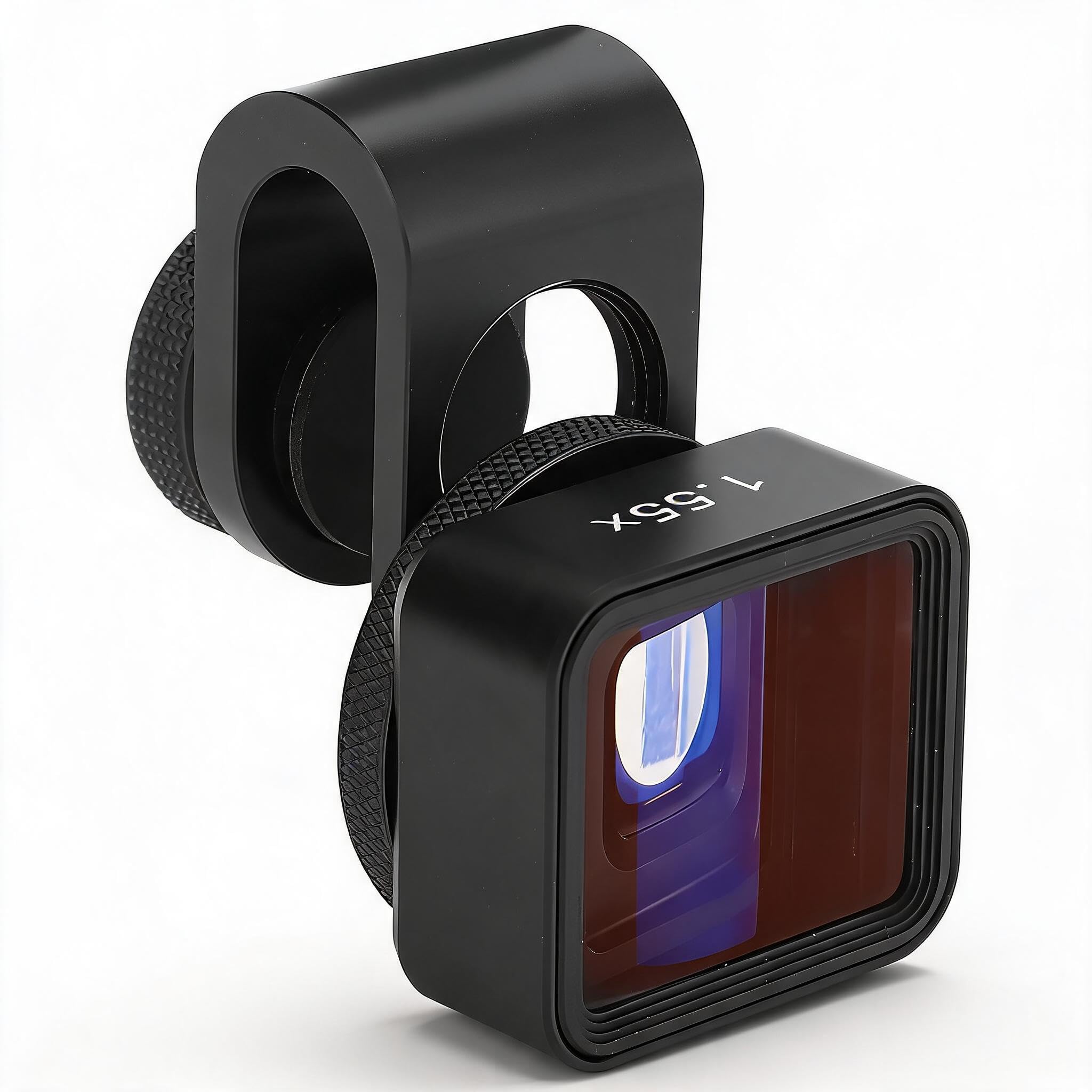
The cheapest way to get a 1.55x widescreen squeeze if you are willing to work around quirks.
The Zyyini 1.55X cuts the cost of anamorphic filmmaking to the bone. It uses an aluminum alloy and optical glass construction, corrects spherical aberrations and axial chromatic aberration, and gives you a 1.55x horizontal stretch that mirrors the full-frame look of much pricier lenses. At 84 g it is lighter than the Freewell 1.55x but still heavier than the SIRUI (18 g) — a middle ground that feels solid without being a gimbal burden.
Compatibility is wide: it clips onto most smartphones and iOS Pads. Owners who shoot with an iPhone 14 Pro Max and Filmic Pro report solid cinematic flares, while one buyer calls it better than buying a dedicated camera anamorphic lens. The all-glass HD coating helps reduce chromatic aberration, and the fixed-focus design keeps the setup simple: clip, align, and shoot.
The honest downsides are hard to ignore. A few owners mention that the screw-in holes on the mount can strip, and the clip-on nature means a secure mount is up to you. On the iPhone 12, the image crops on top and bottom when using the 1x lens, and severely on all sides with the 0.5x wide — essentially making only the 2x lens usable on that model. For the price, it is a decent entry point into anamorphic shooting, but you trade consistency and fit for the low cost.
What works
- 1.55x squeeze delivers a true cinematic widescreen effect that costs many times more in dedicated camera lenses
- Aluminum alloy and optical glass with HD coating help keep image quality respectable for the price
- Broad phone and iOS Pad compatibility means most users can try anamorphic without buying a new case
Where it cuts corners
- Mount screw holes can strip, and the clip-on system is less secure than a threaded mount
- Severe cropping with certain phone models (e.g., iPhone 12) may limit usable camera lenses to the 2x telephoto
Reach for this if: you are budget-conscious and want to experiment with 1.55x anamorphic footage before investing in a premium system.
skip it if: you need a secure, repeatable mount for professional work or own an iPhone 12 where the view is heavily cropped.
5. SMALLRIG 1.33X Anamorphic Lens for Mobile Phone (4590)
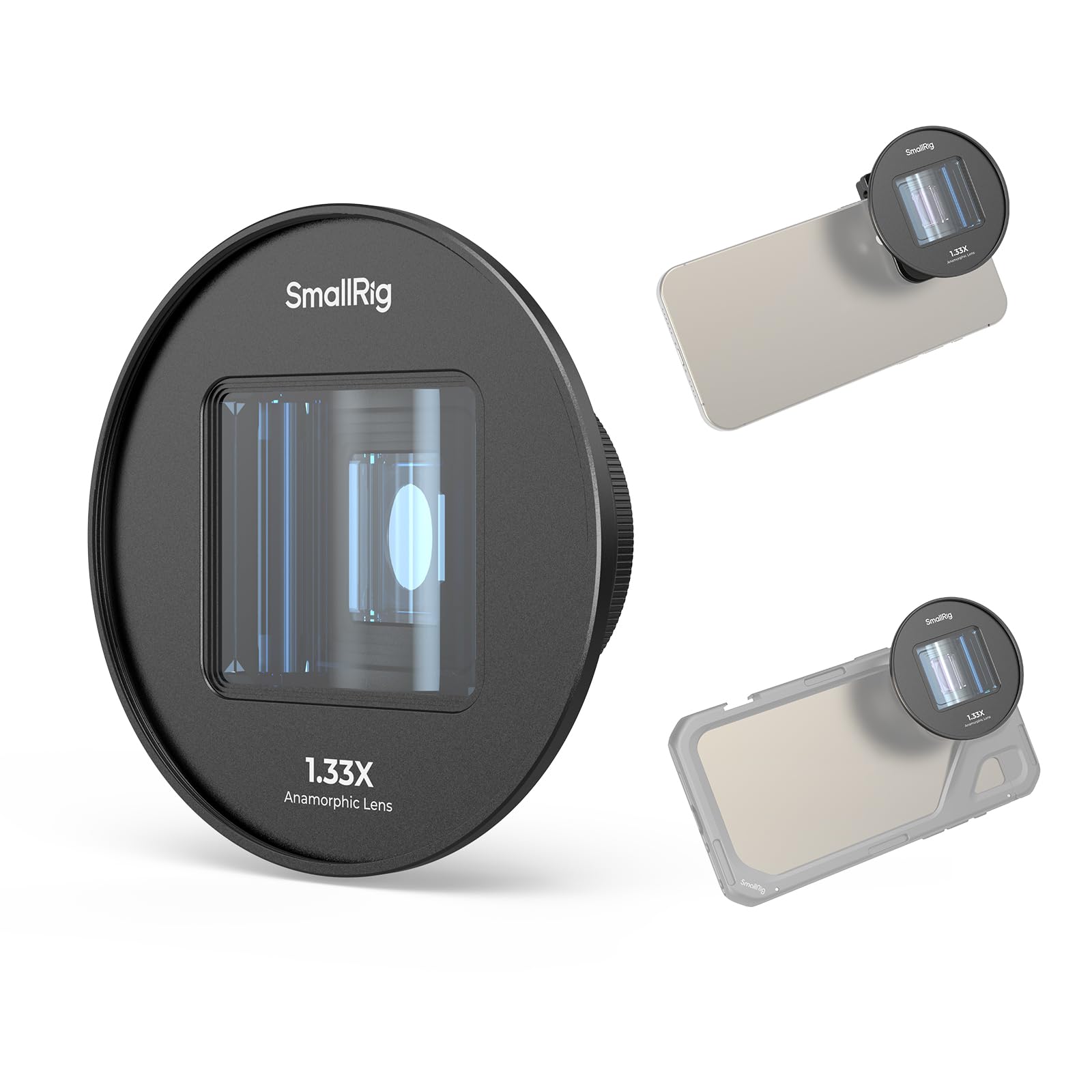
A modular cinema lens that lets you screw on ND filters right on your phone.
The SMALLRIG 4590 uses a standard T-mount with a precise 4-point magnetic alignment system, letting you rotate the lens 90 degrees at a time to perfectly level the anamorphic stretch. It takes standard 67mm threaded filters — ND, VND, CPL, UV — directly on the front, a rare feature that eliminates the need for step-up rings or separate filter adapters. The 1.33x squeeze produces a classic 2.40:1 widescreen with blue anamorphic flare streaks, giving footage that familiar sci-fi look under strong light.
You get a tough build: aluminum alloy with an anodized finish, weighing 113.5 g (about the same as a deck of cards). It works with SmallRig’s own phone cages (models 4391, 4392, 4393, 4473, 4407) and includes a T-mount phone clip so you can attach it directly to your phone. Reviewers who use the Blackmagic Camera app say it runs smoothly, and some call it “one of the best” they have used for iPhone, noting the features are better and cheaper than competitors.
The mixed reality here is real. A notable number of buyers flag the 67mm filter threads as out of spec — filters spin without tightening, even other SmallRig filters. The phone clip can crack a screen if over-tightened or slip if too loose. The image quality gets mixed marks, with some finding it blurry at close range and the blue flare streaks less defined than Freewell’s gold flares. For shooters already invested in SmallRig cages and 67mm filters, the modularity is a big win. For everyone else, it requires patience and maybe an extra filter adapter to work reliably.
Why it stands out
- 67mm filter thread on the lens itself lets you screw in ND/CPL filters without extra adapters
- 4-point magnetic T-mount with 90-degree steps makes horizon alignment fast and repeatable
- Compatible with SmallRig’s cage ecosystem and most modern phones with the included clip
Honest trade-offs
- 67mm filter threads are reported to be out of spec on some units, causing filters to spin without locking
- Image quality can be blurry at close range, and the blue flare streaks are less dramatic than some competitors
Reach for this if: you already use SmallRig phone cages or 67mm filters and want a lens that integrates directly into that system.
Look elsewhere if: filter compatibility is your top priority without any tolerance for threading issues, or you want a warmer gold-flare look.
6. Freewell 1.33x Gold Anamorphic Lens for 17mm Mount

The 1.33x sibling of the top pick, tuned for a classic 2.35:1 cinema ratio.
Where the 1.55x Freewell goes ultra-wide, this 1.33x Gold version sticks to the standard film-canon ratio of 2.35:1 — the same frame you see in most Hollywood productions. It shares the same all-metal build, leather case, and integrated level gauge as its more aggressive sibling, and it also screws into any 17mm threaded mount for a rock-solid connection. The gold flares here are warm and rich, and the oval bokeh adds a creamy depth that separates subjects from the background naturally.
Buyers consistently rave about the packaging and quality, calling it a premium accessory that improves the mobile shooting experience. The level gauge on the barrel is a genuine timesaver: you can check alignment at a glance without relying on your phone’s digital grid. The lens focuses from 35 cm to infinity, and the multi-layer coatings keep flare ghosting under control. It works with Blackmagic Camera for desqueezing, and owners say it produces cinema-quality footage that looks distinctly different from standard phone video.
The honest trade-off is weight and gimbal use — it is not as heavy as the 150 g 1.55x version, but it is still a solid metal lens that may unbalance a compact gimbal. One owner mentions “a bit heavy and hard to use with a gimbal, but manageable.” If your main setup is handheld, tripod, or shoulder rig, the heft is actually an asset for stability. For pure pocket portability, the SIRUI VD-01 wins.
What owners love
- 2.35:1 aspect ratio matches standard cinema format — ideal for narrative filmmakers who want the exact film look
- Built-in spirit level on the lens barrel means you do not need a separate bubble level or app grid
- Premium leather case and metal build give a high-end feel that matches the optical quality
Notable trade-offs
- Solid metal construction adds weight that can challenge a gimbal without careful balancing
- Requires a 17mm threaded mount phone case — not compatible with universal clips or bare phones
Reach for this if: you want the classic 2.35:1 widescreen look in a premium metal lens with a level gauge and gold flares.
Think twice if: you need the widest possible 2.76:1 frame (the 1.55x version covers that) or you want a lens that fits every phone without a dedicated case.
Understanding the Specs
Squeeze Factor (1.33x vs 1.55x)
The squeeze factor is how much the lens compresses the horizontal image onto your phone’s sensor. A 1.33x lens stretches the footage out to a widescreen aspect ratio when desqueezed — nearly identical to standard cinema projectors. A 1.55x lens goes wider, producing a 2.76:1 frame with a more extreme, ultra-widescreen feel. The trade-off is that the higher the squeeze, the more careful you need to be with framing and app compatibility.
Mount Type and Stability
A 17mm threaded mount (like on many premium phone cases) screws the lens directly to the phone body — zero wiggle, perfect alignment every time. A T-mount uses magnets and a locking plate, offering modularity with cages and accessories. A universal spring clip works with any phone but can shift during shooting, sometimes causing the lens edge to appear in the corner of your frame. For run-and-gun work, a threaded mount is the most reliable.
Flare Coating and Color
Anamorphic lenses use specialized coatings to produce horizontal flare streaks when light hits the lens at an angle. Gold coatings produce warm, vintage-film streaks that feel nostalgic and cinematic. Blue coatings create a cooler, science-fiction streak. Higher-quality multi-layer anti-reflective coatings keep the rest of the image contrasty and the flare streaks crisp rather than washed out.
Desqueezing and App Support
Anamorphic footage looks vertically stretched while recording. You need a desqueezing app (like Blackmagic Camera, Filmic Pro, or FotorGear) to restore the correct widescreen proportions. Some lenses require a paid version of these apps. Always check compatibility with your phone model and preferred filming app before buying — not all anamorphic lenses work with the native camera app.
FAQ
Will an anamorphic lens work with my phone’s native camera app?
What is the difference between 1.33x and 1.55x anamorphic lenses?
Do I need a special phone case for an anamorphic lens?
Can I use an anamorphic lens with a gimbal?
Why does the anamorphic lens show the clip edge in my video?
How do I clean an anamorphic lens safely?
Is the anamorphic lens image quality as good as a dedicated cinema lens?
Can I use the lens for photography, or is it only for video?
Final Thoughts: The Verdict
For most buyers, the anamorphic lens for phone winner is the Freewell 1.55x Gold because it delivers the widest 2.76:1 frame (a true widescreen cinema look) with rich gold lens flares and a solid all-metal build that screws into a 17mm mount for zero wiggle. If you want an ultra-light lens for everyday carry, grab the SIRUI VD-01 — at just 19 g it disappears in a pocket. And for the widest possible widescreen on a budget, the USKEYVISION 1.55X gives you the same 2.76:1 ratio as the top pick without the premium price.
How We Picked
We do not accept paid placement. Every pick is matched to a real buyer and a real use-case; we do not hands-on test units.
Sources & Methodology
Specifications: manufacturer listings and product documentation. Review insights: verified customer reviews, as of July 2026. Pricing: not shown on this page (it changes often); check the current price via the retailer link.
As an Amazon Associate, Gadgets Feed earns from qualifying purchases. This does not affect which products we feature.