
Our readers keep the lights on and my morning glass full of iced black tea. As an Amazon Associate, I earn from qualifying purchases.
Specs are compiled from manufacturer listings and verified buyer reviews and can change over time — please confirm the key details on the product page before buying.
You want that satisfying moment when a needle kicks into the red or an LED row pulses with the kick drum. A VU meter (a Volume Unit meter that shows audio level visually) turns your audio setup into something you can watch and feel. The trick is finding one that responds to the music without distorting your sound or burying you in confusing controls.
I’m Min — the founder and writer behind Gadgets Feed. This guide is built by comparing the manufacturers’ published specifications and the patterns across verified customer reviews, so you get each pick’s real strengths and trade-offs instead of marketing spin.
The best audio vu meter for your setup depends on connectivity, display type, and your tolerance for small-button tweaking.
Our Picks at a Glance

How To Choose The Best Audio VU Meter
Picking the right VU meter is less about specs and more about how it fits into your listening chain. You need to consider whether it processes your audio signal or just watches it, how it connects to your gear, and whether the display type matches the look of your room.
Signal Path: Passive Visualizer vs Active Processor
A pure VU meter is a passive visualizer — it reads the signal and shows it without altering anything. That is ideal if you only want eye candy. Some units, like an equalizer or amplifier with a built-in meter, place the display directly in the signal path. That is great if you also want tone shaping, but it adds another component that can introduce noise if not well built.
Input Type and Connectivity
Stereo RCA inputs are the gold standard for a clean wired connection. A 3.5mm auxiliary input is convenient for phones or computers. An internal microphone lets the meter pick up sound without any wires, but it also picks up room noise and can be less accurate. If you are building a system with a preamp or amplifier, look for units with both line-level inputs and outputs so the signal passes through cleanly.
Display Technology and AGC
LED and VFD (Vacuum Fluorescent Display — a retro blue-green glow) are the two main display types. LEDs are bright and modern, while VFD gives a vintage look. A bigger deal is AGC. A good AGC algorithm keeps the display active whether you are playing a quiet acoustic track or a loud rock song. Without it, the meters will barely move on quiet passages and peg into the red on loud ones.
Quick Comparison
| Model | Best For | Display Type | Inputs | AGC | Amazon |
|---|---|---|---|---|---|
| Nobsound AK2515 Pro★ Best Overall | Customizable standalone visualizer | VFD 25×15 | 3.5mm AUX & MIC | Yes | Amazon |
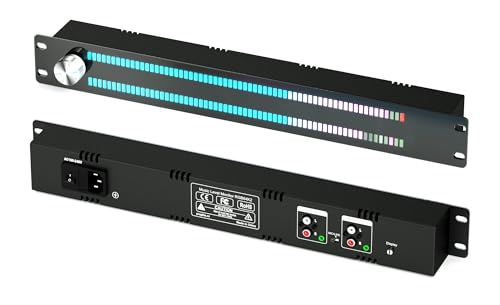
| Generic 1.5U Spectrum AnalyzerBudget Visualizer | Budget rack-mount display | LED 11-band | RCA & 3.5mm | No | Amazon |
| Douk Audio EQ5 Tone | EQ + VU meter combo | Analog VU (45mm) | RCA, Bluetooth | No | Amazon |
| Douk Audio VU22 | Dual analog meter, line accuracy | Analog VU (needle) | RCA, 3.5mm, MIC | Yes | Amazon |
| Decibelvibe TNZ SGVUM6 | Full-color LED bar display | 128 LED (19 colors) | RCA, 3.5mm, MIC | Yes | Amazon |
| AIYIMA A80 | All-in-one amplifier with VU | Digital VU (LCD) | USB, Opt, Coax, BT | No | Amazon |
| Fosi Audio MC351 | Vintage-styled 2.1 amp | Analog VU (round needle) | USB, Opt, Coax, BT | No | Amazon |
In‑Depth Reviews
1. Nobsound AK2515 Pro Audio Spectrum Analyzer
Our pick — 4.5★ from 300+ verified ratings; the strongest balance of quality and price.
The spectrum analyzer that brings retro 90’s style to your desktop without sacrificing accuracy.
The 25×15 resolution VFD display gives your music a crisp, blue-green glow that feels like a vintage studio rack. Buyers consistently call out its clean, premium look. The built-in clock uses an SD3078 crystal oscillator (a precise timing chip) and keeps time within 10 seconds per month — a nice bonus when the audio is paused and the display switches to clock mode.
What sets this apart from simpler LED bars is the advanced AGC algorithm. It adjusts the visual response whether you are playing a quiet vocal track or a loud rock mix, so the bars never drop out or peg into the red. You can switch between 15 frequency bands, three display modes (real output, smooth output I, and smooth output II), and five frequency division curves. The trade-off is the setup: the instructions are a maze. Buyers report the internal microphone tends to favor bass frequencies over high notes, so wiring it directly via the 3.5mm AUX input gives far more accurate results.
The crowd favorite in this category — well over 300 owners give it high marks — and the overwhelming praise for its appearance and functionality makes it the first unit to consider. It is more customizable than the Generic 1.5U below and offers a cleaner signal path than the microphone-based Decibelvibe.
Why owners love it
- VFD display is bright, crisp, and retro-styled — buyers call it “clean and premium”
- AGC algorithm keeps the visual active across all volume levels
- Clock mode with ±3.8ppm crystal accuracy is genuinely useful
The real catch
- Instructions are notoriously tough — ambiguous button references, no clear walkthrough
- Internal mic over-emphasizes bass; line input is the way to go for accuracy
Reach for it if: you want a highly customizable visualizer with genuine AGC, a clock, and a display that looks like it belongs in a pro studio.
Look elsewhere if: you need a simple plug-and-play unit with clear instructions or you hate reading tiny button labels.
2. Generic 1.5U VU Meter LED Spectrum Analyzer
A heavy-duty rack-mount LED bar that is pure eye candy for a stereo setup.
This 1.5U unit fills a standard rack slot with 11 stereo LED bands, adjustable colors, brightness, speed, and gain. It weighs 2.2 pounds — noticeably heavier than the Douk EQ5 at 2.05 pounds — and the full-metal casing gives it a solid feel that buyers respect.
The honest truth: this is not a precision instrument. The review pages sum it up: it “somewhat (and inaccurately) blinks to the music.” It functions as a decorative “color organ” rather than an analytical tool. The built-in microphone has weak response, and the line input needs an amplified signal (headphone out, not aux out) to work properly. Non-standard rack mount dimensions can also cause fit issues with standard rails. But if your goal is to add colorful motion to an empty rack slot without spending much, owners mention it “transforms your stereo” and the setup takes “only a few minutes to figure out.”
For its price, this is the most affordable way to get a full-width LED spectrum display on your rack. It is much cheaper than the Decibelvibe TNZ SGVUM6 below, but lacks that unit’s AGC (Automatic Gain Control) and 19-color precision.
The honest take: A fun, heavy-duty visualizer for the price — but treat it as decoration, not a metering tool.
Best if: you want a budget-friendly rack-filler that adds color and motion without needing a preamp.
Think twice if: you need accurate level metering, standard rack dimensions, or a professional-grade tool.
3. Douk Audio EQ5 Tone 5-Band EQ with VU Meter

A 5-band equalizer that gives you real tone control plus a pair of analog VU needles.
The dual 45mm VU meters are the visual highlight here. A dedicated VU driver chip keeps the needle response faithful to the signal. The upgraded version adds adjustable background light, pointer speed, and gain. That means you can tune the needles to dance exactly how you want them to.
Unlike the purely visual units above, this is an active processor. The five independent op-amp bands (75Hz, 400Hz, 800Hz, 4kHz, 10kHz) let you shape the sound — compensating for room acoustics or speaker quirks. The Bluetooth 5.0 input is a genuine convenience for streaming, and the gold-plated RCA jacks keep signal loss minimal. What owners praise most is the sound quality; they find it adds “warmth to weaker signals” and effectively shapes midrange frequencies. The recurring concern, however, is noise. A few customers note a hum or buzz that disappears with cable swapping or a different signal path, so clean cabling is a must. The functionality divide is real — about as many owners find it noise-free as those who encounter hum.
At 2.05 pounds it is lighter than the Generic 1.5U, but it is also a full-function preamp, not just a display. The all-metal case with aluminum knobs feels premium for the money.
The verdict: The best choice if you actually need to adjust your sound and want a VU meter to watch it happen — just be ready to troubleshoot the noise floor with quality cables.
Pick it for: precise 5-band EQ shaping with a lively VU needle display and wireless Bluetooth input.
skip it if: you want a noise-free plug-and-play experience or you only need a visualizer with no signal processing.
4. Douk Audio VU22 Dual Analog VU Meter

The all-metal dual VU meter that keeps your signal clean while the needles swing.
This is the unit to grab when you want true analog needle movement without compromising your audio quality. The 100k high-impedance input circuit (high enough to avoid dragging down your audio signal) ensures the meter does not color or load down your signal — it is a passive listener, not an active processor. Owners describe it as “solid built” and note it serves as “eye candy” that adds nostalgia to a mini home theater.
The AGC algorithm is a standout feature here. It ensures the needles display visible movement whether your source is a quiet podcast or a cranked guitar riff. The gain adjustment lets you set exactly where the needle hits the red zone. The CNC-machined aluminum panel and gold-plated interfaces feel sturdy, and the all-metal construction is the most praised aspect of the product. At roughly 252 grams (about 0.55 pounds), it is much lighter than the EQ5 or the Generic 1.5U, making it easy to mount or move. The catch is that adjusting the color and level via the gauge faces is tedious — the instructions make it seem easier than it is. A few owners note a minor button-reversal bug between the line-in and microphone modes.
Compared to the Decibelvibe TNZ SGVUM6 below, this Douk is a simpler, more focused device: two needles, pure analog, no 128-LED array. It earns a higher rating than the Decibelvibe and is praised more consistently for build quality.
The honest read: The best pure analog VU meter for someone who wants a clean signal path, AGC, and a premium metal feel.
Get it if: you want dual analog needles with AGC, a noise-free line input, and a build that feels like a piece of studio kit.
Pass if: you need a built-in amplifier, EQ, or a digital LED display.
5. Decibelvibe TNZ SGVUM6 Graphic VU Meter

A 19-color LED bar that brings a full-color party to your sound system.
This unit covers 128 LEDs across two channels (64 per channel), giving you a dense, bright display that changes color on command. The 19 color options are generous. The built-in noise reduction processing and gain adjustment give you some control over how the meter reacts to different sources.
The rear panel includes both RCA and 3.5mm auxiliary inputs and outputs, plus an internal microphone for wireless operation. That makes it flexible for systems where running cables is impractical. Buyers call it a “great addition” visually and note the “awesome mixture of different modes, colors, and controls.” The big drawback is that the meter settings do not always stick; some reviewers point out the display changes modes or colors on its own, which can be frustrating during a listening session. The power cord is also noted as being too short, so placement near an outlet matters. It weighs 2.09 pounds — similar to the Generic 1.5U — and its dimensions (18.9 x 1.89 x 2.28 inches) are tailored for a standard rack slot.
It leads on color variety but falls short of the Douk VU22 in build quality consistency and overall owner satisfaction. If you want a single-rack-unit LED bar with AGC and lots of colors, this is a solid pick over the Generic 1.5U, but it costs more.
The bottom line: Excellent for adding a colorful, responsive LED display to your rack — just be ready for the settings to occasionally reset themselves.
Choose it for: 19 colors, wireless mic input, and a bright 128-LED display that adds serious visual drama.
Think twice if: you need the display to reliably hold your preferred settings between sessions.
6. AIYIMA A80 Bluetooth Amplifier with Digital VU Meter
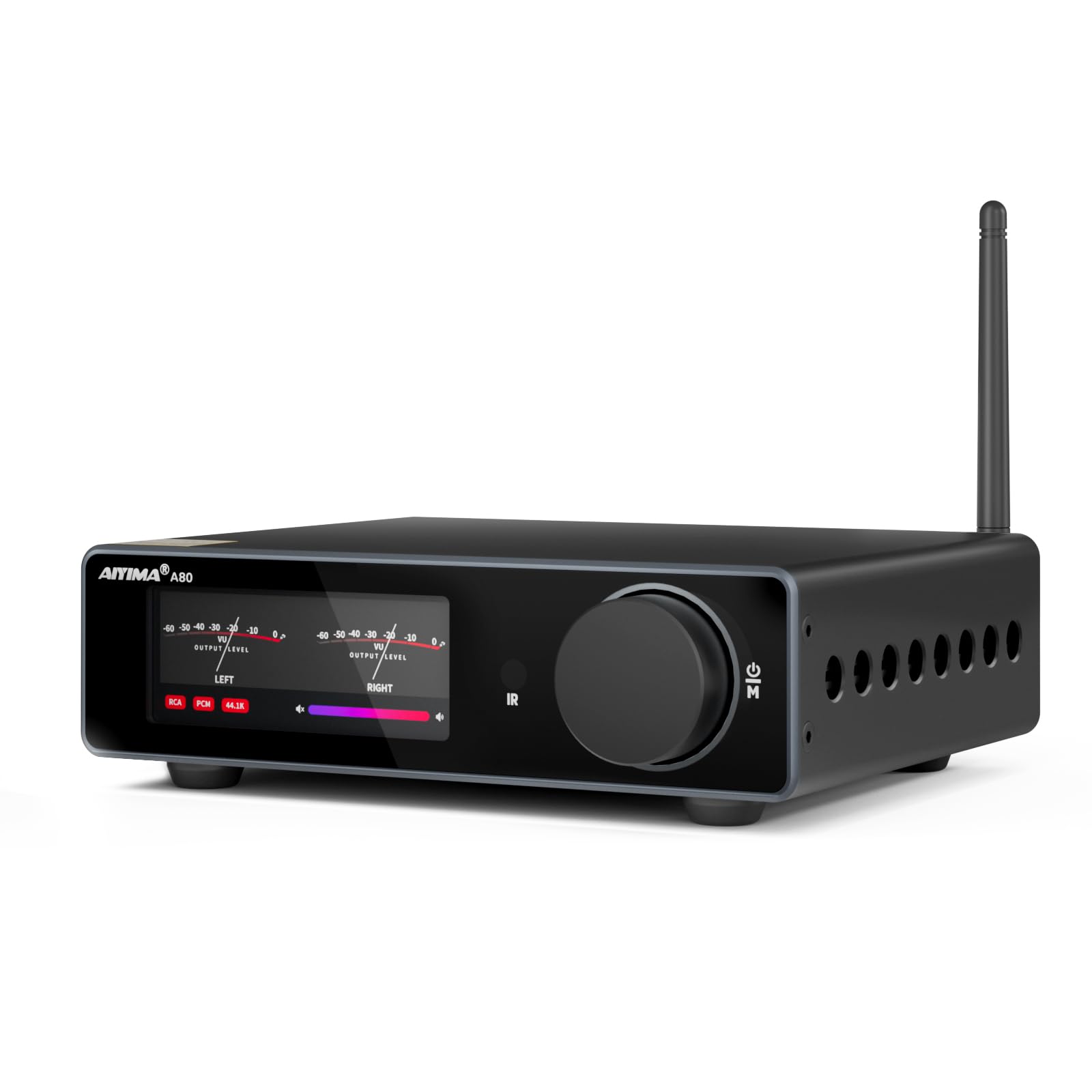
The all-in-one DAC and amp that shows you what it’s doing on a bright digital display.
If you need a full amplifier with a VU meter, the A80 packs an ESS9038Q2M DAC chip (a high-performance digital-to-analog converter) and a TPA3255 Class-D amplifier into a compact 6.1 x 4.84 x 1.61 inch chassis. The digital VU display shows input status, volume, and codec information, and offers multiple display modes. It is not a classic needle meter, but it is far more informative than a passive visualizer.
The sound quality is the most praised aspect — 48 owners single it out. Buyers describe it as “audiophile worthy” and note it makes “cheap speakers sound amazing.” The TRS balanced inputs (a 3-conductor connector that rejects noise) are a rare feature in desktop amps and help eliminate hiss. The onboard Bluetooth is described as near-wired quality. It supports 300W per channel max, with a total harmonic distortion as low as 0.006% and a SINAD of 109dB (Signal-to-Noise and Distortion ratio, a measure of audio purity). The main caveat: reliability is mixed. About as many owners find it works flawlessly as those who report it shuts down unexpectedly. It also runs hot with low-sensitivity speakers and does not auto-power on. At 1.66 kg (about 3.66 pounds), it is heavy for its size, reflecting the sturdy build.
Compared to the Fosi Audio MC351 below, the AIYIMA has a higher end DAC chip and balanced inputs, but the Fosi offers a classic round VU needle and a 2.1 channel configuration with a subwoofer output.
What stands out
- ESS9038Q2M DAC delivers clean, detailed sound — owners call it “audiophile worthy”
- Digital VU display is clear and shows input, volume, and codec info
- TRS balanced inputs eliminate hiss and environmental noise
The gamble
- Reliability is a coin flip — some units shut down unexpectedly
- Runs hot with low-sensitivity speakers; needs ventilation
- No auto-power-on feature; auto-off triggers at very low volume
Best for: someone building a compact 2.0 system who wants a high-end DAC, balanced inputs, and a digital VU readout in one box.
Not for: users who need a rock-solid reliable amp for daily use without any shutdown risk.
7. Fosi Audio MC351 2.1 Amplifier with VU Meter

A retro round VU needle atop a modern dual-chip amplifier.
The round mini VU meter on the MC351 is pure vintage charm. The needle dances to your music while two TPA3255 Class-D chips deliver 165W per channel plus 350W for a subwoofer in a 2.1 setup. The all-aluminum-alloy CNC chassis has no visible screws, giving it a clean, minimalist look.
Buyers praise the sound quality — crisp highs and punchy lows — and the easy Bluetooth pairing. The 100-fin heatsink keeps the unit cool even at higher volumes. It supports one-touch switching between five input modes (Bluetooth, USB, optical, coaxial, and line), and the bass and treble controls have center detents for easy tone defeat. The design is good enough to use with turntables, and the VU meter adds that visual kick when the needle swings. The downsides are a noticeable dip in midrange presence during busy mixes — instruments can feel like they “cut out” — and no remote control. Some owners also report the optical input cutting out intermittently.
It weighs 1 kg (about 2.2 pounds), which is lighter than the AIYIMA A80, but it makes up for it with the subwoofer output and the pure analog VU needle feel. If you want a classic amp with a visible meter, this beats the AIYIMA on aesthetic charm but loses on DAC resolution and balanced inputs.
The final say: Excellent value for a 2.1 amp with a VU meter that looks the part — just know the midrange can get recessed in complex mixes.
Reach for it if: you want a compact 2.1 amplifier with a classic round VU meter, good power, and a clean chassis.
Look elsewhere if: you need a fully transparent midrange or a remote control.
Understanding the Specs
AGC (Automatic Gain Control)
AGC is a circuit that automatically adjusts the meter’s sensitivity. Without it, a quiet passage will show barely any movement and a loud passage will pin the needle. With good AGC, the display stays active and visible across your entire listening range. Look for “AGC algorithm” in the specs — it makes a bigger difference to daily enjoyment than the number of LED bands or frequency bands.
VU Meter vs Spectrum Analyzer
A VU meter (Volume Unit meter) shows overall signal level on a needle or bar. A spectrum analyzer splits the sound into frequency bands (like 15 or 11 bands) and shows each band individually. Spectrum analyzers look more dynamic because multiple bars jump at different heights, but a VU meter is more honest about overall loudness. Choose based on if you want a detailed visual (spectrum) or a clean level readout (VU).
FAQ
Will a VU meter affect my sound quality?
Can I use a VU meter with a microphone input?
What is the difference between LED and VFD displays?
Will a rack-mount VU meter fit in any standard rack?
Do I need a separate preamp for a VU meter?
What does “dual channel” mean on a VU meter?
Can a VU meter help me set recording levels?
How do I connect a VU meter to my amplifier?
Final Thoughts: The Verdict
If you want one dependable pick, the best audio vu meter winner is the Nobsound AK2515 Pro because it combines a sharp VFD display, a proper AGC algorithm, and a clock feature that makes it useful even when the music stops. If you want an analog needle meter that does not process your signal, grab the Douk Audio VU22. And for a full amplifier with a built-in VU display, the AIYIMA A80 delivers exceptional DAC performance and a digital readout in one compact box.
How We Picked
We do not accept paid placement. Every pick is matched to a real buyer and a real use-case; we do not hands-on test units.
Sources & Methodology
Specifications: manufacturer listings and product documentation. Review insights: verified customer reviews, as of July 2026. Pricing: not shown on this page (it changes often); check the current price via the retailer link.
As an Amazon Associate, Gadgets Feed earns from qualifying purchases. This does not affect which products we feature.