
Our readers keep the lights on and my morning glass full of iced black tea. As an Amazon Associate, I earn from qualifying purchases.
Specs are compiled from manufacturer listings and verified buyer reviews and can change over time — please confirm the key details on the product page before buying.
Forgetting to plug in your EV is frustrating, but a slow Level 1 charger that barely adds 4 miles of range per hour is worse. You need a Level 2 charger for your home that turns an empty battery into a full tank by morning, without fiddling with adapters or worrying about the weather. This guide breaks down the top-rated models that actually deliver on their promises of speed, safety, and smart features.
I’m Min — the founder and writer behind Gadgets Feed. This guide is built by comparing the manufacturers’ published specifications and the patterns across verified customer reviews, so you get each pick’s real strengths and trade-offs instead of marketing spin.
Whether you drive a Tesla, a Ford Mustang Mach-E, or a Chevy Bolt, finding the right ev battery charger can save you hours each week and hundreds on installation. We’ve analyzed the specs and real-world feedback for eleven of the most popular and reliable models on the market today to help you make the right call.
Our Picks at a Glance

How To Choose The Best EV Battery Charger
Choosing your first home charger can feel overwhelming with all the talk about amps, plugs, and apps. Focus on a few key decisions to find the one that fits your car, your garage, and your budget.
Amperage: How Fast Do You Need to Charge?
The amperage rating (measured in Amps or “A”) directly controls charging speed. A 40-amp charger delivers about 9.6kW of power, adding roughly 30-40 miles of range per hour. A 48-amp charger pushes 11.5kW, which is about 20% faster. Your car’s onboard charger also has a limit — if your EV maxes out at 40A, buying a 48A unit won’t speed things up. Check your vehicle’s specs first.
Plug-In vs. Hardwired Installation
A plug-in charger uses a NEMA 14-50 outlet (the same kind your electric oven or RV uses). It’s cheaper to install if you already have the outlet, and you can take it with you when you move. A hardwired charger connects directly to your breaker panel, which is generally safer for outdoor use and allows for higher amperage (like 48A). Hardwiring also avoids the risk of a loose plug connection overheating.
Connector Type: J1772 vs. NACS
Most non-Tesla EVs in North America use the J1772 standard connector. Teslas use the NACS connector. Many modern chargers come with a J1772 plug and include a NACS adapter for Teslas, or vice versa. If you have a Tesla, look for a charger that includes a native NACS cable. If you have a J1772 car, you might want an adapter anyway for future compatibility.
Quick Comparison
| Model | Best For | Amperage | Connector Type | Installation | Amazon |
|---|---|---|---|---|---|
| EVIQO NACS Charger★ Best Overall | Best Overall | 48 A | NACS (Tesla) | Hardwired | Amazon |
| VEIPHLOX Level 2 ChargerBest Value Plug-In | Best Value Plug-In | 40 A | J1772 | NEMA 14-50 Plug | Amazon |
| NexCyber Level 2 ChargerBest Display | Best Display | 40 A | J1772 | NEMA 14-50 Plug | Amazon |
| Lectron Level 2 Charger | Best for Portability | 40 A | J1772 | NEMA 14-50 Plug | Amazon |
| WOLFBOX Level 2 Charger | Best for Smart Features | 40 A | J1772 | NEMA 14-50 Plug | Amazon |
| ApexCharger MACH 1 | Best Universal Fit | 48 A | J1772 + NACS | NEMA 14-50 or Hardwire | Amazon |
| Autel MaxiCharger 40A | Best for App Simplicity | 40 A | J1772 | NEMA 14-50 Plug | Amazon |
| EMPORIA Level 2 Charger | Top Performer | 48 A | J1772 | Hardwired | Amazon |
| Grizzl-E Ultimate 48A | Most Durable | 48 A | J1772 | Hardwired | Amazon |
| ChargePoint HomeFlex | Best Network Access | 50 A | NACS (Tesla) | Hardwired | Amazon |
| Autel MaxiCharger 50A | Fastest Charging | 50 A | J1772 | Hardwired | Amazon |
In‑Depth Reviews
1. EVIQO NACS Charger for Tesla 48 Amp 240V Hardwired Level 2 EV Charger
Our pick — over 4.5★ from 300+ verified ratings; the strongest balance of quality and price.
The crowd favorite that pairs Tesla-native hardware with a near-perfect owner experience.
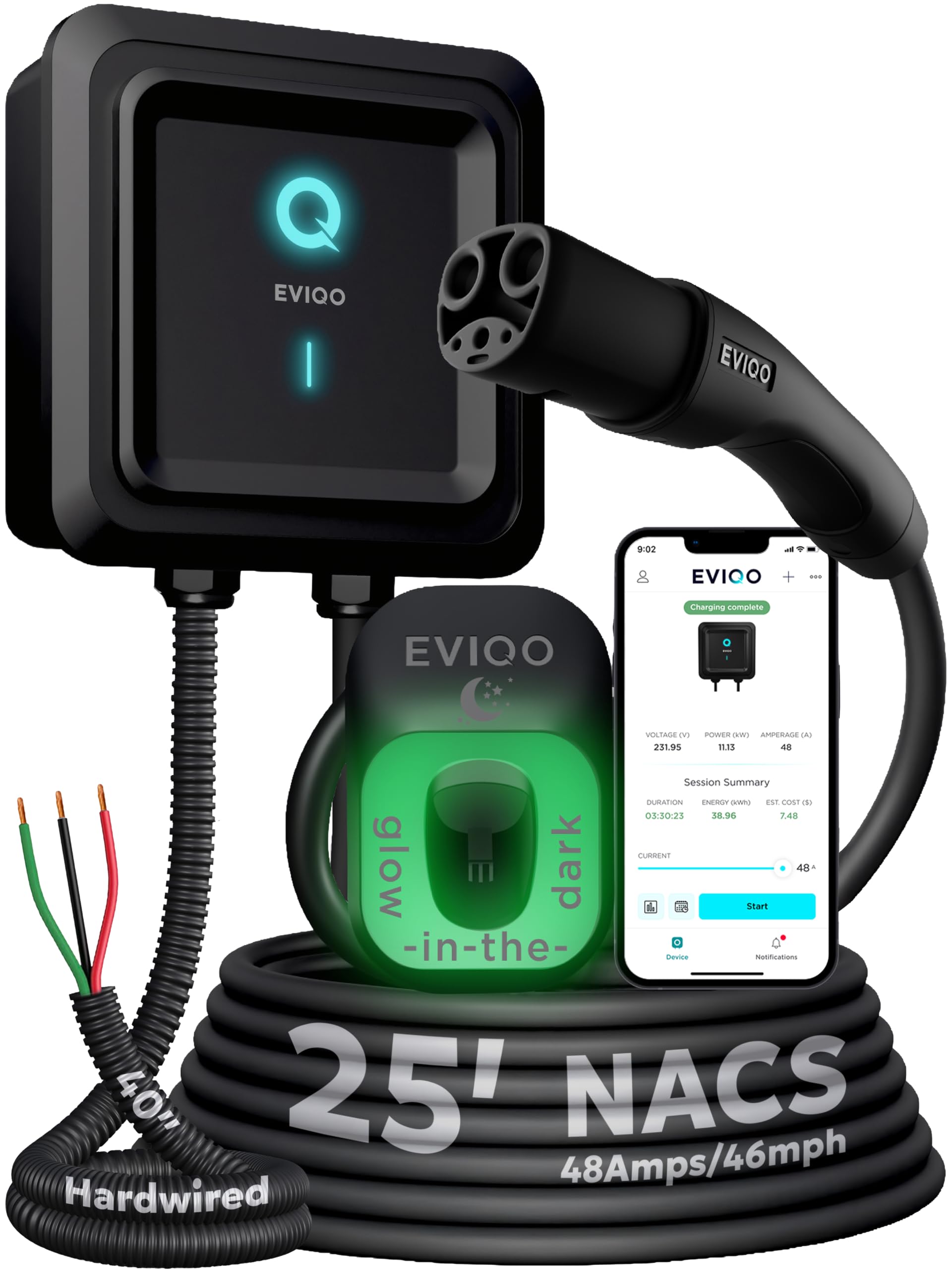
This is the one that takes the top spot for a clear reason: it delivers the full 48 amps a Tesla can handle, and buyers report it charges a VW ID4 in 5-7 hours. You need a licensed electrician to install it on a dedicated 60A circuit, but the payoff is a solid 20% speed advantage over the 40-amp models below. The whole unit is sealed in an IP66 and NEMA 4 weatherproof enclosure, so rain, snow, and dust are non-issues, whether you mount it in the garage or on an exterior wall.
You can control start/stop, track consumption and cost, and adjust the current from 6 to 48 amps through the smart app, which connects over 2.4 GHz WiFi. A neat touch is the fluorescent holster — it absorbs natural and artificial light, glowing for about 10 minutes after just a brief exposure, making late-night plug-ins much easier. Weighing 18.86 pounds, this is a substantial unit, but that heft comes from the sturdy build that owners consistently praise for its functionality and quality.
While it’s perfect for Tesla owners, anyone with a J1772 vehicle can use it with a NACS-to-J1772 adapter (not included). The main trade-off is the hardwired installation requirement — this isn’t a plug-and-play unit for a standard outlet, so factor in electrician costs upfront.
What Owners Celebrate Most
- Fast 48-amp charging fills most EVs overnight; one owner reported a 5-7 hour full charge on a VW ID4.
- Easy WiFi setup with an intuitive app that tracks kWh usage and estimates charging costs.
- IP66 weatherproof rating means it handles rain, snow, and dust without issue.
The Real Trade-Off
- Requires hardwiring by a licensed electrician, adding installation cost compared to plug-in models.
- Weighs 18.86 pounds, making it one of the heavier units on this list.
Your best match if: You drive a Tesla and want the fastest possible home charging with a rock-solid, weatherproof unit and a useful smart app.
Think twice if: You want a plug-in charger you can install yourself or take with you when moving.
2. Level 2 EV Charger 40 Amp, EV Chargers for Home 240V, Electric Car Charger 9.6kW
The simplest path to getting off Level 1 without breaking your budget.
This charger cuts right to the chase: you plug its NEMA 14-50 connector into a standard outlet, and it delivers a reliable 9.6kW (40 amps) to your EV. Owners consistently confirm it delivers 30-40 miles of range per hour, charging a mainstream EV from 0 to 100% in 4 to 7 hours. It’s a no-frills design that uses color-coded lights — blue for ready, flashing green for charging, solid green for done — so you don’t need an app to know what’s happening.
The build quality is a highlight here. At 15 pounds, it’s lighter than the hardwired units, and the NEMA 14-50 plug stays cool even after three hours of continuous use. The IP65-rated housing is dust-tight and water-resistant, so it’s safe for both indoor and outdoor installation. A unique internal cord holding design means you store the cable and connector right inside the unit, keeping your garage tidy without needing an extra holster.
One honest trade-off is the lack of smart features — there’s no WiFi, no app, and no scheduling. If you just want a dependable, fast charge without any digital fuss, this is a fantastic choice. It’s also universally compatible with all J1772 EVs, though Tesla owners will need an adapter.
Built for simplicity: A 40A, 9.6kW unit with an IP65 housing and a unique internal cord storage system that keeps everything neat. The lack of an app is a feature, not a bug, for buyers who just want to plug in and walk away.
Perfect for: The EV owner who wants fast, reliable charging at a great price without needing to download an app or learn smart scheduling.
skip it if: You need WiFi scheduling for time-of-use electricity rates, or you want to track your charging history remotely.
3. Level 2 EV Charger(WiFi APP/Plug-Play), 40A Nema 14-50 Plug, 25ft Cable ETL Certified
A dashboard on your wall that shows amps, voltage, and charging speed in real time.
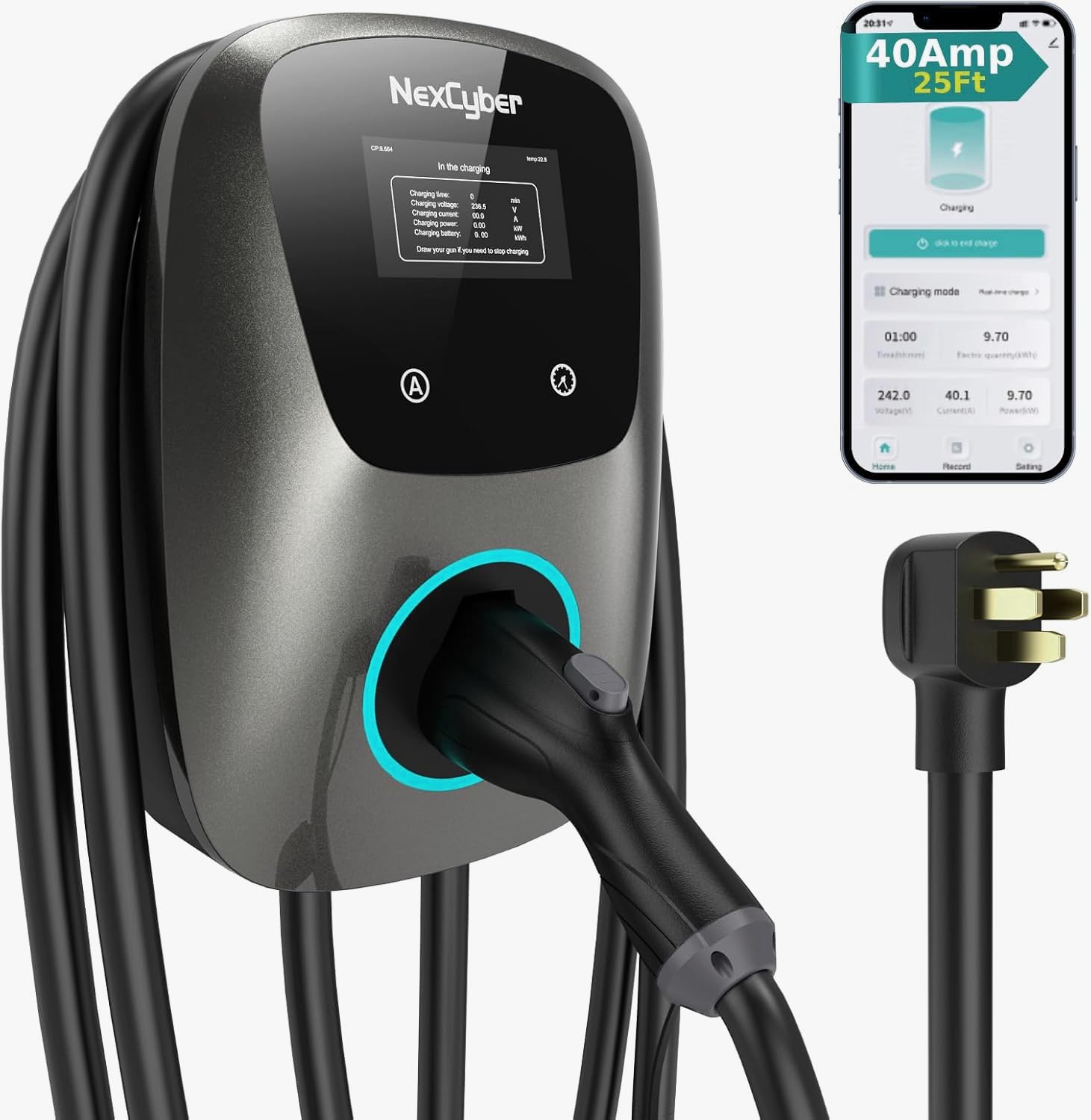
What sets this charger apart is the smart touch screen on the unit itself. You can see the charging amperage, input voltage, and speed without pulling out your phone. It also lets you adjust the current from 16A to 40A or set a delayed start time directly on the touch buttons. If you prefer app control, the WiFi app tracks charging history and cost, and sends a fully-charged notification — making it a strong option for anyone with time-of-use electricity plans.
It’s ETL, FCC, and Energy Star certified, meeting safety standards like UL2231 and UL2594. The NEMA Type 3 rating offers certain weather resistance, though the manufacturer suggests avoiding direct sunlight or rainy exposure. The 25-foot “military grade” charging cable is built tough, with a drop-resistant plug designed for over 10,000 charges.
One aspect owners mention is the app’s functionality — while it works, it’s not as polished as some competitors. The cable length also receives mixed feedback; for some garages 25 feet is plenty, but in larger driveways it can feel tight. If you want a visible interface that gives you control and data at a glance, this is a well-priced contender.
Dashboard charging: The 40A, 9.6kW unit includes a smart touch screen showing amperage, voltage, and delay settings, plus a WiFi app for scheduling and cost tracking. The drop-resistant plug is rated for over 10,000 insertions.
Best suited for: Someone who likes having a clear status display on the charger itself, in addition to basic app control.
Not for you if: You need a charger with a premium, highly polished app experience, or you plan to mount it in direct outdoor weather.
4. Lectron Level 2 EV Charger – ETL Certified, 240V, 40 Amp, NEMA 14-50 Plug

The grab-and-go charger that hides in your trunk until you need it.
This Lectron unit is designed for folks who need Level 2 speed at more than one location. It uses a standard NEMA 14-50 plug, so you can drop it in your trunk and plug it into an RV park, a friend’s house, or your own garage. With 40 amps and 9.6kW of power, it charges most EVs quickly — customers note taking an Ioniq 5 from 60% to 100% in about three hours. It’s FCC and ETL certified, with overvoltage, overcurrent, and short circuit protection.
The 16-foot cable is notably shorter than the 25-foot standard for most wall units, which makes it more portable but less forgiving of a far-away outlet. It includes no app or smart features — just a simple LED that lights up when charging. The build quality is sturdy, with owners describing the cord as thick and durable — one even reported it survived being run over by a car. The connector is J1772 (the standard plug for most EVs), so it fits all non-Tesla EVs without an adapter.
Some owners mention the prongs can oxidize if left sitting for months, though customer service is reported to handle replacements reasonably. If you want a single, simple charger you can take on road trips or share between two EVs at different locations, this is the most practical choice on the list.
Strengths
- True portability — unplugs easily to throw in the trunk for travel or shared use.
- Simple, no-app design with a clear LED indicator; just plug in and it charges.
- Thick, durable cable described by owners as sturdy enough for heavy use.
Limitations
- Short 16-foot cable may require parking closer to the outlet than expected.
- Reports of prong oxidation after sitting unused for months; keep it sheltered.
Grab this if: You need a Level 2 charger you can easily move between home, work, or travel destinations.
Look elsewhere if: Your parking spot is far from the outlet, or you want a wall-mounted unit with smart scheduling and a long fixed cable.
5. WOLFBOX Level 2 EV Charger 40amp – NEMA 14-50 EVSE with J1772 Connector

A connected charging station that puts a full dashboard and voice control on your wall.
The WOLFBOX is for the EV owner who wants to boost every perk of a smart home. It features a 4.3-inch LCD screen that shows charging rate, time, voltage, and total energy dispensed. The companion app integrates with Alexa and Google Assistant for voice control, supports Google account login, and lets you share device control with family members. For security, it includes RFID card access so only authorized users can start a charge cycle.
This is a 40-amp charger with a NEMA 14-50 plug, delivering up to 9.6kW. It’s CSA certified and meets UL2594 safety standards, with an IP66 and NEMA 4 weatherproof housing. At 13.49 pounds, it’s lighter than the EVIQO, and the 25-foot cable offers plenty of flexibility for parking layouts. The basic charging performance is solid — owners note it cuts a PHEV charge time from 12 hours to about 3.5 hours.
A trade-off owners point to is the WiFi connectivity, which can be a bit tricky to establish initially, though it’s stable once connected. The RFID card also stays active after a charge ends, which could potentially allow unauthorized use if someone pulls the uncharged handle. If you value a rich set of smart features — display, voice control, and app scheduling — this is a compelling mid-range option.
Connected hub: A 40A, 9.6kW unit with a 4.3-inch LCD screen, Alexa/Google Assistant compatibility, RFID card security, and a 25-foot cable in a weatherproof IP66 housing.
You’ll love it if: You already have smart home devices and want to control your charger with voice commands and share access with family.
pass on it if: You simply want a reliable plug-and-charge experience without the complexity of apps, RFID cards, and network setup.
6. MACH 1: Fast 48 Amp Level 2 EV Charger, Wall-Mount Electric Vehicle Charging Station
The only charger on this list that works natively with both J1772 and Tesla vehicles from the start.
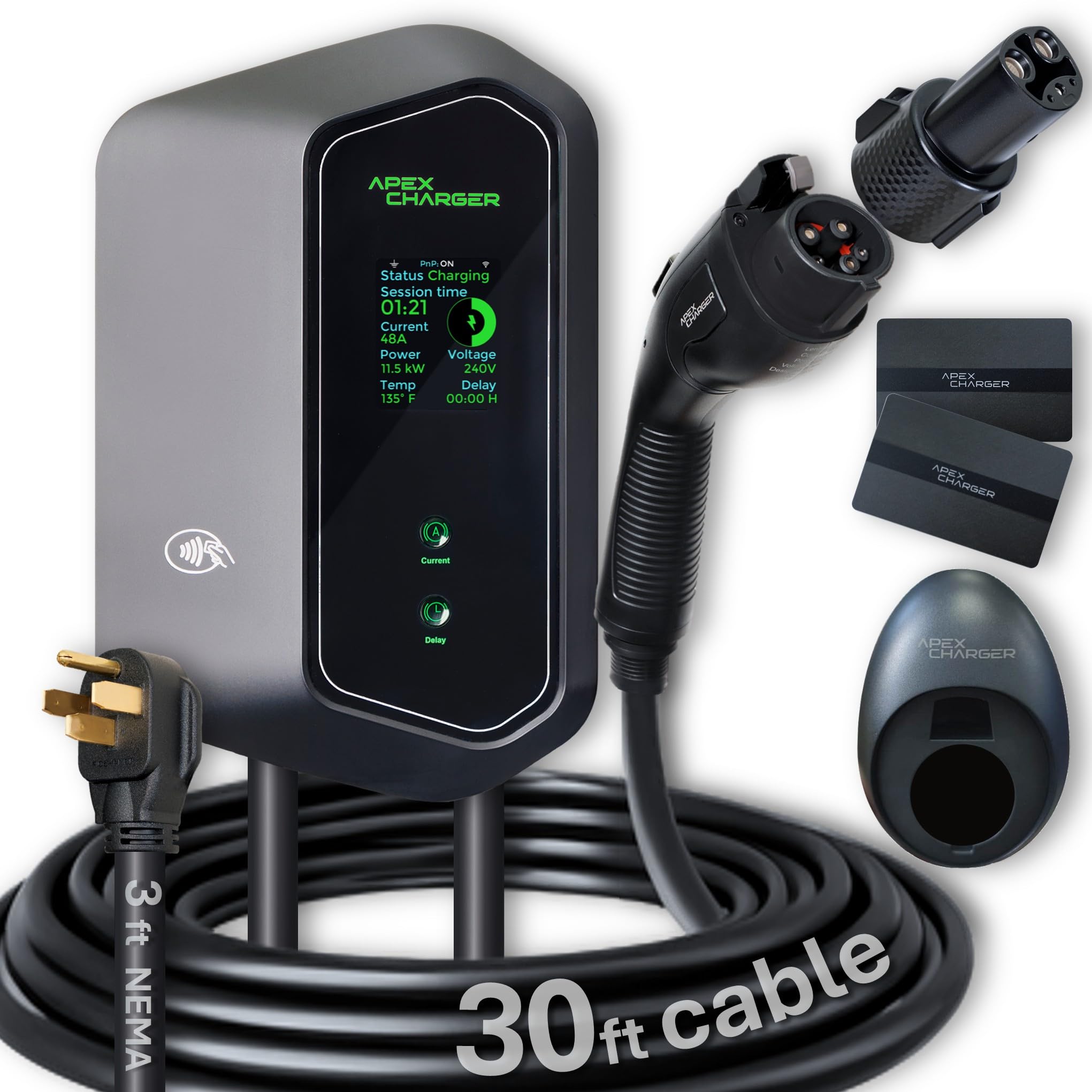
The ApexCharger MACH 1 comes with a J1772 connector and includes a PRO 1 NACS adapter in a carrying bag, making it a turnkey solution for multi-EV households or those who plan to switch vehicles. It’s adjustable from 0 to 48 amps, and the 30-foot cable is the longest on this list, giving you outstanding reach across a driveway or garage. You can install it as a plug-in with a NEMA 14-50 (40A max) or hardwire it for the full 48 amps on a 60A breaker.
The build quality and reliability are standout features, with the aspect count showing Quality (70) and Reliability (68) as the top two positives among owners. It includes Bluetooth and WiFi, a 2.4-inch LED display, two RFID cards, and a mobile app for monitoring. The customer support response time is a recurring highlight — reviewers point out quick, effective help even on weekends.
One caveat is that early models had a scheduling bug that was resolved with an October 2024 firmware update. The time-of-day settings still lack individual day selection, which is a minor inconvenience for strict off-peak schedulers. Despite that, it’s a flexible, high-power charger that genuinely works with every EV in America’s fleet.
Why It Stands Out
- Includes both J1772 cable and a NACS Tesla adapter, so it’s the most universal option here.
- 30-foot cable is the longest in this comparison, offering maximum reach.
- Exceptional 24/7 customer support that owners consistently praise.
Worth Noting
- Time-of-day scheduling lacks individual day selection, a minor app limitation.
- Early firmware bugs were patched, but you may need to update upon installation.
Top choice for: Households with both a Tesla and a J1772 EV, or anyone who wants a future-proof charger that fits any North American car.
Not if: You need a simple, app-free charger and don’t want to deal with initial firmware updates.
7. Autel Level 2 EV Charger 40 Amp Home Smart AI Electric Vehicle (EV) Charger
A refined plug-in charger from a company with two decades of automotive tech experience.
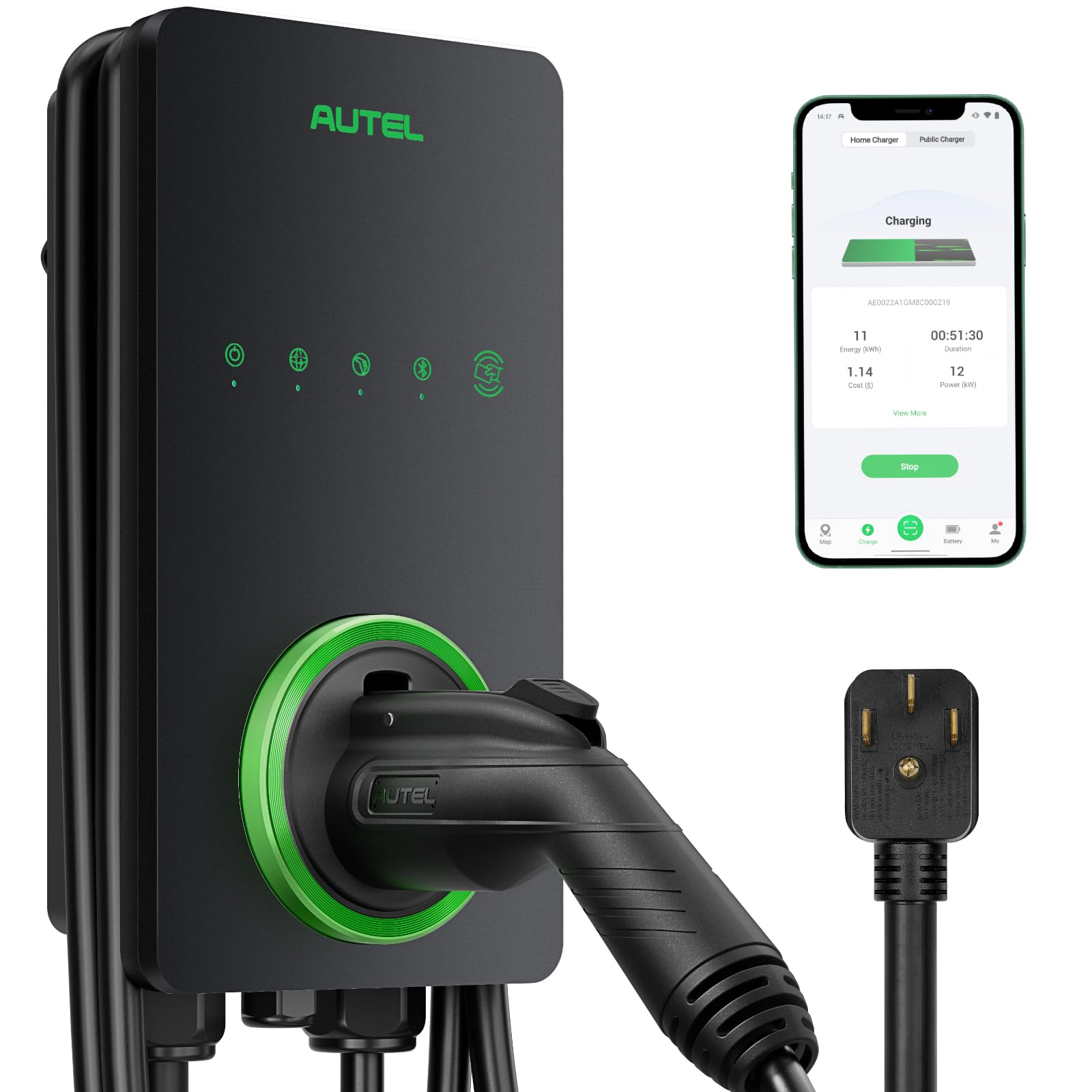
Autel has been building automotive diagnostic tools since 2004, and that engineering background shows in the MaxiCharger’s straightforward design. This is a plug-in unit (NEMA 14-50) that takes about five minutes to mount and connect. The companion app allows you to adjust charging power in 1-amp increments (from 16A to 40A), schedule off-peak charging, and control access via RFID. The NEMA 4X weatherproof rating means it’s dust-tight and resistant to snow, rain, and ice.
Owners consistently rate the charging performance and ease of installation as the top strengths. The app is described as simple and functional — it does exactly what you need without clutter. A thoughtful detail is the charging behavior that ramps down power near the end of the cycle to prevent cable overheating. The 3-year warranty and OTA (over-the-air) firmware updates provide long-term confidence.
The main drawback some owners mention is that setting the maximum amperage below 50A requires removing multiple covers to access a physical DIP switch, which is not ideal for renters or those who want to change settings frequently. Also, scheduled charging on the charger can conflict with your vehicle’s own schedule if both are active. If you want a quality, well-supported charger with a clean app, this is a solid pick.
Simple & capable: A 40A plug-in charger with a clean app, 1-amp adjustment precision, and a 3-year warranty from a known brand. The 5-minute plug-in installation is a major plus.
Best for: The buyer who wants a trusted brand, a straightforward app, and the ability to fine-tune charging current in 1-amp steps.
Consider another if: You frequently change the amperage setting and don’t want to access internal DIP switches.
8. EMPORIA Level 2 EV Charger w/ J1772 Connector — 48 Amp, 240V WiFi Enabled
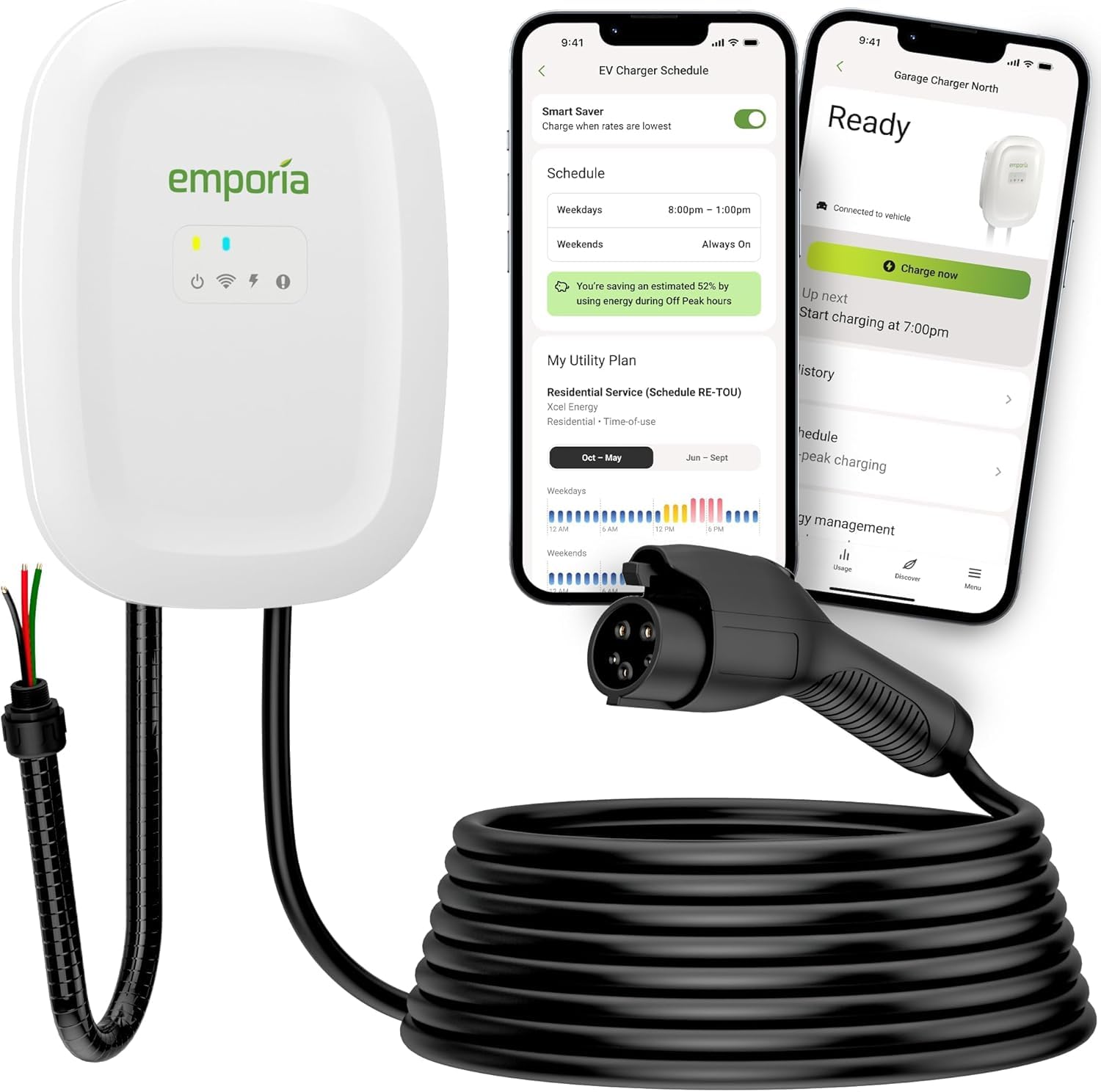
The best-reviewed hardwired charger here, excelling at both speed and smart energy management.
The Emporia is a 48-amp, hardwired charger that delivers up to 11.5kW, providing 46 miles of range per hour — that’s about 9 times faster than a standard wall outlet. It’s UL listed and ENERGY STAR certified, meeting a full suite of safety standards. The app is a highlight, allowing you to schedule charging sessions around utility rates, track cost per charge and per month, and view real-time energy data. If you also have the Emporia Vue energy monitor, the charger integrates with it for whole-home load management.
Reliability and ease of use are the top praise points from owners, with the highest aspect counts in both categories. The charger comes pre-configured for hardwired installation with a whip, so an electrician can set it up cleanly. The 25-foot cable provides good reach, and the J1772 connector works with all non-Tesla EVs. The app’s ability to calculate dollars spent per charge is a feature many owners find genuinely useful for tracking savings.
The only consistent complaint is that the included mounting screws are low quality, so you’ll likely need to buy your own hardware for a solid installation. This is a very minor issue for what is otherwise a top-tier, highly reliable charging station. It’s a fantastic choice for anyone who wants a powerful, data-rich hardwired charger.
Data-driven charging: This 48A hardwired unit delivers 46 miles of range per hour and offers an excellent app for scheduling, cost tracking, and energy management. The owner community of 455 ratings gives it a strong 4.7 out of 5, cementing its reputation for reliability.
Excellent if: You want the fastest standard hardwired charging with the best app for tracking your electricity costs and scheduling around peak rates.
Not ideal if: You need a plug-in portable charger, or you aren’t ready to commit to a permanent hardwired installation.
9. Grizzl-E 48A Ultimate Level 2 Fast Electric Vehicle (EV) Charger, Hardwired, Classic Black, J1772
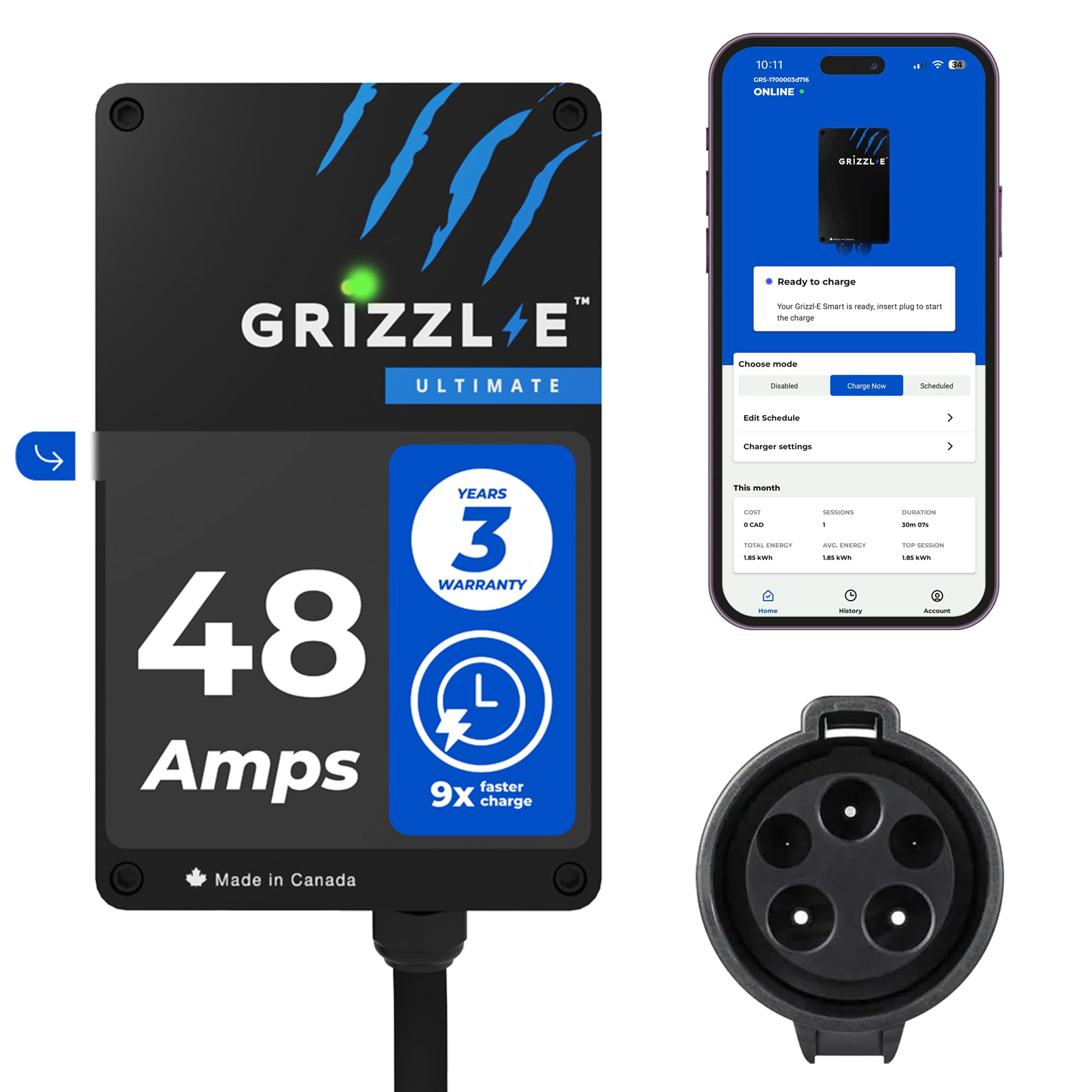
A tank made in Canada that’s built to survive everything from blizzards to desert heat.
The Grizzl-E Ultimate 48A is engineered around a heavy-duty, UL Type 4 rated aluminum cast enclosure. It’s designed for the harshest weather — snow, rain, hail, and extreme heat — and its all-metal body is practically indestructible. This is a hardwire-only unit, delivering the full 48 amps (11.5kW) on a 60A breaker. The 25-foot J1772 cable is thick and durable, and the included mounting bracket makes installation straightforward for an electrician.
The charger is WiFi-connected via the Grizzl-E Connect app, allowing real-time monitoring, charging schedules, and energy consumption statistics. A standout feature is Intelligent Power Distribution, which lets you balance power across multiple Grizzl-E chargers automatically, choosing between equal sharing or priority charging for your primary vehicle. It also supports premium OCPP integration for advanced energy management (one-time activation fee applies).
While the hardware is incredibly tough, the WiFi implementation has received mixed feedback. The unit only broadcasts its signal for 15 minutes after power-up, requiring a power cycle to reconnect if you miss the window. The plastic cable holder and handle latching also feel cheap compared to the premium metal body. If maximum physical durability is your priority, this is the one to beat.
Built like a rock: The 48A, hardwired Grizzl-E features a UL Type 4 aluminum cast enclosure that’s built for the worst weather. The Intelligent Power Distribution feature is unique for multi-EV homes. The app and plastic accessories are less refined than the hardware.
Choose this if: You need a charger that can live outside in extreme weather, or you want load-balancing for multiple EVs in one household.
Look elsewhere if: You need an easy, reliable WiFi connection or prefer a plug-in unit with a polished app experience.
10. ChargePoint HomeFlex Level 2 EV Charger, Hardwired NACS Charging Station – Tesla Compatible

The Tesla-native charger that plugs you into a network of 274,000+ charging stations.
The ChargePoint HomeFlex is a hardwired unit with a native NACS connector, making it a direct fit for Tesla vehicles without any adapter. It’s rated at 50 amps and supports fast charging management through the ChargePoint app, which also gives you access to a vast network for finding and paying at public stations. The app is polished and user-friendly, handling reminders, home energy monitoring, and connection to smart home devices.
The charger is UL-certified and designed for both indoor and outdoor use, with a cold-resistant cable that stays flexible in low temperatures. Installation requires an electrician, but the instructions are clear, and the unit itself is compact (7.06 by 11.19 by 5.2 inches). Owners appreciate the fast charging and easy installation, with several noting it effectively handles long-range EVs like the Model Y.
The biggest downside is the WiFi reliability — this is the most mentioned negative aspect by a wide margin, with some owners reporting persistent connectivity issues that required multiple replacements. The app quality and overall quality also receive mixed feedback. ChargePoint’s customer service struggles with high demand during these issues. If you’re willing to navigate potential WiFi challenges for access to the best public charging ecosystem, it’s a compelling choice.
Connected ecosystem: A 50A, hardwired NACS charger for Teslas that integrates with the ChargePoint network for public station access. The app is excellent when it works, but WiFi issues are the most common gripe among owners.
Great for: Tesla owners who also use public ChargePoint stations and want a smooth app and billing experience.
Think twice if: A flawless, reliable WiFi connection at home is non-negotiable for you, or you want a charger with a simpler setup.
11. Autel Level 2 EV Charger up to 50Amp, 240V, Indoor/Outdoor Car Charging Station with J1772 Connector
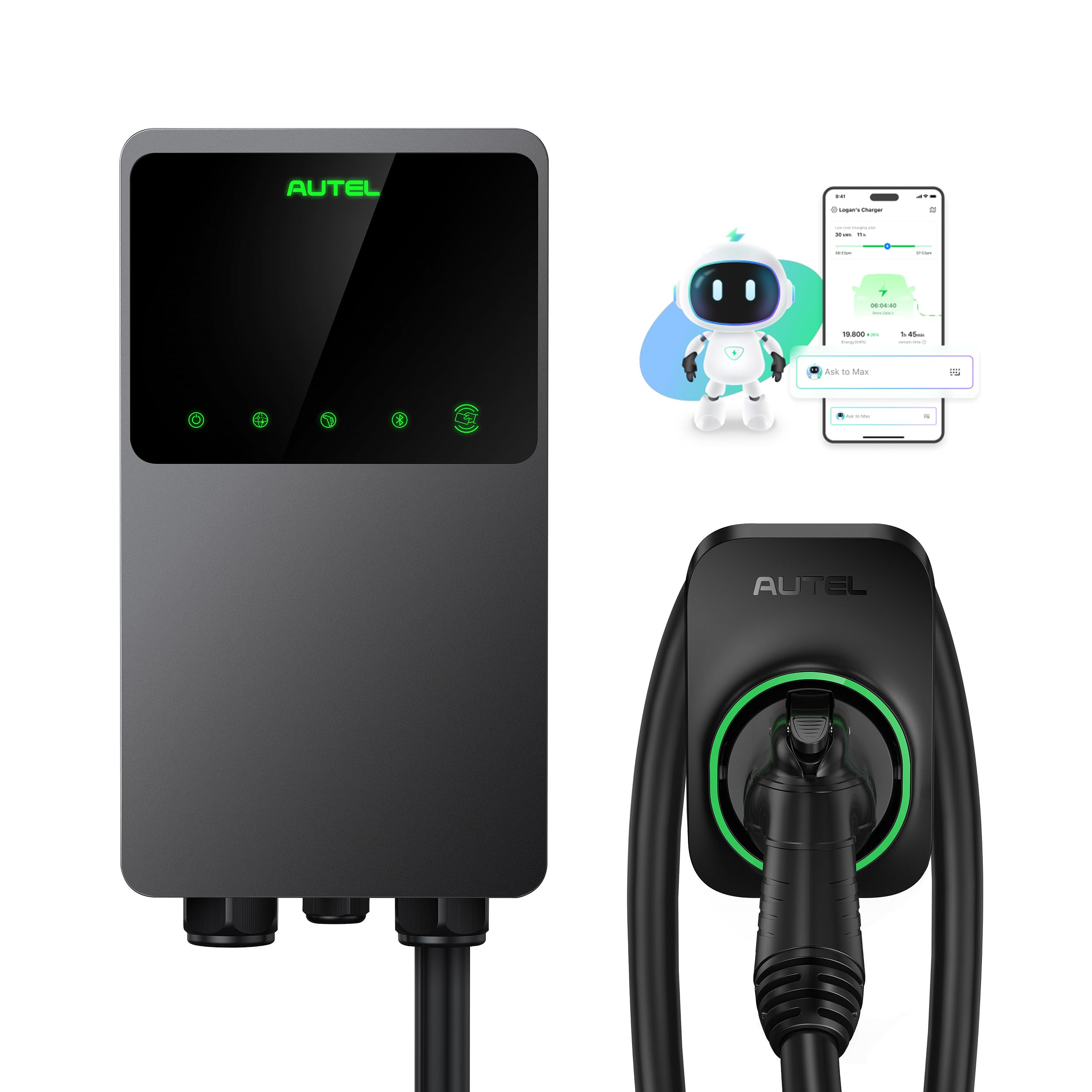
The highest amperage charger here, ready to push a full 12kW into your EV.
The Autel MaxiCharger AC Elite is the powerhouse of this list, capable of delivering up to 50 amps and 12kW of power. That translates to 37 miles of range per hour — the fastest rate available from a standard home unit. It’s hardwired and requires a dedicated circuit, but it comes pre-assembled for easy installation. The 25-foot cable is designed for all-weather flexibility, remaining pliable even at -40°C. It’s CSA certified and NEMA Type 4 rated for complete outdoor protection.
The Autel Charge app controls everything: you can adjust amperage (the physical selector board allows a safe hard limit), schedule off-peak charging, track energy costs by entering your per-kWh rate, and receive OTA firmware updates. The charger also supports Bluetooth, WiFi, and Ethernet connectivity, ensuring you have a backup if your WiFi is spotty.
One note from the data is that Reliability (63) is the most-mentioned aspect, but Amazon marks it as MIXED — meaning some owners have experienced issues that required support intervention, while many others have flawless units. The positive coverage of build quality (46) and charging speed (30) is very high. The tech support team is singled out as responsive, often replacing units quickly when issues arise. If you want the absolute fastest home charge speed and are comfortable with a brand that stands behind its product, this is the one.
Top Speed Advantages
- Fastest on the list at 50 amps and 12kW, adding 37 miles of range per hour.
- Three connectivity options (WiFi, Bluetooth, Ethernet) provide redundancy for app control.
- Flexible cable rated to -40°C, ideal for cold-climate garages.
Honest Fit Note
- Reliability feedback is mixed — many owners are flawless, but a notable group needed support intervention for issues.
- Requires a hardwired professional installation for the full 50A benefit.
Your pick if: Speed is your #1 priority, you want the fastest home charging available, and you value a brand with responsive tech support.
Consider another if: You cannot justify the cost or complexity of a 60A hardwired circuit, or you want the proven reliability record of the Emporia or EVIQO.
Understanding the Specs
Amperage (A) and kW
The amperage rating tells you how much electrical current the charger can push to your car. A 40-amp charger on a 240V circuit delivers 9.6kW of power. A 48-amp charger delivers 11.5kW. Your car also has a limit — a Chevy Bolt may max out at 32A, while a Tesla Model 3 Long Range can accept up to 48A. The higher the amp rating, the faster you’ll add miles of range per hour, but only if your car can handle it.
Connector Types
J1772 is the standard connector for all non-Tesla EVs in North America. NACS is the Tesla-developed standard that is being adopted by other automakers. A charger’s connector must match your car’s port, or you’ll need an adapter. Some chargers include both cables or adapters, which is key for multi-EV households or future-proofing against a vehicle change.
Hardwired vs. Plug-In
A plug-in charger connects to a NEMA 14-50 outlet. It’s easier to install, portable, and often qualifies for a simpler DIY setup. A hardwired charger is wired directly into your breaker panel, which is safer for outdoor use and allows for higher amperage (48A+). Hardwiring is also required by code for some installations and avoids any risk of a loose plug overheating.
Smart Features: App, WiFi, and Scheduling
A smart charger connects to your home WiFi and lets you control charging from your phone. Some models also offer voice control via Alexa or Google Assistant, RFID card security, and integration with home energy monitors.
FAQ
Can I install a Level 2 charger myself?
Will a 48-amp charger work with my car if it only supports 40 amps?
What is the difference between a J1772 and a NACS connector?
How long does it take to fully charge an EV with a Level 2 charger?
Can I leave my EV charger plugged in all the time?
Is a hardwired charger safer than a plug-in charger?
Do I need a WiFi-connected EV charger?
Can I use an extension cord with my EV charger?
What does the IP rating mean on an EV charger?
How long do home EV chargers typically last?
Final Thoughts: The Verdict
For most buyers, the ev battery charger winner is the EVIQO NACS Charger because it offers the perfect blend of speed, durability, and smart features for Tesla owners, backed by a near-perfect owner satisfaction rate. If you want a simpler plug-in option that saves you money, grab the VEIPHLOX Level 2 Charger. And for the absolute fastest charging available, the Autel MaxiCharger 50A is the one to reach for, as long as you are comfortable with its hardwired installation and mixed reliability feedback.
How We Picked
We do not accept paid placement. Every pick is matched to a real buyer and a real use-case; we do not hands-on test units.
Sources & Methodology
Specifications: manufacturer listings and product documentation. Review insights: verified customer reviews, as of July 2026. Pricing: not shown on this page (it changes often); check the current price via the retailer link.
As an Amazon Associate, Gadgets Feed earns from qualifying purchases. This does not affect which products we feature.