
Our readers keep the lights on and my morning glass full of iced black tea. As an Amazon Associate, I earn from qualifying purchases.
Specs are compiled from manufacturer listings and verified buyer reviews and can change over time — please confirm the key details on the product page before buying.
If you work on trucks, tractors, or heavy appliances, you will reach for a 15/16-inch wrench often — and a rounded-off bolt is a real headache at this size. The difference between a clean crack and a stripped fastener depends on how the jaws grip, how hard the steel is, and whether the head can reach a bolt recessed an inch deep. This guide covers nine wrenches that handle that 15/16-inch job well, from budget singles to premium ratcheting models, with real owner experience baked into every pick.
I’m Min — the founder and writer behind Gadgets Feed. This guide is built by comparing the manufacturers’ published specifications and the patterns across verified customer reviews, so you get each pick’s real strengths and trade-offs instead of marketing spin.
If you need a single tool that fits stubborn tractor nuts, tight brake calipers, or awkward engine bolts without rounding the head, then understanding the jaw bite and the steel hardness of your 15/16 wrench is the only shortcut worth taking.
Our Picks at a Glance


How To Choose The Best 15/16 Wrench
Picking a single 15/16-inch wrench is different from buying a set — you are filling a gap, solving one specific bolt, or grabbing a backup for a size that always hides. The three things that change how a wrench feels and performs are the grip design, the beam length, and the steel quality.
Off-Corner Loading vs Standard Jaws
A standard open-end wrench grabs the corners of a bolt, which is exactly where a rounded head starts. Off-corner loading pushes the contact points onto the flat sides of the fastener instead. The result is less slip and less fastener damage, especially on bolts that are already stuck or corroded. If you work on older equipment or rust-prone areas, off-corner design is a real advantage.
Ratcheting vs Standard Combination
A standard combination wrench gives you a box end on one side and an open end on the other — simple, strong, and no moving parts. A ratcheting wrench speeds up the job because you do not have to lift and reseat the tool after every turn. The trade-off is a bulkier head and a mechanism that can fail under extreme torque. For tight spots where you can barely swing the handle, a 72-tooth ratchet needs only a 5-degree swing arc, which is a lifesaver.
Beam Length and Leverage
Longer beams multiply your torque without you having to push harder. A standard 15/16-inch wrench runs about 12 inches, while long-pattern versions stretch closer to 15 inches. That extra length means the difference between a bolt that breaks free and one that stays frozen. The catch is fit — a long beam will not fit in a tight engine bay the way a stubby or standard length will.
Quick Comparison
| Model | Best For | Length | Steel Type | Ratchet Teeth | Amazon |
|---|---|---|---|---|---|
| GEARWRENCH 86952★ Best Overall | Ratcheting all-rounder | 13.11 in | Alloy Steel | 90 | Amazon |
| DURATECH B0CNTMHCMMBest Value | Budget ratcheting value | 12.2 in | Chrome Vanadium | 72 | Amazon |
| MAXPOWER MAX-COM-15ov16Premium Leverage | Extra leverage at a budget | 15 in | Chrome Vanadium | — | Amazon |
| Powerbuilt 644150 | Reliable standard combo | ANSI spec | Chrome Vanadium | — | Amazon |
| TIGHTSPOT T-RW1516IN-IND | Tight-swing access | 15.16 in | Chrome Vanadium | 120 | Amazon |
| Capri Tools CP11950-15161 | Deep-offset specialty | — | Chrome Vanadium | — | Amazon |
| uxcell a20102800ux0417 | Budget ratcheting single | 33 cm | Chrome Vanadium | 72 | Amazon |
| GEARWRENCH 81663 | Long-pattern reach | 8 in | Alloy Steel | — | Amazon |
| HORUSDY 81043 | Multi-size set | — | Chrome Vanadium | — | Amazon |
In‑Depth Reviews
1. GEARWRENCH 15/16″ 4 Degree Swing Arch 12 Point Ratcheting Combination Wrench – 86952
Our pick — over 4.5★ from 800+ verified ratings; the strongest balance of quality and price.
The ratcheting standard that sets the pace for speed without sacrificing bite.
This is the single 15/16-inch wrench that keeps showing up in serious toolboxes, and the reason is the 90-tooth ratchet mechanism. It needs just a 4-degree swing arc to engage the next tooth, which makes a huge difference on a fastener tucked behind a brake line or inside a tractor frame. The box end uses an off-corner loading design — meaning it contacts the flat surfaces of the bolt rather than the corners — so even a stubborn fastener resists rounding as you lean into it. At 13.11 inches, the beam is shorter than the MAXPOWER at 15 inches, which is a trade-off for tighter spaces but means you lose a little leverage on seized bolts.
The open end also gets the off-corner treatment, and the dual-direction geometry works whether you are tightening or loosening. Owners consistently praise the polished chrome finish and the satiny action of the ratchet, calling it a quality build that holds up to daily pro use. A few have reported stripped ratchet teeth under very high torque, so this is not the wrench to reef on with a cheater bar — treat it as the fast, fluid tool it is.
What gives it the edge
- 90-tooth ratchet delivers a 4-degree swing, ideal for cramped engine bays
- Off-corner loading on both ends protects bolt heads from rounding
- Mirror-polished alloy steel resists corrosion and cleans easily
Where some pull up short
- Beam is shorter than long-pattern alternatives, so you give up some mechanical leverage
- A small number of owners have had the ratchet mechanism fail under extreme torque
Reach for this if: you work on vehicles or equipment where swing clearance is tight and you want a ratchet that moves like it is lubricated.
Look elsewhere if: you regularly break loose rusted 15/16-inch bolts that need every inch of leverage a longer beam provides.
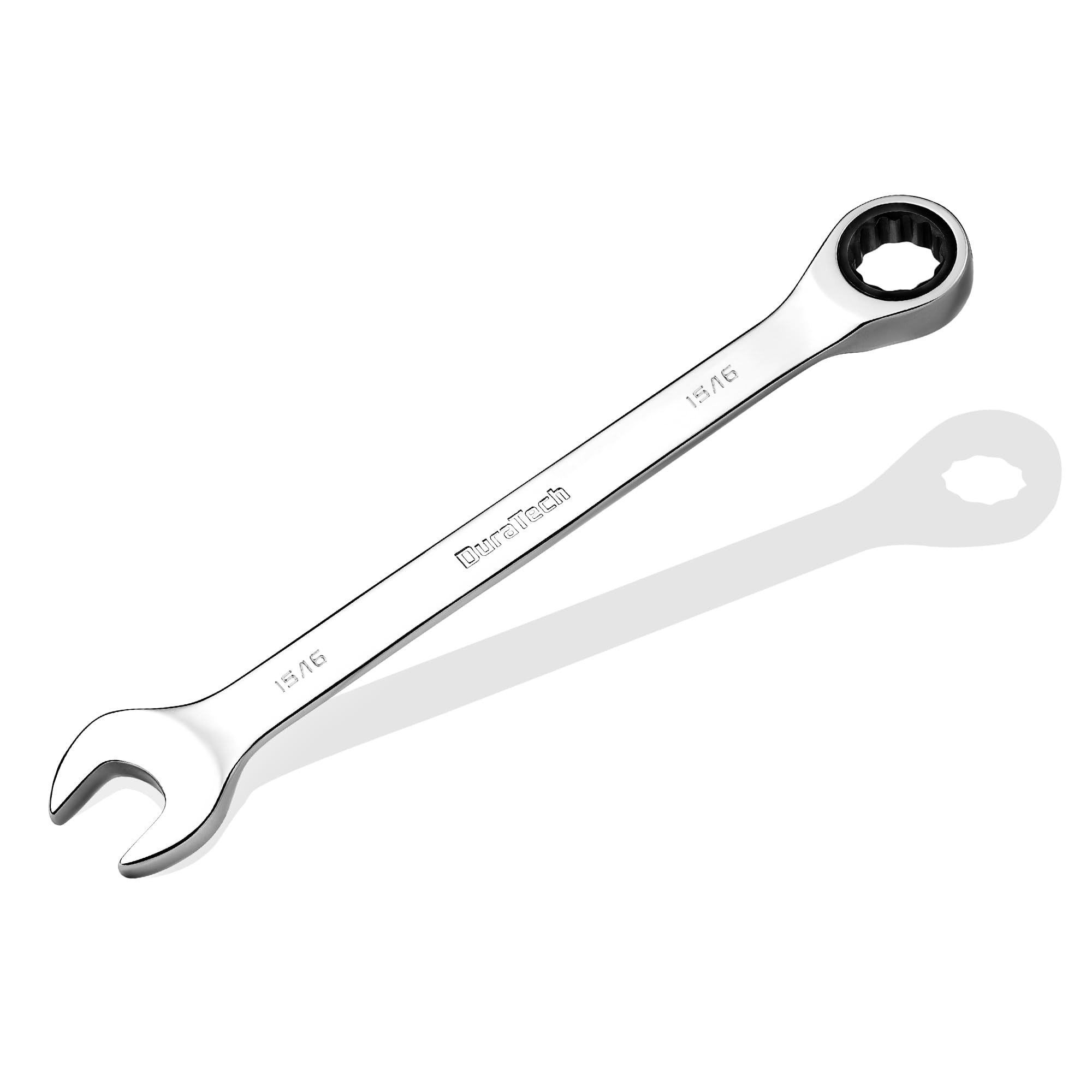
2. DURATECH 15/16″ Ratcheting Combination Wrench, SAE | 72-Tooth, 12-Point
A surprising amount of ratcheting quality for the money, cut from chrome vanadium steel.
This is the budget-friendly ratcheting pick that gives you a 72-tooth mechanism with a 5-degree swing arc, all in a chrome vanadium steel body that feels denser than its price suggests. At 12.2 inches, the beam is shorter than both the GEARWRENCH 86952 and the MAXPOWER standard — which actually helps when you are squeezing into a tight spot under a mower deck or inside an appliance panel. The 12-point box end wraps the fastener flats instead of the corners, reducing the chance of rounding off a bolt that is already on its way out.
The mirror-polished finish is easy to wipe clean, and the size is stamped permanently into the handle so you never have to squint. Owners who bought this as a spare or a gap-fill tool often end up using it more than expected, praising the heft and the smooth ratchet action. The catch is durability — a few owners have reported the ratchet mechanism giving way after moderate use on high-torque applications. Keep it for general maintenance and repair, and do not expect it to survive daily professional abuse the way a premium ratchet will.
Why it works
- 72-tooth ratchet needs just 5 degrees of swing, making tight spots manageable
- Chrome vanadium steel is heat-treated for strength and resists rust
- Permanent size stamping stays legible through years of shop use
Where it fades
- Durability is mixed — a minority report the ratchet failing under moderate torque
- Beam is on the shorter side, so leverage is limited for seized fasteners
Snap this up if: you need a capable ratcheting 15/16-inch wrench for home garage use at a price that makes it easy to keep one in the truck and one in the shop.
skip it if: you are a daily professional who applies sustained high torque and needs the ratchet to survive years of hard use.
3. MAXPOWER 15/16″ Combination Wrench, Industrial Grade – 12-Point Box End
The longest beam in this lineup, built for buyers who need torque without a cheater bar.
At 15 inches, this MAXPOWER is the full-length king of the list — longer than the GEARWRENCH 86952 at 13.11 inches — and that extra length delivers serious mechanical advantage on stuck bolts. The box end has a 15-degree offset that keeps your knuckles clear of metal edges and recessed fasteners, while the off-corner design directs force onto the flat surfaces of the fastener to prevent rounding. It is forged from heat-treated chrome vanadium steel with a satin finish that shrugs off oil, moisture, and workshop chemicals.
Owners consistently call it heavy-duty and praise the precise fit on 15/16-inch nuts and bolts. The recurring observation is that the wrench looks smaller in photos than it is in hand — the beam is actually substantial. A few buyers have noted that the size runs a tiny fraction large, which can mean a slight slip on an already worn fastener. For the price, this is the go-to if you need pure, unpowered leverage on a 15/16-inch bolt that has not moved in years.
Torque monster: The 15-inch beam gives this wrench a real mechanical edge over every other standard combination wrench on this list. If your 15/16-inch fasteners are rusted or torqued, this is the one that breaks them free without needing a pipe cheater. The trade-off is fit — one owner reported the size being microscopically generous, so test it on a known-good bolt first.
Buy it for: tractors, heavy equipment, or any situation where a seized 15/16-inch bolt needs maximum hand torque and you have room to swing a 15-inch handle.
Pass if: you mostly work inside tight engine compartments where a wrench longer than 13 inches will not fit.
4. Powerbuilt 15/16-Inch Combination Wrench, SAE 12 Point Double Ended Box and Open End
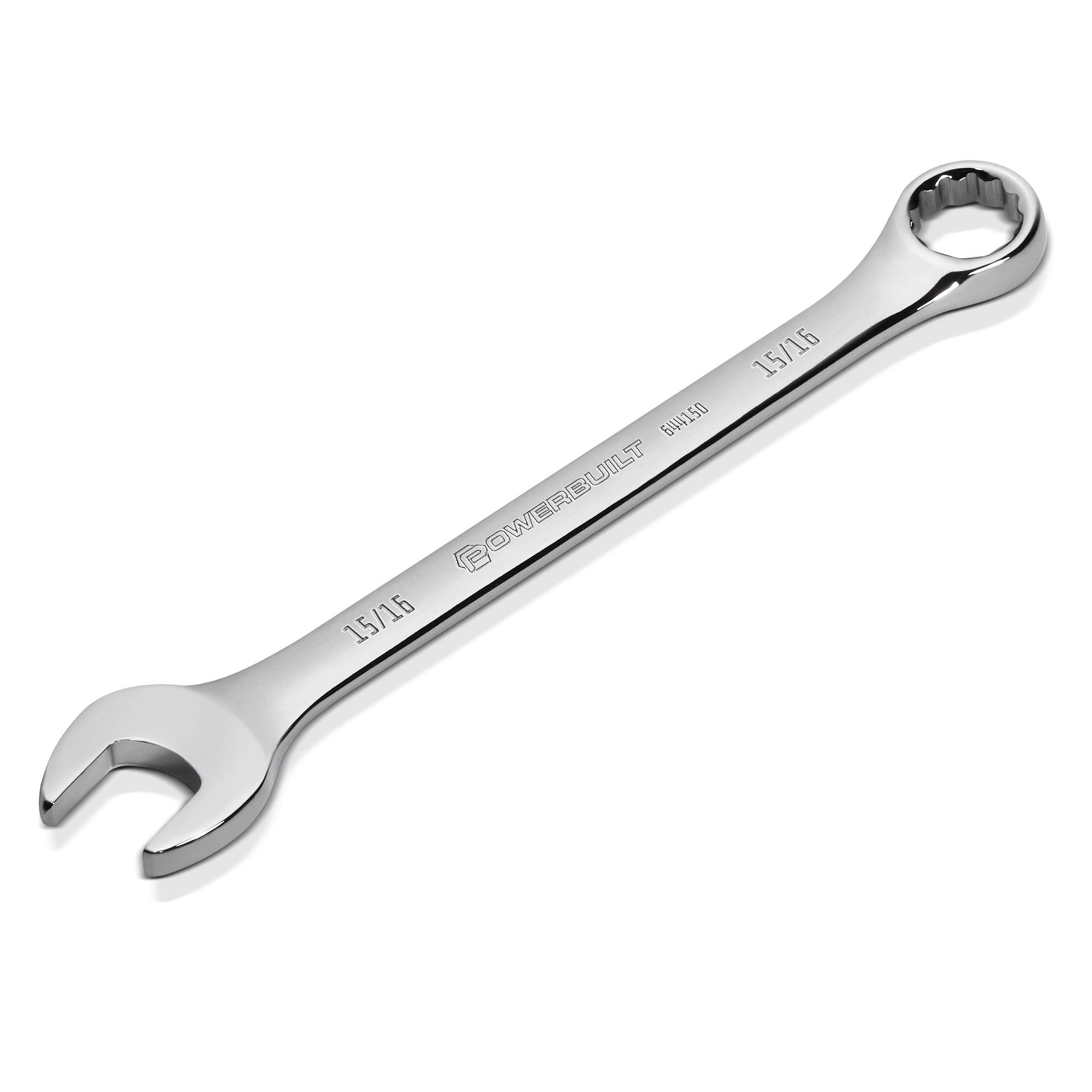
The affordable standard combination that meets full ANSI specs and still feels solid in your hand.
Powerbuilt uses a Z-Drive box end design on this 15/16-inch combination wrench, which contacts the flat sides of the fastener rather than the corners — the same off-corner principle as the GEARWRENCH, but in a simpler, non-ratcheting body. The 15-degree offset on the box end gives your knuckles breathing room when you are reaching into a recessed area, and the chamfered walls make it easier to slip the wrench onto the bolt. It is built from mirror-polished chrome vanadium steel, so it resists rust and cleans up fast with a rag.
This is the wrench one owner specifically bought for an old Massey Ferguson tractor, and it fit almost everything on that machine. The quality-to-price ratio is what people mention most — the finish is glossy, the beam has good weight, and the Z-Drive grip (an offset jaw design that grabs the flat sides of a fastener, not the corners) is effective on both new and worn fasteners. A few owners note that the fit can be slightly on the small side, meaning it may feel loose on a fastener that is already borderline worn. For a straightforward, no-moving-parts 15/16-inch combo wrench at a friendly price, this is tough to top.
No-nonsense build: The Z-Drive geometry and chrome vanadium steel make this a reliable second copy or a primary tool for farm and tractor work. The single honest caveat is that fit tolerance can run a hair undersized on some units, so test it on your reference fastener before relying on it under torque.
Reach for this if: you want a simple, strong 15/16-inch wrench that costs little but still delivers a professional-grade finish and proper ANSI-rated length.
pass on it if: you need the speed of a ratcheting mechanism — this is a traditional combination tool, so every turn requires lifting and reseating.
5. Capri Tools 15/16 x 1 in. 75-Degree Deep Offset Double Box End Wrench

The specialty wrench for bolts that a standard combination tool simply cannot reach.
This Capri Tools wrench uses a 75-degree deep offset on both box ends, meaning the handle drops away from the fastener at a steep angle. That clearance is the difference between reaching a bolt on a Harley clutch or a Chevy Corvette spark plug and staring at it hopelessly. One end is 15/16-inch and the other is 1-inch, giving you two useful sizes in one tool. The 12-point WaveDrive box ends transfer torque uniformly across the flat surfaces of the bolt to prevent rounding, and the MaxChrome plating protects against corrosion.
Owners specifically mention using this on cylinder 8 of small-block Chevys and on headers where clearance is measured in millimeters. The build quality is called out as sturdier than expected, with clear, permanent stampings and a finish that holds up to engine bay grime. The limitation is obvious — this is a double box end tool, so there is no open end for slipping over a line or a stud. If your job needs that open jaw, this is not the one; if you need to reach a buried fastener, it is the only shape that works.
Clearance king: The 75-degree offset is the defining feature — it is what lets you turn a fastener that is recessed behind an exhaust manifold or a frame rail. Owners in the automotive space swear by it for those one or two bolts that nothing else grabs. The double box end means no open-end versatility, so keep a standard combination wrench nearby for the rest of the job.
Buy this if: you wrench on vehicles and have run into a 15/16-inch bolt that a straight or 15-degree offset wrench cannot engage.
it’s not for you if: your work never puts you in the kind of deep, confined space that demands a 75-degree clearance profile.
6. GEARWRENCH 12 Pt. Long Pattern Combination Wrench, 15/16″ – 81663

A long-pattern beam that stretches your reach without the moving parts of a ratchet.
This is the non-ratcheting long-pattern version from GEARWRENCH, built for situations where leverage and reach matter more than speed. The off-corner loading box end applies force to the flats of the fastener, same as the brand’s ratcheting models, so bolt heads stay round even under heavy torque. The beam is what GEARWRENCH calls long pattern, giving you a reach advantage over standard-length wrenches that helps with GM fuel filters, suspension bolts, and other fasteners tucked deep in a chassis.
Owners consistently call this a good-looking tool with a high-end chrome finish, and many use it to complete a professional-grade set without paying truck-brand prices. The beam is polished and smooth, and the 12-point box end is chamfered for easy engagement. The catch is that the long-pattern label may overpromise — some owners describe the length as more of a medium than truly long. If you absolutely need the extra 2 inches of a full-length beam like the MAXPOWER, this one may leave you wanting. For most automotive work, though, the balance between reach and maneuverability is spot-on.
Reach and finish: George’s off-corner box end and polished chrome finish make this a premium-feeling standard combination wrench at a price below truck-brand alternatives. The beam length falls between standard and full-length, so it works for deeper fasteners but is not the leverage monster of the MAXPOWER. Good for filling a gap in a pro-grade set.
Reach for this if: you want the build quality and off-corner grip of GEARWRENCH in a non-ratcheting body with a longer-than-standard beam for extra leverage.
Pass if: you need the extreme length of a 15-inch beam or the speed of a ratcheting mechanism — this sits in the middle of both categories.
7. TIGHTSPOT 15/16 Inch Combo Ratchet Wrench – Hardened, Tight-Spot Tool
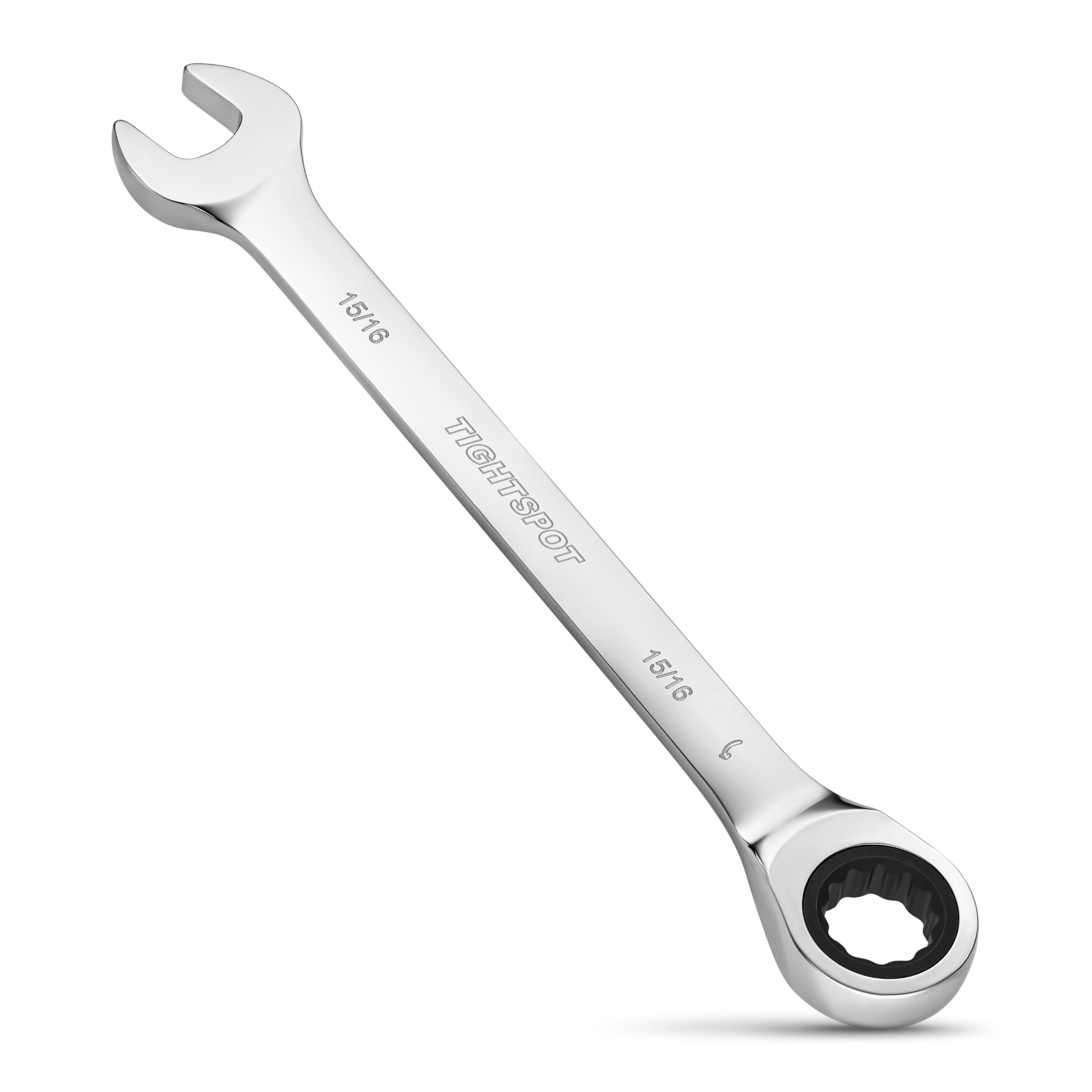
The tightest swing arc on the list, engineered for the spots where you can barely move the handle.
The TIGHTSPOT lives up to its name with a 120-tooth ratchet mechanism that requires only a 3-degree swing arc to engage. That is the tightest swing on this list — beating the GEARWRENCH 90-tooth by a noticeable margin — and it matters when the wrench is sandwiched between a frame rail and a component. The box end is 100% steel with no plastic internals, and the company drop-forges and heat-treats the chrome vanadium alloy with aerospace-grade vanadium and chromium for corrosion resistance. The reinforced open end also uses off-corner geometry to reduce bolt rounding.
Owners consistently call it well-made and functional, with one specifically buying it to keep in a trunk for bike rack installation. The tool feels comfortable in the hand, and the polished mirror finish looks sharp. The main trade-off is that the head is proportionally larger than a standard ratcheting wrench, which can limit access in the very tight spots the tool is supposed to solve. A few buyers also note that the build quality, while good, does not match the heavy-duty feel of the GEARWRENCH or Capri options. For occasional use in cramped quarters, it is a smart buy.
Standout strengths
- 120-tooth ratchet delivers a 3-degree swing arc — the tightest in this lineup
- Reinforced open end with off-corner geometry reduces bolt rounding
- Drop-forged chrome vanadium steel with aerospace-grade hardening
Areas to consider
- Ratcheting head is bulkier than standard, which can limit access in very tight spaces
- Build quality is good but not at the level of premium American-made brands
Grab this if: you regularly face a 15/16-inch fastener with less than 5 degrees of swing clearance and need a ratchet that clicks through without lifting.
Look elsewhere if: you need a slim head profile to fit into a narrow recess — the 120-tooth mechanism is physically larger than standard ratchets.
8. uxcell 15/16 Inch Ratcheting Combination Wrench SAE 72 Teeth 12 Point

The cheapest ratcheting 15/16-inch single on the list, but it still turns bolts smoothly.
The uxcell ratcheting wrench gives you a 72-tooth mechanism with a 5-degree swing arc, a 12-point box end, and a 15-degree open end — all for a price that undercuts the DURATECH and the TIGHTSPOT. It is made from heat-treated chrome vanadium steel with a polished chrome finish, so it looks respectable next to more expensive wrenches in your drawer. The size is stamped on both ends of the handle, making identification quick even when the tool is lying flat in a toolbox.
Owners describe it as good quality for the money and effective for oddball sizes that are missing from standard sets. The most common practical note is that the ratchet head is bulky — one owner had to grind it down with a belt sander to fit a tight space. The reversing mechanism is also less convenient than a switch-lever design, requiring you to flip the entire wrench to change direction. For the price, it is a capable fill-in tool for the 15/16-inch gap in your collection, but it is not the one you reach for on a high-torque job every day.
Price-to-function: A 72-tooth ratchet with a 5-degree swing for this low a cost is hard to argue with. The catch is the head thickness — it is chunkier than premium ratchets, which can be a problem in confined spaces. Perfect as a spare or a trunk tool, less ideal as a daily driver on a pro mechanic’s cart.
Buy it if: you are on a tight budget and just need a functional ratcheting 15/16-inch wrench for occasional home or roadside use.
Pass if: the bulk of the ratchet head will prevent you from accessing the fasteners you actually work on.
9. HORUSDY Large Wrench Set with Rolling Pouch | SAE | 6-Piece
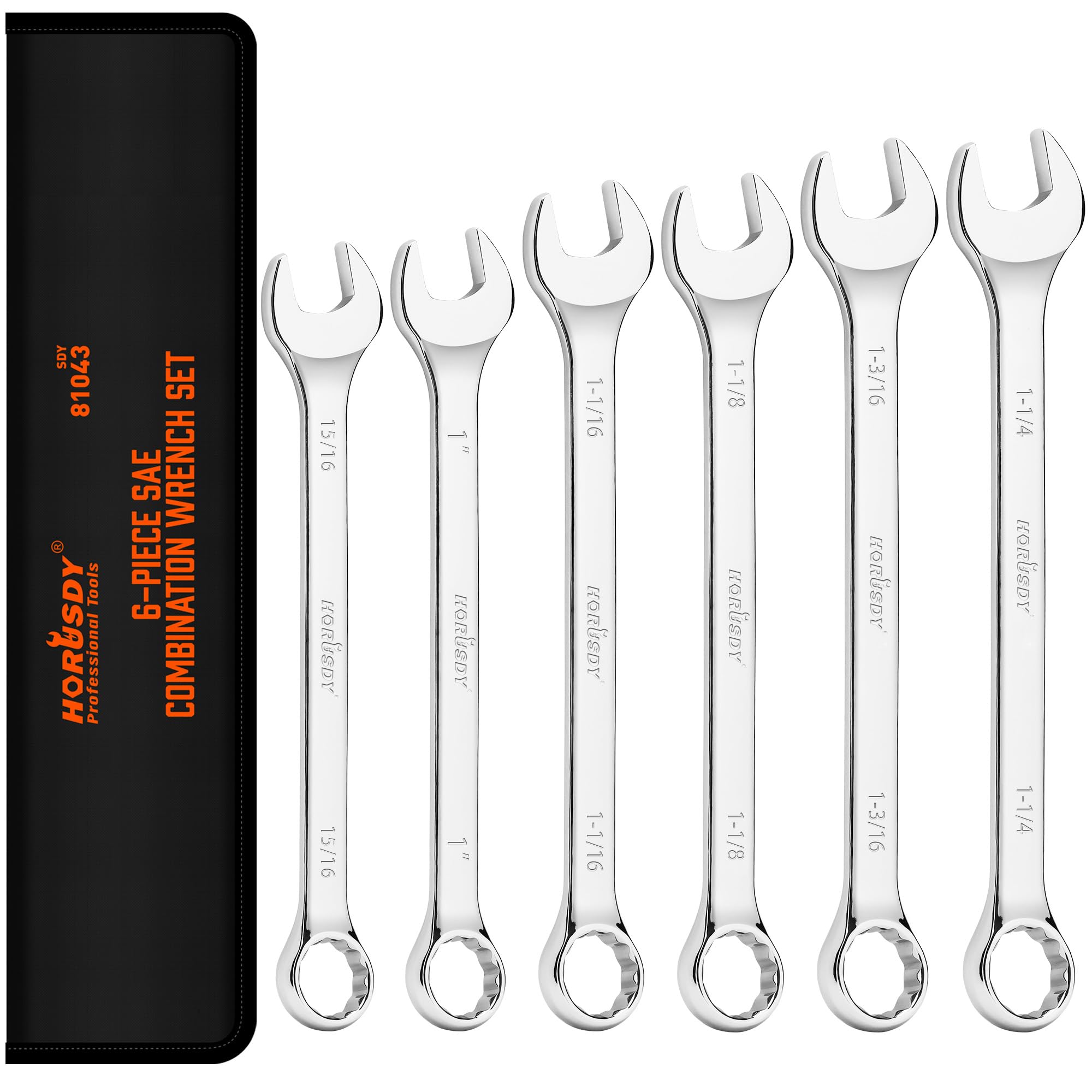
A six-wrench set that covers the big SAE sizes, including 15/16-inch, in a single organized pouch.
If you need more than just the 15/16-inch size — maybe the 1-inch, 1-1/16-inch, or 1-1/4-inch are also missing from your box — this HORUSDY set gives you six wrenches from 15/16-inch up to 1-1/4-inch in a single purchase. Each one is made from heat-treated chrome vanadium steel (a strong alloy that resists bending) with a mirror-polished finish and a 12-point box end (a closed end with 12 notches, so you can turn a fastener with less movement). The set exceeds ANSI (American National Standards Institute) standards for length and strength, and the rolling storage pouch keeps them organized in a tool bag or truck box.
Owners consistently call this good quality for the value, especially for farm and skid-steer work where larger SAE sizes are common. The wrenches have a slim profile that helps in tighter spaces, and the laser-etched size markings are easy to read. The main trade-off is that these are not top-tier professional tools — one owner describes them as perfectly fine for occasional use but lacking the refined feel of a premium brand. If you are filling a gap in a home or farm toolbox and need the whole range, this set covers more ground than any single wrench.
Set coverage: Six wrenches from 15/16-inch up to 1-1/4-inch at a price that is competitive with a single premium ratcheting wrench. The chrome vanadium steel and ANSI-exceeding length make these functional for most farm and automotive jobs. Not a pro-grade set, but for the home shop or truck kit, the roll pouch alone is worth the convenience.
Buy this if: you need several large SAE wrenches at once and want a compact storage solution that keeps them from rattling around in a drawer.
look elsewhere if: you only need a single 15/16-inch wrench — buying the set just for size wastes the other five wrenches and the pouch.
Understanding the Specs
Off-Corner Loading vs Standard Grip
When you tighten a bolt with a standard open-end wrench, the jaws contact the corners of the fastener. That is fine for a clean bolt, but on a corroded or already-worn head, the corners strip first. Off-corner loading shifts the contact point to the flat surfaces (the “flats”) of the bolt, spreading the force across a wider area. The result is a stronger grip and a much lower chance of rounding the fastener. Both the GEARWRENCH and the Powerbuilt Z-Drive designs use this principle.
Ratcheting Swing Arc (Tooth Count)
The number on a ratcheting wrench (say, “72-tooth”) tells you how many engagement points the internal gear has. More teeth mean a smaller swing arc before the ratchet clicks to the next tooth. A 72-tooth needs about 5 degrees of movement, a 90-tooth needs about 4 degrees, and a 120-tooth needs just 3 degrees. That narrow arc is the difference between working in a wide-open space and turning a bolt that is trapped between a frame rail and a hose. Fewer teeth often means a stronger gear, so there is a trade-off between access speed and ultimate torque capacity.
FAQ
Will a 15/16-inch wrench fit a 24mm bolt?
What is the difference between a standard pattern and a long pattern wrench?
Can I use a cheater pipe on a ratcheting wrench?
Is a 12-point or 6-point box end better for 15/16-inch fasteners?
What does off-corner loading mean in plain English?
Will a 15/16 ratcheting wrench handle the torque of a truck lug nut?
Is chrome vanadium steel better than standard alloy steel for wrenches?
What does ANSI specification mean for a wrench?
How do I clean and maintain a polished chrome wrench?
Can I use a 15/16-inch impact socket on a standard combination wrench?
Final Thoughts: The Verdict
For most people, the 15/16 wrench winner is the GEARWRENCH 86952 because its 90-tooth ratchet, off-corner jaw design, and polished alloy steel body hit the ideal balance of speed, grip, and durability for both DIY and professional use. If you want pure mechanical leverage to break free rusted farm bolts, grab the MAXPOWER with its 15-inch beam. And for automotive DIYers who keep hitting fasteners that no standard wrench reaches, the Capri Tools 75-degree offset is the one to reach for.
How We Picked
We do not accept paid placement. Every pick is matched to a real buyer and a real use-case; we do not hands-on test units.
Sources & Methodology
Specifications: manufacturer listings and product documentation. Review insights: verified customer reviews, as of July 2026. Pricing: not shown on this page (it changes often); check the current price via the retailer link.
As an Amazon Associate, Gadgets Feed earns from qualifying purchases. This does not affect which products we feature.